Back
NM_000264.5:c.2173C>T
p.Pro725Ser · PTCH1
ACMG/AMP
0%
complete
Final classification
Benign
BS1BS2BP1BP5
PTCH1
c.2173C>T
p.Pro725Ser
missense · exon 14

PTCH1 encodes a transmembrane receptor for hedgehog signaling proteins such as sonic hedgehog, a pathway that guides embryonic development. The protein normally keeps hedgehog signaling in check by inhibiting the Smoothened protein, so when PTCH1 is inactivated the pathway becomes overactive. Inherited changes in PTCH1 cause Gorlin syndrome (nevoid basal cell carcinoma syndrome), which predisposes to basal cell carcinoma and medulloblastoma, and can also contribute to holoprosencephaly. As a tumor suppressor, its loss drives basal cell carcinoma and medulloblastoma.

This variant

PTCH1 encodes the hedgehog-pathway receptor whose germline inactivation causes autosomal dominant Gorlin syndrome with predisposition to basal cell carcinoma and medulloblastoma, so a variant in this gene is assessed against a dominant, loss-of-function-driven cancer predisposition mechanism rather than a recessive one.

Transcript
NM_000264.5
HGVS · transcript:coding
NM_000264.5:c.2173C>T
GRCh38
chr9:95468828 G>A
GRCh37
chr9:98231110 G>A
Benign: BS1 (strong) plus BS2 (strong) satisfy the generic ACMG/AMP 2015 rule that two strong benign criteria support a Benign classification.
Classification rationale
BS1BS2BP1BP5 Benign
PTCH1 c.2173C>T missense · exon 14

Benign: BS1 (strong) - gnomAD v4.1 Middle Eastern frequency 1.4517% (grpmax FAF 1.2068%) exceeds the frequency expected for Gorlin syndrome. Benign: BS2 (strong) - 1,413 adult heterozygous and 7 homozygous gnomAD v4.1 carriers are incompatible with a fully penetrant early-onset dominant disorder. Benign: BP1 (supporting) - p.Pro725Ser is a missense change in PTCH1, where 87% of NBCCS-causing variants are truncating. Benign: BP5 (supporting) - in the affected Gorlin syndrome case the phenotype was explained by a separate pathogenic PTCH1 c.2726dupA allele, not by p.Pro725Ser.

BS1 + BS2 + BP1 + BP5 → Benign
LYFE Sciences is an AI system, and it can make mistakes. Criteria may be applied incorrectly, sources may be misread, and a confident-looking classification can still be wrong. Double-check every criterion and its underlying evidence before relying on any call.
Gene diagram · NM_000264.5 · variants mapped to exon structure
PTCH1 NM_000264.5
Fetching transcript structure from UCSC…
Applied criteria · 4 applied · 19 assessed
MetEvidence satisfies this criterion.
Not metEvaluated against available evidence; threshold not reached.
Not assessedApplies in principle, but no evidence was found to evaluate it.
N/ADoesn't apply to this variant type.
Applied · 4
Strength Supporting Moderate Strong Very strong
BS1 strong review Benign
Met (strong): gnomAD v4.1 Middle Eastern frequency 1.4517% and grpmax FAF 1.2068% exceed the 1% BS1 threshold.
gnomAD v4.1 grpmax FAF 0.012068 (1.2068%) >= 0.01; Middle Eastern popmax AF 1.4517% (88/6,062 alleles, 3 homozygotes).gnomAD v2.1 grpmax FAF 0.001203 (0.12%) < 0.01; popmax 0.2492% (Remaining individuals, 18/7,224 alleles); v2.1 lacked a large Middle Eastern cohort.Global allele frequency below 1% in both releases: 0.000891 (v2.1) and 0.000880 (v4.1).
BS2 strong Benign
Met (strong): 1,413 adult heterozygous and 7 homozygous gnomAD v4.1 carriers are incompatible with a fully penetrant dominant disorder.
gnomAD v4.1: 1,413 heterozygotes and 7 homozygotes (1,420/1,614,158 alleles); Middle Eastern 88 alleles / 3 homozygotes; non-Finnish European 1,037 alleles / 2 homozygotes; Remaining 112 alleles / 2 homozygotes.gnomAD v2.1: 252 heterozygous carriers (252/282,872 alleles) and no homozygotes.PMID:20485063 states Gorlin-Goltz syndrome is inherited autosomal dominant with complete penetrance and variable expressivity, satisfying the 'full penetrance expected at an early age' premise of BS2.
BP1 supporting Benign
Met at supporting strength: PTCH1 NBCCS variants are primarily truncating, with 17 truncating versus 2 missense novel mutations and truncating changes in 87% of patients.
PMID:28733979 direct quote: 'The majority of the described mutations result in premature protein truncation.'PMID:28733979 cohort counts: 17 novel truncating mutations (11 frameshift, 5 nonsense, one splice-site) versus 2 novel missense mutations; 'truncating mutations in 87% of the patients'.PMID:28733979 mechanism statement: PTCH1 truncating mutations produce a protein 'which is unable to supress Smoothened protein and continuously activates the downstream pathway', i.e. disease is driven by loss of function.
BP5 supporting Benign
Met (supporting): in the affected Gorlin syndrome case, disease was explained by pathogenic PTCH1 c.2726dupA, not by p.P725S (PMID:20485063).
PMID:20485063 (single-patient case report, 52-year-old male with Gorlin-Goltz syndrome): genetic analysis found the pathogenic PTCH1 c.2726dupA (exon 17) causing the syndrome plus the separate PTCH1 p.P725S (exon 14), described as 'of uncertain functional meaning' - i.e. the affected case has an alternate molecular basis (c.2726dupA) explaining the phenotype.PMID:25741868 defines BP5 ('variant found in a case with an alternate molecular basis for disease') and its default supporting strength.
Assessed · not applied · 14 not met · 5 not assessed
Pathogenic
PS1 Not met: no previously established pathogenic p.Pro725Ser change exists, and this exact variant is Benign or Likely benign across all ClinVar submitters.
PS2 Not met: no parental testing confirms a de novo origin, and the variant is present in gnomAD v2.1 at 252/282,872 alleles.
PS3 Not assessed: no validated functional assay of PTCH1 p.(Pro725Ser) was reported; PMID:28733979 performed no assay and in silico tools predicted a neutral effect.
PS4 Not met: no case-control enrichment exists, and the variant is carried in gnomAD v4.1 at AF 0.00088 with seven homozygotes.
PM1 Not met: PTCH1 has no mutational hotspot and residue 725 is not a VCEP-approved critical domain, while gnomAD v4.1 carries 1,420 alleles with 7 homozygotes there.
PM2 Not met: gnomAD frequency ~0.088% (v4.1 and v2.1) is about nine-fold above the 0.0001 PM2 threshold.
PM5 Not met: the only other residue-725 missense variants, p.Pro725Arg and p.Pro725His, are Uncertain significance or Benign in ClinVar, not established pathogenic.
PM6 Not met: no source assumes a de novo origin, and p.P725S recurs in gnomAD v4.1 with 1,420 alleles including 7 homozygotes.
PP1 Not assessed: zero informative meioses, because the only genotyped relatives in the reported cohort carried different, truncating PTCH1 variants.
PP2 Not met: PTCH1 disease variants are predominantly truncating (17 of 19 novel mutations; 87% of patients), so missense change is not the primary mechanism.
PP3 Not met: REVEL 0.299 for the p.(Pro725Ser) missense variant is below the PP3 supporting threshold of 0.644 under the ClinGen SVI calibration.
PP4 Not assessed: no proband phenotype or family history is available to test specificity for a single-gene disorder.
PP5 Not met: the exact variant's ClinVar record has no expert-panel submission (expert_panels empty; highest review status 2-star, benign).
Benign
BA1 Not met: the highest gnomAD frequency anywhere is 1.45% (Middle Eastern), far below the 5% BA1 threshold.
BS3 Not assessed: no functional assay demonstrated normal PTCH1 function for p.(Pro725Ser); the only relevant study (PMID:28733979) performed no assay and reported in silico neutral predictions.
BS4 Not assessed: no family has been genotyped for p.P725S, so lack of segregation cannot be demonstrated.
BP2 Not met: the only co-occurrence, p.(Pro725Ser) with pathogenic PTCH1 c.2726dupA in one Gorlin-Goltz patient, has undetermined cis/trans phase, so the required BP2 observation is absent.
BP4 Not met: REVEL 0.299 exceeds the <=0.29 BP4 supporting threshold, placing this missense variant in the gray zone where BP4 is not satisfied.
BP6 Not met: no exact-variant expert-panel benign classification exists; the ClinVar record is 2-star from ordinary laboratory submitters.
N/A · 5 PVS1 · PM3 · PM4 · BP3 · BP7
Research & evidence
Population frequency · supports benign
gnomAD v4.1 screenshot
gnomAD v4.1
gnomAD v2.1 screenshot
gnomAD v2.1
v4.1
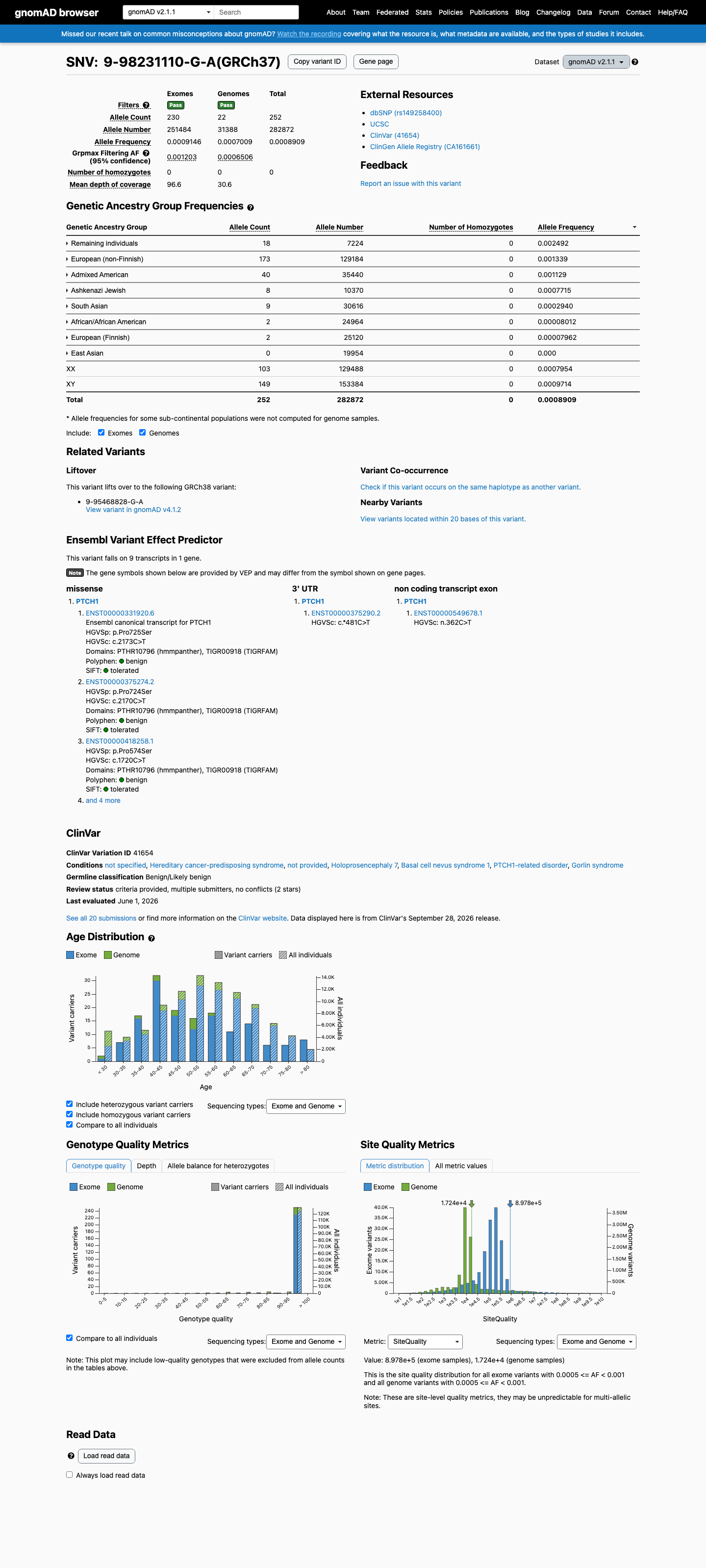
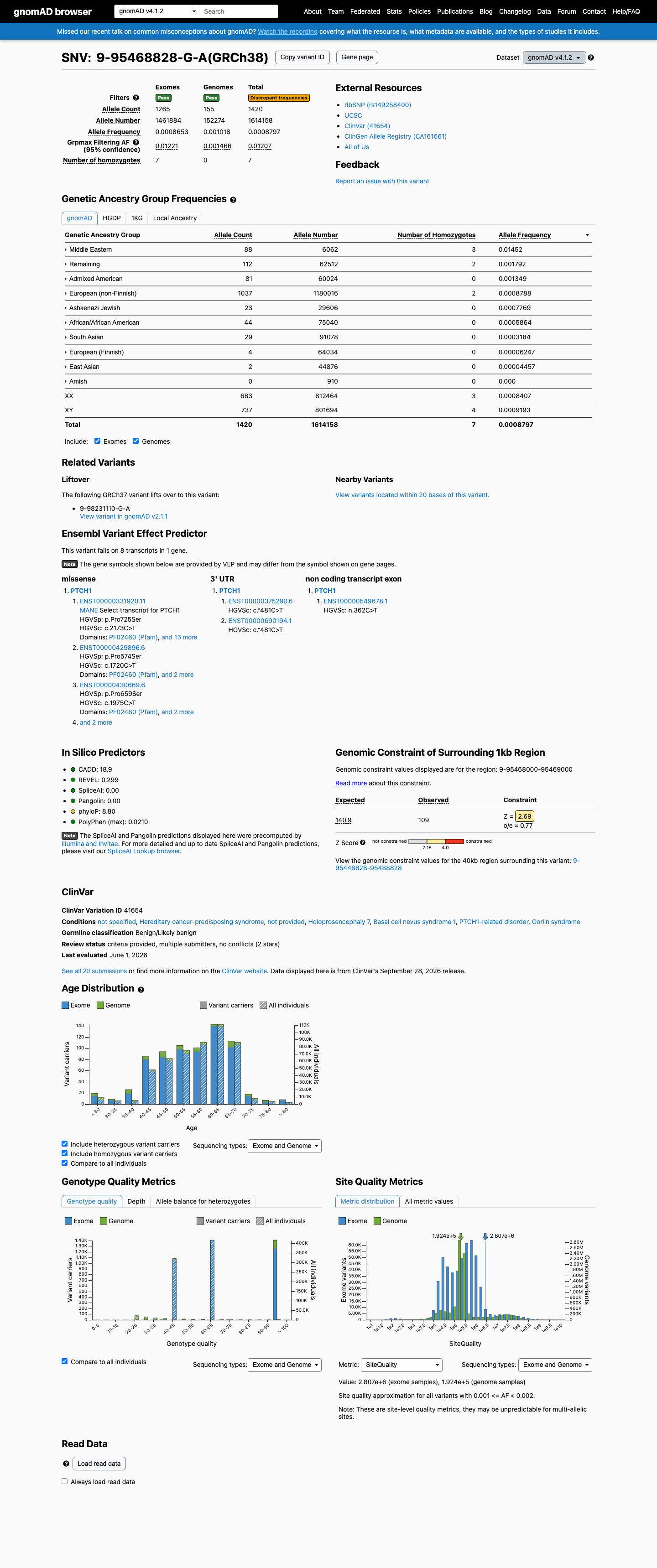
This variant is present in gnomAD v4.1 (AF= 0.000879716; MAF= 0.08797%, 1420/1614158 alleles, homozygotes = 7) and has highest observed frequency in the Middle Eastern population (AF= 0.0145167; MAF= 1.45167%, 88/6062 alleles, homozygotes = 3); grpmax FAF= 0.0120684.
v2.1
This variant is present in gnomAD v2.1 (AF= 0.000890862; MAF= 0.08909%, 252/282872 alleles, homozygotes = 0) and has highest observed frequency in the Remaining individuals population (AF= 0.00249169; MAF= 0.24917%, 18/7224 alleles, homozygotes = 0); grpmax FAF= 0.00120318.
🇨🇦 CA
This variant is present in gnomAD-Canada v1.0 (AF= 0.0014659572157671842, 27/18418 alleles, homozygotes = 0).
Allele frequency by ancestry
three datasets · side by side
gnomAD v4.1
0.088% · 1420 / 1,614,158
7 hom · FAF 1.2%
Middle Eastern
88 / 6,062
1.5%
3 hom
Remaining individuals
112 / 62,512
0.18%
2 hom
Admixed American
81 / 60,024
0.13%
European (non-Finnish)
1037 / 1,180,016
0.088%
2 hom
Ashkenazi Jewish
23 / 29,606
0.078%
African/African American
44 / 75,040
0.059%
South Asian
29 / 91,078
0.032%
European (Finnish)
4 / 64,034
0.0062%
East Asian
2 / 44,876
0.0045%
+ 1 not observed (Amish)
gnomAD v2.1
0.089% · 252 / 282,872
0 hom · FAF 0.12%
Remaining individuals
18 / 7,224
0.25%
European (non-Finnish)
173 / 129,184
0.13%
Admixed American
40 / 35,440
0.11%
Ashkenazi Jewish
8 / 10,370
0.077%
South Asian
9 / 30,616
0.029%
African/African American
2 / 24,964
0.008%
European (Finnish)
2 / 25,120
0.008%
+ 1 not observed (East Asian)
gnomAD Canada 🇨🇦
0.15% · 27 / 18,418
0 hom · FAF 0.042%
Middle Eastern
1 / 144
0.69%
Latino/Admixed American
2 / 838
0.24%
European (non-Finnish)
19 / 11,740
0.16%
South Asian
2 / 1,362
0.15%
Ashkenazi Jewish
1 / 832
0.12%
African/African American
1 / 1,018
0.098%
Remaining individuals
1 / 1,138
0.088%
+ 2 not observed (East Asian, European (Finnish))
ClinVar screenshot
ClinVar
This variant has been reported in ClinVar as Likely benign (10 clinical laboratories) and as Benign (5 clinical laboratories) and as benign (1 clinical laboratory). (ClinVarID = 41654)
SpliceAI screenshot
In silico
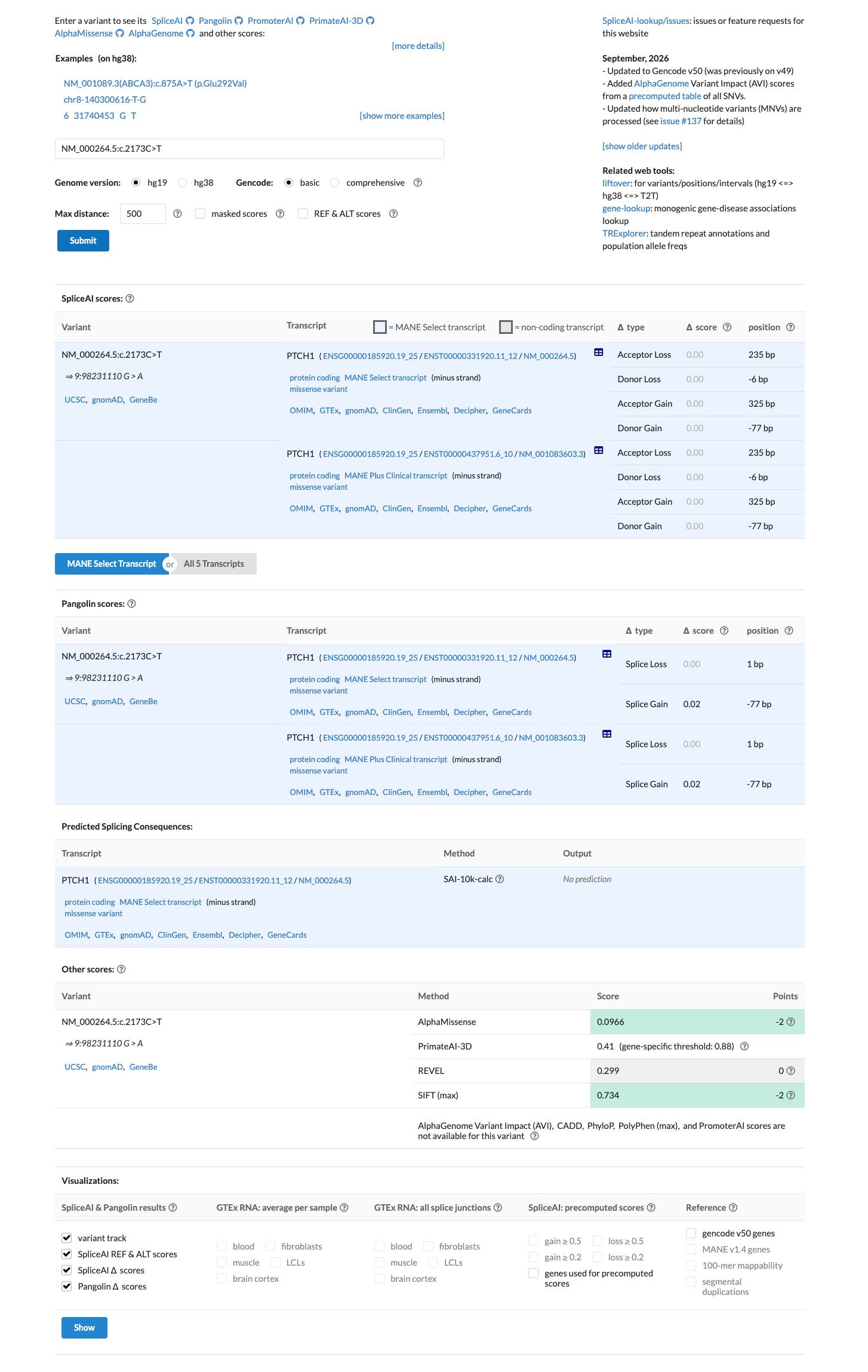
SpliceAI predicts no significant splice impact for this variant (max delta score = 0.00). REVEL score = 0.299. BayesDel score = -0.283106.
Functional / OncoKB screenshot
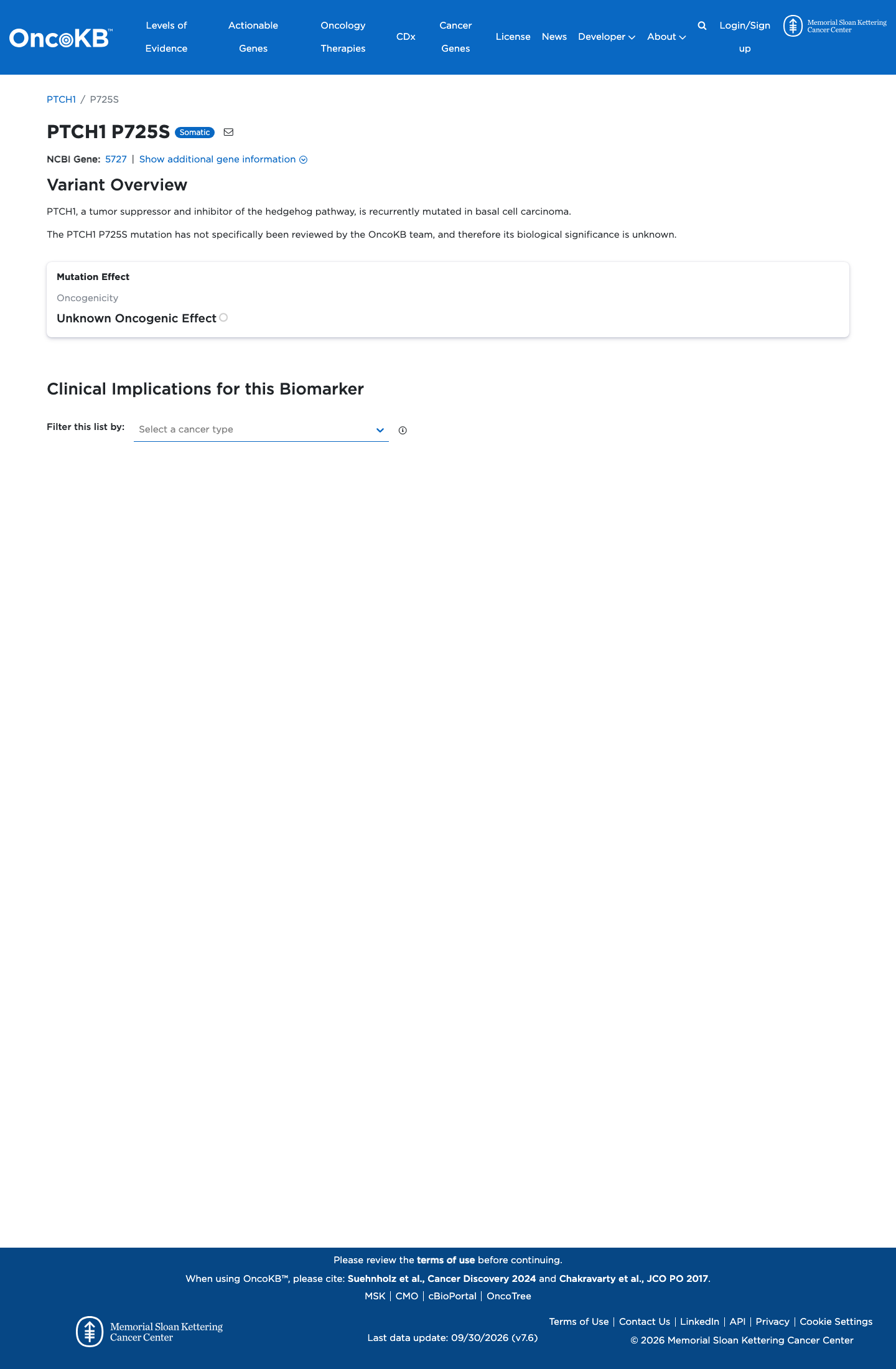
Functional Unknown Oncogenic Effect
OncoKB did not identify variant-specific reviewed functional evidence for this variant; gene-level curated context is available for reviewer follow-up. PTCH1, a tumor suppressor and inhibitor of the hedgehog pathway, is recurrently mutated in basal cell carcinoma.
OncoKB ↗
COSMIC screenshot
COSMIC
Cancer hotspots screenshot
Cancer hotspots
Somatic evidence Not in COSMIC / hotspots
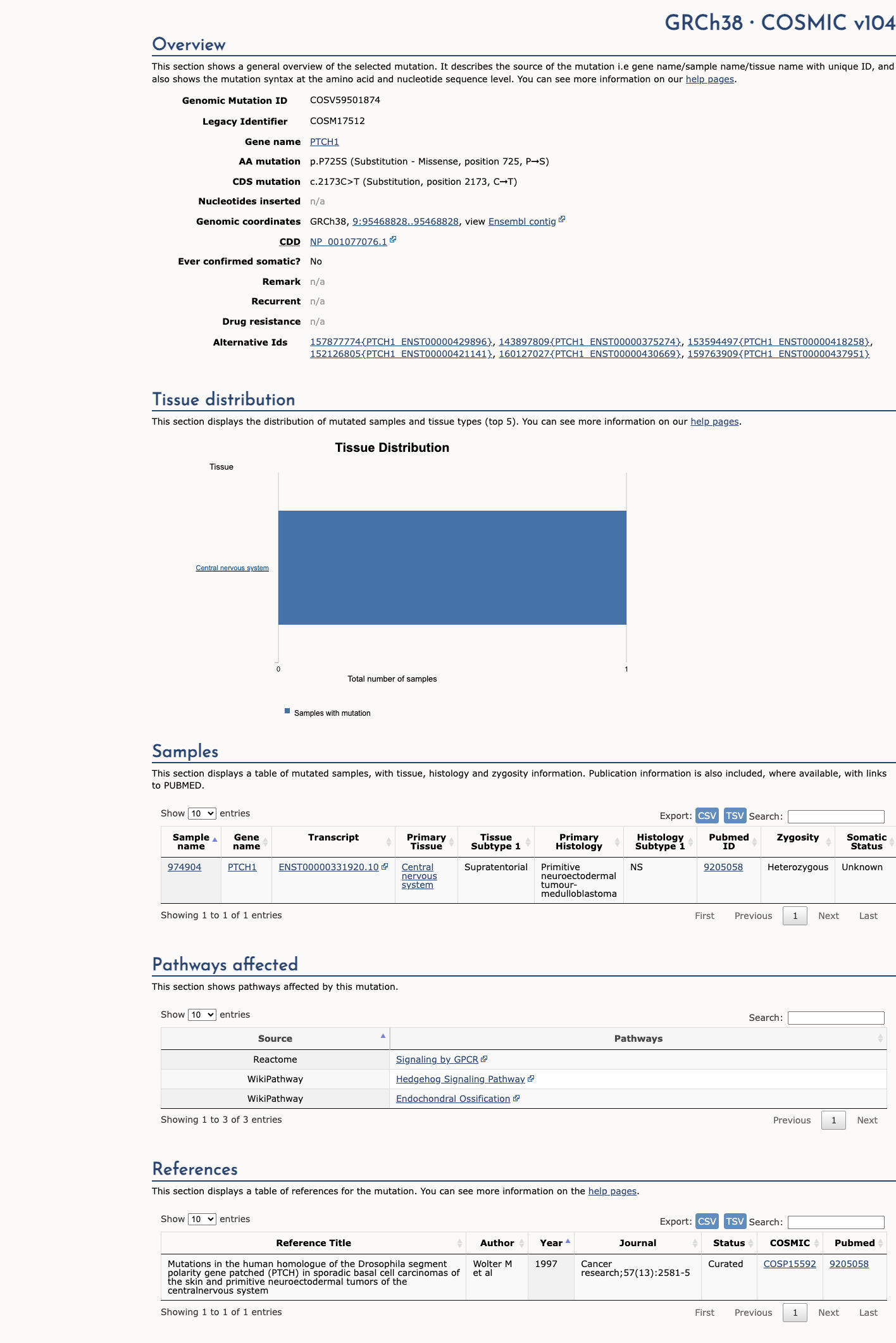
COSMIC
This variant does not lie in a statistically significant hotspot. This variant has previously been reported in somatic cancers (COSMIC; COSV59501874, n = 1 times).
Hotspots
This variant does not lie in a statistically significant hotspot.
Literature · how each cited paper was used
5papers cited
Each card is an audit: what was searched, what was found, whether it names the variant, which criteria it fed, and why. 4 further PMIDs triaged but not cited — see Sources & references.
Follicular cyst of the jaw developing into a keratocyst in a patient with unrecognized Gorlin-Goltz syndrome.
Searched
c.2173C>TNP_000255.2:p.(P725S)p.P725S
Found
Single-patient case report of a 52-year-old man with Gorlin-Goltz syndrome in whom genetic testing identified the pathogenic PTCH1 frameshift c.2726dupA (exon 17) that explains the syndrome, and separately the PTCH1 variant p.P725S in exon 14, which the authors describe as being 'of uncertain functional meaning'. The report provides no functional assay, segregation, or population-frequency data for p.P725S and treats it as an incidental secondary finding, not as the disease-causing change.
Variant
✓ Names this variant — characterised directly
Applied to
→BS2 strong
Supplies the penetrance premise BS2 depends on: PTCH1/Gorlin-Goltz syndrome is autosomal dominant with complete penetrance and variable expressivity.
→BP5 supporting
Affected case carries p.P725S alongside a pathogenic PTCH1 c.2726dupA that explains the Gorlin-Goltz phenotype (alternate molecular basis).
Moreover, the evaluation revealed the variant p.P725S in the 14th exon, which was of uncertain functional meaning.
Location Clinical Study / Genetic evaluation paragraph (final paragraph of the case description)  ·  Context Single-patient case report; molecular analysis of PTCH1 (exon 14 and exon 17) in a 52-year-old male with clinically diagnosed Gorlin-Goltz syndrome; the pathogenic change identified was c.2726dupA in exon 17.  ·  full text
Novel clinical and molecular findings in Spanish patients with naevoid basal cell carcinoma syndrome.
Searched
c.2173C>Tp.(P725S)p.P725SNP_000255.2:p.(P725S)rs149258400hotspottruncating
Found
Spanish NBCCS cohort study (22 unrelated patients, plus 5 relatives) that is the primary literature source for this codon: it reports the PTCH1 missense variant p.P725S (rs149258400) in index case IC11, localizes it to intracellular loop 3 (exon 14), and states explicitly that no mutational hotspots were found in PTCH1. The cohort's mutation spectrum is overwhelmingly truncating (17 novel truncating mutations versus 2 novel missense), with truncating mutations in 87% of patients. For p.P725S specifically, the authors report that eight in silico tools predicted a neutral change, that the variant is also present in the 1000 Genomes database with unclear clinical significance, and that the only pathogenic claim in the literature is from medulloblastoma tumour data; they nonetheless note the substituted residue is strictly conserved and was absent from 400 control alleles, and call for further functional studies.
Variant
✓ Names this variant — characterised directly
Applied to
→BS2 strong
→BP1 supporting
States the majority of PTCH1 disease mutations result in premature protein truncation and that truncating mutations were found in 87% of the cohort.
Missense p.P725S was predicted to be a neutral change; however, it has already been reported as pathogenic in medulloblastoma tumours 56. It substitutes a strictly conserved amino acid, located within a well conserved area of the protein, which suggests a functional significance. Absence of this variant in 400 alleles from healthy individuals used as controls also supports its pathogenicity. Further studies need to be performed in order to fully address its role at protein level.
Location Results, paragraph on PTCH1 sequencing (exon 14 missense findings) and Discussion, paragraph on missense mutations; supporting statements in Abstract and 'What is already known about this topic?'  ·  Context Cohort of 22 unrelated Spanish NBCCS patients plus 5 relatives; Sanger sequencing of PTCH1 exons 2-23 and exon-intron boundaries (RefSeq NM_000264, exon 1b excluded); 8 in silico algorithms (PolyPhen-2, SIFT, Pmut, PANTHER, Align-GVGD, MutationTaster, SNPS3D, PSIPRED) plus Clustal Omega multiple sequence alignment of 17 PTCH1 orthologues; 200 cancer-free controls (>65 years, 400 alleles); dbSNP and HGMD database lookups.  ·  full text
Rule & framework references · cited for criterion definitions, not variant evidence
22703879 ↗ Secondary variants in individuals undergoing exome sequencing: screening of 572 individuals identifies high-penetrance mutations in cancer-susceptibility genes.
24728327 ↗ Germline variation in cancer-susceptibility genes in a healthy, ancestrally diverse cohort: implications for individual genome sequencing.
25741868 ↗ Standards and guidelines for the interpretation of sequence variants: a joint consensus recommendation of the American College of Medical Genetics and Genomics and the Association for Molecular Pathology.
Sources & reference links
8Sources
ClinVar
gnomAD v2.1
gnomAD v4.1
gnomAD-Canada
SpliceAI
OncoKB
COSMIC
Cancer hotspots
Triaged references · 4 PMIDs not cited in assessment
26467025 ↗ A Standardized DNA Variant Scoring System for Pathogenicity Assessments in Mendelian Disorders. CLINVAR
15604628 ↗ Genetic cancer risk assessment and counseling: recommendations of the national society of genetic counselors. CLINVAR
20301702 ↗ Holoprosencephaly Overview. CLINVAR
28492532 ↗ Sherloc: a comprehensive refinement of the ACMG-AMP variant classification criteria. CLINVAR