Analysis in progress
Initialising…
0%
complete
This report is still being assembled — sections appear as each stage finishes. It isn't final yet.
PTEN
Final classification
VUS
PS3PM2PP3
PTEN
c.95T>G
p.Ile32Ser
missense · exon 2

PTEN is a tumor suppressor gene that encodes a phosphatase converting the lipid messenger PIP3 back to PIP2 at the cell membrane, thereby restraining the AKT/mTOR signaling pathway that drives cell growth, proliferation, and survival. It is one of the most frequently mutated genes across many types of human cancer, and its loss promotes unchecked cell growth, survival, and genomic instability, partly through impaired DNA repair. Germline loss-of-function variants in PTEN cause Cowden syndrome, an inherited cancer predisposition disorder associated with elevated risk of breast and thyroid cancer.

This variant

PTEN is a tumor suppressor whose germline loss-of-function variants cause Cowden syndrome, an inherited predisposition to breast and thyroid cancer. This missense variant shows strong functional and computational evidence of damage but lacks confirmatory population, de novo, segregation, and case data, so it remains a variant of uncertain significance (VUS) pending further evidence.

Transcript
NM_000314.6
HGVS · transcript:coding
NM_000314.6:c.95T>G
GRCh38
chr10:87894040 T>G
GRCh37
chr10:89653797 T>G
Basis Applied ClinGen PTEN VCEP (CSPEC v3.2) criteria PS3 (Moderate), PM2 (Supporting), and PP3 (Supporting); with no combination rule met, the variant defaults to VUS.
Applied ClinGen PTEN VCEP (CSPEC v3.2) criteria PS3 (Moderate), PM2 (Supporting), and PP3 (Supporting); with no combination rule met, the variant defaults to VUS.
Classification rationale
PS3PM2PP3 VUS
PTEN c.95T>G missense · exon 2

PS3 (Moderate): Mighell 2018 saturation mutagenesis measured a phosphatase activity score of -3.483, below the -1.11 pathogenic threshold. PM2 (Supporting): variant is absent from gnomAD v2.1, v4.1, and gnomAD-Canada (<0.001% allele frequency). PP3 (Supporting): REVEL score 0.967 exceeds the 0.7 pathogenic-supporting threshold. One Moderate and two Supporting criteria meet no CSPEC v3.2 combination rule, so the variant is classified as VUS.

PS3 + PM2 + PP3 VUS
Gene diagram · NM_000314.6 · variants mapped to exon structure
PTEN NM_000314.6
Fetching transcript structure from UCSC…
Applied criteria · 3 applied · 17 assessed
MetEvidence satisfies this criterion.
Not metEvaluated against available evidence; threshold not reached.
Not assessedApplies in principle, but no evidence was found to evaluate it.
N/ADoesn't apply to this variant type.
Applied · 3
Strength Supporting Moderate Strong Very strong
PS3 moderate Pathogenic
Met (Moderate): Mighell 2018 saturation mutagenesis measured a phosphatase activity score of -3.483, well below the -1.11 pathogenic threshold.
PTEN cspec v3.2 PS3 rule: 'Well-established in vitro or in vivo functional studies supportive of a damaging effect on the gene or gene product... Phosphatase activity <= -1.11 per Mighell et al. 2018, PMID: 29706350' assigns Moderate strength.mmc2.xlsx Table S2 (Mighell et al. 2018 saturation mutagenesis dataset, PMID 29706350) direct row lookup for Variant='I32S', Change='Ile32Ser': Cum_score = -3.483131746, Cum_SE = 0.383916646, High_conf = TRUE, High_conf_nature = 'Pass SE Filter', Imputed_Score = 'NA' (i.e. directly measured, not imputed).Cum_score of -3.483 is well below the VCEP PS3_Moderate cutoff of <= -1.11, indicating markedly reduced phosphatase activity consistent with a damaging functional effect.
PM2 supporting Pathogenic
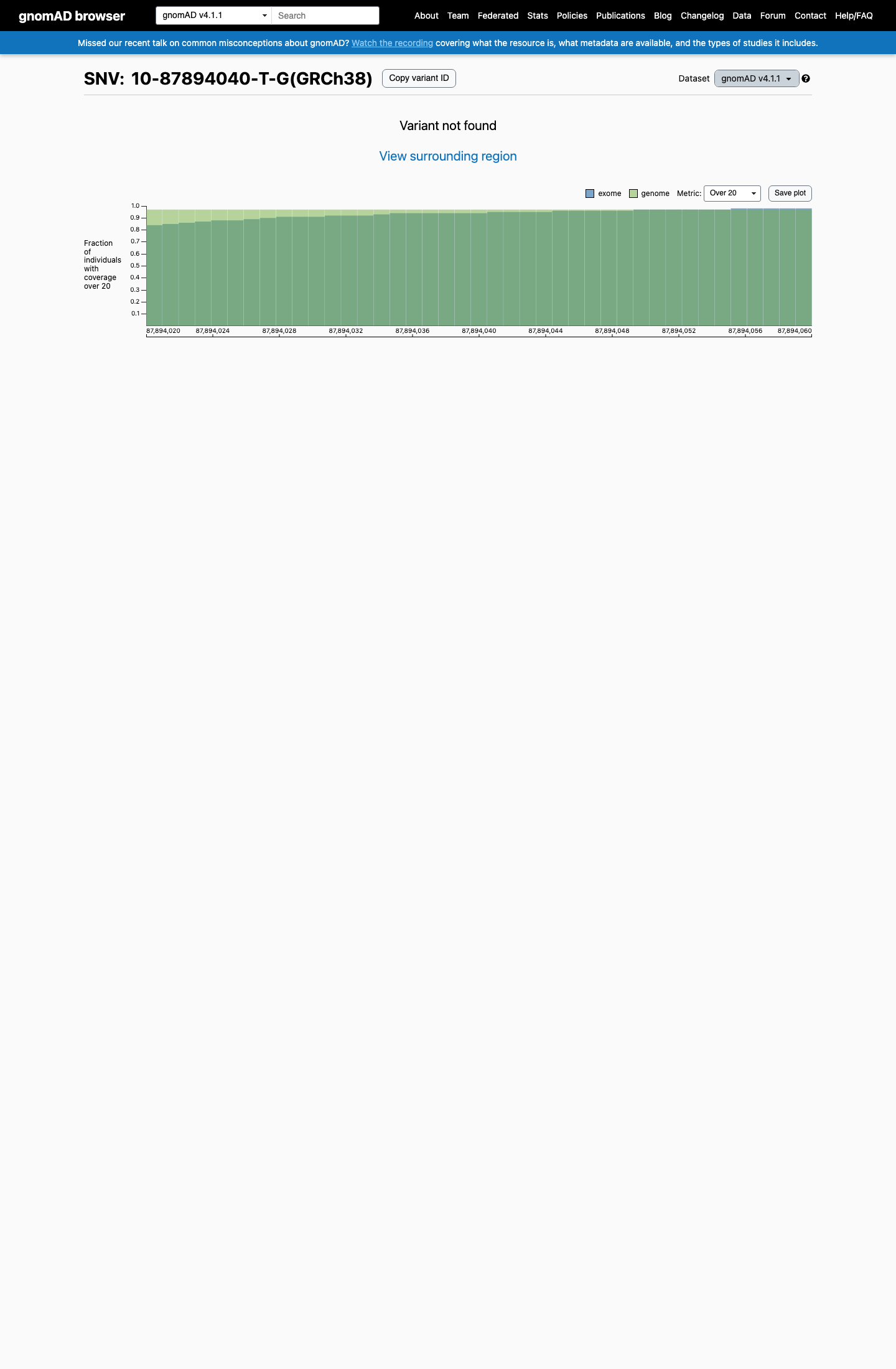
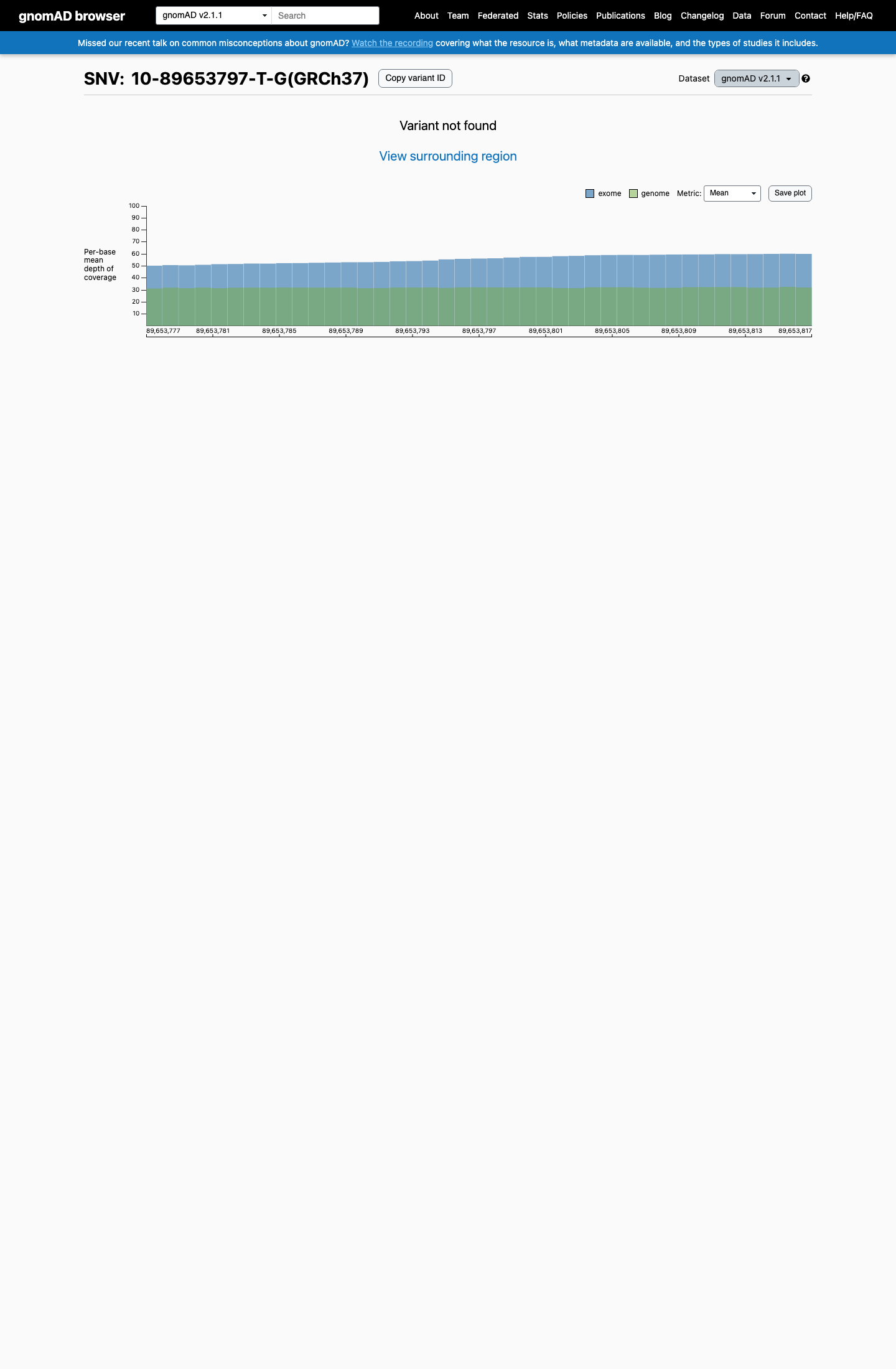
Met (Supporting): variant is absent from gnomAD v2.1, v4.1, and gnomAD-Canada, meeting the <0.001% population-absence threshold.
gnomAD v2.1 reports the exact genomic variant 10-89653797-T-G as absent.gnomAD v4.1 reports the exact genomic variant chr10-87894040-T-G as absent.gnomAD-Canada v1.0 reports the exact genomic variant 10-87894040-T-G as absent.
PP3 supporting Pathogenic
Met (Supporting): REVEL score 0.967 exceeds the VCEP's >0.7 pathogenic-supporting threshold for missense variants.
PTEN VCEP CSPEC v3.2 PP3 rule (defaultStrength Pathogenic Supporting): 'Multiple lines of computational evidence support a deleterious effect on the gene or gene product... Missense variants: REVEL score > 0.7.' VCEP commentary notes REVEL>0.7/<0.5 thresholds were calibrated to moderate OddsPath strength via Tavtigian et al. 2018 Bayesian framework, then downgraded to Supporting because PP2 is also applied for PTEN missense variants.Local REVEL predictor lookup (source_registry key 'revel') returns score 0.967 for NM_000314.6:c.95T>G, exceeding the VCEP's PP3 threshold of >0.7.
Assessed · not applied · 4 not met · 13 not assessed
Pathogenic
PS1 Not assessed: insufficient evidence was available to determine whether this amino acid change matches a known pathogenic variant.
PS2 Not assessed: no confirmed de novo observation with proband phenotype, family history, or maternity/paternity documentation was available.
PS4 Not assessed: no case-control counts, phenotype-specificity scores, or enrichment statistics for this variant were available.
PM1 Not assessed: insufficient evidence was available to evaluate location in a PTEN functional domain or mutational hotspot.
PM5 Not assessed: insufficient evidence was available to assess other pathogenic missense changes at this same residue.
PM6 Not assessed: no assumed de novo observation with documented phenotype and family history was available.
PP1 Not assessed: no family segregation or meiosis data were available for this variant.
PP2 Not assessed: insufficient evidence was available to evaluate the gene's rate of benign missense variation.
Benign
BA1 Not met: variant is absent from gnomAD, with no allele frequency exceeding the >0.056% BA1 threshold.
BS1 Not met: variant is absent from gnomAD, so no allele frequency falls in the BS1 range of 0.00043% to 0.056%.
BS2 Not assessed: no homozygous observations of the variant in healthy individuals were documented.
BS3 Not met: measured phosphatase activity score -3.483 is far below zero, indicating damaging rather than benign function.
BS4 Not assessed: no non-segregation data in affected family members were available.
BP1 Not assessed: insufficient evidence was available to evaluate whether only truncating variants cause disease in this gene.
BP2 Not assessed: no data on phase with a pathogenic PTEN variant or in-trans observations were available.
BP4 Not met: REVEL score 0.967 is far above the <0.5 benign-supporting threshold.
BP5 Not assessed: no alternate pathogenic molecular diagnosis or non-overlapping family history was available.
N/A · 8 PVS1 · PM3 · PM4 · PP4 · PP5 · BP3 · BP6 · BP7
Research & evidence
Population frequency
gnomAD v4.1 screenshot
gnomAD v4.1
gnomAD v2.1 screenshot
gnomAD v2.1
v4.1
Absent from gnomAD v4.1.
v2.1
Absent from gnomAD v2.1.
🇨🇦 CA
Absent from gnomAD-Canada v1.0.
Allele frequency by ancestry
three datasets · side by side
gnomAD v4.1
Absent · 0 / ?
0 hom
Not observed in any ancestry group.
gnomAD v2.1
Absent · 0 / ?
0 hom
Not observed in any ancestry group.
gnomAD Canada 🇨🇦
Absent · 0 / ?
0 hom
Not observed in any ancestry group.
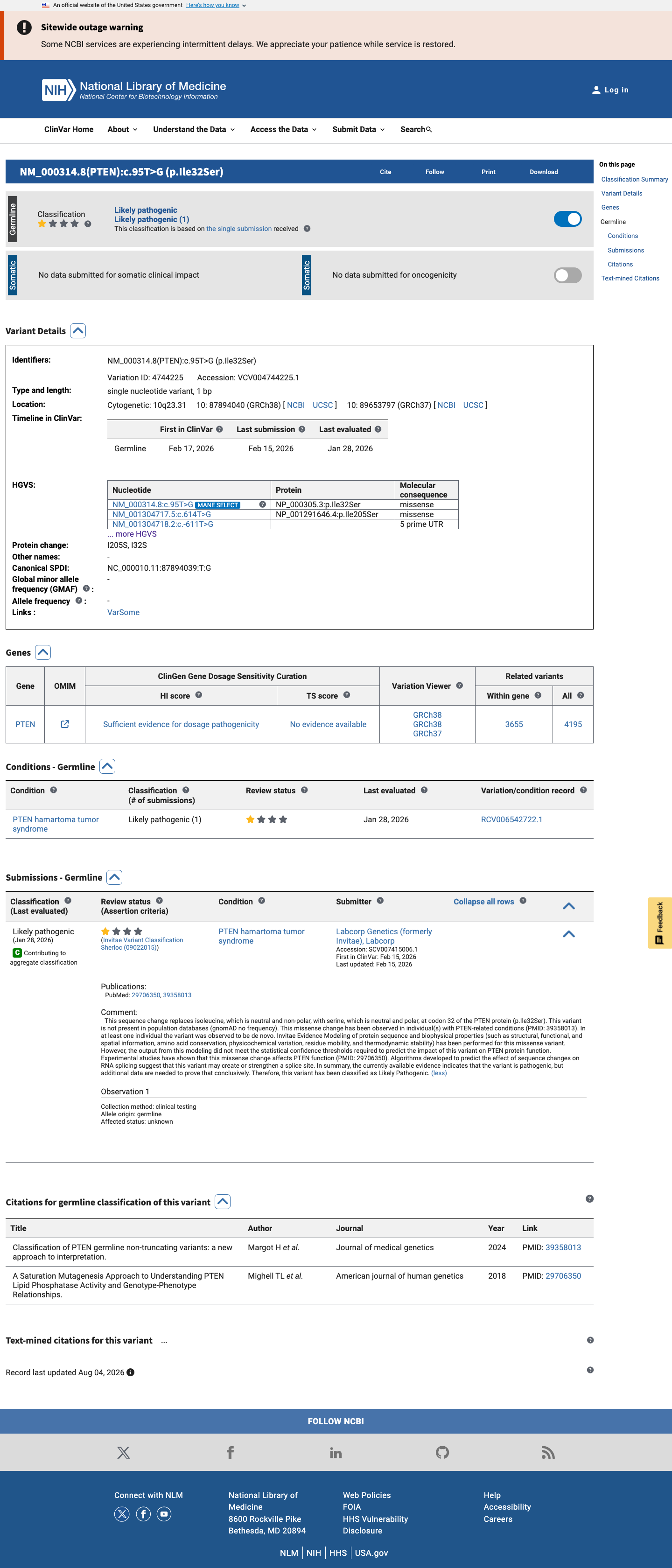
ClinVar screenshot
ClinVar
This variant has been reported in ClinVar as Likely pathogenic (1 clinical laboratory). (ClinVarID = 4744225)
SpliceAI screenshot
In silico
SpliceAI predicts possible splice impact for this variant (max delta score = 0.42). REVEL score = 0.967. BayesDel score = 0.59368.
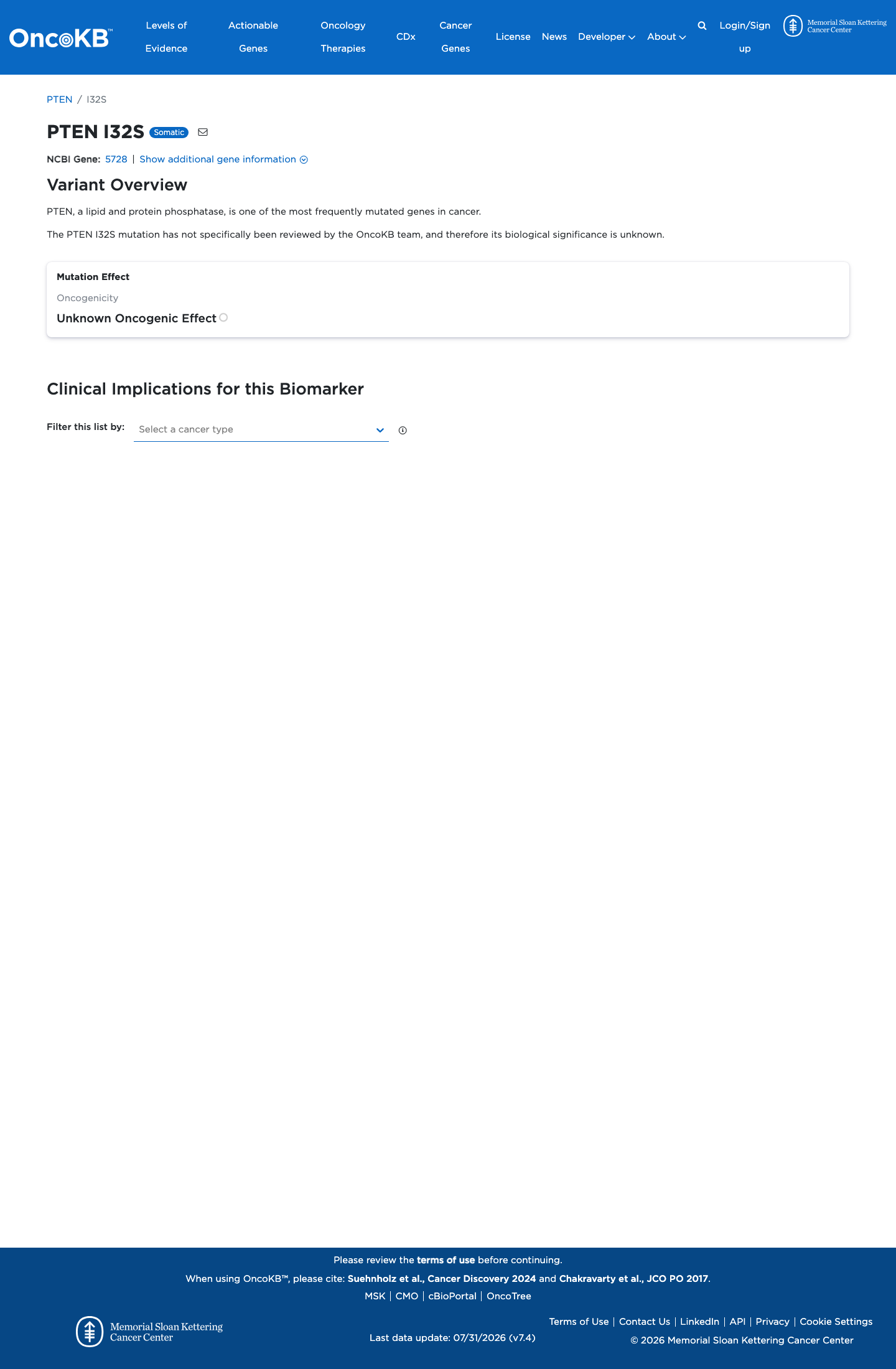
Functional / OncoKB screenshot
Functional Unknown Oncogenic Effect
OncoKB did not identify variant-specific reviewed functional evidence for this variant; gene-level curated context is available for reviewer follow-up. PTEN, a lipid and protein phosphatase, is one of the most frequently mutated genes in cancer.
OncoKB ↗
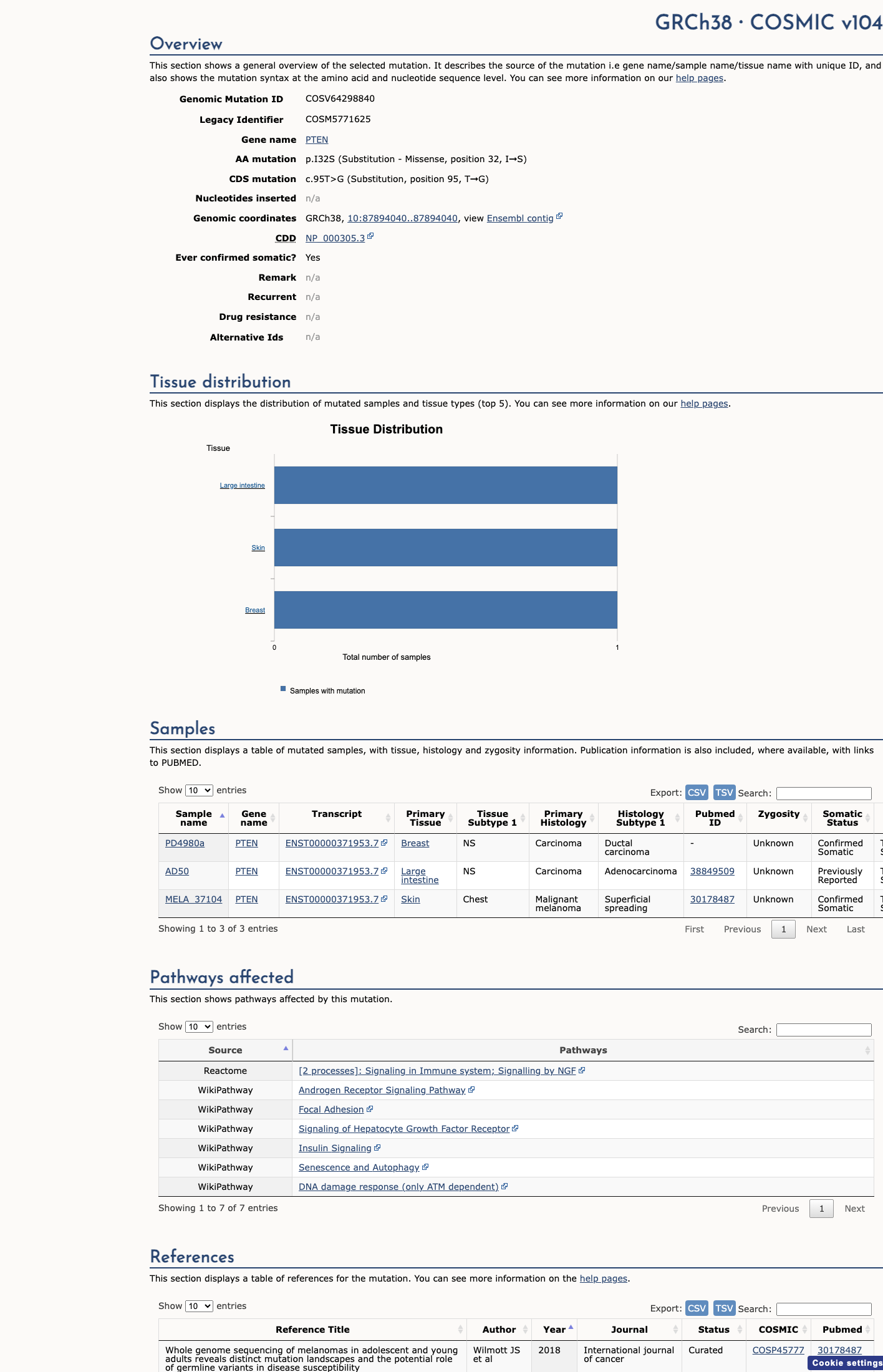
COSMIC screenshot
COSMIC
Cancer hotspots screenshot
Cancer hotspots
Somatic evidence Not in COSMIC / hotspots
COSMIC
This variant does not lie in a statistically significant hotspot. This variant has previously been reported in somatic cancers (COSMIC; COSV64298840, n = 3 times).
Hotspots
This variant does not lie in a statistically significant hotspot.
Literature · how each cited paper was used
1papers cited
Each card is an audit: what was searched, what was found, whether it names the variant, which criteria it fed, and why. 7 further PMIDs triaged but not cited — see Sources & references.
A Saturation Mutagenesis Approach to Understanding PTEN Lipid Phosphatase Activity and Genotype-Phenotype Relationships.
Searched
I32SIle32Serc.95T>G
Found
Massively parallel saturation mutagenesis and yeast-based phosphatase activity screening of essentially all possible PTEN missense variants, reported as cumulative fitness (phosphatase activity) scores in Table S2 (mmc2.xlsx). This dataset is directly incorporated into the PTEN VCEP specification as the source for PS3/BS3 functional evidence, with PS3_Moderate assigned at Cum_score <= -1.11 and BS3_Supporting assigned at Cum_score >0.
Variant
✓ Names this variant — characterised directly
Applied to
PS3 moderate
Directly measured Cum_score for I32S (-3.483) meets the PTEN VCEP PS3_Moderate threshold (<=-1.11) with High_conf=TRUE.
I32S, Ile32Ser, S (Ser), ATT, TCT, missense, Cum_score=-3.483131746, Cum_SE=0.383916646, High_conf=TRUE, High_conf_nature='Pass SE Filter', Imputed_Score='NA'
Location Table S2 (sheet 'Table S2' of supplementary file mmc2.xlsx), row for Variant (one letter) = 'I32S'  ·  Context Massively parallel phosphatase activity (fitness) assay in a yeast-based functional screen of PTEN saturation mutagenesis library, with biological replicates (A/B) and multiple selections (X1-X3); high-confidence flag requires passing standard-error/concordance filters.  ·  full text
Sources & reference links
9Sources
CSpec VCEP
ClinVar
gnomAD v2.1
gnomAD v4.1
gnomAD-Canada
SpliceAI
OncoKB
COSMIC
Cancer hotspots
Triaged references · 7 PMIDs not cited in assessment
17392385 ↗ American Cancer Society guidelines for breast screening with MRI as an adjunct to mammography. CLINVAR
25356965 ↗ ACMG policy statement: updated recommendations regarding analysis and reporting of secondary findings in clinical genome-scale sequencing. CLINVAR
26389210 ↗ Genetics of Breast and Gynecologic Cancers (PDQ®): Health Professional Version. CLINVAR
26389258 ↗ Cancer Genetics Risk Assessment and Counseling (PDQ®): Health Professional Versi CLINVAR
27854360 ↗ Recommendations for reporting of secondary findings in clinical exome and genome sequencing, 2016 update (ACMG SF v2.0): a policy statement of the American College of Medical Genetics and Genomics. CLINVAR
28492532 ↗ Sherloc: a comprehensive refinement of the ACMG-AMP variant classification crite CLINVAR
39358013 ↗ Classification of PTEN germline non-truncating variants: a new approach to interpretation. CLINVAR