Back
NM_000314.8:c.-491_-486dup
p.? · PTEN
0%
complete
Final classification
Benign
BA1BS2
PTEN
c.-491_-486dup
p.?
unknown · exon 1

PTEN is a tumor suppressor gene that encodes a phosphatase converting the lipid messenger PIP3 back to PIP2 at the cell membrane, thereby restraining the AKT/mTOR signaling pathway that drives cell growth, proliferation, and survival. It is one of the most frequently mutated genes across many types of human cancer, and its loss promotes unchecked cell growth, survival, and genomic instability, partly through impaired DNA repair. Germline loss-of-function variants in PTEN cause Cowden syndrome, an inherited cancer predisposition disorder associated with elevated risk of breast and thyroid cancer.

This variant

This 5' UTR repeat duplication is assessed in PTEN, a tumor-suppressor gene whose germline loss of function causes Cowden syndrome and inherited cancer predisposition.

Transcript
NM_000314.8
HGVS · transcript:coding
NM_000314.8:c.-491_-486dup
GRCh38
chr10:87863967 A>AGCGGCG
GRCh37
chr10:89623724 A>AGCGGCG
Benign: PTEN Expert Panel Rule17 is satisfied by BA1 (stand-alone benign); BS2 (supporting) is additionally met.
Classification rationale
BA1BS2 Benign
PTEN c.-491_-486dup unknown · exon 1

Benign: gnomAD v4.1 allele frequency 0.001394 exceeds the PTEN BA1 threshold of >0.00056. Benign evidence: gnomAD v4.1 reports three homozygous observations, meeting PTEN BS2 supporting criteria.

BA1 + BS2 → Benign
LYFE Sciences is an AI system, and it can make mistakes. Criteria may be applied incorrectly, sources may be misread, and a confident-looking classification can still be wrong. Double-check every criterion and its underlying evidence before relying on any call.
Gene diagram · NM_000314.8 · variants mapped to exon structure
PTEN NM_000314.8
Fetching transcript structure from UCSC…
Applied criteria · 2 applied · 12 assessed
MetEvidence satisfies this criterion.
Not metEvaluated against available evidence; threshold not reached.
Not assessedApplies in principle, but no evidence was found to evaluate it.
N/ADoesn't apply to this variant type.
Applied · 2
Strength Supporting Moderate Strong Very strong
BA1 stand-alone Benign
Met: gnomAD v4.1 all-comers AF 0.001394 exceeds the PTEN BA1 threshold of >0.00056.
PTEN VCEP Version 3.2 specifies BA1 when gnomAD filtering allele frequency is >0.00056.The default all-comers gnomAD source is appropriate because the PTEN specification does not mandate a non-cancer or exome-only population subset.gnomAD v4.1 reports AF 0.0013939683 (526/377340), Finnish population AF 0.006070159, and grpmax FAF 0.00127765.
BS2 supporting Benign
Met at supporting strength: gnomAD v4.1 reports three homozygotes, exceeding the PTEN rule requiring two observations without clinical data.
PTEN VCEP Version 3.2 specifies BS2 strong for one confirmed homozygous observation or two unconfirmed observations, and supporting for two homozygous observations without clinical data.gnomAD v4.1 reports three homozygotes overall: two in the Finnish population and one in the European non-Finnish population.The gnomAD record provides no individual clinical or PHTS-unaffected status, so the VCEP supporting rule for homozygous observations without clinical data applies.
Assessed · not applied · 4 not met · 8 not assessed
Pathogenic
PS2 Not assessed: no documented de novo proband or parental testing was available to satisfy the PTEN PS2 requirement for confirmed maternity and paternity.
PS3 Not assessed: mmc2.xlsx has no entry for c.-491_-486dup, p.?, or p.(=), and no qualifying variant-specific functional assay result is available.
PS4 Not assessed: no exact-variant case-control odds ratio, p value, confidence interval, or PTEN phenotype-specific proband score is available for comparison with the PS4 thresholds.
PM2 Not met: gnomAD v4.1 AF 0.001394 is far above the PTEN PM2 threshold of <0.00001.
PM4 Not met: predicted protein consequence NP_000305.3:p.(=) shows no protein-length change, and the variant is upstream of all PTEN catalytic motifs.
PM6 Not assessed: zero documented assumed de novo observations were available against the PTEN PM6 minimum of one disease proband without confirmed maternity and paternity.
PP1 Not assessed: zero informative meioses or affected relatives were documented, below the PTEN PP1 Supporting threshold of 3 or 4 meioses.
Benign
BS1 Not met: gnomAD v4.1 AF 0.001394 is above the PTEN BS1 upper limit of 0.00056 and meets BA1 instead.
BS3 Not assessed: mmc2.xlsx has no entry for c.-491_-486dup, p.?, or p.(=), and no qualifying benign functional or splicing assay result is available.
BS4 Not assessed: no affected-family segregation comparison was documented, while the PTEN BS4 Supporting threshold requires lack of segregation in one family.
BP2 Not met: no documented trans observation or at least three cis/unknown-phase observations with pathogenic or likely pathogenic PTEN variants.
BP5 Not assessed: no two qualifying cases with a highly penetrant alternate molecular diagnosis and non-overlapping personal or family history are documented.
N/A · 14 PVS1 · PS1 · PM1 · PM3 · PM5 · PP2 · PP3 · PP4 · PP5 · BP1 · BP3 · BP4 · BP6 · BP7
Research & evidence
Population frequency · supports benign
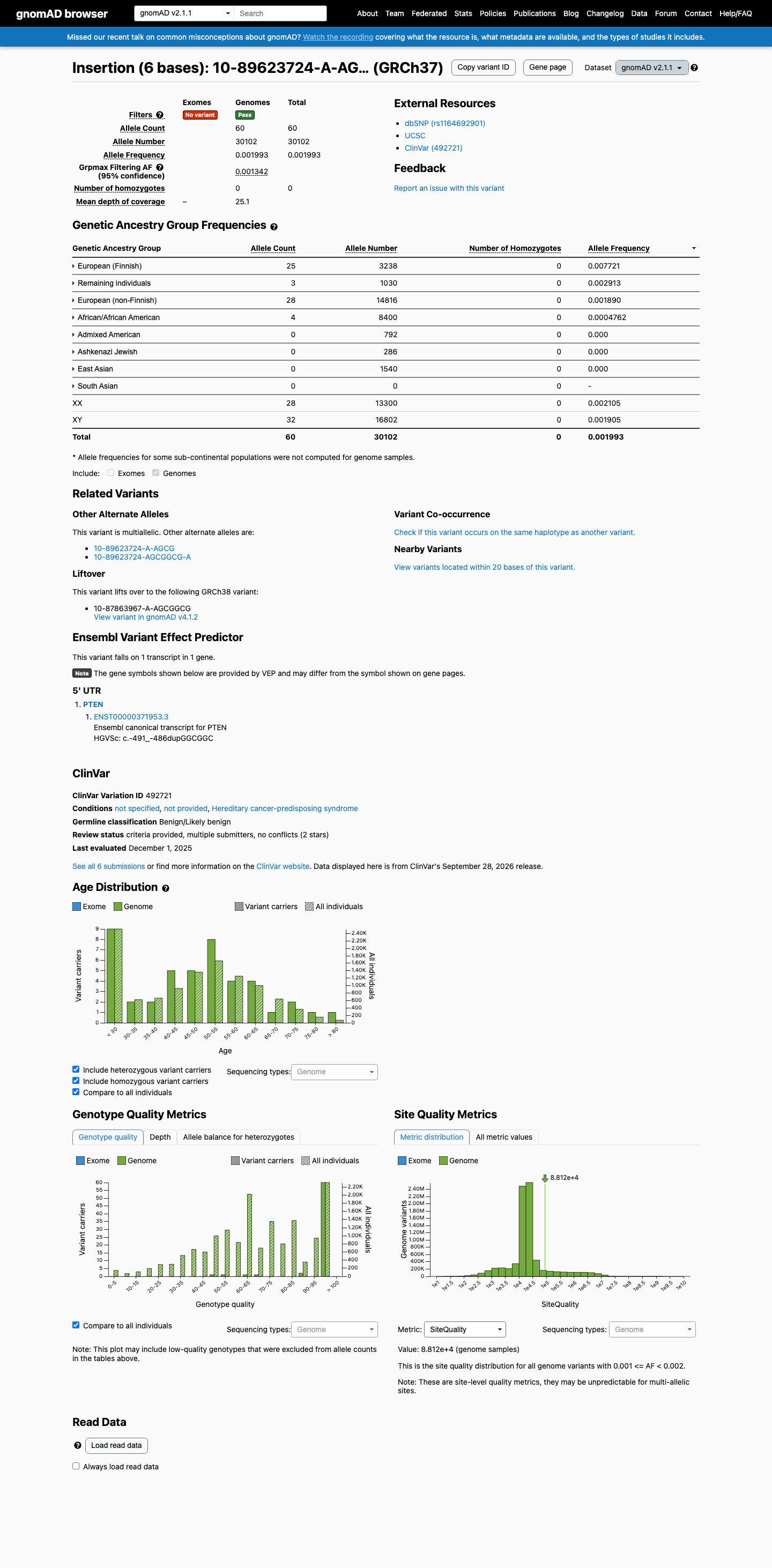
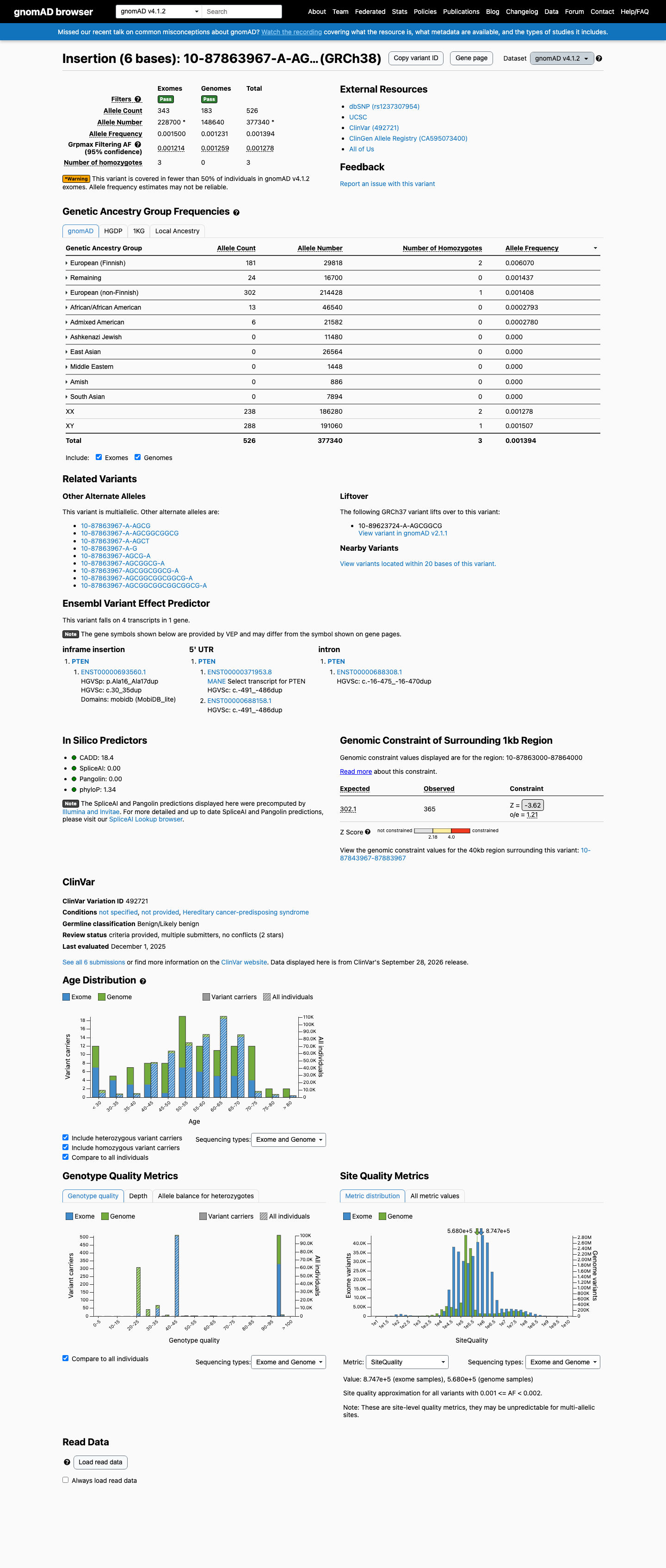
gnomAD v4.1 screenshot
gnomAD v4.1
gnomAD v2.1 screenshot
gnomAD v2.1
v4.1
This variant is present in gnomAD v4.1 (AF= 0.00139397; MAF= 0.13940%, 526/377340 alleles, homozygotes = 3) and has highest observed frequency in the European (Finnish) population (AF= 0.00607016; MAF= 0.60702%, 181/29818 alleles, homozygotes = 2); grpmax FAF= 0.00127765.
v2.1
This variant is present in gnomAD v2.1 (AF= 0.00199322; MAF= 0.19932%, 60/30102 alleles, homozygotes = 0) and has highest observed frequency in the European (Finnish) population (AF= 0.00772082; MAF= 0.77208%, 25/3238 alleles, homozygotes = 0); grpmax FAF= 0.00134244.
🇨🇦 CA
This variant is present in gnomAD-Canada v1.0 (AF= 0.001053565487412665, 19/18034 alleles, homozygotes = 0).
Allele frequency by ancestry
three datasets · side by side
gnomAD v4.1
0.14% · 526 / 377,340
3 hom · FAF 0.13%
European (Finnish)
181 / 29,818
0.61%
2 hom
Remaining individuals
24 / 16,700
0.14%
European (non-Finnish)
302 / 214,428
0.14%
1 hom
African/African American
13 / 46,540
0.028%
Admixed American
6 / 21,582
0.028%
+ 5 not observed (Amish, East Asian, Middle Eastern, South Asian, Ashkenazi Jewish)
gnomAD v2.1
0.2% · 60 / 30,102
0 hom · FAF 0.13%
European (Finnish)
25 / 3,238
0.77%
Remaining individuals
3 / 1,030
0.29%
European (non-Finnish)
28 / 14,816
0.19%
African/African American
4 / 8,400
0.048%
+ 4 not observed (Admixed American, Ashkenazi Jewish, East Asian, South Asian)
gnomAD Canada 🇨🇦
0.11% · 19 / 18,034
0 hom · FAF 0.11%
indel · split
European (non-Finnish)
19 / 11,502
0.17%
+ 8 not observed (African/African American, Latino/Admixed American, Ashkenazi Jewish, East Asian, European (Finnish), Middle Eastern, Remaining individuals, South Asian)
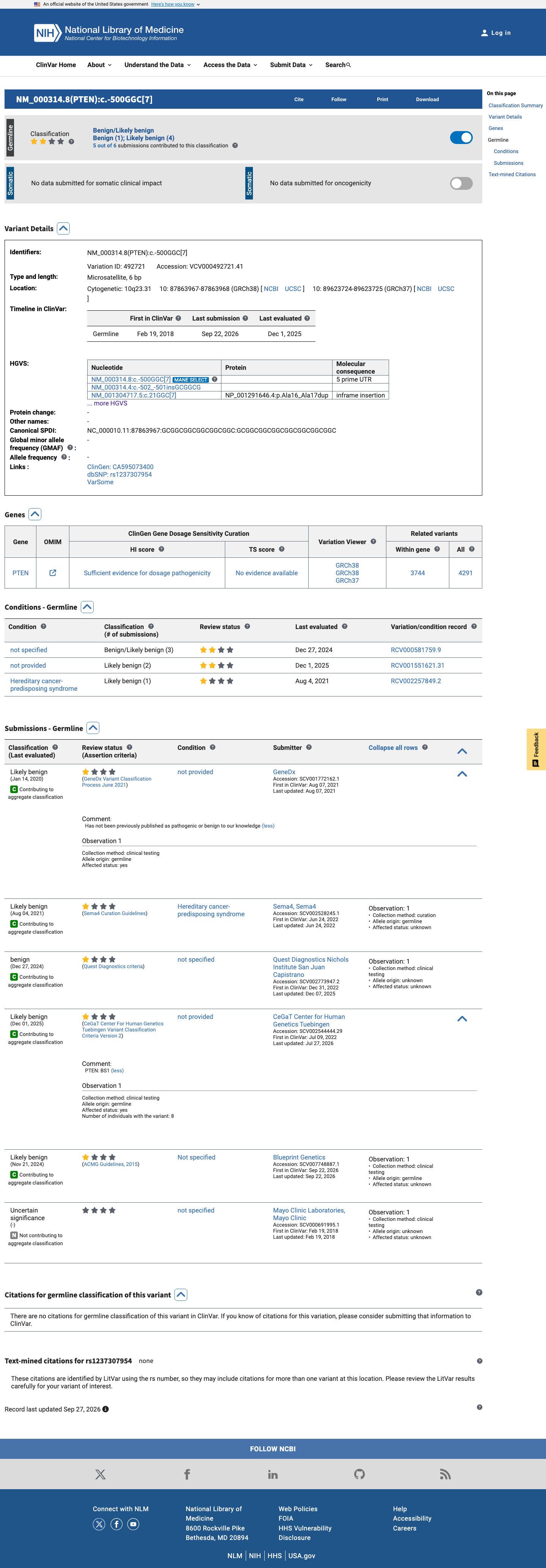
ClinVar screenshot
ClinVar
This variant has been reported in ClinVar as Likely benign (3 clinical laboratories) and as Uncertain significance (1 clinical laboratory) and as benign (1 clinical laboratory). (ClinVarID = 492721)
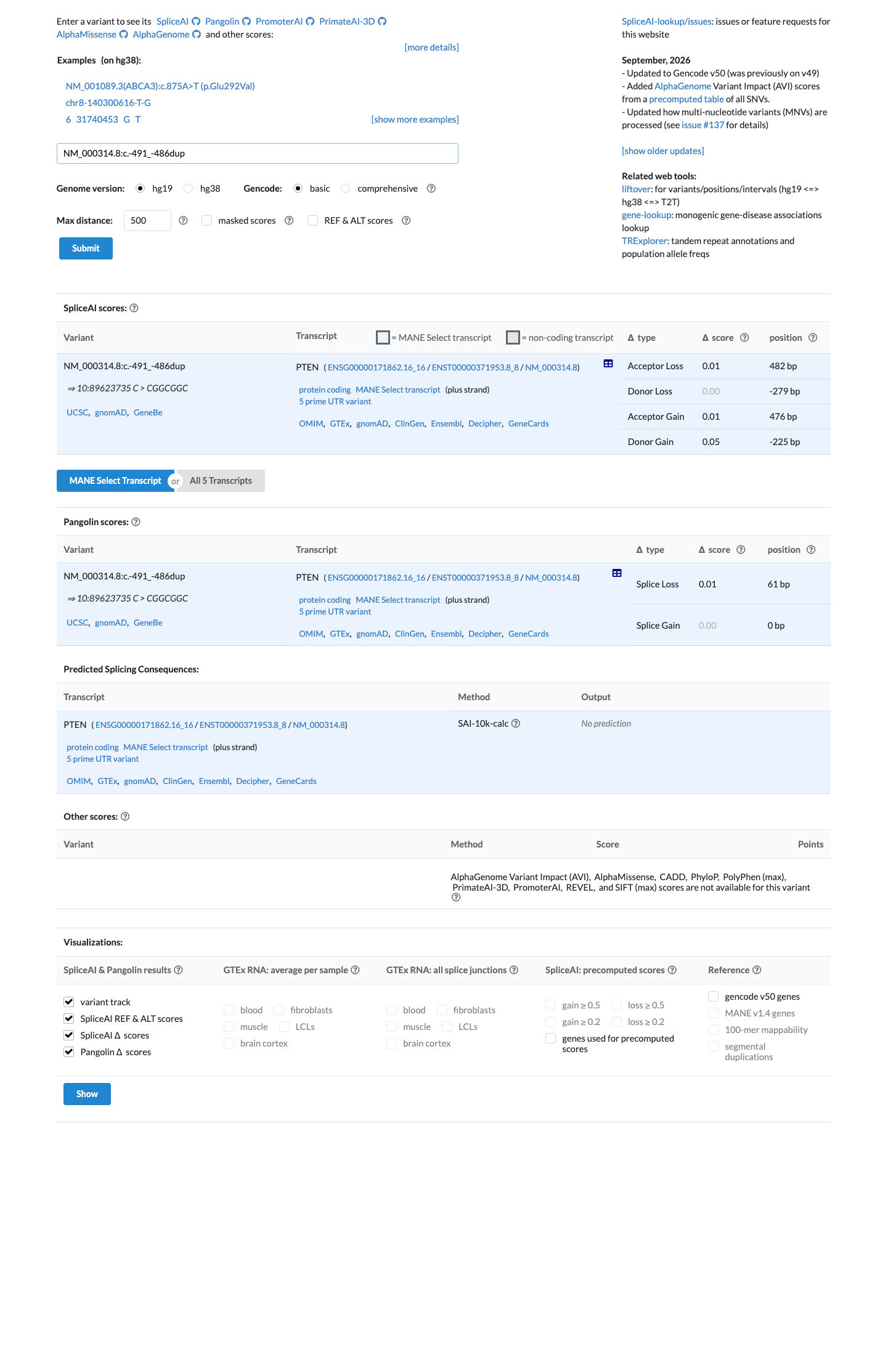
SpliceAI screenshot
In silico
SpliceAI predicts no significant splice impact for this variant (max delta score = 0.05).
Functional No data
No calibrated functional assay or RNA evidence was identified for this variant.
OncoKB ↗
COSMIC screenshot
COSMIC
Somatic evidence
COSMIC
This variant has not previously been reported in somatic cancers (COSMIC).
Hotspots
This variant does not lie in a statistically significant cancer hotspot.
COSMIC ↗
Sources & reference links
8Sources
CSpec VCEP
ClinVar
gnomAD v2.1
gnomAD v4.1
gnomAD-Canada
SpliceAI
OncoKB
COSMIC
Triaged references · 2 PMIDs not cited in assessment
25741868 ↗ Standards and guidelines for the interpretation of sequence variants: a joint consensus recommendation of the American College of Medical Genetics and Genomics and the Association for Molecular Pathology. CLINVAR
26467025 ↗ A Standardized DNA Variant Scoring System for Pathogenicity Assessments in Mendelian Disorders. CLINVAR