This variant was interpreted by pipeline
7.1.0.
The current version is
8.0.0.
Re-running queues a fresh interpretation; the result replaces this page when complete.
Re-runs are not free. Blank = draws on today's public interpretation allowance.
With a code = uses 1 of that code's uses.
PTEN is a tumor suppressor gene that encodes a phosphatase converting the lipid messenger PIP3 back to PIP2 at the cell membrane, thereby restraining the AKT/mTOR signaling pathway that drives cell growth, proliferation, and survival. It is one of the most frequently mutated genes across many types of human cancer, and its loss promotes unchecked cell growth, survival, and genomic instability, partly through impaired DNA repair. Germline loss-of-function variants in PTEN cause Cowden syndrome, an inherited cancer predisposition disorder associated with elevated risk of breast and thyroid cancer.
This variant
PTEN is a tumor suppressor that restrains the AKT/mTOR growth pathway, and germline loss-of-function variants cause Cowden syndrome with elevated breast and thyroid cancer risk. This nonsense variant truncates the PTEN protein (~26.6% removed) and is predicted to undergo nonsense-mediated decay, indicating loss of PTEN function; the Likely Pathogenic classification means it is expected to predispose to Cowden syndrome and its associated cancers.
Transcript
NM_000314.8
HGVS · transcript:coding
NM_000314.8:c.888T>A
GRCh38
chr10:87960980 T>A
GRCh37
chr10:89720737 T>A
Under ClinGen PTEN EP v3.2, PVS1 (Very Strong: nonsense p.Cys296Ter predicted NMD) + PM2 (Supporting: absent from gnomAD) satisfies Rule20, mapping to Likely Pathogenic with no conflicting evidence.
Classification rationale
PVS1PM2Likely Pathogenic
PTEN c.888T>Astop gained
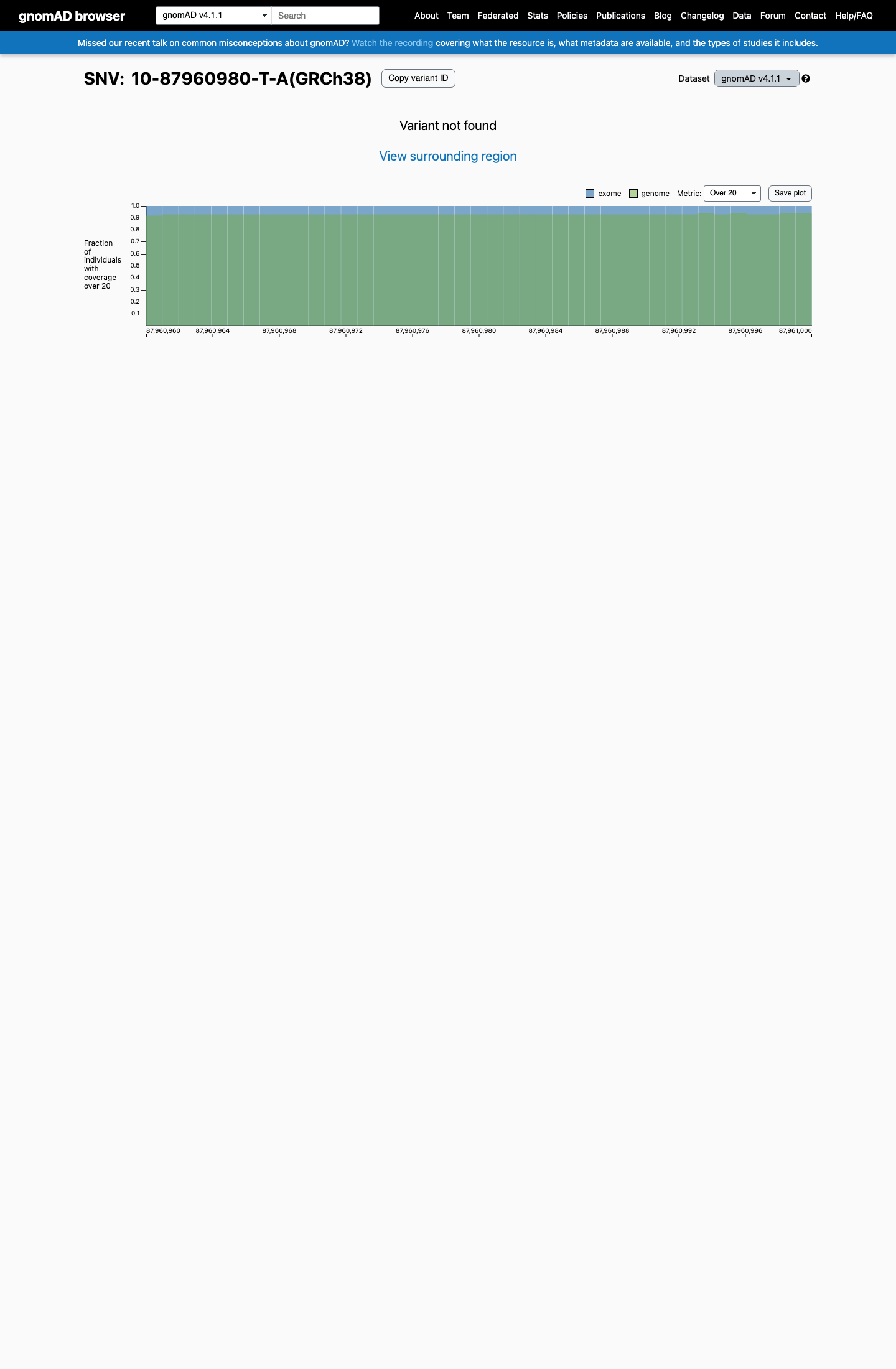
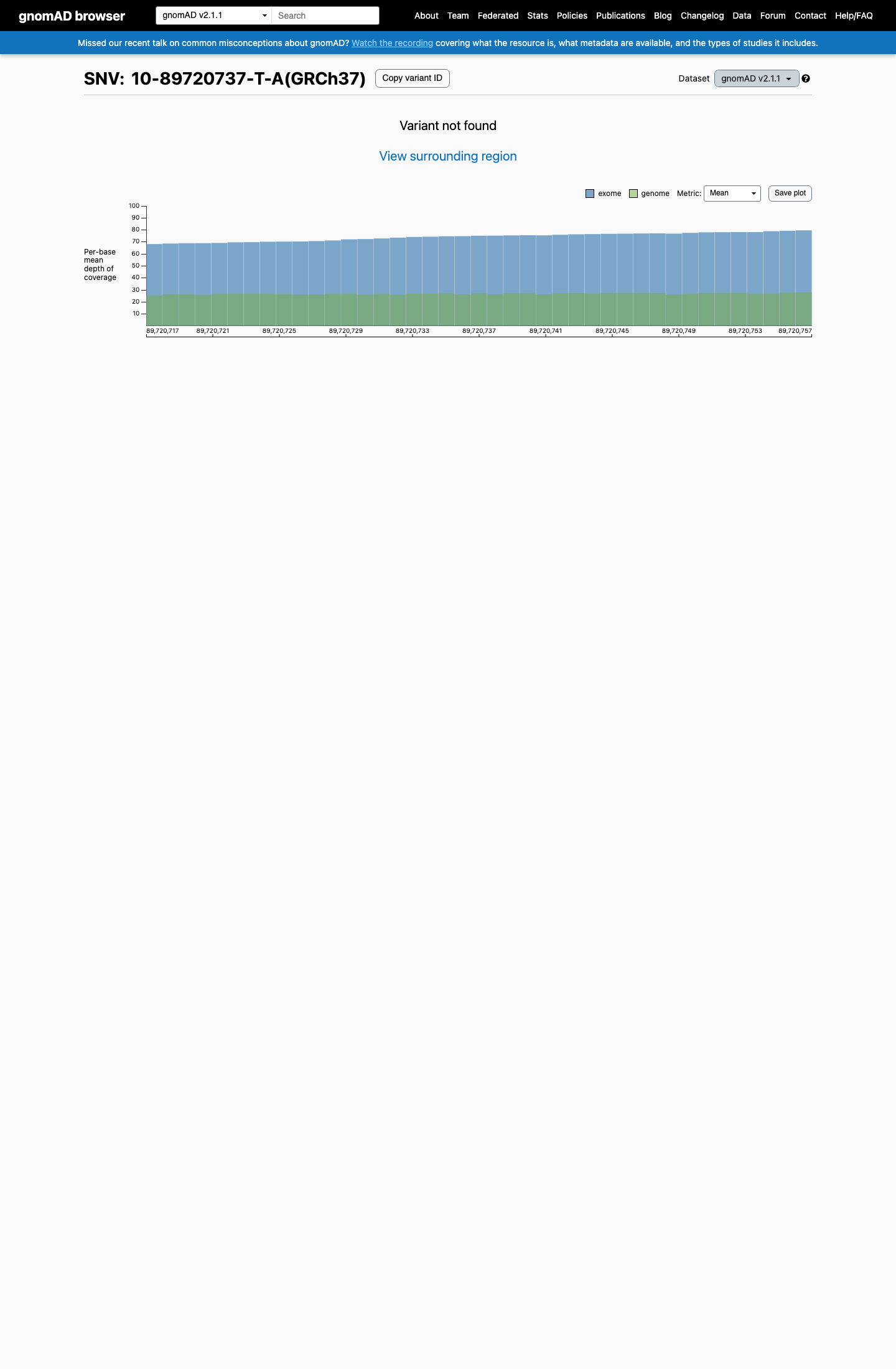
PVS1 (Very Strong): nonsense p.Cys296Ter — stop codon at 296, 5' to p.D375, predicted to trigger nonsense-mediated decay. PM2 (Supporting): absent from gnomAD v2.1, v4.1, and gnomAD-Canada (allele frequency 0). Overall: Likely Pathogenic under ClinGen PTEN EP v3.2 Rule20 (1 Pathogenic Very Strong + 1 Pathogenic Supporting).
PVS1 + PM2→Likely Pathogenic
LYFE Sciences is an AI system, and it can make mistakes. Criteria
may be applied incorrectly, sources may be misread, and a confident-looking
classification can still be wrong. Double-check every criterion and
its underlying evidence before relying on any call.
Gene diagram
· NM_000314.8 · variants mapped to exon structure
PTENNM_000314.8
Fetching transcript structure from UCSC…
Exons
—
Transcript span
—
Strand
—
Variants mapped
—
Source
UCSC ncbiRefSeqCurated
All variants in PTEN—click a row to locate it on the plot · use the link column to open its page
Protein
Location
Classification
Link
Applied criteria · 2 applied · 15 assessed
MetEvidence satisfies this criterion.
Not metEvaluated against available evidence; threshold not reached.
Not assessedApplies in principle, but no evidence was found to evaluate it.
N/ADoesn't apply to this variant type.
Applied · 2
Strength Supporting Moderate Strong Very strong
✓
PVS1very strongPathogenic
Met: nonsense p.Cys296Ter — stop codon 296 lies 5' of p.D375/c.1121, predicted to trigger nonsense-mediated decay, satisfying the PTEN PVS1 tree at very strong strength.
PTEN VCEP PVS1 decision tree (vcep_pvs1_decisiontree_pten, index.txt): nonsense/frameshift with stop codon or disruption at or 5' to p.D375 (c.1121), exon present in biologically-relevant transcript NM_000314.8 and predicted to undergo NMD -> PVS1; stop codon 3' to p.D375 not predicted to undergo NMD -> PVS1_ModerateClinGen PTEN EP CSPEC v3.2 PVS1 rule (cspec): 'Use PTEN PVS1 decision tree'; defaultStrength Pathogenic Very Strongprefetch normalization (Mutalyzer): NM_000314.8:c.888T>A -> NP_000305.3:p.(Cys296Ter); predicted protein MTAII...ENGSL* (296 aa) vs wild-type 403 aa
PM4Not met: the variant is a truncating nonsense change, not an in-frame indel or stop-loss extension, so PM4 does not apply to this consequence class.
PM6Not assessed: no assumed or presumed de novo observation of c.888T>A is documented, and no family-history data are available.
PP1Not assessed: zero documented meioses — no segregation study or pedigree involving c.888T>A exists in the available literature.
Benign
BA1Not met: allele frequency 0, far below the gnomAD BA1 threshold of 0.00056.
BS1Not met: allele frequency 0 is below the lowest BS1 supporting-tier threshold of 0.0000043.
BS2Not met: zero homozygous or heterozygous observations in any population cohort; no healthy or unaffected homozygote data.
BS3Not met: no functional evidence of normal protein function exists; the VCEP assay covers missense variants only.
BS4Not assessed: no documented non-segregation observation for c.888T>A; absence of segregation data cannot establish lack of segregation.
BP2Not assessed: no trans/cis phase data — no second PTEN variant, parental testing, or phase information is documented for c.888T>A.
BP5Not assessed: no carrier-level clinical data — no alternate molecular cause or phenotype-overlap history is documented for c.888T>A.
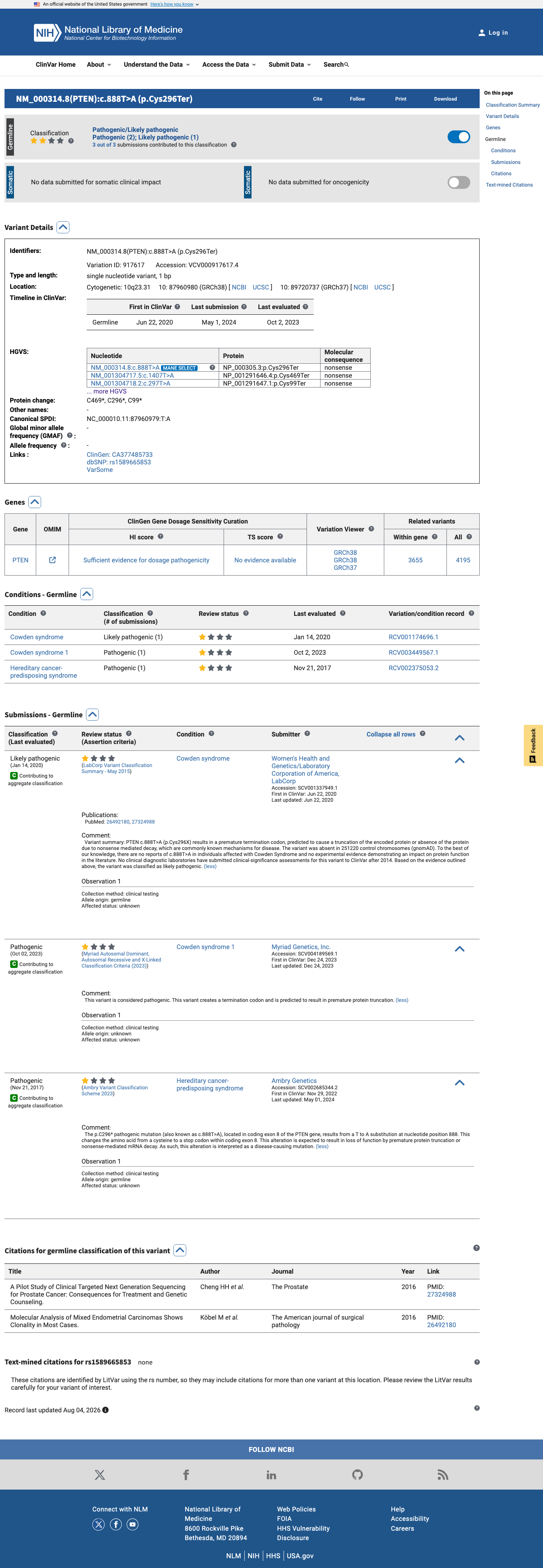
This variant has been reported in ClinVar as Pathogenic (2 clinical laboratories) and as Likely pathogenic (1 clinical laboratory). (ClinVarID = 917617)
25394175 ↗A practice guideline from the American College of Medical Genetics and Genomics and the National Society of Genetic Counselors: referral indications for cancer predisposition assessment.CLINVAR
26389210 ↗Genetics of Breast and Gynecologic Cancers (PDQ®): Health Professional Version.CLINVAR
26389333 ↗Genetics of Skin Cancer (PDQ®): Health Professional Version.CLINVAR
26492180 ↗Molecular Analysis of Mixed Endometrial Carcinomas Shows Clonality in Most Cases.CLINVAR
27324988 ↗A Pilot Study of Clinical Targeted Next Generation Sequencing for Prostate Cancer: Consequences for Treatment and Genetic Counseling.CLINVAR