NM_000314.8:c.1027-2A>C disrupts the canonical AG splice-acceptor of exon 9 (intron 8, -2 position), 5' to the p.D375 (c.1121) threshold, and is assigned PVS1 at very strong strength under the ClinGen PTEN Expert Panel PVS1 decision tree.1 RNA analysis in patient-derived cells (RT-PCR and 3'RACE) demonstrated that this exact variant causes premature transcript termination within exon 8 at r.962 with polyadenylation, producing p.(Thr321_403del), meeting PS3 at strong strength.2 The variant is absent from gnomAD v2.1, v4.1, and gnomAD-Canada v1.0, meeting PM2 at supporting strength.3 The variant has been reported in ClinVar as Pathogenic by three clinical laboratories and Likely pathogenic by one clinical laboratory, consistent with a pathogenic interpretation.4 PVS1 alone (one very strong pathogenic criterion) satisfies the ClinGen PTEN Expert Panel combination rules for a Pathogenic classification.5
Final classification
Pathogenic
PVS1PS3PM2
PTEN
c.1027-2A>C
p.?
canonical splice
This variant
NM_000314.8:c.1027-2A>C disrupts the canonical AG splice-acceptor of exon 9 (intron 8, -2 position), 5' to the p.D375 (c.1121) threshold, and is assigned PVS1 at very strong strength under the ClinGen PTEN Expert Panel PVS1 decision tree.
ClinGen PTEN Expert Panel Specifications to the ACMG/AMP Variant Interpretation Guidelines for PTEN Version 3.2 v3.2 criteria-combination framework: matched Rule1 (1 Pathogenic.Very Strong + Pathogenic.Strong >=1) with applied criteria: PVS1 very strong, PS3 strong, PM2 supporting; maps to Pathogenic.
Classification rationale
PVS1PS3PM2
Pathogenic
PTEN c.1027-2A>C
canonical splice
PVS1 + PS3 + PM2
→
Pathogenic
1
vcep_pvs1_decisiontree_ptenpvs1_variant_assessmentPMID:28677221 ↗
5
cspec ↗final_classification_framework
LYFE Sciences is an AI system, and it can make mistakes. Criteria
may be applied incorrectly, sources may be misread, and a confident-looking
classification can still be wrong. Double-check every criterion and
its underlying evidence before relying on any call.
Gene diagram
· NM_000314.8 · variants mapped to exon structure
PTEN
NM_000314.8
Fetching transcript structure from UCSC…
Applied criteria · 3 applied · 16 assessed
MetEvidence satisfies this criterion.
Not metEvaluated against available evidence; threshold not reached.
Not assessedApplies in principle, but no evidence was found to evaluate it.
N/ADoesn't apply to this variant type.
Applied · 3
Strength
Supporting
Moderate
Strong
Very strong
PVS1
very strong
Pathogenic
NM_000314.8:c.1027-2A>C disrupts the canonical AG splice-acceptor of exon 9 (intron 8, -2 position), a GT-AG 1,2 splice site 5' to p.D375 (c.1121). Under the ClinGen PTEN Expert Panel PVS1 decision tree this is assigned full PVS1, and functional RNA analysis confirms abnormal transcript termination producing p.(Thr321_403del).
Canonical splice-acceptor disruption (AG>CG at c.1027-2) in a biologically-relevant transcript NM_000314.8Position 5' to the p.D375 (c.1121) threshold per PTEN PVS1 decision treeRNA analysis (28677221) shows premature transcript termination in exon 8 at r.962
PS3
strong
Pathogenic
Well-established RNA functional assay in patient-derived cells (RT-PCR and 3'RACE) demonstrated that this exact variant causes premature transcript termination within exon 8 at r.962 with polyadenylation, producing p.(Thr321_403del). This meets PTEN EP PS3 at strong strength (RNA assay showing impact on splicing).
Direct RNA analysis of the exact variant showing abnormal splicing/transcript terminationPredicted protein consequence p.(Thr321_403del)removing the C-terminal region
PM2
supporting
Pathogenic
The variant is absent from gnomAD v2.1, gnomAD v4.1, and gnomAD-Canada v1.0, meeting the PTEN EP PM2 threshold (allele frequency <0.00001 / 0.001%).
Absent from gnomAD v2.1Absent from gnomAD v4.1Absent from gnomAD-Canada v1.0
Assessed · not applied
· 16 not met · 0 not assessed
Pathogenic
PS1
No established pathogenic variant at the same nucleotide position (c.1027-2) with a different nucleotide change was identified to satisfy the PS1 'same nucleotide position' rule.
PS2
No confirmed de novo observation (maternity and paternity confirmed) for this variant was read in the literature.
PS4
No case-control data, odds ratio, or proband specificity score establishing significantly increased prevalence of this variant in affected individuals was available.
PM1
The PTEN EP PM1 is defined for residues in the catalytic motifs (90-94, 123-130, 166-168).
PM6
No assumed de novo observation for this variant was read in the literature.
PP1
No co-segregation data (meioses) in affected family members was available for this variant.
PP3
The splice-effect prediction (SpliceAI max delta 0.994) is already captured by PVS1 and should not be double-counted.
Benign
BA1
The variant is absent from gnomAD, far below the BA1 filtering allele frequency threshold (>0.00056 / 0.056%).
BS1
The variant is absent from gnomAD, not present at the BS1 allele frequency range (0.000043-0.00056).
BS2
No homozygous observations in a healthy or PHTS-unaffected individual were identified.
BS3
Functional RNA analysis demonstrates a damaging effect on splicing (premature transcript termination), which is inconsistent with BS3.
BS4
No lack-of-segregation data in affected family members was available.
BP2
No observation of this variant in trans (or three observations in cis/unknown phase) with a pathogenic or likely pathogenic PTEN variant was identified.
BP4
SpliceAI predicts splice impact (max delta 0.994), inconsistent with a benign computational prediction.
BP5
No case with an alternate molecular basis for disease was identified.
BP7
BP7 requires an intronic variant at or beyond +7/-21 with no predicted splice impact.
N/A · 9
PM3 · PM4 · PM5 · PP2 · PP4 · PP5 · BP1 · BP3 · BP6
Research & evidence
Population frequency · supports pathogenic
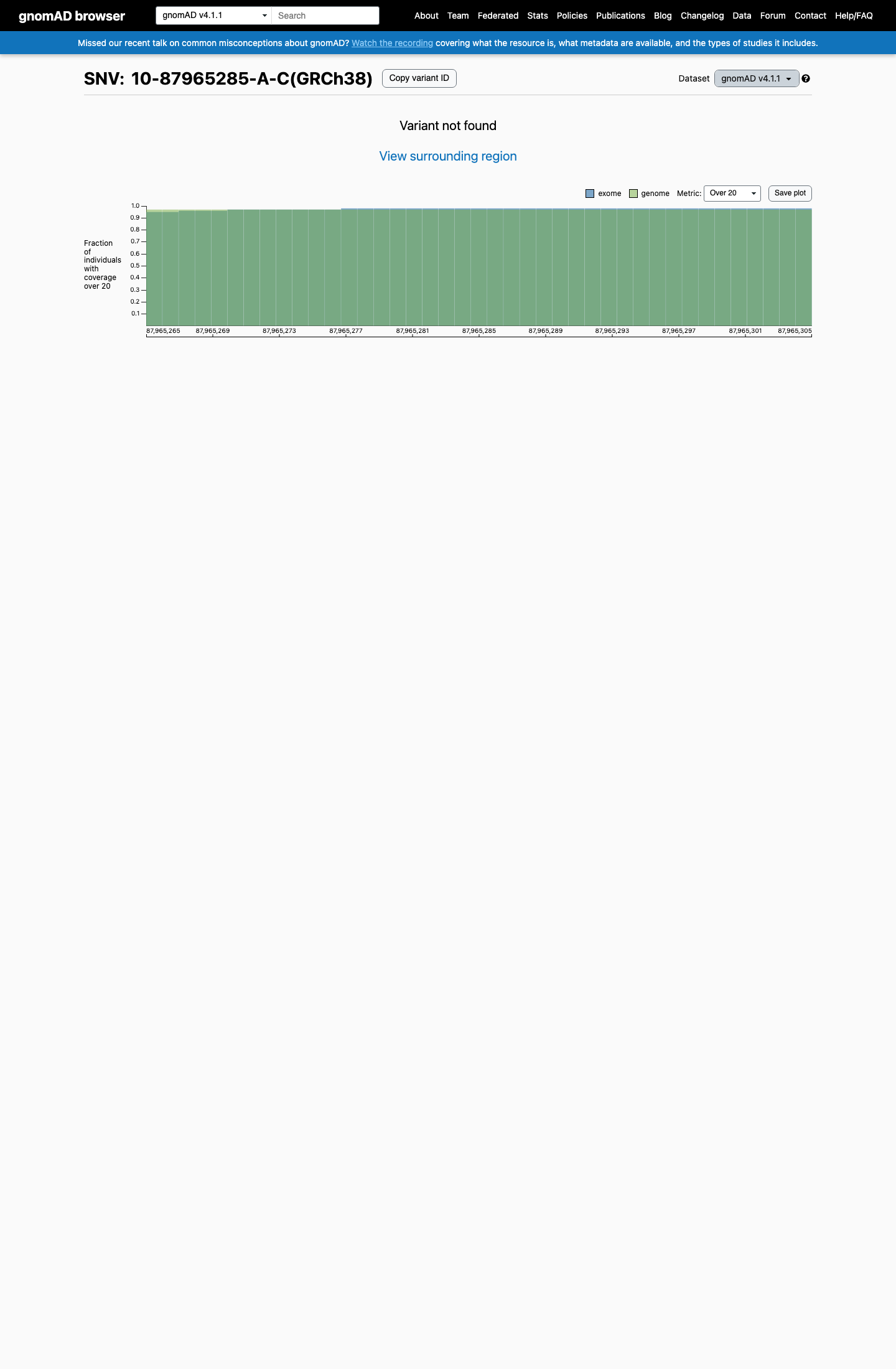
gnomAD v4.1
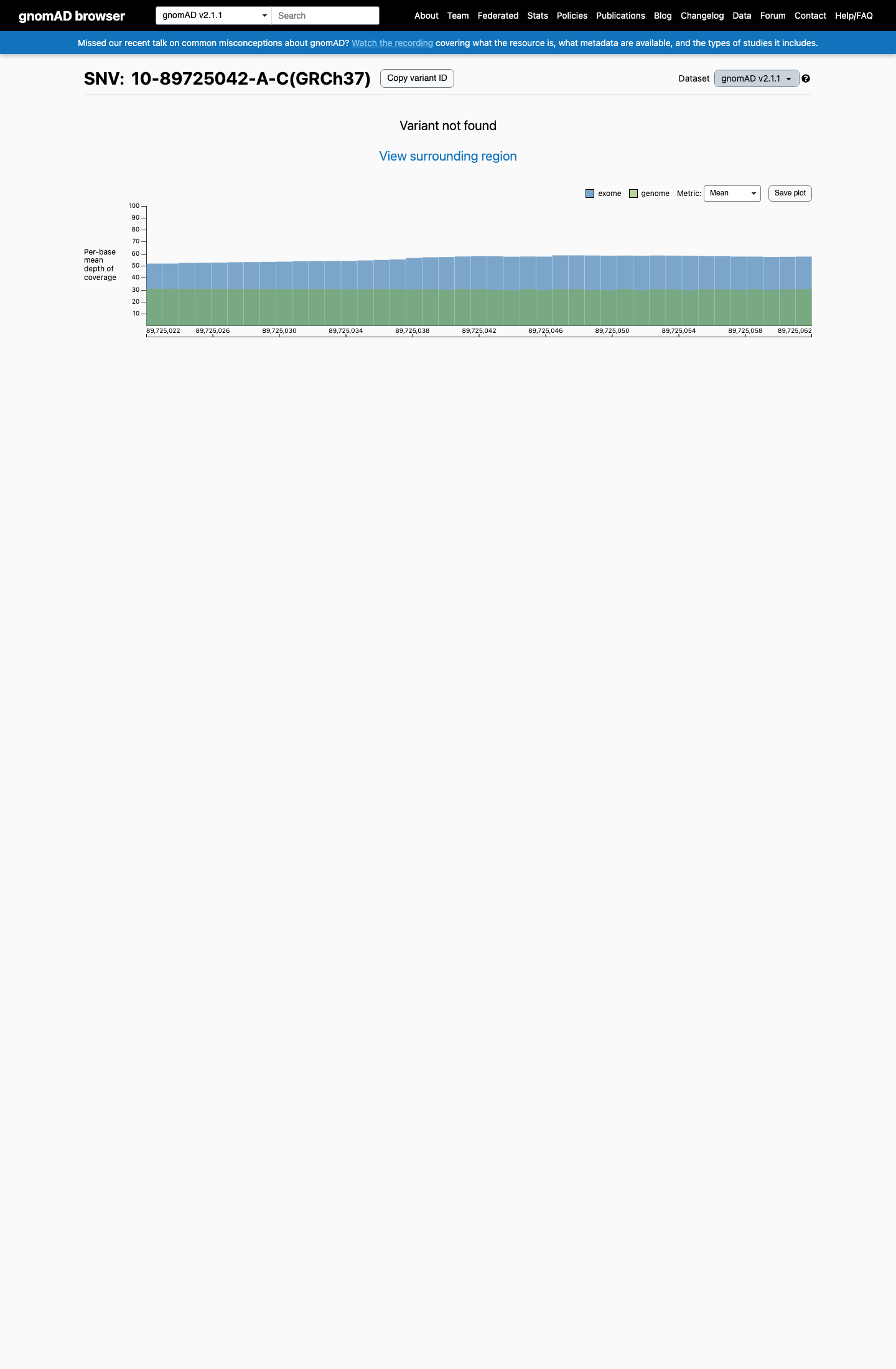
gnomAD v2.1
v4.1
Absent from gnomAD v4.1.
v2.1
Absent from gnomAD v2.1.
🇨🇦 CA
Absent from gnomAD-Canada v1.0.
Allele frequency by ancestry
three datasets · side by side
gnomAD v4.1
Absent
· 0 / ?
0 hom
0 hom
Not observed in any ancestry group.
gnomAD v2.1
Absent
· 0 / ?
0 hom
0 hom
Not observed in any ancestry group.
gnomAD Canada 🇨🇦
Absent
· 0 / ?
0 hom
0 hom
Not observed in any ancestry group.
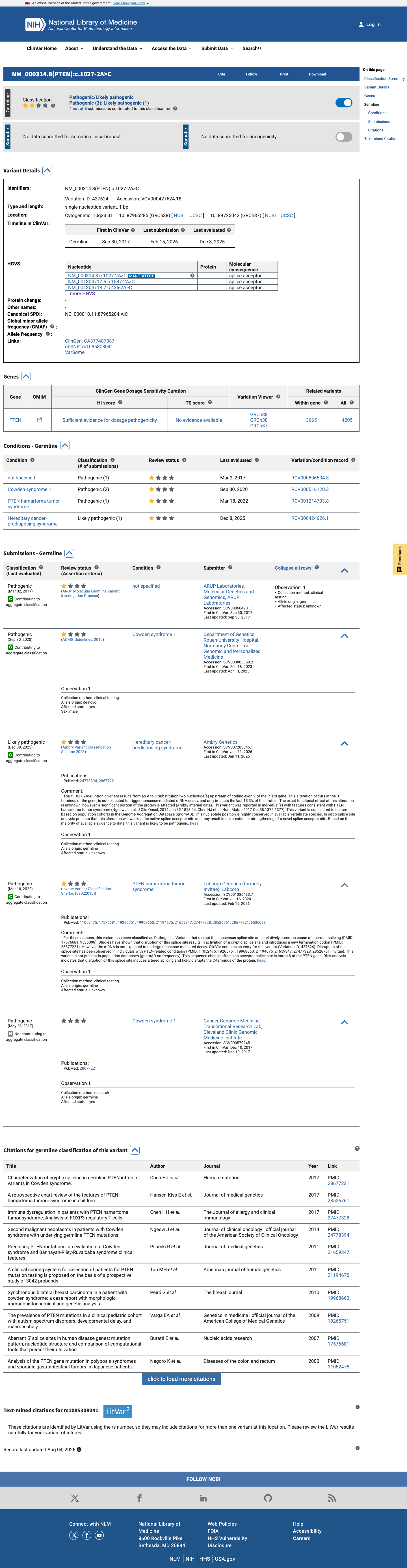
ClinVar
This variant has been reported in ClinVar as Pathogenic (3 clinical laboratories) and as Likely pathogenic (1 clinical laboratory). (ClinVarID = 427624)
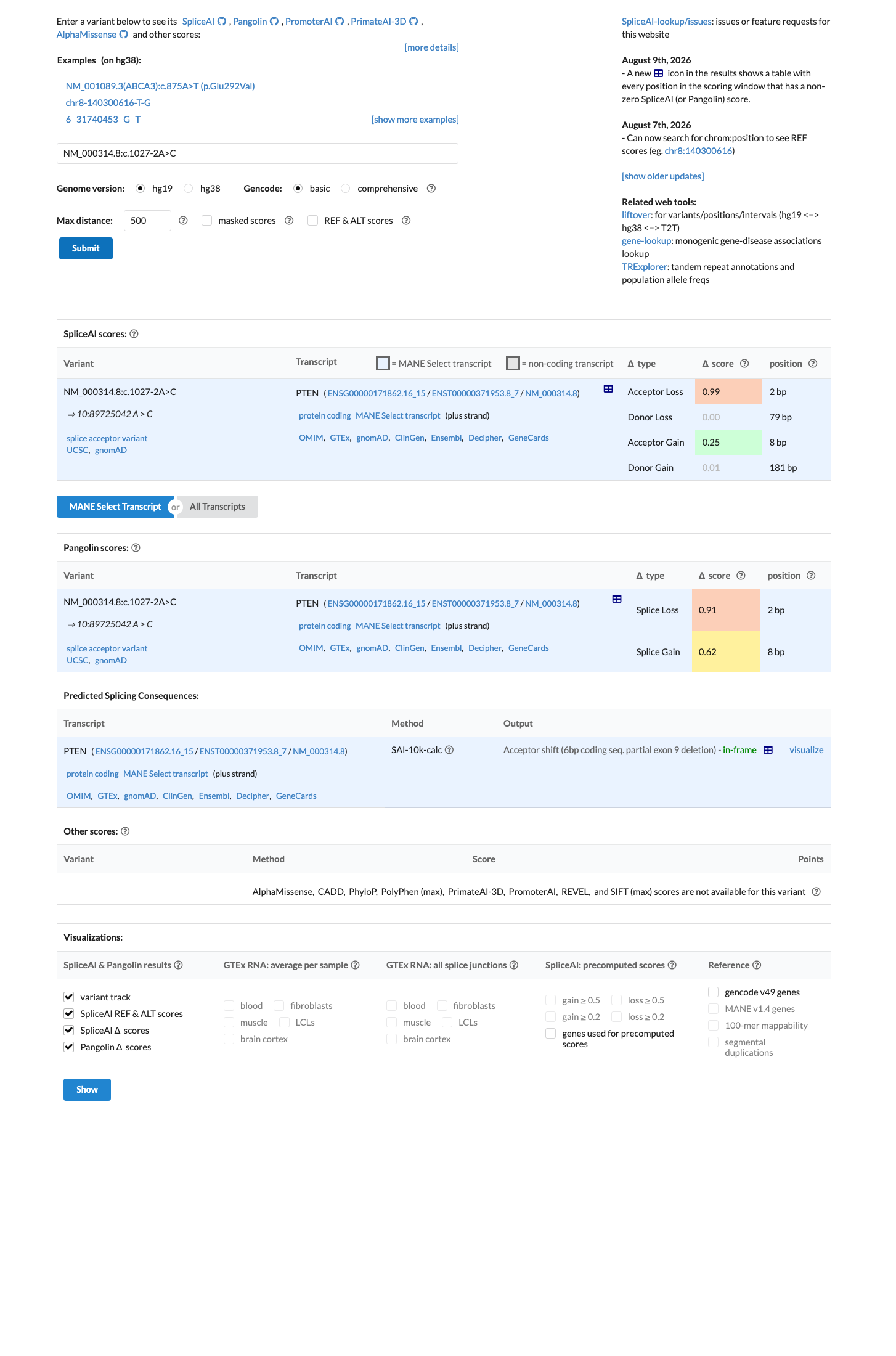
In silico
SpliceAI predicts possible splice impact for this variant (max delta score = 0.99). BayesDel score = -0.00757039.
Functional
No data
No calibrated functional assay or RNA evidence was identified for this variant.
COSMIC
Somatic evidence
COSMIC
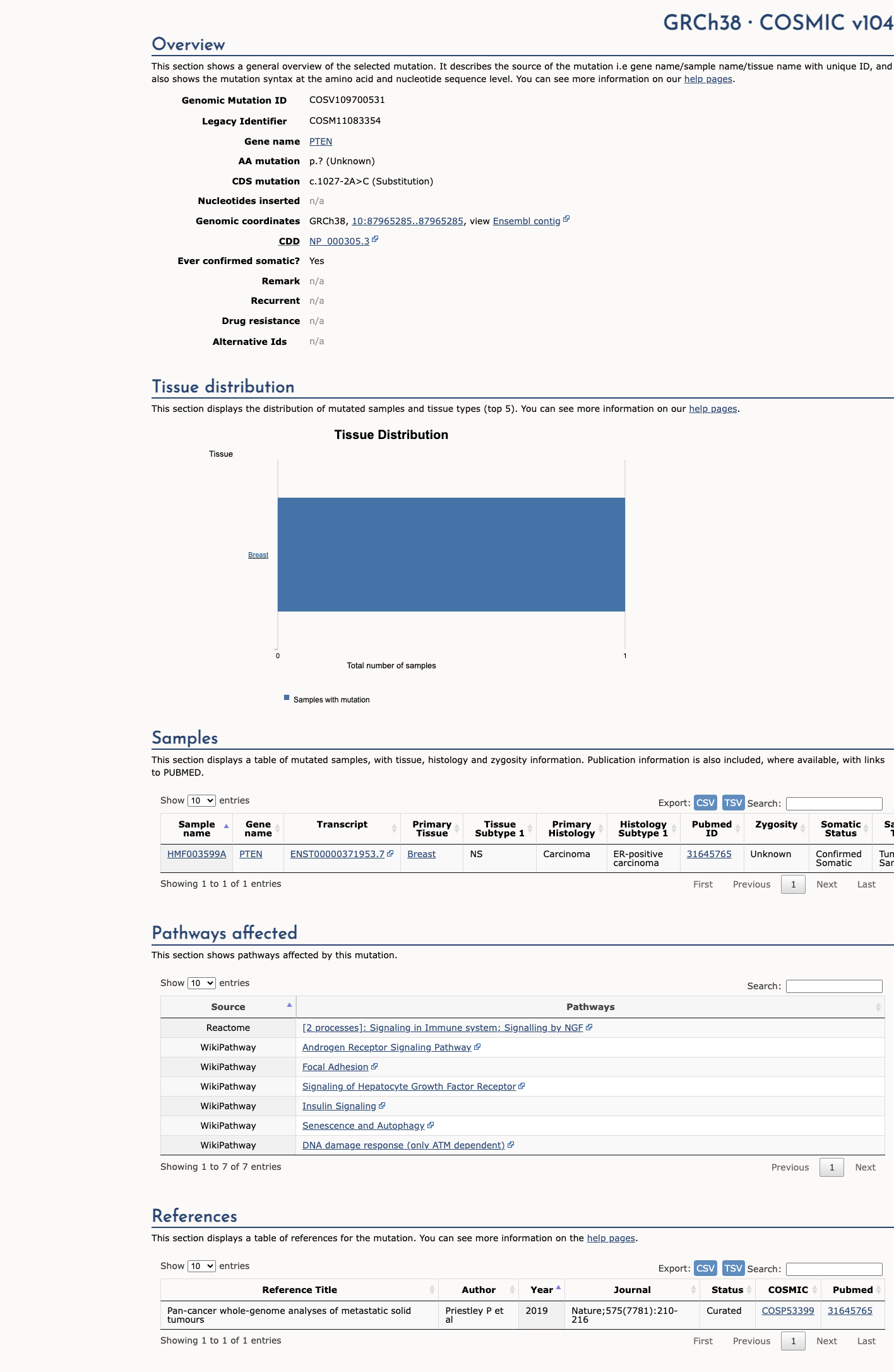
This variant has previously been reported in somatic cancers (COSMIC; COSV109700531, n = 1 times).
Hotspots
This variant does not lie in a statistically significant cancer hotspot.
Literature · how each cited paper was used
1papers cited
Each card is an audit: what was searched, what was found, whether it names the variant, which criteria it fed, and why. 8 further PMIDs triaged but not cited — see Sources & references.
Characterization of cryptic splicing in germline PTEN intronic variants in Cowden syndrome.
Searched
c.1027-2A>C1027intron 8
Found
Characterizes cryptic splicing of germline PTEN intronic variants in Cowden syndrome. NM_000314.8:c.1027-2A>C (intron 8 splice-acceptor) causes premature transcript termination within exon 8 at r.962 with polyadenylation, predicted to produce p.(Thr321_403del), an abnormal RNA processing outcome.
Variant
✓ Names this variant — characterised directly
Applied to
→PVS1
met
→PS3
met
Why
Variant-specific RNA functional data confirmed abnormal splicing; referenced in PS3 (strong) and supports PVS1.
The transcript of this intron 8 mutation was cleaved within exon 8 at r.962 and a poly(A) tail was added directly onto the termination site.
Location Table 1; Results (fourth type of splicing defect); Supp. Fig. S2 · Context Patient-derived lymphoblastoid cells; RT-PCR and 3'RACE RNA analysis · full text
Sources & reference links
Triaged references · 8 PMIDs not cited in assessment
11052475 ↗
Analysis of the PTEN gene mutation in polyposis syndromes and sporadic gastrointestinal tumors in Japanese patients.
CLINVAR
17576681 ↗
Aberrant 5' splice sites in human disease genes: mutation pattern, nucleotide structure and comparison of computational tools that predict their utilization.
CLINVAR
19968660 ↗
Synchronous bilateral breast carcinoma in a patient with cowden syndrome: a case report with morphologic, immunohistochemical and genetic analysis.
CLINVAR
25741868 ↗
Standards and guidelines for the interpretation of sequence variants: a joint consensus recommendation of the American College of Medical Genetics and Genomics and the Association for Molecular Pathology.
CLINVAR
27477328 ↗
Immune dysregulation in patients with PTEN hamartoma tumor syndrome: Analysis of FOXP3 regulatory T cells.
CLINVAR
15604628 ↗
Genetic cancer risk assessment and counseling: recommendations of the national society of genetic counselors.
CLINVAR
28492532 ↗
Sherloc: a comprehensive refinement of the ACMG-AMP variant classification criteria.
CLINVAR