Back
NM_000314.8:c.254-1G>A
p.? · PTEN
0%
complete
Final classification
VUS
PM2
PTEN
c.254-1G>A
p.?
canonical_splice · exon 4i

PTEN is a tumor suppressor gene that encodes a phosphatase converting the lipid messenger PIP3 back to PIP2 at the cell membrane, thereby restraining the AKT/mTOR signaling pathway that drives cell growth, proliferation, and survival. It is one of the most frequently mutated genes across many types of human cancer, and its loss promotes unchecked cell growth, survival, and genomic instability, partly through impaired DNA repair. Germline loss-of-function variants in PTEN cause Cowden syndrome, an inherited cancer predisposition disorder associated with elevated risk of breast and thyroid cancer.

This variant

This variant lies in PTEN, a tumor-suppressor gene that restrains AKT/mTOR signaling, and germline PTEN loss-of-function variants cause Cowden syndrome and related cancer predisposition.

Transcript
NM_000314.8
HGVS · transcript:coding
NM_000314.8:c.254-1G>A
GRCh38
chr10:87933012 G>A
GRCh37
chr10:89692769 G>A
VUS: PM2 (supporting) is the only applied criterion, and no ClinGen PTEN VCEP combination rule is satisfied.
Classification rationale
PM2 VUS
PTEN c.254-1G>A canonical_splice · exon 4i

PM2 supporting: gnomAD v4.1 allele frequency is 6.22e-7, below the PTEN VCEP threshold of <0.00001.

PM2 → VUS
LYFE Sciences is an AI system, and it can make mistakes. Criteria may be applied incorrectly, sources may be misread, and a confident-looking classification can still be wrong. Double-check every criterion and its underlying evidence before relying on any call.
Gene diagram · NM_000314.8 · variants mapped to exon structure
PTEN NM_000314.8
Fetching transcript structure from UCSC…
Applied criteria · 1 applied · 16 assessed
MetEvidence satisfies this criterion.
Not metEvaluated against available evidence; threshold not reached.
Not assessedApplies in principle, but no evidence was found to evaluate it.
N/ADoesn't apply to this variant type.
Applied · 1
Strength Supporting Moderate Strong Very strong
PM2 supporting Pathogenic
Met at supporting: gnomAD v4.1 total allele frequency is 6.22e-7, below the PTEN VCEP PM2 threshold of <0.00001.
ClinGen PTEN VCEP specification v3.2, PM2 supporting rule: Databases present at <0.00001 (0.001%) allele frequency in gnomAD or another large sequenced population. If multiple alleles are present within any subpopulation, allele frequency in that subpopulation must be <0.00002 (0.002%).gnomAD v4.1 all-comers: total AC=1, AN=1,607,542, AF=6.220677282459805e-07, homozygotes=0; highest observed subpopulation was European (non-Finnish), AC=1, AN=1,174,220, AF=8.516291665956976e-07, homozygotes=0.gnomAD v2.1: absent. gnomAD v2.1 non-cancer: absent. gnomAD v3.1 non-cancer: absent.
Assessed · not applied · 2 not met · 14 not assessed
Pathogenic
PVS1 Not assessed: canonical splice disruption has SpliceAI DS_AL 0.993, but the required NMD outcome and resulting reading-frame consequence are not established.
PS1 Not assessed: the canonical splice variant lacks a documented same-position pathogenic comparator and the required comparative in-silico evidence.
PS2 Not assessed: no documented proband-level de novo observation with both maternity and paternity confirmed and no family history.
PS3 Not assessed: no RNA, mini-gene, or other splicing assay result is available for canonical splice-site variant c.254-1G>A.
PS4 Not assessed: no variant-specific case-control statistics or PTEN phenotype-specificity scores are available to compare with the VCEP PS4 thresholds.
PM6 Not assessed: no documented assumed or presumed de novo observation in a patient with disease and no family history.
PP1 Not assessed: no affected relatives carrying the variant or informative meiosis count is documented.
PP3 Not assessed: SpliceAI max delta 0.993 meets the VCEP pathogenic range, but the required concordant VarSeak result is unavailable.
Benign
BA1 Not met: gnomAD v4.1 total allele frequency is 6.22e-7, far below the PTEN VCEP BA1 threshold of >0.00056.
BS1 Not met: gnomAD v4.1 total allele frequency is 6.22e-7, below the PTEN VCEP BS1 supporting lower boundary of 0.0000043.
BS2 Not assessed: gnomAD reports zero homozygotes, with no qualifying healthy or PHTS-unaffected homozygous observation available for the PTEN VCEP rule.
BS3 Not assessed: no RNA, mini-gene, or other assay demonstrates no splicing impact for canonical splice-site variant c.254-1G>A.
BS4 Not assessed: no affected relatives lacking the variant are documented in one or more families.
BP2 Not assessed: no co-occurring pathogenic or likely pathogenic PTEN variant with documented trans, cis, or unknown phase is available.
BP4 Not assessed: SpliceAI max delta 0.993 is outside the VCEP benign range, and the required VarSeak result is unavailable for concordance.
BP5 Not assessed: no two cases with a highly penetrant alternate diagnosis and demonstrably non-overlapping PTEN history are documented.
N/A · 11 PM1 · PM3 · PM4 · PM5 · PP2 · PP4 · PP5 · BP1 · BP3 · BP6 · BP7
Research & evidence
Population frequency
gnomAD v4.1 screenshot
gnomAD v4.1
gnomAD v2.1 screenshot
gnomAD v2.1
v4.1
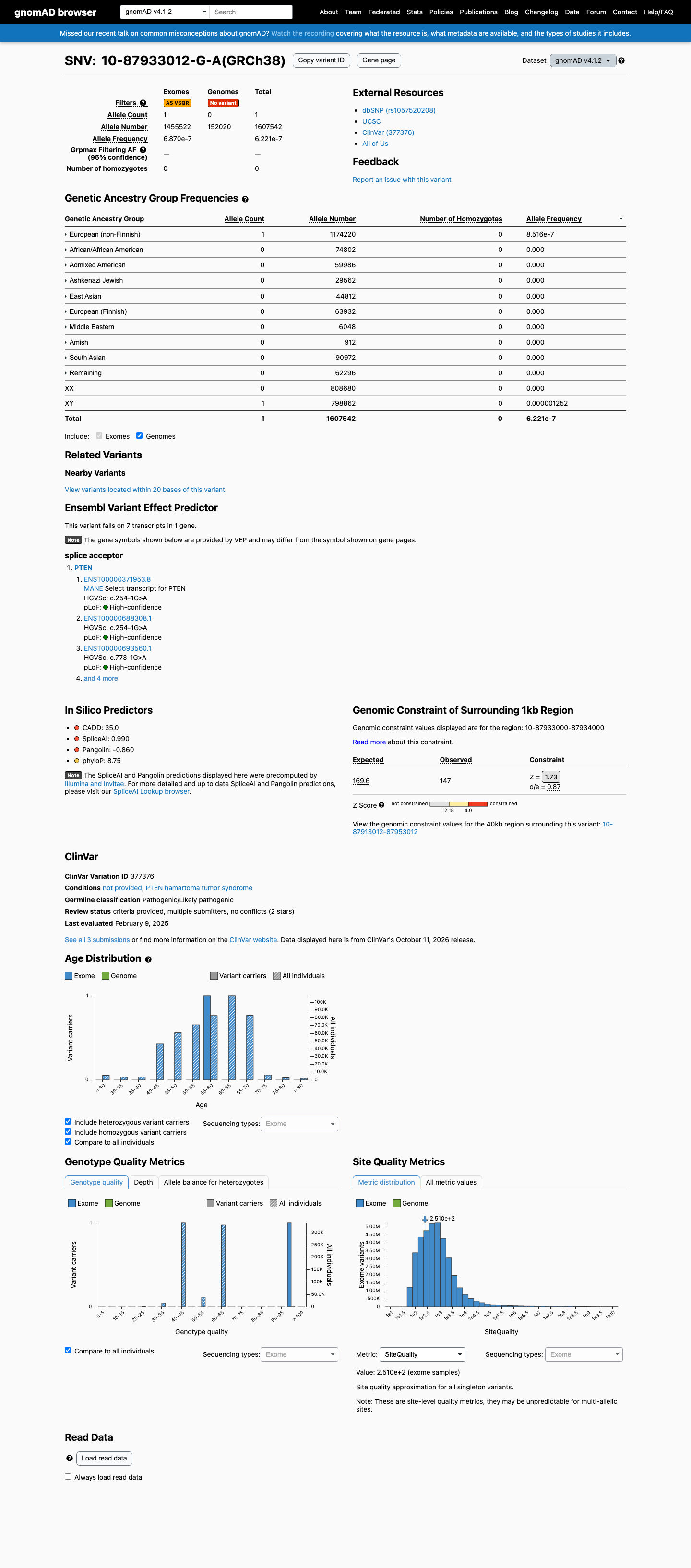
This variant is present in gnomAD v4.1 (AF= 6.22068e-07; MAF= 0.00006%, 1/1607542 alleles, homozygotes = 0) and has highest observed frequency in the European (non-Finnish) population (AF= 8.51629e-07; MAF= 0.00009%, 1/1174220 alleles, homozygotes = 0).
v2.1
Absent from gnomAD v2.1.
🇨🇦 CA
Absent from gnomAD-Canada v1.0.
Allele frequency by ancestry
three datasets · side by side
gnomAD v4.1
6.2e-05% · 1 / 1,607,542
0 hom
European (non-Finnish)
1 / 1,174,220
8.5e-05%
+ 9 not observed (Remaining individuals, Admixed American, European (Finnish), Amish, East Asian, Middle Eastern, South Asian, Ashkenazi Jewish, African/African American)
gnomAD v2.1
Absent · 0 / ?
0 hom
Not observed in any ancestry group.
gnomAD Canada 🇨🇦
Absent · 0 / ?
0 hom
Not observed in any ancestry group.
ClinVar screenshot
ClinVar
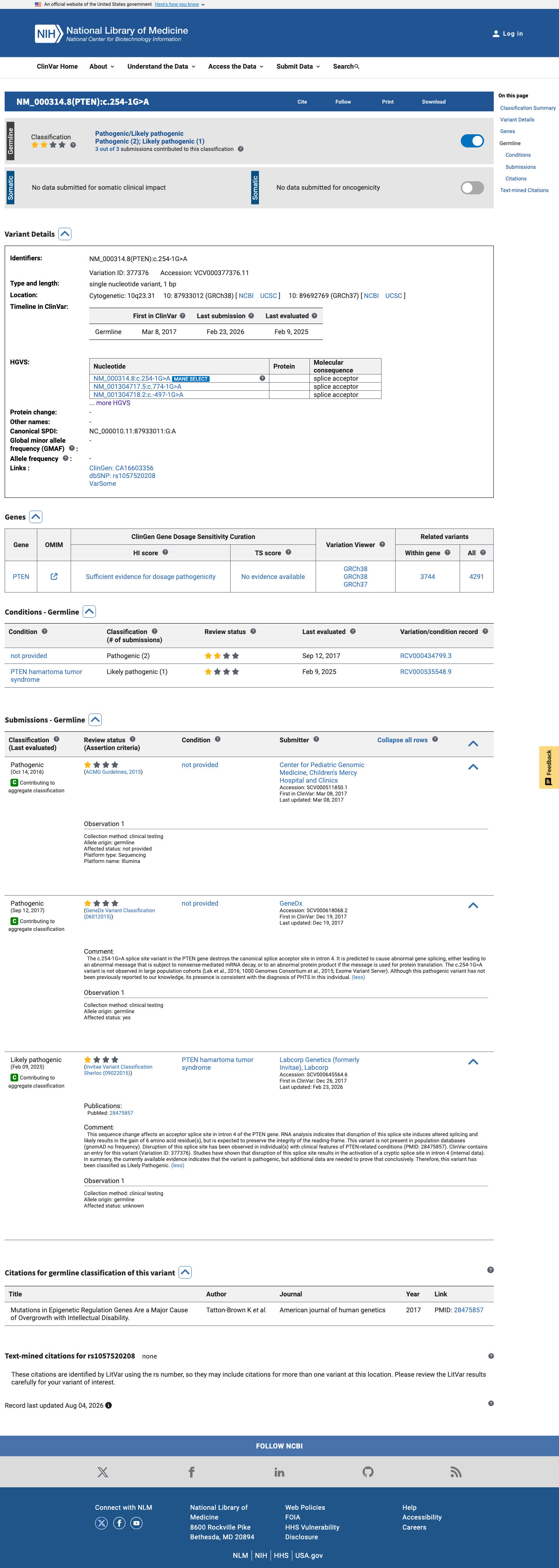
This variant has been reported in ClinVar as Pathogenic (2 clinical laboratories) and as Likely pathogenic (1 clinical laboratory). (ClinVarID = 377376)
SpliceAI screenshot
In silico
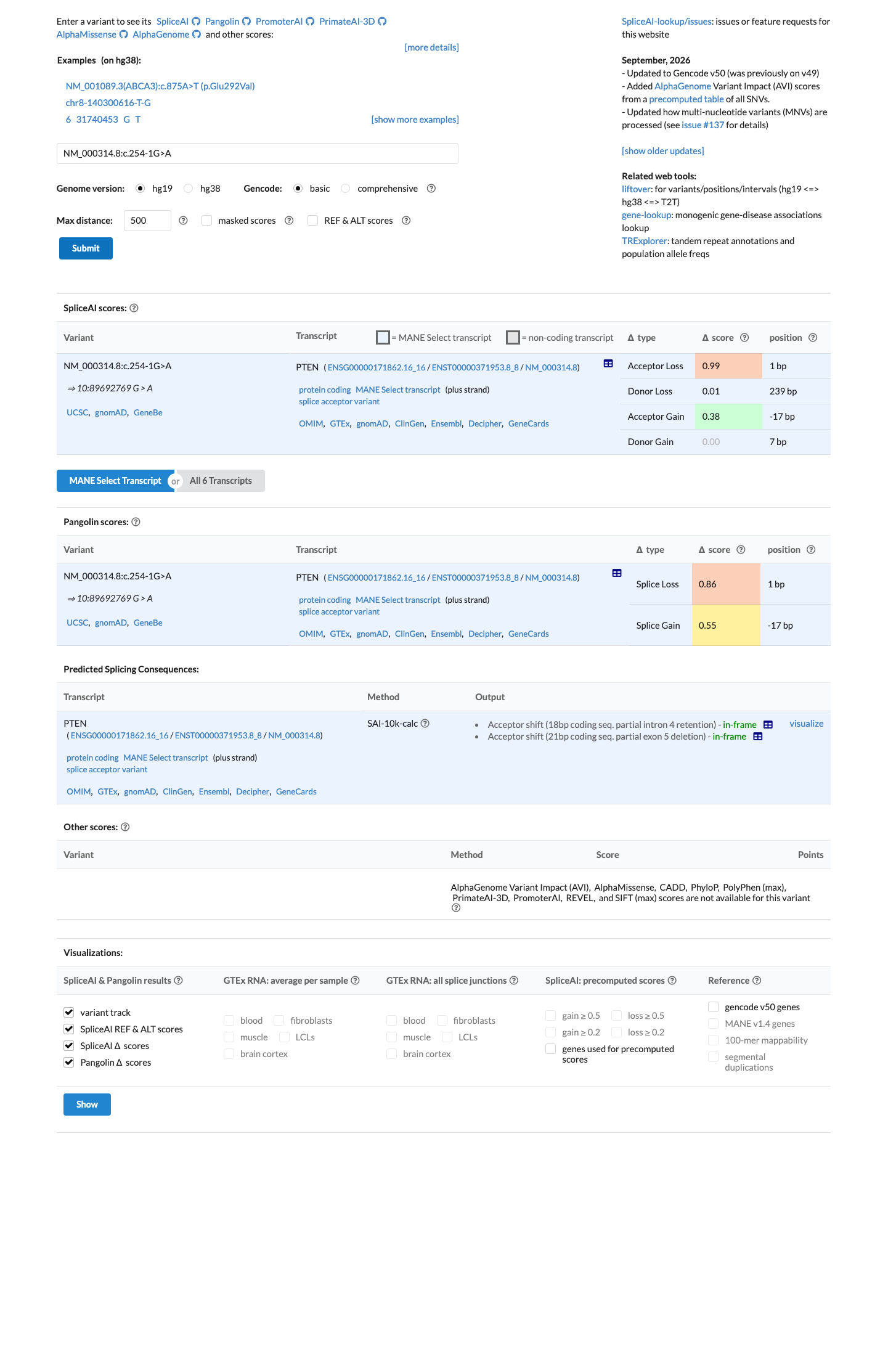
SpliceAI predicts possible splice impact for this variant (max delta score = 0.99). BayesDel score = 0.31948.
Functional No data
No calibrated functional assay or RNA evidence was identified for this variant.
OncoKB ↗
COSMIC screenshot
COSMIC
Somatic evidence
COSMIC
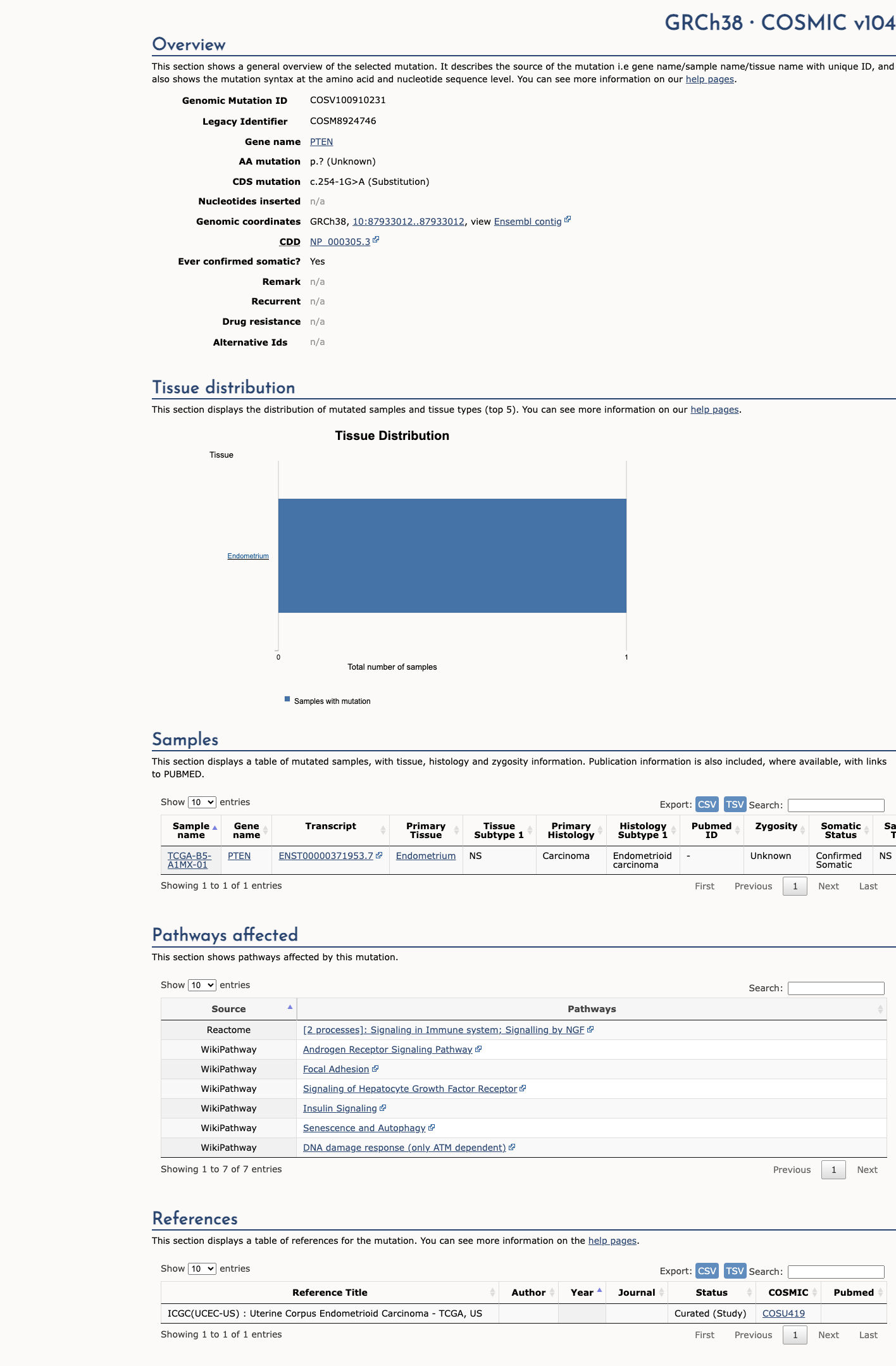
This variant has previously been reported in somatic cancers (COSMIC; COSV100910231, n = 1 times).
Hotspots
This variant does not lie in a statistically significant cancer hotspot.
COSMIC ↗
Sources & reference links
8Sources
CSpec VCEP
ClinVar
gnomAD v2.1
gnomAD v4.1
gnomAD-Canada
SpliceAI
OncoKB
COSMIC
Triaged references · 7 PMIDs not cited in assessment
25741868 ↗ Standards and guidelines for the interpretation of sequence variants: a joint consensus recommendation of the American College of Medical Genetics and Genomics and the Association for Molecular Pathology. CLINVAR
28475857 ↗ Mutations in Epigenetic Regulation Genes Are a Major Cause of Overgrowth with Intellectual Disability. CLINVAR
20301661 ↗ PTEN Hamartoma Tumor Syndrome. CLINVAR
23519317 ↗ Clinical genetics evaluation in identifying the etiology of autism spectrum disorders: 2013 guideline revisions. CLINVAR
23788249 ↗ ACMG recommendations for reporting of incidental findings in clinical exome and genome sequencing. CLINVAR
25190698 ↗ Genetic/familial high-risk assessment: breast and ovarian, version 1.2014. CLINVAR
27854360 ↗ Recommendations for reporting of secondary findings in clinical exome and genome sequencing, 2016 update (ACMG SF v2.0): a policy statement of the American College of Medical Genetics and Genomics. CLINVAR