Back
NM_000314.8:c.46T>G
p.Tyr16Asp · PTEN
0%
complete
Final classification
VUS
PS3PM2PP2PP3
PTEN
c.46T>G
p.Tyr16Asp
missense

PTEN is a tumor suppressor gene that encodes a phosphatase converting the lipid messenger PIP3 back to PIP2 at the cell membrane, thereby restraining the AKT/mTOR signaling pathway that drives cell growth, proliferation, and survival. It is one of the most frequently mutated genes across many types of human cancer, and its loss promotes unchecked cell growth, survival, and genomic instability, partly through impaired DNA repair. Germline loss-of-function variants in PTEN cause Cowden syndrome, an inherited cancer predisposition disorder associated with elevated risk of breast and thyroid cancer.

This variant

PTEN restrains the AKT/mTOR growth pathway and is among the most frequently mutated genes in cancer; germline loss-of-function variants cause Cowden syndrome with elevated breast and thyroid cancer risk. Although this variant severely impairs PTEN phosphatase function in a direct functional assay, the evidence does not reach the strength required for a pathogenic classification, so it is reported as a variant of uncertain significance.

Transcript
NM_000314.8
HGVS · transcript:coding
NM_000314.8:c.46T>G
GRCh38
chr10:87864515 T>G
GRCh37
chr10:89624272 T>G
VUS: PS3 moderate (fitness score -2.205 vs -1.11), PM2, PP2, PP3 supporting — matching no combination rule for pathogenic or benign in the PTEN framework.
Classification rationale
PS3PM2PP2PP3 VUS
PTEN c.46T>G missense

PS3 (Moderate): direct saturation-mutagenesis assay (Mighell 2018) shows severely impaired lipid phosphatase function (fitness score -2.205, below the -1.11 threshold). PM2 (Supporting): absent from gnomAD v2.1, v4.1, and gnomAD-Canada (allele frequency 0, below 0.001%). PP2 (Supporting): PTEN has a low rate of benign missense variation, and missense variants are a common disease mechanism. PP3 (Supporting): REVEL score 0.844 exceeds the 0.7 threshold. Overall classification: VUS — one moderate plus three supporting pathogenic criteria match no combination rule in the PTEN expert panel framework, with no strong/very-strong or benign criterion met.

PS3 + PM2 + PP2 + PP3 VUS
LYFE Sciences is an AI system, and it can make mistakes. Criteria may be applied incorrectly, sources may be misread, and a confident-looking classification can still be wrong. Double-check every criterion and its underlying evidence before relying on any call.
Gene diagram · NM_000314.8 · variants mapped to exon structure
PTEN NM_000314.8
Fetching transcript structure from UCSC…
Applied criteria · 4 applied · 15 assessed
MetEvidence satisfies this criterion.
Not metEvaluated against available evidence; threshold not reached.
Not assessedApplies in principle, but no evidence was found to evaluate it.
N/ADoesn't apply to this variant type.
Applied · 4
Strength Supporting Moderate Strong Very strong
PS3 moderate Pathogenic
Met (Moderate): the Mighell 2018 saturation-mutagenesis assay directly measured this variant at fitness score -2.205, below the -1.11 threshold.
ClinGen PTEN EP Specification v3.2 (cspec doc 135637575), PS3_moderate rule: 'Phosphatase activity <= -1.11 per Mighell et al. 2018, PMID: 29706350.' Instructions require the variant to be listed TRUE under Table S2 column I (high confidence) and state 'Apply PS3_moderate for all variants with scores <= -1.11.'Mighell et al. 2018, Am J Hum Genet 102:943-955, PMID 29706350, Table 1 footnote c: 'variants with scores less than or equal to -1.11, the lower 95th percentile (two-tailed) for synonymous variants' - published calibration of the less-than-wild-type (likely damaging) threshold used by the VCEP.Mighell et al. 2018 Table S2 (source_registry key vcep_mmc2, mmc2.xlsx), row Y16D: Cum_score = -2.205 (Cum_SE 0.373), High_conf = TRUE ('Pass SE Filter'), Imputed_Score = NA (directly measured); biological replicates A1 -3.26, B1 -2.02, A2 -3.39, B2 -2.30, A3 -2.73, B3 -1.88 (all <= -1.88).
PM2 supporting Pathogenic
Met (Supporting): absent from gnomAD v2.1, v4.1, and gnomAD-Canada (allele frequency 0), below the 0.001% threshold.
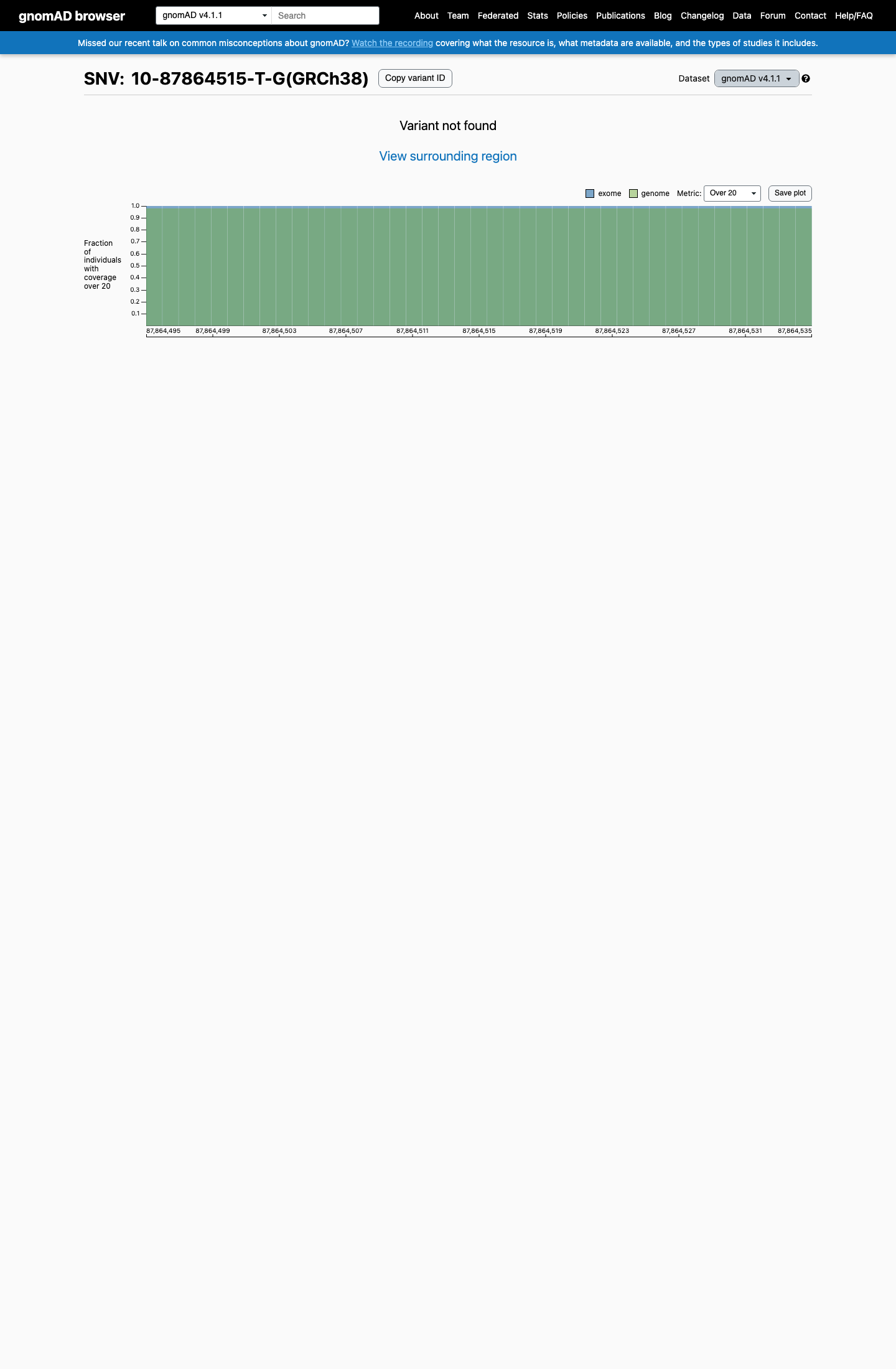
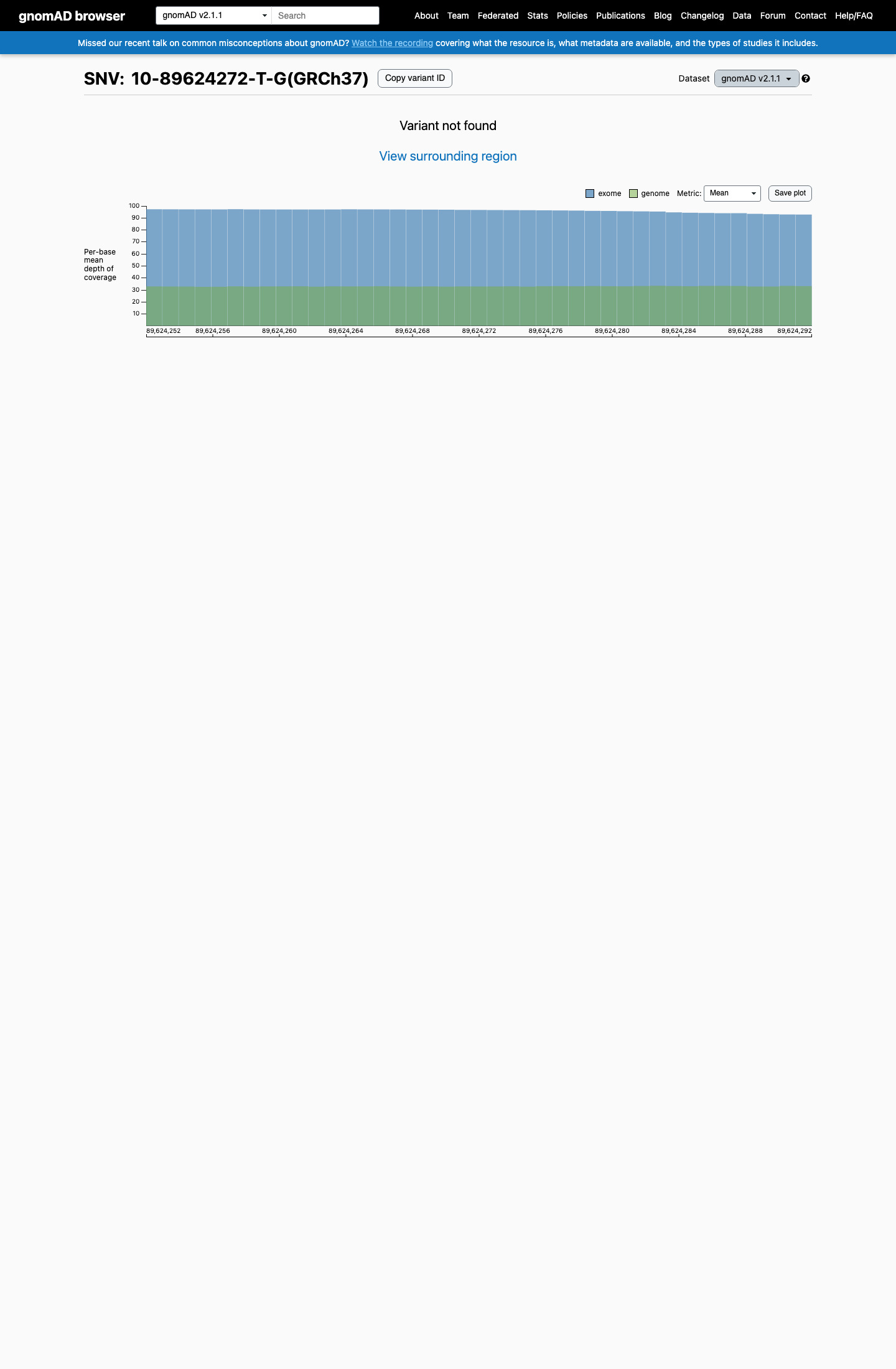
gnomAD v2.1 (exome) variant lookup 10-89624272-T-G: variant absent; AF=0 < 0.001%gnomAD v4.1 (exome) variant lookup chr10-87864515-T-G: variant absent; AF=0 < 0.001%gnomAD-Canada v1.0 (HostSeq genomes) variant lookup 10-87864515-T-G: variant absent; AF=0 < 0.001%
PP2 supporting Pathogenic
Met (Supporting): PTEN has a low rate of benign missense variation, and missense variants are a common disease mechanism.
PTEN VCEP v3.2 (cspec doc 135637575) PP2 rule: 'Missense variant in a gene that has a low rate of benign missense variation and where missense variants are a common mechanism of disease' - Applicable, default strength SupportingMighell et al. 2018 (PMID:29706350): 'We identified 2,273 mutations with reduced cellular lipid phosphatase activity, which includes 1,789 missense mutations' - gene-level evidence of low PTEN missense tolerance (humanized yeast saturation assay)
PP3 supporting Pathogenic
Met (Supporting): REVEL score 0.844 exceeds the 0.7 missense threshold.
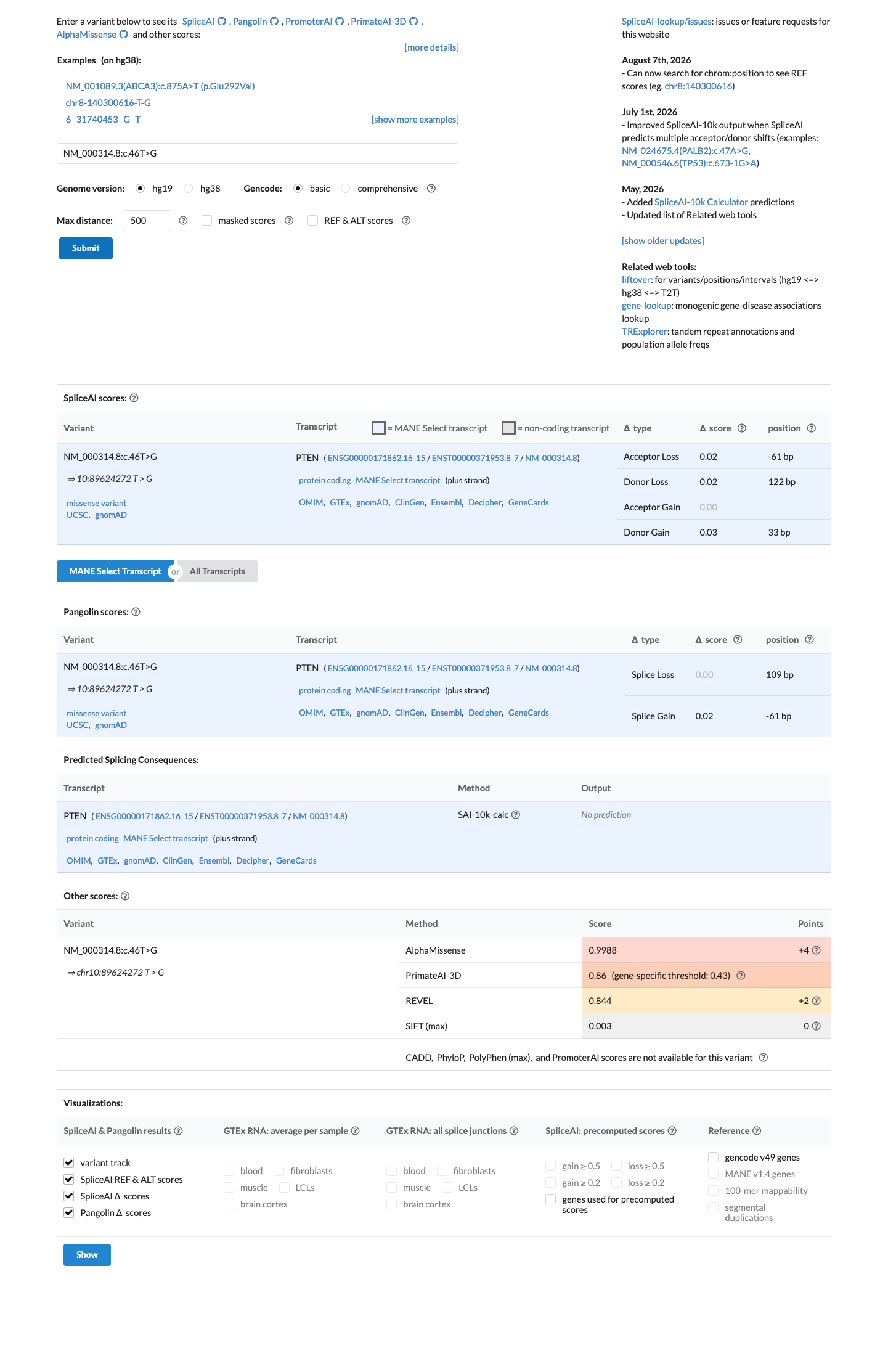
REVEL score 0.844 (source_registry key 'revel'; local REVEL v1.3 lookup, GRCh38 chr10:87864515 T>G) exceeds the ClinGen PTEN Expert Panel Specifications v3.2 (cspec doc 135637575) missense PP3 threshold of > 0.7 -> PP3 SupportingSpliceAI max delta score 0.03 (DS_AG 0.00, DS_AL 0.02, DS_DG 0.03, DS_DL 0.02; source_registry key 'spliceai', SpliceAI Lookup for NM_000314.8:c.46T>G) is well below the VCEP PP3 splice threshold of 0.5; no splice-impact evidence for PP3ClinGen PTEN Expert Panel Specifications v3.2 (source_registry key 'cspec', doc 135637575): PP3 Supporting rule 'Missense variants: REVEL score > 0.7'; VCEP commentary cites Bayesian adaptation of the ACMG/AMP framework (Tavtigian et al., 2018, PMID 29300386, referenced within the cspec document) as the calibration basis
Assessed · not applied · 8 not met · 7 not assessed
Pathogenic
PS1 Not met: no alternate single-nucleotide change at codon 16 (TAT) can produce p.Tyr16Asp, so the same-amino-acid condition cannot be satisfied.
PS2 Insufficient evidence: no documented de novo occurrence or parental-testing data was available.
PS4 Insufficient evidence: no case-control study or phenotype-specificity scores for this variant were available.
PM1 Not met: residue 16 lies outside the PTEN catalytic motifs (WPD loop, P-loop, TI-loop) that define PM1.
PM5 Insufficient evidence: no pathogenic same-residue comparator at Tyr16 could be confirmed.
PM6 Insufficient evidence: no proband with a presumed de novo occurrence was available.
PP1 Insufficient evidence: no family segregation data was available, so co-segregation could not be evaluated.
Benign
BA1 Not met: absent from gnomAD (allele frequency 0), far below the 0.056% stand-alone threshold.
BS1 Not met: absent from gnomAD (allele frequency 0), below even the lowest supporting-strength frequency band.
BS2 Not met: no homozygous observations in unaffected individuals exist; the variant is absent from population databases.
BS3 Not met: the same validated assay shows severely reduced phosphatase activity (fitness score -2.205), not the >0 score BS3 requires.
BS4 Insufficient evidence: no documented lack of segregation in affected family members was available.
BP2 Not met: no trans or cis observations alongside a pathogenic PTEN variant were found.
BP4 Not met: REVEL score 0.844 is above the 0.5 threshold BP4 requires for missense variants.
BP5 Insufficient evidence: no case with an alternate molecular basis for disease was reported.
N/A · 9 PVS1 · PM3 · PM4 · PP4 · PP5 · BP1 · BP3 · BP6 · BP7
Research & evidence
Population frequency
gnomAD v4.1 screenshot
gnomAD v4.1
gnomAD v2.1 screenshot
gnomAD v2.1
v4.1
Absent from gnomAD v4.1.
v2.1
Absent from gnomAD v2.1.
🇨🇦 CA
Absent from gnomAD-Canada v1.0.
Allele frequency by ancestry
three datasets · side by side
gnomAD v4.1
Absent · 0 / ?
0 hom
Not observed in any ancestry group.
gnomAD v2.1
Absent · 0 / ?
0 hom
Not observed in any ancestry group.
gnomAD Canada 🇨🇦
Absent · 0 / ?
0 hom
Not observed in any ancestry group.
ClinVar screenshot
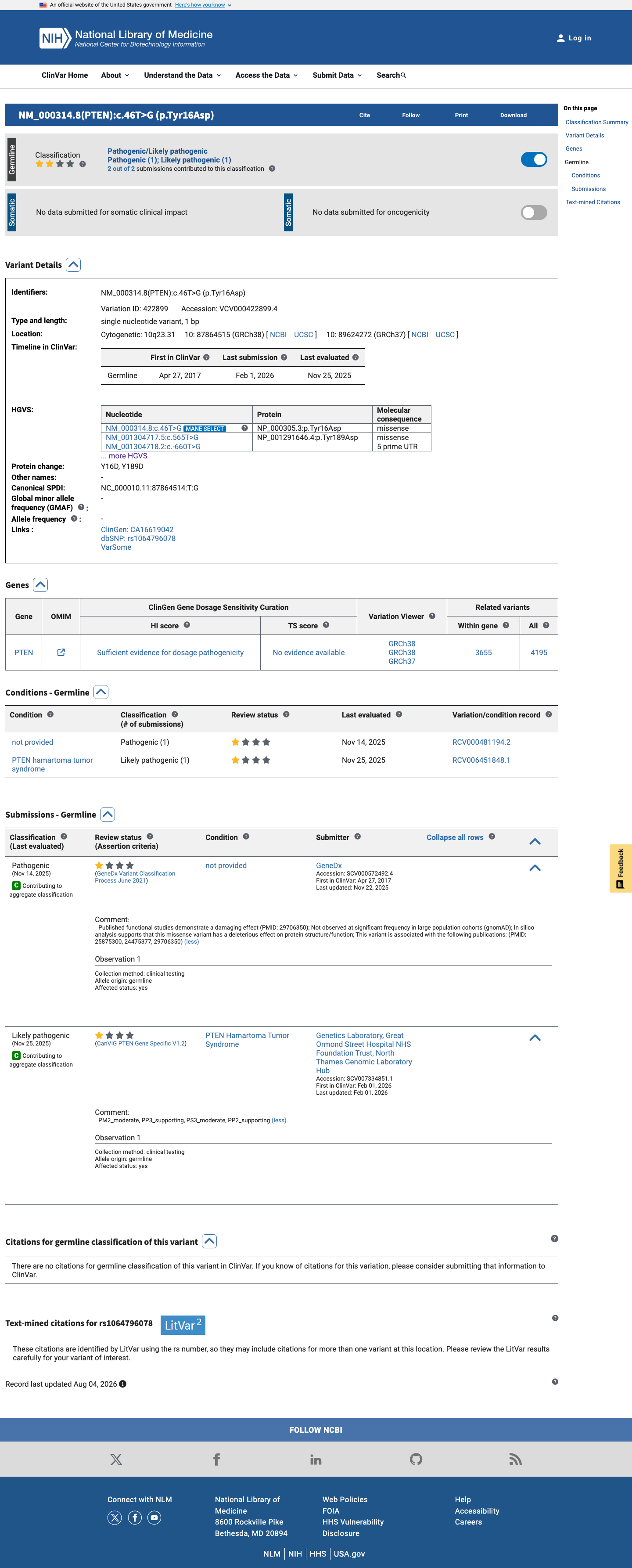
ClinVar
This variant has been reported in ClinVar as Pathogenic (1 clinical laboratory) and as Likely pathogenic (1 clinical laboratory). (ClinVarID = 422899)
SpliceAI screenshot
In silico
SpliceAI predicts no significant splice impact for this variant (max delta score = 0.03). REVEL score = 0.844. BayesDel score = 0.518836.
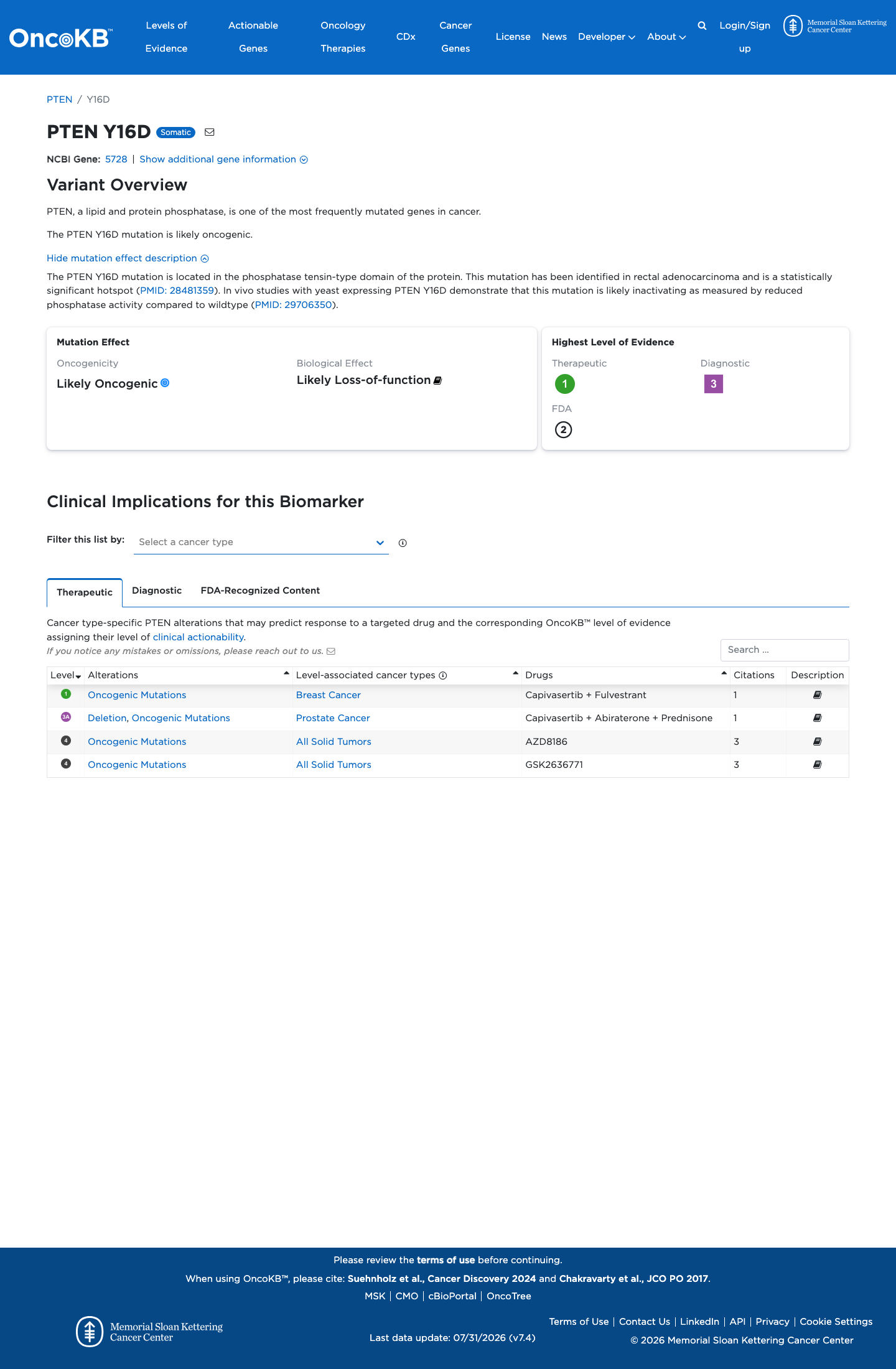
Functional / OncoKB screenshot
Functional Likely Oncogenic
OncoKB identified variant-specific curated literature and context relevant to functional review; biological-effect context: Likely Loss-of-function; curated oncogenicity label: Likely Oncogenic.
OncoKB ↗
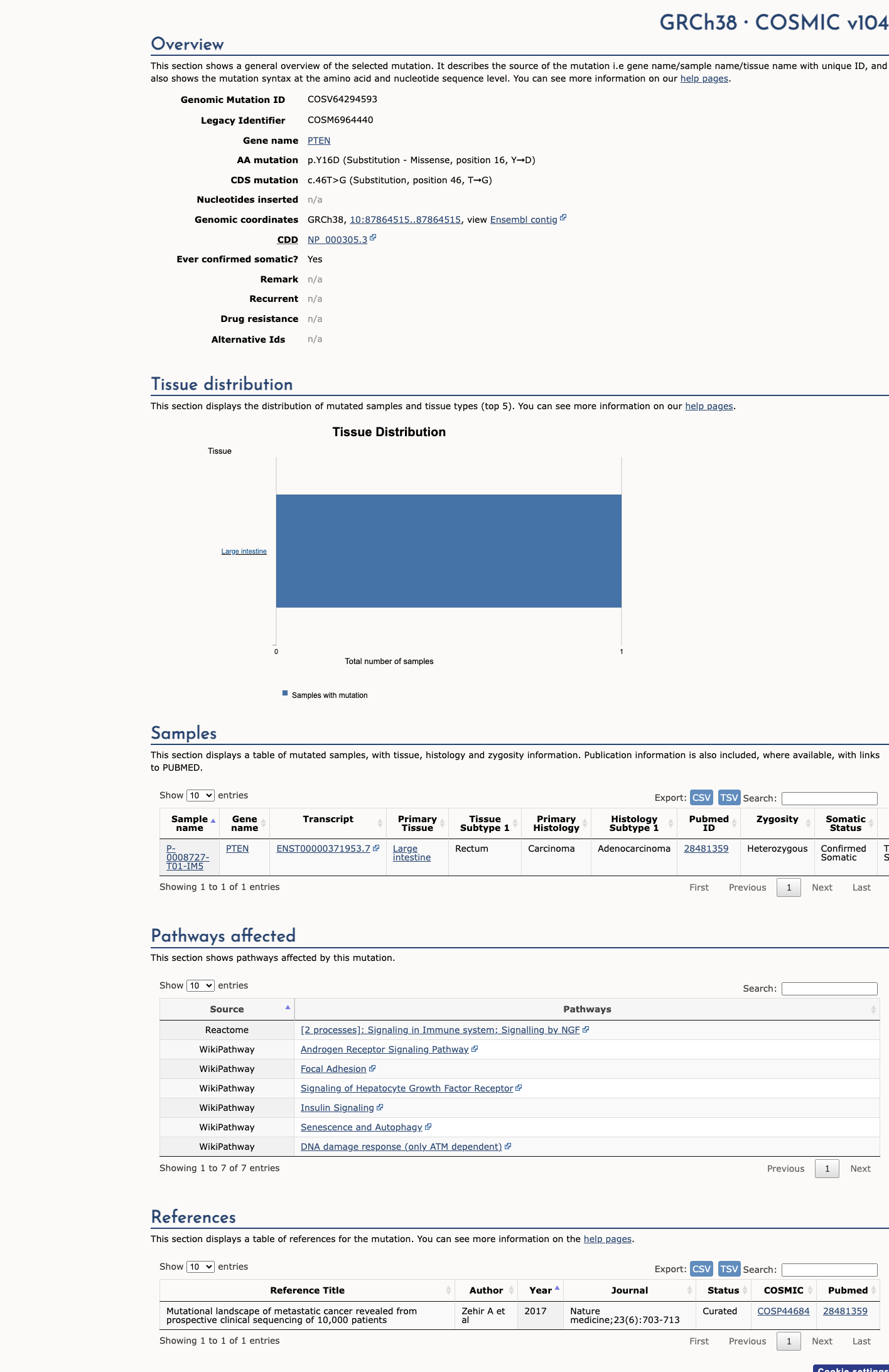
COSMIC screenshot
COSMIC
Cancer hotspots screenshot
Cancer hotspots
Somatic evidence Hotspot
COSMIC
This variant lies in a statistically significant hotspot. This variant has previously been reported in somatic cancers (COSMIC; COSV64294593, n = 1 times).
Hotspots
This variant lies in a statistically significant hotspot.
Literature · how each cited paper was used
2papers cited
Each card is an audit: what was searched, what was found, whether it names the variant, which criteria it fed, and why. 5 further PMIDs triaged but not cited — see Sources & references.
A Saturation Mutagenesis Approach to Understanding PTEN Lipid Phosphatase Activi
Searched
c.46T>Gp.Tyr16AspY16DTyr16
Found
Saturation mutagenesis functional assay of PTEN lipid phosphatase activity (Mighell et al. 2018). Full text was searched for the variant identifiers and no occurrence of c.46T>G or p.Tyr16Asp was found, so this paper does not provide variant-specific evidence relevant to PVS1, PM4, or BP3 (protein consequence/length-change criteria). It is primarily relevant to functional criteria (PS3/BS3) evaluated by other groups.
Variant
✓ Names this variant — characterised directly
Applied to
PS3 moderate
Y16D directly assayed with Cum_score -2.205 <= -1.11 (published lower 95th percentile of synonymous variants, Table 1 footnote c) and High_conf TRUE; meets PTEN VCEP PS3_moderate.
PP2 supporting
Gene-level evidence that PTEN has a low rate of benign missense variation (majority of assayed missense variants impair lipid phosphatase activity), supporting PP2 for this PTEN missense variant
Using a massively parallel approach that leverages an artificial humanized yeast model, we derived high-confidence estimates of functional impact for 7,244 single amino acid PTEN variants (86% of possible). We identified 2,273 mutations with reduced cellular lipid phosphatase activity, which includes 1,789 missense mutations.
Location Full text publications/29706350.txt - searched; variant identifiers c.46T>G / p.Tyr16Asp / Y16D absent  ·  Context Massively parallel saturation mutagenesis (Mighell et al. 2018, Am J Hum Genet) measuring PTEN lipid phosphatase activity (Cum_score) for all possible PTEN missense variants; VCEP mmc2.xlsx uses Cum_score <= -1.11 for PS3_Moderate.  ·  full text
Rule & framework references · cited for criterion definitions, not variant evidence
28481359 ↗ Mutational landscape of metastatic cancer revealed from prospective clinical seq
Sources & reference links
9Sources
CSpec VCEP
ClinVar
gnomAD v2.1
gnomAD v4.1
gnomAD-Canada
SpliceAI
OncoKB
COSMIC
Cancer hotspots
Triaged references · 5 PMIDs not cited in assessment
17392385 ↗ American Cancer Society guidelines for breast screening with MRI as an adjunct to mammography. CLINVAR
20301661 ↗ PTEN Hamartoma Tumor Syndrome. CLINVAR
23788249 ↗ ACMG recommendations for reporting of incidental findings in clinical exome and genome sequencing. CLINVAR
25645574 ↗ ACG clinical guideline: Genetic testing and management of hereditary gastrointestinal cancer syndromes. CLINVAR
26389333 ↗ Genetics of Skin Cancer (PDQ®): Health Professional Version. CLINVAR