NM_000314.8:c.544T>G (p.Leu182Val) is a missense variant in exon 6 of PTEN. It is absent from gnomAD v2.1 and v4.1 (0/1,612,242 alleles), meeting PM2_Supporting per the PTEN VCEP threshold of <0.001%.1 In the Mighell et al. 2018 (PMID:29706350) saturation mutagenesis functional assay, L182V has a cumulative fitness score of -1.24 (High_conf=True), meeting the PTEN VCEP PS3_Moderate threshold of Cum_score <= -1.11, indicating a damaging effect on PTEN phosphatase activity.2 PTEN is a gene with a low rate of benign missense variation where missense variants are a common mechanism of disease (PHTS, autosomal dominant). PP2 is applied at Supporting level per the PTEN VCEP specification.3 L182V REVEL score is 0.682, below the PTEN VCEP PP3 threshold of >0.7, and above the BP4 missense threshold of <0.5. Computational evidence is indeterminate and does not contribute to either pathogenic or benign criteria.4 The variant lies outside PTEN catalytic motifs (WPD loop 90-94, P-loop 123-130, TI-loop 166-168). PM1 is not met.5 L182S (c.545T>C) is a pathogenic ClinVar missense at the same residue, but PM5 is not met because the BLOSUM62 score for Leu->Val (+1) is greater than Leu->Ser (-2), failing the VCEP BLOSUM62 requirement.6 No proband, segregation, de novo, or case-control data are available. PS2, PS4, PM6, PP1, BS4, BP2, and BP5 are not met. Criteria not applicable per the PTEN VCEP include PVS1 (missense, not null), PP4, PP5, BP1, BP6, and BP7.7 Overall, met criteria: PS3_Moderate (1 moderate), PM2_Supporting (1 supporting), PP2 (1 supporting). This yields 1 moderate + 2 supporting pathogenic criteria with no benign criteria. Under the PTEN VCEP/ACMG 2015 combination rules, Likely Pathogenic requires at least 3 moderate, or 2 moderate + >=2 supporting, or 1 strong + >=2 supporting, or 1 strong + 1 moderate. With only 1 moderate + 2 supporting, none of the Pathogenic or Likely Pathogenic rules are satisfied. The variant is classified as a Variant of Uncertain Significance (VUS).8
Final classification
VUS
PS3PM2PP2
PTEN
c.544T>G
p.Leu182Val
This variant
NM_000314.8:c.544T>G (p.Leu182Val) is a missense variant in exon 6 of PTEN. It is absent from gnomAD v2.1 and v4.1 (0/1,612,242 alleles), meeting PM2_Supporting per the PTEN VCEP threshold of <0.001%.
Richards et.al., 2015 - Combining rules v3.2.0 criteria-combination framework was evaluated deterministically with applied criteria: PS3 moderate, PM2 supporting, PP2 supporting; no rule matched the adjudicated criteria.
Classification rationale
PS3PM2PP2
VUS
PTEN c.544T>G
PS3 + PM2 + PP2
→
VUS
LYFE Sciences is an AI system, and it can make mistakes. Criteria
may be applied incorrectly, sources may be misread, and a confident-looking
classification can still be wrong. Double-check every criterion and
its underlying evidence before relying on any call.
Gene diagram
· NM_000314.8 · variants mapped to exon structure
PTEN
NM_000314.8
Fetching transcript structure from UCSC…
Applied criteria · 3 applied · 16 assessed
MetEvidence satisfies this criterion.
Not metEvaluated against available evidence; threshold not reached.
Not assessedApplies in principle, but no evidence was found to evaluate it.
N/ADoesn't apply to this variant type.
Applied · 3
Strength
Supporting
Moderate
Strong
Very strong
PS3
moderate
Pathogenic
L182V has a cumulative fitness score of -1.24 (Cum_SE=0.49, High_conf=True) in the Mighell et al. 2018 (PMID:29706350) massively parallel phosphatase activity saturation mutagenesis assay. This meets the PTEN VCEP PS3_Moderate threshold of Cum_score <= -1.11, indicating well-established in vitro functional evidence supportive of a damaging effect on protein function.
Mighell et al. 2018 Table S2: L182V Cum_score=-1.238High_conf=Truemeeting PS3_Moderate threshold (<= -1.11).
PM2
supporting
Pathogenic
NM_000314.8:c.544T>G is absent from gnomAD v2.1 and gnomAD v4.1 (0/1,612,242 alleles, AF=0.00000%). Per the PTEN VCEP specification, PM2 is applied at Supporting level for variants with allele frequency <0.00001 (0.001%) in gnomAD.
gnomAD v2.1: absent.gnomAD v4.1: 0/1612
PP2
supporting
Pathogenic
PTEN is a gene with a low rate of benign missense variation where missense variants are a common mechanism of disease (PTEN hamartoma tumor syndrome, autosomal dominant). PP2 is applicable per the PTEN VCEP specification for missense variants in PTEN.
PTEN has low benign missense variation ratemissense variants are a known disease mechanism in PHTS.PP2 applicable per PTEN VCEP v3.2.0.
Assessed · not applied
· 16 not met · 0 not assessed
Pathogenic
PS1
PS1 requires the same amino acid change (L182V) to have been previously established as pathogenic via a different nucleotide change.
PS2
PS2 requires a proven de novo observation (both maternity and paternity confirmed) in a patient with PHTS and no family history.
PS4
PS4 requires proband counts with phenotype specificity scores.
PM1
PM1 requires the variant to be located in a PTEN catalytic motif.
PM5
PM5 requires a different missense change at the same residue (Leu182) to be pathogenic or likely pathogenic, AND the interrogated variant must have a BLOSUM62 score equal to or less than the known variant.
PM6
PM6 requires assumed de novo occurrence in a proband with PHTS and no family history.
PP1
PP1 requires co-segregation data with at least 3 meioses across affected family members.
PP3
PP3 for missense variants requires REVEL score >0.7 per the PTEN VCEP specification.
Benign
BA1
BA1 requires gnomAD filtering allele frequency >0.00056 (0.056%) per the PTEN VCEP specification.
BS1
BS1 requires gnomAD filtering allele frequency from 0.000043 (0.0043%) to 0.00056 (0.056%) per the PTEN VCEP specification.
BS2
BS2 requires observation in the homozygous state in a healthy or PHTS-unaffected individual.
BS3
BS3_Supporting requires phosphatase activity >0 per Mighell et al.
BS4
BS4 requires lack of segregation in affected family members.
BP2
BP2 requires observation in trans with a pathogenic or likely pathogenic PTEN variant, or at least three observations in cis/unknown phase with different P/LP PTEN variants.
BP4
BP4 for missense variants requires REVEL score <0.5 per the PTEN VCEP specification.
BP5
BP5 requires the variant to be found in a case with an alternate molecular basis for disease, with at least two such cases required per the PTEN VCEP specification.
N/A · 6
PVS1 · PP4 · PP5 · BP1 · BP6 · BP7
Research & evidence
Population frequency
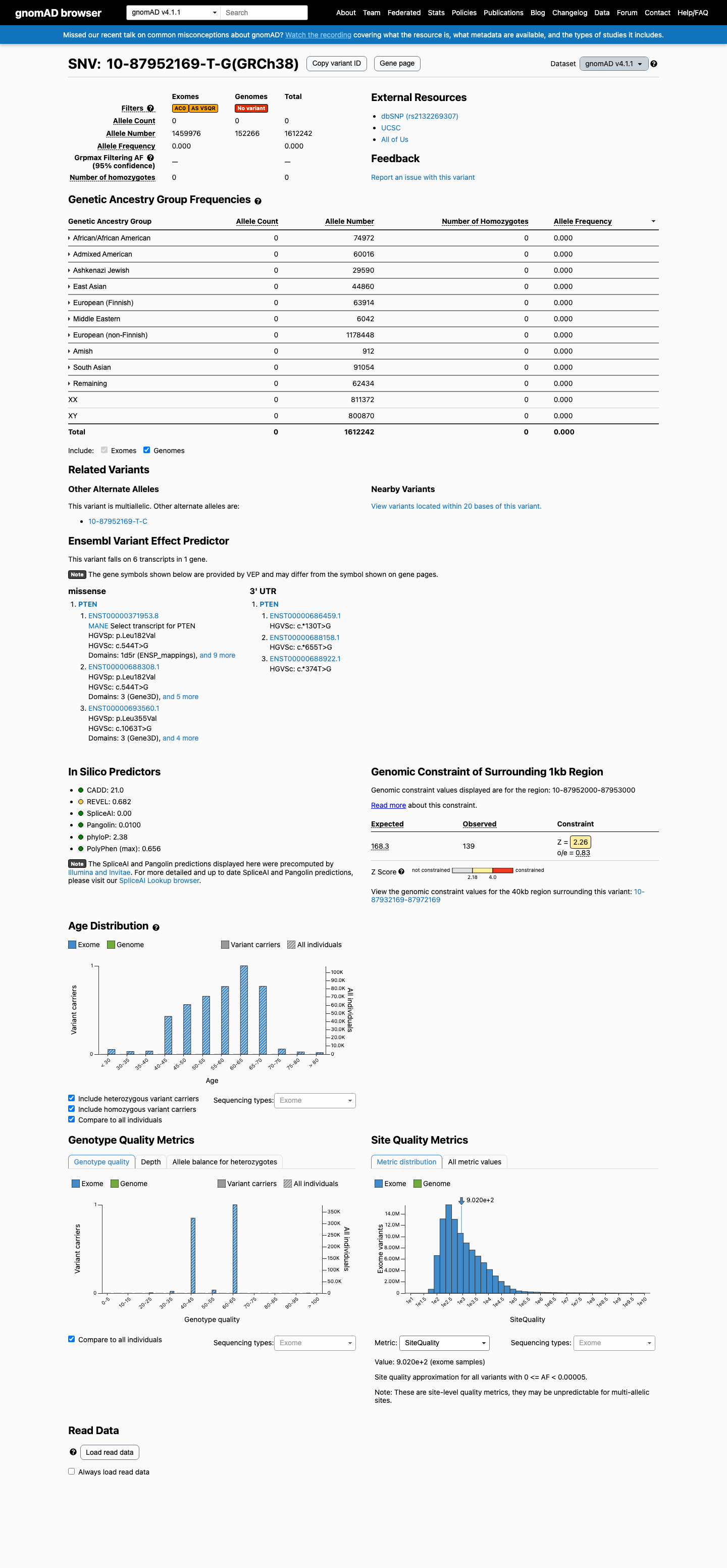
gnomAD v4.1
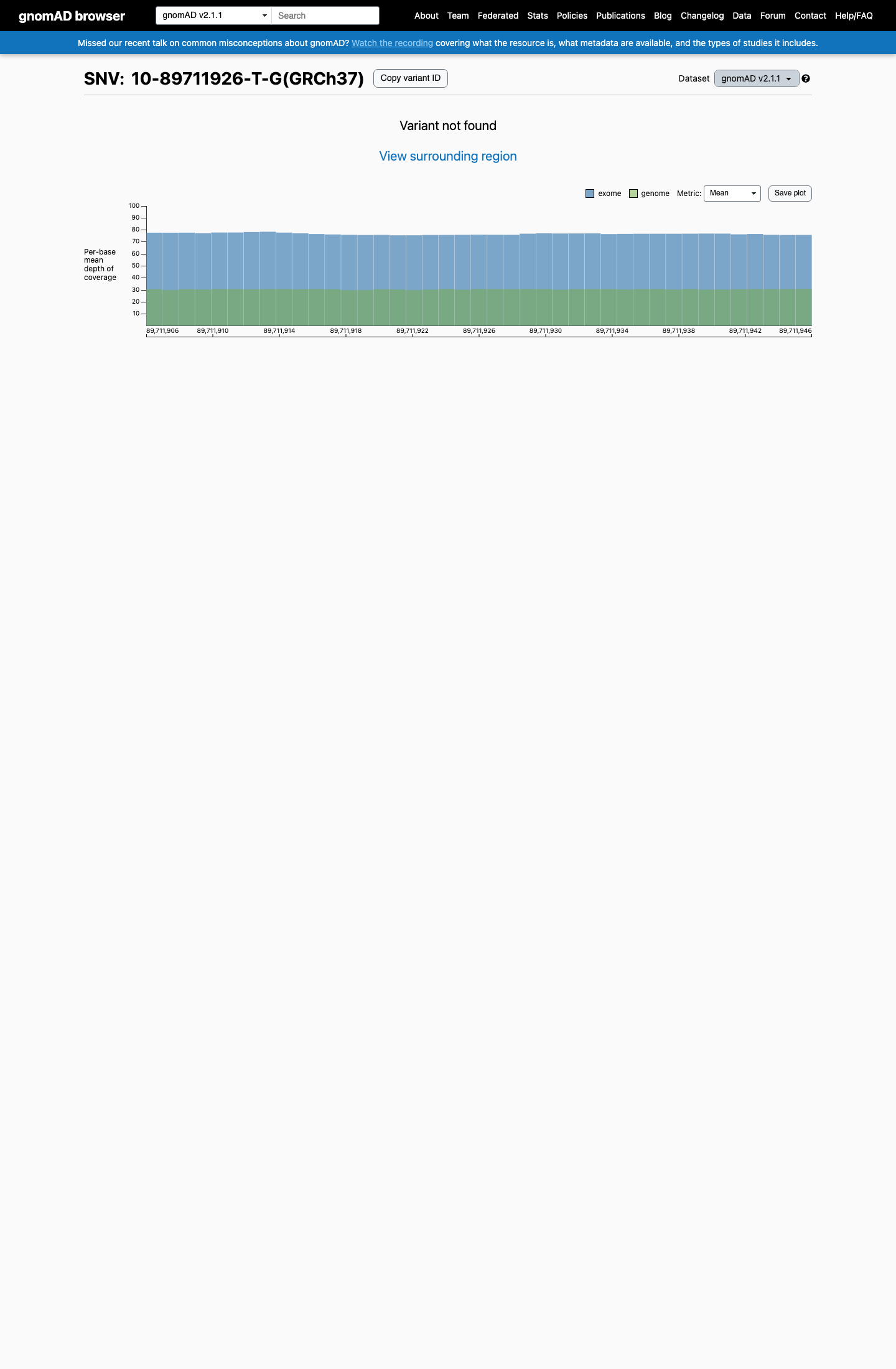
gnomAD v2.1
v4.1
This variant is present in gnomAD v4.1 (AF= 0; MAF= 0.00000%, 0/1612242 alleles, homozygotes = 0) and has highest observed frequency in the African/African American population (AF= 0; MAF= 0.00000%, 0/74972 alleles, homozygotes = 0).
v2.1
Absent from gnomAD v2.1.
🇨🇦 CA
Absent from gnomAD-Canada v1.0.
Allele frequency by ancestry
three datasets · side by side
gnomAD v4.1
Absent
· 0 / 1,612,242
0 hom
0 hom
Not observed in any ancestry group.
+ 10 not observed (Remaining individuals, Admixed American, European (Finnish), Amish, East Asian, Middle Eastern, South Asian, Ashkenazi Jewish, African/African American, European (non-Finnish))
gnomAD v2.1
Absent
· 0 / ?
0 hom
0 hom
Not observed in any ancestry group.
gnomAD Canada 🇨🇦
Absent
· 0 / ?
0 hom
0 hom
Not observed in any ancestry group.
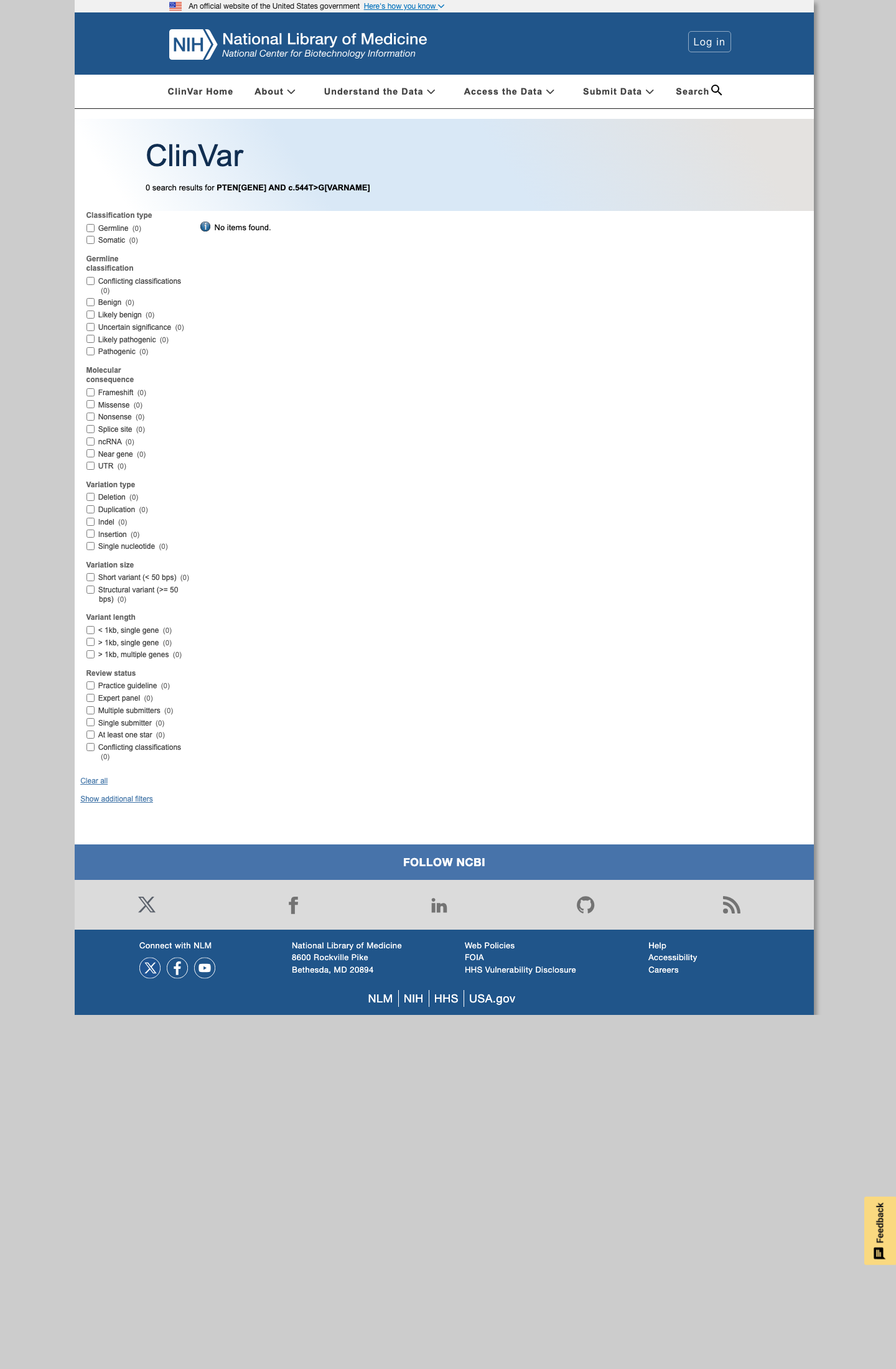
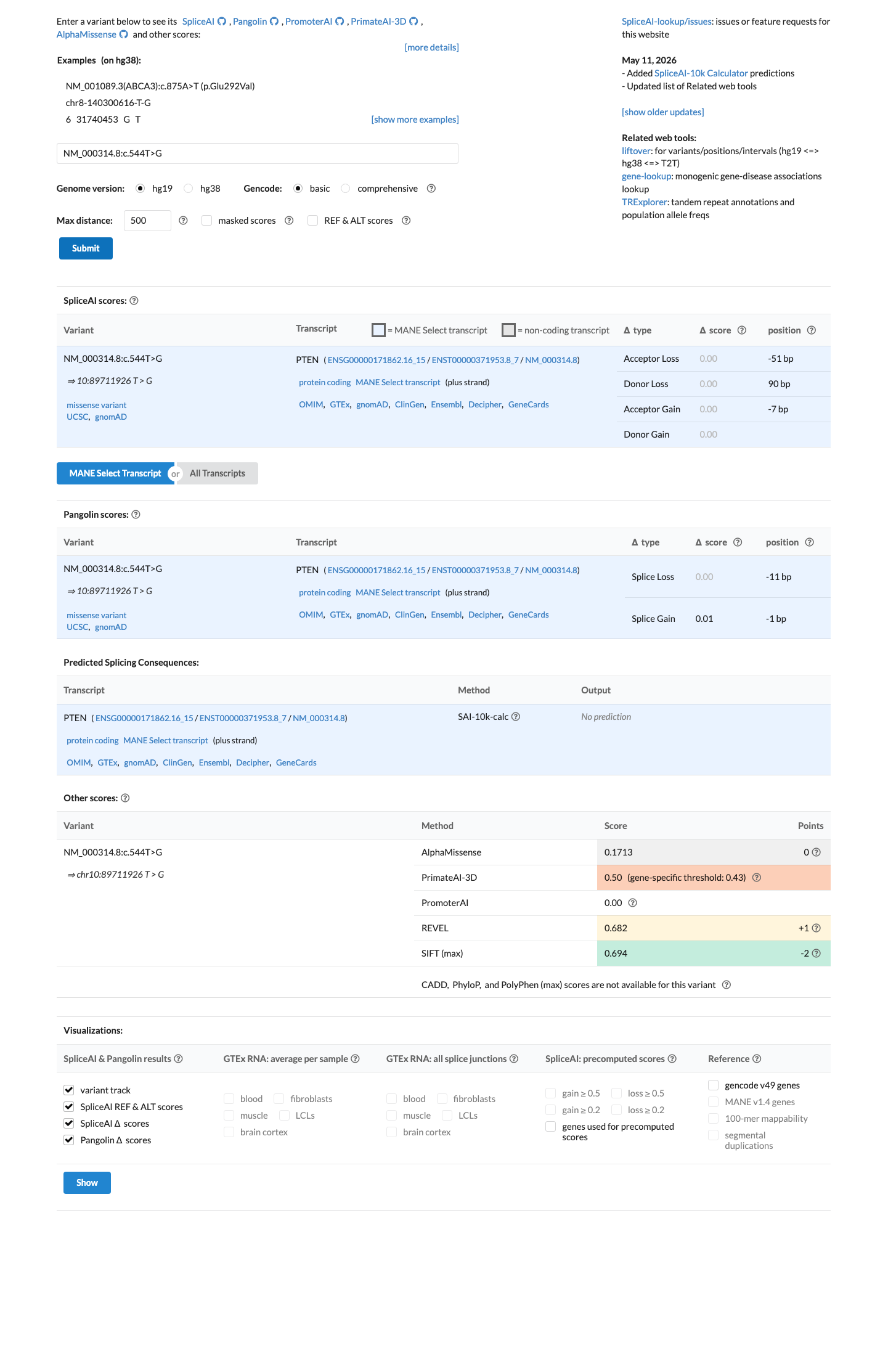
In silico
SpliceAI predicts no significant splice impact for this variant (max delta score = 0.00). REVEL score = 0.682. BayesDel score = 0.205836.

Functional
Unknown Oncogenic Effect
OncoKB did not identify variant-specific reviewed functional evidence for this variant; gene-level curated context is available for reviewer follow-up. PTEN, a lipid and protein phosphatase, is one of the most frequently mutated genes in cancer.
COSMIC

Cancer hotspots
Somatic evidence
Not in COSMIC / hotspots
COSMIC
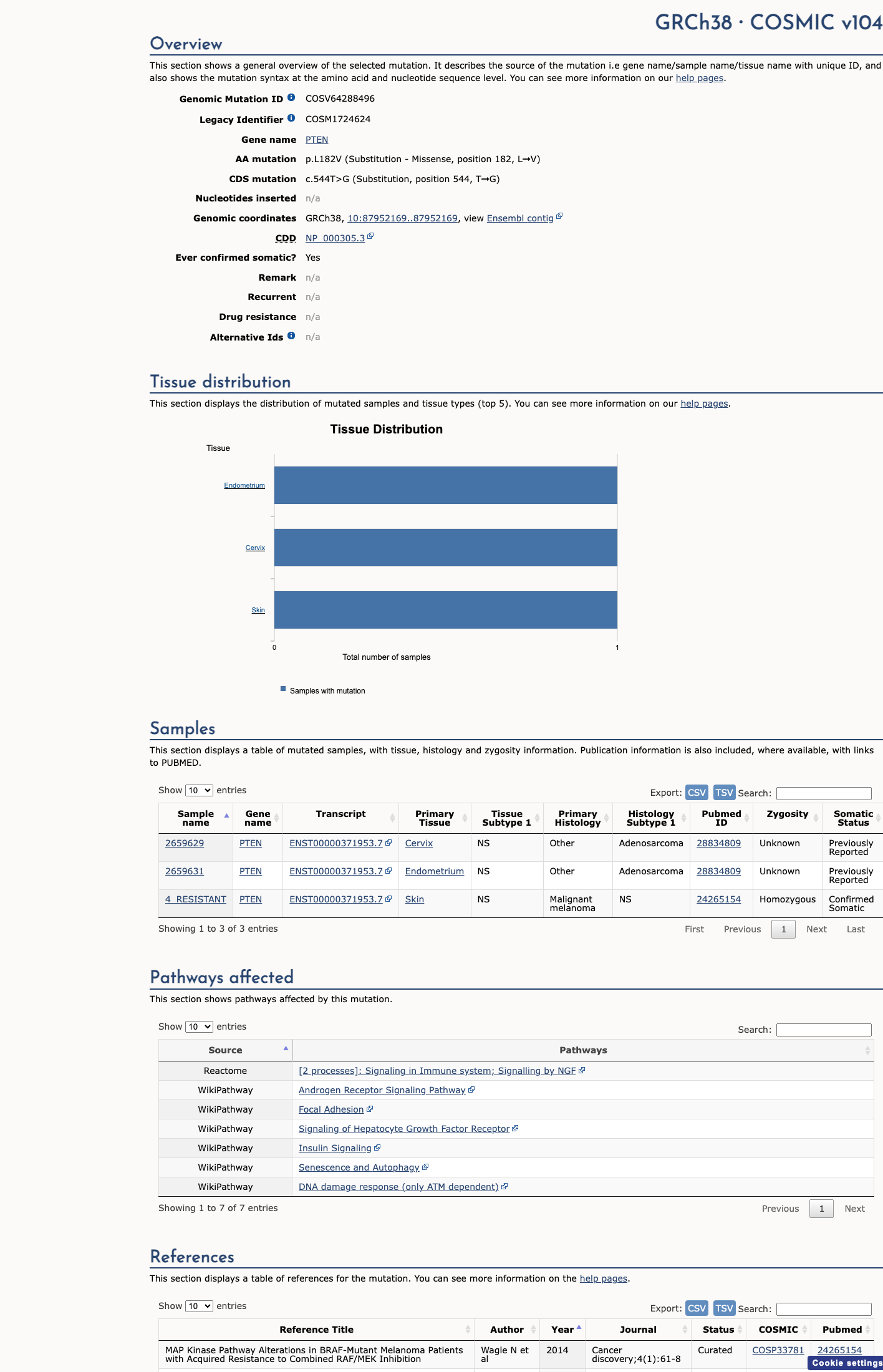
This variant does not lie in a statistically significant hotspot. This variant has previously been reported in somatic cancers (COSMIC; COSV64288496, n = 3 times).
Hotspots
This variant does not lie in a statistically significant hotspot.
Sources & reference links