Analysis in progress
Initialising…
0%
complete
This report is still being assembled — sections appear as each stage finishes. It isn't final yet.
RB1
Final classification
VUS
BP4
RB1
c.13A>C
p.Thr5Pro
missense · exon 1

RB1 encodes a protein that acts as a key brake on cell division: in its active form it blocks cells from moving from the G1 into the S phase of the cell cycle, and it also helps maintain the structure of packaged DNA in the nucleus. It was the first tumor suppressor gene identified. Loss of RB1 function removes this brake, leading to uncontrolled cell growth and contributing to many cancers, including retinoblastoma (a childhood eye cancer), bladder cancer, osteogenic sarcoma, and cancers of the lung, breast, and prostate. Inherited changes in RB1 predispose children to retinoblastoma and adults to sarcomas and other tumors.

This variant

RB1 is a tumor suppressor whose loss predisposes to retinoblastoma and other cancers, and this missense change (p.Thr5Pro) does not by itself establish or exclude such loss. Classified as a VUS, it should not alone drive clinical management or cancer-risk decisions.

Transcript
NM_000321.3
HGVS · transcript:coding
NM_000321.3:c.13A>C
GRCh38
chr13:48303925 A>C
GRCh37
chr13:48878061 A>C
Basis With no RB1-specific framework available, generic ACMG/AMP 2015 rules were applied; the sole met criterion, BP4 at supporting strength, falls short of the two supporting benign criteria required for Likely Benign, yielding VUS.
With no RB1-specific framework available, generic ACMG/AMP 2015 rules were applied; the sole met criterion, BP4 at supporting strength, falls short of the two supporting benign criteria required for Likely Benign, yielding VUS.
Classification rationale
BP4 VUS
RB1 c.13A>C missense · exon 1

BP4 (Supporting): missense with REVEL 0.127, below the 0.250 benign-prediction threshold. Overall VUS: BP4 alone does not reach the two benign-supporting criteria required for Likely Benign under generic ACMG/AMP 2015 combination rules.

BP4 VUS
Gene diagram · NM_000321.3 · variants mapped to exon structure
RB1 NM_000321.3
Fetching transcript structure from UCSC…
Applied criteria · 1 applied · 23 assessed
MetEvidence satisfies this criterion.
Not metEvaluated against available evidence; threshold not reached.
Not assessedApplies in principle, but no evidence was found to evaluate it.
N/ADoesn't apply to this variant type.
Applied · 1
Strength Supporting Moderate Strong Very strong
BP4 supporting Benign
Met (Supporting): missense with REVEL 0.127, below the 0.250 BP4 benign-prediction threshold.
No applicable RB1 CSPEC/VCEP material or gene-specific PP3/BP4 lookup was retrieved; the case framework is generic ACMG fallback.REVEL score is 0.127. The governing generic fallback specifies REVEL <0.250 for BP4 supporting in missense variants. Calibration of individual computational predictors for PP3/BP4 is described by Pejaver et al., PMID:36413997.SpliceAI max delta is 0.00 but is not independently applied to this missense variant under the governing mechanism-specific rule. BayesDel score -0.136964 is not used because the pipeline has no verified published BayesDel calibration.
Assessed · not applied · 6 not met · 17 not assessed
Pathogenic
PS1 Not assessed: no validated pathogenic report of a different nucleotide change producing p.Thr5Pro was available.
PS2 Not assessed: no proband-specific de novo observation or parental testing was documented.
PS3 Not assessed: no variant-specific functional assay demonstrating a damaging effect was available.
PS4 Not assessed: no affected-case series, case-control comparison, or enrichment data for this variant was available.
PM1 Not met: no statistically significant cancer hotspot or RB1 domain evidence establishes residue 5 as a critical functional region.
PM2 Not met: the variant is present in gnomAD v4.1 (59/1,497,328 alleles), so it is not absent from population databases.
PM3 Not assessed: no observation places this variant in trans with a pathogenic variant.
PM5 Not assessed: no validated pathogenic missense comparator at RB1 codon 5 was available.
PM6 Not assessed: no suspected de novo occurrence without confirmed parentage was documented.
PP1 Not assessed: no family genotypes, informative meioses, or cosegregation results were available.
PP2 Not assessed: no gene-level analysis showing that benign RB1 missense variation is uncommon and disease-causing variants are predominantly missense.
PP3 Not met: REVEL score 0.127 falls below the PP3 threshold and in the benign-supporting range.
PP4 Not assessed: no proband phenotype or clinical information linking the variant to an RB1-related disorder was available.
PP5 Not met: ClinVar holds no expert-panel Pathogenic or Likely pathogenic assertion for this exact variant.
Benign
BA1 Not met: gnomAD v4.1 allele frequency 0.00394% is far below the 5% stand-alone benign threshold.
BS1 Not assessed: no RB1-specific maximum credible allele frequency model was available; the observed frequency is rare.
BS2 Not assessed: no phenotype-confirmed healthy adult carriers or validated unaffected-heterozygote count was available.
BS3 Not assessed: no variant-specific functional assay demonstrating a normal effect was available.
BS4 Not assessed: no unaffected-carrier relatives or non-segregation data were provided.
BP1 Not assessed: no gene-specific analysis demonstrating that RB1 disease is caused primarily by truncating variants.
BP2 Not assessed: no co-occurring pathogenic variant or in-trans phase determination was documented.
BP5 Not assessed: no evidence that an alternate molecular cause explains a phenotype in a carrier.
BP6 Not met: ClinVar holds no expert-panel Benign or Likely benign assertion for this exact variant.

N/A · 4 PVS1 · PM4 · BP3 · BP7
Research & evidence
Population frequency
gnomAD v4.1 screenshot
gnomAD v4.1
gnomAD v2.1 screenshot
gnomAD v2.1
v4.1
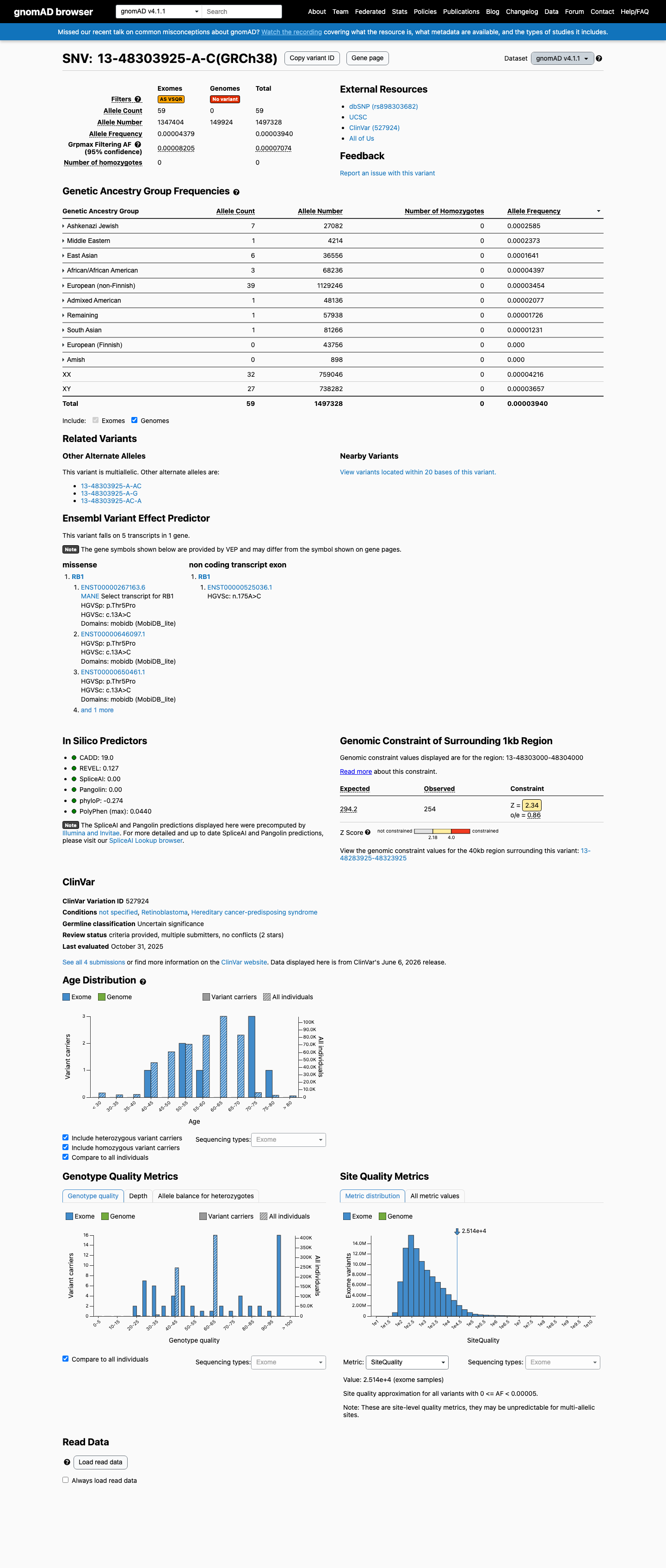
This variant is present in gnomAD v4.1 (AF= 3.94035e-05; MAF= 0.00394%, 59/1497328 alleles, homozygotes = 0) and has highest observed frequency in the Ashkenazi Jewish population (AF= 0.000258474; MAF= 0.02585%, 7/27082 alleles, homozygotes = 0); grpmax FAF= 7.074e-05.
v2.1
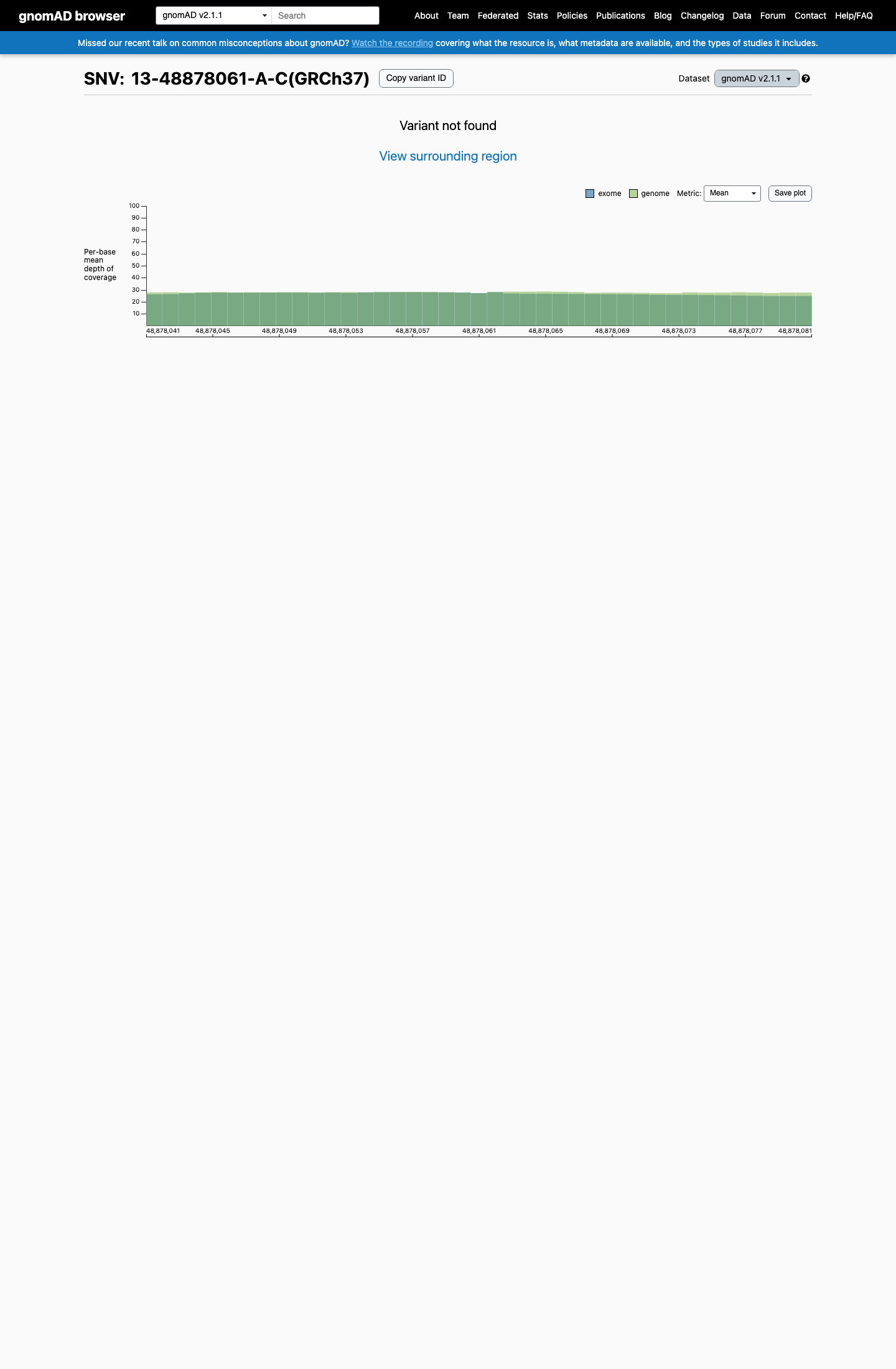
Absent from gnomAD v2.1.
🇨🇦 CA
Absent from gnomAD-Canada v1.0.
Allele frequency by ancestry
three datasets · side by side
gnomAD v4.1
0.0039% · 59 / 1,497,328
0 hom · FAF 0.0071%
Ashkenazi Jewish
7 / 27,082
0.026%
Middle Eastern
1 / 4,214
0.024%
East Asian
6 / 36,556
0.016%
African/African American
3 / 68,236
0.0044%
European (non-Finnish)
39 / 1,129,246
0.0035%
Admixed American
1 / 48,136
0.0021%
Remaining individuals
1 / 57,938
0.0017%
South Asian
1 / 81,266
0.0012%
+ 2 not observed (European (Finnish), Amish)
gnomAD v2.1
Absent · 0 / ?
0 hom
Not observed in any ancestry group.
gnomAD Canada 🇨🇦
Absent · 0 / ?
0 hom
Not observed in any ancestry group.
ClinVar screenshot
ClinVar
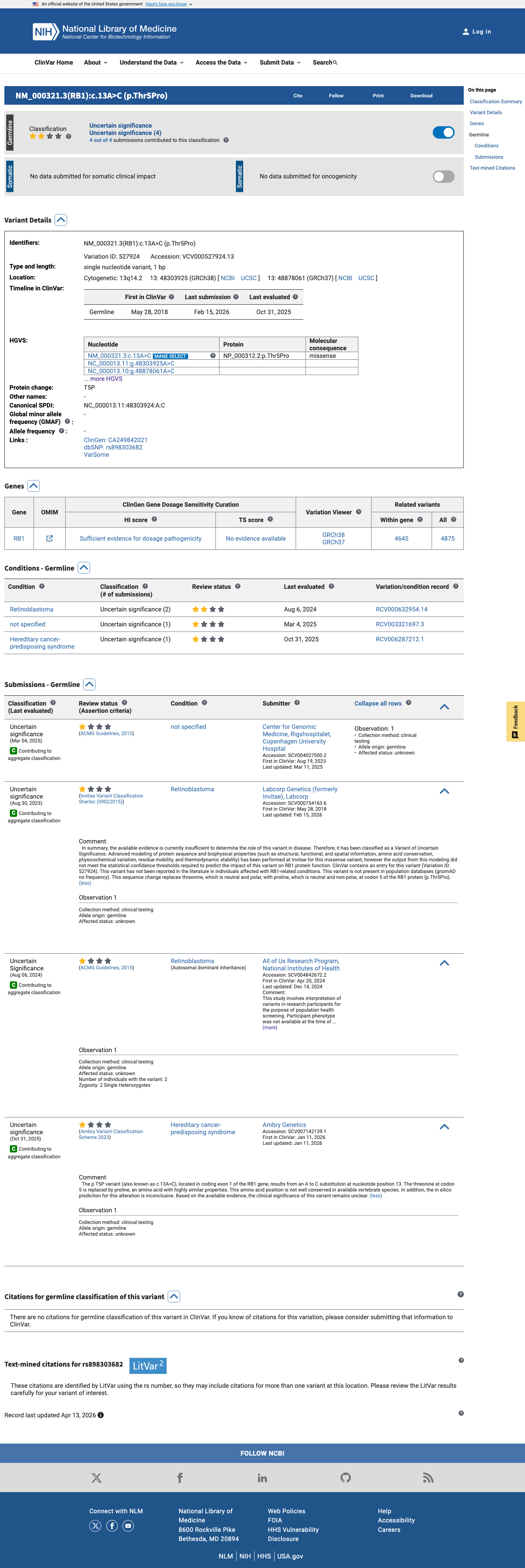
This variant has been reported in ClinVar as Uncertain significance (3 clinical laboratories) and as Uncertain Significance (1 clinical laboratory). (ClinVarID = 527924)
SpliceAI screenshot
In silico
SpliceAI predicts no significant splice impact for this variant (max delta score = 0.00). REVEL score = 0.127. BayesDel score = -0.136964.
Functional / OncoKB screenshot
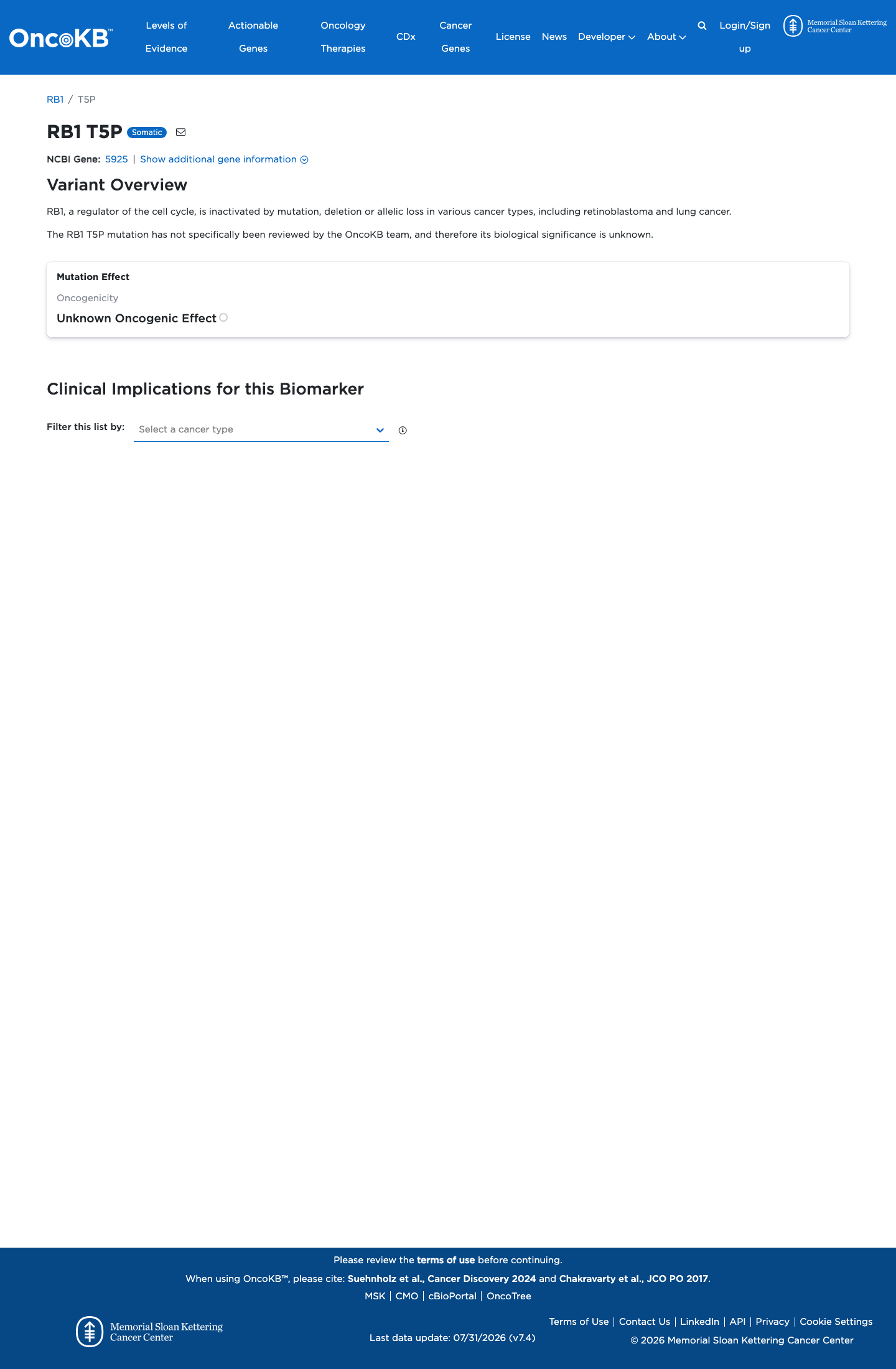
Functional Unknown Oncogenic Effect
OncoKB did not identify variant-specific reviewed functional evidence for this variant; gene-level curated context is available for reviewer follow-up. RB1, a regulator of the cell cycle, is inactivated by mutation, deletion or allelic loss in various cancer types, including retinoblastoma and lung ca
OncoKB ↗
COSMIC screenshot
COSMIC
Cancer hotspots screenshot
Cancer hotspots
Somatic evidence Not in COSMIC / hotspots
COSMIC
This variant does not lie in a statistically significant hotspot. This variant has not previously been reported in somatic cancers (COSMIC).
Hotspots
This variant does not lie in a statistically significant hotspot.
Sources & reference links
8Sources
ClinVar
gnomAD v2.1
gnomAD v4.1
gnomAD-Canada
SpliceAI
OncoKB
COSMIC
Cancer hotspots
Triaged references · 6 PMIDs not cited in assessment
25741868 ↗ Standards and guidelines for the interpretation of sequence variants: a joint consensus recommendation of the American College of Medical Genetics and Genomics and the Association for Molecular Pathology. CLINVAR
15604628 ↗ Genetic cancer risk assessment and counseling: recommendations of the national society of genetic counselors. CLINVAR
25356965 ↗ ACMG policy statement: updated recommendations regarding analysis and reporting of secondary findings in clinical genome-scale sequencing. CLINVAR
27854360 ↗ Recommendations for reporting of secondary findings in clinical exome and genome sequencing, 2016 update (ACMG SF v2.0): a policy statement of the American College of Medical Genetics and Genomics. CLINVAR
35802134 ↗ ACMG SF v3.1 list for reporting of secondary findings in clinical exome and genome sequencing: A policy statement of the American College of Medical Genetics and Genomics (ACMG). CLINVAR
26140447 ↗ Points to Consider: Ethical, Legal, and Psychosocial Implications of Genetic Testing in Children and Adolescents. CLINVAR