Analysis in progress
Initialising…
0%
complete
This report is still being assembled — sections appear as each stage finishes. It isn't final yet.
STK11
Final classification
Benign
BA1BS1BP4
STK11
c.369G>A
p.Gln123=
synonymous · exon 2

STK11 encodes a serine/threonine kinase that acts as a tumor suppressor, regulating cell polarity, energy metabolism, and stress responses through the AMPK signaling pathway. Germline mutations in this gene cause Peutz-Jeghers syndrome, an inherited condition marked by gastrointestinal polyps, mucocutaneous pigmentation, and an elevated risk of several cancers. Loss of STK11 function also occurs in cancers of the lung, pancreas, breast, cervix, liver, and other tissues, where it promotes tumor growth.

This variant

STK11 is a tumor suppressor whose loss causes Peutz-Jeghers syndrome and predisposes to several cancers. This variant is a synonymous change with no predicted effect on splicing or protein function, so its Benign classification indicates it does not confer STK11-related disease risk.

Transcript
NM_000455.4
HGVS · transcript:coding
NM_000455.4:c.369G>A
GRCh38
chr19:1218495 G>A
GRCh37
chr19:1218494 G>A
Basis Benign: gnomAD African/African American allele frequency 2.117% exceeds the 1% BA1 threshold, which alone yields Benign (BS1 and BP4 also met).
Benign: gnomAD African/African American allele frequency 2.117% exceeds the 1% BA1 threshold, which alone yields Benign (BS1 and BP4 also met).
Classification rationale
BA1BS1BP4 Benign
STK11 c.369G>A synonymous · exon 2

BA1 (Stand-alone Benign): allele frequency 2.117% in gnomAD African/African American, exceeding the >1% population threshold. BS1 (Strong Benign): ancestry-specific allele frequency 2.117% (gnomAD v4.1), exceeding the >0.3% threshold. BP4 (Supporting): SpliceAI max delta 0.003, below the <0.1 threshold, indicating no splice impact. Under generic ACMG/AMP 2015 combination rules, BA1 alone is sufficient for Benign.

BA1 + BS1 + BP4 Benign
Gene diagram · NM_000455.4 · variants mapped to exon structure
STK11 NM_000455.4
Fetching transcript structure from UCSC…
Applied criteria · 3 applied · 17 assessed
MetEvidence satisfies this criterion.
Not metEvaluated against available evidence; threshold not reached.
Not assessedApplies in principle, but no evidence was found to evaluate it.
N/ADoesn't apply to this variant type.
Applied · 3
Strength Supporting Moderate Strong Very strong
BA1 stand-alone Benign
Met (stand-alone benign): gnomAD African/African American allele frequency is 2.117% (23 homozygotes), exceeding the >1% BA1 threshold.
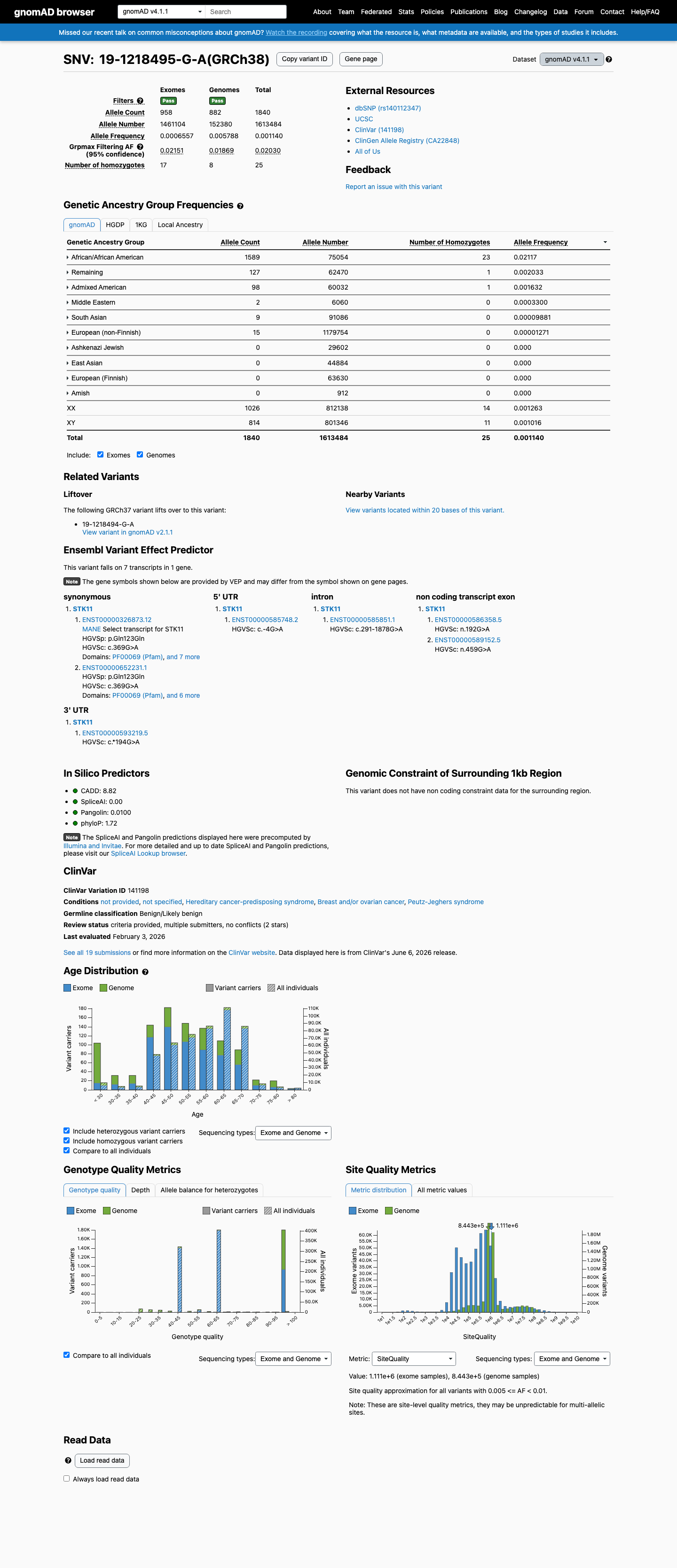
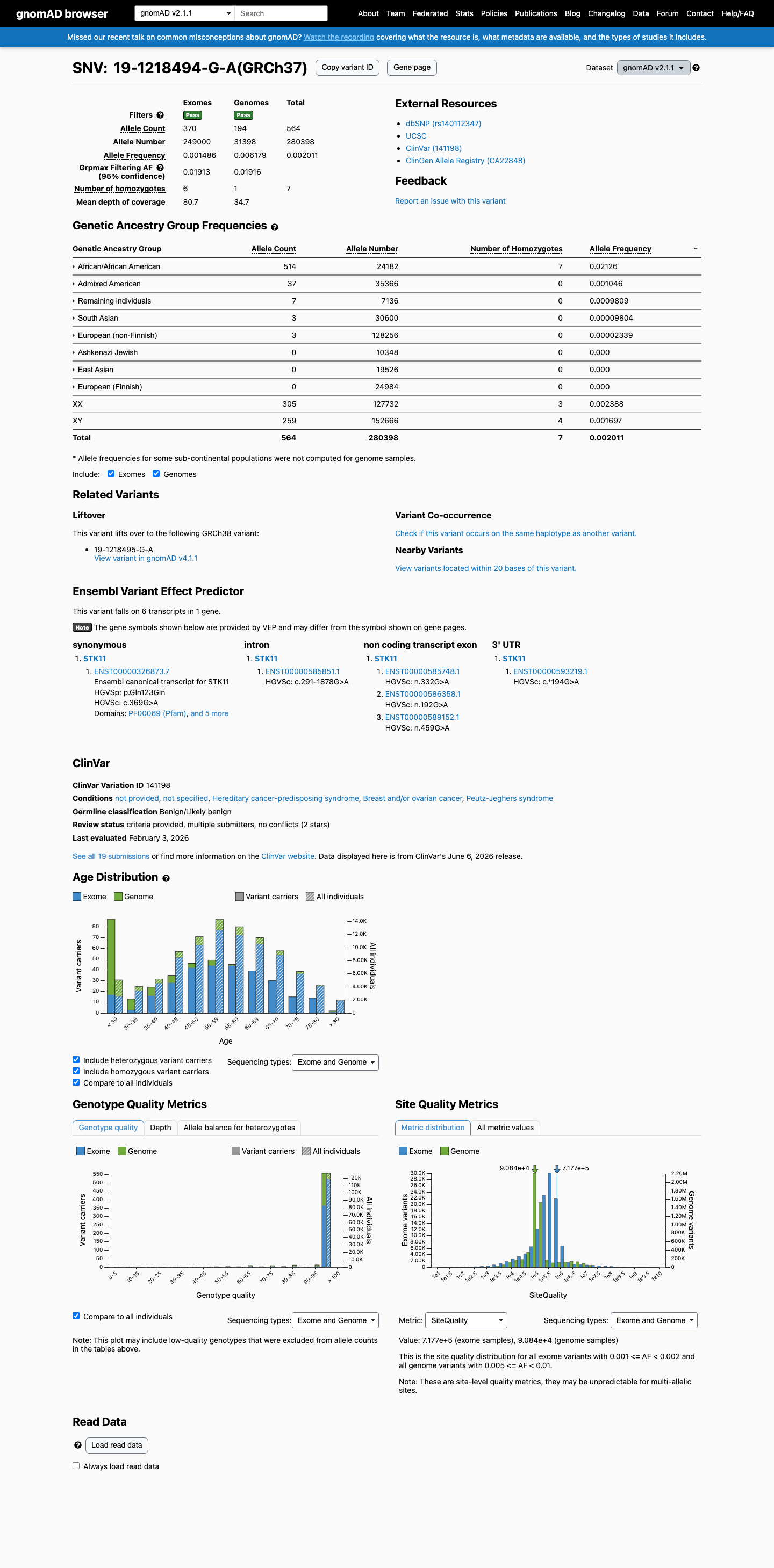
gnomAD v4.1 reports NM_000455.4:c.369G>A / 19-1218495-G-A at overall AF 0.0011403893685961559 (1,840/1,613,484 alleles) and African/African American AF 0.021171423241932476 (1,589/75,054 alleles; 23 homozygotes).gnomAD v2.1 reports overall AF 0.002011426615025785 and African/African American AF 0.021255479282110662 (514/24,182 alleles; 7 homozygotes).gnomAD-Canada v1.0 reports AF 0.0016835016835016834 (31/18,414 alleles; 1 homozygote); its African population AF is 0.028431372549019607 (29/1,020 alleles; 1 homozygote).
BS1 strong Benign
Met (strong benign): ancestry-specific frequency reaches 2.117% (African/African American, gnomAD v4.1), well above the >0.3% BS1 threshold.
gnomAD v4.1 reports African/African American AF 0.021171423241932476 (1,589/75,054 alleles; 23 homozygotes), well above 0.003.gnomAD v2.1 reports African/African American AF 0.021255479282110662 (514/24,182 alleles; 7 homozygotes), well above 0.003.gnomAD-Canada v1.0 reports African population AF 0.028431372549019607 (29/1,020 alleles; 1 homozygote), also above 0.003.
BP4 supporting Benign
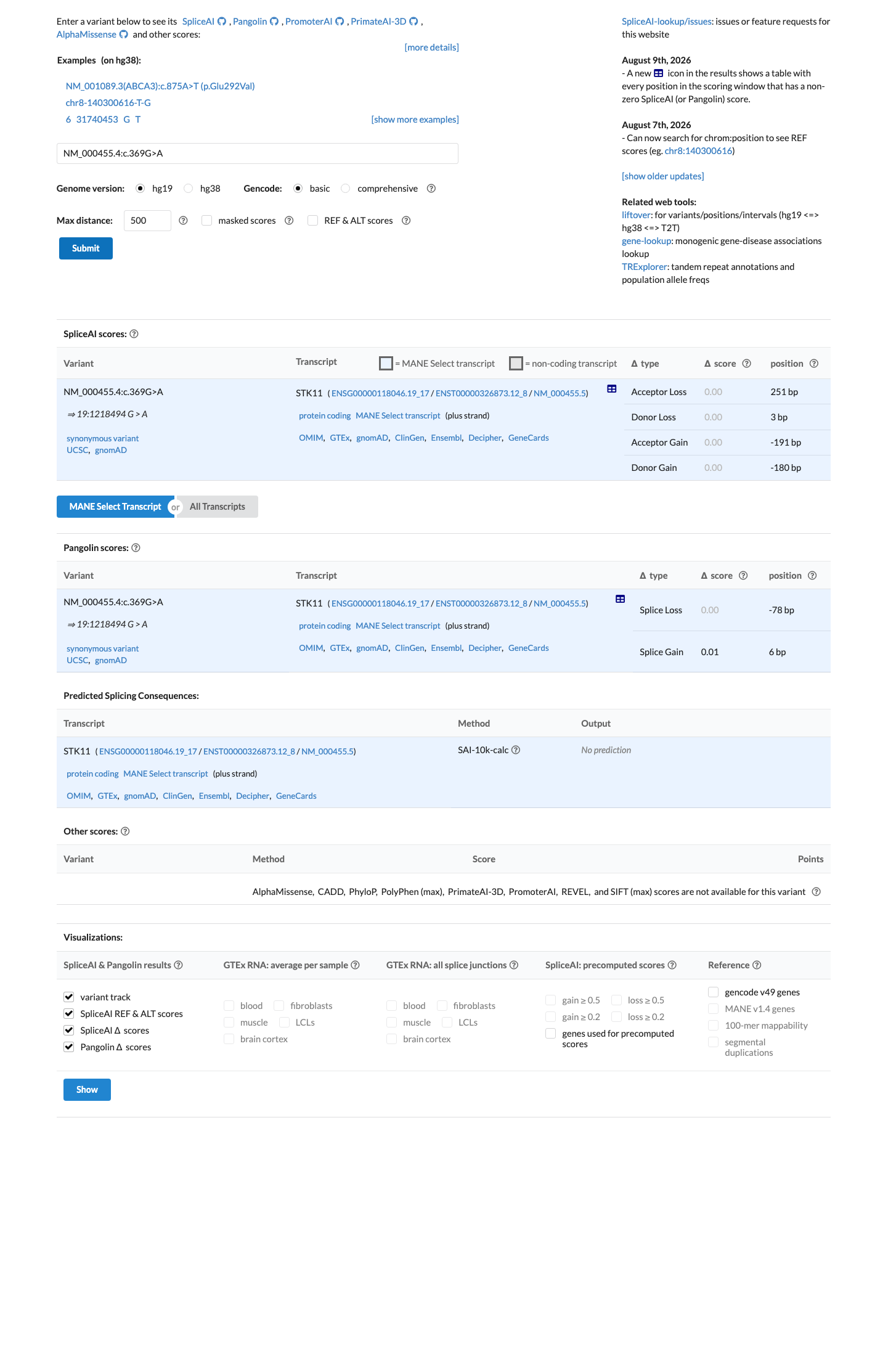
Met (supporting): SpliceAI max delta is 0.003, well below the <0.1 threshold for BP4.
SpliceAI predicts no significant splice impact for this variant (max delta score = 0.003).Generic ACMG fallback rule: SpliceAI max delta < 0.1 -> BP4 (supporting) for non-missense (synonymous/intronic/non-canonical-splice-position) variants.REVEL score not found (null) and BayesDel score not found (null) in prefetch for this variant; in any case both are missense-path predictors inapplicable to this synonymous variant, and BayesDel additionally has no verified published calibration threshold available to this pipeline.
Assessed · not applied · 4 not met · 13 not assessed
Pathogenic
PS2 Not assessed: no proband or parental testing data (e.g., de novo observation) was available for this variant.
PS3 Not assessed: no functional assay data (kinase activity, splicing, or other validated studies) was available for this variant.
PS4 Not assessed: no case-control study or affected-case series for this exact variant was available.
PM2 Not met: the variant is present in gnomAD at ~0.114% (v4.1) overall with 25 homozygotes, above the <0.1% rarity threshold.
PM3 Not assessed: no affected-proband observations, second pathogenic allele, or phase information was available.
PM6 Not assessed: no report of this variant arising de novo, with parental testing absent.
PP1 Not assessed: no affected or unaffected relatives with informative genotype data were reported, so cosegregation could not be evaluated.
PP3 Not met: SpliceAI max delta is 0.003, far below the >0.2 threshold required for PP3.
PP4 Not assessed: no patient phenotype or clinical findings establishing a Peutz-Jeghers syndrome-specific presentation were provided.
PP5 Not met: the ClinVar record has no expert-panel submission (0), and laboratory assertions alone cannot support PP5.
Benign
BS2 Not assessed: homozygotes exist (25 in gnomAD v4.1), but their clinically unaffected status could not be confirmed.
BS3 Not assessed: no functional assay demonstrating normal or wild-type activity was available for this variant.
BS4 Not assessed: no affected relatives lacking the variant were documented, so absence of segregation could not be shown.
BP2 Not assessed: no observation of this variant in trans or in cis with a pathogenic variant was documented.
BP5 Not assessed: no alternative molecular diagnosis explaining the patient's phenotype was documented.
BP6 Not met: no ClinVar expert-panel benign assertion exists for this variant (0 expert-panel submissions).
BP7 Not assessed: splice impact is minimal, but no nucleotide-conservation metric was available to complete the required pair of conditions.
N/A · 8 PVS1 · PS1 · PM1 · PM4 · PM5 · PP2 · BP1 · BP3
Research & evidence
Population frequency · supports benign
gnomAD v4.1 screenshot
gnomAD v4.1
gnomAD v2.1 screenshot
gnomAD v2.1
v4.1
This variant is present in gnomAD v4.1 (AF= 0.00114039; MAF= 0.11404%, 1840/1613484 alleles, homozygotes = 25) and has highest observed frequency in the African/African American population (AF= 0.0211714; MAF= 2.11714%, 1589/75054 alleles, homozygotes = 23); grpmax FAF= 0.0203047.
v2.1
This variant is present in gnomAD v2.1 (AF= 0.00201143; MAF= 0.20114%, 564/280398 alleles, homozygotes = 7) and has highest observed frequency in the African/African American population (AF= 0.0212555; MAF= 2.12555%, 514/24182 alleles, homozygotes = 7); grpmax FAF= 0.0191609.
🇨🇦 CA
This variant is present in gnomAD-Canada v1.0 (AF= 0.0016835016835016834, 31/18414 alleles, homozygotes = 1).
Allele frequency by ancestry
three datasets · side by side
gnomAD v4.1
0.11% · 1840 / 1,613,484
25 hom · FAF 2%
African/African American
1589 / 75,054
2.1%
23 hom
Remaining individuals
127 / 62,470
0.2%
1 hom
Admixed American
98 / 60,032
0.16%
1 hom
Middle Eastern
2 / 6,060
0.033%
South Asian
9 / 91,086
0.0099%
European (non-Finnish)
15 / 1,179,754
0.0013%
+ 4 not observed (European (Finnish), Amish, East Asian, Ashkenazi Jewish)
gnomAD v2.1
0.2% · 564 / 280,398
7 hom · FAF 1.9%
African/African American
514 / 24,182
2.1%
7 hom
Admixed American
37 / 35,366
0.1%
Remaining individuals
7 / 7,136
0.098%
South Asian
3 / 30,600
0.0098%
European (non-Finnish)
3 / 128,256
0.0023%
+ 3 not observed (Ashkenazi Jewish, East Asian, European (Finnish))
gnomAD Canada 🇨🇦
0.17% · 31 / 18,414
1 hom · FAF 2%
African/African American
29 / 1,020
2.8%
1 hom
Latino/Admixed American
1 / 838
0.12%
European (non-Finnish)
1 / 11,734
0.0085%
+ 6 not observed (Ashkenazi Jewish, East Asian, European (Finnish), Middle Eastern, Remaining individuals, South Asian)
ClinVar screenshot
ClinVar
This variant has been reported in ClinVar as Benign (13 clinical laboratories) and as Likely benign (5 clinical laboratories). (ClinVarID = 141198)
SpliceAI screenshot
In silico
SpliceAI predicts no significant splice impact for this variant (max delta score = 0.00).
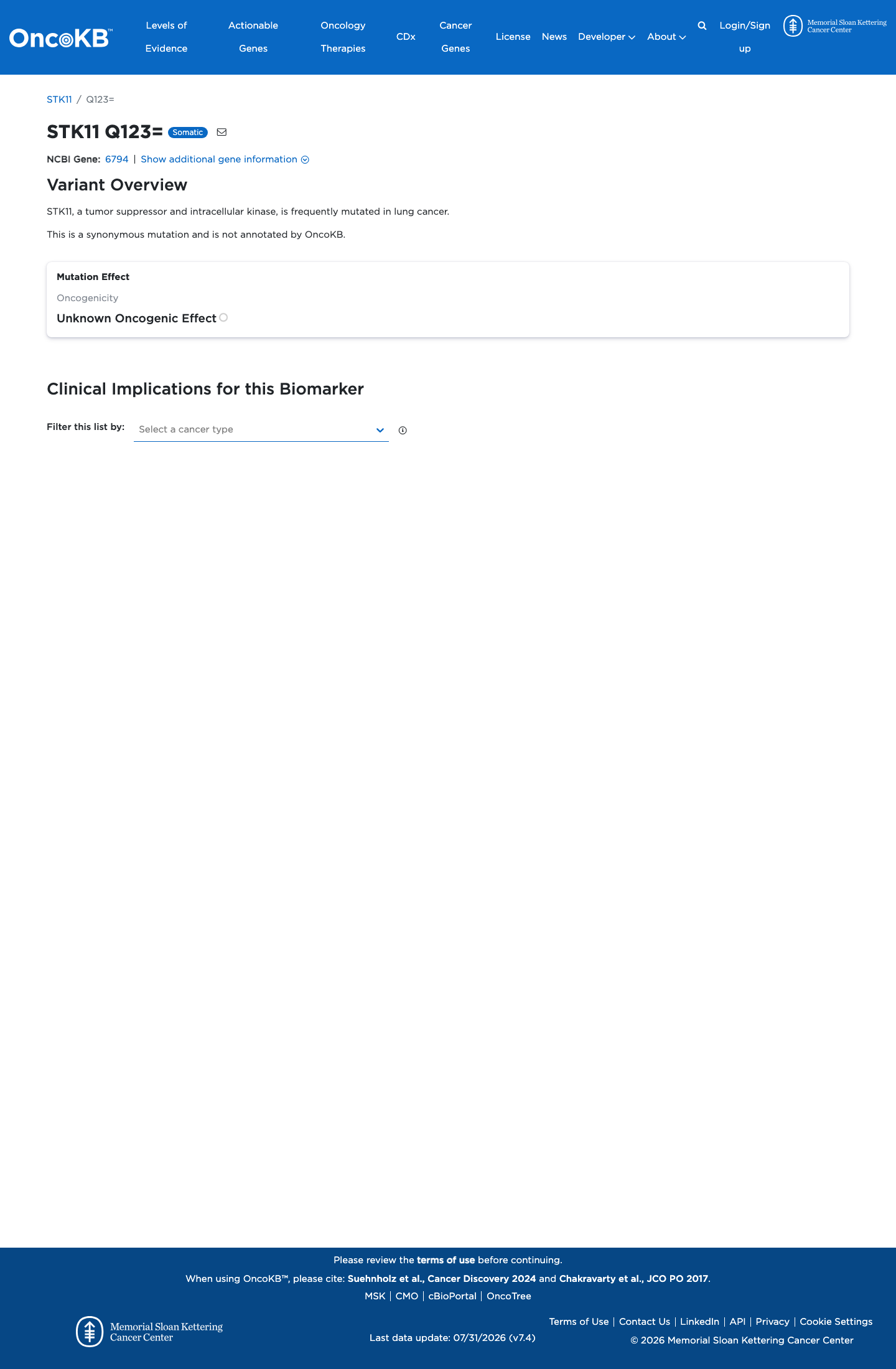
Functional / OncoKB screenshot
Functional Unknown Oncogenic Effect
OncoKB identified curated literature and non-variant-specific oncogenicity context for review; listed oncogenicity label: Unknown Oncogenic Effect.
OncoKB ↗
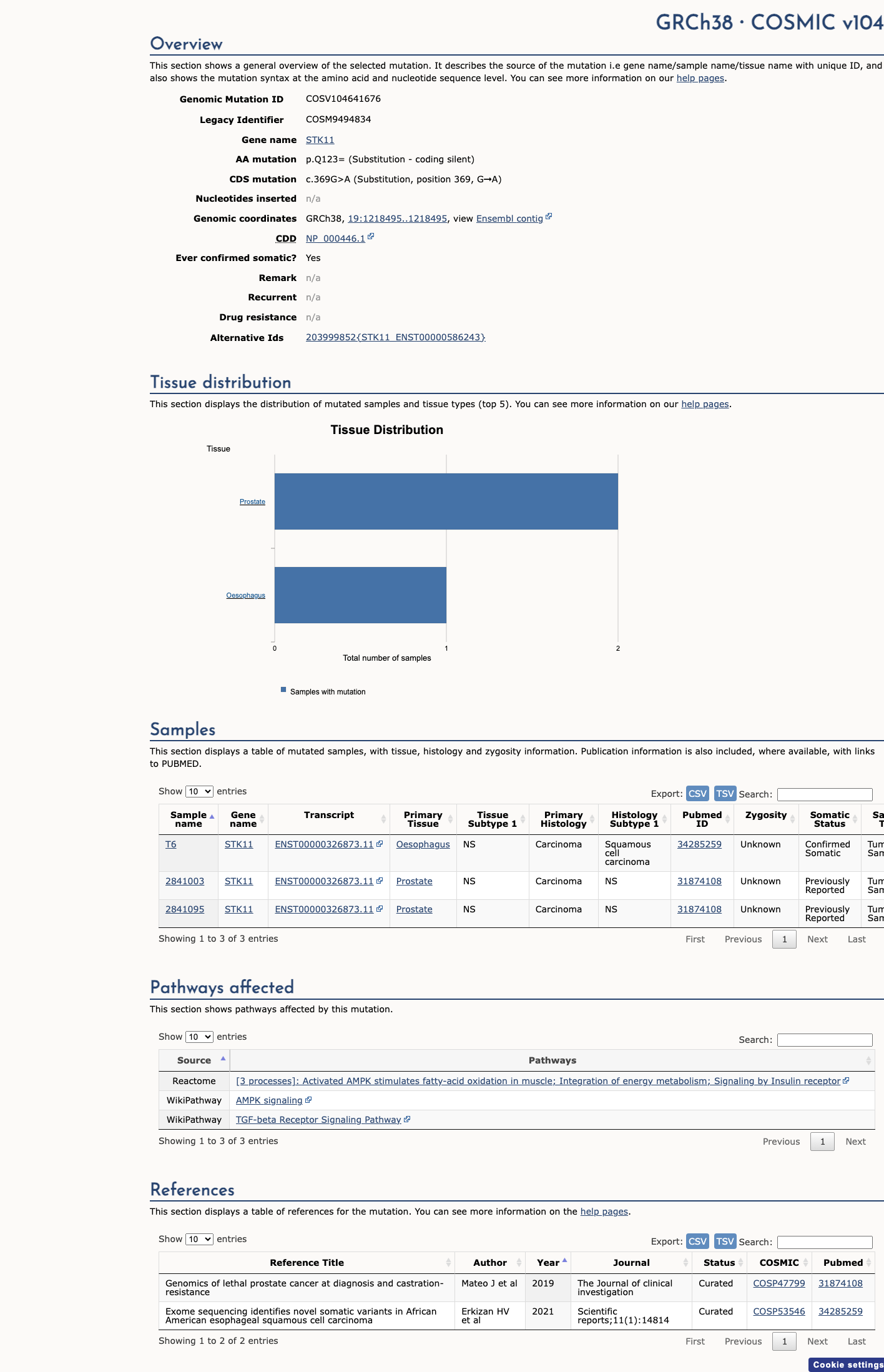
COSMIC screenshot
COSMIC
Cancer hotspots screenshot
Cancer hotspots
Somatic evidence Not in COSMIC / hotspots
COSMIC
This variant does not lie in a statistically significant hotspot. This variant has previously been reported in somatic cancers (COSMIC; COSV104641676, n = 3 times).
Hotspots
This variant does not lie in a statistically significant hotspot.
Sources & reference links
8Sources
ClinVar
gnomAD v2.1
gnomAD v4.1
gnomAD-Canada
SpliceAI
OncoKB
COSMIC
Cancer hotspots
Triaged references · 7 PMIDs not cited in assessment
25741868 ↗ Standards and guidelines for the interpretation of sequence variants: a joint consensus recommendation of the American College of Medical Genetics and Genomics and the Association for Molecular Pathology. CLINVAR
25356965 ↗ ACMG policy statement: updated recommendations regarding analysis and reporting of secondary findings in clinical genome-scale sequencing. CLINVAR
25394175 ↗ A practice guideline from the American College of Medical Genetics and Genomics and the National Society of Genetic Counselors: referral indications for cancer predisposition assessment. CLINVAR
26389210 ↗ Genetics of Breast and Gynecologic Cancers (PDQ®): Health Professional Version. CLINVAR
26389258 ↗ Cancer Genetics Risk Assessment and Counseling (PDQ®): Health Professional Versi CLINVAR
27854360 ↗ Recommendations for reporting of secondary findings in clinical exome and genome sequencing, 2016 update (ACMG SF v2.0): a policy statement of the American College of Medical Genetics and Genomics. CLINVAR
28492532 ↗ Sherloc: a comprehensive refinement of the ACMG-AMP variant classification criteria. CLINVAR