Back
NM_000455.5:c.160C>T
p.Leu54= · STK11
ACMG/AMP
0%
complete
Final classification
VUS
PM2BP7
STK11
c.160C>T
p.Leu54=
synonymous · exon 1

STK11 encodes a serine/threonine kinase that acts as a tumor suppressor, regulating cell polarity, energy metabolism, and stress responses through the AMPK signaling pathway. Germline mutations in this gene cause Peutz-Jeghers syndrome, an inherited condition marked by gastrointestinal polyps, mucocutaneous pigmentation, and an elevated risk of several cancers. Loss of STK11 function also occurs in cancers of the lung, pancreas, breast, cervix, liver, and other tissues, where it promotes tumor growth.

This variant

STK11 encodes a tumor-suppressor kinase whose germline loss of function causes autosomal dominant Peutz-Jeghers syndrome with elevated cancer risk, so a synonymous change in this gene is relevant to that hereditary cancer context even though it provides no evidence of disrupted protein function here.

Transcript
NM_000455.5
HGVS · transcript:coding
NM_000455.5:c.160C>T
GRCh38
chr19:1207073 C>T
GRCh37
chr19:1207072 C>T
VUS: PM2 (supporting) and BP7 (supporting) together meet no Likely Pathogenic or Likely Benign combination under the generic ACMG/AMP 2015 fallback rules.
Classification rationale
PM2 BP7 VUS
STK11 c.160C>T synonymous · exon 1

VUS: PM2 (supporting) - gnomAD v4.1 AF 4.34e-06 and v2.1 AF 8.05e-06 fall below the 0.01% rarity ceiling, establishing rarity only. VUS: BP7 (supporting) - synonymous p.(Leu54=) with SpliceAI maximum delta 0.003, far below the 0.1 no-splice-impact cutoff. VUS: one supporting pathogenic plus one supporting benign criterion reaches no ACMG/AMP 2015 combination threshold.

PM2 + BP7 → VUS
LYFE Sciences is an AI system, and it can make mistakes. Criteria may be applied incorrectly, sources may be misread, and a confident-looking classification can still be wrong. Double-check every criterion and its underlying evidence before relying on any call.
Gene diagram · NM_000455.5 · variants mapped to exon structure
STK11 NM_000455.5
Fetching transcript structure from UCSC…
Applied criteria · 2 applied · 15 assessed
MetEvidence satisfies this criterion.
Not metEvaluated against available evidence; threshold not reached.
Not assessedApplies in principle, but no evidence was found to evaluate it.
N/ADoesn't apply to this variant type.
Applied · 2
Strength Supporting Moderate Strong Very strong
PM2 supporting Pathogenic
Met (supporting): gnomAD v4.1 AF 4.34e-06 and v2.1 AF 8.05e-06 are below the 0.0001 PM2 threshold, with zero homozygotes.
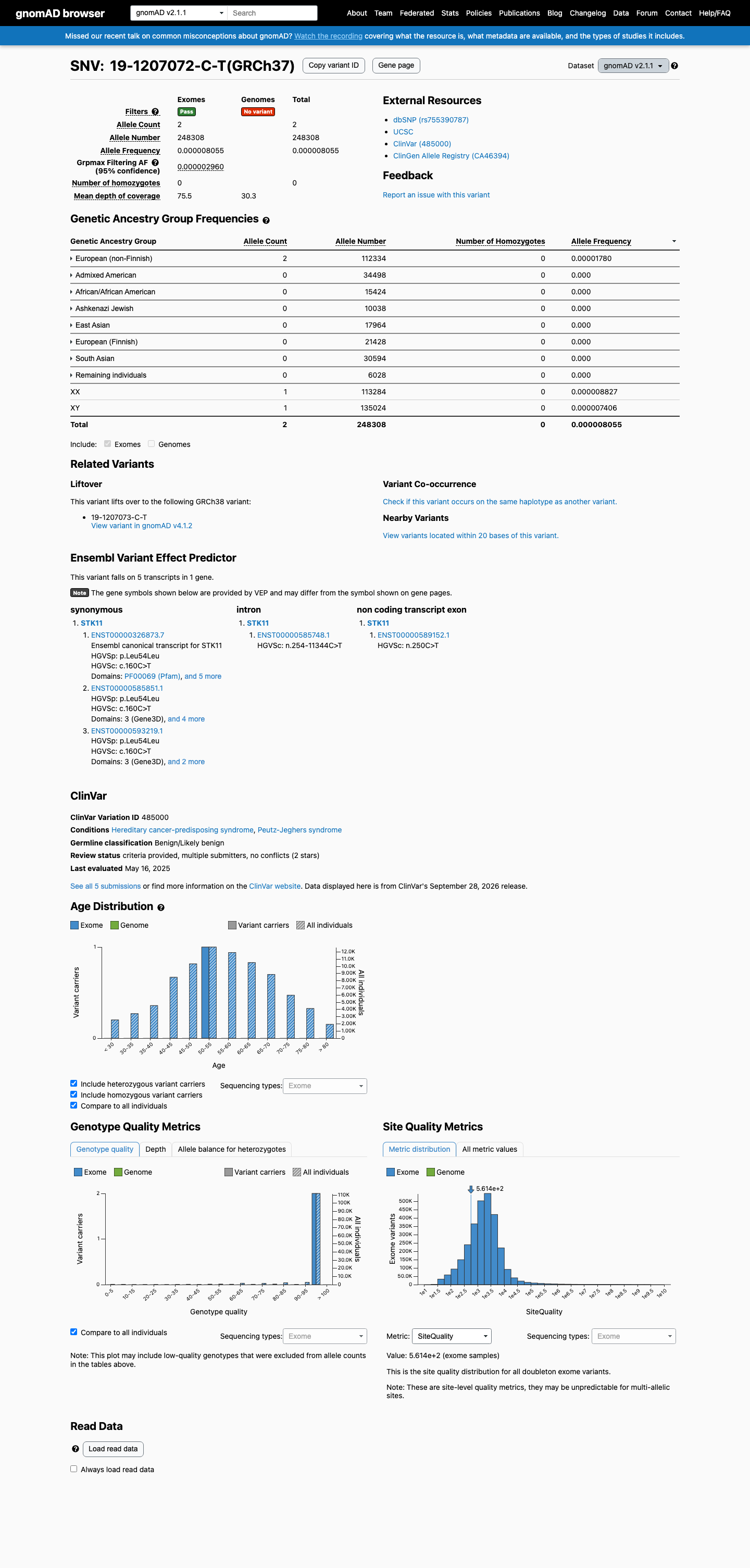
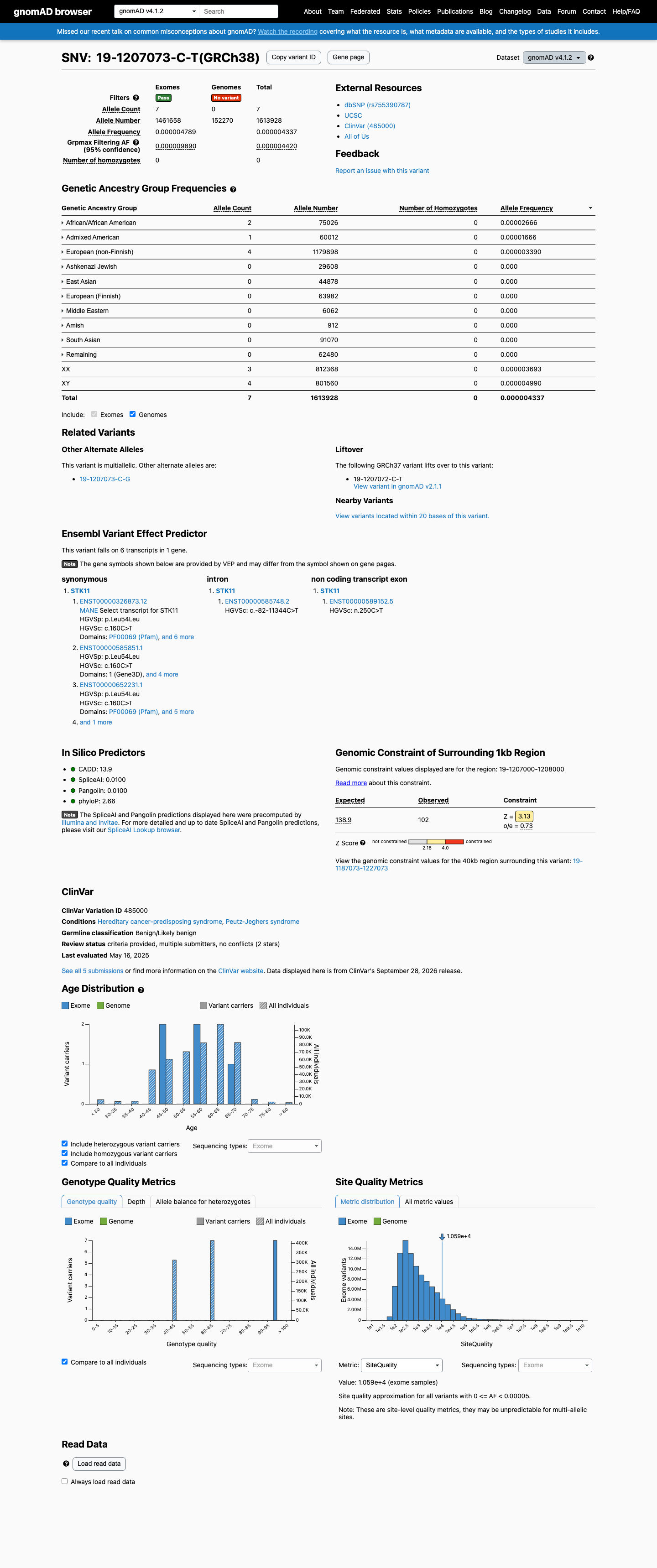
gnomAD v4.1 (all-comers joint): total AF 4.33724e-06 (7/1,613,928 alleles), 0 homozygotes; highest ancestry group African/African American AF 2.66574e-05 (2/75,026 alleles); grpmax FAF 4.42e-06.gnomAD v2.1 (all-comers exomes): total AF 8.05451e-06 (2/248,308 alleles), 0 homozygotes; highest ancestry group European (non-Finnish) AF 1.7804e-05 (2/112,334 alleles); grpmax FAF 2.96e-06.PM2 supporting rarity threshold <= 0.0001 (0.01%), SVI recommendation to apply PM2 at supporting strength (PMID:25741868).
BP7 supporting Benign
Met at supporting strength: synonymous p.(Leu54=) with SpliceAI max delta 0.003, far below the 0.1 no-splice-impact cutoff.
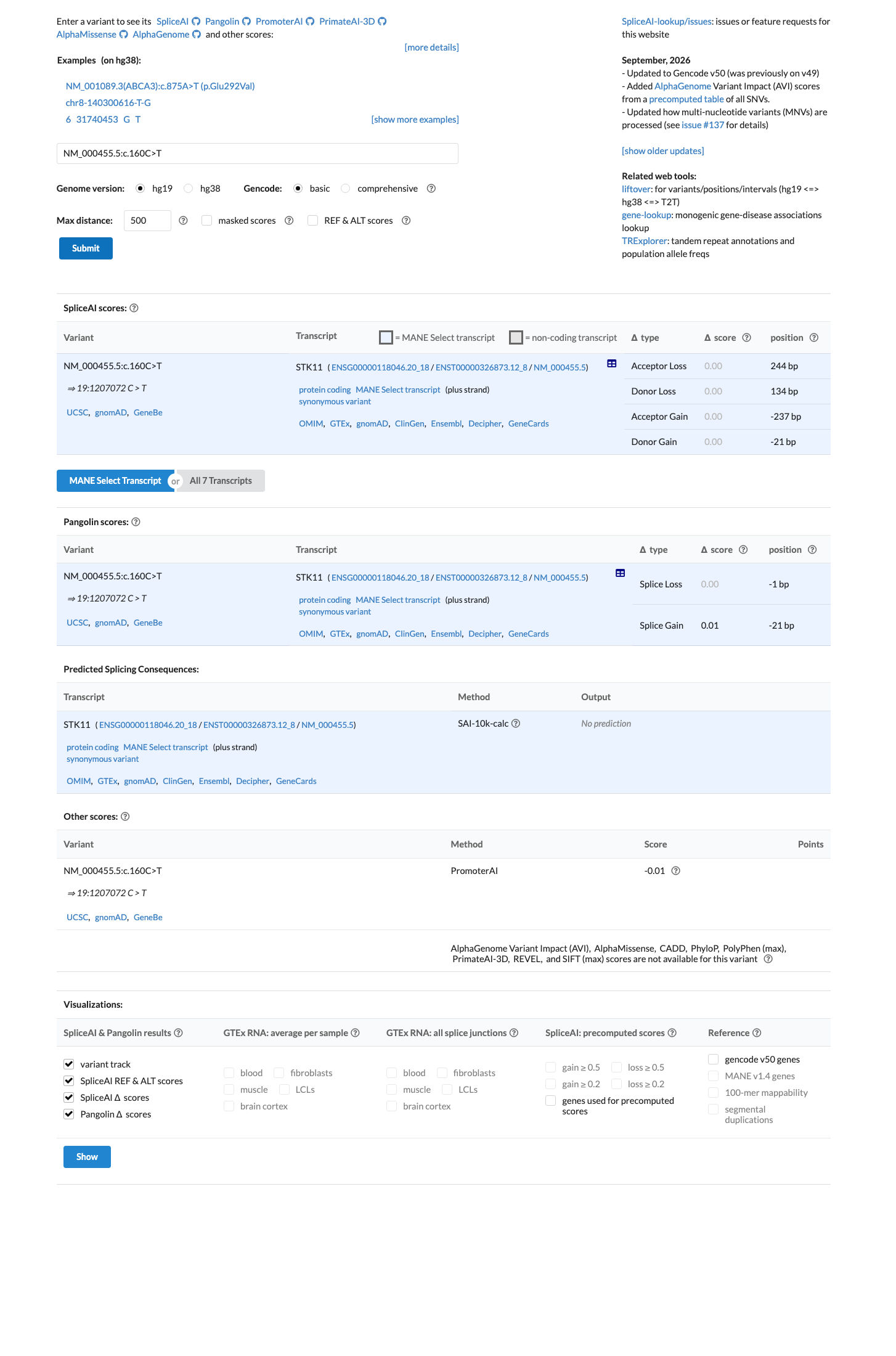
Variant is synonymous: NM_000455.5:c.160C>T, NP_000446.1:p.(Leu54=), leucine 54 unchanged (variant_validator / prefetch normalization).SpliceAI (spliceai) result available for NM_000455.5:c.160C>T (GRCh37 g.1207072C>T): DS_AG 0.001, DS_AL 0.003, DS_DG 0.002, DS_DL 0.000; maximum delta score 0.003; affected-site offsets DP_AG -237, DP_AL 244, DP_DG -21, DP_DL 134; variant_consequence 'sequence_variant'; spliceai_available = true.The 0.003 maximum delta is below the SpliceAI no-impact cutoff of 0.1 (Jaganathan et al. 2019, Cell, PMID:30661751), so no impact on the splice consensus sequence and no new splice site are predicted.
Assessed · not applied · 11 not met · 4 not assessed
Pathogenic
PS2 Not assessed: no proband or confirmed-parentage (trio) genotype data exists for STK11 c.160C>T, so a de novo occurrence cannot be evaluated.
PS3 Not met: no functional assay reports STK11 c.160C>T (p.Leu54=), and the only molecular data are computational SpliceAI 0.00, not an assay.
PS4 Not met: no case-control or case-series enrichment data exists for this synonymous variant, so no odds ratio was available for any threshold comparison.
PM6 Not assessed: no proband or parental testing data exists for STK11 c.160C>T, so an assumed de novo occurrence cannot be evaluated.
PP1 Not assessed: no pedigree or genotyped affected relatives exist, so co-segregation meioses for STK11 c.160C>T cannot be counted.
PP4 Not met: no affected individual carrying this variant is reported, so no case-level Peutz-Jeghers-specific phenotype can be matched to the genotype.
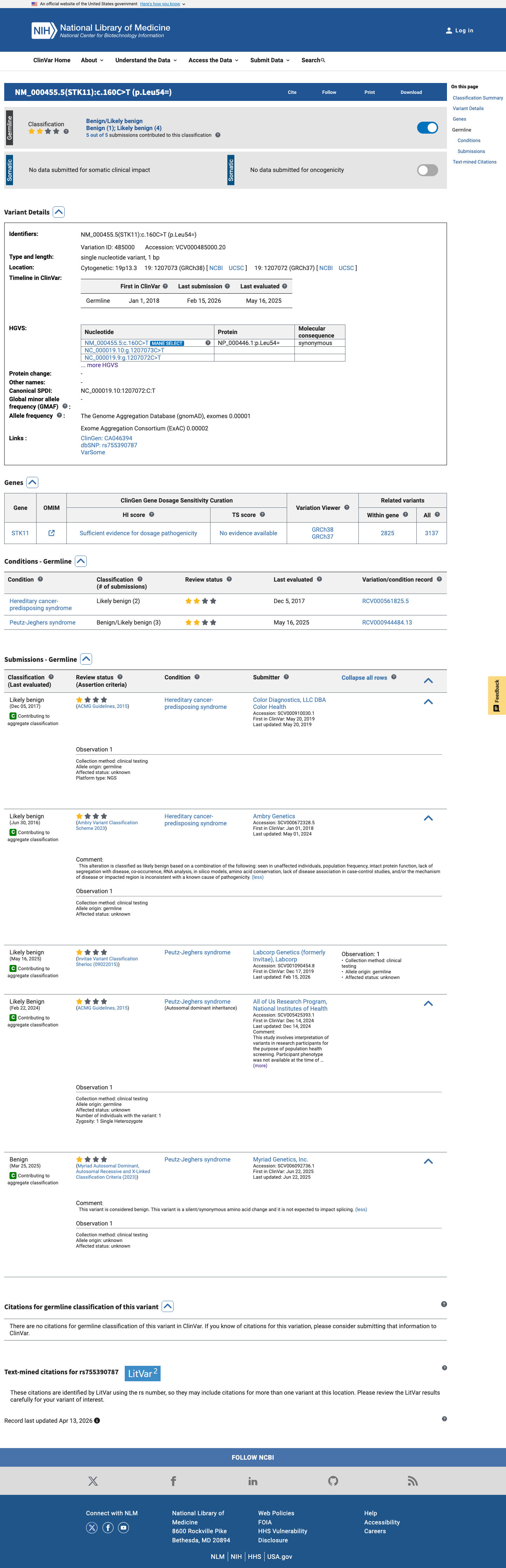
PP5 Not met: the exact-variant ClinVar record is a 2-star Benign/Likely benign aggregate from five clinical laboratories, with zero expert-panel submissions.
Benign
BA1 Not met: highest observed gnomAD subpopulation AF 0.00267% (v4.1 AFR) is far below the 5% BA1 stand-alone threshold.
BS1 Not met: highest observed gnomAD subpopulation AF 0.00267% (v4.1 AFR) is roughly 375-fold below the 1% BS1 threshold.
BS2 Not met: zero homozygotes and only 7 heterozygous alleles observed, and Peutz-Jeghers syndrome penetrance is not full at an early age.
BS3 Not met: no functional assay of STK11 c.160C>T (p.Leu54=) exists, so preserved function/normal splicing cannot be demonstrated.
BS4 Not assessed: no family or segregation data exists, so non-segregation in affected relatives cannot be shown for STK11 c.160C>T.
BP2 Not met: no source documents c.160C>T in cis or trans with a pathogenic allele - all five ClinVar submissions report the variant in isolation without phase information.
BP5 Not met: no affected individual carrying this variant with a documented alternate molecular basis for disease has been reported in any consulted source.
BP6 Not met: the exact-variant ClinVar Benign/Likely benign label comes only from five clinical laboratories, with no expert-panel assertion to trigger BP6.
N/A · 11 PVS1 · PS1 · PM1 · PM3 · PM4 · PM5 · PP2 · PP3 · BP1 · BP3 · BP4
Research & evidence
Population frequency
gnomAD v4.1 screenshot
gnomAD v4.1
gnomAD v2.1 screenshot
gnomAD v2.1
v4.1
This variant is present in gnomAD v4.1 (AF= 4.33724e-06; MAF= 0.00043%, 7/1613928 alleles, homozygotes = 0) and has highest observed frequency in the African/African American population (AF= 2.66574e-05; MAF= 0.00267%, 2/75026 alleles, homozygotes = 0); grpmax FAF= 4.42e-06.
v2.1
This variant is present in gnomAD v2.1 (AF= 8.05451e-06; MAF= 0.00081%, 2/248308 alleles, homozygotes = 0) and has highest observed frequency in the European (non-Finnish) population (AF= 1.7804e-05; MAF= 0.00178%, 2/112334 alleles, homozygotes = 0); grpmax FAF= 2.96e-06.
🇨🇦 CA
Not available in gnomAD-Canada v1.0.
Allele frequency by ancestry
three datasets · side by side
gnomAD v4.1
0.00043% · 7 / 1,613,928
0 hom · FAF 0.00044%
African/African American
2 / 75,026
0.0027%
Admixed American
1 / 60,012
0.0017%
European (non-Finnish)
4 / 1,179,898
0.00034%
+ 7 not observed (Remaining individuals, European (Finnish), Amish, East Asian, Middle Eastern, South Asian, Ashkenazi Jewish)
gnomAD v2.1
0.00081% · 2 / 248,308
0 hom · FAF 0.0003%
European (non-Finnish)
2 / 112,334
0.0018%
+ 7 not observed (African/African American, Admixed American, Ashkenazi Jewish, East Asian, European (Finnish), Remaining individuals, South Asian)
gnomAD Canada 🇨🇦
Absent · 0 / ?
0 hom
Not observed in any ancestry group.
ClinVar screenshot
ClinVar
This variant has been reported in ClinVar as Likely benign (3 clinical laboratories) and as Likely Benign (1 clinical laboratory) and as Benign (1 clinical laboratory). (ClinVarID = 485000)
SpliceAI screenshot
In silico
SpliceAI predicts no significant splice impact for this variant (max delta score = 0.00).
Functional / OncoKB screenshot
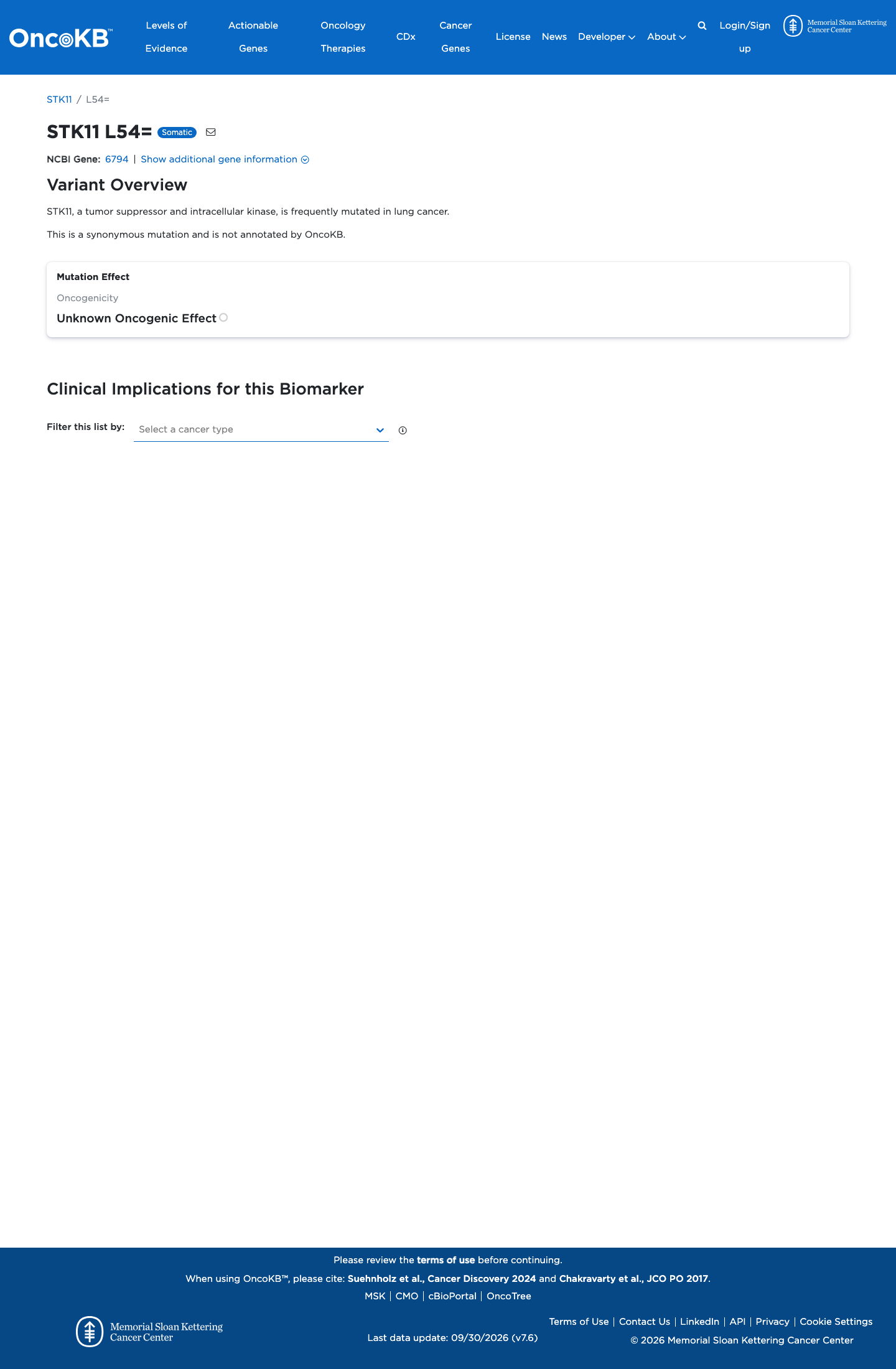
Functional Unknown Oncogenic Effect
OncoKB identified curated literature and non-variant-specific oncogenicity context for review; listed oncogenicity label: Unknown Oncogenic Effect.
OncoKB ↗
COSMIC screenshot
COSMIC
Cancer hotspots screenshot
Cancer hotspots
Somatic evidence Not in COSMIC / hotspots
COSMIC
This variant does not lie in a statistically significant hotspot. This variant has not previously been reported in somatic cancers (COSMIC).
Hotspots
This variant does not lie in a statistically significant hotspot.
Literature · how each cited paper was used
1papers cited
Each card is an audit: what was searched, what was found, whether it names the variant, which criteria it fed, and why. 6 further PMIDs triaged but not cited — see Sources & references.
Rule & framework references · cited for criterion definitions, not variant evidence
25741868 ↗ Standards and guidelines for the interpretation of sequence variants: a joint consensus recommendation of the American College of Medical Genetics and Genomics and the Association for Molecular Pathology.
Sources & reference links
8Sources
ClinVar
gnomAD v2.1
gnomAD v4.1
gnomAD-Canada
SpliceAI
OncoKB
COSMIC
Cancer hotspots
Triaged references · 6 PMIDs not cited in assessment
25645574 ↗ ACG clinical guideline: Genetic testing and management of hereditary gastrointestinal cancer syndromes. CLINVAR
31672839 ↗ Management of patients with increased risk for familial pancreatic cancer: updated recommendations from the International Cancer of the Pancreas Screening (CAPS) Consortium. CLINVAR
26389258 ↗ Cancer Genetics Risk Assessment and Counseling (PDQ®): Health Professional Version. CLINVAR
26389505 ↗ Genetics of Colorectal Cancer (PDQ®): Health Professional Version. CLINVAR
27854360 ↗ Recommendations for reporting of secondary findings in clinical exome and genome sequencing, 2016 update (ACMG SF v2.0): a policy statement of the American College of Medical Genetics and Genomics. CLINVAR
28492532 ↗ Sherloc: a comprehensive refinement of the ACMG-AMP variant classification criteria. CLINVAR