BARD1 encodes a protein that partners with BRCA1 to form a complex essential for repairing damaged DNA, particularly double-stranded breaks, and for maintaining genome stability through cell-cycle checkpoints and chromatin regulation. Germline mutations in BARD1 predispose to breast and ovarian cancer, among other cancers, and the gene is generally regarded as a tumor suppressor, although some evidence suggests it can also promote cancer in certain cellular contexts.
This variant
BARD1 partners with BRCA1 in DNA double-strand-break repair and genome-stability pathways, and germline BARD1 mutations are associated with hereditary breast and ovarian cancer susceptibility.
Transcript
NM_000465.4
HGVS · transcript:coding
NM_000465.4:c.-4G>A
GRCh38
chr2:214809573 C>T
GRCh37
chr2:215674297 C>T
VUS: PM2 (supporting) was the only applied criterion, which does not meet a generic ACMG/AMP benign or pathogenic combination threshold.
Classification rationale
PM2VUS
BARD1 c.-4G>Aunknown · exon 1
VUS: PM2 supporting was assigned because the variant is rare in the default gnomAD datasets. VUS: PM2 supporting alone does not meet a generic ACMG/AMP combination threshold for another classification. VUS: no other criterion was met or applied at a classification-changing strength.
PM2→VUS
LYFE Sciences is an AI system, and it can make mistakes. Criteria
may be applied incorrectly, sources may be misread, and a confident-looking
classification can still be wrong. Double-check every criterion and
its underlying evidence before relying on any call.
Gene diagram
· NM_000465.4 · variants mapped to exon structure
BARD1NM_000465.4
Fetching transcript structure from UCSC…
Exons
—
Transcript span
—
Strand
—
Variants mapped
—
Source
UCSC ncbiRefSeqCurated
All variants in BARD1—click a row to locate it on the plot · use the link column to open its page
Protein
Location
Classification
Link
Applied criteria · 1 applied · 16 assessed
MetEvidence satisfies this criterion.
Not metEvaluated against available evidence; threshold not reached.
Not assessedApplies in principle, but no evidence was found to evaluate it.
N/ADoesn't apply to this variant type.
Applied · 1
Strength Supporting Moderate Strong Very strong
✓
PM2supportingreviewPathogenic
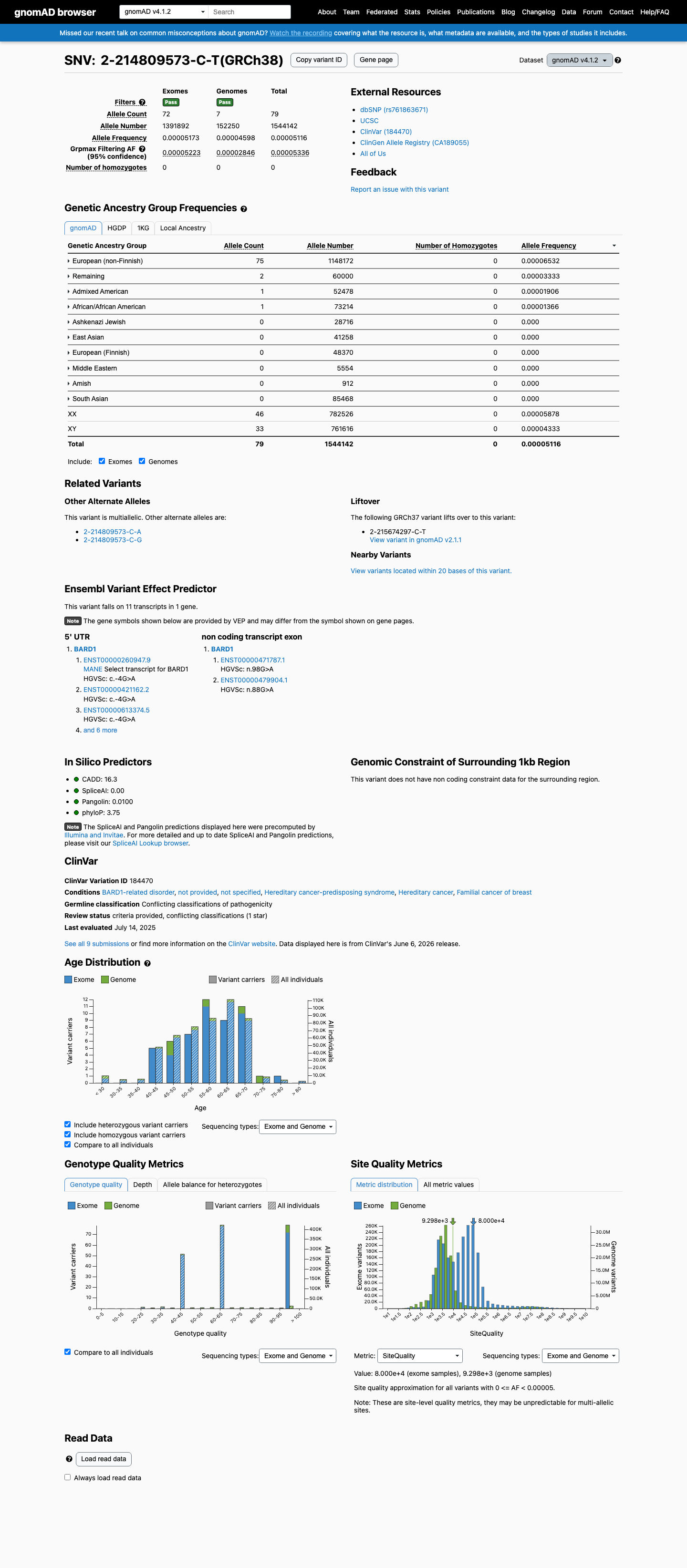
Met, supporting: gnomAD v4.1 AF 5.11611e-05 is below the PM2 threshold of <=0.0001, although gnomAD-Canada reports 0.0002716505.
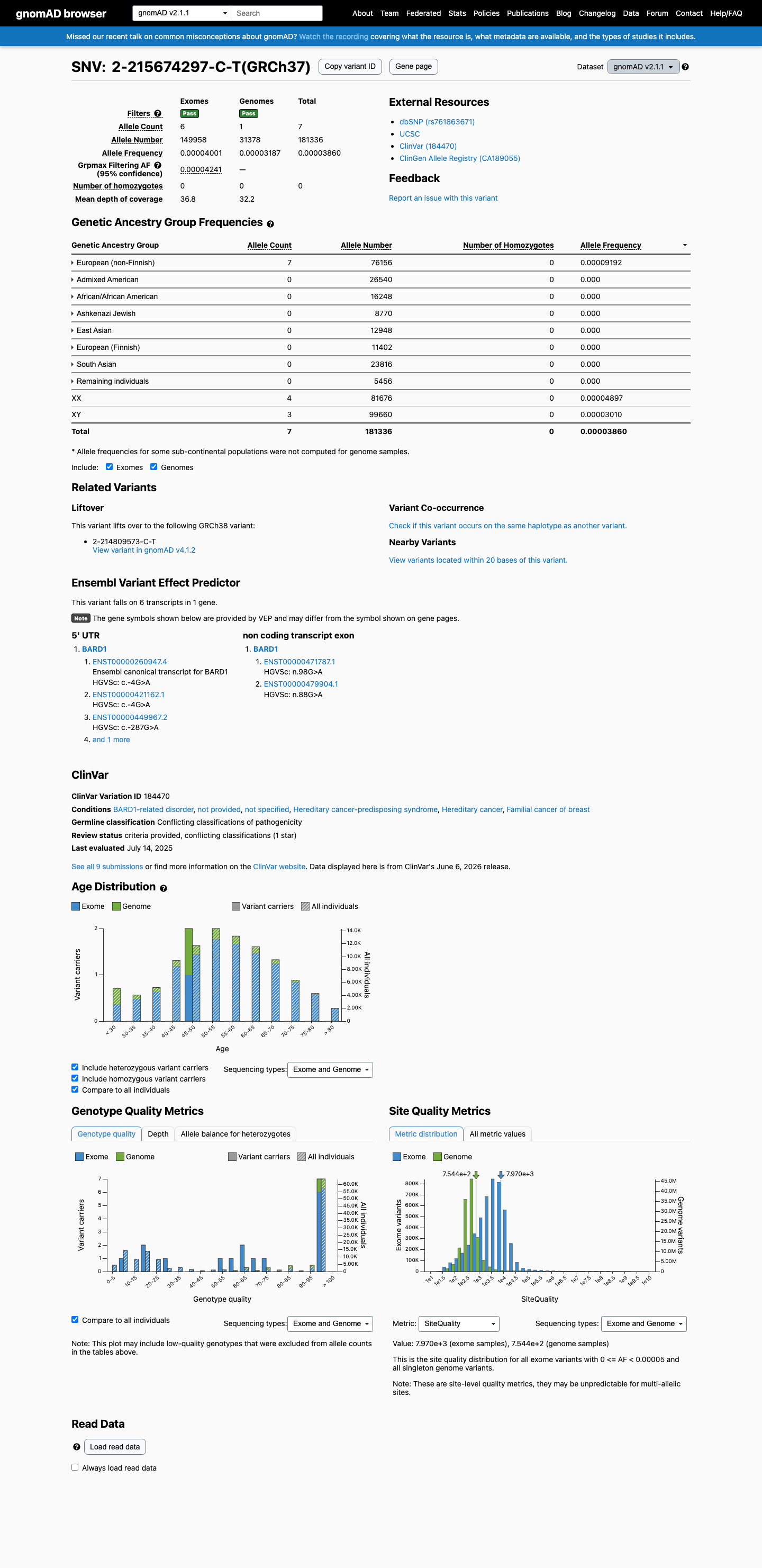
gnomAD v2.1 reports AF 3.86024e-05 from 7 of 181336 alleles, with zero homozygotes; the highest reported ancestry AF is 9.19166e-05 in European non-Finnish individuals.gnomAD v4.1 reports AF 5.11611e-05 from 79 of 1544142 alleles, with zero homozygotes; the highest reported ancestry AF is 6.53212e-05 in European non-Finnish individuals.Both default all-comers gnomAD frequencies are below the supplied PM2 supporting threshold of <=0.0001, the ClinGen SVI recommendation supplied for this adjudication (PMID:25741868).
Assessed · not applied
· 5 not met · 11 not assessed
Pathogenic
PS2Not assessed: no proband-level de novo observation or confirmed absence of BARD1 c.-4G>A in both biological parents is documented.
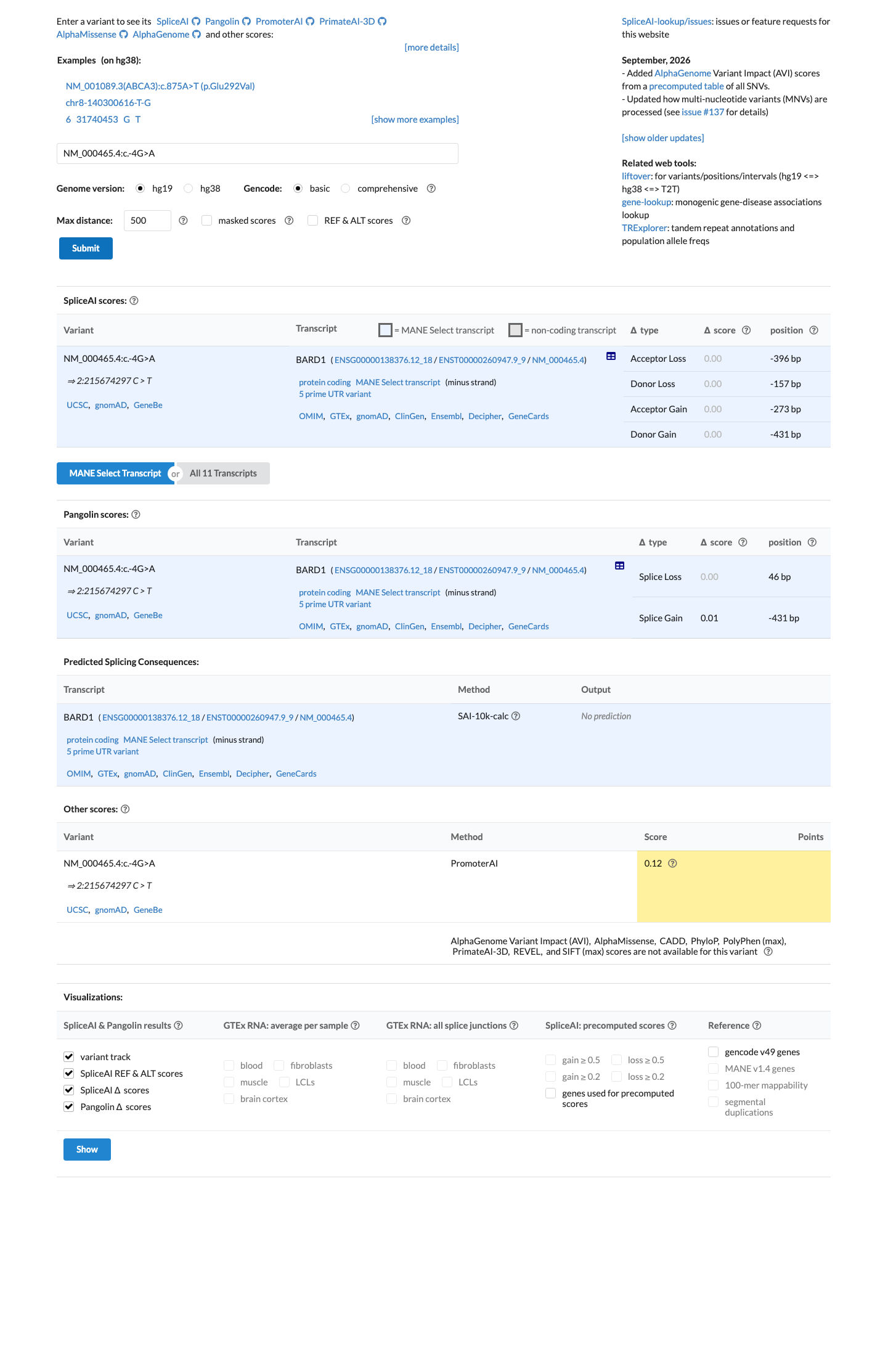
PS3Not assessed: no validated variant-specific functional assay was identified, and the available SpliceAI maximum delta was 0.002 rather than experimental evidence.
PS4Not assessed: no case-control enrichment, odds ratio, or variant-specific affected-case series is available for NM_000465.4:c.-4G>A.
PM3Not assessed: no affected-proband biallelic observation or phase-confirmed pathogenic variant in trans is documented for BARD1 c.-4G>A.
PM6Not assessed: no apparently de novo BARD1 c.-4G>A occurrence without confirmed parental testing is documented.
PP1Not assessed: no informative affected-relative genotypes or meioses are documented to demonstrate segregation of BARD1 c.-4G>A.
PP4Not assessed: no patient phenotype, family history, or variant-specific phenotype correlation is documented for PP4.
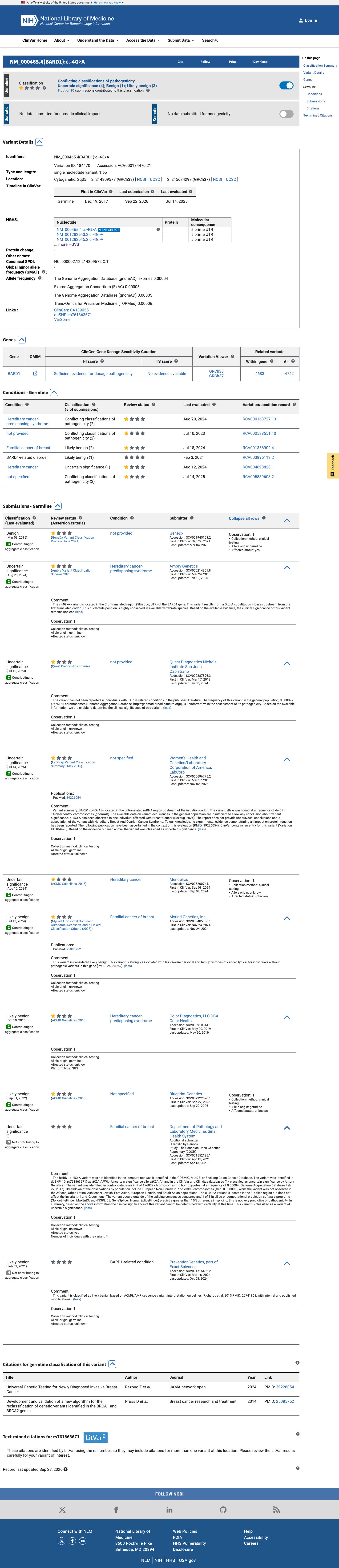
PP5Not met: ClinVar variation 184470 has zero expert-panel submissions and no expert-panel Pathogenic or Likely pathogenic classification.
Benign
BA1Not met: gnomAD v4.1 total allele frequency is 5.11611e-05, far below the BA1 threshold of >=0.05.
BS1Not met: the highest reported frequency is 0.0002716505 in gnomAD-Canada, below the generic BS1 threshold of >=0.01.
BS2Not met: all available population datasets report zero homozygotes, with no qualifying healthy-adult genotype observation.
BS3Not assessed: no validated benign functional assay was identified, while the SpliceAI maximum delta of 0.002 is not experimental evidence.
BS4Not assessed: no informative unaffected-relative testing or age- and phenotype-qualified non-segregation data are documented.
BP2Not assessed: no documented co-occurrence of BARD1 c.-4G>A with another pathogenic variant and no phase information is available.
BP5Not assessed: no affected case with this exact variant and a confirmed alternate molecular basis for disease is documented.
BP6Not met: ClinVar variation 184470 has zero expert-panel submissions; its Benign and Likely benign labels are ordinary laboratory assertions.
This variant is present in gnomAD v4.1 (AF= 5.11611e-05; MAF= 0.00512%, 79/1544142 alleles, homozygotes = 0) and has highest observed frequency in the European (non-Finnish) population (AF= 6.53212e-05; MAF= 0.00653%, 75/1148172 alleles, homozygotes = 0); grpmax FAF= 5.336e-05.
v2.1
This variant is present in gnomAD v2.1 (AF= 3.86024e-05; MAF= 0.00386%, 7/181336 alleles, homozygotes = 0) and has highest observed frequency in the European (non-Finnish) population (AF= 9.19166e-05; MAF= 0.00919%, 7/76156 alleles, homozygotes = 0); grpmax FAF= 4.241e-05.
🇨🇦 CA
This variant is present in gnomAD-Canada v1.0 (AF= 0.00027165054873410846, 5/18406 alleles, homozygotes = 0).
Allele frequency by ancestry
three datasets · side by side
gnomAD v4.1
0.0051%
· 79 / 1,544,142
0 hom · FAF 0.0053%
European (non-Finnish)
75 / 1,148,172
0.0065%
Remaining individuals
2 / 60,000
0.0033%
Admixed American
1 / 52,478
0.0019%
African/African American
1 / 73,214
0.0014%
+ 6 not observed (European (Finnish), Amish, East Asian, Middle Eastern, South Asian, Ashkenazi Jewish)
gnomAD v2.1
0.0039%
· 7 / 181,336
0 hom · FAF 0.0042%
European (non-Finnish)
7 / 76,156
0.0092%
+ 7 not observed (African/African American, Admixed American, Ashkenazi Jewish, East Asian, European (Finnish), Remaining individuals, South Asian)
gnomAD Canada 🇨🇦
0.027%
· 5 / 18,406
0 hom
Latino/Admixed American
1 / 836
0.12%
European (non-Finnish)
4 / 11,736
0.034%
+ 7 not observed (African/African American, Ashkenazi Jewish, East Asian, European (Finnish), Middle Eastern, Remaining individuals, South Asian)
This variant has been reported in ClinVar as Uncertain significance (5 clinical laboratories) and as Likely benign (4 clinical laboratories) and as Benign (1 clinical laboratory). (ClinVarID = 184470)
Each card is an audit: what was searched, what was found, whether it names the variant, which criteria it fed, and why. 7 further PMIDs triaged but not cited — see Sources & references.
Standards and guidelines for the interpretation of sequence variants: a joint consensus recommendation of the American College of Medical Genetics and Genomics and the Association for Molecular Pathology.
Both default all-comers gnomAD frequencies are below the supplied PM2 supporting threshold of <=0.0001, the ClinGen SVI recommendation supplied for this adjudication (PMID:25741868).
Applied to
→PM2
supporting
Sources & reference links
7Sources
ClinVar
gnomAD v2.1
gnomAD v4.1
gnomAD-Canada
SpliceAI
OncoKB
COSMIC
Triaged references · 7 PMIDs not cited in assessment
26467025 ↗A Standardized DNA Variant Scoring System for Pathogenicity Assessments in Mendelian Disorders.CLINVAR
34242744 ↗Customizing local and systemic therapies for women with early breast cancer: the St. Gallen International Consensus Guidelines for treatment of early breast cancer 2021.CLINVAR
15604628 ↗Genetic cancer risk assessment and counseling: recommendations of the national society of genetic counselors.CLINVAR
20301425 ↗BRCA1- and BRCA2-Associated Hereditary Breast and Ovarian Cancer.CLINVAR
25085752 ↗Development and validation of a new algorithm for the reclassification of genetic variants identified in the BRCA1 and BRCA2 genes.CLINVAR
26389258 ↗Cancer Genetics Risk Assessment and Counseling (PDQ®): Health Professional VersiCLINVAR
34012068 ↗ACMG SF v3.0 list for reporting of secondary findings in clinical exome and genome sequencing: a policy statement of the American College of Medical Genetics and Genomics (ACMG).CLINVAR