NM_000465.4:c.1835A>T (p.Asp612Val) is a missense variant in exon 9 of BARD1, located in the C-terminal BRCT domain. It is rare in population databases, with an allele frequency of 0.012% in gnomAD v4.1 (199/1,613,842 alleles, 0 homozygotes).1 Functional data from a published homology-directed repair assay (PMID:30925164) demonstrated that p.Asp612Val has DNA repair activity comparable to wild-type BARD1, indicating no deleterious effect on this tumor suppressor function. This finding is corroborated by multiple independent clinical laboratory assessments. Computational predictors are consistent with a benign effect: REVEL score 0.27 and BayesDel score -0.224875 both predict a benign impact. While SpliceAI delta score is 0.65, this is not corroborated by the protein-level in silico tools.2 BARD1 disease mechanism is loss-of-function through truncating variants; missense variants without demonstrated functional impact are less likely to be pathogenic. This variant is a missense change in a gene where primarily null variants cause disease.3 In ClinVar, this variant has conflicting classifications: 9 clinical laboratories report it as Uncertain Significance and 5 report it as Likely Benign. No expert panel has reviewed this variant. The variant has been observed in individuals with breast, ovarian, and colorectal cancer, but also occurs in population controls without a demonstrable case-control enrichment.4 Applying ACMG/AMP 2015 criteria: PM1 (supporting, BRCT domain), PM2 (supporting, rare in population) are met for pathogenic evidence. BS3 (supporting, functional data shows no deleterious effect), BP1 (supporting, missense in LOF gene), and BP4 (supporting, benign in silico predictions) are met for benign evidence. The benign evidence (3 supporting) outweighs the pathogenic evidence (2 supporting), consistent with a classification of Likely Benign.5
Final classification
Likely Benign
PM1PM2BP1BP4
BARD1
c.1835A>T
p.Asp612Val
missense
This variant
NM_000465.4:c.1835A>T (p.Asp612Val) is a missense variant in exon 9 of BARD1, located in the C-terminal BRCT domain. It is rare in population databases, with an allele frequency of 0.012% in gnomAD v4.1 (199/1,613,842 alleles, 0 homozygotes).
gene-specific framework lacked a usable explicit final combination framework, so generic ACMG/AMP 2015 final-combination rules were applied as fallback; applied criteria: PM1 supporting, PM2 supporting, BP1 supporting benign, BP4 supporting benign; combination = 2 supporting + 2 supporting benign, which maps to Likely Benign.
Classification rationale
PM1PM2
BP1BP4
Likely Benign
BARD1 c.1835A>T
missense
PM1 + PM2 + BP1 + BP4
→
Likely Benign
LYFE Sciences is an AI system, and it can make mistakes. Criteria
may be applied incorrectly, sources may be misread, and a confident-looking
classification can still be wrong. Double-check every criterion and
its underlying evidence before relying on any call.
Gene diagram
· NM_000465.4 · variants mapped to exon structure
BARD1
NM_000465.4
Fetching transcript structure from UCSC…
Applied criteria · 4 applied · 17 assessed
MetEvidence satisfies this criterion.
Not metEvaluated against available evidence; threshold not reached.
Not assessedApplies in principle, but no evidence was found to evaluate it.
N/ADoesn't apply to this variant type.
Applied · 4
Strength
Supporting
Moderate
Strong
Very strong
PM1
supporting
Pathogenic
p.Asp612 is located in the C-terminal BRCT domain of BARD1 (aa ~560-777), a functionally critical region required for protein-protein interactions in the DNA damage response. The BRCT domain is a well-characterized functional domain; however, the Asp612 residue shows poor evolutionary conservation and does not lie within a statistically significant mutational hotspot (cancerhotspots.org negative). Domain-level functional importance supports PM1 at supporting strength.
BRCT domain (IPR001357) location confirmed by ClinVar submission SCV002067829 and SCV001337907domain is known to be functional in DNA damage response. Residue is poorly conserved per SCV002067829. Cancerhotspots.org: residue not significant.
PM2
supporting
Pathogenic
Variant is rare in population databases. gnomAD v2.1: AF = 0.00743% (21/282,498 alleles, 0 homozygotes); gnomAD v4.1: AF = 0.01233% (199/1,613,842 alleles, 0 homozygotes); grpmax FAF = 0.0141%. Both allele frequencies are below the 0.1% PM2 threshold for non-VCEP frameworks. Absent from gnomAD-Canada.
gnomAD v2.1 AF 0.00743% (<0.1%)gnomAD v4.1 AF 0.01233% (<0.1%)0 homozygotes in all datasets.
BP1
supporting
Benign
Missense variant in BARD1, a gene where primarily truncating (loss-of-function) variants are established as pathogenic through germline disease association. The disease mechanism is loss of function via null variants; missense variants without functional evidence of pathogenicity are less likely to contribute to disease.
BARD1 LOF mechanism supported by germline literature (PMID:28709830PMID:35353237). Truncating variants are the primary pathogenic variant type.
BP4
supporting
Benign
Multiple lines of computational evidence suggest no deleterious impact on the gene product. REVEL score 0.27 predicts a benign effect. BayesDel score -0.224875 predicts a benign effect. SpliceAI max delta 0.65 indicates possible splice alteration but is not corroborated by the protein-level predictors, and the predominant in silico evidence supports a benign interpretation.
REVEL 0.27 (benignbelow 0.5 threshold)BayesDel -0.224875 (benign
Assessed · not applied
· 16 not met · 1 not assessed
Pathogenic
PS1
No alternative nucleotide change at this codon producing the same amino acid substitution (p.Asp612Val) has been reported as pathogenic in ClinVar or the literature.
PS2
No de novo observation has been reported for this variant.
PS3
Functional study (PMID:30925164) demonstrated that p.Asp612Val has homology-directed repair (HDR) activity comparable to wild-type, indicating no deleterious functional effect.
PS4
Variant has been observed in individuals with breast, ovarian, and colorectal cancer but is also present in population controls (gnomAD v4.1: 199/1,613,842 alleles).
PM6
No de novo observation has been reported for this variant.
PP1
No co-segregation data available for this variant.
PP2
BARD1 disease mechanism is primarily loss-of-function through truncating variants.
PP3
Multiple in silico tools predict a benign effect.
PP4
No specific phenotypic data for the proband is available.
PP5
ClinVar classification is Conflicting classifications of pathogenicity with 2-star review status (criteria provided, conflicting classifications).
Benign
BA1
gnomAD v2.1 AF = 0.00743%, v4.1 AF = 0.01233%.
BS1
gnomAD v2.1 AF = 0.00743%, v4.1 AF = 0.01233%.
BS2
Although present in gnomAD (21-199 alleles across datasets), the low allele count in a gene of moderate penetrance like BARD1 does not establish observation in healthy adults at a frequency clearly inconsistent with disease penetrance.
BS3
Variant-specific functional data from PMID:30925164 demonstrates that p.Asp612Val exhibits homology-directed repair (HDR) activity comparable to wild-type BARD1, indicating no deleterious effect on this DNA repair function.
BP2
No data on whether this variant has been observed in trans with a pathogenic variant in BARD1.
BP5
No evidence that this variant is found in a case with an alternate molecular basis for disease (e.g., a different pathogenic variant explaining the phenotype).
BP6
ClinVar classification is Conflicting classifications of pathogenicity with 2-star review status (criteria provided, conflicting classifications).
N/A · 4
PVS1 · PM5 · BS4 · BP7
Research & evidence
Population frequency · supports benign
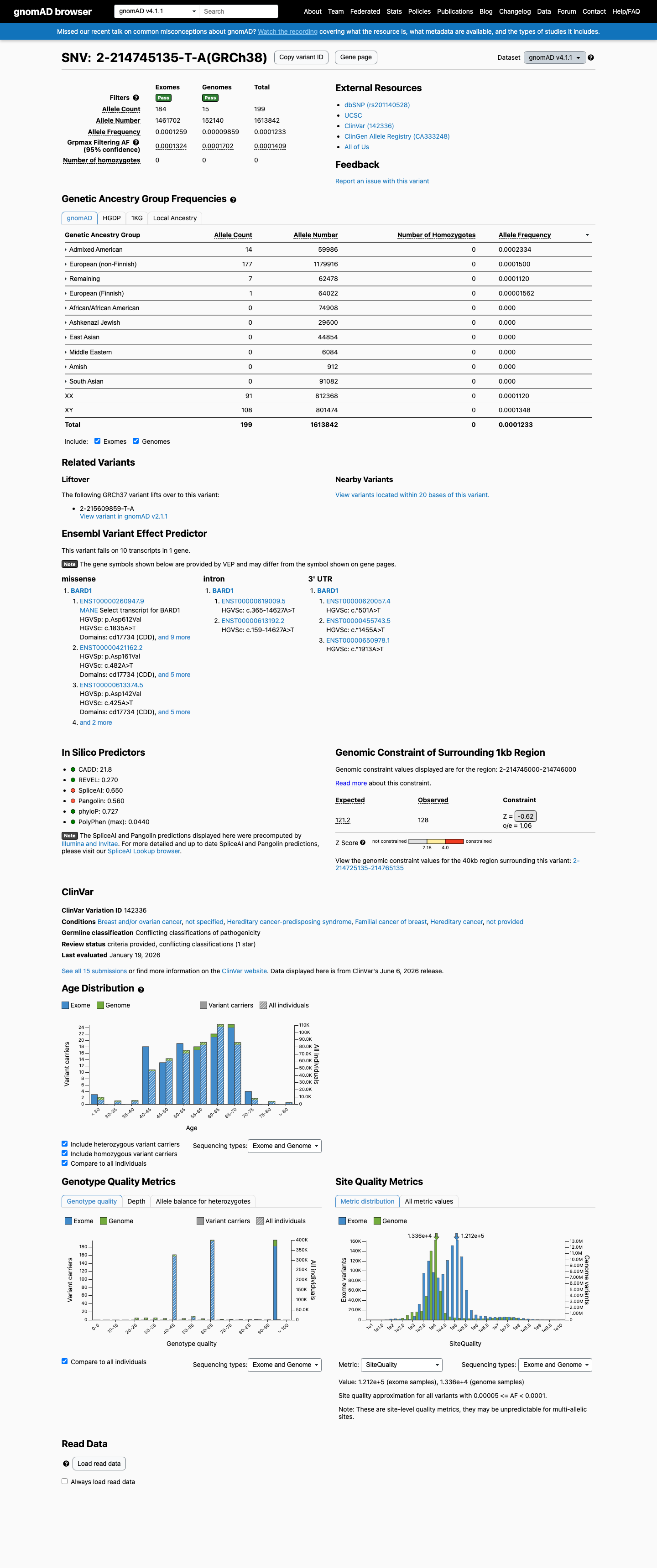
gnomAD v4.1
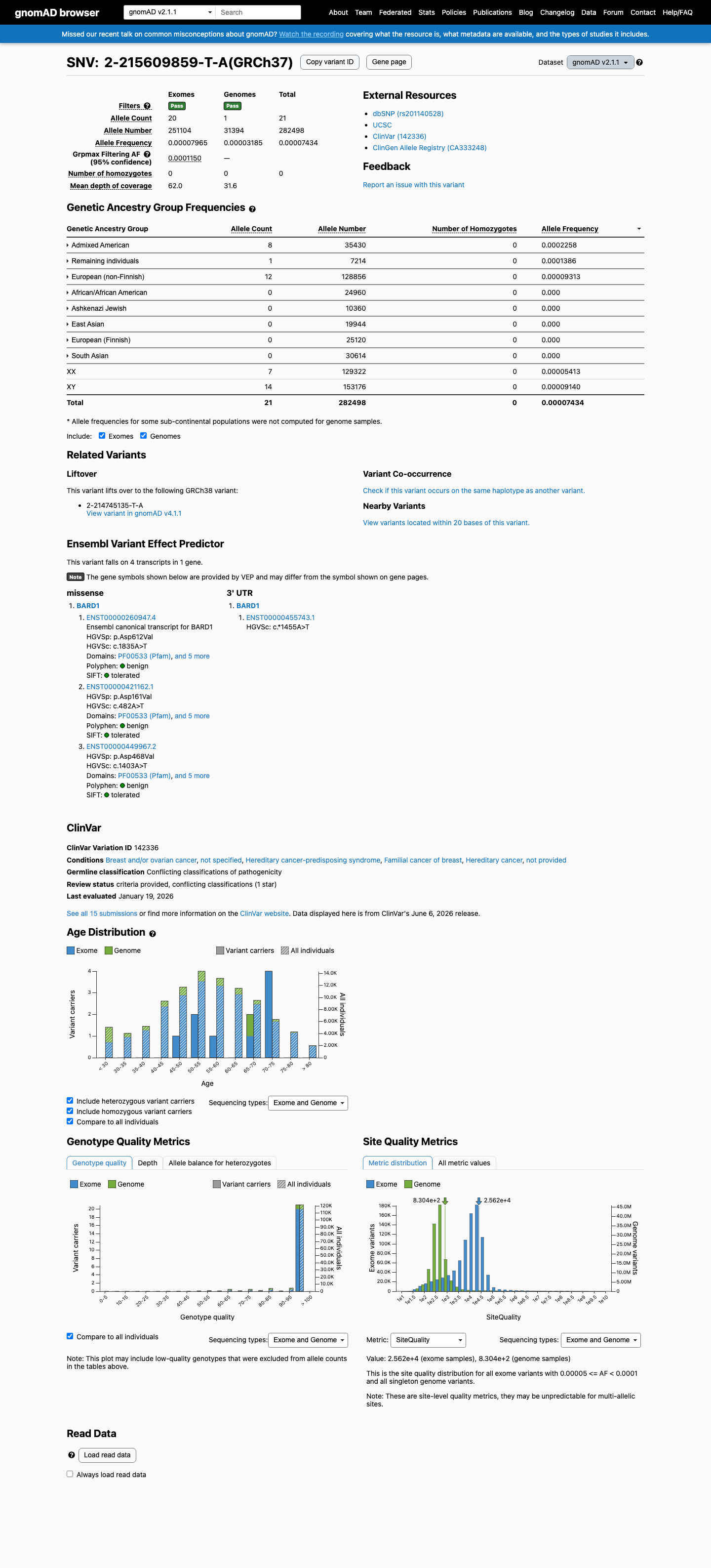
gnomAD v2.1
v4.1
This variant is present in gnomAD v4.1 (AF= 0.000123308; MAF= 0.01233%, 199/1613842 alleles, homozygotes = 0) and has highest observed frequency in the Admixed American population (AF= 0.000233388; MAF= 0.02334%, 14/59986 alleles, homozygotes = 0); grpmax FAF= 0.00014093.
v2.1
This variant is present in gnomAD v2.1 (AF= 7.43368e-05; MAF= 0.00743%, 21/282498 alleles, homozygotes = 0) and has highest observed frequency in the Admixed American population (AF= 0.000225797; MAF= 0.02258%, 8/35430 alleles, homozygotes = 0); grpmax FAF= 0.00011501.
🇨🇦 CA
This variant is present in gnomAD-Canada v1.0 (AF= 0.0003259806584809301, 6/18406 alleles, homozygotes = 0).
Allele frequency by ancestry
three datasets · side by side
gnomAD v4.1
0.012%
· 199 / 1,613,842
0 hom · FAF 0.014%
0 hom · FAF 0.014%
Admixed American 14 / 59,986 |
0.023% |
European (non-Finnish) 177 / 1,179,916 |
0.015% |
Remaining individuals 7 / 62,478 |
0.011% |
European (Finnish) 1 / 64,022 |
0.0016% |
+ 6 not observed (Amish, East Asian, Middle Eastern, South Asian, Ashkenazi Jewish, African/African American)
gnomAD v2.1
0.0074%
· 21 / 282,498
0 hom · FAF 0.012%
0 hom · FAF 0.012%
Admixed American 8 / 35,430 |
0.023% |
Remaining individuals 1 / 7,214 |
0.014% |
European (non-Finnish) 12 / 128,856 |
0.0093% |
+ 5 not observed (African/African American, Ashkenazi Jewish, East Asian, European (Finnish), South Asian)
gnomAD Canada 🇨🇦
0.033%
· 6 / 18,406
0 hom · FAF 0.022%
0 hom · FAF 0.022%
European (non-Finnish) 6 / 11,730 |
0.051% |
+ 8 not observed (African/African American, Latino/Admixed American, Ashkenazi Jewish, East Asian, European (Finnish), Middle Eastern, Remaining individuals, South Asian)

ClinVar
This variant is present in ClinVar (Variation ID: 142336); submission details unavailable.
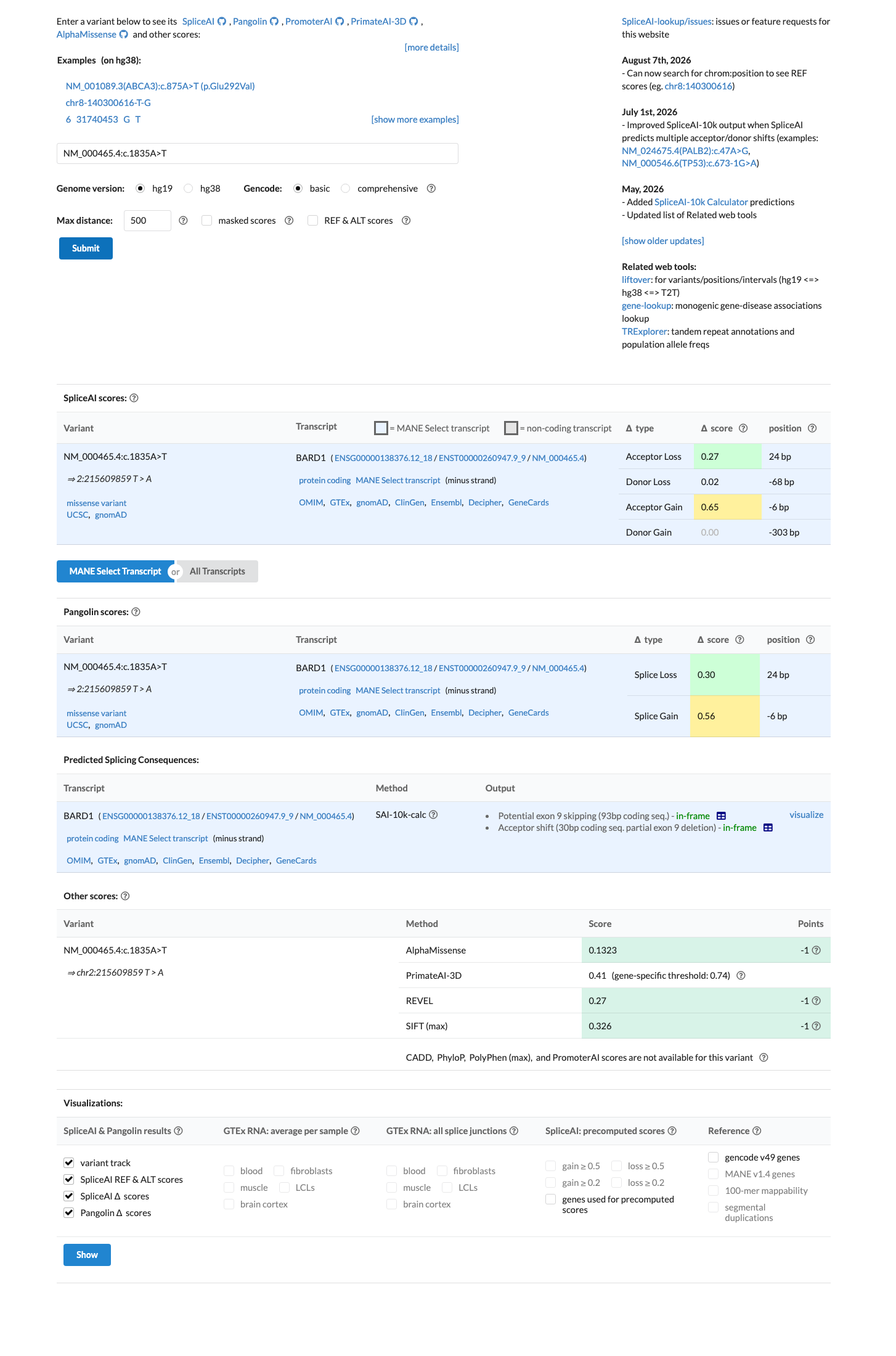
In silico
SpliceAI predicts possible splice impact for this variant (max delta score = 0.65). REVEL score = 0.27. BayesDel score = -0.224875.
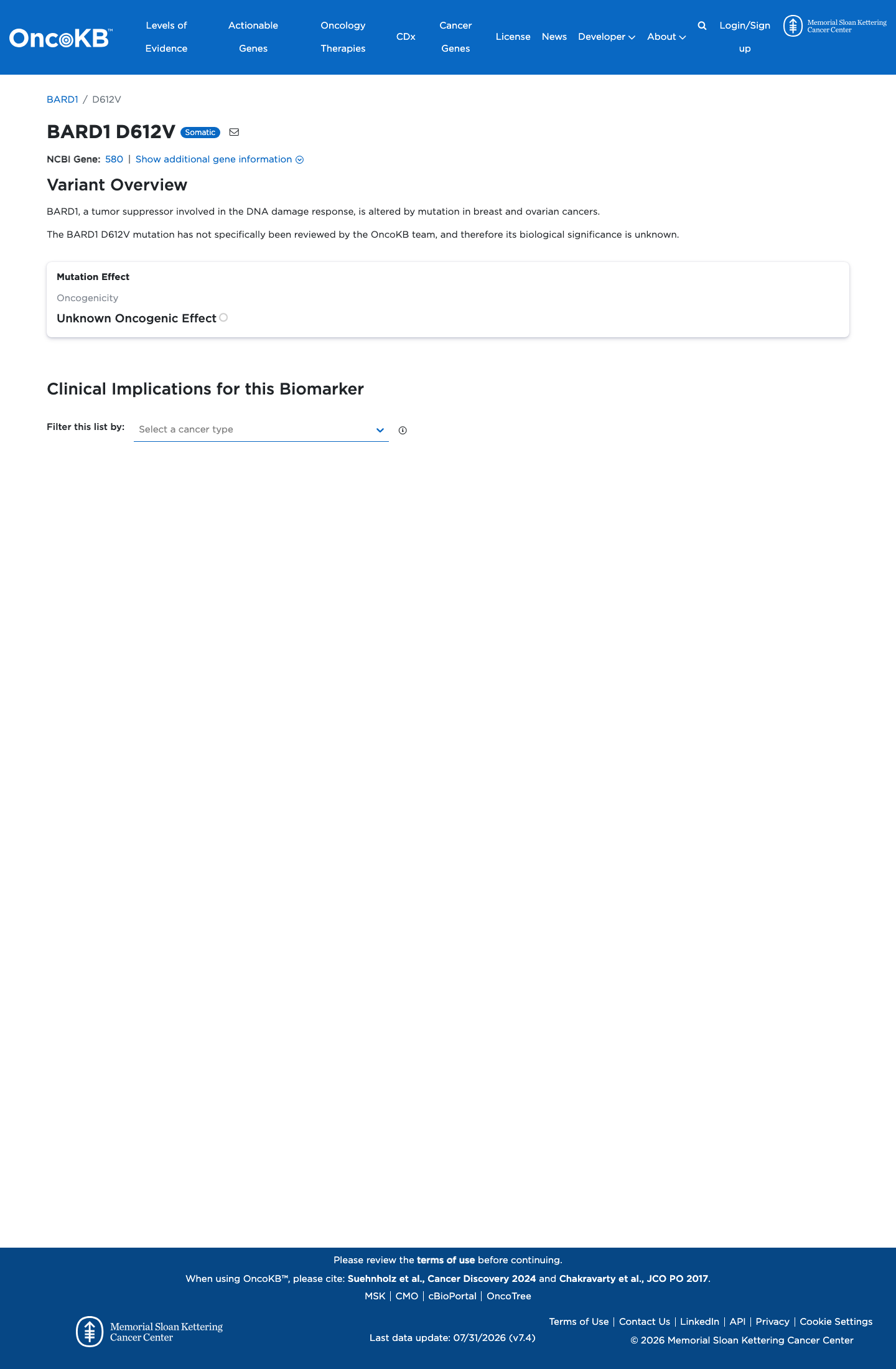
Functional
Unknown Oncogenic Effect
OncoKB did not identify variant-specific reviewed functional evidence for this variant; gene-level curated context is available for reviewer follow-up. BARD1, a tumor suppressor involved in the DNA damage response, is altered by mutation in breast and ovarian cancers.

COSMIC

Cancer hotspots
Somatic evidence
Not in COSMIC / hotspots
COSMIC
This variant does not lie in a statistically significant hotspot. This variant has not previously been reported in somatic cancers (COSMIC).
Hotspots
This variant does not lie in a statistically significant hotspot.
Sources & reference links
Triaged references · 8 PMIDs not cited in assessment
25085752 ↗
Development and validation of a new algorithm for the reclassification of genetic variants identified in the BRCA1 and BRCA2 genes.
CLINVAR
26315354 ↗
Germline Mutations in the BRIP1, BARD1, PALB2, and NBN Genes in Women With Ovarian Cancer.
CLINVAR