Back
NM_000465.4:c.354T>C
p.Asn118= · BARD1
ACMG/AMP
0%
complete
Final classification
VUS
PM2BP4
BARD1
c.354T>C
p.Asn118=
synonymous · exon 3

BARD1 encodes a protein that partners with BRCA1 to form a complex essential for repairing damaged DNA, particularly double-stranded breaks, and for maintaining genome stability through cell-cycle checkpoints and chromatin regulation. Germline mutations in BARD1 predispose to breast and ovarian cancer, among other cancers, and the gene is generally regarded as a tumor suppressor, although some evidence suggests it can also promote cancer in certain cellular contexts.

This variant

BARD1 encodes the BRCA1-associated RING domain protein that partners with BRCA1 in double-strand break repair and genome maintenance, and germline loss-of-function variation in this tumour-suppressor gene confers autosomal dominant susceptibility to breast and ovarian cancer; this synonymous change leaves the encoded Asn118 residue and the predicted splice pattern unaltered, so it provides no gene-level mechanistic support for disease.
Transcript
NM_000465.4
HGVS · transcript:coding
NM_000465.4:c.354T>C
GRCh38
chr2:214792307 A>G
GRCh37
chr2:215657031 A>G
VUS: PM2 (supporting, absent from gnomAD) and BP4 (supporting, SpliceAI 0.009) leave conflicting supporting-level evidence that meets no Pathogenic or Benign combination rule.
Classification rationale
PM2 BP4 VUS
BARD1 c.354T>C synonymous · exon 3

PM2 (supporting): absent from gnomAD v2.1 and v4.1 and both non-cancer subsets, with API verification, so the allele frequency is effectively 0. BP4 (supporting): SpliceAI maximum delta score 0.009 for this synonymous variant is at or below the <=0.1 no-splice-impact cutoff. PP3 not met: the same SpliceAI score of 0.009 is far below the >=0.2 supporting cutoff for a predicted splice effect. PVS1, PS1, PM1, PM4, PM5, PP2, BP1 not applicable: a synonymous p.(Asn118=) change satisfies none of their structural prerequisites. PS4 and PP4 not met: no affected carrier, cohort enrichment or proband phenotype is reported for this variant. PP5 and BP6 not met: ClinVar variation 3260425 has zero expert-panel (3-star) submissions, only two single-laboratory classifications. BA1, BS1 and BS2 not met: zero observed alleles and no heterozygous or homozygous carriers in gnomAD, so no frequency-based benign argument is available. No VCEP/CSPEC or local BARD1 framework exists, so generic ACMG/AMP 2015 combination rules were applied.

PM2 + BP4 → VUS
LYFE Sciences is an AI system, and it can make mistakes. Criteria may be applied incorrectly, sources may be misread, and a confident-looking classification can still be wrong. Double-check every criterion and its underlying evidence before relying on any call.
Gene diagram · NM_000465.4 · variants mapped to exon structure
BARD1 NM_000465.4
Fetching transcript structure from UCSC…
Applied criteria · 2 applied · 18 assessed
MetEvidence satisfies this criterion.
Not metEvaluated against available evidence; threshold not reached.
Not assessedApplies in principle, but no evidence was found to evaluate it.
N/ADoesn't apply to this variant type.
Applied · 2
Strength Supporting Moderate Strong Very strong
PM2 supporting review Pathogenic
Met (supporting): absent from gnomAD v2.1 and v4.1, satisfying the <=0.0001 PM2 frequency threshold, though this is a synonymous change.
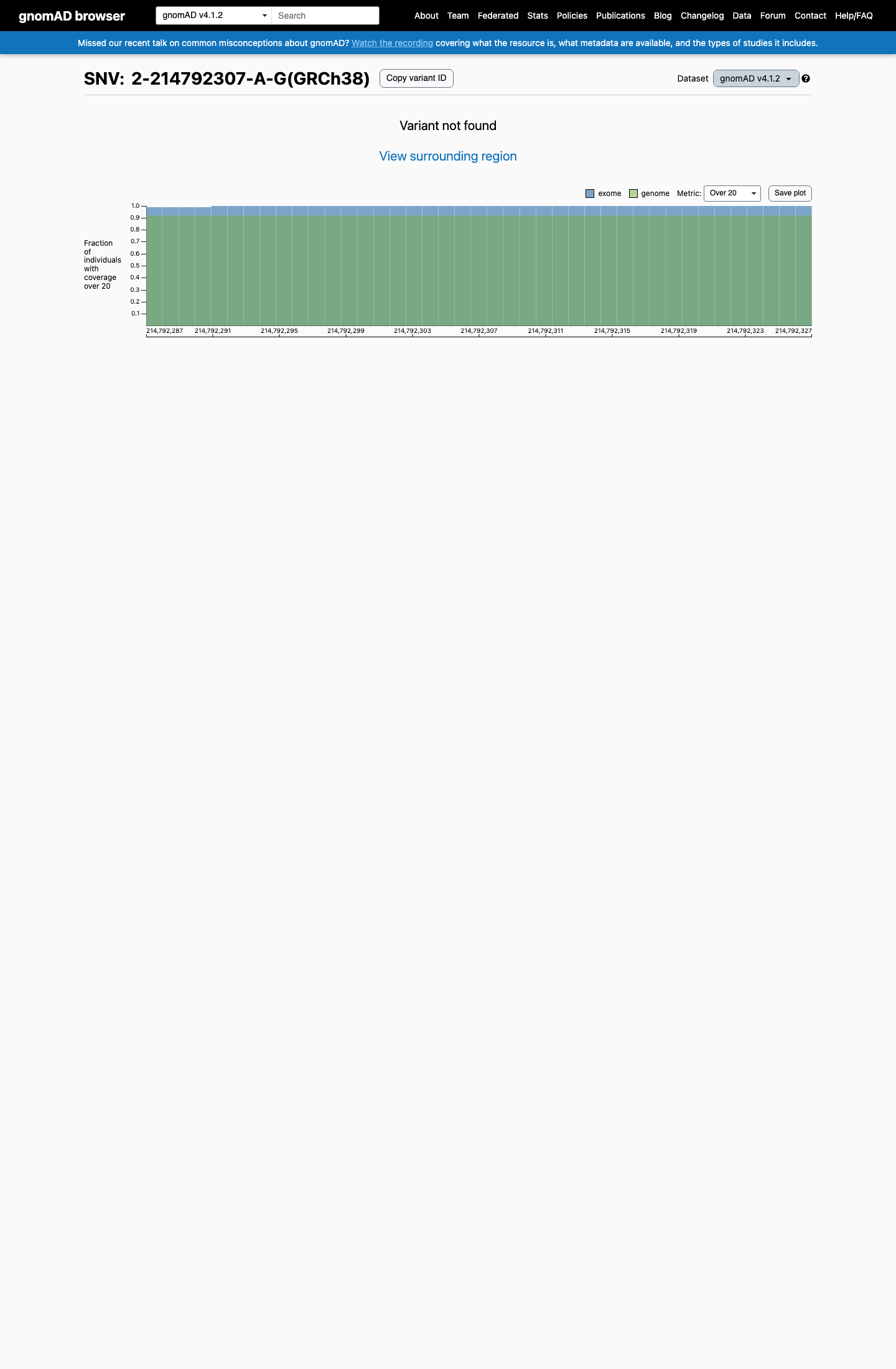
gnomAD v2.1 (exomes, all-comers) reports the variant absent - no allele count, no allele frequency, no homozygotes.gnomAD v4.1 reports the variant absent - no allele count, no allele frequency, no homozygotes.GNOMAD_V2_1_NON_CANCER (reported by its exome-only figures) and GNOMAD_V3_1_NON_CANCER (genomes only) both report absence, so no non-cancer-cohort allele frequency exists either.
BP4 supporting Benign
Met at supporting strength: SpliceAI max delta 0.009 is at or below the <=0.1 no-splice-impact BP4 cutoff, counted once and not reused for BP7.
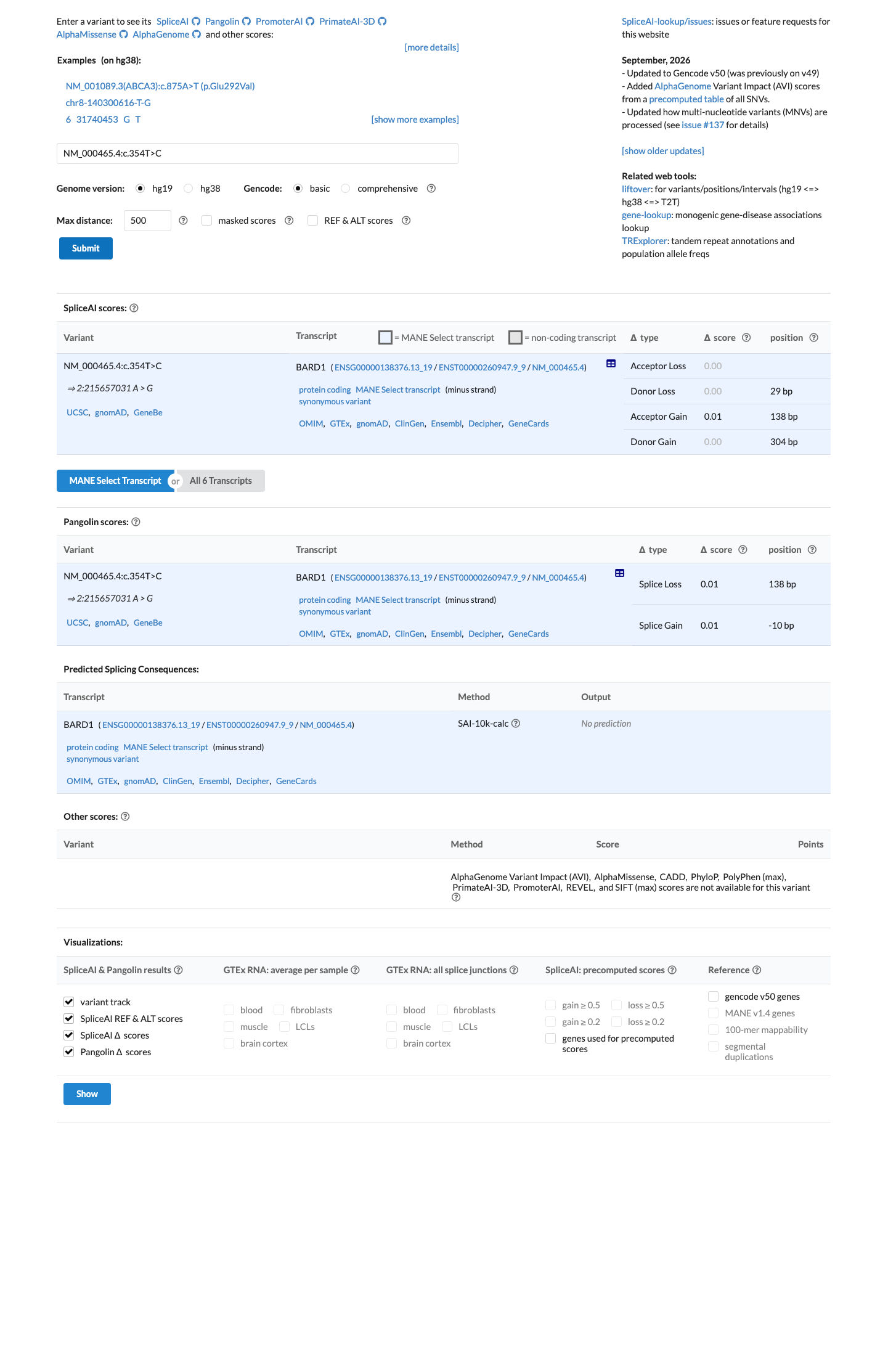
Consequence type fixed first: NM_000465.4:c.354T>C = NP_000456.2:p.(Asn118=) (Mutalyzer/VariantValidator normalisation in prefetch.json), so BP4 is assessed on the SpliceAI splice path only; the REVEL missense path does not apply to a synonymous change (REVEL not found) and BayesDel has no generic ACMG-strength calibration.SpliceAI Lookup for NM_000465.4:c.354T>C / 2-215657031-A-G: maximum delta score 0.009 (DS_AG 0.009, DS_AL 0.000, DS_DG 0.001, DS_DL 0.003), DP_AG 138, DP_DL 29, DP_DG 304; Pangolin SG 0.015, SL -0.007; spliceai_available = true.Threshold applied verbatim from the supplied generic ACMG/ClinGen-SVI calibration: SpliceAI max delta <= 0.1 -> BP4 (supporting) (Jaganathan et al. 2019, Cell, PMID:30661751); 0.009 satisfies it.
Assessed · not applied · 9 not met · 9 not assessed
Pathogenic
PS2 Not assessed: no proband or parental testing exists, so the confirmed de novo status PS2 requires cannot be established.
PS3 Not assessed: no functional assay data exist for BARD1 c.354T>C, and PS3 requires experimental evidence of a damaging effect.
PS4 Not met: zero affected carriers or case-control data reported for BARD1 c.354T>C, so no enrichment statistic exists to support PS4.
PM3 Not assessed: no affected-proband genotype, second BARD1 pathogenic allele, or phase evidence exists to meet the PM3 in-trans requirement.
PM6 Not assessed: no proband or parental genotype data exists, so an assumed de novo occurrence for PM6 cannot be evaluated.
PP1 Not assessed: no pedigree or family genotyping data exists, so co-segregation for PP1 cannot be evaluated.
PP3 Not met: SpliceAI max delta 0.009 is far below the >=0.2 PP3 supporting cutoff for this synonymous variant, which is scored on the splice path only.
PP4 Not met: no proband or family phenotype is documented for BARD1 c.354T>C, so phenotype specificity for a single-gene disease cannot be established.
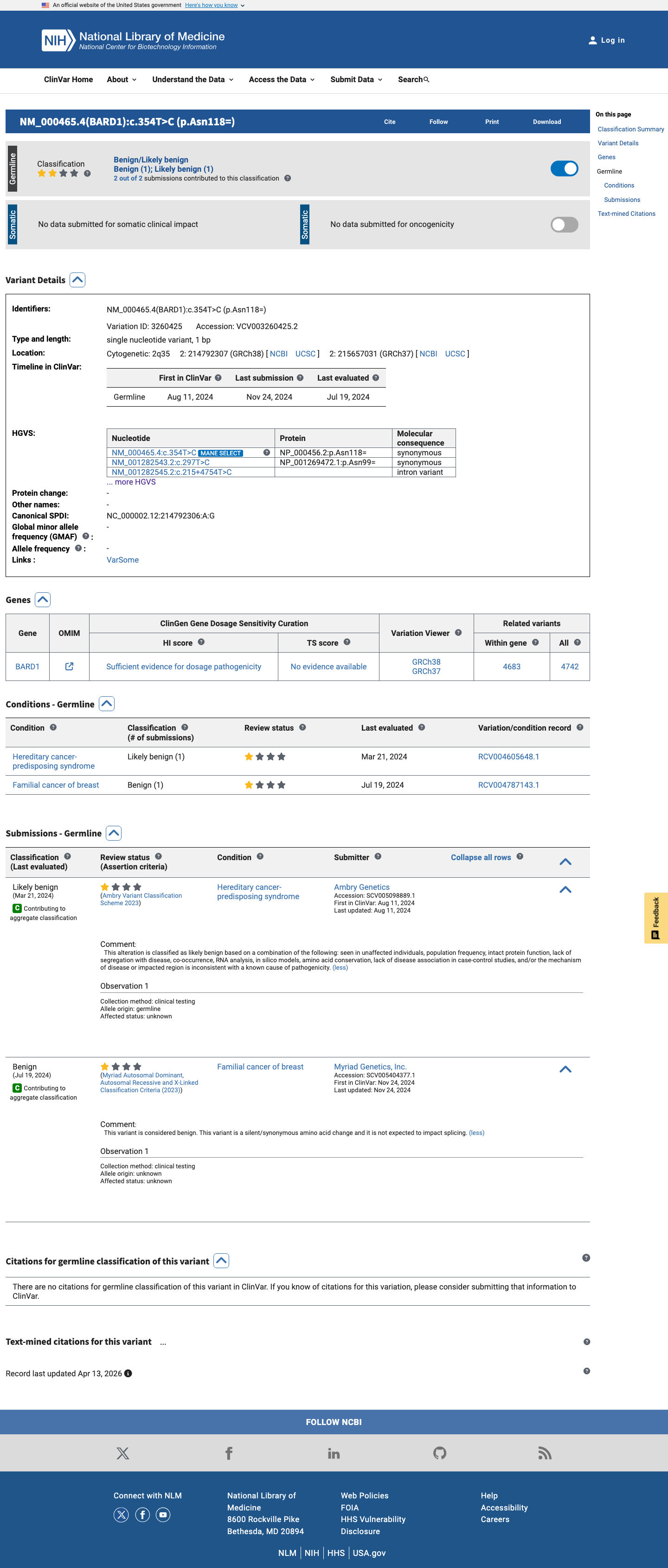
PP5 Not met: ClinVar has zero expert-panel (3-star) classifications of this variant, only two single-laboratory submissions (Ambry Likely benign, Myriad Benign).
Benign
BA1 Not met: absent from gnomAD v2.1 and v4.1 (frequency effectively 0), far below the >=0.05 BA1 stand-alone benign threshold.
BS1 Not met: absent from gnomAD v2.1/v4.1, giving an allele frequency of ~0 versus the >=0.01 BS1 strong-benign threshold.
BS2 Not met: no carriers of any genotype in gnomAD v2.1/v4.1, so no healthy-adult observation exists to support BS2.
BS3 Not assessed: no functional assay exists for BARD1 c.354T>C, and BS3 requires experimental evidence of no damaging effect.
BS4 Not assessed: no family segregation data exists, so non-segregation with disease for BS4 cannot be demonstrated.
BP2 Not assessed: no cis/trans phase or co-occurring pathogenic BARD1 allele is documented, and no proband-level genotype exists to evaluate BP2.
BP5 Not assessed: no affected case carrying BARD1 c.354T>C is documented, so an alternate molecular cause for disease cannot be evaluated.
BP6 Not met: no expert-panel (3-star) Benign/Likely benign classification exists; the 2-star ClinVar label comes only from two single clinical laboratories.
BP7 Not met: this synonymous variant's only supporting result, SpliceAI max delta 0.009, is already counted under BP4, and no conservation data is available.
N/A · 8 PVS1 · PS1 · PM1 · PM4 · PM5 · PP2 · BP1 · BP3
Research & evidence
Population frequency
gnomAD v4.1 screenshot
gnomAD v4.1
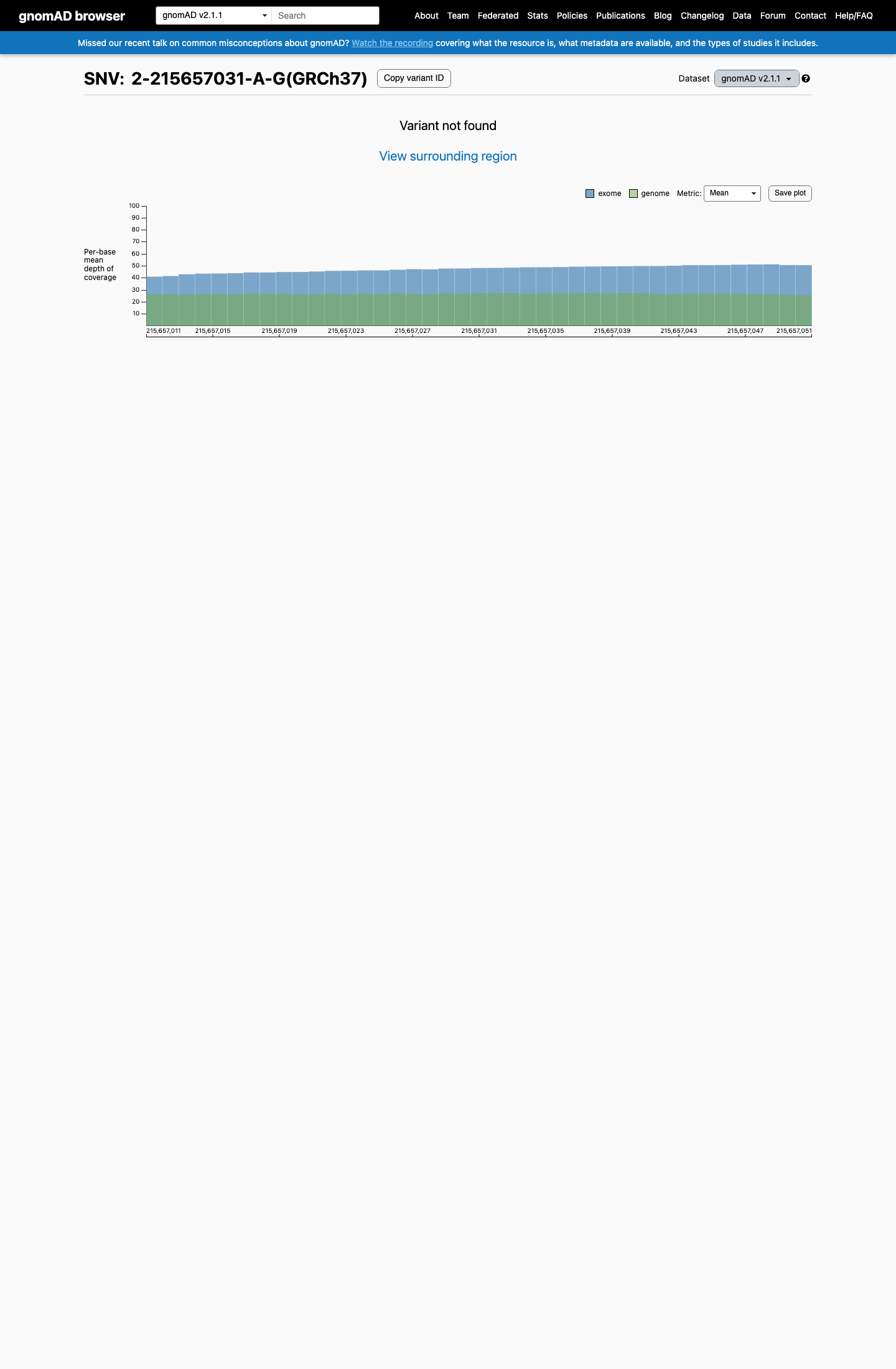
gnomAD v2.1 screenshot
gnomAD v2.1
v4.1
Absent from gnomAD v4.1.
v2.1
Absent from gnomAD v2.1.
🇨🇦 CA
Not available in gnomAD-Canada v1.0.
Allele frequency by ancestry
three datasets · side by side
gnomAD v4.1
Absent · 0 / ?
0 hom
Not observed in any ancestry group.
gnomAD v2.1
Absent · 0 / ?
0 hom
Not observed in any ancestry group.
gnomAD Canada 🇨🇦
Absent · 0 / ?
0 hom
Not observed in any ancestry group.
ClinVar screenshot
ClinVar
This variant has been reported in ClinVar as Likely benign (1 clinical laboratory) and as Benign (1 clinical laboratory). (ClinVarID = 3260425)
SpliceAI screenshot
In silico
SpliceAI predicts no significant splice impact for this variant (max delta score = 0.01).
Functional / OncoKB screenshot
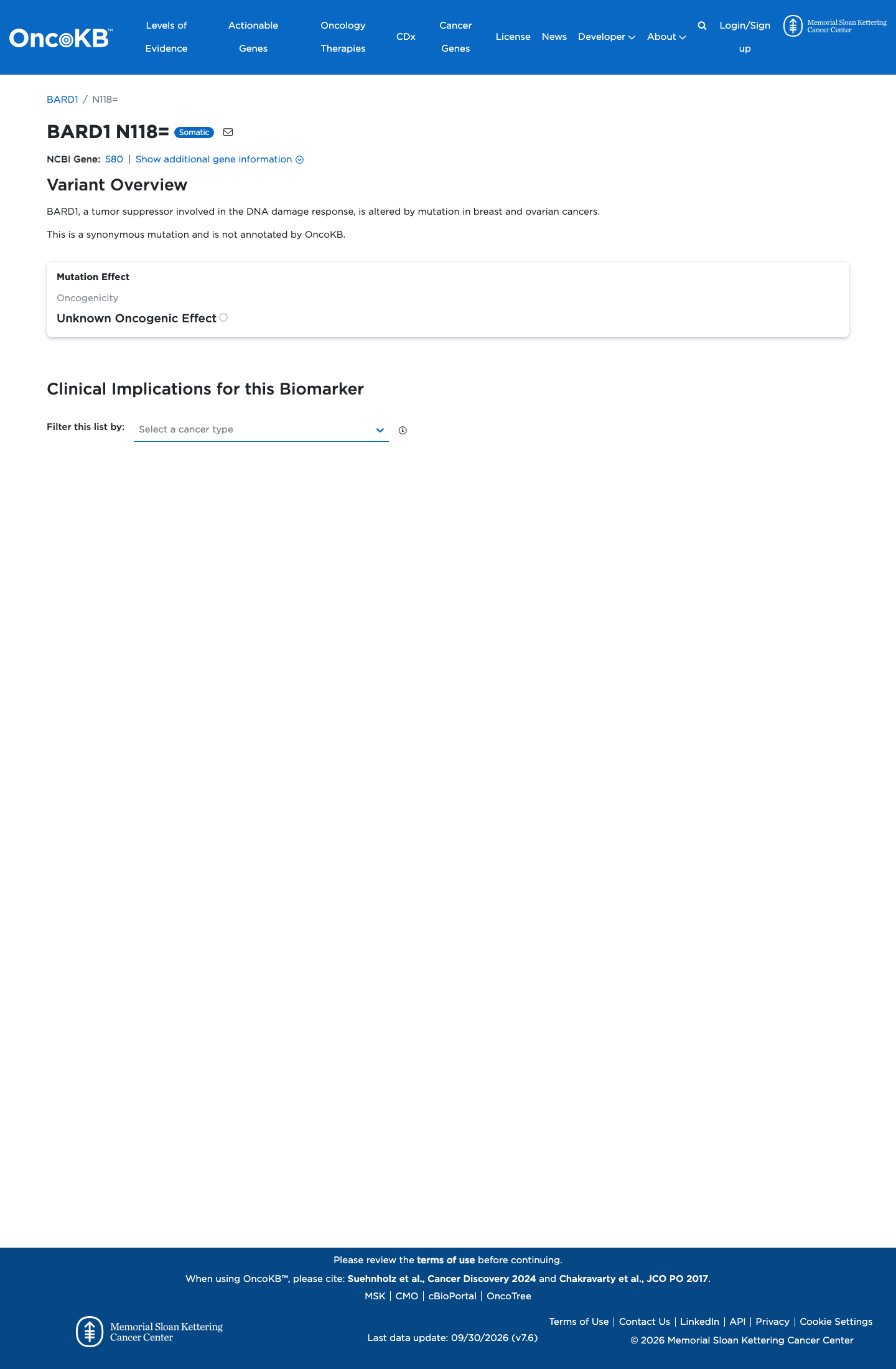
Functional Unknown Oncogenic Effect
OncoKB identified curated literature and non-variant-specific oncogenicity context for review; listed oncogenicity label: Unknown Oncogenic Effect.
OncoKB ↗
COSMIC screenshot
COSMIC
Cancer hotspots screenshot
Cancer hotspots
Somatic evidence Not in COSMIC / hotspots
COSMIC
This variant does not lie in a statistically significant hotspot. This variant has not previously been reported in somatic cancers (COSMIC).
Hotspots
This variant does not lie in a statistically significant hotspot.
Literature · how each cited paper was used
2papers cited
Each card is an audit: what was searched, what was found, whether it names the variant, which criteria it fed, and why. 3 further PMIDs triaged but not cited — see Sources & references.
Rule & framework references · cited for criterion definitions, not variant evidence
15604628 ↗ Genetic cancer risk assessment and counseling: recommendations of the national society of genetic counselors.
31429903 ↗ Risk Assessment, Genetic Counseling, and Genetic Testing for BRCA-Related Cancer: US Preventive Services Task Force Recommendation Statement.
Sources & reference links
8Sources
ClinVar
gnomAD v2.1
gnomAD v4.1
gnomAD-Canada
SpliceAI
OncoKB
COSMIC
Cancer hotspots
Triaged references · 3 PMIDs not cited in assessment
26389210 ↗ Genetics of Breast and Gynecologic Cancers (PDQ®): Health Professional Version. CLINVAR
26389258 ↗ Cancer Genetics Risk Assessment and Counseling (PDQ®): Health Professional Version. CLINVAR
31479213 ↗ PMID 31479213 CLINVAR