NM_000465.4:c.568G>A (p.Asp190Asn) is a missense variant in exon 4 of BARD1. This variant is present at extremely low frequency in population databases: gnomAD v2.1 AF = 0.00607% (17/280,222 alleles) and gnomAD v4.1 AF = 0.01216% (196/1,611,434 alleles), meeting PM2 at supporting strength.1 Multiple lines of computational evidence support a benign interpretation: REVEL score 0.053, BayesDel score -0.567, and SpliceAI max delta 0.11, meeting BP4 at supporting strength.2 No variant-specific functional data exist. Adamovich et al. 2019 (PMID:30925164) tested 76 BARD1 missense variants in an HDR assay but did not include p.Asp190Asn. All 22 variants in the linker region between the RING and ankyrin domains were found to be HDR-functional.3 This variant has been reported in ClinVar as Uncertain significance (12 clinical laboratories) and Likely benign (5 clinical laboratories), with review status 'criteria provided, single submitter' (1-star). No expert panel has evaluated this variant.4 PVS1 is not applicable as this is a missense variant. PS1-PS5, PM1, PM5-PM6, PP1-PP5, BA1, BS1-BS4, BP1-BP2, BP5-BP6 are not met. BP7 is not applicable. The net evidence balance is PM2 (supporting pathogenic) + BP4 (supporting benign), resulting in a classification of Variant of Uncertain Significance.
Final classification
VUS
PM2BP4
BARD1
c.568G>A
p.Asp190Asn
missense
This variant
NM_000465.4:c.568G>A (p.Asp190Asn) is a missense variant in exon 4 of BARD1.
gene-specific framework lacked a usable explicit final combination framework, so generic ACMG/AMP 2015 final-combination rules were applied as fallback; applied criteria: PM2 supporting, BP4 supporting; combination = 1 supporting + 1 supporting benign, which maps to VUS.
Classification rationale
PM2
BP4
VUS
BARD1 c.568G>A
missense
PM2 + BP4
→
VUS
LYFE Sciences is an AI system, and it can make mistakes. Criteria
may be applied incorrectly, sources may be misread, and a confident-looking
classification can still be wrong. Double-check every criterion and
its underlying evidence before relying on any call.
Gene diagram
· NM_000465.4 · variants mapped to exon structure
BARD1
NM_000465.4
Fetching transcript structure from UCSC…
Applied criteria · 2 applied · 21 assessed
MetEvidence satisfies this criterion.
Not metEvaluated against available evidence; threshold not reached.
Not assessedApplies in principle, but no evidence was found to evaluate it.
N/ADoesn't apply to this variant type.
Applied · 2
Strength
Supporting
Moderate
Strong
Very strong
PM2
supporting
Pathogenic
This variant is present at extremely low frequency in population databases. gnomAD v2.1: 17/280,222 alleles (AF = 0.00607%); gnomAD v4.1: 196/1,611,434 alleles (AF = 0.01216%). Both are well below the 0.1% threshold for PM2 supporting. No homozygotes observed. Highest subpopulation frequency is European (non-Finnish): 0.0125% (v2.1) and 0.0155% (v4.1).
gnomAD v2.1 AF = 0.00607% (<0.1%)v4.1 AF = 0.01216% (<0.1%)absent from gnomAD-Canada.
BP4
supporting
Benign
Multiple lines of computational evidence support a benign interpretation. REVEL score is 0.053 (strongly predicts benign), BayesDel score is -0.567 (predicts benign), and SpliceAI max delta is 0.11 (no predicted splicing impact). All available in silico tools agree on a lack of deleterious effect.
REVEL 0.053 (benign)BayesDel -0.567 (benign)SpliceAI 0.11 (no splice impact). All computational tools predict no deleterious effect.
Assessed · not applied
· 21 not met · 0 not assessed
Pathogenic
PS1
No known pathogenic missense variant with the same amino acid change (p.Asp190) has been established in ClinVar or the literature.
PS2
No de novo data are available for this variant.
PS3
No variant-specific functional data exist for p.Asp190Asn.
PS4
No case-control data are available demonstrating enrichment of this variant in affected individuals versus controls.
PM1
p.Asp190 is located in the linker region between the BARD1 RING domain (aa ~46-90) and the ankyrin repeat domain (aa ~427+), not within a characterized critical functional domain.
PM5
No pathogenic missense variant at the same residue (p.Asp190) with a different amino acid change has been established.
PM6
No de novo data are available for this variant.
PP1
No cosegregation data are available for this variant.
PP2
BARD1 has known pathogenic missense variants (e.g., in RING domain: L44R, C53W, C71Y; in BRCT domain: T598I, S660R, G698D, P707S, G753D per PMID:30925164), indicating that missense variation is an established disease mechanism for this gene.
PP3
Multiple lines of computational evidence support a benign interpretation.
PP4
No patient-specific phenotype or family history data are available for this variant.
PP5
ClinVar classification is Uncertain significance (12 clinical laboratories) and Likely benign (5 clinical laboratories), with review status 'criteria provided, single submitter' (1-star).
Benign
BA1
The maximum population allele frequency of this variant is 0.0155% (gnomAD v4.1 European non-Finnish), far below the 1% threshold required for BA1 (stand-alone benign).
BS1
The maximum population allele frequency of this variant is 0.0155% (gnomAD v4.1 European non-Finnish), below the 0.3% threshold required for BS1 (strong benign) under the generic ACMG framework.
BS2
No data are available regarding observation of this variant in healthy adult individuals at significant frequency.
BS3
No variant-specific well-established functional studies demonstrate no damaging effect.
BS4
No segregation data are available for this variant.
BP1
BARD1 is a gene for which both missense and truncating variants are known to cause disease.
BP2
No data are available regarding observation of this variant in trans with a pathogenic variant for BARD1, which is associated with autosomal dominant inheritance.
BP5
No data are available identifying an alternate molecular basis for disease in a case carrying this variant.
BP6
While 5 clinical laboratories have classified this variant as Likely benign in ClinVar, the overall review status is 'criteria provided, single submitter' (1-star).
N/A · 2
PVS1 · BP7
Research & evidence
Population frequency
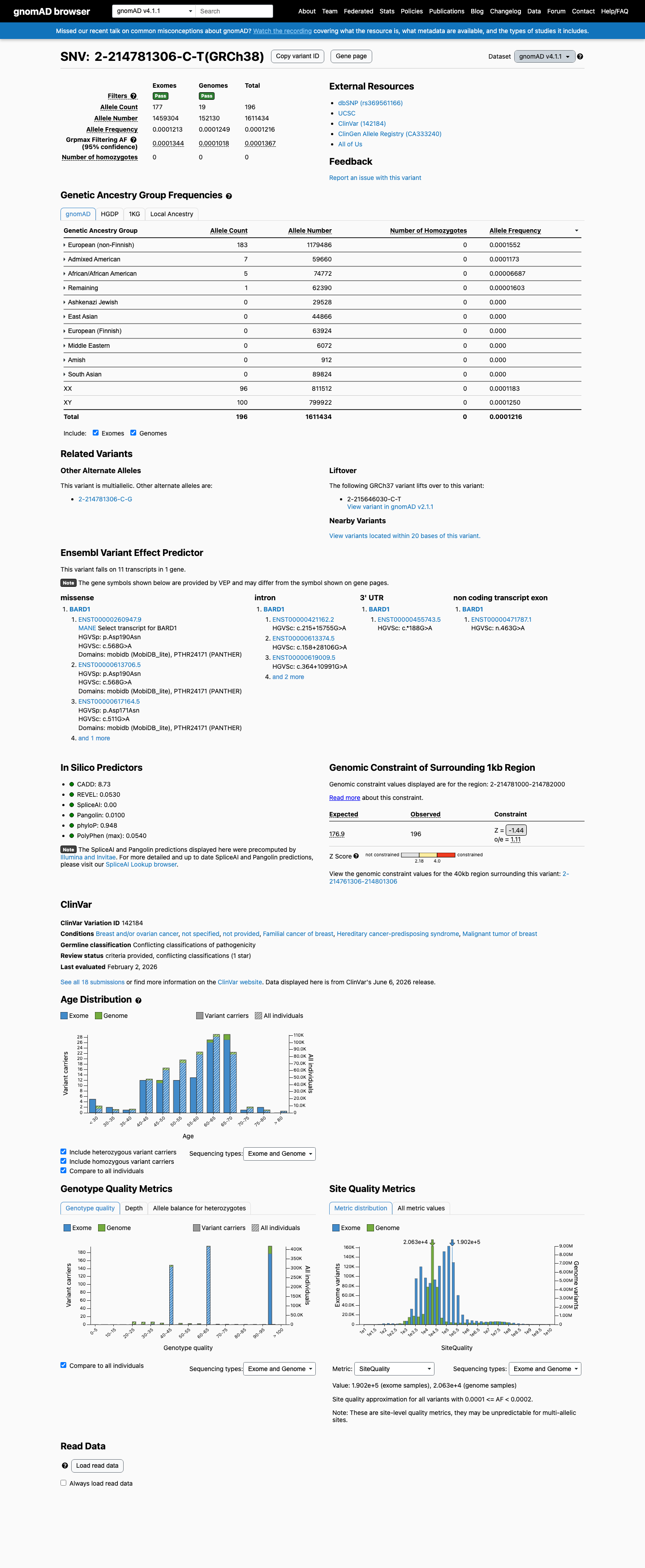
gnomAD v4.1
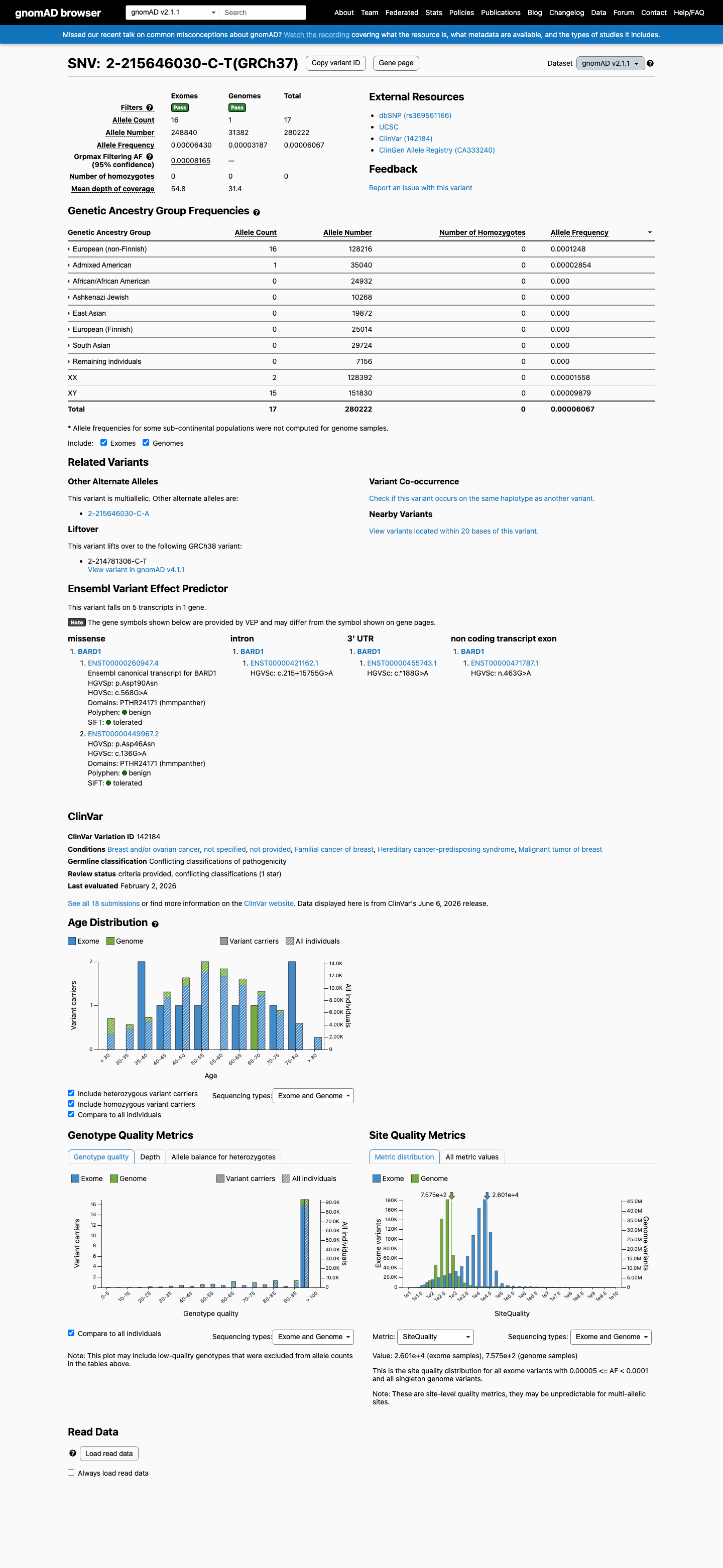
gnomAD v2.1
v4.1
This variant is present in gnomAD v4.1 (AF= 0.000121631; MAF= 0.01216%, 196/1611434 alleles, homozygotes = 0) and has highest observed frequency in the European (non-Finnish) population (AF= 0.000155152; MAF= 0.01552%, 183/1179486 alleles, homozygotes = 0); grpmax FAF= 0.00013673.
v2.1
This variant is present in gnomAD v2.1 (AF= 6.06662e-05; MAF= 0.00607%, 17/280222 alleles, homozygotes = 0) and has highest observed frequency in the European (non-Finnish) population (AF= 0.000124789; MAF= 0.01248%, 16/128216 alleles, homozygotes = 0); grpmax FAF= 8.165e-05.
🇨🇦 CA
This variant is present in gnomAD-Canada v1.0 (AF= 0.0003801042571676803, 7/18416 alleles, homozygotes = 0).
Allele frequency by ancestry
three datasets · side by side
gnomAD v4.1
0.012%
· 196 / 1,611,434
0 hom · FAF 0.014%
0 hom · FAF 0.014%
European (non-Finnish) 183 / 1,179,486 |
0.016% |
Admixed American 7 / 59,660 |
0.012% |
African/African American 5 / 74,772 |
0.0067% |
Remaining individuals 1 / 62,390 |
0.0016% |
+ 6 not observed (European (Finnish), Amish, East Asian, Middle Eastern, South Asian, Ashkenazi Jewish)
gnomAD v2.1
0.0061%
· 17 / 280,222
0 hom · FAF 0.0082%
0 hom · FAF 0.0082%
European (non-Finnish) 16 / 128,216 |
0.012% |
Admixed American 1 / 35,040 |
0.0029% |
+ 6 not observed (African/African American, Ashkenazi Jewish, East Asian, European (Finnish), Remaining individuals, South Asian)
gnomAD Canada 🇨🇦
0.038%
· 7 / 18,416
0 hom · FAF 0.028%
0 hom · FAF 0.028%
European (non-Finnish) 7 / 11,738 |
0.06% |
+ 8 not observed (African/African American, Latino/Admixed American, Ashkenazi Jewish, East Asian, European (Finnish), Middle Eastern, Remaining individuals, South Asian)

ClinVar
This variant has been reported in ClinVar as Uncertain significance (12 clinical laboratories) and as Likely benign (5 clinical laboratories). (ClinVarID = 142184)
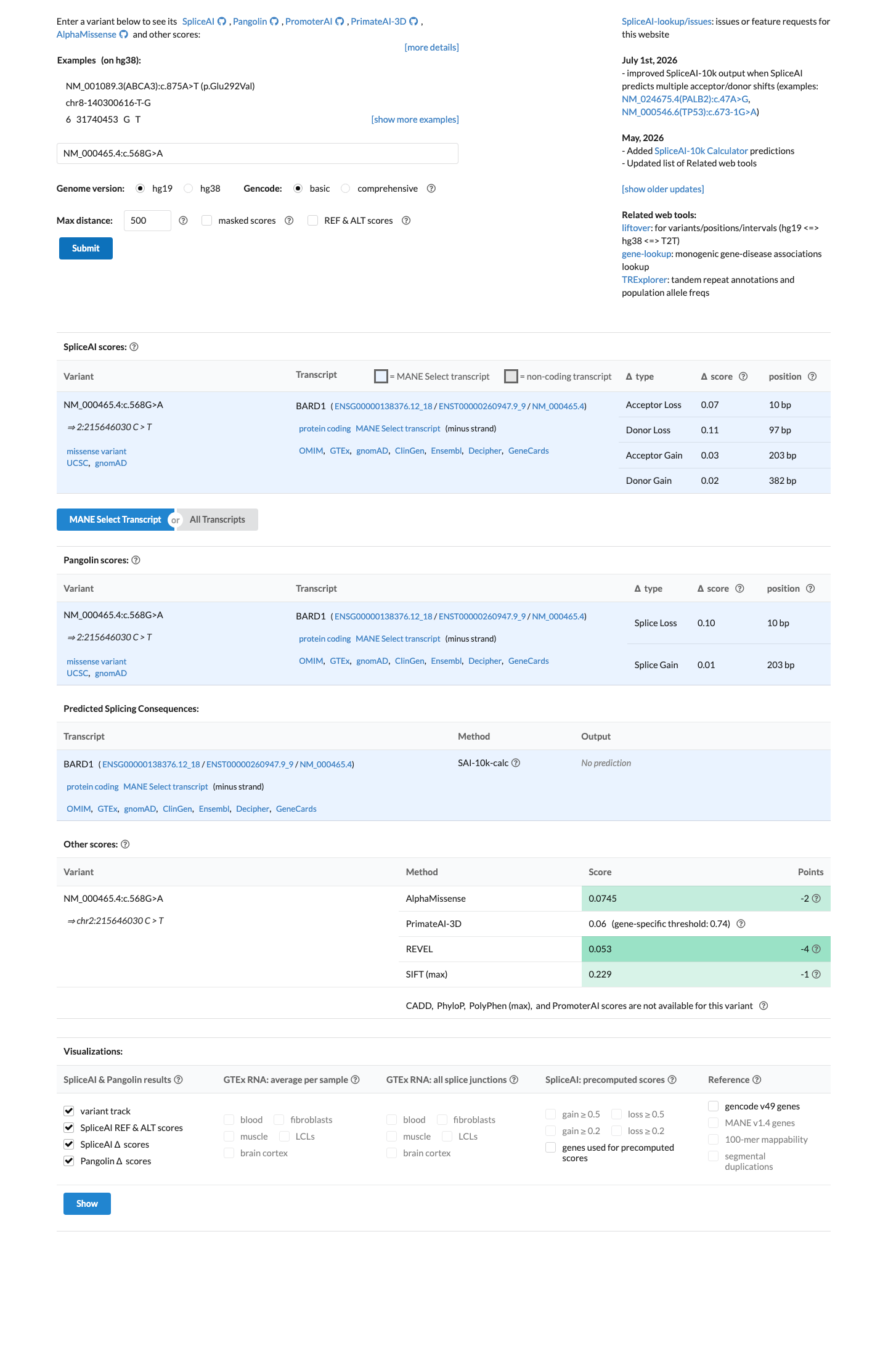
In silico
SpliceAI predicts no significant splice impact for this variant (max delta score = 0.11). REVEL score = 0.053. BayesDel score = -0.567143.
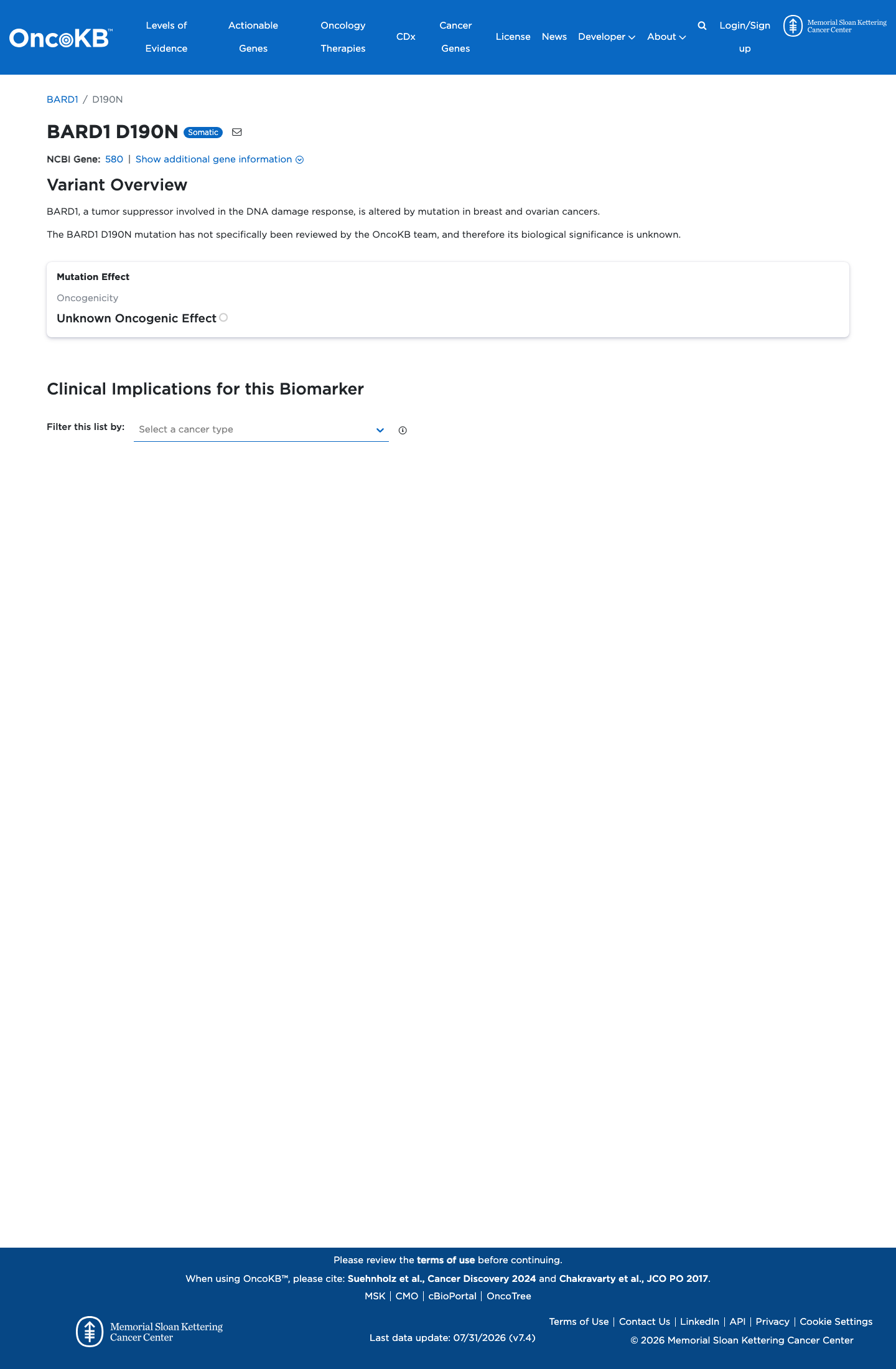
Functional
Unknown Oncogenic Effect
OncoKB did not identify variant-specific reviewed functional evidence for this variant; gene-level curated context is available for reviewer follow-up. BARD1, a tumor suppressor involved in the DNA damage response, is altered by mutation in breast and ovarian cancers.
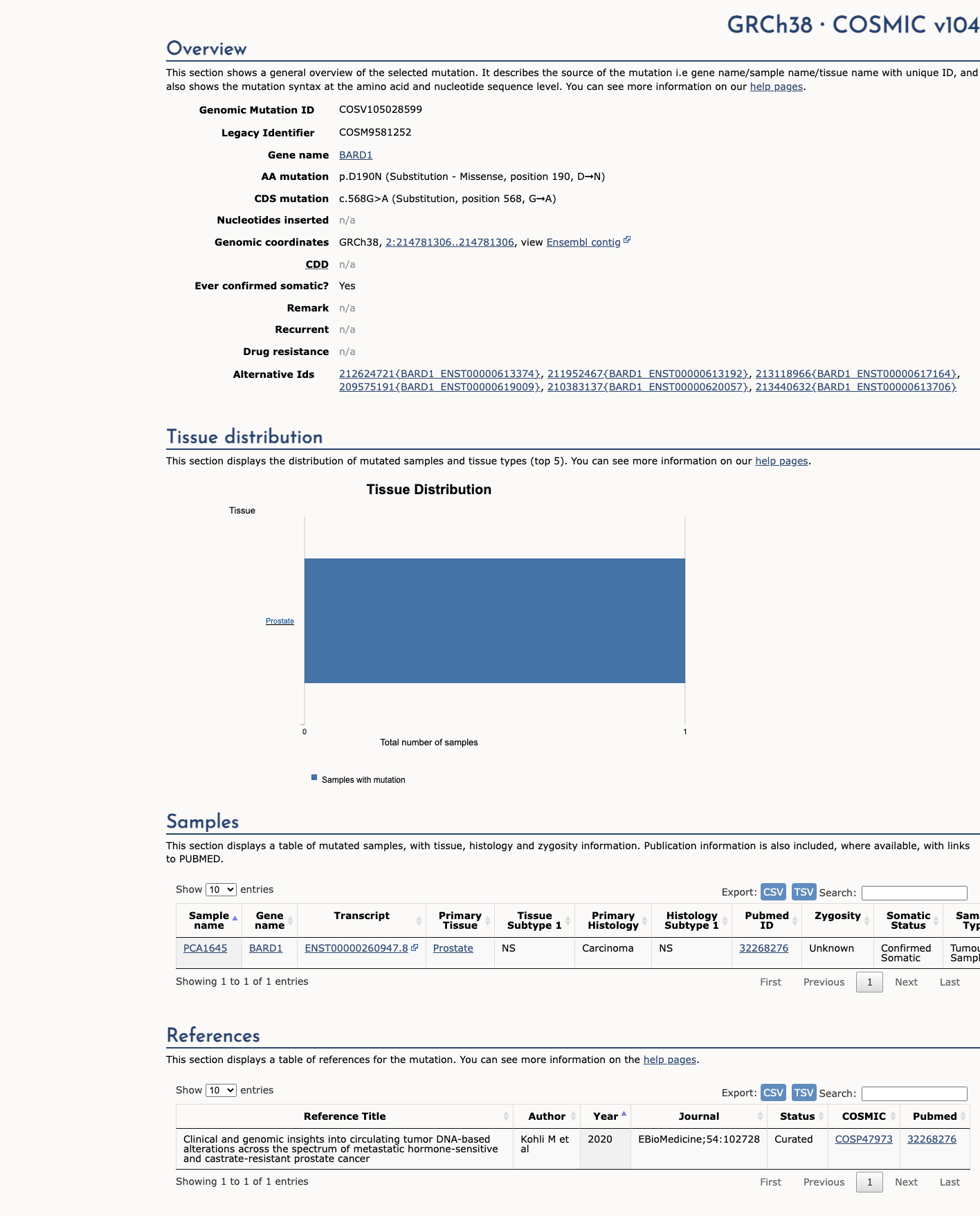
COSMIC

Cancer hotspots
Somatic evidence
Not in COSMIC / hotspots
COSMIC
This variant does not lie in a statistically significant hotspot. This variant has previously been reported in somatic cancers (COSMIC; COSV105028599, n = 1 times).
Hotspots
This variant does not lie in a statistically significant hotspot.
Sources & reference links
Triaged references · 9 PMIDs not cited in assessment
25741868 ↗
Standards and guidelines for the interpretation of sequence variants: a joint consensus recommendation of the American College of Medical Genetics and Genomics and the Association for Molecular Pathology.
CLINVAR
26467025 ↗
A Standardized DNA Variant Scoring System for Pathogenicity Assessments in Mendelian Disorders.
CLINVAR
27978560 ↗
Prevalence and Spectrum of Germline Cancer Susceptibility Gene Mutations Among Patients With Early-Onset Colorectal Cancer.
CLINVAR
30925164 ↗
Functional analysis of BARD1 missense variants in homology-directed repair and damage sensitivity.
CLINVAR
34326862 ↗
Analysis of Sequence and Copy Number Variants in Canadian Patient Cohort With Familial Cancer Syndromes Using a Unique Next Generation Sequencing Based Approach.
CLINVAR
15604628 ↗
Genetic cancer risk assessment and counseling: recommendations of the national society of genetic counselors.
CLINVAR
28492532 ↗
Sherloc: a comprehensive refinement of the ACMG-AMP variant classification criteria.
CLINVAR