Back
NM_000489.5:c.4699+2T>C
p.? · ATRX
ACMG/AMP
0%
complete
Final classification
Likely Pathogenic
PVS1PM2
ATRX
c.4699+2T>C
p.?
canonical splice

ATRX encodes a chromatin-remodeling protein in the SWI/SNF family that regulates gene expression, DNA methylation, and chromosome structure, including the incorporation of histone H3.3 during telomere replication. Germline mutations in ATRX cause an X-linked syndrome characterized by intellectual disability and alpha-thalassemia. In cancer, ATRX acts as a tumor suppressor: its loss promotes an alternative lengthening of telomeres (ALT) pathway, chromosomal instability, and epigenetic remodeling in a variety of tumors, and tumors with ATRX mutations may be more sensitive to agents that target DNA repair.

This variant

Predicted to eliminate ATRX function entirely, this variant is classified Likely Pathogenic, matching the germline loss-of-function mechanism that causes ATR-X syndrome (intellectual disability with alpha-thalassemia). In cancer, the same loss of ATRX function promotes the alternative lengthening of telomeres (ALT) pathway and chromosomal instability, although this germline variant's relevance to tumor risk is not established.

Transcript
NM_000489.5
HGVS · transcript:coding
NM_000489.5:c.4699+2T>C
GRCh38
chrX:77635913 A>G
GRCh37
chrX:76891404 A>G
Likely Pathogenic: one very strong (PVS1) plus one supporting (PM2) criterion maps to Likely Pathogenic, posterior probability 0.988, under the SVI 2020 PM2-downgrade combination rule.
Classification rationale
PVS1PM2 Likely Pathogenic
ATRX c.4699+2T>C canonical splice

PVS1 (Very Strong): canonical +2 donor splice-site disruption in intron 16 predicted to cause loss of function via nonsense-mediated decay (SpliceAI max delta 0.99). PM2 (Supporting): absent from gnomAD v2.1, v4.1, and gnomAD-Canada (AF 0, below the 0.1% threshold). Combined, PVS1 + PM2 (one very strong plus one supporting) yields Likely Pathogenic under the SVI 2020 PM2-downgrade rule (posterior probability 0.988).

PVS1 + PM2 Likely Pathogenic
LYFE Sciences is an AI system, and it can make mistakes. Criteria may be applied incorrectly, sources may be misread, and a confident-looking classification can still be wrong. Double-check every criterion and its underlying evidence before relying on any call.
Gene diagram · NM_000489.5 · variants mapped to exon structure
ATRX NM_000489.5
Fetching transcript structure from UCSC…
Applied criteria · 2 applied · 17 assessed
MetEvidence satisfies this criterion.
Not metEvaluated against available evidence; threshold not reached.
Not assessedApplies in principle, but no evidence was found to evaluate it.
N/ADoesn't apply to this variant type.
Applied · 2
Strength Supporting Moderate Strong Very strong
PVS1 very strong Pathogenic
Met (Very Strong): disruption of the canonical +2 donor splice site of intron 16 is predicted to cause loss of function via nonsense-mediated decay (SpliceAI max delta 0.99).
pvs1_variant_assessment: variant classified canonical_splice, canonical_splice_consensus=true, variant_bucket='canonical_splice', apply_generic_pvs1_framework=true, suggested_default_strength='PVS1'pvs1_gene_context: germline LoF mechanism supported for ATRX (ATR-X syndrome), pvs1_gene_gate='eligible'VariantValidator normalization (prefetch.json): c.4699+2T>C maps to intron 16 ('16i') of the 36-exon NM_000489.5 transcript; RefSeq Select transcript (refseq_select=true)
PM2 supporting Pathogenic
Met (Supporting): absent from gnomAD v2.1, v4.1, and gnomAD-Canada (AF 0, below the 0.1% PM2 threshold).
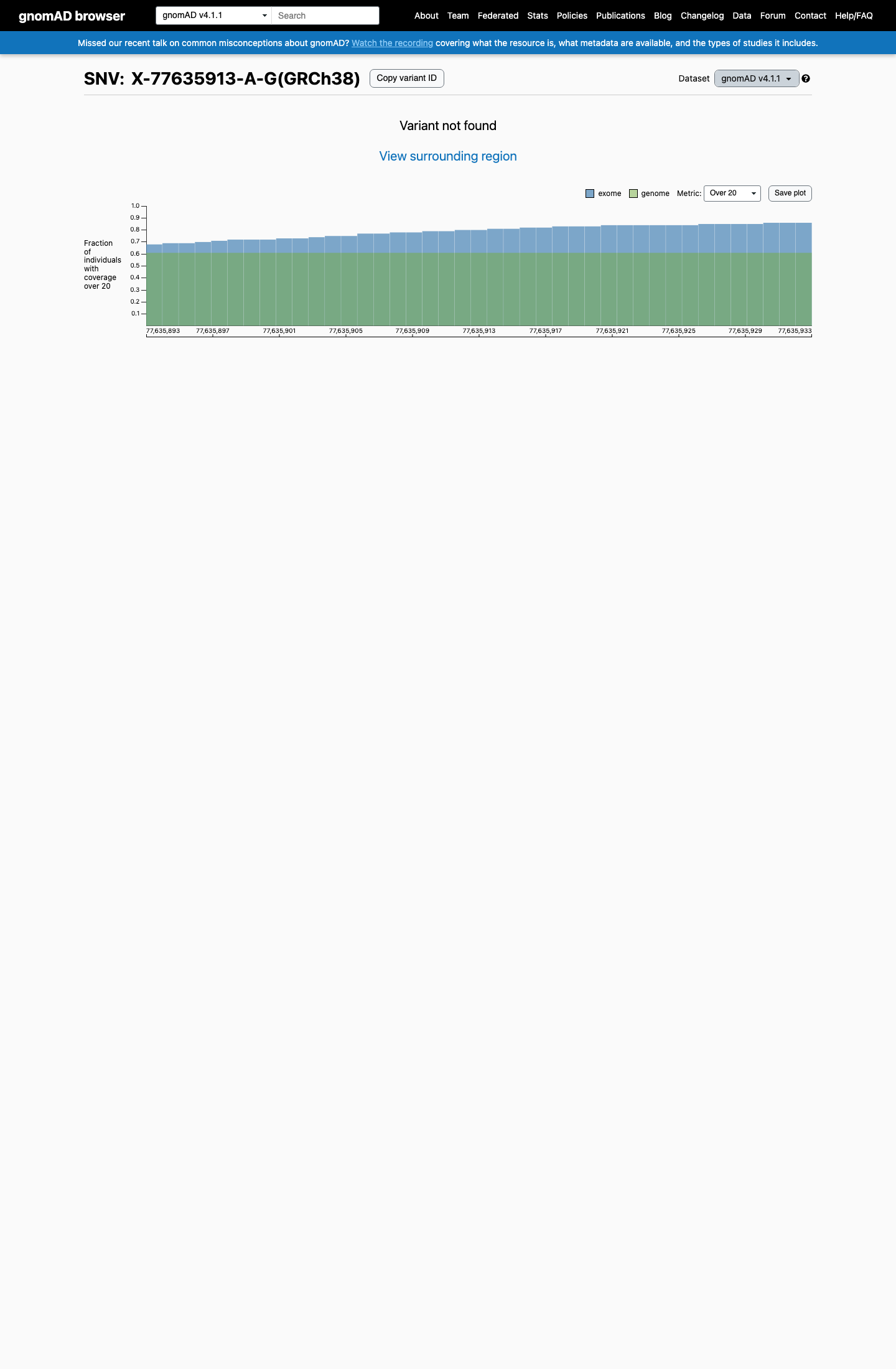
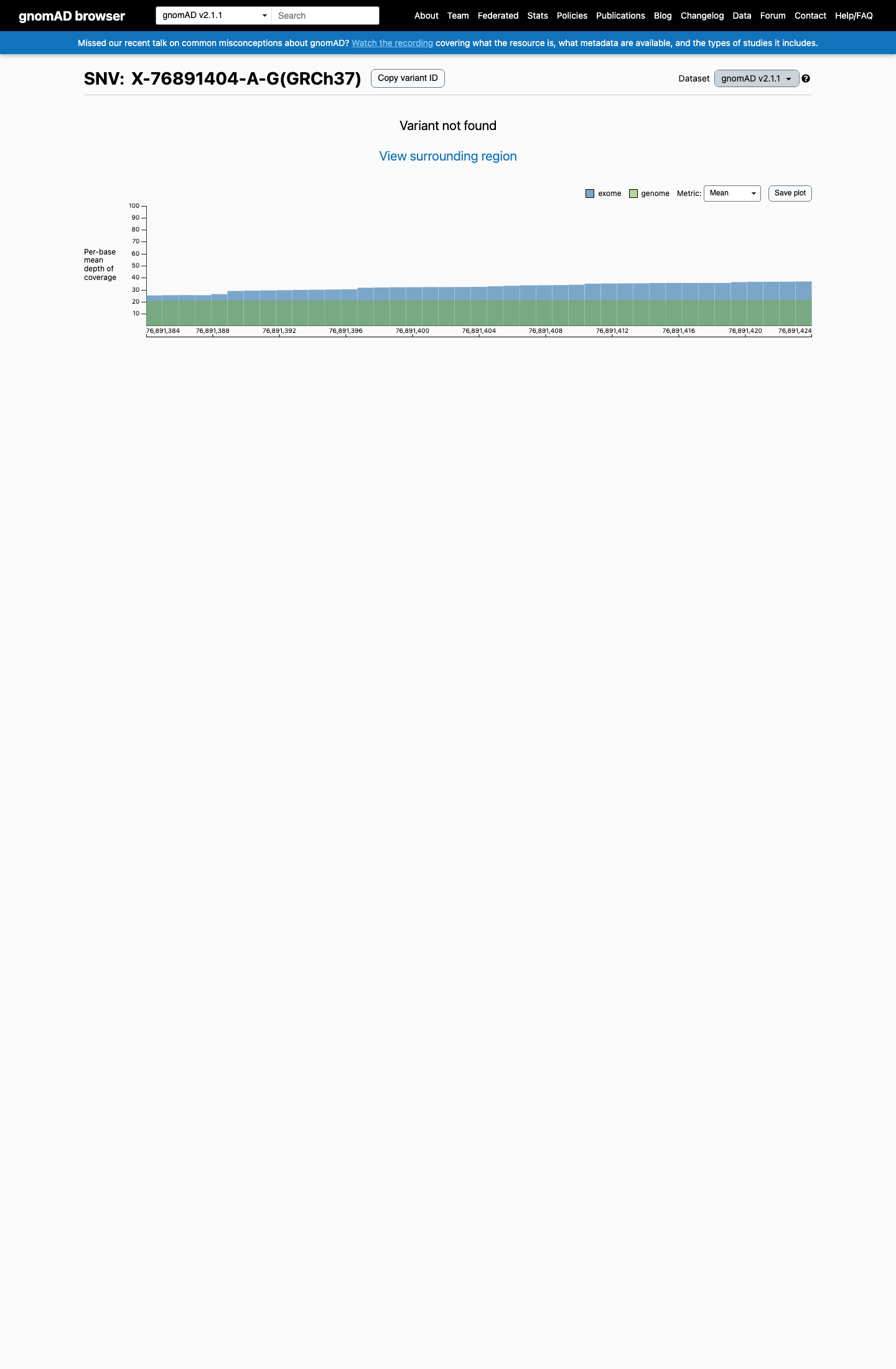
gnomAD v2.1 (GRCh37 X-76891404-A-G): variant absent (AF effectively 0, <0.1% threshold)gnomAD v4.1 (GRCh38 chrX-77635913-A-G): variant absent (AF effectively 0, <0.1% threshold)gnomAD-Canada v1.0: AC=0, AN=0, AF=0.0
Assessed · not applied · 7 not met · 10 not assessed
Pathogenic
PS2 Not assessed: no de novo occurrence is documented; no parental testing or parentage confirmation is available, and the variant is absent from ClinVar.
PS3 Not assessed: no functional assay evidence (RNA or protein studies) exists for this variant.
PS4 Not assessed: no case-control, cohort, or proband reports of this variant exist in ClinVar or the literature.
PM6 Not assessed: no de novo observation of this variant is documented in any individual or source.
PP1 Not assessed: no pedigree or family genotyping data exist, so segregation with disease in affected relatives cannot be evaluated.
PP3 Not met: SpliceAI predicts near-certain splice disruption (max delta 0.99), but this same prediction already underlies PVS1 and is not double-counted.
PP4 Not assessed: no proband phenotype or family-history information is available, so phenotype specificity cannot be evaluated.
PP5 Not met: no ClinVar record exists for this variant, so no expert-panel pathogenic classification is available.
Benign
BA1 Not met: allele frequency is 0 across gnomAD v2.1, v4.1, and gnomAD-Canada, far below the >1% threshold.
BS1 Not met: allele frequency is 0 across gnomAD v2.1, v4.1, and gnomAD-Canada, far below the >0.3% threshold.
BS2 Not met: absent from gnomAD v2.1, v4.1, and gnomAD-Canada, with no hemizygous males or homozygous females observed.
BS3 Not assessed: no functional studies exist to show a lack of damaging effect, and the available in silico predictions (SpliceAI 0.99) point away from benign.
BS4 Not assessed: no family genotyping or non-segregation data exist, so absence of segregation cannot be established.
BP2 Not assessed: no phase data exist to establish cis or trans arrangement, and the X-linked inheritance makes the trans prong inapplicable.
BP4 Not met: all computational lines predict an impact (SpliceAI max delta 0.99), and no benign-direction prediction exists.
BP5 Not assessed: no proband molecular data exist, so an alternative genetic cause of disease cannot be evaluated.
BP6 Not met: no ClinVar record exists for this variant, so no expert-panel benign classification is available.
N/A · 9 PS1 · PM1 · PM3 · PM4 · PM5 · PP2 · BP1 · BP3 · BP7
Research & evidence
Population frequency · supports pathogenic
gnomAD v4.1 screenshot
gnomAD v4.1
gnomAD v2.1 screenshot
gnomAD v2.1
v4.1
Absent from gnomAD v4.1.
v2.1
Absent from gnomAD v2.1.
🇨🇦 CA
Absent from gnomAD-Canada v1.0.
Allele frequency by ancestry
three datasets · side by side
gnomAD v4.1
Absent · 0 / ?
0 hom
Not observed in any ancestry group.
gnomAD v2.1
Absent · 0 / ?
0 hom
Not observed in any ancestry group.
gnomAD Canada 🇨🇦
Absent · 0 / ?
0 hom
Not observed in any ancestry group.
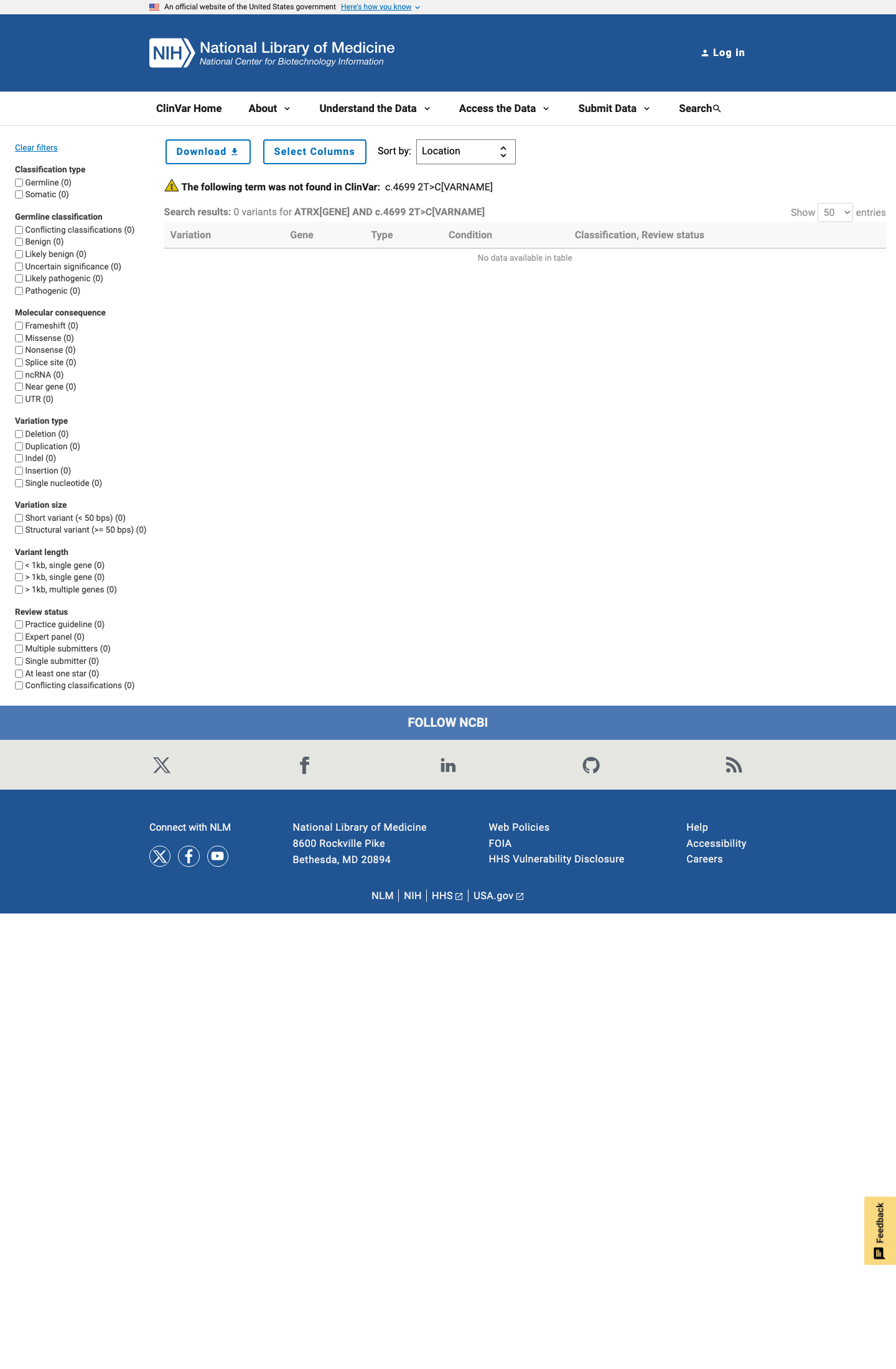
ClinVar screenshot
ClinVar
This variant is absent from ClinVar.
SpliceAI screenshot
In silico
SpliceAI predicts possible splice impact for this variant (max delta score = 0.99). BayesDel score = 0.83.
Functional No data
No calibrated functional assay or RNA evidence was identified for this variant.
OncoKB ↗
COSMIC screenshot
COSMIC
Somatic evidence
COSMIC
This variant has not previously been reported in somatic cancers (COSMIC).
Hotspots
This variant does not lie in a statistically significant cancer hotspot.
COSMIC ↗
Sources & reference links
7Sources
ClinVar
gnomAD v2.1
gnomAD v4.1
gnomAD-Canada
SpliceAI
OncoKB
COSMIC