Back
NM_000535.7:c.497T>C
p.Leu166Pro · PMS2
0%
complete
Final classification
VUS
PP3BS1
PMS2
c.497T>C
p.Leu166Pro
missense · exon 5

PMS2 is a DNA mismatch-repair protein that works with MLH1 to correct replication errors, including mismatches and small insertion or deletion loops. It acts as a tumor suppressor, and inherited loss of PMS2 function can cause Lynch syndrome and constitutional mismatch repair deficiency, increasing the risk of colorectal, endometrial, ovarian, urothelial, and other cancers. Loss of PMS2 function in tumors can cause hypermutation and microsatellite instability, which may make some cancers responsive to certain immunotherapies.

This variant

This missense change alters residue 166 (p.Leu166Pro) of PMS2, the mismatch-repair tumour suppressor that partners with MLH1 to correct replication errors, in a gene whose inherited loss of function causes Lynch syndrome and constitutional mismatch repair deficiency and whose loss in tumours produces microsatellite instability.

Transcript
NM_000535.7
HGVS · transcript:coding
NM_000535.7:c.497T>C
GRCh38
chr7:6002493 A>G
GRCh37
chr7:6042124 A>G
VUS: PP3 (moderate) for the PMS2 HCI prior of 0.9595 and BS1 (strong) for gnomAD Grpmax FAF 0.00242754 conflict under InSiGHT PMS2 Version 2.0 Rule22.
Classification rationale
PP3 BS1 VUS
PMS2 c.497T>C missense · exon 5

VUS: PP3 (moderate) because the PMS2 HCI MAPP/PP2 prior of 0.9595 exceeds the 0.81 threshold for a damaging missense prediction. VUS: BS1 (strong) because gnomAD v4.1 Grpmax FAF 0.00242754 lies within the PMS2 VCEP 0.00028-0.0028 benign frequency band.

PP3 + BS1 VUS
LYFE Sciences is an AI system, and it can make mistakes. Criteria may be applied incorrectly, sources may be misread, and a confident-looking classification can still be wrong. Double-check every criterion and its underlying evidence before relying on any call.
Gene diagram · NM_000535.7 · variants mapped to exon structure
PMS2 NM_000535.7
Fetching transcript structure from UCSC…
Applied criteria · 2 applied · 17 assessed
MetEvidence satisfies this criterion.
Not metEvaluated against available evidence; threshold not reached.
Not assessedApplies in principle, but no evidence was found to evaluate it.
N/ADoesn't apply to this variant type.
Applied · 2
Strength Supporting Moderate Strong Very strong
PP3 moderate Pathogenic
Met at Moderate: the PMS2 HCI MAPP/PP2 prior for c.497T>C (p.L166P) is 0.9595, above the VCEP PP3_Moderate threshold of >0.81.
ClinGen InSiGHT PMS2 VCEP specification v2.0 (cspec) PP3: missense variant with 'MAPP/PP2 Prior P' score >0.81 = PP3_Moderate; >0.68 and <=0.81 = PP3_Supporting. The VCEP PP3 path for a missense variant is the gene-specific MAPP/PP2 prior, not the generic REVEL calibration.On-record VCEP file HCI-PRIORS-PMS2.txt (declared by this gene's VCEP index as governing PP3/BP4) row 1074: c.497T>C, protein p.L166P, Variant/Custom_PP2_score 0.998, Variant/MAPP_score 35.66, Variant/MAPP/PP2_Prior 0.9595, reference {PMID22949387:Thompson et al., 2013}, DBID PMS2_01071.Column headers of HCI-PRIORS-PMS2.txt line 2: '{{ Variant/DNA }}', '{{ Variant/Protein }}', '{{ Variant/Custom_PP2_score }}', '{{ Variant/MAPP_score }}', '{{ Variant/MAPP/PP2_Prior }}'. The header 'Variant/MAPP/PP2_Prior' matches the metric named in the VCEP PP3 rule text.
BS1 strong Benign
Met at Strong: gnomAD v4.1 grpmax filtering AF 0.00242754 lies within the 0.00028-0.0028 benign-strong BS1 band.
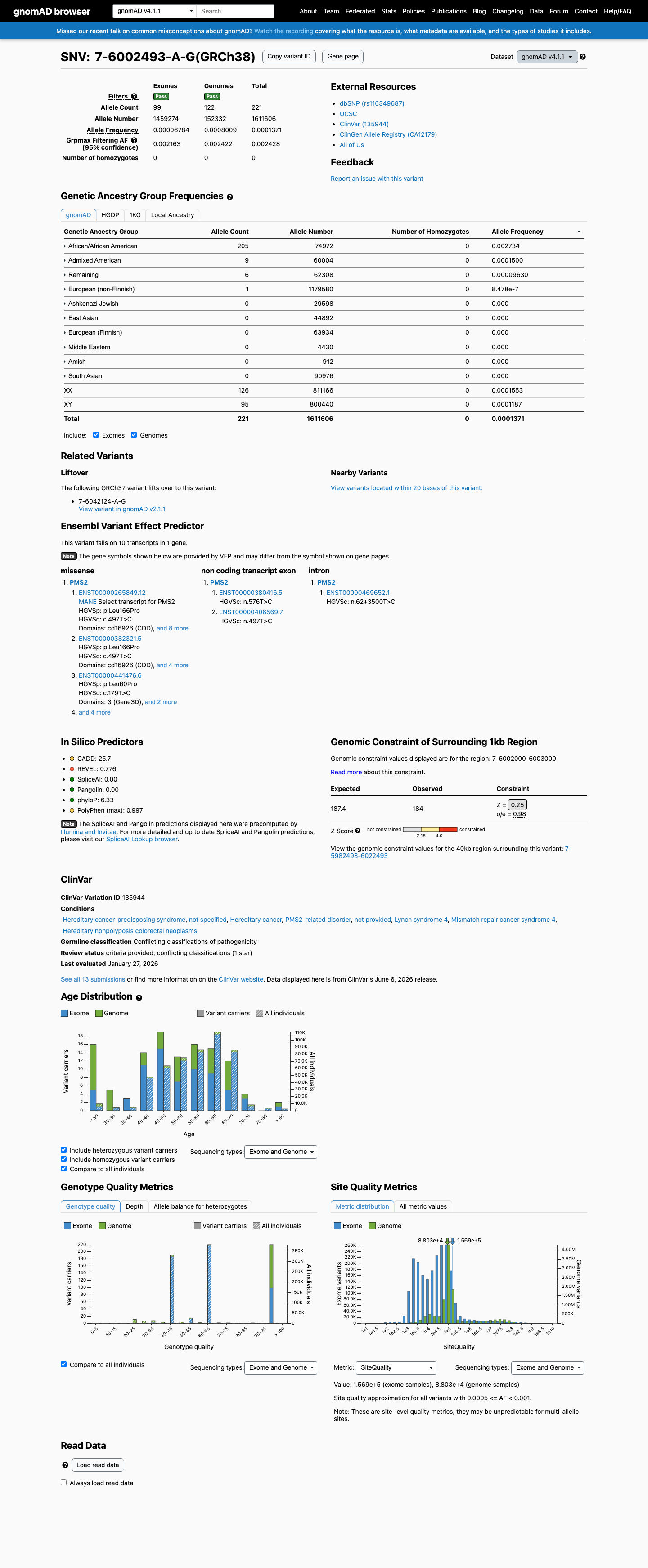
PMS2 v2.0 specification (cspec): BS1 default strength 'Benign Strong', rule 'GnomAD v4 Grpmax filtering allele frequency >= 0.00028 and < 0.0028 (0.028-0.28%) and variant is excluded as founder pathogenic variant.' No non-cancer or exome-only population source is specified, so gnomAD v4 all-comers is the governing source.gnomAD v4.1 grpmax filtering AF = 0.00242754 >= 0.00028 and < 0.0028, satisfying the BS1 band; total AF 0.00013713 (221/1,611,606 alleles), exome AF 0.00006784, genome AF 0.00080088, homozygotes = 0.The elevated frequency is ancestry-specific: African/African American AF 0.00273435 (205/74,972 alleles) versus 0.0000391 in European (non-Finnish) and near-absence elsewhere; no homozygotes in any population.
Assessed · not applied · 9 not met · 8 not assessed
Pathogenic
PVS1 Not met: PMS2 c.497T>C is a missense substitution, not a nonsense, frameshift, splice-site, initiation-codon or copy-number null, and SpliceAI max delta 0.012 excludes a splice consequence.
PS1 Not met: Leu166 is a CTN codon, so only c.497T>C itself can encode p.Leu166Pro - no alternate nucleotide change exists for PS1.
PS2 Not assessed: with no proband parental testing or tumor data, zero of the >=0.5 de novo points required for PS2_Supporting could be assigned.
PS3 Not assessed: no calibrated MMR functional assay or functional-odds result exists for c.497T>C (p.Leu166Pro), so the VCEP PS3 threshold of functional odds >2.08 cannot be evaluated.
PM2 Not met: gnomAD v4.1 total AF 0.00013713 is about 7-fold above the 0.00002 gnomAD-v4 rarity threshold.
PM3 Not assessed: the PMS2 VCEP PM3 rule requires a co-occurring pathogenic/likely pathogenic PMS2 variant in trans and a CMMRD-consistent proband, and neither is documented.
PM5 Not met: the only other missense at residue 166, p.Leu166Gln, is a single-submitter ClinVar VUS, so no VCEP-pathogenic comparator exists for PM5.
PP1 Not assessed: no pedigree or relative genotypes exist for this variant, so the combined Bayes likelihood ratio needed for PP1 (>=2.08) cannot be computed.
PP4 Not assessed: CSPEC PP4 requires tumour MSI-H and/or MMR-protein-loss data at a 1-3 tumour threshold, and no tumour phenotype data exist for this case.
PP5 Not met: ClinVar VCV000135944 has zero expert-panel submissions (1 star, conflicting single-lab classifications), so no expert-panel pathogenic assertion exists to trigger PP5.
Benign
BA1 Not met: gnomAD v4.1 grpmax filtering AF 0.00242754 falls below the 0.0028 stand-alone BA1 threshold.
BS2 Not met: no source reports c.497T>C in trans with a pathogenic PMS2 variant, the observation the BS2 rule requires.
BS3 Not assessed: no MMR functional assay shows variant-specific proficient function for c.497T>C (p.Leu166Pro), so the VCEP BS3 requirement for calibrated functional odds <=0.05 cannot be applied.
BS4 Not assessed: no segregation analysis exists, so the combined Bayes likelihood ratio required for BS4 (<0.05 or <=0.48) cannot be derived.
BP4 Not met: the PMS2 missense BP4 rule requires an HCI MAPP/PP2 prior below 0.11, but c.497T>C (p.L166P) scores 0.9595.
BP5 Not assessed: CSPEC BP5 requires 2-4 MSS/no-MMR-loss tumours (or BRAF V600E/MLH1 methylation), and no tumour data exist for this case.
BP6 Not met: ClinVar VCV000135944 carries no expert-panel benign classification (0 expert-panel submissions, 1 star), so aggregate single-lab benign labels cannot trigger BP6.
N/A · 9 PS4 · PM1 · PM4 · PM6 · PP2 · BP1 · BP2 · BP3 · BP7
Research & evidence
Population frequency
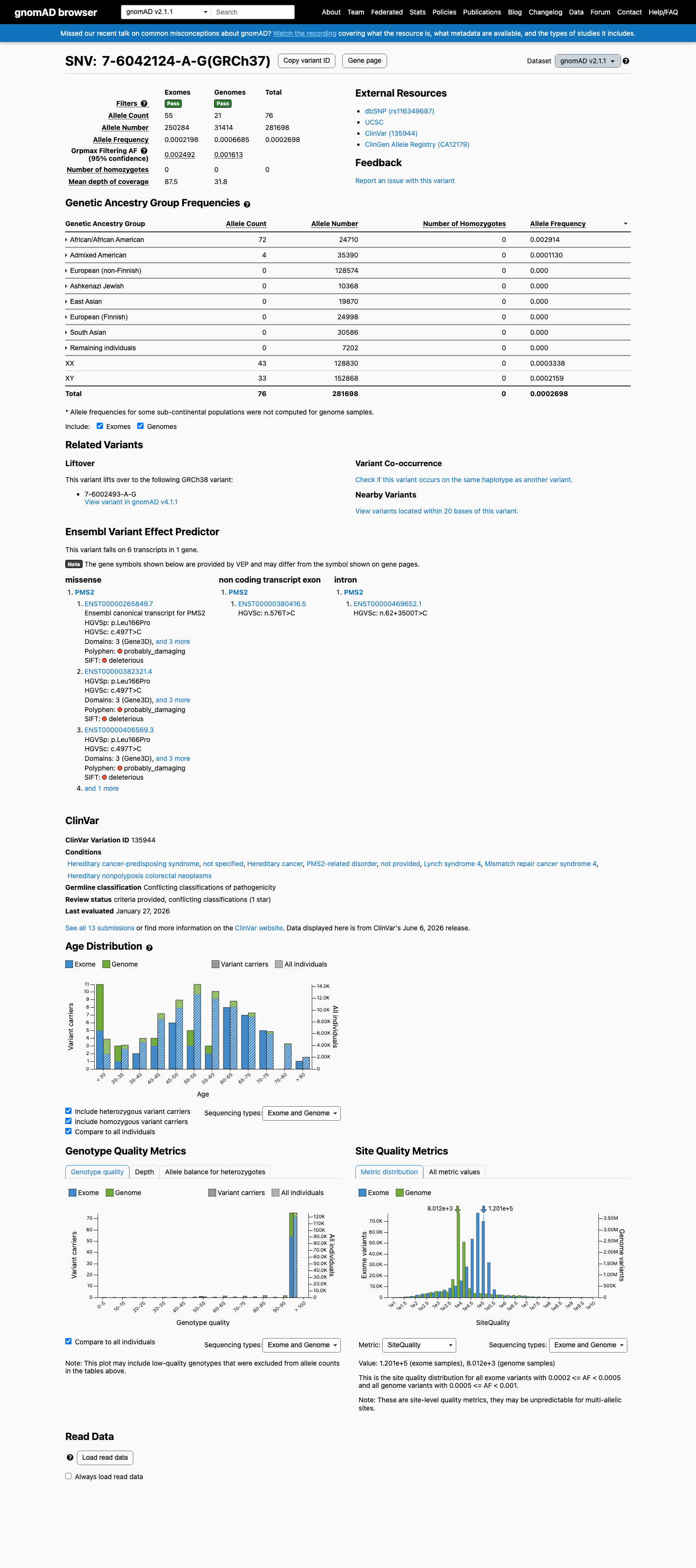
gnomAD v4.1 screenshot
gnomAD v4.1
gnomAD v2.1 screenshot
gnomAD v2.1
v4.1
This variant is present in gnomAD v4.1 (AF= 0.00013713; MAF= 0.01371%, 221/1611606 alleles, homozygotes = 0) and has highest observed frequency in the African/African American population (AF= 0.00273435; MAF= 0.27344%, 205/74972 alleles, homozygotes = 0); grpmax FAF= 0.00242754.
v2.1
This variant is present in gnomAD v2.1 (AF= 0.000269792; MAF= 0.02698%, 76/281698 alleles, homozygotes = 0) and has highest observed frequency in the African/African American population (AF= 0.0029138; MAF= 0.29138%, 72/24710 alleles, homozygotes = 0); grpmax FAF= 0.00249164.
🇨🇦 CA
This variant is present in gnomAD-Canada v1.0 (AF= 0.00021732043898728675, 4/18406 alleles, homozygotes = 0).
Allele frequency by ancestry
three datasets · side by side
gnomAD v4.1
0.014% · 221 / 1,611,606
0 hom · FAF 0.24%
African/African American
205 / 74,972
0.27%
Admixed American
9 / 60,004
0.015%
Remaining individuals
6 / 62,308
0.0096%
European (non-Finnish)
1 / 1,179,580
8.5e-05%
+ 6 not observed (European (Finnish), Amish, East Asian, Middle Eastern, South Asian, Ashkenazi Jewish)
gnomAD v2.1
0.027% · 76 / 281,698
0 hom · FAF 0.25%
African/African American
72 / 24,710
0.29%
Admixed American
4 / 35,390
0.011%
+ 6 not observed (Ashkenazi Jewish, East Asian, European (Finnish), European (non-Finnish), Remaining individuals, South Asian)
gnomAD Canada 🇨🇦
0.022% · 4 / 18,406
0 hom · FAF 0.08%
African/African American
3 / 1,020
0.29%
Remaining individuals
1 / 1,138
0.088%
+ 7 not observed (Latino/Admixed American, Ashkenazi Jewish, East Asian, European (Finnish), Middle Eastern, European (non-Finnish), South Asian)
ClinVar screenshot
ClinVar
This variant has been reported in ClinVar as Likely benign (5 clinical laboratories) and as Uncertain significance (4 clinical laboratories) and as Benign (3 clinical laboratories) and as likely benign (1 clinical laboratory). (ClinVarID = 135944)
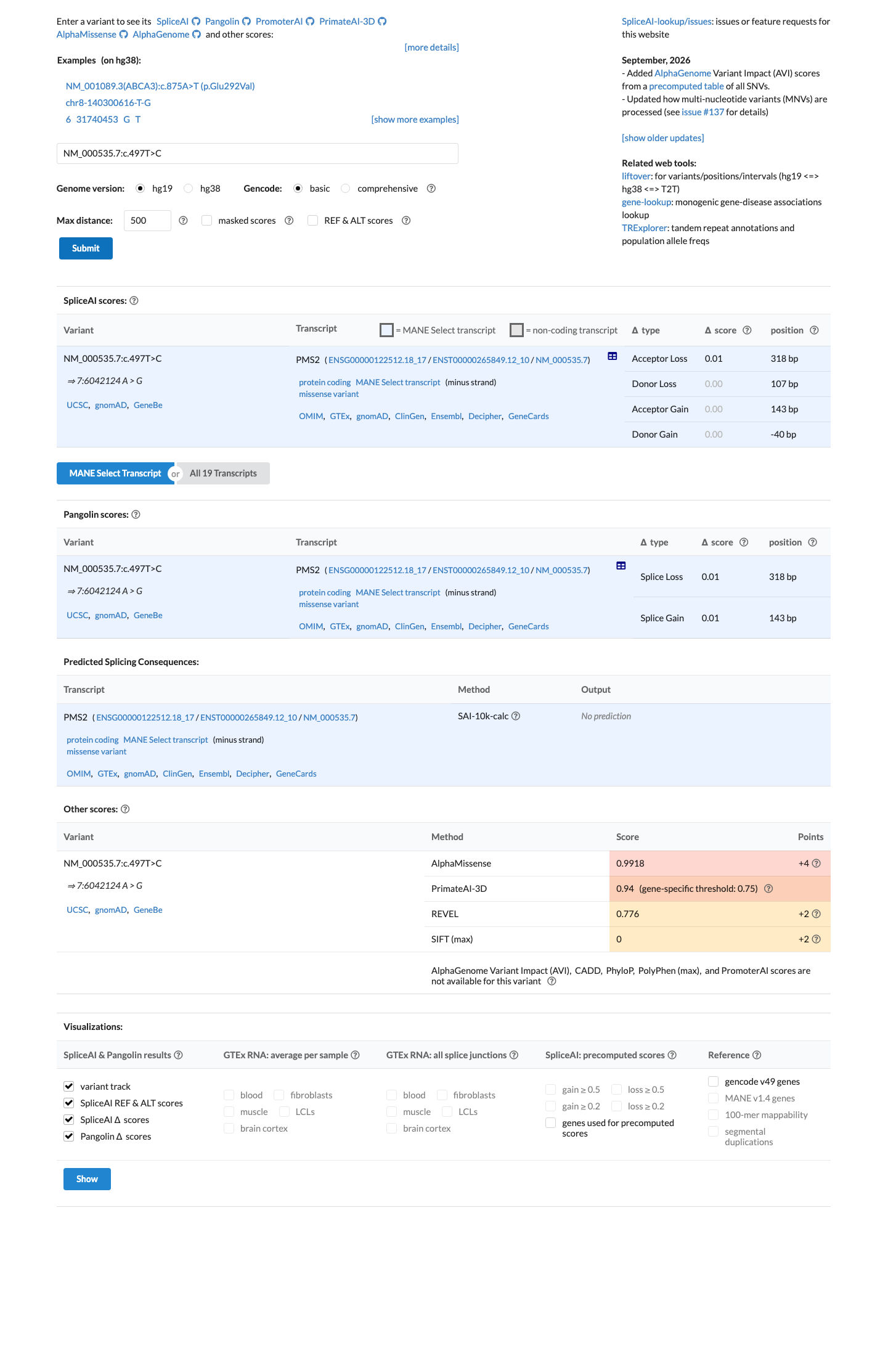
SpliceAI screenshot
In silico
SpliceAI predicts no significant splice impact for this variant (max delta score = 0.01). REVEL score = 0.776. BayesDel score = 0.369188. HCI prior probability for pathogenicity = 0.9595. MAPP score = 35.66. Custom PP2 score = 0.998.
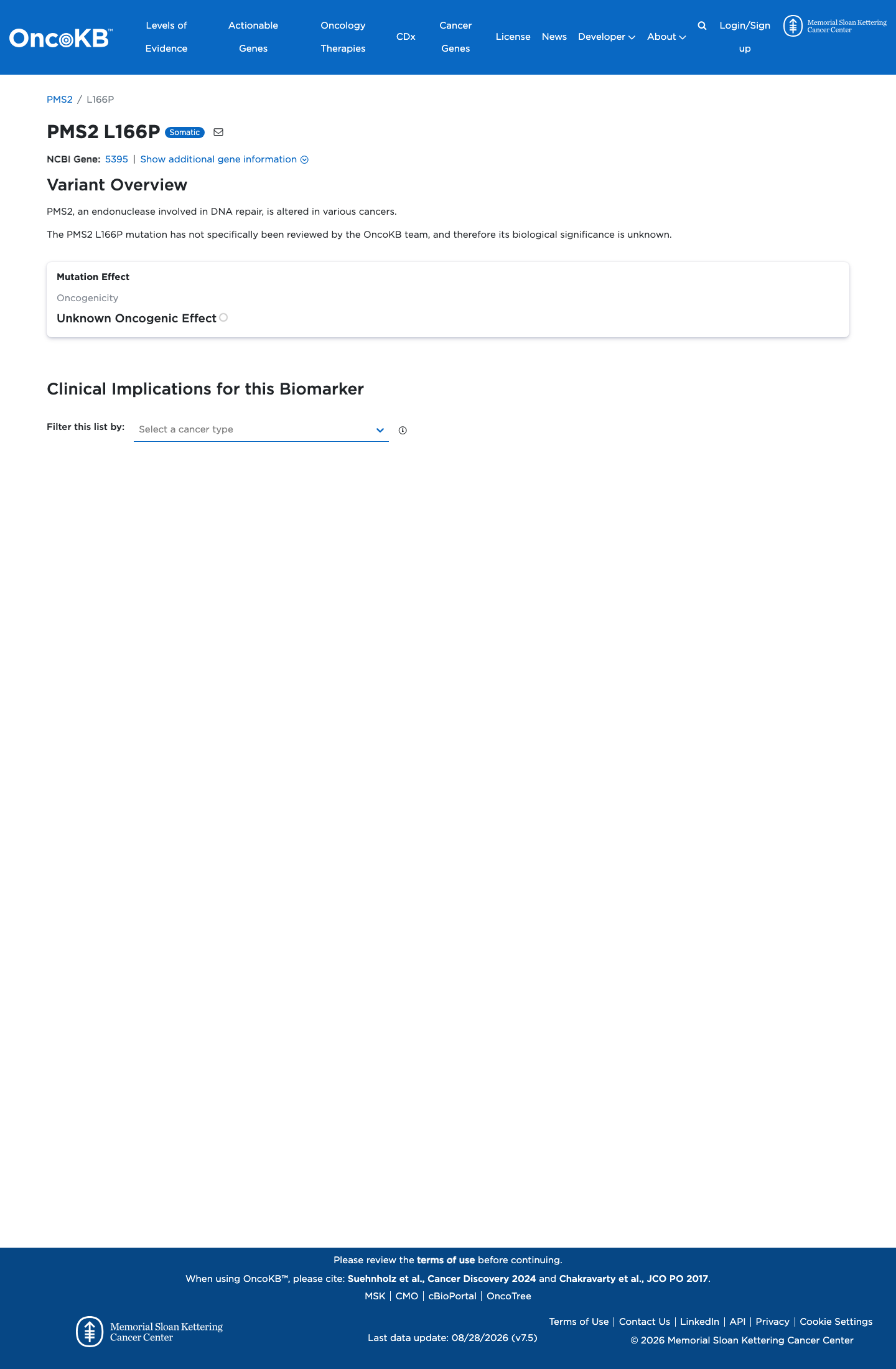
Functional / OncoKB screenshot
Functional Unknown Oncogenic Effect
OncoKB did not identify variant-specific reviewed functional evidence for this variant; gene-level curated context is available for reviewer follow-up. PMS2, an endonuclease involved in DNA repair, is altered in various cancers.
OncoKB ↗
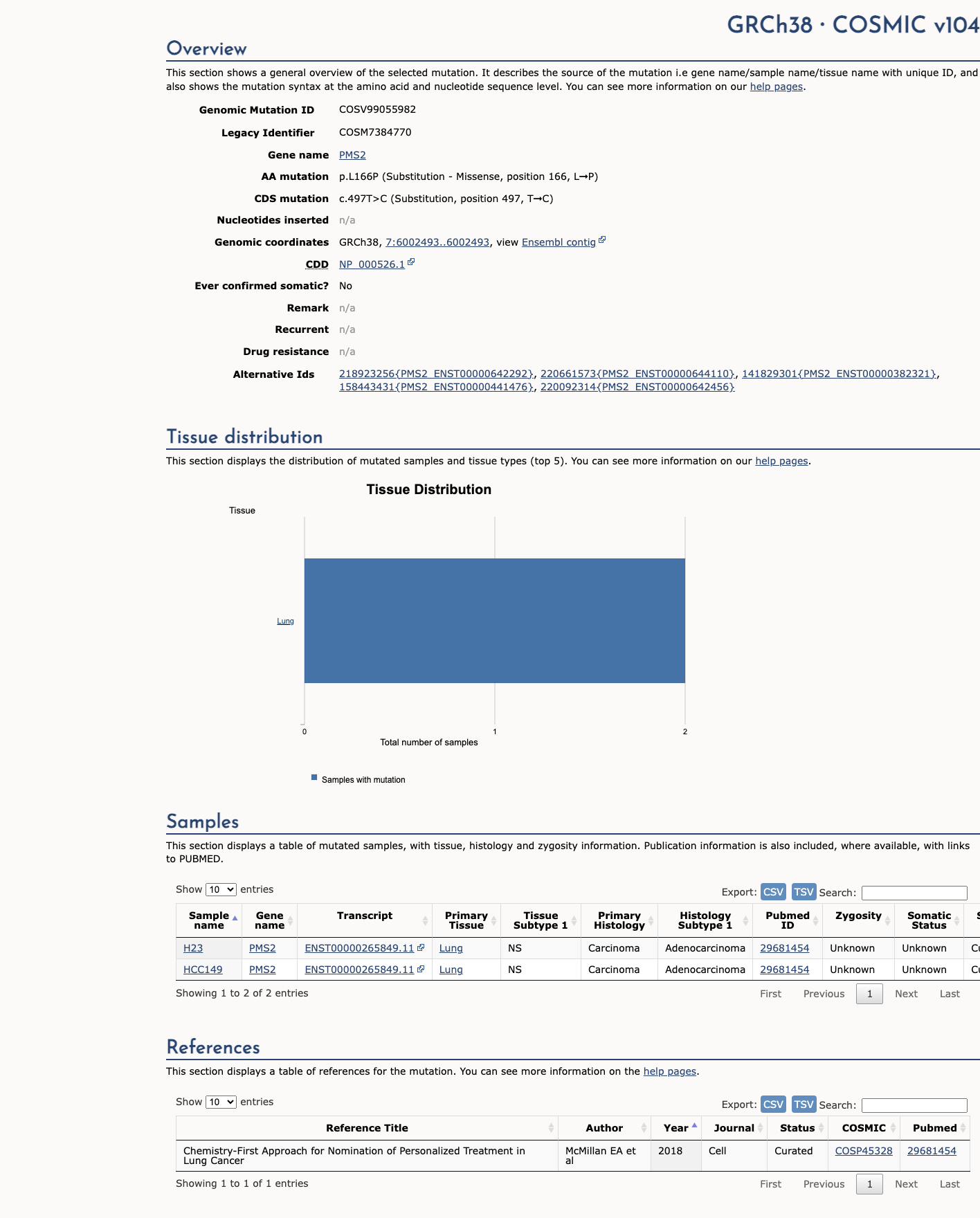
COSMIC screenshot
COSMIC
Cancer hotspots screenshot
Cancer hotspots
Somatic evidence Not in COSMIC / hotspots
COSMIC
This variant does not lie in a statistically significant hotspot. This variant has previously been reported in somatic cancers (COSMIC; COSV99055982, n = 2 times).
Hotspots
This variant does not lie in a statistically significant hotspot.
Literature · how each cited paper was used
2papers cited
Each card is an audit: what was searched, what was found, whether it names the variant, which criteria it fed, and why. 6 further PMIDs triaged but not cited — see Sources & references.
The integration of next-generation sequencing panels in the clinical cancer genetics practice: an institutional experience.
Searched
c.497T>Cp.L166PNP_000526.2:p.(L166P)
Found
In a retrospective series of germline NGS hereditary cancer panels, the PMS2 missense change p.L166P (equivalent to c.497T>C) was detected on one ColoNext panel and was classified by the performing laboratory as a variant of uncertain significance. The paper reports no functional assay, RNA/splicing, segregation or population-frequency data for this change, so it provides no evidence bearing on PVS1, PM4 or BP3; its relevance to this group is only to confirm that the variant is a missense substitution reported without any consequence-level (null/splice/frameshift) claim.
Variant
✓ Names this variant — characterised directly
Applied to
BS1 strong
PMS2 ColoNext p.L166P VUS
Location Table 2 (Identified DNA changes found by NGS panels), row for PMS2/ColoNext  ·  Context Retrospective review of 60 germline NGS hereditary cancer panels (Ambry Genetics BreastNext, OvaNext, ColoNext, CancerNext) ordered by an academic/community cancer genetics program between April 2012 and January 2013; the variant was called on the ColoNext panel and classified as a VUS by the laboratory.  ·  full text
Rule & framework references · cited for criterion definitions, not variant evidence
25741868 ↗ Standards and guidelines for the interpretation of sequence variants: a joint co
Sources & reference links
9Sources
CSpec VCEP
ClinVar
gnomAD v2.1
gnomAD v4.1
gnomAD-Canada
SpliceAI
OncoKB
COSMIC
Cancer hotspots
Triaged references · 6 PMIDs not cited in assessment
20301390 ↗ Lynch Syndrome. CLINVAR
23788249 ↗ ACMG recommendations for reporting of incidental findings in clinical exome and genome sequencing. CLINVAR
25356965 ↗ ACMG policy statement: updated recommendations regarding analysis and reporting CLINVAR
25980754 ↗ Identification of a Variety of Mutations in Cancer Predisposition Genes in Patients With Suspected Lynch Syndrome. CLINVAR
26467025 ↗ A Standardized DNA Variant Scoring System for Pathogenicity Assessments in Mende CLINVAR
27443514 ↗ Germline multi-gene hereditary cancer panel testing in an unselected endometrial cancer cohort. CLINVAR