Back
NM_000546.5:c.309C>A
p.Tyr103Ter · TP53
0%
complete
Final classification
Likely Pathogenic
PVS1PM2
TP53
c.309C>A
p.Tyr103Ter
nonsense · exon 4

TP53 encodes the p53 tumor suppressor protein, a transcription factor that responds to cellular stress such as DNA damage by switching on genes that trigger cell cycle arrest, DNA repair, senescence, or programmed cell death. In healthy cells, p53 is kept at low levels by constant degradation, but stress signals stabilize and activate it to protect against damaged cells surviving and dividing. Inherited mutations in TP53 cause Li-Fraumeni syndrome, a condition marked by a high risk of developing multiple cancers at a young age. TP53 is the most commonly mutated gene across human cancers, and loss of its normal function promotes tumor growth, spread, drug resistance, and genomic instability.

This variant

This TP53 variant disrupts the tumor-suppressor gene that normally coordinates DNA-damage responses, cell-cycle arrest, DNA repair, senescence, and apoptosis, a mechanism relevant to Li-Fraumeni syndrome.

Transcript
NM_000546.5
HGVS · transcript:coding
NM_000546.5:c.309C>A
GRCh38
chr17:7676060 G>T
GRCh37
chr17:7579378 G>T
Likely Pathogenic: PVS1 very strong (8 points) plus PM2 supporting (1 point) total 9 points under the TP53 VCEP Version 2.4 framework.
Classification rationale
PVS1PM2 Likely Pathogenic
TP53 c.309C>A nonsense · exon 4

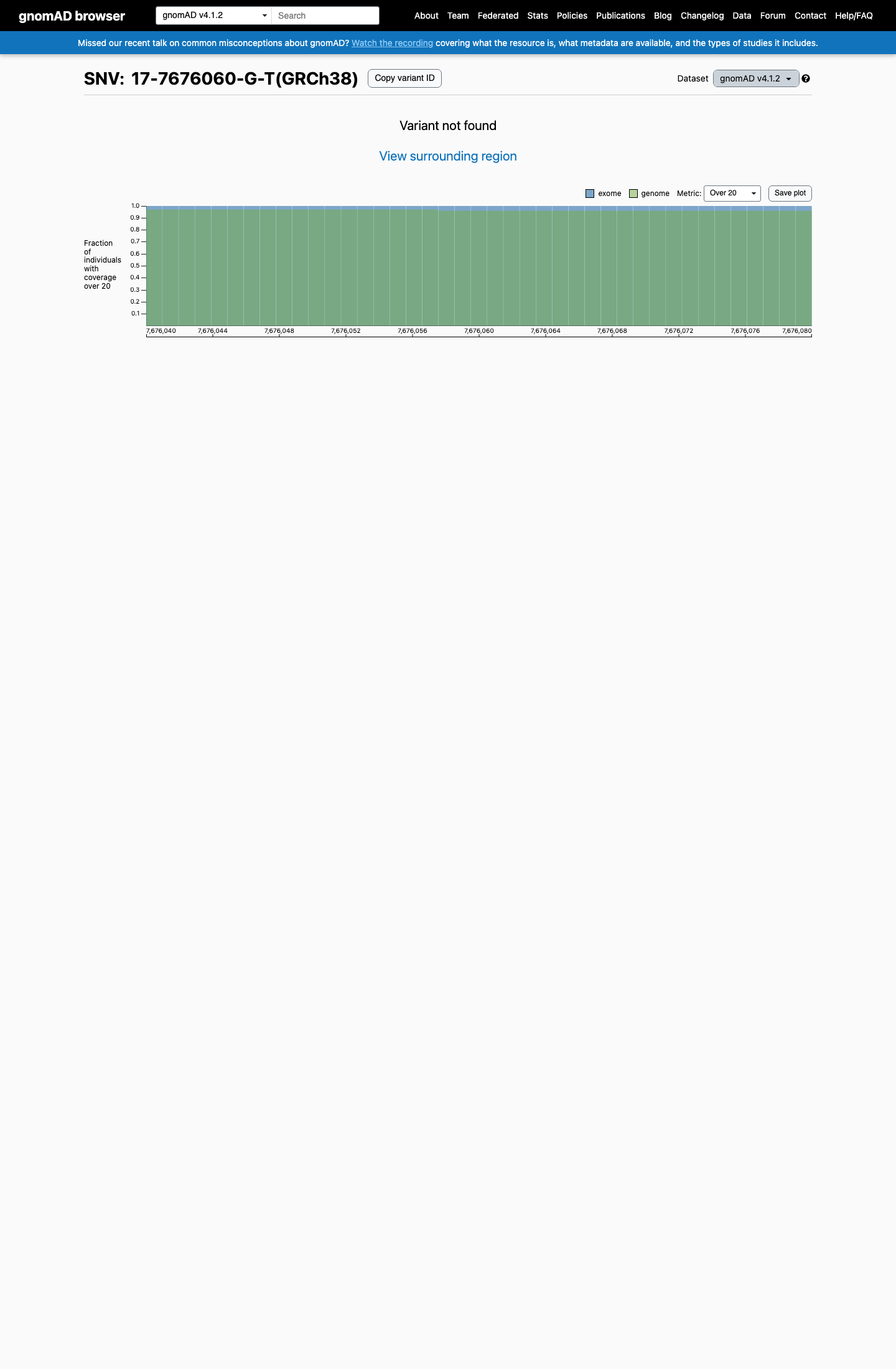
PVS1 very strong: p.Tyr103Ter is an upstream nonsense variant predicted to undergo nonsense-mediated decay. PM2 supporting: the variant is absent from the reported gnomAD population datasets.

PVS1 + PM2 → Likely Pathogenic
LYFE Sciences is an AI system, and it can make mistakes. Criteria may be applied incorrectly, sources may be misread, and a confident-looking classification can still be wrong. Double-check every criterion and its underlying evidence before relying on any call.
Gene diagram · NM_000546.5 · variants mapped to exon structure
TP53 NM_000546.5
Fetching transcript structure from UCSC…
Applied criteria · 2 applied · 8 assessed
MetEvidence satisfies this criterion.
Not metEvaluated against available evidence; threshold not reached.
Not assessedApplies in principle, but no evidence was found to evaluate it.
N/ADoesn't apply to this variant type.
Applied · 2
Strength Supporting Moderate Strong Very strong
PVS1 very strong Pathogenic
Met at very strong strength: p.Tyr103Ter is a nonsense variant upstream of TP53 p.Lys351, satisfying the VCEP NMD PVS1 rule.
The TP53 VCEP CSPEC version 2.4 identifies PVS1 as applicable to nonsense variants and directs use of the TP53 PVS1 decision tree.PVS1-Flowchart.pdf states that a nonsense variant upstream of p.Lys351 is predicted to undergo NMD and receives PVS1.The case normalization gives NM_000546.5:c.309C>A as NP_000537.3:p.(Tyr103Ter)/p.(Y103*) and predicts the protein terminates at residue 103 rather than the normal residue 394.
PM2 supporting Pathogenic
Met at supporting: the variant is absent from all reported gnomAD datasets, consistent with an allele frequency below the TP53 VCEP PM2 threshold of 0.00003.
The TP53 VCEP Version 2.4 specifies PM2 only at Supporting strength for allele frequency <0.00003, with <0.00004 required for any ancestry group containing multiple variant alleles; founder-effect groups are ignored.The variant was absent from gnomAD v2.1 and gnomAD v4.1.The variant was also absent from the reported gnomAD v2.1 non-cancer exome subset and gnomAD v3.1 non-cancer genome subset; no alternative frequency or homozygote signal was reported.
Assessed · not applied · 2 not met · 6 not assessed
Pathogenic
PS2 Not assessed: the exact variant was reported in one LFS-like family, but confirmed parental testing and de novo status required for PS2 are not documented.
PS4 Not assessed: one family reports p.Y103X, but the VCEP PS4 point total for the proband is not explicitly established.
PP1 Not assessed: one family report documents the variant and cancer history, but no variant-positive affected relatives or countable cosegregating meioses are provided.
PP4 Not assessed: the VCEP PP4 VAF rule requires blood multigene-panel evidence, but no VAF or testing-context data are available.
Benign
BA1 Not met: the variant is absent from gnomAD v2.1 and v4.1, with no ancestry-specific FAF meeting the TP53 VCEP BA1 threshold of 0.001.
BS1 Not met: the variant is absent from gnomAD v2.1 and v4.1, rather than showing the TP53 VCEP BS1 FAF interval of 0.0003 to below 0.001.
BS2 Not assessed: no qualifying unrelated female carriers aged 60 or older without cancer were reported for comparison with the TP53 VCEP BS2 thresholds.
BS4 Not assessed: no tested affected family member is documented as lacking the exact TP53 variant, so non-segregation cannot be demonstrated.
N/A · 18 PS1 · PS3 · PM1 · PM3 · PM4 · PM5 · PM6 · PP2 · PP3 · PP5 · BS3 · BP1 · BP2 · BP3 · BP4 · BP5 · BP6 · BP7
Research & evidence
Population frequency · supports pathogenic
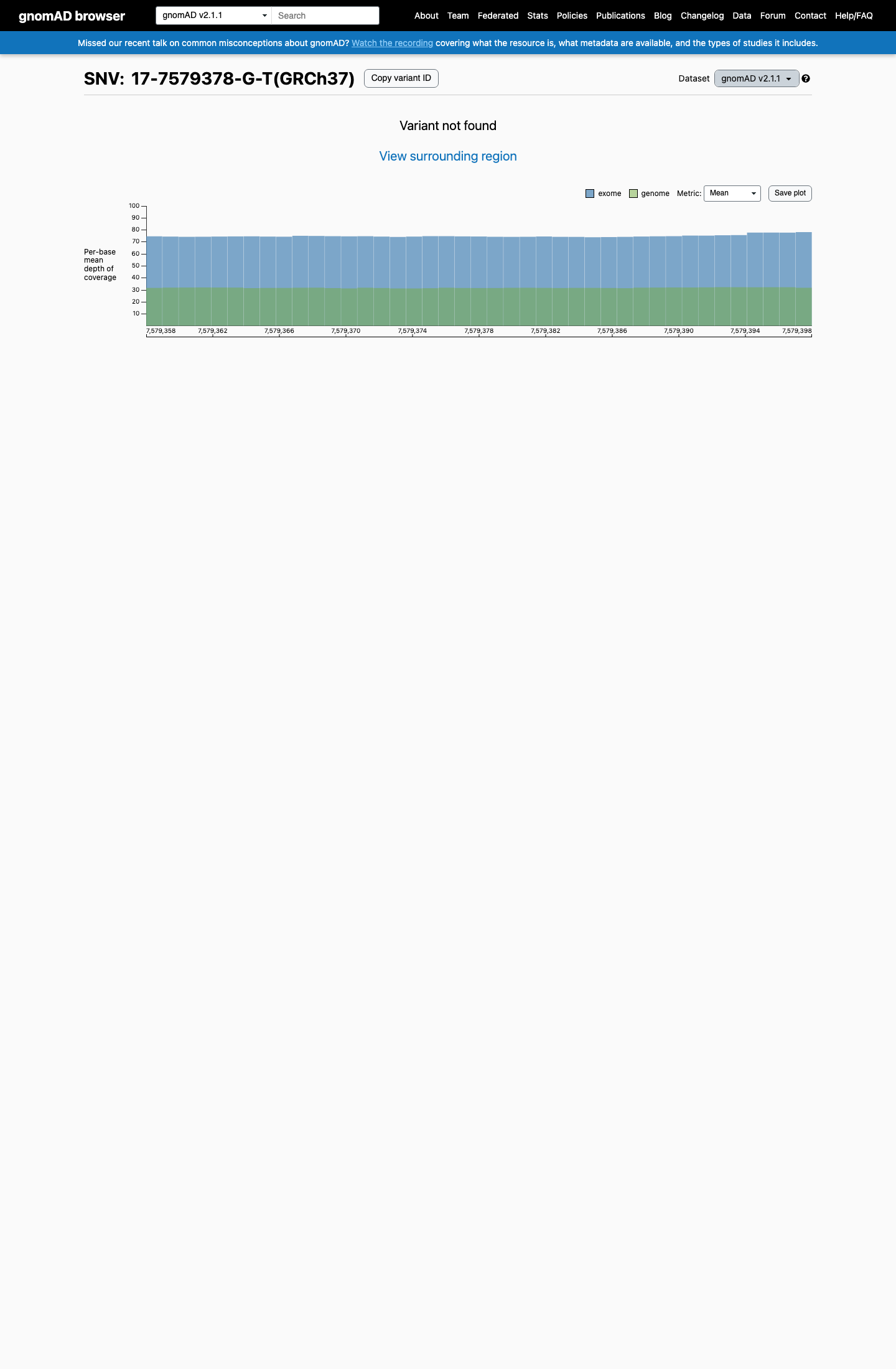
gnomAD v4.1 screenshot
gnomAD v4.1
gnomAD v2.1 screenshot
gnomAD v2.1
v4.1
Absent from gnomAD v4.1.
v2.1
Absent from gnomAD v2.1.
🇨🇦 CA
Absent from gnomAD-Canada v1.0.
Allele frequency by ancestry
three datasets · side by side
gnomAD v4.1
Absent · 0 / ?
0 hom
Not observed in any ancestry group.
gnomAD v2.1
Absent · 0 / ?
0 hom
Not observed in any ancestry group.
gnomAD Canada 🇨🇦
Absent · 0 / ?
0 hom
Not observed in any ancestry group.
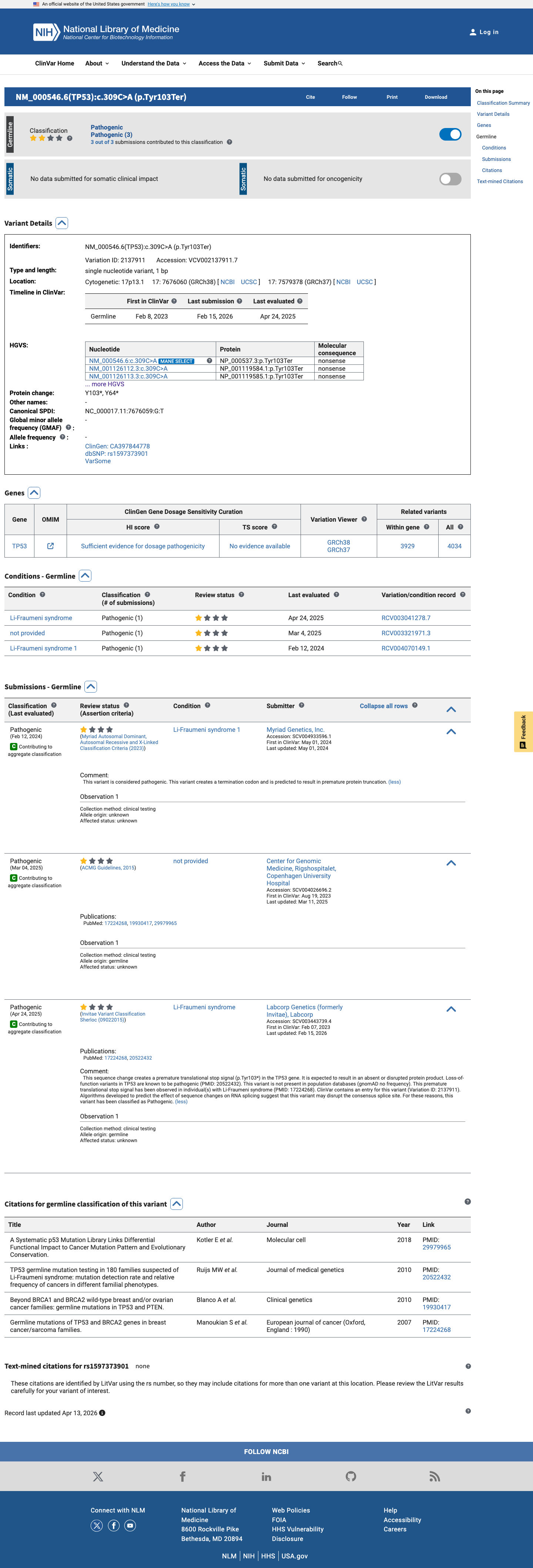
ClinVar screenshot
ClinVar
This variant has been reported in ClinVar as Pathogenic (3 clinical laboratories). (ClinVarID = 2137911)
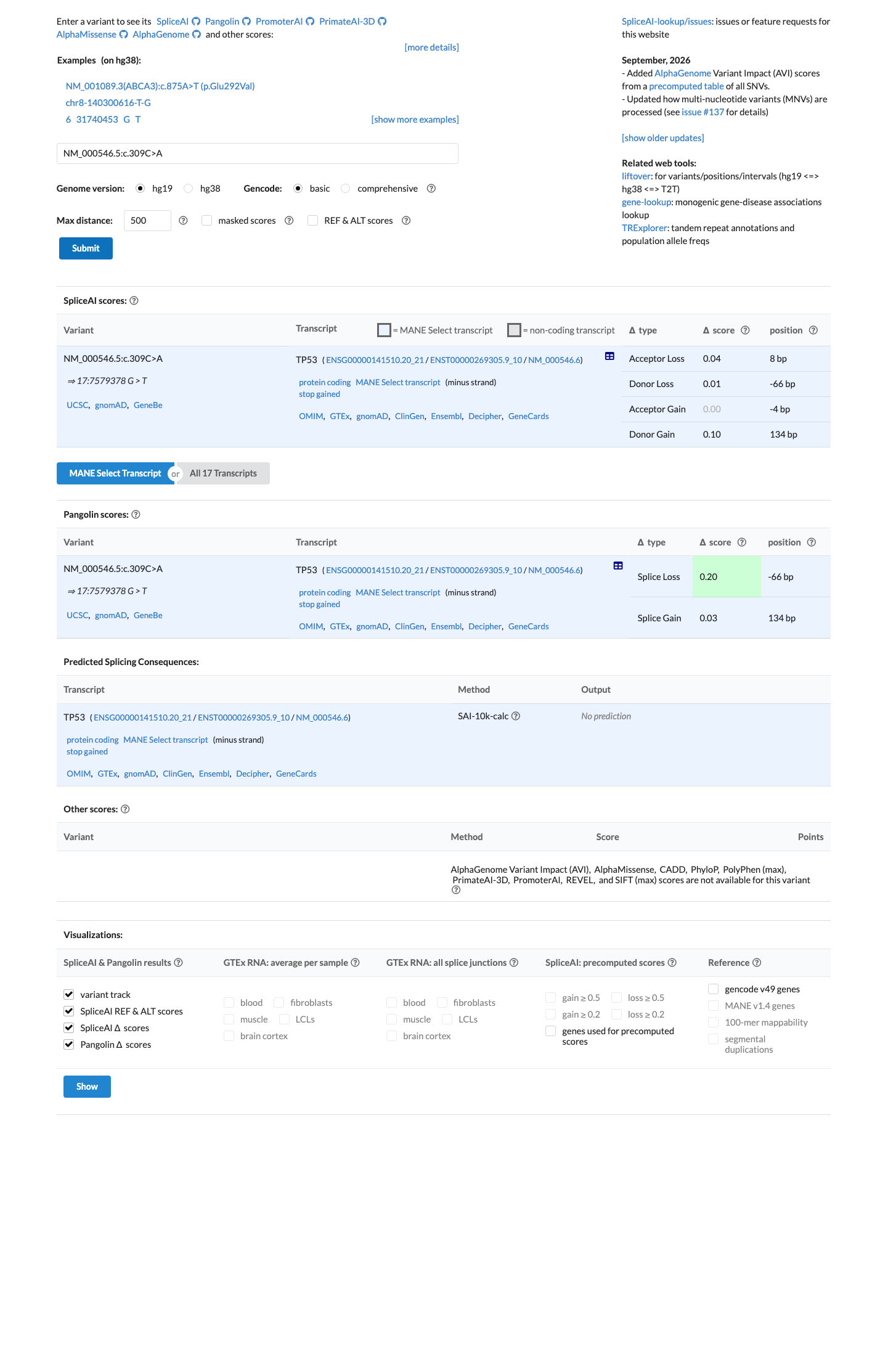
SpliceAI screenshot
In silico
SpliceAI predicts no significant splice impact for this variant (max delta score = 0.10). BayesDel score = 0.66.
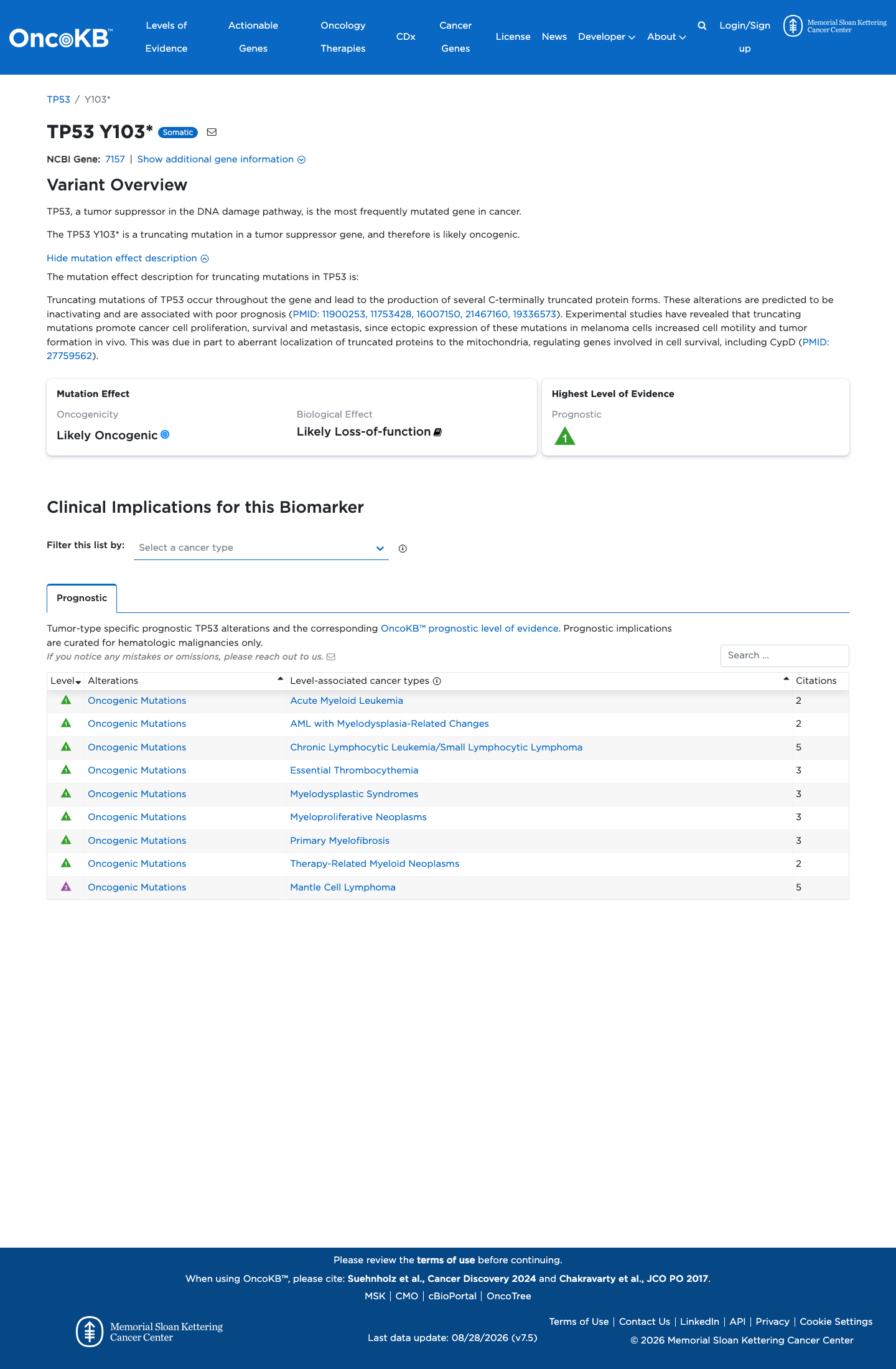
Functional / OncoKB screenshot
Functional Likely Oncogenic
OncoKB identified variant-specific curated literature and context relevant to functional review; biological-effect context: Likely Loss-of-function; curated oncogenicity label: Likely Oncogenic.
OncoKB ↗
COSMIC screenshot
COSMIC
Cancer hotspots screenshot
Cancer hotspots
Somatic evidence Not in COSMIC / hotspots
COSMIC
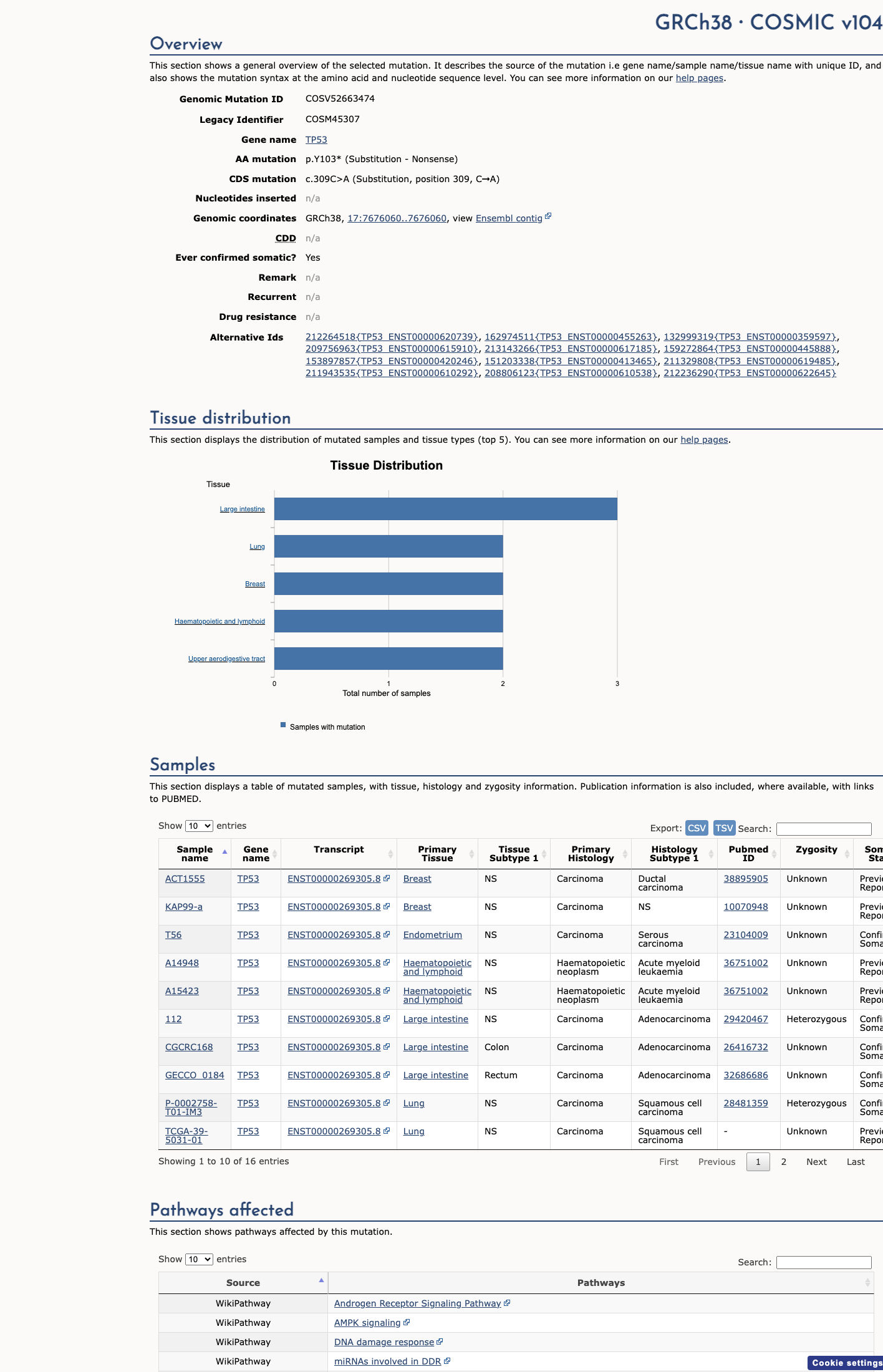
This variant does not lie in a statistically significant hotspot. This variant has previously been reported in somatic cancers (COSMIC; COSV52663474, n = 16 times).
Hotspots
This variant does not lie in a statistically significant hotspot.
Literature · how each cited paper was used
1papers cited
Each card is an audit: what was searched, what was found, whether it names the variant, which criteria it fed, and why. 8 further PMIDs triaged but not cited — see Sources & references.
Germline mutations of TP53 and BRCA2 genes in breast cancer/sarcoma families.
Searched
c.309C>Ap.(Y103*)p.Y103X
Found
This paper explicitly reports the TP53 germline nonsense variant c.309C>A (p.Y103X), corresponding to p.(Y103*), in family 2 and states that the alteration is predicted to result in protein truncation and is most likely deleterious.
Variant
✓ Names this variant — characterised directly
Applied to
→PVS1 very strong
The exact variant is reported as a nonsense change predicted to cause protein truncation, supporting the consequence characterization used with the VCEP PVS1 rule.
Identified alterations included a nonsense (Y103X), a splice site (IVS4 + 1_IVS4 + 2insG) and a missense (R283C) mutation. All mutations are most likely deleterious. The first is predicted to result in protein truncation and the second to influence mRNA splicing.
Location Table 2, Family 2; Results, paragraph beginning "Identified alterations included a nonsense (Y103X)"  ·  Context Twenty-three unrelated individuals from breast cancer/sarcoma families were screened using PCR amplification and direct sequencing of TP53 coding and non-coding exons, splice-site junctions, promoter, and 3' untranslated region.  ·  full text
Sources & reference links
9Sources
CSpec VCEP
ClinVar
gnomAD v2.1
gnomAD v4.1
gnomAD-Canada
SpliceAI
OncoKB
COSMIC
Cancer hotspots
Triaged references · 8 PMIDs not cited in assessment
11753428 ↗ A novel mechanism of tumorigenesis involving pH-dependent destabilization of a mutant p53 tetramer. ONCOKB
11900253 ↗ Rescuing the function of mutant p53. ONCOKB
16007150 ↗ The relationship among p53 oligomer formation, structure and transcriptional activity using a comprehensive missense mutation library. ONCOKB
19336573 ↗ High incidence of protein-truncating TP53 mutations in BRCA1-related breast cancer. ONCOKB
21467160 ↗ Prognostic significance of truncating TP53 mutations in head and neck squamous cell carcinoma. ONCOKB
25741868 ↗ Standards and guidelines for the interpretation of sequence variants: a joint consensus recommendation of the American College of Medical Genetics and Genomics and the Association for Molecular Pathology. CLINVAR
29979965 ↗ A Systematic p53 Mutation Library Links Differential Functional Impact to Cancer Mutation Pattern and Evolutionary Conservation. CLINVAR
26140447 ↗ Points to Consider: Ethical, Legal, and Psychosocial Implications of Genetic Testing in Children and Adolescents. CLINVAR