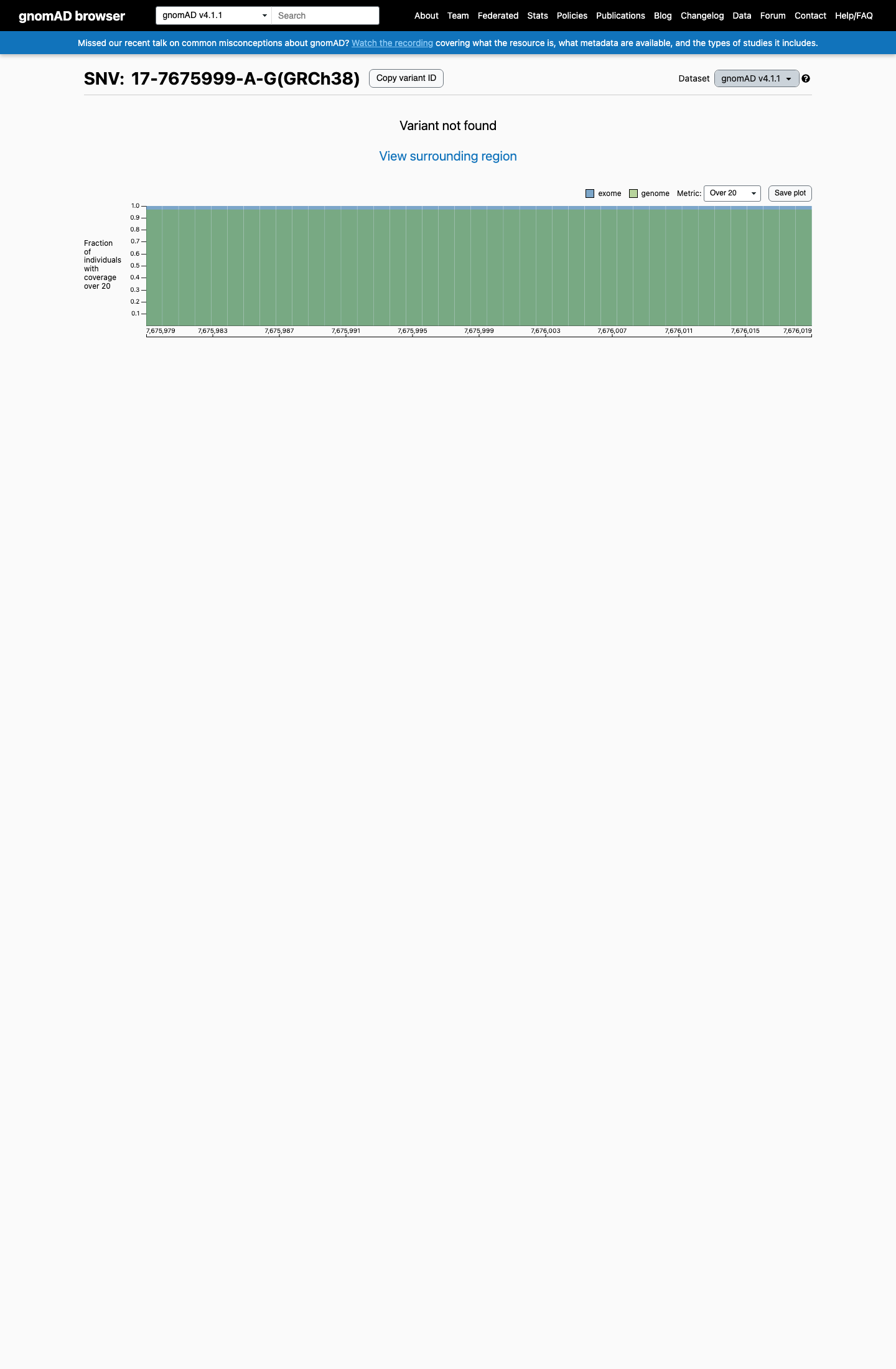
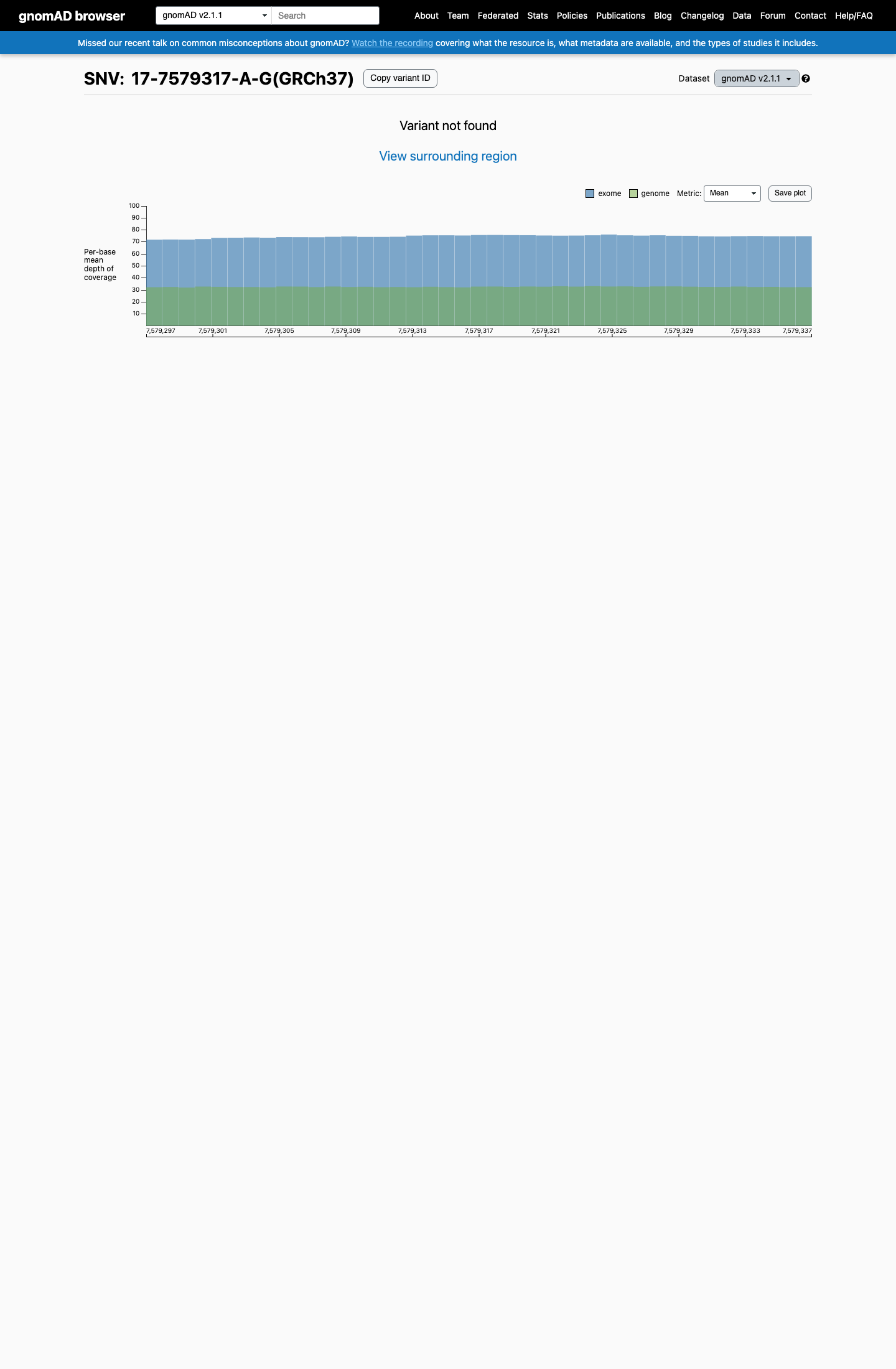
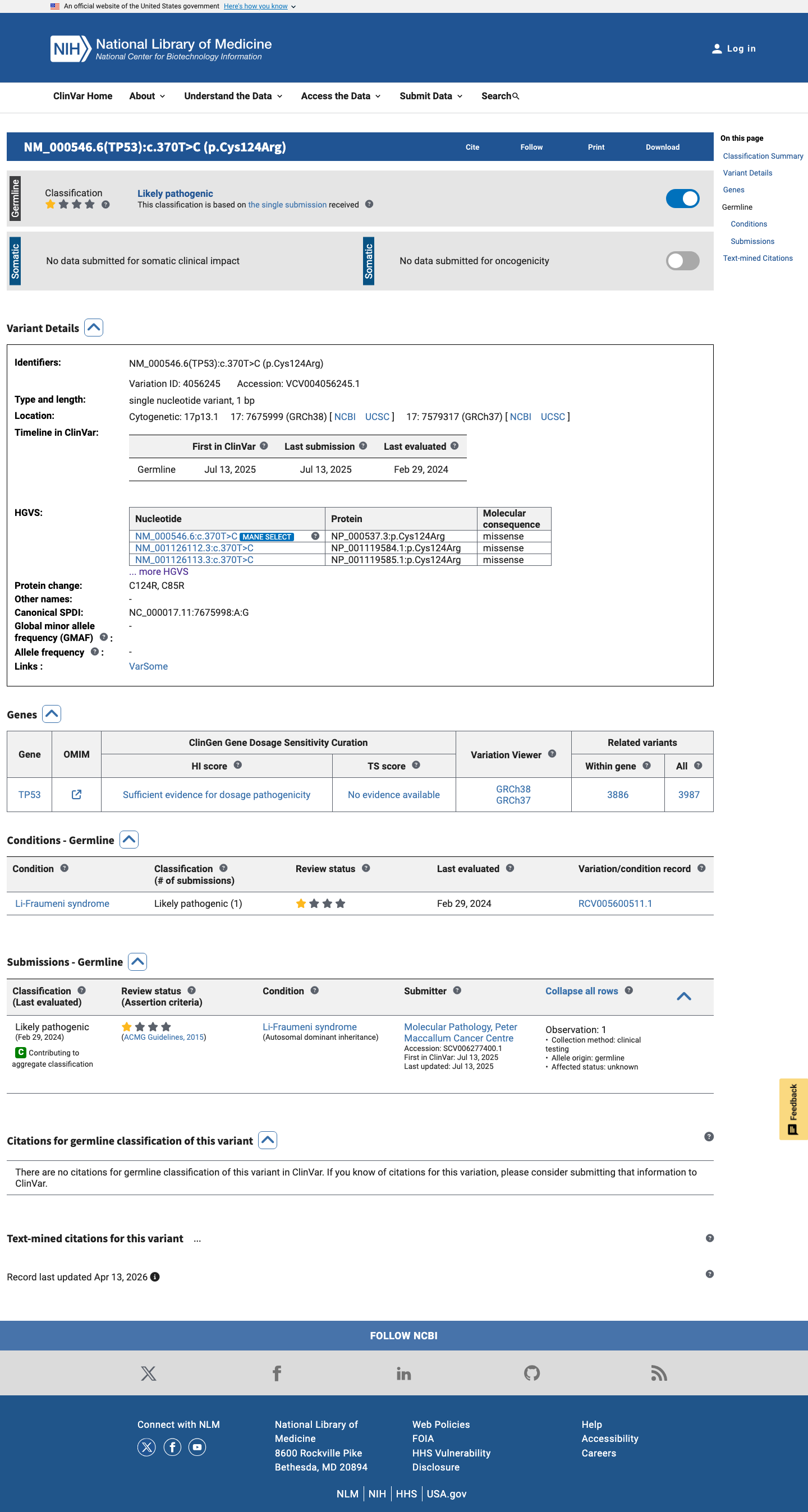
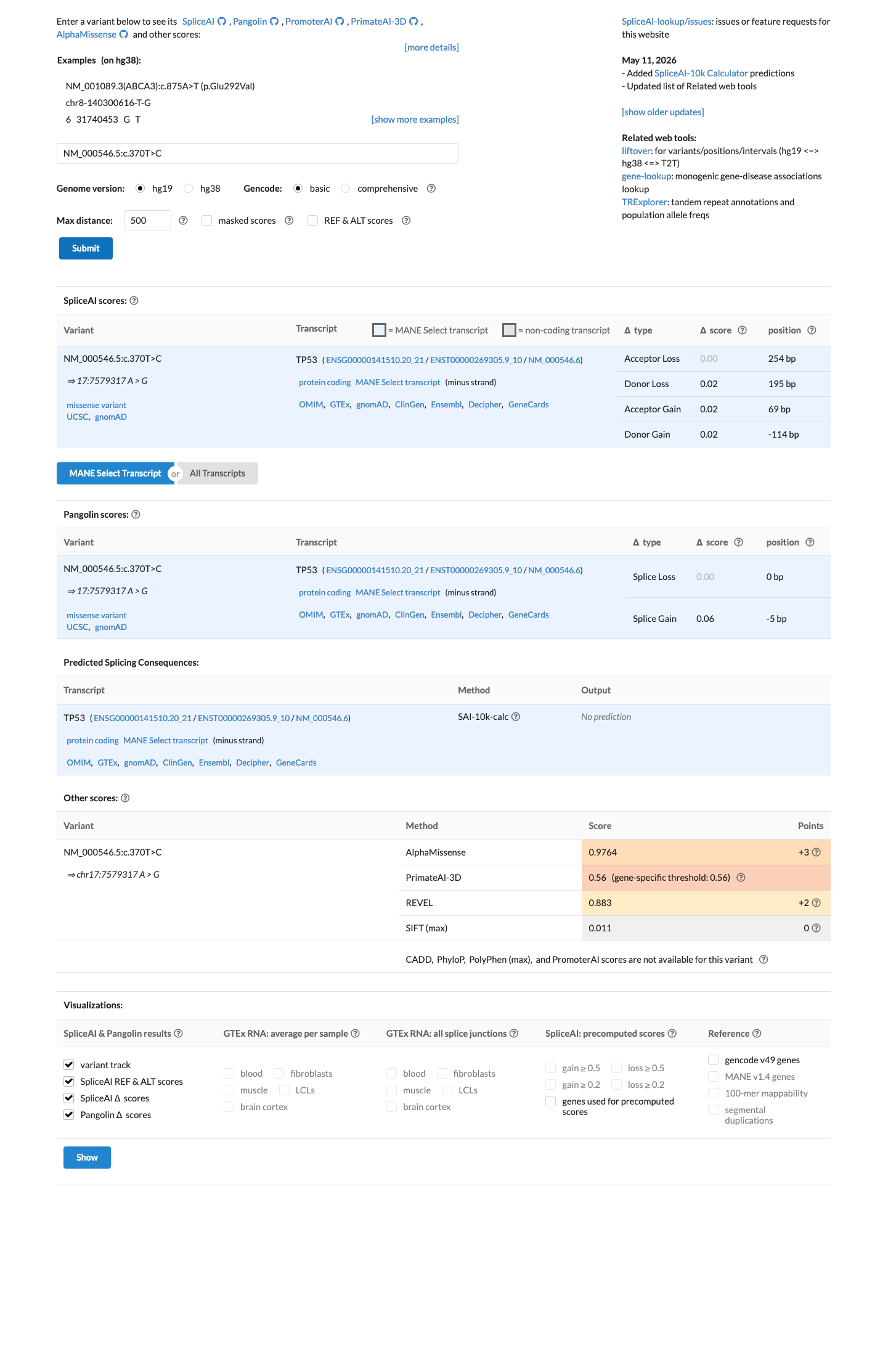
NM_000546.5(NP_000537.3):c.370T>C (p.Cys124Arg) is a missense variant in exon 4 of TP53. This variant is absent from gnomAD v2.1 and v4.1 population databases, meeting PM2_Supporting per TP53 VCEP v2.4.0 (allele frequency <0.003%).1 Functional studies demonstrate that p.Cys124Arg is non-functional in the Kato et al. assay and exhibits loss of function in the majority of other eligible assays (Giacomelli, Kotler), meeting PS3 at strong strength per TP53 VCEP specifications (Functional-worksheet.xlsx, Supplementary Table S3).2 In silico predictors support a deleterious effect: aGVGD Class C65, BayesDel score 0.25469, REVEL score 0.883, meeting PP3 at moderate strength per TP53 VCEP specifications (PP3-BP4-codes.xlsx, Supplementary Table S2). SpliceAI predicts no splicing impact (max delta 0.02).3 The variant has been reported in ClinVar as Likely pathogenic by one clinical laboratory (ClinVar Variation ID: 4056245) and is observed in COSMIC with 8 somatic occurrences (COSV52752618).4 No de novo observations, cosegregation data, proband phenotype scoring, or unaffected elderly carrier data were identified for this variant. PS2, PS4, PP1, PP4, BS2, and BS4 remain unassessed. Applying the TP53 VCEP v2.4.0 Tavtigian point system: PS3 (+4) + PP3_Moderate (+2) + PM2_Supporting (+1) = +7 points, which falls in the Likely Pathogenic range (6-9 points).5
Final classification
Likely Pathogenic
PS3PM2PP3
TP53
c.370T>C
p.Cys124Arg
This variant
NM_000546.5(NP_000537.3):c.370T>C (p.Cys124Arg) is a missense variant in exon 4 of TP53.
Tavtigian et.al., 2020 - Bayesian adaptation of Richards et.al., 2015 v2.4.0 point-based framework: PS3 strong (+4) + PM2 supporting (+1) + PP3 moderate (+2) = 7 points, which maps to Likely Pathogenic.
Classification rationale
PS3PM2PP3
Likely Pathogenic
TP53 c.370T>C
PS3 + PM2 + PP3
→
Likely Pathogenic
LYFE Sciences is an AI system, and it can make mistakes. Criteria
may be applied incorrectly, sources may be misread, and a confident-looking
classification can still be wrong. Double-check every criterion and
its underlying evidence before relying on any call.
Gene diagram
· NM_000546.5 · variants mapped to exon structure
TP53
NM_000546.5
Fetching transcript structure from UCSC…
Applied criteria · 3 applied · 12 assessed
MetEvidence satisfies this criterion.
Not metEvaluated against available evidence; threshold not reached.
Not assessedApplies in principle, but no evidence was found to evaluate it.
N/ADoesn't apply to this variant type.
Applied · 3
Strength
Supporting
Moderate
Strong
Very strong
PS3
strong
Pathogenic
The TP53 VCEP Functional-worksheet.xlsx (Supplementary Table S3) assigns PS3 to p.Cys124Arg. Per VCEP rule: Non-functional on Kato et al. data AND loss of function (LOF) by the majority of other eligible assays qualifies for PS3 at strong strength. C124R is annotated as Non-functional on Kato data with LOF on Giacomelli and Kotler assays.
VCEP Functional-worksheet.xlsx: C124R assigned PS3 — Non-functional on KatoLOF on GiacomelliLOF on Kotler
PM2
supporting
Pathogenic
The variant is absent from gnomAD v2.1 and v4.1, meeting the TP53 VCEP PM2_Supporting threshold of allele frequency <0.00003 (0.003%). Absent from all population databases examined.
Absent from gnomAD v2.1. Absent from gnomAD v4.1. Absent from gnomAD-Canada v1.0.
PP3
moderate
Pathogenic
The TP53 VCEP PP3-BP4-codes.xlsx (Supplementary Table S2) assigns PP3_moderate to c.370T>C. Per VCEP rule: aGVGD Class C65 and BayesDel score ≥0.16 qualifies for PP3_moderate. The variant has aGVGD Class C65, BayesDel score 0.25469, REVEL score 0.883, and SpliceAI max delta 0.02 (no predicted splicing impact).
aGVGD Class C65BayesDel 0.25469 (≥0.16)REVEL 0.883
Assessed · not applied
· 6 not met · 6 not assessed
Pathogenic
PS2
No de novo observation with confirmed maternity/paternity was identified for this variant in any reviewed publication or database.
PS4
PS4 requires a significantly increased prevalence in affected individuals versus controls, scored by proband count and cancer type per the TP53 VCEP PS4 points table.
PM1
Codon 124 is not among the six TP53 VCEP-designated PM1_Moderate codons (175, 245, 248, 249, 273, 282).
PM5
PM5 requires a different pathogenic or likely pathogenic missense variant at the same amino acid residue (Cys124) classified per TP53 VCEP specifications.
PP1
No cosegregation data was identified in any reviewed publication.
PP4
The TP53 VCEP PP4 criterion requires observation of the variant at low variant allele fraction (VAF 5-35%) indicating possible somatic mosaicism or clonal hematopoiesis.
Benign
BA1
The TP53 VCEP BA1 rule requires a filtering allele frequency (FAF) ≥0.001 (0.1%) in a non-founder gnomAD continental subpopulation with ≥2,000 alleles and ≥2 alleles present.
BS1
The TP53 VCEP BS1 rule requires a filtering allele frequency (FAF) ≥0.0003 but <0.001 in a non-founder gnomAD continental subpopulation.
BS2
The TP53 VCEP BS2 rule requires observation in unrelated females ≥60 years without cancer (≥8 for Strong, 4-7 for Moderate, 2-3 for Supporting).
BS3
BS3 requires well-established functional studies showing no deleterious effect.
BS4
BS4 requires lack of segregation in affected family members.
BP4
The TP53 VCEP BP4 rule requires BayesDel score <0.16 (Supporting: <0.16 and >-0.008; Moderate: ≤-0.008) AND no predicted splicing impact (SpliceAI <0.2).
N/A · 10
PVS1 · PS1 · PM6 · PP2 · PP5 · BP1 · BP2 · BP5 · BP6 · BP7
Research & evidence
Population frequency · supports pathogenic
gnomAD v4.1
gnomAD v2.1
v4.1
Absent from gnomAD v4.1.
v2.1
Absent from gnomAD v2.1.
🇨🇦 CA
This variant is absent from gnomAD-Canada.
Allele frequency by ancestry
three datasets · side by side
gnomAD v4.1
Absent
· 0 / ?
0 hom
0 hom
Not observed in any ancestry group.
gnomAD v2.1
Absent
· 0 / ?
0 hom
0 hom
Not observed in any ancestry group.
gnomAD Canada 🇨🇦
Absent
· 0 / ?
0 hom
0 hom
Not observed in any ancestry group.
ClinVar
This variant has been reported in ClinVar as Likely pathogenic (1 clinical laboratory). (ClinVarID = 4056245)
In silico
SpliceAI predicts no significant splice impact for this variant (max delta score = 0.02). REVEL score = 0.883. BayesDel score = 0.25469.
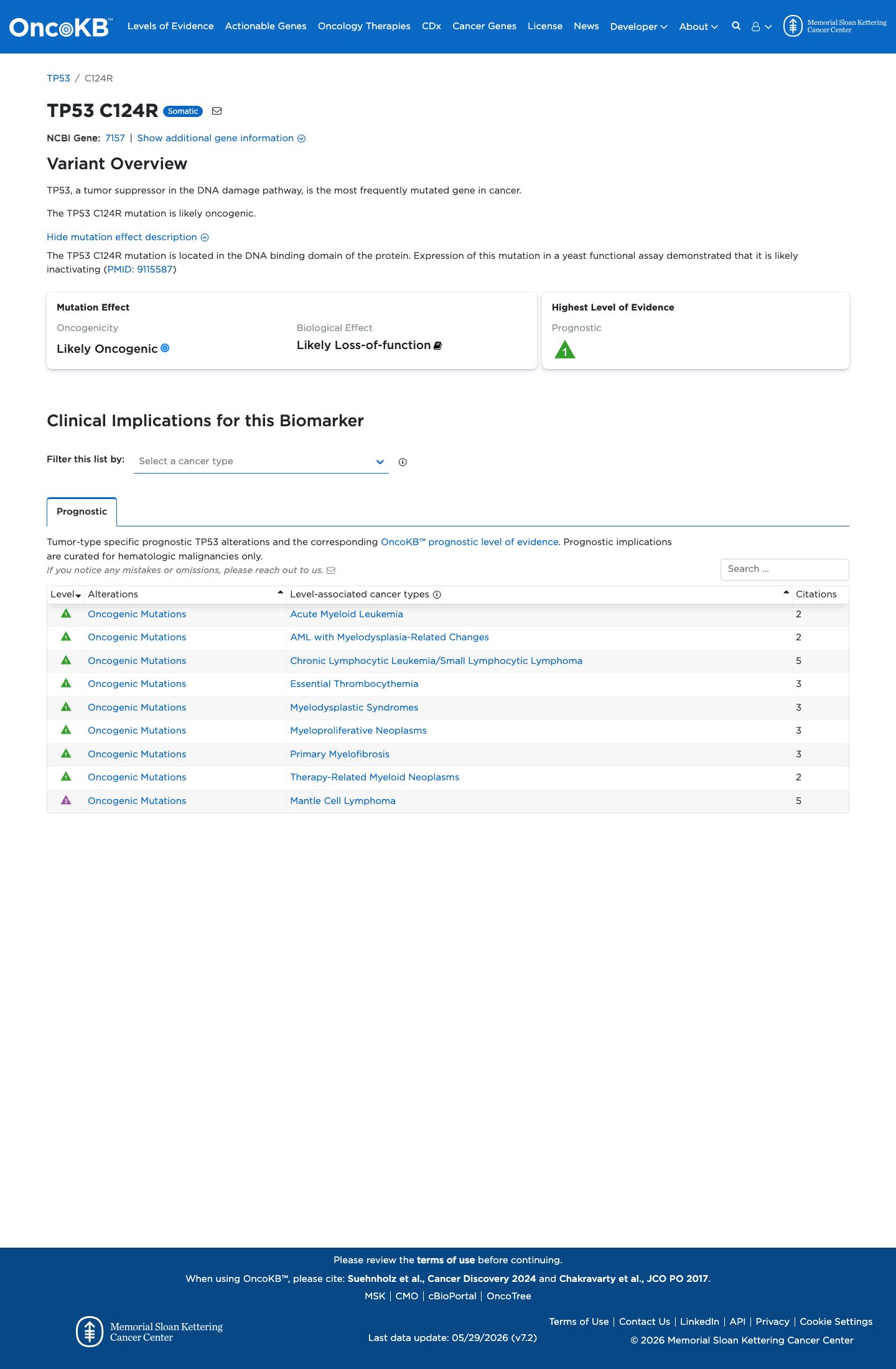
Functional
Likely Oncogenic
OncoKB identified variant-specific curated literature and context relevant to functional review; biological-effect context: Likely Loss-of-function; curated oncogenicity label: Likely Oncogenic.
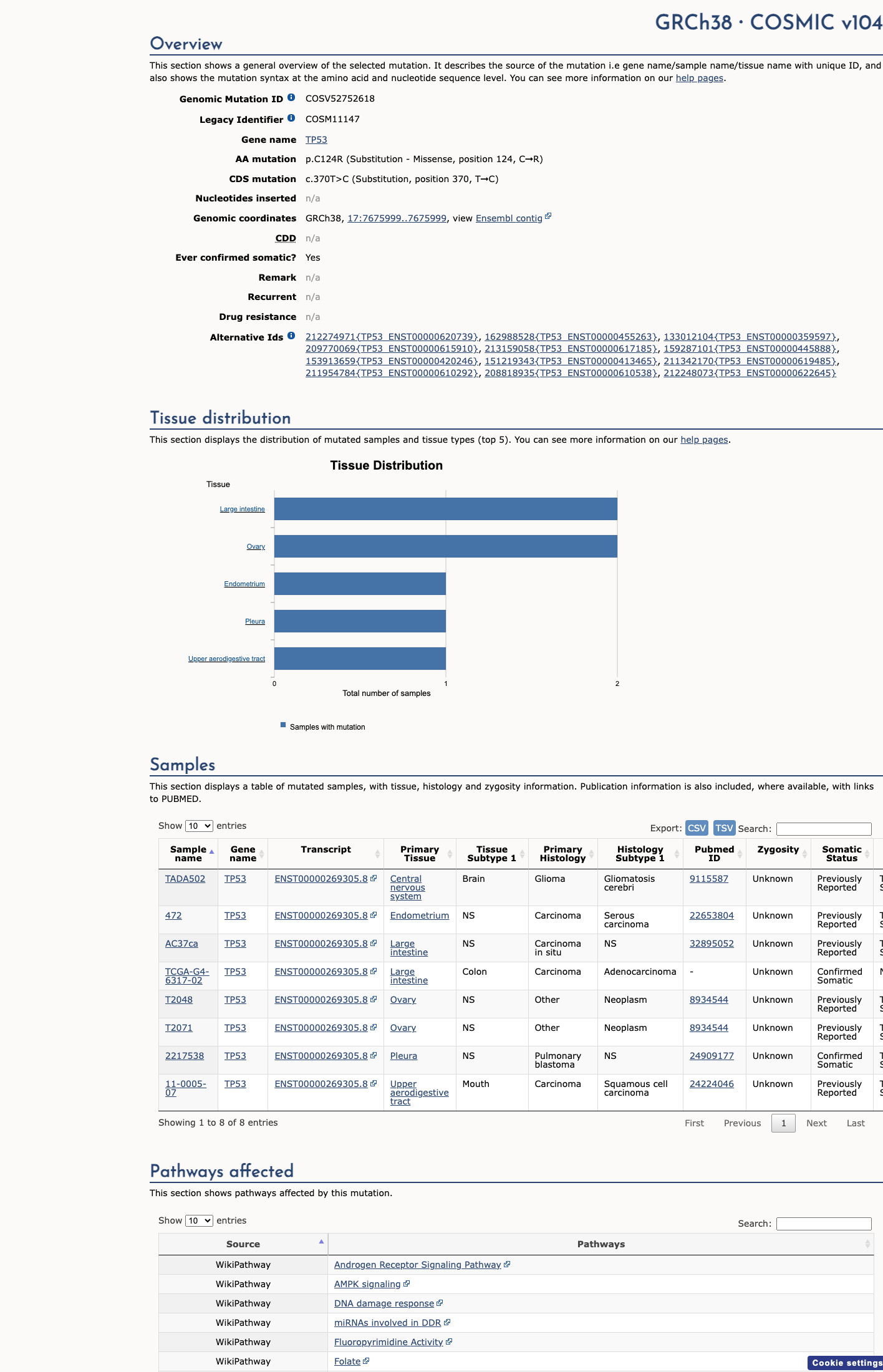
COSMIC

Cancer hotspots
Somatic evidence
Not in COSMIC / hotspots
COSMIC
This variant does not lie in a statistically significant hotspot. This variant has previously been reported in somatic cancers (COSMIC; COSV52752618, n = 8 times).
Hotspots
This variant does not lie in a statistically significant hotspot.
Sources & reference links
Triaged references · 7 PMIDs not cited in assessment
9115587 ↗
Reappraisal of p53 mutations in human malignant astrocytic neoplasms by p53 functional assay: comparison with conventional structural analyses.
ONCOKB
25741868 ↗
Standards and guidelines for the interpretation of sequence variants: a joint consensus recommendation of the American College of Medical Genetics and Genomics and the Association for Molecular Pathology.
CLINVAR
17392385 ↗
American Cancer Society guidelines for breast screening with MRI as an adjunct to mammography.
CLINVAR
24493721 ↗
American Society of Clinical Oncology Expert Statement: collection and use of a cancer family history for oncology providers.
CLINVAR
26389258 ↗
Cancer Genetics Risk Assessment and Counseling (PDQ®): Health Professional Version.
CLINVAR