TP53 encodes the p53 tumor suppressor protein, a transcription factor that responds to cellular stress such as DNA damage by switching on genes that trigger cell cycle arrest, DNA repair, senescence, or programmed cell death. In healthy cells, p53 is kept at low levels by constant degradation, but stress signals stabilize and activate it to protect against damaged cells surviving and dividing. Inherited mutations in TP53 cause Li-Fraumeni syndrome, a condition marked by a high risk of developing multiple cancers at a young age. TP53 is the most commonly mutated gene across human cancers, and loss of its normal function promotes tumor growth, spread, drug resistance, and genomic instability.
This variant
The p.Ser261Thr change occurs in TP53, which encodes the p53 tumor-suppressor transcription factor that protects cells from DNA damage and whose inherited disruption causes Li-Fraumeni syndrome.
Transcript
NM_000546.5
HGVS · transcript:coding
NM_000546.5:c.782G>C
GRCh38
chr17:7674181 C>G
GRCh37
chr17:7577499 C>G
Likely Benign: BS3 (strong) and BP4 (moderate) outweigh PM2 (supporting), producing a TP53 VCEP point score of -5 within the Likely Benign range.
Classification rationale
PM2BS3BP4Likely Benign
TP53 c.782G>Cmissense · exon 7
PM2 Supporting: c.782G>C is absent from the reported gnomAD datasets. BS3 Strong: TP53 functional assays show Functional Kato results and a majority of non-Kato assays without loss of function. BP4 Moderate: the TP53 VCEP pre-assigns BP4_moderate for p.Ser261Thr with BayesDel score -0.162486.
PM2 + BS3 + BP4→Likely Benign
LYFE Sciences is an AI system, and it can make mistakes. Criteria
may be applied incorrectly, sources may be misread, and a confident-looking
classification can still be wrong. Double-check every criterion and
its underlying evidence before relying on any call.
Gene diagram
· NM_000546.5 · variants mapped to exon structure
TP53NM_000546.5
Fetching transcript structure from UCSC…
Exons
—
Transcript span
—
Strand
—
Variants mapped
—
Source
UCSC ncbiRefSeqCurated
All variants in TP53—click a row to locate it on the plot · use the link column to open its page
Protein
Location
Classification
Link
Applied criteria · 3 applied · 13 assessed
MetEvidence satisfies this criterion.
Not metEvaluated against available evidence; threshold not reached.
Not assessedApplies in principle, but no evidence was found to evaluate it.
N/ADoesn't apply to this variant type.
Applied · 3
Strength Supporting Moderate Strong Very strong
✓
PM2supportingPathogenic
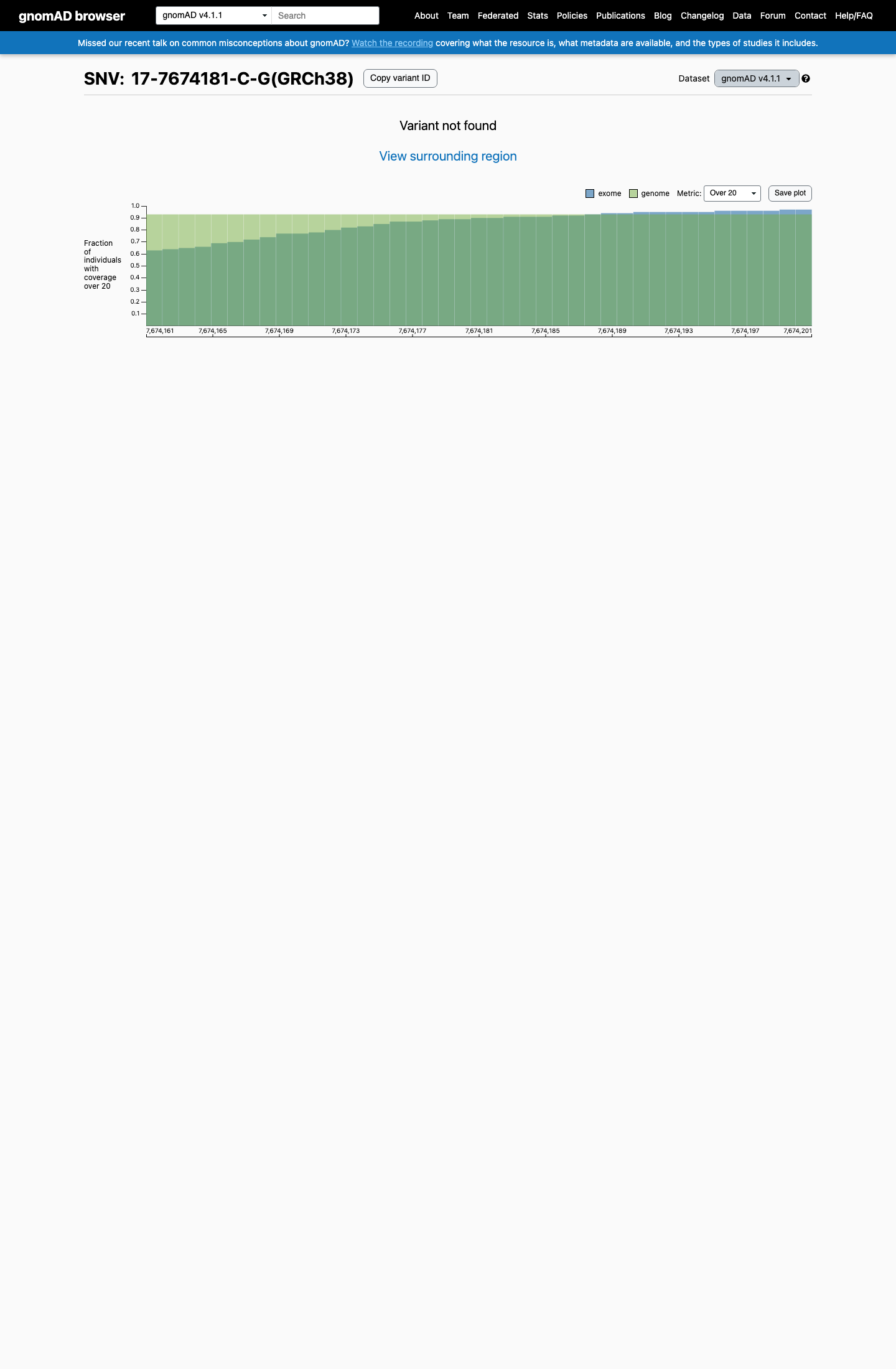
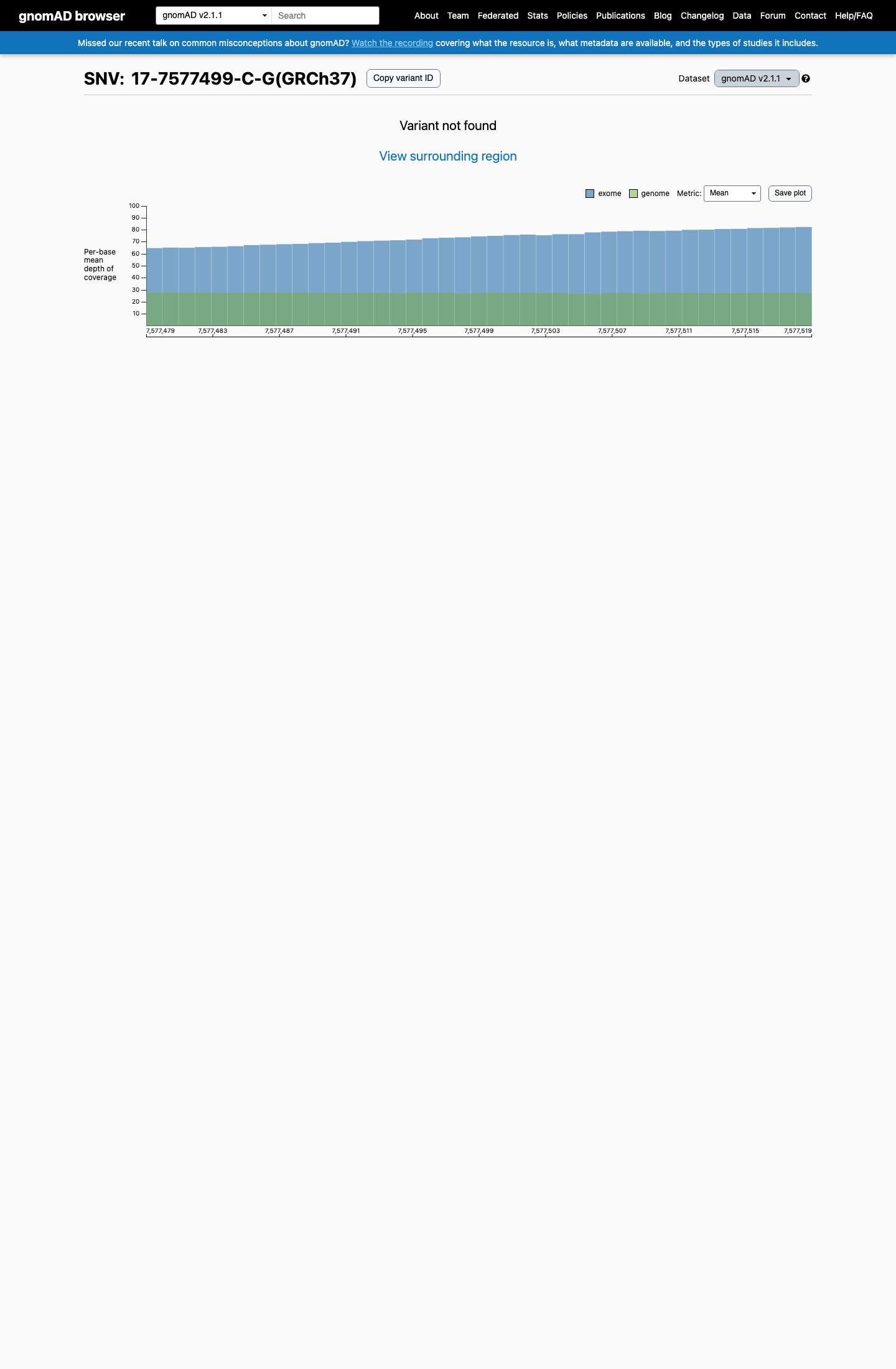
Met at Supporting: the variant is absent from gnomAD v2.1, v4.1, and non-cancer subsets, with observed allele frequency 0 versus the TP53 VCEP threshold below 0.00003.
The TP53 VCEP Version 2.4 requires PM2 at Supporting strength for allele frequency <0.00003; when multiple alleles occur in an ancestry group, that group's frequency must be <0.00004.GNOMAD_V2_1 reports the variant as absent, corresponding to observed allele frequency 0; GNOMAD_V2_1_NON_CANCER exomes also report it as absent.GNOMAD_V4_1 reports the variant as absent, corresponding to observed allele frequency 0; GNOMAD_V3_1_NON_CANCER genomes also report it as absent.
Met, strong: the VCEP row assigns BS3 with Kato Functional and majority noLOF among non-Kato assays (2 of 3), subject to splice-effect review.
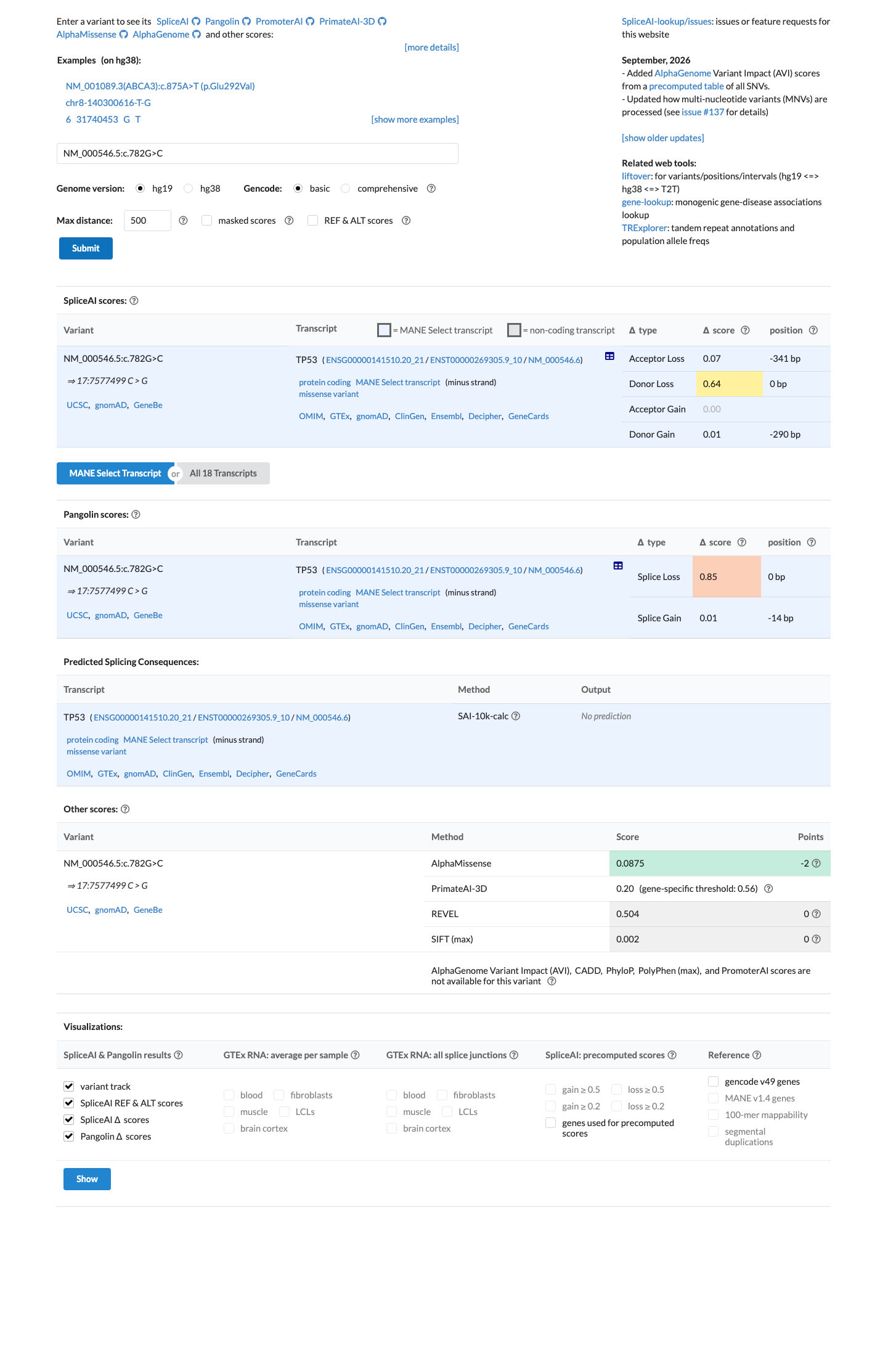
The exact Functional-worksheet.xlsx entry is S261T: Kato Functional; Funk LOF; Giacomelli noLOF; Kotler noLOF; Kawaguchi NA; preliminary functional code BS3.The TP53 VCEP BS3 strong rule is Functional on Kato data AND no loss of function by the majority of available eligible assays; the available non-Kato assays are majority noLOF (2 of 3).The case SpliceAI result has max delta score 0.638, and the TP53 VCEP framework cautions that BS3 should not be applied to missense variants if PP3 is applied based on SpliceAI; this interaction requires human review.
Met at moderate: the TP53 VCEP table pre-assigns BP4_moderate for c.782G>C with BayesDel -0.162486.
The governing TP53 VCEP Supplementary Table S2 row for c.782G>C / p.Ser261Thr directly assigns BP4_moderate, with BayesDel class C0 and score -0.162486.The same authoritative row reports maximum SpliceAI delta 0.64 and the note 'Consider PP3 based on predicted splicing effect'; this note is not a replacement for the explicitly assigned BP4_moderate code.REVEL is 0.504, which does not meet the supplied generic REVEL BP4 supporting threshold of <=0.29 from the ClinGen SVI REVEL calibration (Pejaver et al. 2022, PMID:36413997); therefore the result relies on the VCEP pre-assignment rather than generic REVEL thresholding.
Assessed · not applied
· 7 not met · 6 not assessed
Pathogenic
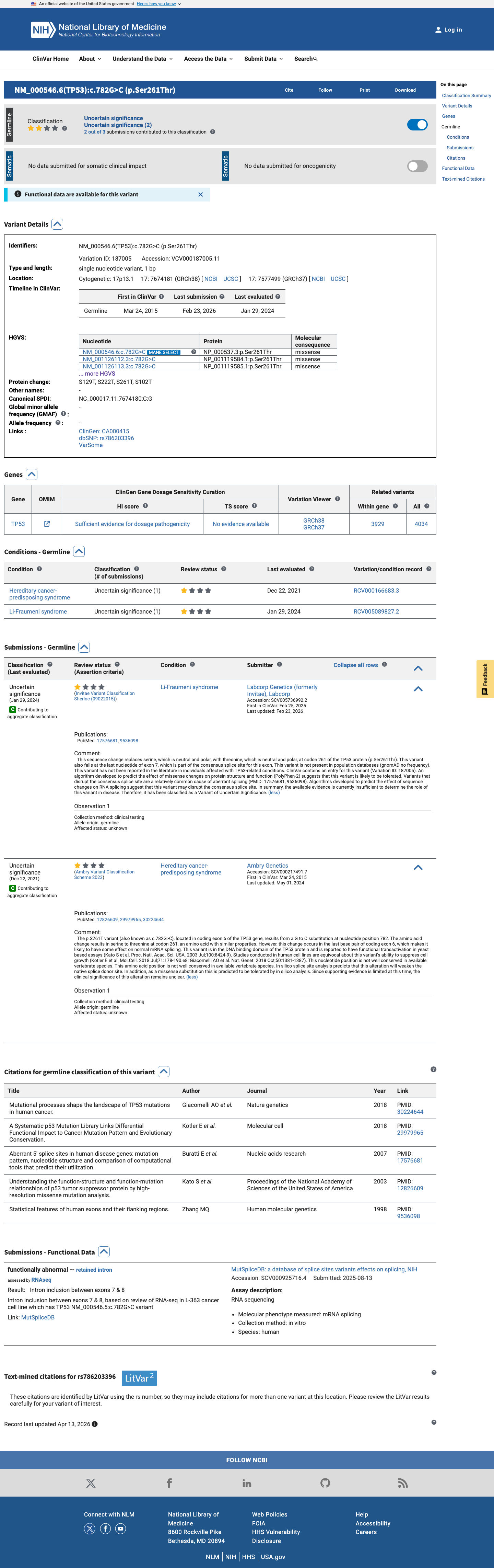
PS1Not met: no qualifying pathogenic p.Ser261Thr comparator is documented, and SpliceAI max delta 0.638 exceeds the VCEP <0.2 no-splicing requirement.
PS2Not assessed: no qualifying de novo proband, parental confirmation, or PS2 point total is available for NM_000546.5:c.782G>C.
PS3Not met: Kato classified p.S261T as Functional, while the available non-Kato assays were mostly noLOF (2 noLOF versus 1 LOF).
PS4Not assessed: no proband phenotype or cancer-history data are available to assign TP53 PS4 points against the 1-1.5, 2-3.5, 4-7.5, or >=8 thresholds.
PM1Not met: residue 261 is outside the VCEP hotspot codons, cancerhotspots returned no result, and vcep_materials domain_tables is empty.
PM5Not met: the residue-261 review found 0 qualifying pathogenic or likely pathogenic alternate missense comparators for PM5.
PP1Not assessed: no variant-positive affected relatives, obligate carriers, or countable PP1 meioses are documented for this variant.
PP3Not met: missense REVEL 0.504 is below the 0.644 PP3 supporting threshold, and the VCEP row assigns BP4_moderate rather than PP3.
PP4Not assessed: no multigene-panel VAF observation is available to compare with the TP53 PP4 Supporting 5-35% or Moderate 5-25% ranges.
Benign
BA1Not met: the variant is absent from gnomAD v2.1 and v4.1, below the TP53 VCEP BA1 FAF threshold of 0.001.
BS1Not met: the variant is absent from gnomAD v2.1 and v4.1, below the TP53 VCEP BS1 FAF range beginning at 0.0003.
BS2Not assessed: no qualifying unaffected females aged 60 years or older carrying the variant were reported for the TP53 VCEP BS2 threshold of at least 2.
BS4Not assessed: no affected non-carrier relatives or other documented lack-of-segregation evidence is available.
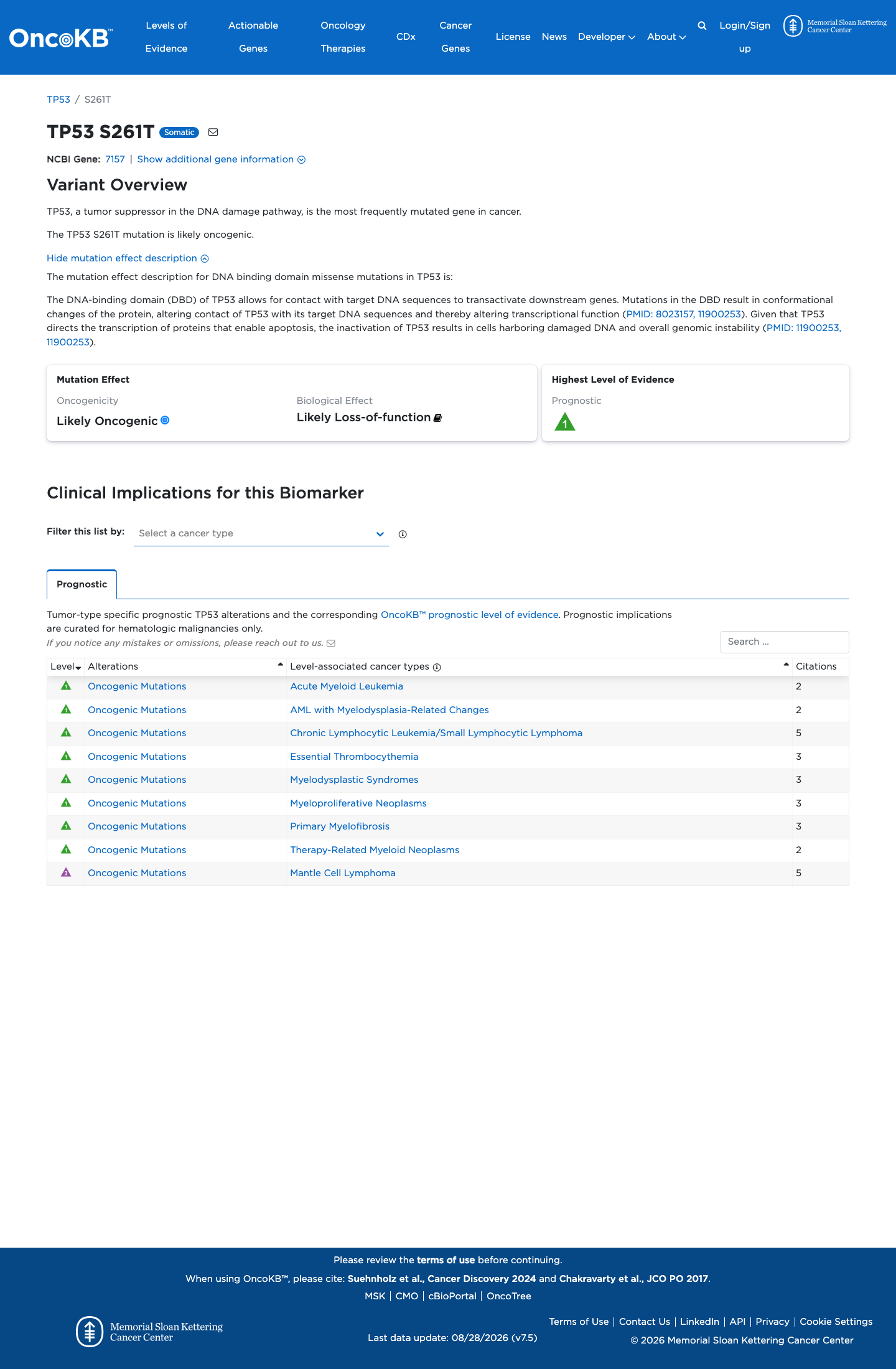
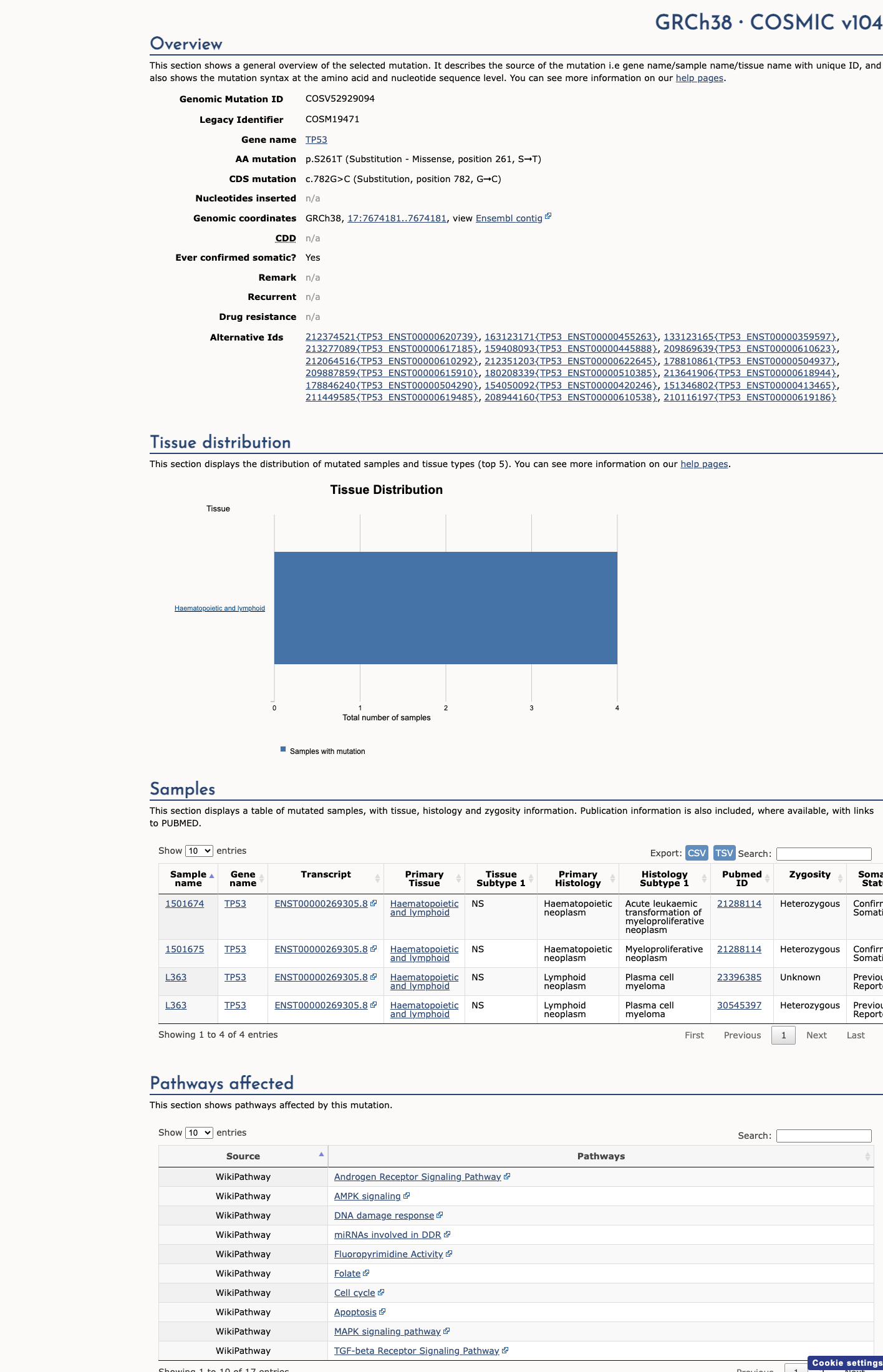
This variant does not lie in a statistically significant hotspot. This variant has previously been reported in somatic cancers (COSMIC; COSV52929094, n = 3 times).
Hotspots
This variant does not lie in a statistically significant hotspot.
Each card is an audit: what was searched, what was found, whether it names the variant, which criteria it fed, and why. 7 further PMIDs triaged but not cited — see Sources & references.
Rule & framework references · cited for criterion definitions, not variant evidence
12826609 ↗Understanding the function-structure and function-mutation relationships of p53 tumor suppressor protein by high-resolution missense mutation analysis.
Sources & reference links
9Sources
CSpec VCEP
ClinVar
gnomAD v2.1
gnomAD v4.1
gnomAD-Canada
SpliceAI
OncoKB
COSMIC
Cancer hotspots
Triaged references · 7 PMIDs not cited in assessment
11900253 ↗Rescuing the function of mutant p53.ONCOKB
8023157 ↗Crystal structure of a p53 tumor suppressor-DNA complex: understanding tumorigenONCOKB
17392385 ↗American Cancer Society guidelines for breast screening with MRI as an adjunct to mammography.CLINVAR
17576681 ↗Aberrant 5' splice sites in human disease genes: mutation pattern, nucleotide structure and comparison of computational tools that predict their utilization.CLINVAR
24493721 ↗American Society of Clinical Oncology Expert Statement: collection and use of a cancer family history for oncology providers.CLINVAR
25394175 ↗A practice guideline from the American College of Medical Genetics and Genomics and the National Society of Genetic Counselors: referral indications for cancer predisposition assessment.CLINVAR
26389210 ↗Genetics of Breast and Gynecologic Cancers (PDQ®): Health Professional Version.CLINVAR