TP53 encodes the p53 tumor suppressor protein, a transcription factor that responds to cellular stress such as DNA damage by switching on genes that trigger cell cycle arrest, DNA repair, senescence, or programmed cell death. In healthy cells, p53 is kept at low levels by constant degradation, but stress signals stabilize and activate it to protect against damaged cells surviving and dividing. Inherited mutations in TP53 cause Li-Fraumeni syndrome, a condition marked by a high risk of developing multiple cancers at a young age. TP53 is the most commonly mutated gene across human cancers, and loss of its normal function promotes tumor growth, spread, drug resistance, and genomic instability.
This variant
NM_000546.6:c.527G>T (p.Cys176Phe) alters TP53, a tumor-suppressor gene whose normal p53 protein coordinates DNA-damage responses and whose inherited loss-of-function variants cause Li-Fraumeni syndrome.
Transcript
NM_000546.6
HGVS · transcript:coding
NM_000546.6:c.527G>T
GRCh38
chr17:7675085 C>A
GRCh37
chr17:7578403 C>A
VUS: PS3 moderate, PM2 supporting, and PP3 moderate total 5 points under the TP53 Expert Panel's Version 2.4 point-based framework.
Classification rationale
PS3PM2PP3VUS
TP53 c.527G>Tmissense · exon 5
PS3 moderate: the VCEP worksheet records partial function in Kato data and loss of function in three other eligible assays. PM2 supporting: gnomAD v4.1 allele frequency is 1.23897e-06, below the TP53 VCEP threshold. PP3 moderate: the exact VCEP lookup row pre-assigns PP3_moderate for c.527G>T/p.Cys176Phe with BayesDel 0.579613.
PS3 + PM2 + PP3→VUS
LYFE Sciences is an AI system, and it can make mistakes. Criteria
may be applied incorrectly, sources may be misread, and a confident-looking
classification can still be wrong. Double-check every criterion and
its underlying evidence before relying on any call.
Gene diagram
· NM_000546.6 · variants mapped to exon structure
TP53NM_000546.6
Fetching transcript structure from UCSC…
Exons
—
Transcript span
—
Strand
—
Variants mapped
—
Source
UCSC ncbiRefSeqCurated
All variants in TP53—click a row to locate it on the plot · use the link column to open its page
Protein
Location
Classification
Link
Applied criteria · 3 applied · 13 assessed
MetEvidence satisfies this criterion.
Not metEvaluated against available evidence; threshold not reached.
Not assessedApplies in principle, but no evidence was found to evaluate it.
N/ADoesn't apply to this variant type.
Applied · 3
Strength Supporting Moderate Strong Very strong
✓
PS3moderatePathogenic
Met at moderate: the VCEP worksheet assigns C176F PS3_Moderate, with partially functional Kato results and loss of function in three other eligible assays.
The TP53 VCEP Functional-worksheet.xlsx row for C176F records Kato: Partially functional; Funk: LOF; Giacomelli: LOF; Kotler: LOF; Kawaguchi: NA; preliminary functional code: PS3_Moderate.The TP53 VCEP specification defines PS3_Moderate as partially functional on Kato et al. data plus loss of function by the majority of other available assays.The TP53 VCEP functional flowchart lists Kato, Funk, Giacomelli, Kotler, and Kawaguchi as eligible functional studies for PS3/BS3 assessment.
Met at supporting: gnomAD v4.1 AF is 1.23897e-06, below the TP53 VCEP PM2 threshold of 0.00003.
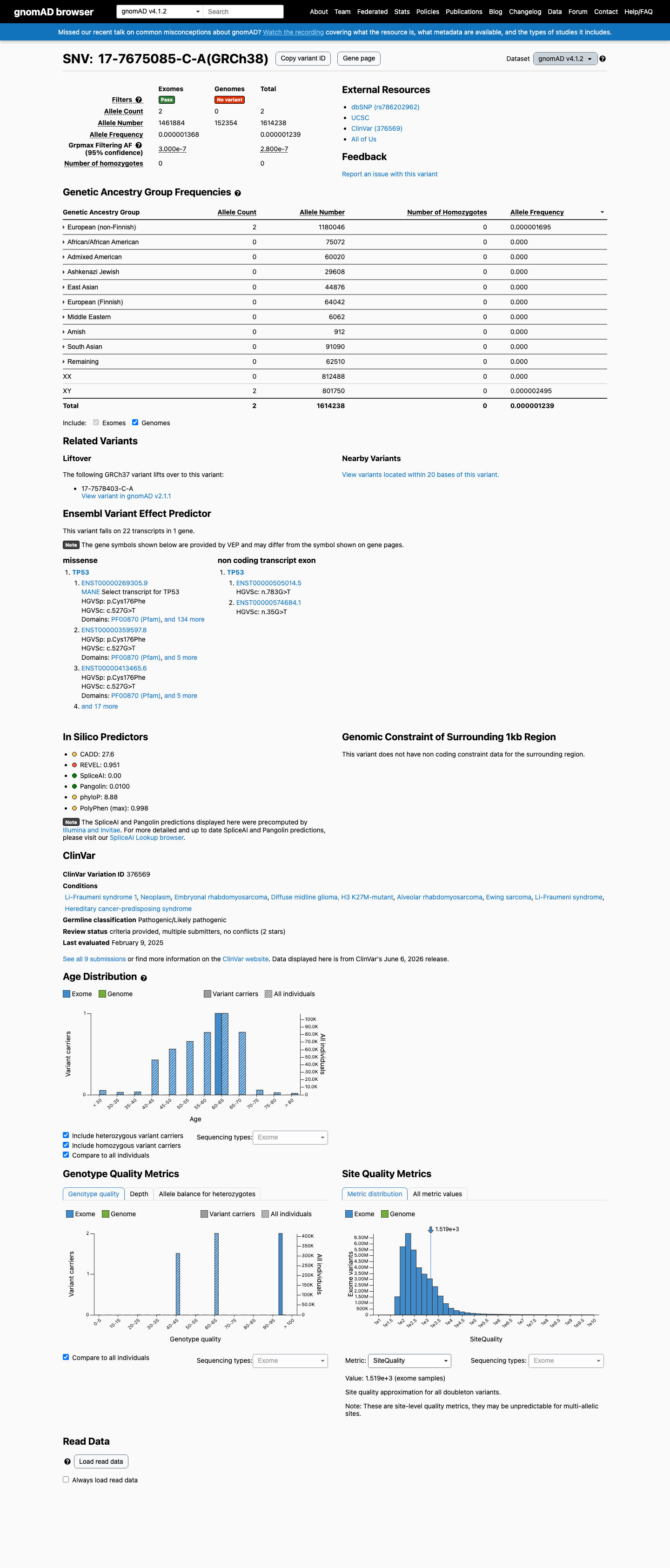
TP53 VCEP v2.4 specifies PM2 Supporting for AF <0.00003 in gnomAD or another large sequenced population; when multiple alleles occur in an ancestry group, that group must have AF <0.00004, with founder-effect groups ignored.gnomAD v4.1 all-comers reports AF 1.23897e-06 from 2/1,614,238 alleles, grpmax FAF 2.8e-07, and 0 homozygotes.gnomAD v2.1 non-cancer exomes report AF 4.22358e-06 from 1/236,766 alleles and 0 homozygotes; the highest listed non-cancer ancestry AF is 4.05976e-05 from 1/24,632 NFE_ONF alleles, so the VCEP multiple-allele ancestry clause does not apply.
Met: the TP53 VCEP lookup pre-assigns PP3_moderate for c.527G>T / p.Cys176Phe with BayesDel score 0.579613 and C65 classification.
The TP53 VCEP PP3-BP4 lookup table was searched for c.527G>T, p.Cys176Phe, and p.C176F; the exact c.527G>T row assigns Class C65, BayesDel 0.579613, and PP3_moderate.The TP53 VCEP specification defines PP3_moderate for missense variants with aGVGD C65 and BayesDel score at least 0.16; the exact lookup-table pre-assignment takes precedence over independently recomputing the code.Case normalization identifies NM_000546.6:c.527G>T as the missense variant NP_000537.3:p.(Cys176Phe) / p.(C176F).
Assessed · not applied
· 4 not met · 9 not assessed
Pathogenic
PS1Not assessed: no qualifying independent variant with a different nucleotide change producing the same p.Cys176Phe amino-acid substitution was identified.
PS2Not assessed: no confirmed de novo proband, parental testing, or TP53 VCEP PS2 point assignment is documented for this variant.
PS4Not assessed: the exact-variant tumor reports lack germline status and the VCEP-defined PS4 cancer-point total needed to reach the >=1-point threshold.
PM1Not assessed: p.Cys176Phe is outside the VCEP codon list, while the partial C176 hotspot record lacks the required same-amino-acid count of at least 10.
PM5Not assessed: no qualifying different missense substitution at Cys176 with a VCEP-concordant pathogenic or clinically supported likely pathogenic classification was identified.
PP1Not assessed: no affected relatives, family genotypes, or counted cosegregating meioses are documented for this variant.
PP4Not assessed: no qualifying multigene-panel VAF observation between 5% and 35% is documented for this TP53 variant.
Benign
BA1Not met: gnomAD v4.1 maximum population FAF is 2.8e-07, below the TP53 VCEP BA1 threshold of 0.001.
BS1Not met: gnomAD v4.1 maximum population FAF is 2.8e-07, below the TP53 VCEP BS1 lower threshold of 0.0003.
BS2Not assessed: no qualifying count of unrelated female carriers aged at least 60 years without cancer is available.
BS3Not met: the VCEP worksheet assigns PS3_Moderate and records loss of function in three eligible assays, precluding a benign functional interpretation.
BS4Not assessed: no affected relatives with discrepant genotypes or documented non-segregation are available for this variant.
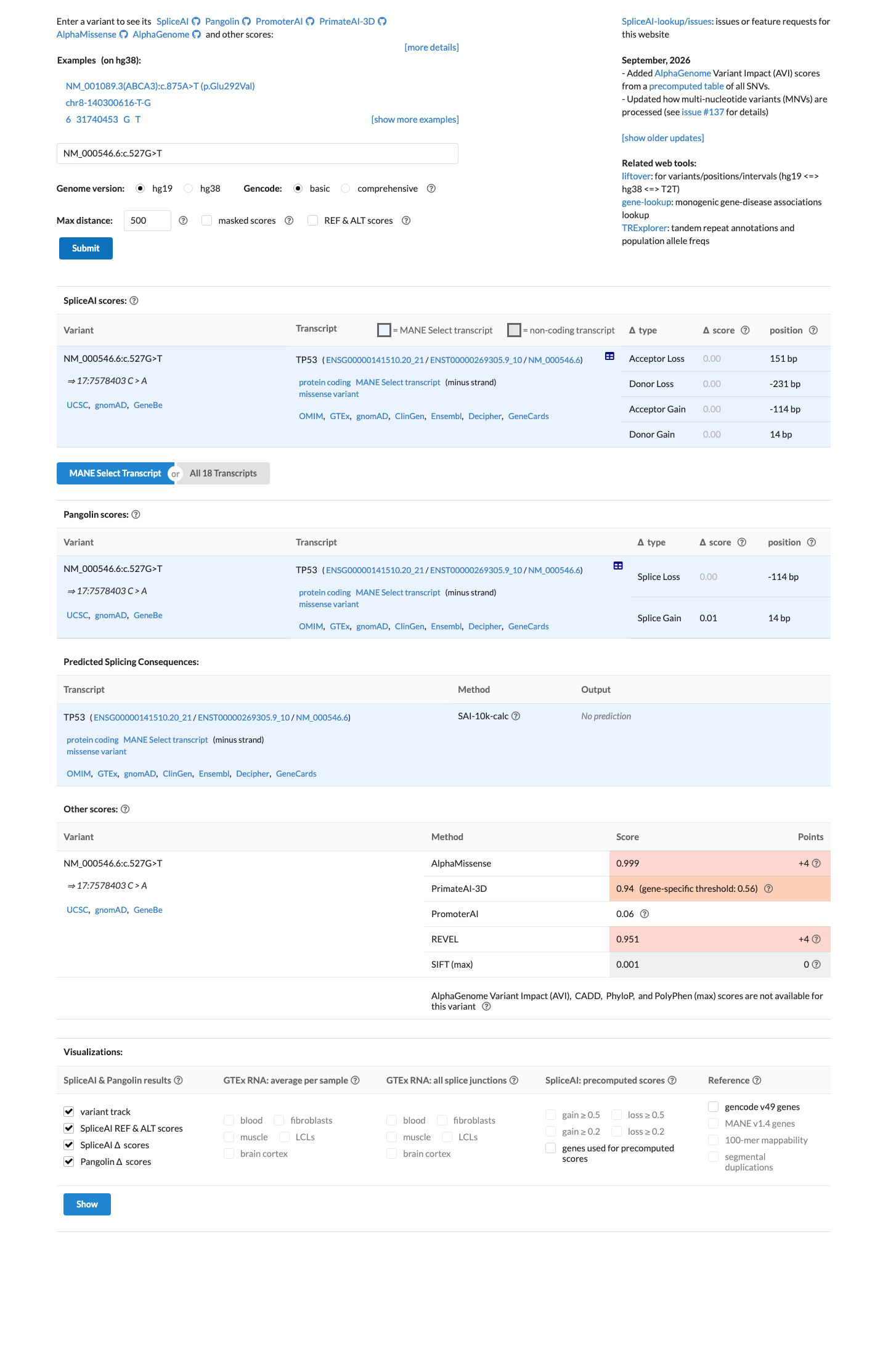
BP4Not met: missense BayesDel 0.579613 exceeds the TP53 VCEP BP4 threshold of <0.16, so the SpliceAI max delta 0.004 cannot establish BP4.
This variant is present in gnomAD v4.1 (AF= 1.23897e-06; MAF= 0.00012%, 2/1614238 alleles, homozygotes = 0) and has highest observed frequency in the European (non-Finnish) population (AF= 1.69485e-06; MAF= 0.00017%, 2/1180046 alleles, homozygotes = 0); grpmax FAF= 2.8e-07.
v2.1
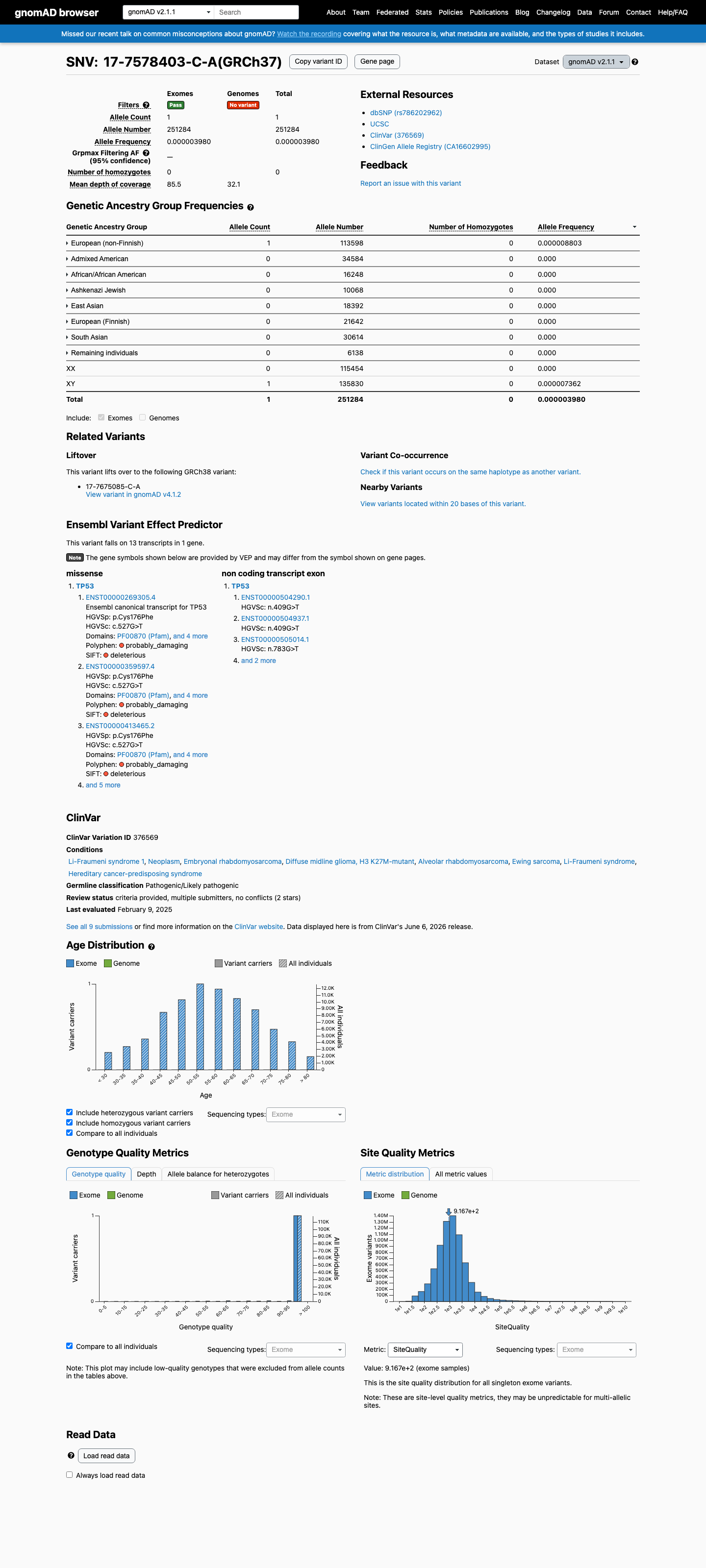
This variant is present in gnomAD v2.1 (AF= 3.97956e-06; MAF= 0.00040%, 1/251284 alleles, homozygotes = 0) and has highest observed frequency in the European (non-Finnish) population (AF= 8.80297e-06; MAF= 0.00088%, 1/113598 alleles, homozygotes = 0).
🇨🇦 CA
Absent from gnomAD-Canada v1.0.
Allele frequency by ancestry
three datasets · side by side
gnomAD v4.1
0.00012%
· 2 / 1,614,238
0 hom · FAF 2.8e-05%
European (non-Finnish)
2 / 1,180,046
0.00017%
+ 9 not observed (Remaining individuals, Admixed American, European (Finnish), Amish, East Asian, Middle Eastern, South Asian, Ashkenazi Jewish, African/African American)
gnomAD v2.1
0.0004%
· 1 / 251,284
0 hom
European (non-Finnish)
1 / 113,598
0.00088%
+ 7 not observed (African/African American, Admixed American, Ashkenazi Jewish, East Asian, European (Finnish), Remaining individuals, South Asian)
This variant has been reported in ClinVar as Likely pathogenic (2 clinical laboratories) and as Likely Pathogenic (1 clinical laboratory) and as Pathogenic (1 clinical laboratory). (ClinVarID = 376569)
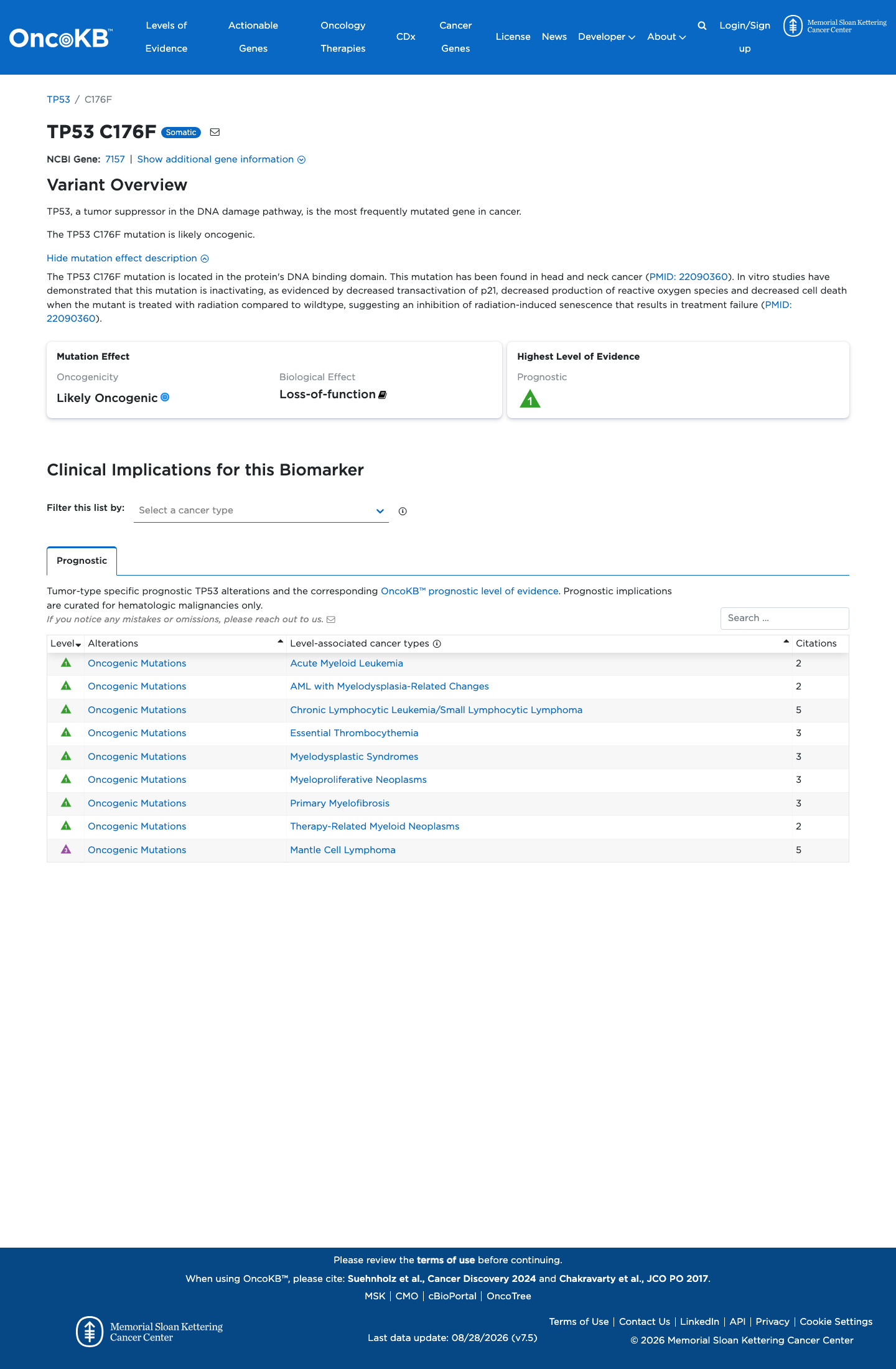
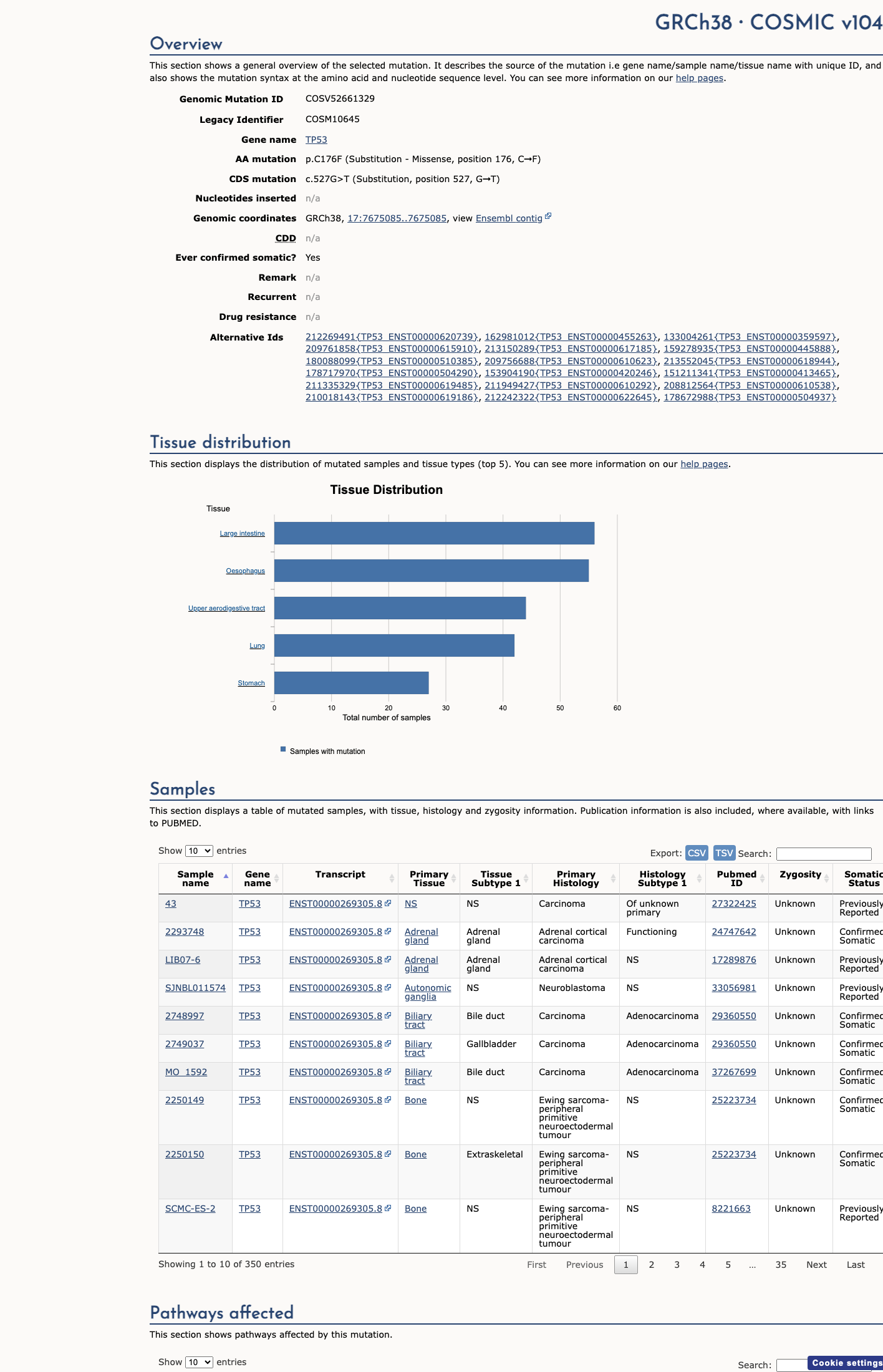
This variant lies in a statistically significant hotspot. This variant has previously been reported in somatic cancers (COSMIC; COSV52661329, n = 343 times).
Hotspots
This variant lies in a statistically significant hotspot.
Each card is an audit: what was searched, what was found, whether it names the variant, which criteria it fed, and why. 6 further PMIDs triaged but not cited — see Sources & references.
TP53 disruptive mutations lead to head and neck cancer treatment failure through
The paper explicitly studied TP53 C176F in HNSCC models and classified it as a disruptive TP53 mutation. In p53-null UMSCC1 cells, C176F expression produced relative radioresistance compared with wild-type and nondisruptive TP53 controls; C176F-expressing cells also showed no radiation-induced p21 induction.
Variant
✓ Names this variant — characterised directly
Applied to
→PS3
moderate
Direct cellular functional evidence characterizes C176F as disruptive and shows loss of expected p53 responses.
Disruptive TP53 expressing UMSCC1 cells were found to be radioresistant relative to wild type TP53 and nondisruptive TP53 expressing cells.
Location Results, paragraph 2 of 'Disruptive TP53 mutations are associated with p53-mediated radioresistance'; Figure 2 · Context TP53 constructs were expressed in p53-null UMSCC1 cells; endogenous p53 was silenced in HNSCC cell lines including HN 31 cells carrying C176F. Radiosensitivity was measured by clonogenic survival after irradiation, with p21 assessed by immunoblotting and reporter activity. · full text
Sources & reference links
9Sources
CSpec VCEP
ClinVar
gnomAD v2.1
gnomAD v4.1
gnomAD-Canada
SpliceAI
OncoKB
COSMIC
Cancer hotspots
Triaged references · 6 PMIDs not cited in assessment
10713666 ↗Quantitative analysis of residual folding and DNA binding in mutant p53 core domain: definition of mutant states for rescue in cancer therapy.CLINVAR
11900253 ↗Rescuing the function of mutant p53.CLINVAR
11920959 ↗Complex functions of mutant p53 alleles from human prostate cancer.CLINVAR
12826609 ↗Understanding the function-structure and function-mutation relationships of p53 tumor suppressor protein by high-resolution missense mutation analysis.CLINVAR
15037740 ↗A global suppressor motif for p53 cancer mutants.CLINVAR
15611505 ↗Prediction of TP53 status for primary cisplatin, fluorouracil, and leucovorin chemotherapy in ethmoid sinus intestinal-type adenocarcinoma.CLINVAR