TP53 encodes the p53 tumor suppressor protein, a transcription factor that responds to cellular stress such as DNA damage by switching on genes that trigger cell cycle arrest, DNA repair, senescence, or programmed cell death. In healthy cells, p53 is kept at low levels by constant degradation, but stress signals stabilize and activate it to protect against damaged cells surviving and dividing. Inherited mutations in TP53 cause Li-Fraumeni syndrome, a condition marked by a high risk of developing multiple cancers at a young age. TP53 is the most commonly mutated gene across human cancers, and loss of its normal function promotes tumor growth, spread, drug resistance, and genomic instability.
This variant
This TP53 variant occurs in a gene encoding the stress-responsive p53 tumor suppressor, whose inherited disease-associated mutations cause Li-Fraumeni syndrome and predispose to multiple early-onset cancers.
Transcript
NM_000546.6
HGVS · transcript:coding
NM_000546.6:c.760A>G
GRCh38
chr17:7674203 T>C
GRCh37
chr17:7577521 T>C
Likely Benign: PM1 and PM2 supporting plus PP3 supporting were outweighed by BS3 strong and BP6 supporting benign under the TP53 VCEP point framework.
Classification rationale
PM1PM2PP3BS3BP6Likely Benign
TP53 c.760A>Gmissense · exon 7
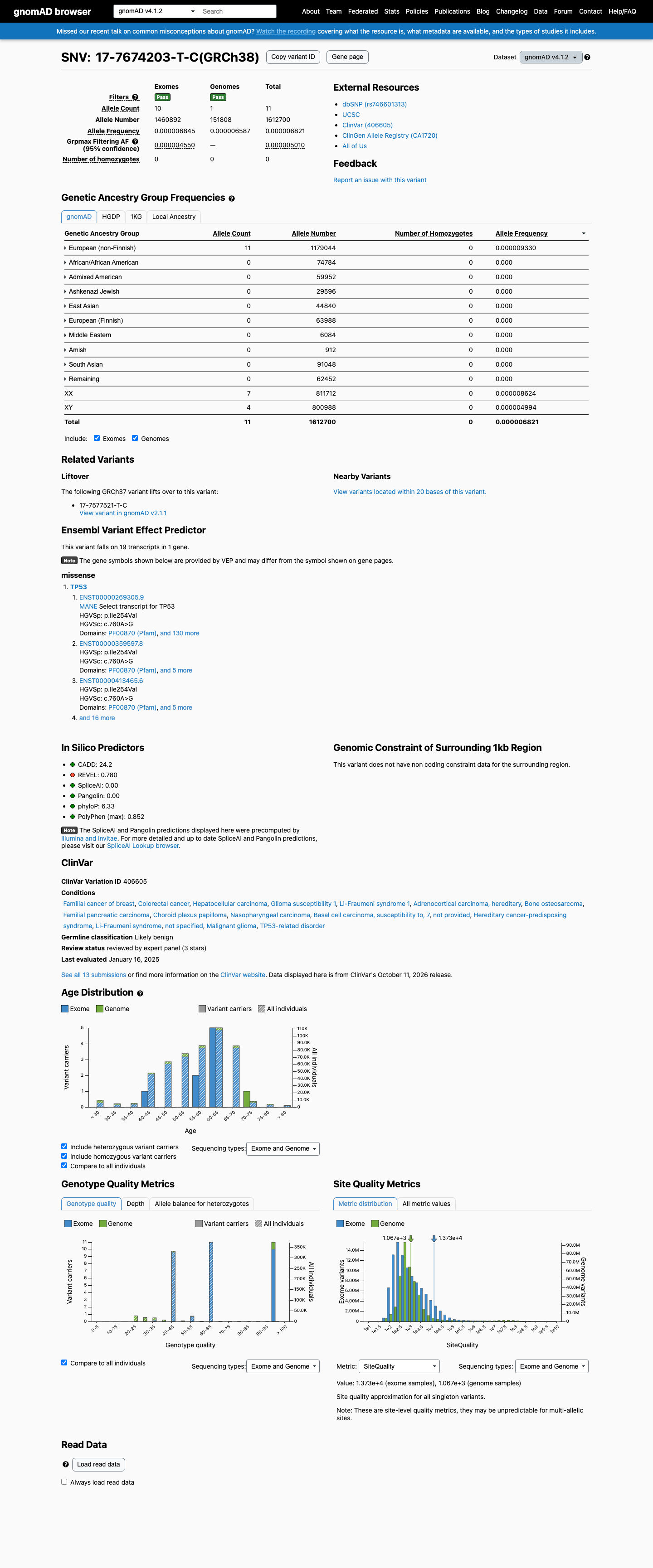
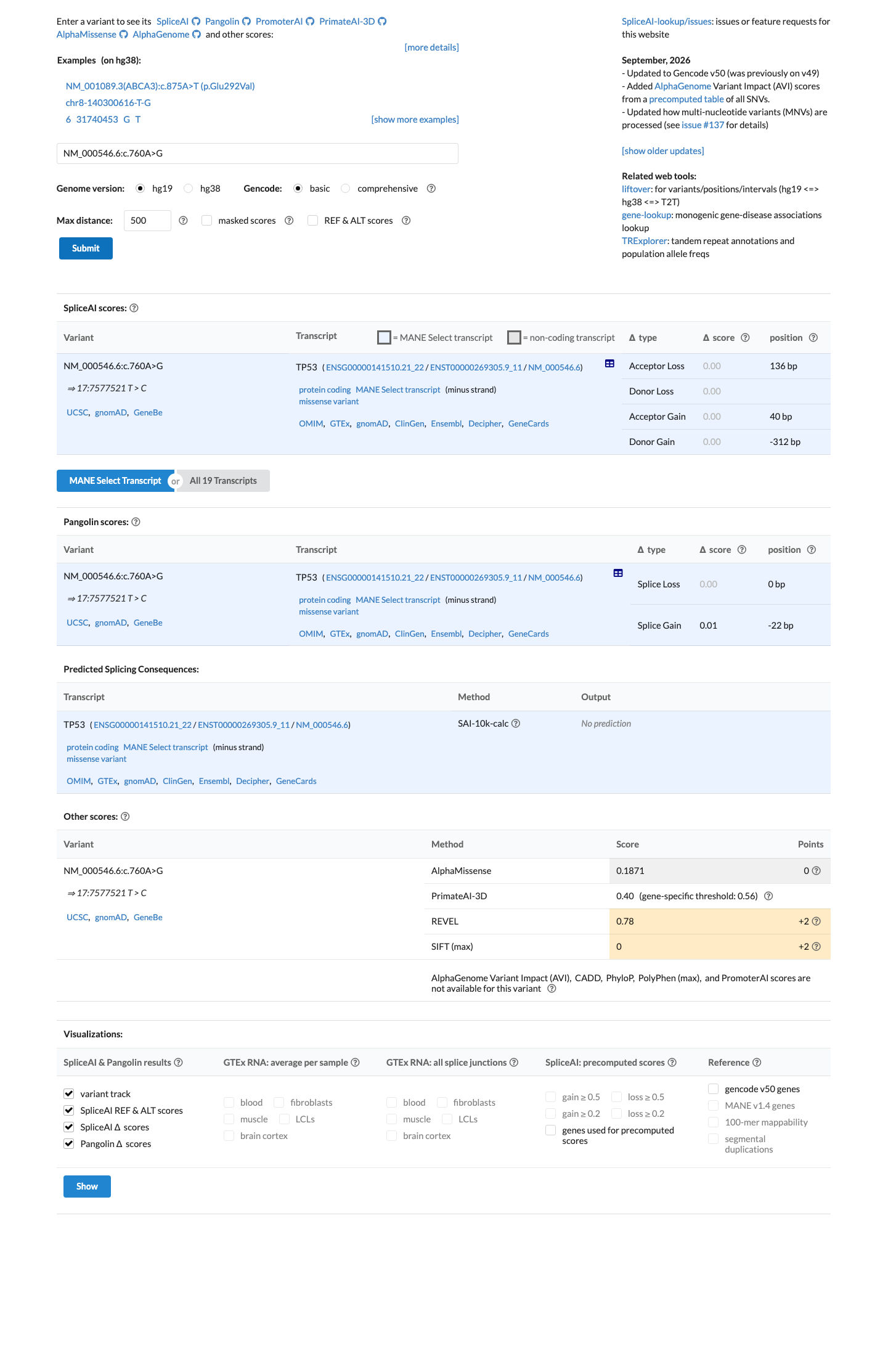
PM1 supporting: p.Ile254Val has two somatic Cancer Hotspots occurrences. PM2 supporting: gnomAD v4.1 total allele frequency is 6.82086e-06. PP3 supporting: the VCEP assigns PP3 with Class C25 and BayesDel 0.17079. BS3 strong: the VCEP worksheet records Functional Kato data and no LOF in most eligible assays. BP6 supporting benign: an expert-panel ClinVar record classifies the variant as Likely benign.
PM1 + PM2 + PP3 + BS3 + BP6→Likely Benign
LYFE Sciences is an AI system, and it can make mistakes. Criteria
may be applied incorrectly, sources may be misread, and a confident-looking
classification can still be wrong. Double-check every criterion and
its underlying evidence before relying on any call.
Gene diagram
· NM_000546.6 · variants mapped to exon structure
TP53NM_000546.6
Fetching transcript structure from UCSC…
Exons
—
Transcript span
—
Strand
—
Variants mapped
—
Source
UCSC ncbiRefSeqCurated
All variants in TP53—click a row to locate it on the plot · use the link column to open its page
Protein
Location
Classification
Link
Applied criteria · 5 applied · 12 assessed
MetEvidence satisfies this criterion.
Not metEvaluated against available evidence; threshold not reached.
Not assessedApplies in principle, but no evidence was found to evaluate it.
N/ADoesn't apply to this variant type.
Applied · 5
Strength Supporting Moderate Strong Very strong
✓
PM1supportingPathogenic
Met at supporting: p.Ile254Val has 2 somatic occurrences for the same amino-acid change, within the VCEP's 2-9 Cancer Hotspots threshold.
ClinGen TP53 VCEP PM1 rules: residue 254 is not among the explicitly listed codons 175, 245, 248, 249, 273, and 282; the alternate hotspot path permits supporting strength for 2-9 somatic occurrences of the same amino-acid change.ClinVar expert-panel criterion signal states: "this variant has 2 somatic occurrences for the same amino acid change in cancerhotspots".vcep_materials.json domain_tables is empty for TP53; therefore the authoritative complete domain-table list contains no additional entry to match against residue 254.
Met at supporting: gnomAD v4.1 total AF is 6.82086e-06, below the TP53 VCEP PM2 threshold of 0.00003.
gnomAD v4.1 all-comers: total AF 6.82086e-06 (11/1,612,700 alleles), highest observed European non-Finnish AF 9.32959e-06 (11/1,179,044 alleles), maximum group FAF 5.01e-06, homozygotes 0.The governing VCEP rule does not specify a non-cancer or exome-only population source for PM2; gnomAD v4.1 all-comers is therefore the default source under the requested source-selection rule.
Met (strong): I254V is pre-assigned BS3 with Functional Kato data and no LOF in the majority of available eligible assays.
Functional-worksheet.xlsx, Supplementary Table S3, row I254V: Kato class Functional; Funk class noLOF; Giacomelli class noLOF; Kotler class noLOF; Kawaguchi class NA; preliminary functional code BS3.Flowchart-for-application-of-functional-rule-codes.pdf: eligible functional studies include Kato, Funk, Giacomelli, Kotler, and Kawaguchi; no variant-specific I254V row is present.PMID:12826609 paper extract: the exact p.I254V variant is not explicitly mentioned; the paper describes the systematic yeast transactivation assay underlying the Kato classification.
Assessed · not applied
· 4 not met · 8 not assessed
Pathogenic
PS1Not assessed: SpliceAI max delta was 0.003, but no eligible same-residue pathogenic or likely pathogenic comparator was confirmed and the comparator search ended with HTTP 429.
PS2Not assessed: no documented de novo proband observation, parental testing, or LFS cancer points are available to assign a PS2 strength.
PS3Not met: the VCEP worksheet pre-assigns BS3 for I254V, with Functional Kato data and no LOF in Funk, Giacomelli, and Kotler assays.
PS4Not assessed: no proband phenotype or PS4 point total is available, and PS4-Points-Table.pdf has no c.760A>G, p.Ile254Val, or p.I254V entry.
PM5Not assessed: SpliceAI max delta was 0.003, but zero same-residue comparators were retrieved and the comparator search recorded HTTP 429.
PP1Not assessed: no affected relatives, genotype segregation results, or countable meioses are documented for this variant.
PP4Not assessed: no qualifying VAF observation is available for PP4's 5-25% or 5-35% thresholds.
Benign
BA1Not met: gnomAD v4.1 maximum group FAF is 5.01e-06, below the TP53 VCEP BA1 threshold of 0.001.
BS1Not met: gnomAD v4.1 maximum group FAF is 5.01e-06, below the TP53 VCEP BS1 lower threshold of 0.0003.
BS2Not assessed: no single-source count of qualifying unrelated females aged at least 60 years without cancer is available.
BS4Not assessed: no affected relatives with LFS-associated cancers and no family genotyping results are documented to establish non-segregation.
BP4Not met: BayesDel 0.17079 exceeds the VCEP BP4 supporting cutoff of <0.16, despite SpliceAI maximum delta 0.003 being <0.2.
This variant is present in gnomAD v4.1 (AF= 6.82086e-06; MAF= 0.00068%, 11/1612700 alleles, homozygotes = 0) and has highest observed frequency in the European (non-Finnish) population (AF= 9.32959e-06; MAF= 0.00093%, 11/1179044 alleles, homozygotes = 0); grpmax FAF= 5.01e-06.
v2.1
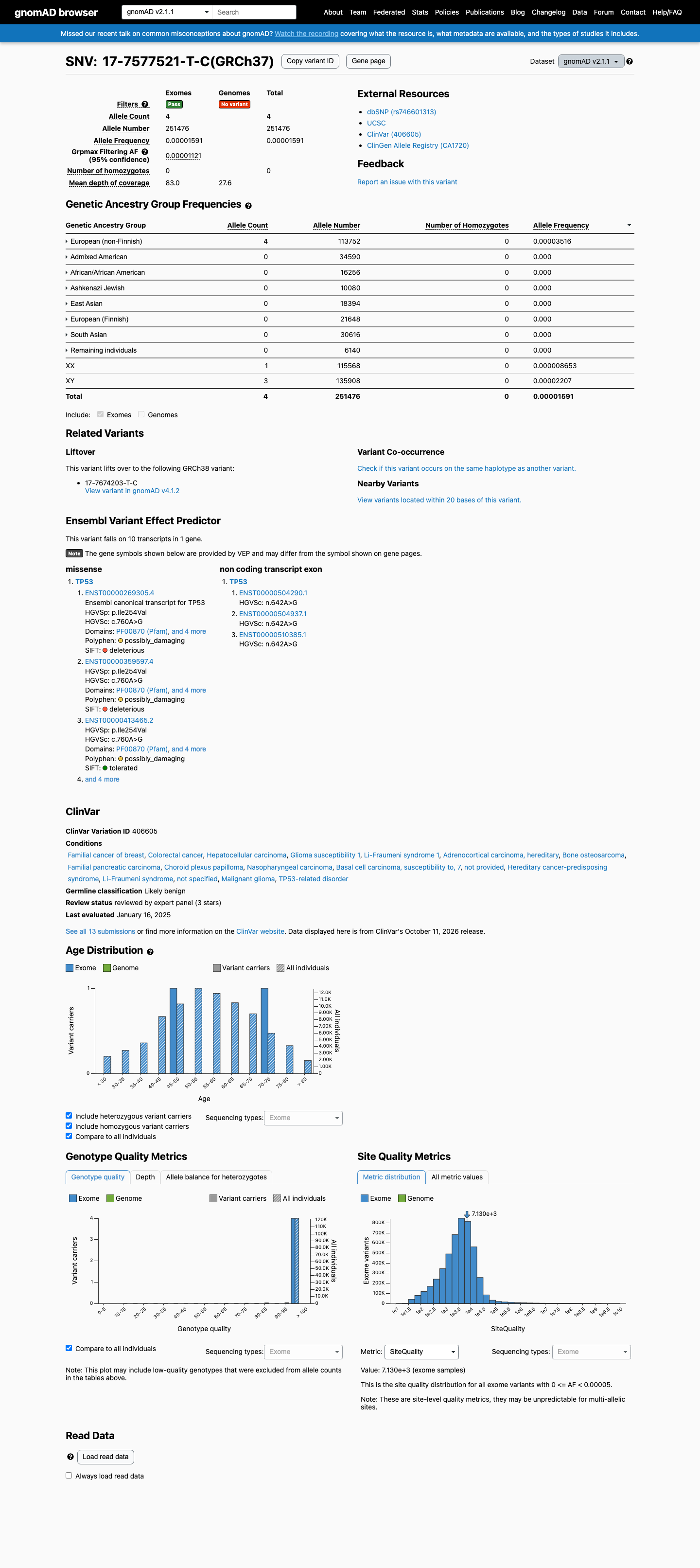
This variant is present in gnomAD v2.1 (AF= 1.59061e-05; MAF= 0.00159%, 4/251476 alleles, homozygotes = 0) and has highest observed frequency in the European (non-Finnish) population (AF= 3.51642e-05; MAF= 0.00352%, 4/113752 alleles, homozygotes = 0); grpmax FAF= 1.121e-05.
🇨🇦 CA
Not available in gnomAD-Canada v1.0.
Allele frequency by ancestry
three datasets · side by side
gnomAD v4.1
0.00068%
· 11 / 1,612,700
0 hom · FAF 0.0005%
European (non-Finnish)
11 / 1,179,044
0.00093%
+ 9 not observed (Remaining individuals, Admixed American, European (Finnish), Amish, East Asian, Middle Eastern, South Asian, Ashkenazi Jewish, African/African American)
gnomAD v2.1
0.0016%
· 4 / 251,476
0 hom · FAF 0.0011%
European (non-Finnish)
4 / 113,752
0.0035%
+ 7 not observed (African/African American, Admixed American, Ashkenazi Jewish, East Asian, European (Finnish), Remaining individuals, South Asian)
This variant has been reported in ClinVar as Uncertain significance (7 clinical laboratories) and as Likely benign (3 clinical laboratories) and as Uncertain Significance (1 clinical laboratory) and as Likely Benign by ClinGen TP53 Variant Curation Expert Panel, ClinGen (expert panel). (ClinVarID = 406605)
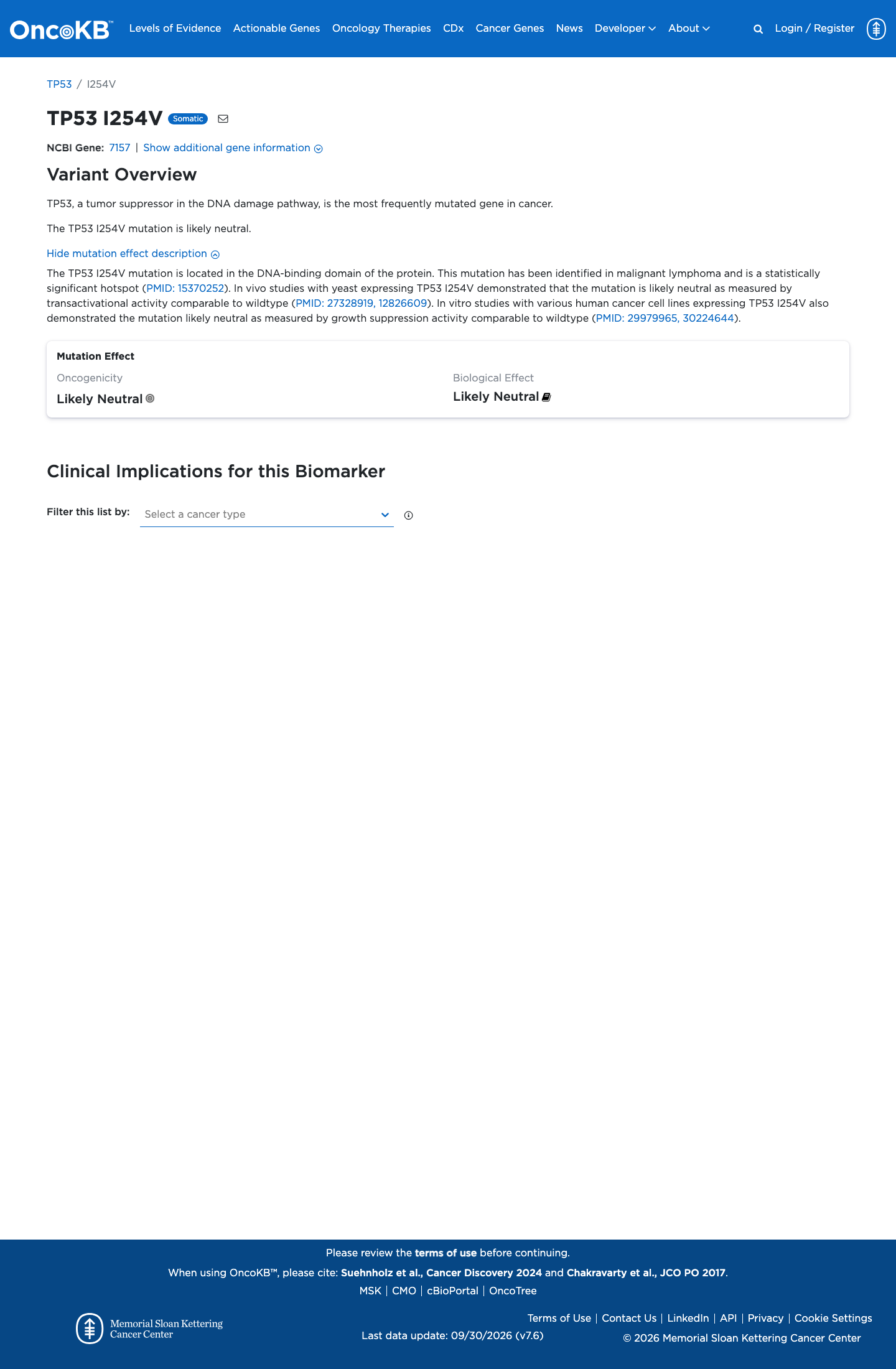
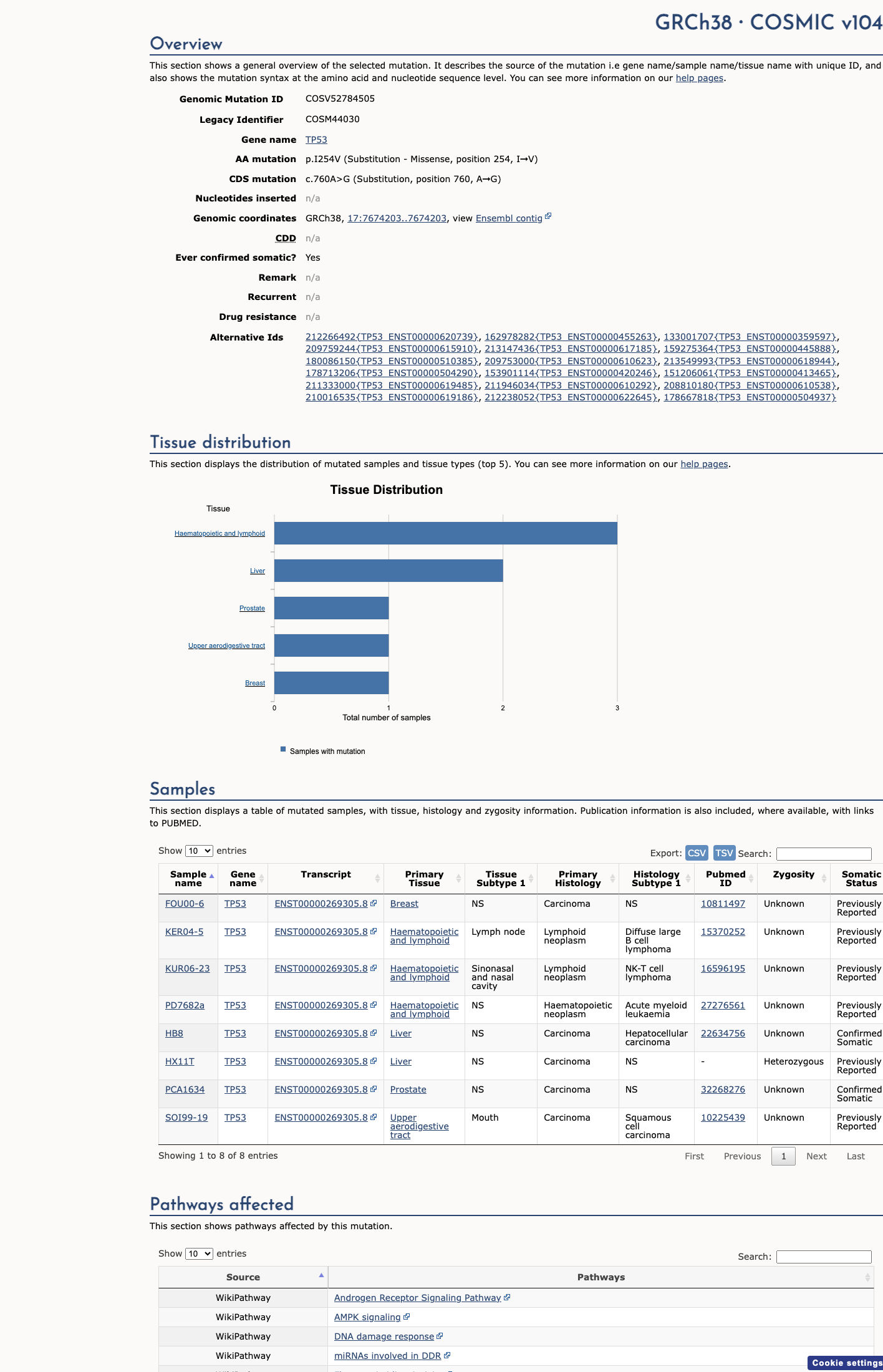
This variant lies in a statistically significant hotspot. This variant has previously been reported in somatic cancers (COSMIC; COSV52784505, n = 8 times).
Hotspots
This variant lies in a statistically significant hotspot.
Each card is an audit: what was searched, what was found, whether it names the variant, which criteria it fed, and why. 2 further PMIDs triaged but not cited — see Sources & references.
Rule & framework references · cited for criterion definitions, not variant evidence
12826609 ↗Understanding the function-structure and function-mutation relationships of p53 tumor suppressor protein by high-resolution missense mutation analysis.
29979965 ↗A Systematic p53 Mutation Library Links Differential Functional Impact to Cancer
30224644 ↗Mutational processes shape the landscape of TP53 mutations in human cancer.
Sources & reference links
9Sources
CSpec VCEP
ClinVar
gnomAD v2.1
gnomAD v4.1
gnomAD-Canada
SpliceAI
OncoKB
COSMIC
Cancer hotspots
Triaged references · 2 PMIDs not cited in assessment
15370252 ↗Detection and possible prognostic relevance of p53 gene mutations in diffuse larONCOKB
27328919 ↗TP53 Variations in Human Cancers: New Lessons from the IARC TP53 Database and GeONCOKB