Back
NM_000546.6:c.877G>A
p.Gly293Arg · TP53
ClinGen TP53 Expert Panel Specifications to the ACMG/AMP Variant Interpretation Guidelines for TP53 Version 2.4 · v2.4
0%
complete
Final classification
Likely Benign
PM2BS3BP4
TP53
c.877G>A
p.Gly293Arg
missense · exon 8

TP53 encodes the p53 tumor suppressor protein, a transcription factor that responds to cellular stress such as DNA damage by switching on genes that trigger cell cycle arrest, DNA repair, senescence, or programmed cell death. In healthy cells, p53 is kept at low levels by constant degradation, but stress signals stabilize and activate it to protect against damaged cells surviving and dividing. Inherited mutations in TP53 cause Li-Fraumeni syndrome, a condition marked by a high risk of developing multiple cancers at a young age. TP53 is the most commonly mutated gene across human cancers, and loss of its normal function promotes tumor growth, spread, drug resistance, and genomic instability.

This variant

TP53 encodes the p53 tumor suppressor that responds to cellular stress by regulating cell-cycle arrest, DNA repair, senescence, and apoptosis; inherited pathogenic variants cause Li-Fraumeni syndrome with high early-onset cancer risk.

Transcript
NM_000546.6
HGVS · transcript:coding
NM_000546.6:c.877G>A
GRCh38
chr17:7673743 C>T
GRCh37
chr17:7577061 C>T
Likely Benign: PM2 supporting (+1), BS3 strong (-4), and BP4 moderate (-2) produce -5 points under the TP53 Version 2.4 framework.
Classification rationale
PM2 BS3BP4 Likely Benign
TP53 c.877G>A missense · exon 8

PM2 supporting: qualifying gnomAD allele frequency is below 0.00003 with no homozygotes. BS3 strong: the TP53 worksheet records functional Kato data and no loss of function in Funk and Giacomelli assays. BP4 moderate: the exact TP53 lookup assigns BP4_moderate with BayesDel -0.0095438 and Class C0.

PM2 + BS3 + BP4 → Likely Benign
LYFE Sciences is an AI system, and it can make mistakes. Criteria may be applied incorrectly, sources may be misread, and a confident-looking classification can still be wrong. Double-check every criterion and its underlying evidence before relying on any call.
Gene diagram · NM_000546.6 · variants mapped to exon structure
TP53 NM_000546.6
Fetching transcript structure from UCSC…
Applied criteria · 3 applied · 15 assessed
MetEvidence satisfies this criterion.
Not metEvaluated against available evidence; threshold not reached.
Not assessedApplies in principle, but no evidence was found to evaluate it.
N/ADoesn't apply to this variant type.
Applied · 3
Strength Supporting Moderate Strong Very strong
PM2 supporting Pathogenic
Met at supporting: gnomAD v2.1 non-cancer exome AF was 8.44067e-06, below the TP53 PM2 threshold of 0.00003, with no homozygotes.
The TP53 Expert Panel specification applies PM2 at Supporting strength for AF <0.00003; if an ancestry group contains multiple variant alleles, its AF must be <0.00004, with founder-effect groups ignored.The specified gnomAD v2.1 non-cancer exome subset reports AF 8.440670526866655e-06 from 2/236,948 alleles, zero homozygotes, and South Asian AF 3.2758959575443885e-05 from 1/30,526 alleles; no ancestry group has multiple observed variant alleles.gnomAD v4.1 reports total AF 1.8585403024464585e-06 from 3/1,614,170 alleles and zero homozygotes, consistent with rarity.
BS3 strong Benign
Met, strong: TP53 VCEP assigns BS3 because Kato is functional and both available additional assays, Funk and Giacomelli, are noLOF.
Functional-worksheet.xlsx directly lists G293R as: Kato Functional; Funk noLOF; Giacomelli noLOF; Kotler NA; Kawaguchi NA; preliminary code BS3.The TP53 VCEP BS3_Strong rule requires functional Kato data and no LOF by the majority of available eligible assays; the worksheet records this exact pattern.The functional-rule flowchart was searched for c.877G>A, p.Gly293Arg, and p.G293R; no variant-specific entry was present, so the worksheet remains the governing variant-specific assignment.
BP4 moderate Benign
Met at moderate strength: the exact TP53 lookup assigns BP4_moderate with BayesDel -0.0095438 and class C0.
The TP53 PP3-BP4-codes.xlsx exact row for c.877G>A / p.Gly293Arg reports Class C0, BayesDel -0.0095438, and pre-assigns BP4_moderate.The governing VCEP lookup assignment outranks generic predictor thresholds and is applied directly.SpliceAI returned no score for this variant; this is missing data, not evidence of absent splice impact, and does not negate the exact VCEP BP4_moderate assignment.
Assessed · not applied · 7 not met · 8 not assessed
Pathogenic
PS1 Not assessed: no qualifying pathogenic or likely pathogenic variant producing the same amino-acid change as p.Gly293Arg is documented in the reviewed evidence.
PS2 Not assessed: no proband cancer, de novo observation, or parental testing is documented, so the VCEP PS2 point thresholds cannot be applied.
PS3 Not met: TP53 VCEP assigns BS3 because Kato is functional and Funk/Giacomelli are noLOF, with no majority-LOF pattern required for PS3.
PS4 Not assessed: no proband phenotype or PS4 point total is available, and the searched PS4-Points-Table.pdf has no c.877G>A, p.Gly293Arg, or p.G293R entry.
PM1 Not met: p.Gly293Arg is at codon 293, outside the six TP53 PM1 codons, and cancerhotspots returned no significant hotspot for TP53 G293.
PM5 Not assessed: p.Gly293Trp is reported at residue 293, but its pathogenicity is unestablished and the same-residue search ended with an HTTP 429 error.
PP1 Not assessed: no relatives, meioses, or cosegregation data are documented, so the VCEP PP1 thresholds cannot be applied.
PP3 Not met: the exact TP53 lookup entry reports BayesDel -0.0095438, below the VCEP PP3 missense threshold of 0.16, and assigns BP4_moderate instead.
PP4 Not assessed: no PP4-qualifying VAF observation is available; the framework requires VAF 5-35% for Supporting or at least two 5-25% observations for Moderate.
PP5 Not met: exact-match ClinVar variation 230208 has zero Expert Panel submissions and no Expert Panel Pathogenic or Likely Pathogenic classification.
Benign
BA1 Not met: highest qualifying population frequency was 3.2759e-05, below the TP53 VCEP BA1 FAF threshold of 0.001, with only one observed allele.
BS1 Not met: maximum observed ancestry frequency was 3.2759e-05, below the TP53 VCEP BS1 FAF threshold of 0.0003 and based on one allele.
BS2 Not assessed: no single-source records identify at least two unrelated cancer-free females aged 60 years or older carrying this variant.
BS4 Not assessed: no affected-relative genotypes or documented non-segregation are available for this variant.
BP6 Not met: ClinVar exact-match variation 230208 has no Expert Panel submission, so its single-submitter Likely benign assertion cannot trigger BP6.
N/A · 10 PVS1 · PM3 · PM4 · PM6 · PP2 · BP1 · BP2 · BP3 · BP5 · BP7
Research & evidence
Population frequency · supports benign
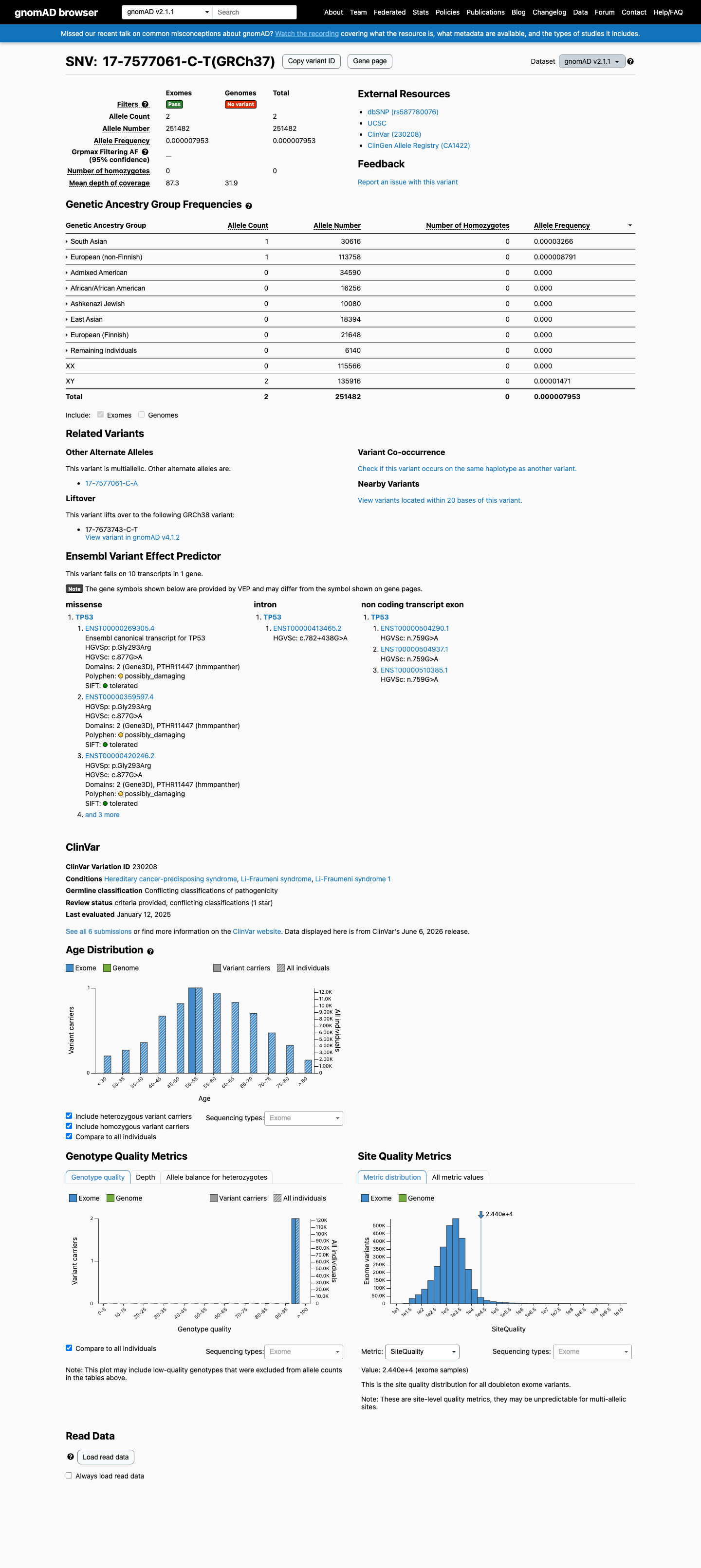
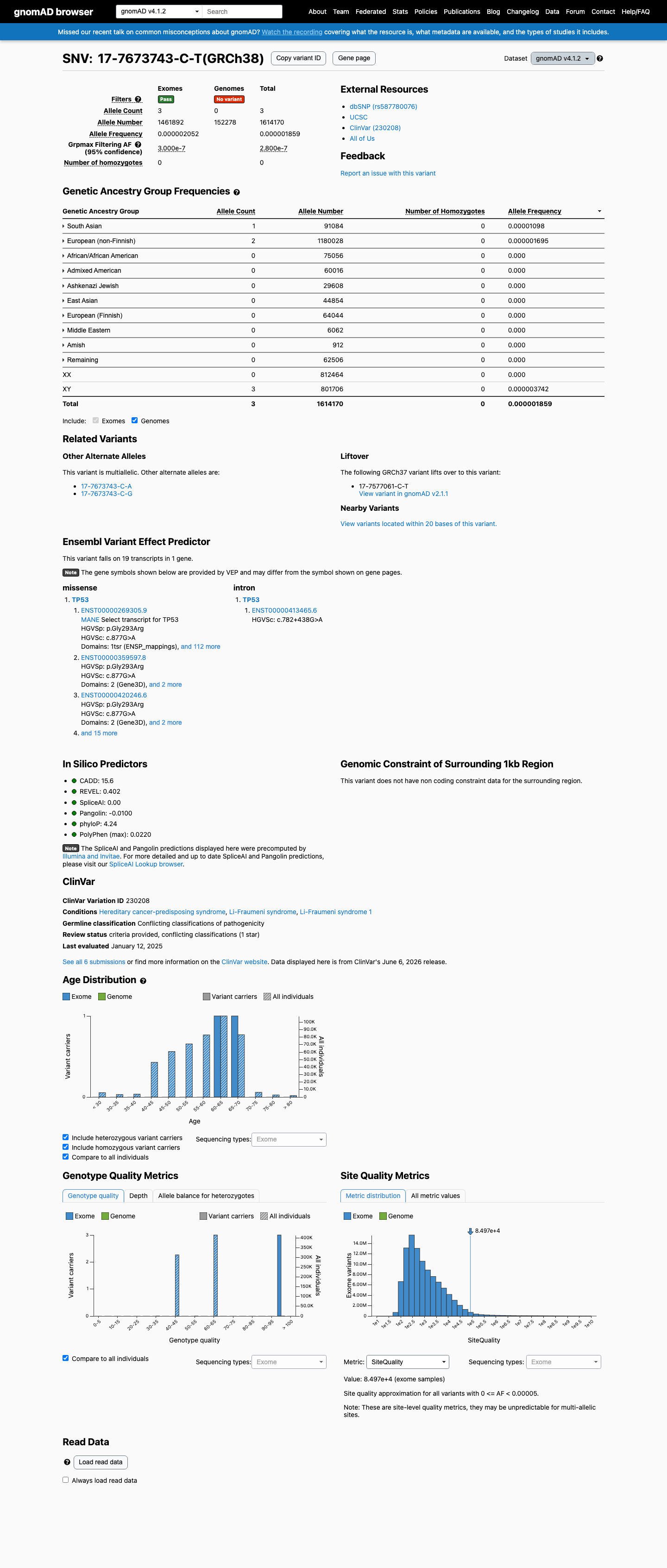
gnomAD v4.1 screenshot
gnomAD v4.1
gnomAD v2.1 screenshot
gnomAD v2.1
v4.1
This variant is present in gnomAD v4.1 (AF= 1.85854e-06; MAF= 0.00019%, 3/1614170 alleles, homozygotes = 0) and has highest observed frequency in the South Asian population (AF= 1.09789e-05; MAF= 0.00110%, 1/91084 alleles, homozygotes = 0); grpmax FAF= 2.8e-07.
v2.1
This variant is present in gnomAD v2.1 (AF= 7.95286e-06; MAF= 0.00080%, 2/251482 alleles, homozygotes = 0) and has highest observed frequency in the South Asian population (AF= 3.26627e-05; MAF= 0.00327%, 1/30616 alleles, homozygotes = 0).
🇨🇦 CA
Absent from gnomAD-Canada v1.0.
Allele frequency by ancestry
three datasets · side by side
gnomAD v4.1
0.00019% · 3 / 1,614,170
0 hom · FAF 2.8e-05%
South Asian
1 / 91,084
0.0011%
European (non-Finnish)
2 / 1,180,028
0.00017%
+ 8 not observed (Remaining individuals, Admixed American, European (Finnish), Amish, East Asian, Middle Eastern, Ashkenazi Jewish, African/African American)
gnomAD v2.1
0.0008% · 2 / 251,482
0 hom
South Asian
1 / 30,616
0.0033%
European (non-Finnish)
1 / 113,758
0.00088%
+ 6 not observed (African/African American, Admixed American, Ashkenazi Jewish, East Asian, European (Finnish), Remaining individuals)
gnomAD Canada 🇨🇦
Absent · 0 / ?
0 hom
Not observed in any ancestry group.
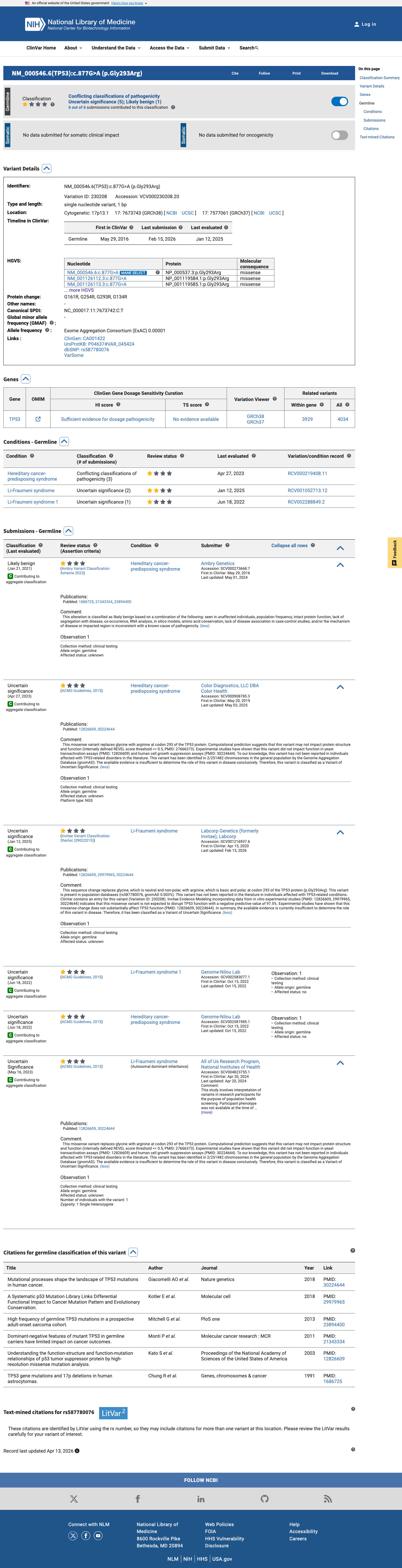
ClinVar screenshot
ClinVar
This variant has been reported in ClinVar as Uncertain significance (4 clinical laboratories) and as Likely benign (1 clinical laboratory) and as Uncertain Significance (1 clinical laboratory). (ClinVarID = 230208)
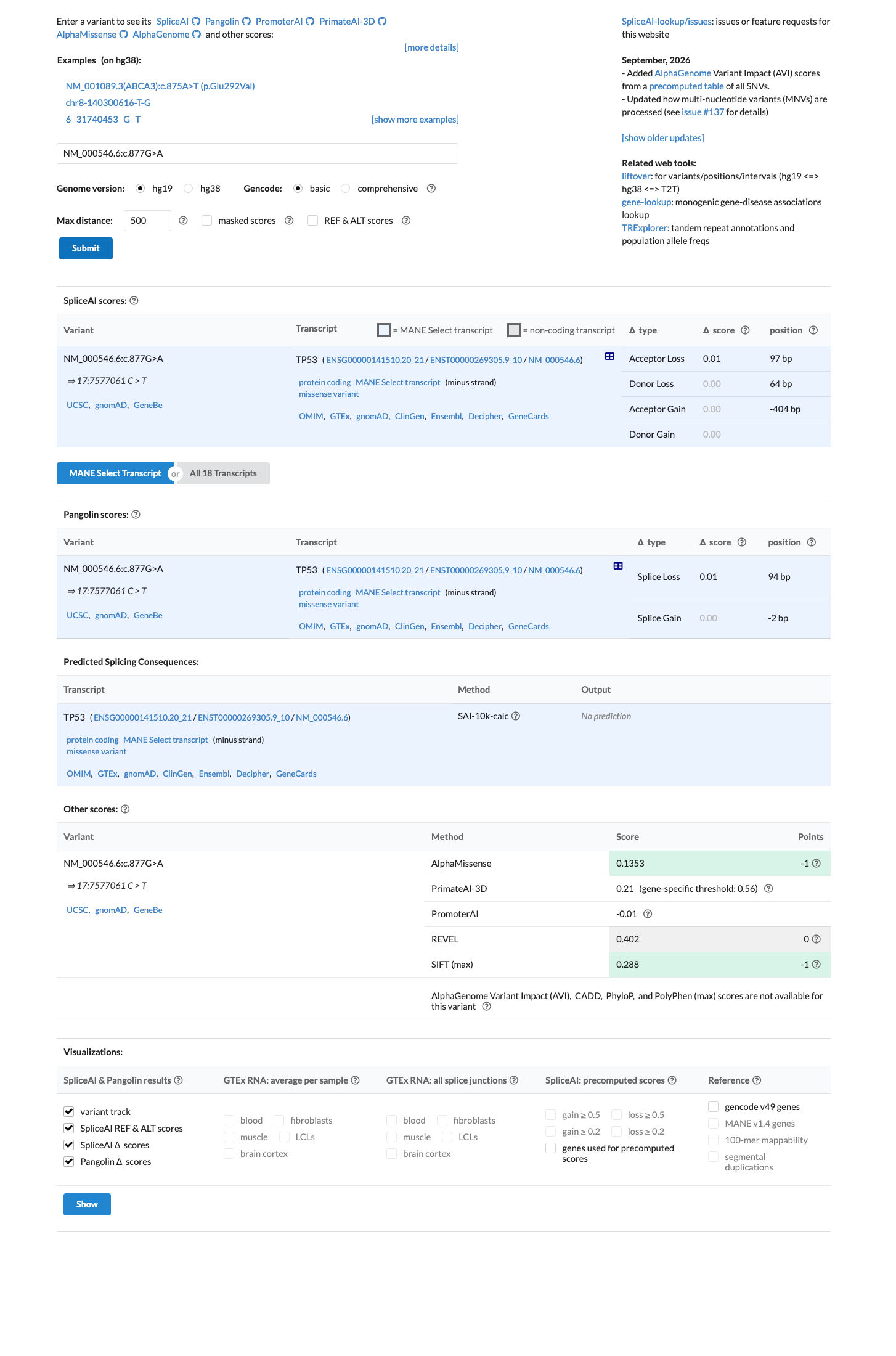
SpliceAI screenshot
In silico
SpliceAI returned NO scores for this variant, so no SpliceAI-based splice prediction is available. This is missing data, NOT evidence of absent splice impact: it must not be used to support BP4 or to argue against PP3/PVS1. Pangolin scores may be present but are not calibrated for PP3/BP4 here. REVEL score = 0.402. BayesDel score = -0.0095438.
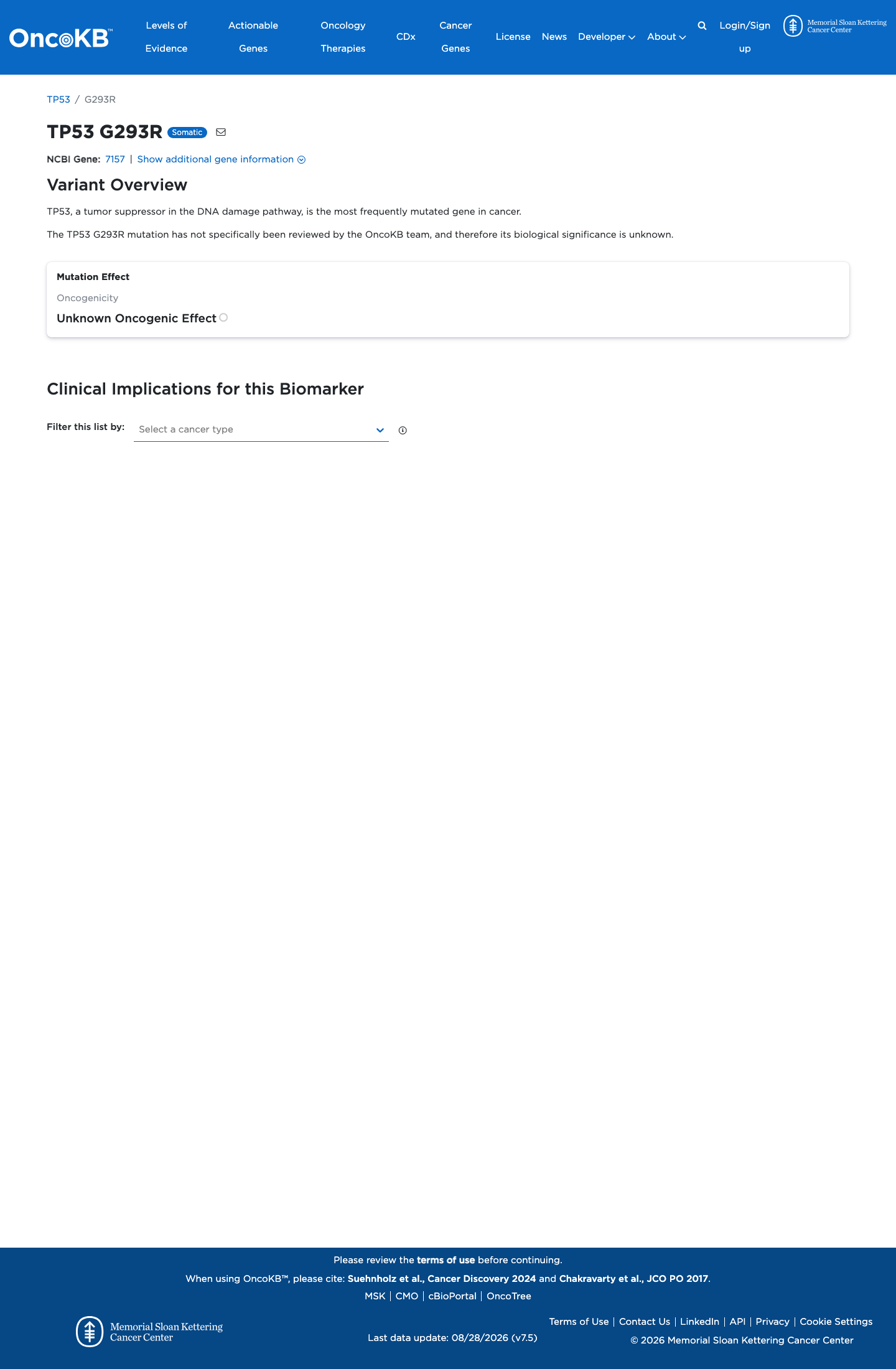
Functional / OncoKB screenshot
Functional Unknown Oncogenic Effect
OncoKB did not identify variant-specific reviewed functional evidence for this variant; gene-level curated context is available for reviewer follow-up. TP53, a tumor suppressor in the DNA damage pathway, is the most frequently mutated gene in cancer.
OncoKB ↗
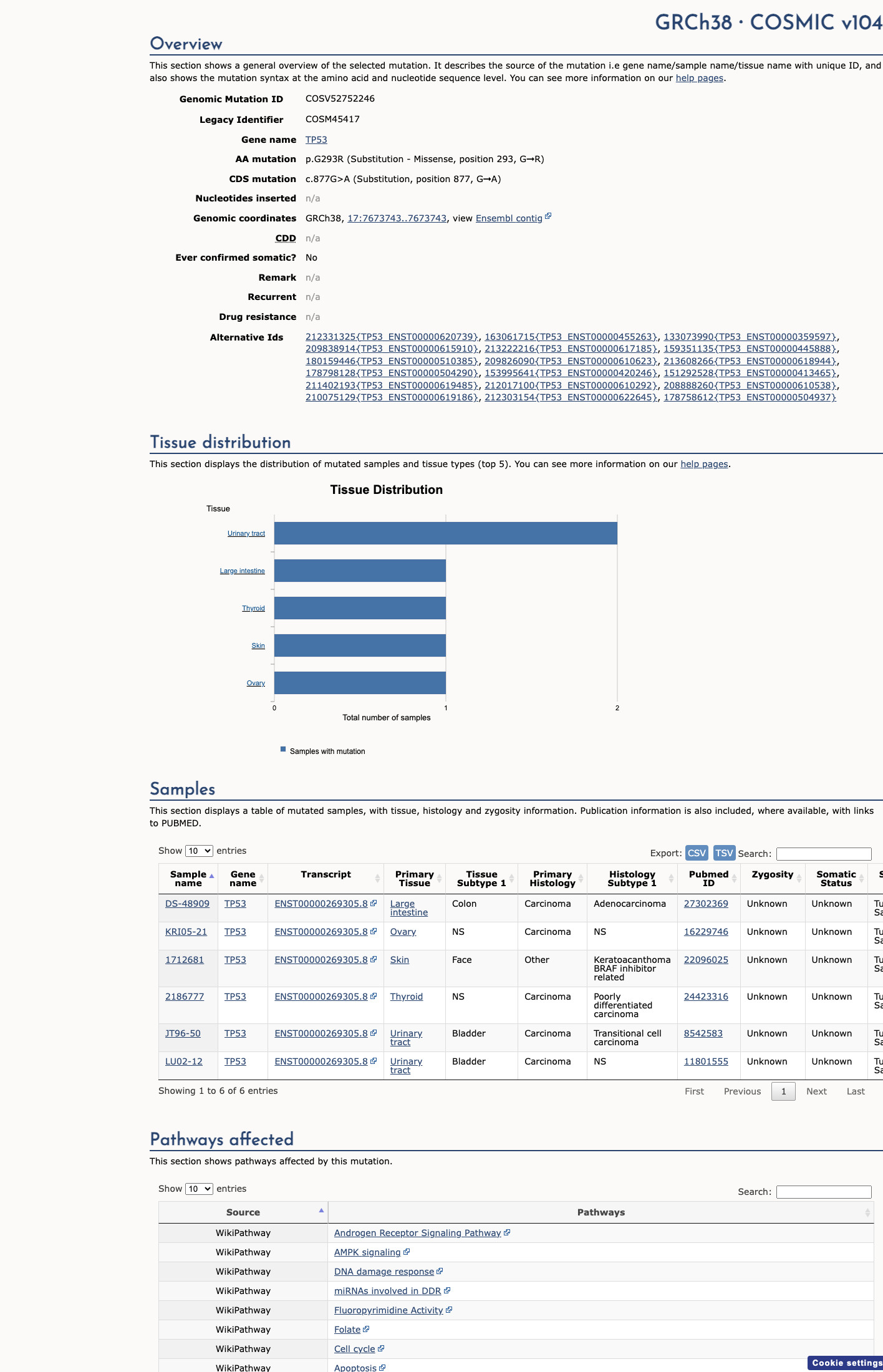
COSMIC screenshot
COSMIC
Cancer hotspots screenshot
Cancer hotspots
Somatic evidence Not in COSMIC / hotspots
COSMIC
This variant does not lie in a statistically significant hotspot. This variant has previously been reported in somatic cancers (COSMIC; COSV52752246, n = 6 times).
Hotspots
This variant does not lie in a statistically significant hotspot.
Literature · how each cited paper was used
1papers cited
Each card is an audit: what was searched, what was found, whether it names the variant, which criteria it fed, and why. 7 further PMIDs triaged but not cited — see Sources & references.
Rule & framework references · cited for criterion definitions, not variant evidence
12826609 ↗ Understanding the function-structure and function-mutation relationships of p53 tumor suppressor protein by high-resolution missense mutation analysis.
Sources & reference links
8Sources
ClinVar
gnomAD v2.1
gnomAD v4.1
gnomAD-Canada
SpliceAI
OncoKB
COSMIC
Cancer hotspots
Triaged references · 7 PMIDs not cited in assessment
1686725 ↗ TP53 gene mutations and 17p deletions in human astrocytomas. CLINVAR
21343334 ↗ Dominant-negative features of mutant TP53 in germline carriers have limited impact on cancer outcomes. CLINVAR
23788249 ↗ ACMG recommendations for reporting of incidental findings in clinical exome and CLINVAR
23894400 ↗ High frequency of germline TP53 mutations in a prospective adult-onset sarcoma cohort. CLINVAR
25356965 ↗ ACMG policy statement: updated recommendations regarding analysis and reporting CLINVAR
25741868 ↗ Standards and guidelines for the interpretation of sequence variants: a joint co CLINVAR
26140447 ↗ Points to Consider: Ethical, Legal, and Psychosocial Implications of Genetic Tes CLINVAR