NM_000546.6:c.390C>T (p.Leu130=) is a synonymous variant in exon 5 of TP53. SpliceAI predicts no splicing impact (max delta score 0.01). The variant is present at very low frequency in gnomAD (v2.1: 6/250,352 alleles; v4.1: 12/1,613,912 alleles) though the Admixed American subpopulation carries multiple alleles with AF above the PM2 subpopulation ceiling. BP7_Supporting is met as a synonymous variant outside the core splice motif with no predicted splicing effect.1 No pathogenic criteria are met. PVS1, PS1, and PM5 are not applicable (synonymous variant). PM1 is not met (not a missense at a VCEP-designated hotspot codon). PM2 is not met (AMR subpopulation AF exceeds 0.004% ceiling). PS3 and BS3 are not met (VCEP functional rules apply only to missense and in-frame deletions). No proband-level clinical data were available to assess PS2, PS4, PP1, PP4, BS2, or BS4.2 The only met criterion is BP7_Supporting (-1 point under the Tavtigian Bayesian point system). This places the variant in the VUS range (total points = -1). No pathogenic evidence criteria are met to elevate classification.3
Final classification
Likely Benign
BP4BP7
TP53
c.390C>T
p.Leu130=
missense
This variant
NM_000546.6:c.390C>T (p.Leu130=) is a synonymous variant in exon 5 of TP53. SpliceAI predicts no splicing impact (max delta score 0.01). The variant is present at very low frequency in gnomAD (v2.1: 6/250,352 alleles; v4.1: 12/1,613,912 alleles) though the Admixed American subpopulation carries multiple alleles with AF above the PM2 subpopulation ceiling. BP7_Supporting is met as a synonymous variant outside the core splice motif with no predicted splicing effect.
ClinGen TP53 Expert Panel Specifications to the ACMG/AMP Variant Interpretation Guidelines for TP53 Version 2.4 v2.4 point-based framework: BP4 supporting benign (-1) + BP7 supporting benign (-1) = -2 points, which maps to Likely Benign.
Classification rationale
BP4BP7
Likely Benign
TP53 c.390C>T
missense
BP4 + BP7
→
Likely Benign
LYFE Sciences is an AI system, and it can make mistakes. Criteria
may be applied incorrectly, sources may be misread, and a confident-looking
classification can still be wrong. Double-check every criterion and
its underlying evidence before relying on any call.
Gene diagram
· NM_000546.6 · variants mapped to exon structure
TP53
NM_000546.6
Fetching transcript structure from UCSC…
Applied criteria · 2 applied · 13 assessed
MetEvidence satisfies this criterion.
Not metEvaluated against available evidence; threshold not reached.
Not assessedApplies in principle, but no evidence was found to evaluate it.
N/ADoesn't apply to this variant type.
Applied · 2
Strength
Supporting
Moderate
Strong
Very strong
BP4
supporting
Benign
NM_000546.6:c.390C>T is a silent/synonymous variant outside the canonical splice sites (±1,2 positions). SpliceAI predicts no splicing impact (max delta score = 0.01, ≤0.1 threshold for silent variants). Per the TP53 VCEP BP4 rules for silent/intronic variants: SpliceAI ≤0.1 satisfies BP4_Supporting. Note: BP7 is the more specific code for synonymous variants and is assessed separately; BP4 is reported here per the VCEP specification which lists BP4 as a prerequisite for BP7_Supporting.
SpliceAI max delta = 0.01 (≤0.1)Synonymous variant outside core splice motifVCEP BP4_Supporting rule for silent/intronic variants
BP7
supporting
Benign
NM_000546.6:c.390C>T is a synonymous variant at position c.390 within exon 5 (c.376-c.559). The variant is outside the core splice motif (last three nucleotides and first nucleotide of the exon). SpliceAI predicts no impact to the splice consensus and no creation of a new splice site (max delta score = 0.01 ≤ 0.1, BP4 criterion met). Per the TP53 VCEP BP7_Supporting rule for synonymous variants outside the core splice motif with SpliceAI ≤0.1, this criterion is met at supporting benign strength.
Synonymous variant c.390C>T (p.Leu130=) at codon 130 in exon 5Outside core splice motif (exon 5 boundaries: c.376-c.559)SpliceAI max delta = 0.01 (≤0.1
Assessed · not applied
· 7 not met · 6 not assessed
Pathogenic
PS2
No de novo observation data were provided for this case.
PS3
The TP53 VCEP functional assay rules (PS3/BS3 flowchart and Functional-worksheet.xlsx) apply only to missense amino acid substitutions and small in-frame deletions.
PS4
No proband-level case data with LFS cancer diagnoses were provided.
PM1
The TP53 VCEP restricts PM1 to missense variants at specified hotspot codons (175, 245, 248, 249, 273, 282) or germline missense variants with sufficient somatic occurrences at cancerhotspots.org.
PM2
Total gnomAD allele frequencies are below the VCEP PM2_Supporting threshold of 0.003% (v2.1: AF=0.00240%, 6/250352; v4.1: AF=0.00074%, 12/1613912).
PP1
No cosegregation data were provided.
PP3
The TP53 VCEP PP3 rules for missense variants require aGVGD class C25-C65 or C65 with BayesDel ≥0.16; for exonic variants with predicted splicing effect, SpliceAI ≥0.2 is required.
PP4
No variant allele fraction (VAF) data were provided.
Benign
BA1
The TP53 VCEP BA1 threshold is a filtering allele frequency (FAF) ≥0.001 (0.1%) in a non-founder gnomAD continental subpopulation.
BS1
The TP53 VCEP BS1 threshold is a filtering allele frequency (FAF) ≥0.0003 but <0.001 in a non-founder gnomAD continental subpopulation with ≥2000 alleles and ≥2 alleles present.
BS2
No data on unrelated females aged ≥60 years without cancer were provided.
BS3
The TP53 VCEP functional assay rules (BS3 flowchart and Functional-worksheet.xlsx) apply only to missense amino acid substitutions and small in-frame deletions.
BS4
No segregation data in affected family members were provided.
N/A · 10
PVS1 · PS1 · PM5 · PM6 · PP2 · PP5 · BP1 · BP2 · BP5 · BP6
Research & evidence
Population frequency · supports benign
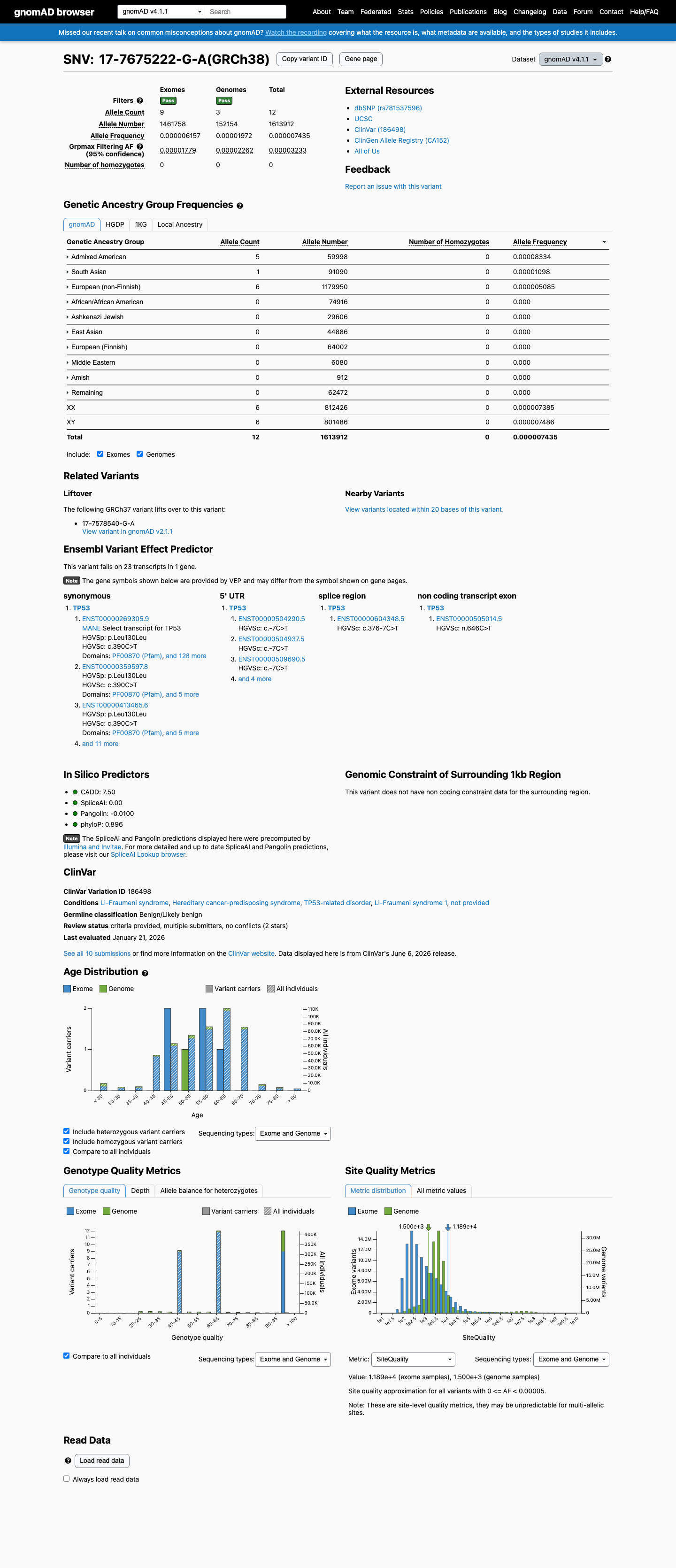
gnomAD v4.1
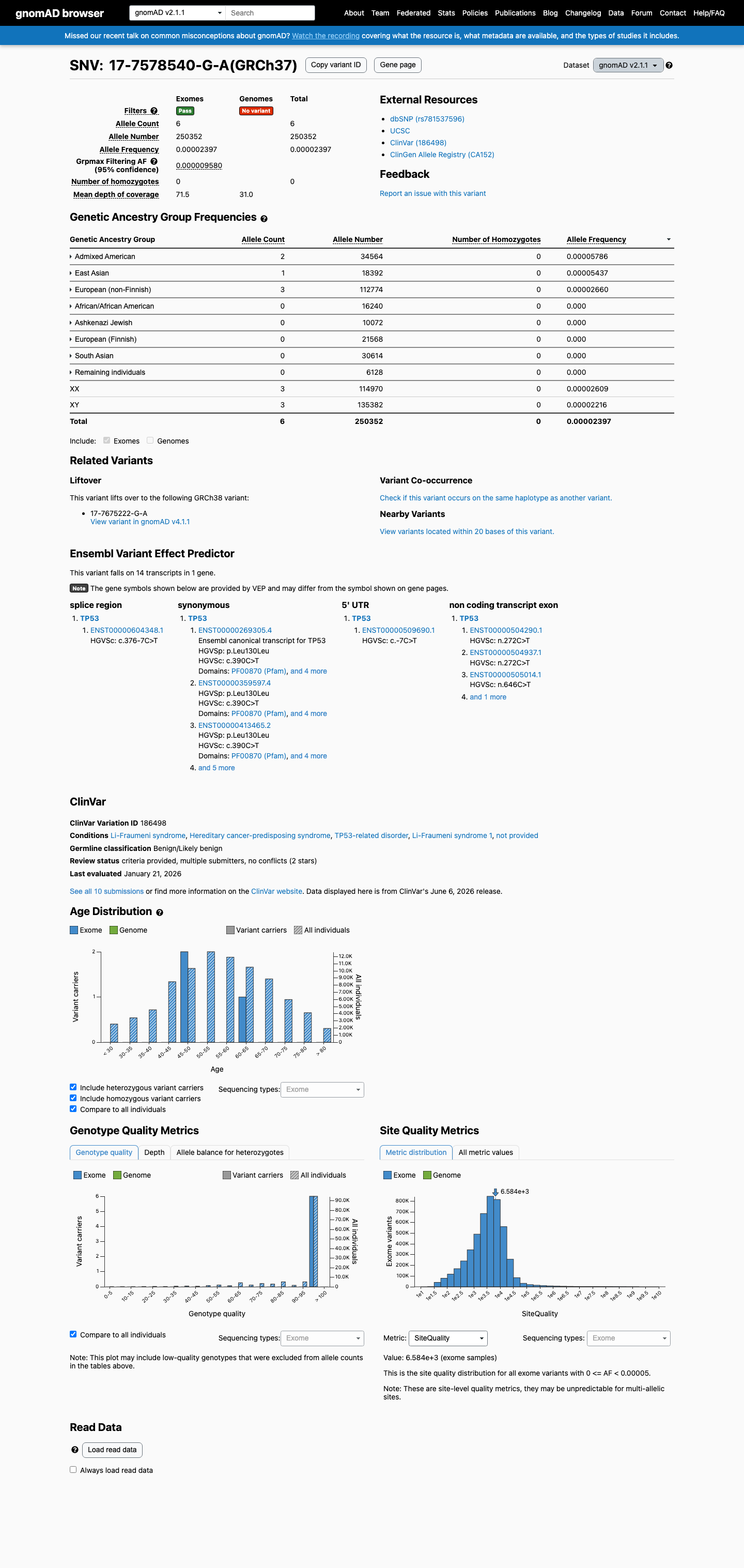
gnomAD v2.1
v4.1
This variant is present in gnomAD v4.1 (AF= 7.43535e-06; MAF= 0.00074%, 12/1613912 alleles, homozygotes = 0) and has highest observed frequency in the Admixed American population (AF= 8.33361e-05; MAF= 0.00833%, 5/59998 alleles, homozygotes = 0); grpmax FAF= 3.233e-05.
v2.1
This variant is present in gnomAD v2.1 (AF= 2.39663e-05; MAF= 0.00240%, 6/250352 alleles, homozygotes = 0) and has highest observed frequency in the Admixed American population (AF= 5.78637e-05; MAF= 0.00579%, 2/34564 alleles, homozygotes = 0); grpmax FAF= 9.58e-06.
🇨🇦 CA
Absent from gnomAD-Canada v1.0.
Allele frequency by ancestry
three datasets · side by side
gnomAD v4.1
0.00074%
· 12 / 1,613,912
0 hom · FAF 0.0032%
0 hom · FAF 0.0032%
Admixed American 5 / 59,998 |
0.0083% |
South Asian 1 / 91,090 |
0.0011% |
European (non-Finnish) 6 / 1,179,950 |
0.00051% |
+ 7 not observed (Remaining individuals, European (Finnish), Amish, East Asian, Middle Eastern, Ashkenazi Jewish, African/African American)
gnomAD v2.1
0.0024%
· 6 / 250,352
0 hom · FAF 0.00096%
0 hom · FAF 0.00096%
Admixed American 2 / 34,564 |
0.0058% |
East Asian 1 / 18,392 |
0.0054% |
European (non-Finnish) 3 / 112,774 |
0.0027% |
+ 5 not observed (African/African American, Ashkenazi Jewish, European (Finnish), Remaining individuals, South Asian)
gnomAD Canada 🇨🇦
Absent
· 0 / ?
0 hom
0 hom
Not observed in any ancestry group.
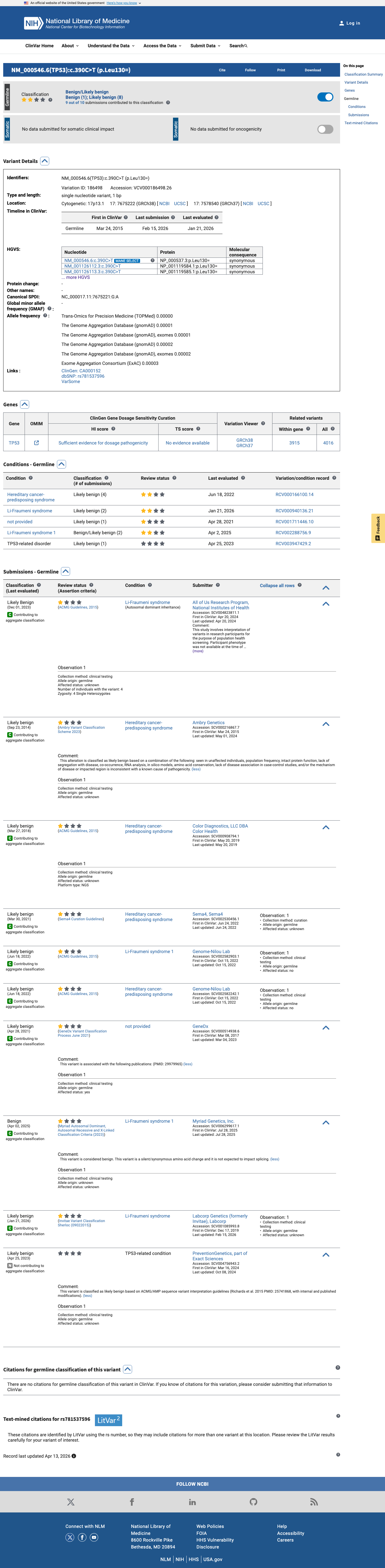
ClinVar
This variant has been reported in ClinVar as Likely benign (7 clinical laboratories) and as Likely Benign (1 clinical laboratory) and as Benign (1 clinical laboratory). (ClinVarID = 186498)
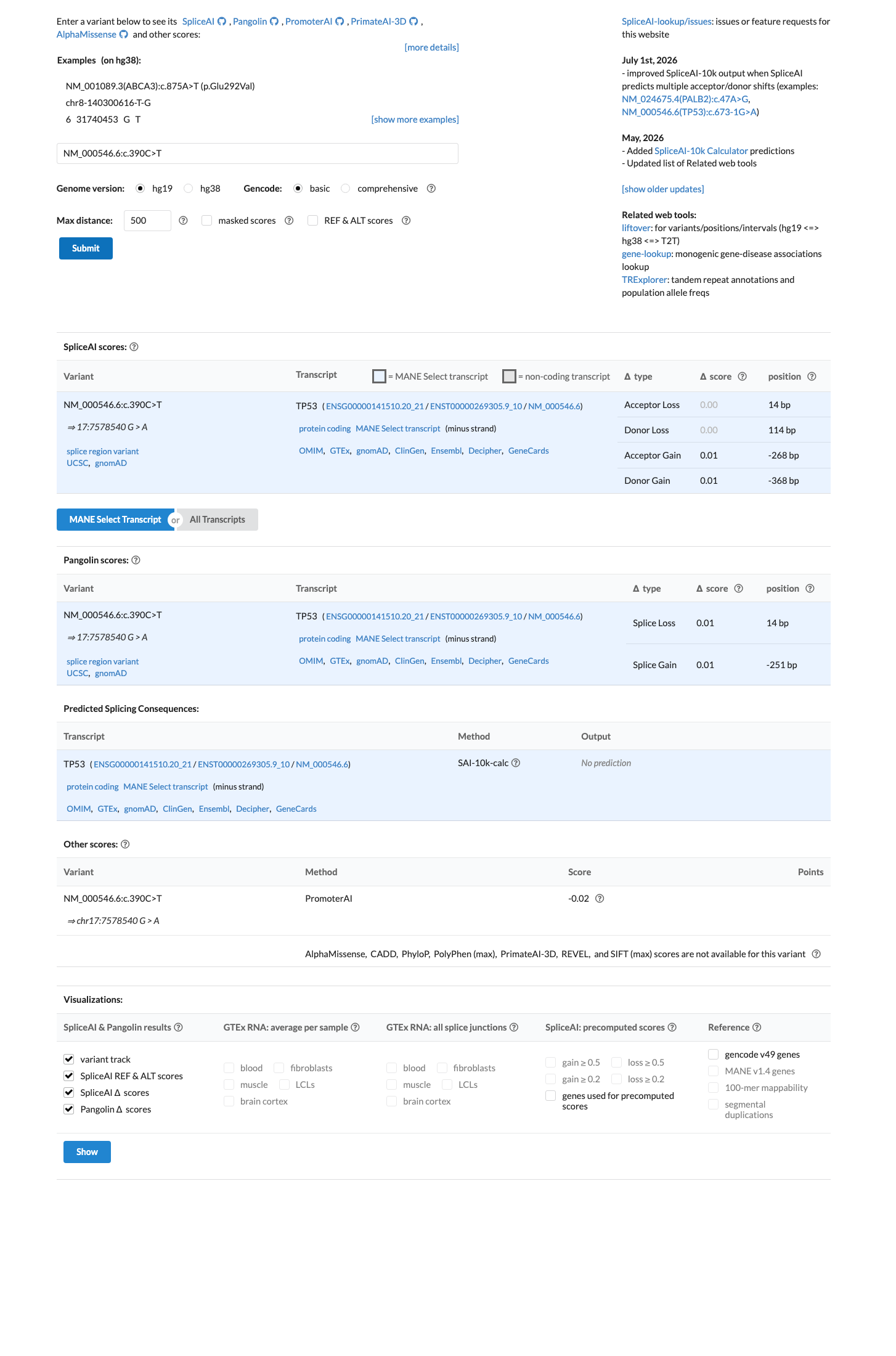
In silico
SpliceAI predicts no significant splice impact for this variant (max delta score = 0.01).
Functional
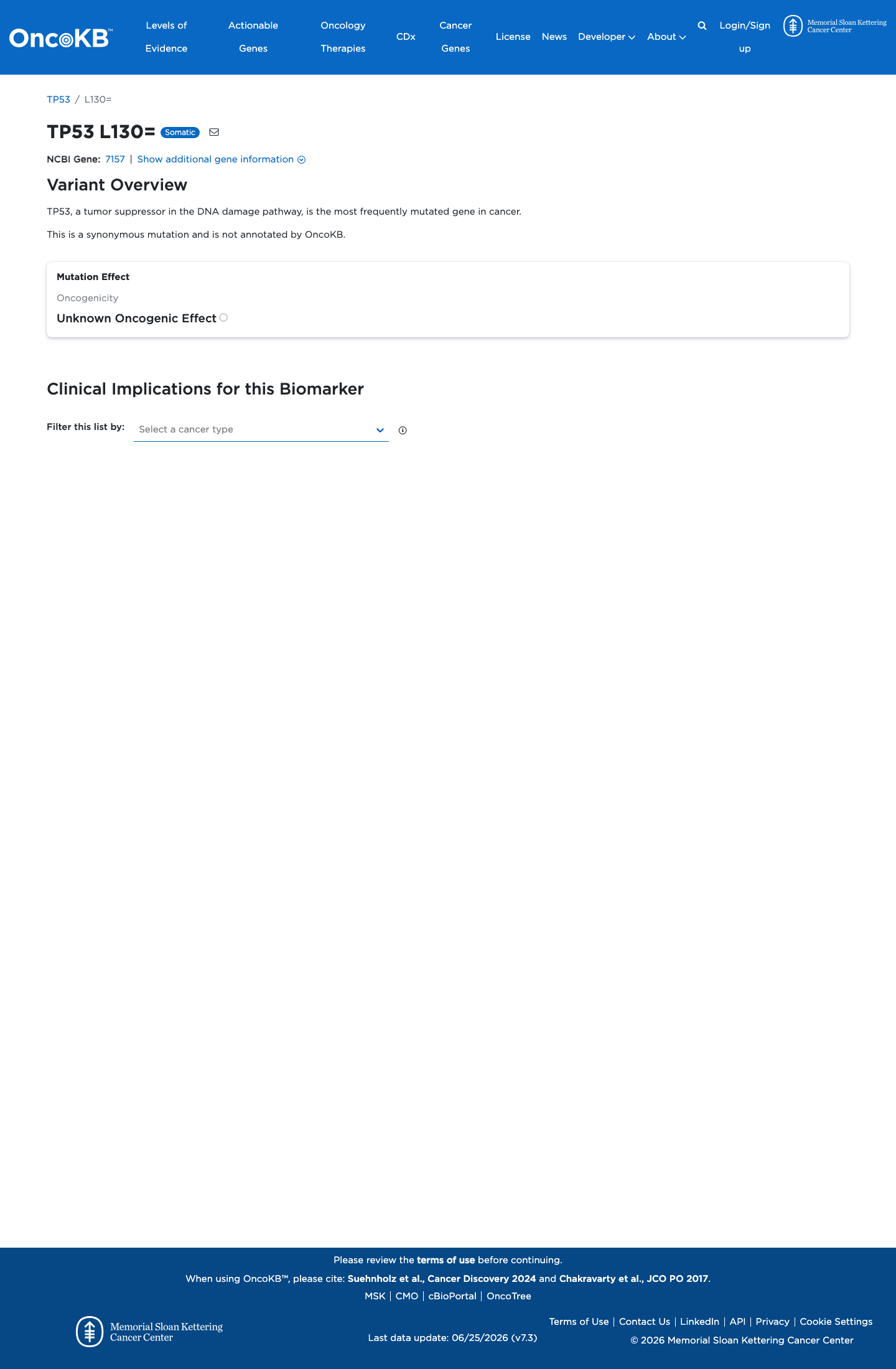
Unknown Oncogenic Effect
OncoKB identified curated literature and non-variant-specific oncogenicity context for review; listed oncogenicity label: Unknown Oncogenic Effect.
COSMIC

Cancer hotspots
Somatic evidence
Hotspot
COSMIC
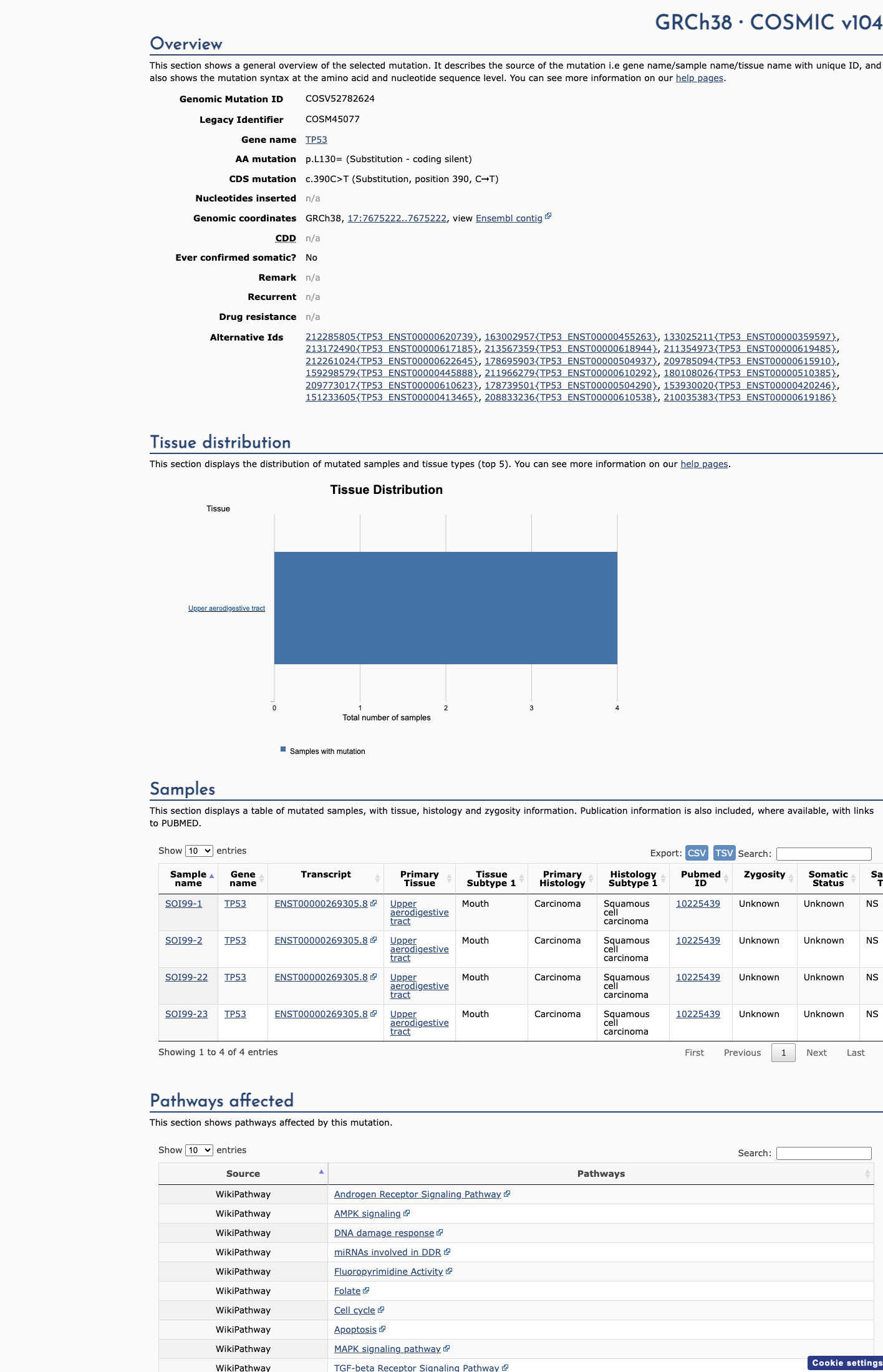
This variant lies in a statistically significant hotspot. This variant has previously been reported in somatic cancers (COSMIC; COSV52782624, n = 4 times).
Hotspots
This variant lies in a statistically significant hotspot.
Sources & reference links
9Sources
Triaged references · 7 PMIDs not cited in assessment
25741868 ↗
Standards and guidelines for the interpretation of sequence variants: a joint consensus recommendation of the American College of Medical Genetics and Genomics and the Association for Molecular Pathology.
CLINVAR
15604628 ↗
Genetic cancer risk assessment and counseling: recommendations of the national society of genetic counselors.
CLINVAR
23788249 ↗
ACMG recommendations for reporting of incidental findings in clinical exome and genome sequencing.
CLINVAR
25394175 ↗
A practice guideline from the American College of Medical Genetics and Genomics and the National Society of Genetic Counselors: referral indications for cancer predisposition assessment.
CLINVAR
26140447 ↗
Points to Consider: Ethical, Legal, and Psychosocial Implications of Genetic Testing in Children and Adolescents.
CLINVAR
28492532 ↗
Sherloc: a comprehensive refinement of the ACMG-AMP variant classification criteria.
CLINVAR