0%
complete
Final classification
VUS
PM2
TP53
c.919+17A>G
p.?
unknown · exon 8i

TP53 encodes the p53 protein, a critical tumor suppressor that acts as a transcription factor to protect cells from damage. When activated by cellular stress such as DNA damage, p53 triggers responses including DNA repair, cell cycle arrest, and programmed cell death (apoptosis) to prevent the propagation of damaged cells. TP53 is the most frequently mutated gene in human cancers, and loss of its function contributes to tumor development, invasion, drug resistance, and genomic instability. Inherited mutations in TP53 cause Li-Fraumeni syndrome, a rare hereditary condition that greatly increases the risk of developing multiple types of cancer at a young age.

This variant

TP53 is a critical tumor suppressor whose inherited mutations cause Li-Fraumeni syndrome, making accurate variant classification essential for cancer-risk management. This deep intronic variant (c.919+17A>G) is classified as a VUS: it is extremely rare in the general population, but no functional or splicing evidence currently exists to determine whether it affects p53 function or cancer risk.

Transcript
NM_000546.6
HGVS · transcript:coding
NM_000546.6:c.919+17A>G
GRCh38
chr17:7673684 T>C
GRCh37
chr17:7577002 T>C
VUS: total score 1 under the ClinGen TP53 VCEP v2.4 point framework (Rule 3, -1 to 5), with PM2_Supporting the only met criterion.
Classification rationale
PM2 VUS
TP53 c.919+17A>G unknown · exon 8i

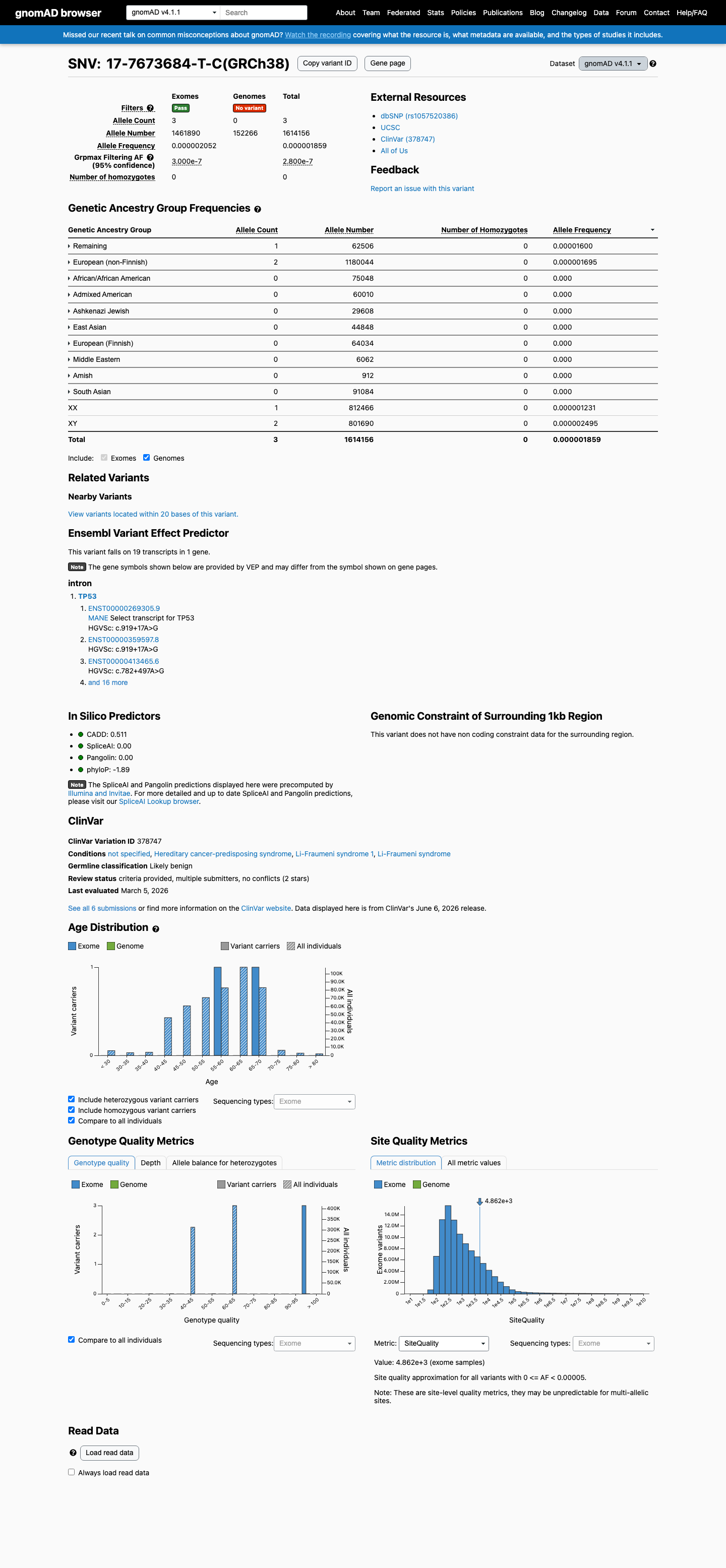
PM2 (Supporting): gnomAD v4.1 allele frequency 1.86e-06 (3/1,614,156 alleles), well below the <0.003% threshold. Overall classification: VUS - PM2_Supporting (+1) is the only met criterion, and a total score of 1 falls within Rule 3 (-1 to 5) of the TP53 VCEP v2.4 framework.

PM2 VUS
Gene diagram · NM_000546.6 · variants mapped to exon structure
TP53 NM_000546.6
Fetching transcript structure from UCSC…
Applied criteria · 1 applied · 12 assessed
MetEvidence satisfies this criterion.
Not metEvaluated against available evidence; threshold not reached.
Not assessedApplies in principle, but no evidence was found to evaluate it.
N/ADoesn't apply to this variant type.
Applied · 1
Strength Supporting Moderate Strong Very strong
PM2 supporting Pathogenic
Met (supporting): gnomAD v4.1 allele frequency 1.86e-06 (3/1,614,156 alleles), well below the <0.003% PM2 threshold.
ClinGen TP53 VCEP v2.4 PM2 rule (cspec): apply at supporting level when allele frequency is < 0.00003 (0.003%) in gnomAD or another large sequenced population; if multiple alleles are present within any genetic ancestry group, the group AF must be < 0.00004 (0.004%); founder-effect groups (Ashkenazi Jewish, Finnish, Amish, Middle Eastern, 'Remaining') are ignored.gnomAD v4.1 (17-7673684-T-C): total AF 1.85856e-06 (0.000186%; 3/1,614,156 alleles), 0 homozygotes; European non-Finnish is the only non-excluded group with >= 2 alleles (2/1,180,044; AF 1.69485e-06, 0.000169%, below 0.004%); Remaining individuals (1/62,506; AF 1.59985e-05) is excluded by rule; grpmax FAF 2.8e-07.gnomAD v2.1 (17-7577002-T-C) and gnomAD-Canada v1.0: variant absent, consistent with extreme rarity.
Assessed · not applied · 3 not met · 9 not assessed
Pathogenic
PVS1 Not met: this intronic substitution at +17 has no predicted protein change and lies outside the canonical splice sites, so it is not a null variant.
PS2 Not assessed: no proband phenotype, parental testing, or maternity/paternity confirmation is available to establish a de novo event.
PS4 Not assessed: no proband phenotype or case-control data exists to tally PS4 points.
PP1 Not assessed: no family segregation studies or meiosis counts are available.
PP3 Not assessed: no SpliceAI score was available to test the required >=0.2 threshold.
PP4 Not assessed: no multigene-panel variant allele fraction (VAF 5-35%) observation is available for this variant.
Benign
BA1 Not met: highest eligible group frequency ~1.7e-06, about 600-fold below the >=0.1% BA1 threshold.
BS1 Not met: highest eligible group frequency 1.7e-06, about 180-fold below the >=0.03% BS1 threshold.
BS2 Not assessed: no source provides counts of unaffected women aged 60 or older without cancer.
BS4 Not assessed: no family testing data exists to demonstrate lack of segregation in affected relatives.
BP4 Not assessed: no SpliceAI score was available to test the required <=0.1 threshold.
BP7 Not assessed: no SpliceAI score to confirm the <=0.1 requirement, and no RNA assay data are available.
N/A · 15 PS1 · PS3 · PM1 · PM3 · PM4 · PM5 · PM6 · PP2 · PP5 · BS3 · BP1 · BP2 · BP3 · BP5 · BP6
Research & evidence
Population frequency
gnomAD v4.1 screenshot
gnomAD v4.1
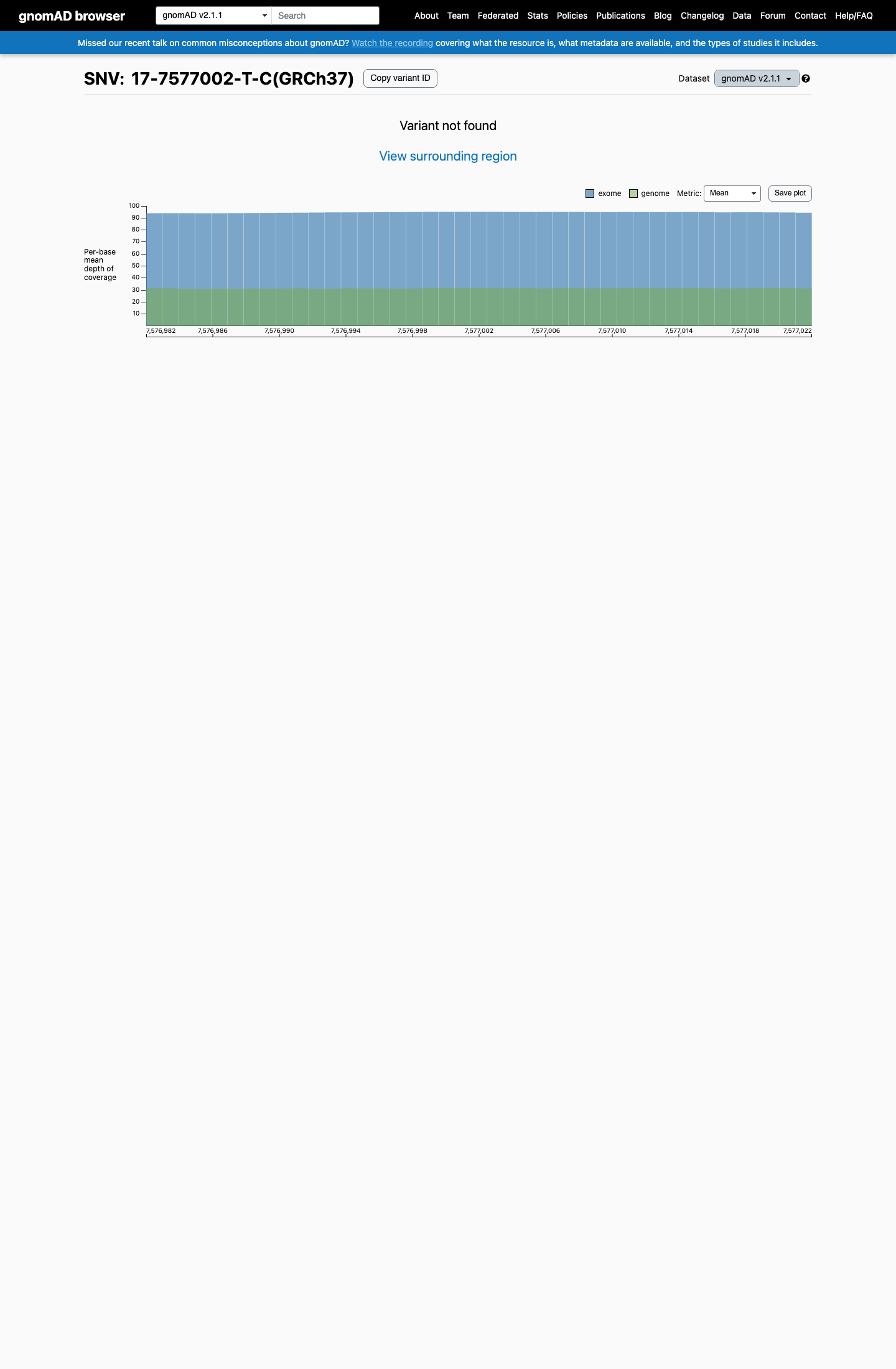
gnomAD v2.1 screenshot
gnomAD v2.1
v4.1
This variant is present in gnomAD v4.1 (AF= 1.85856e-06; MAF= 0.00019%, 3/1614156 alleles, homozygotes = 0) and has highest observed frequency in the Remaining individuals population (AF= 1.59985e-05; MAF= 0.00160%, 1/62506 alleles, homozygotes = 0); grpmax FAF= 2.8e-07.
v2.1
Absent from gnomAD v2.1.
🇨🇦 CA
Absent from gnomAD-Canada v1.0.
Allele frequency by ancestry
three datasets · side by side
gnomAD v4.1
0.00019% · 3 / 1,614,156
0 hom · FAF 2.8e-05%
Remaining individuals
1 / 62,506
0.0016%
European (non-Finnish)
2 / 1,180,044
0.00017%
+ 8 not observed (Admixed American, European (Finnish), Amish, East Asian, Middle Eastern, South Asian, Ashkenazi Jewish, African/African American)
gnomAD v2.1
Absent · 0 / ?
0 hom
Not observed in any ancestry group.
gnomAD Canada 🇨🇦
Absent · 0 / ?
0 hom
Not observed in any ancestry group.
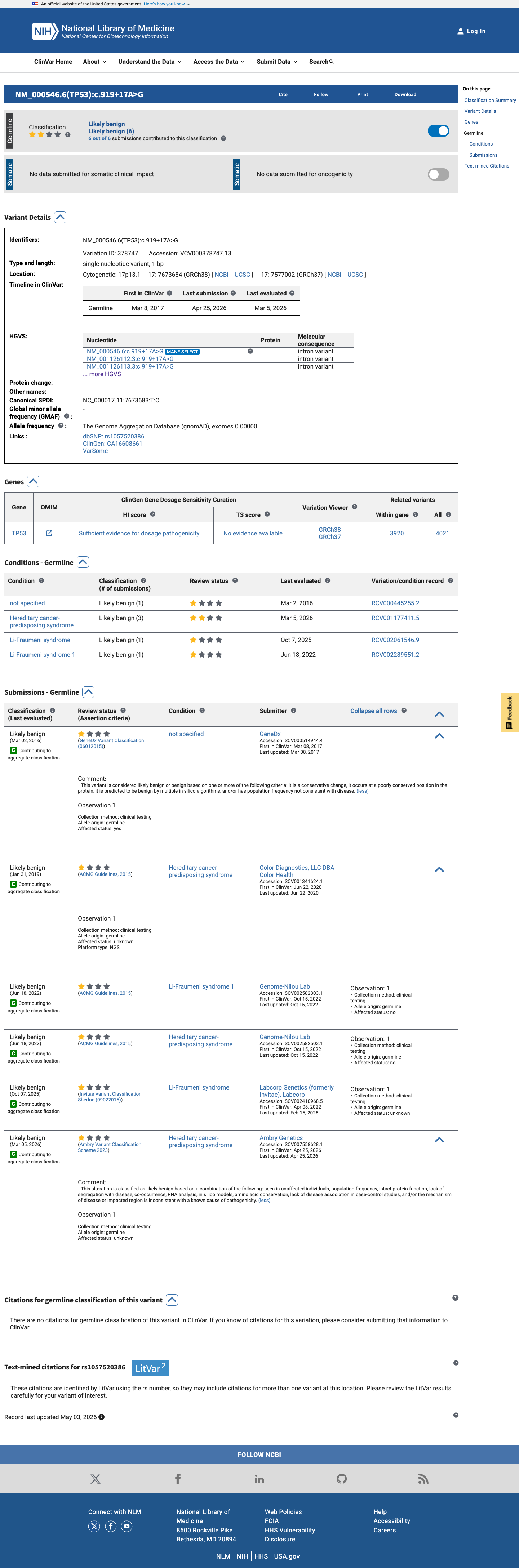
ClinVar screenshot
ClinVar
This variant has been reported in ClinVar as Likely benign (6 clinical laboratories). (ClinVarID = 378747)
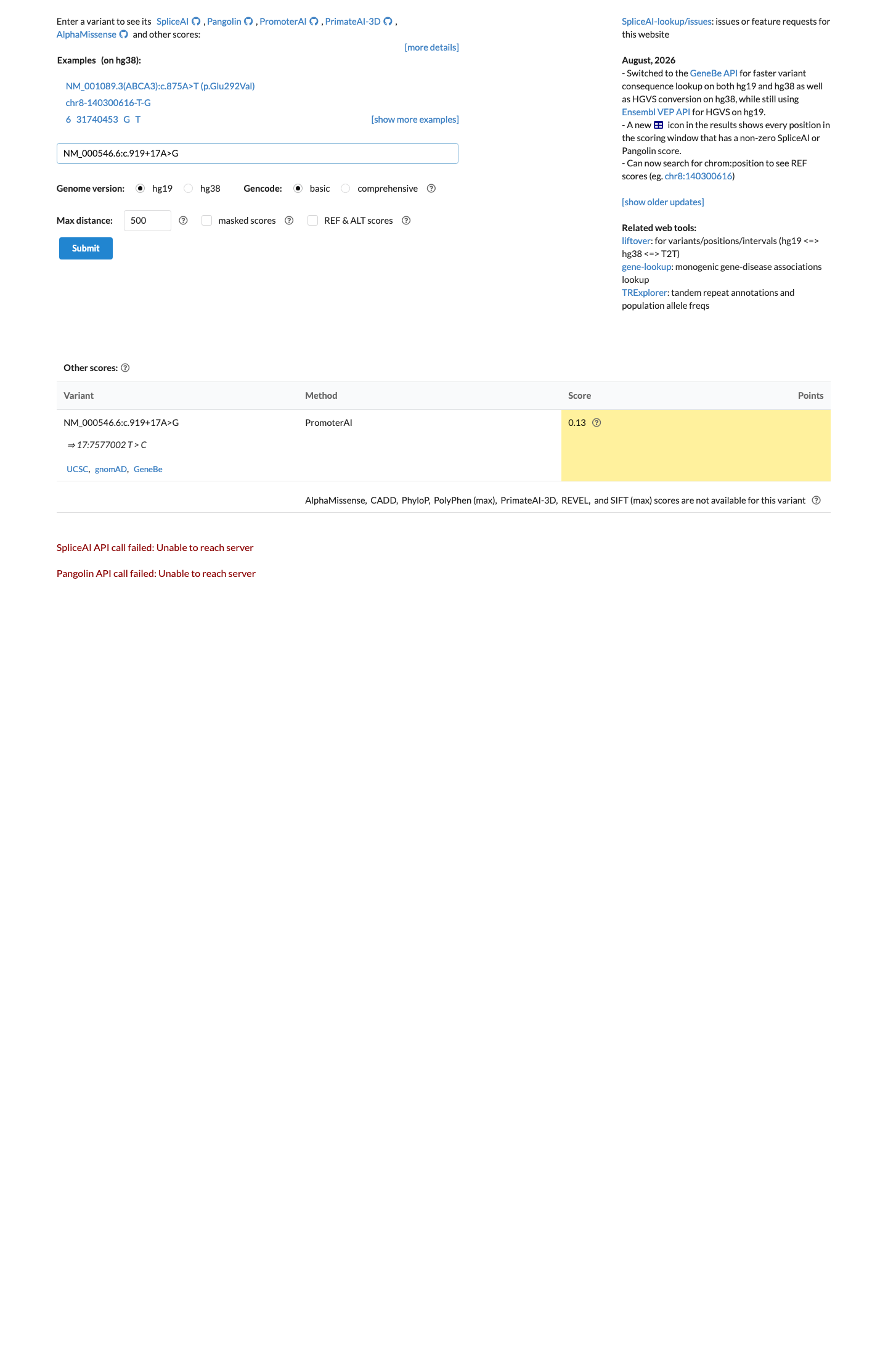
SpliceAI screenshot
In silico No data
No in-silico prediction was recorded for this variant.
Functional No data
No calibrated functional assay or RNA evidence was identified for this variant.
OncoKB ↗
COSMIC screenshot
COSMIC
Somatic evidence
COSMIC
This variant has not previously been reported in somatic cancers (COSMIC).
Hotspots
This variant does not lie in a statistically significant cancer hotspot.
COSMIC ↗
Literature · how each cited paper was used
3papers cited
Each card is an audit: what was searched, what was found, whether it names the variant, which criteria it fed, and why. 4 further PMIDs triaged but not cited — see Sources & references.
Rule & framework references · cited for criterion definitions, not variant evidence
20065170 ↗ American Society of Clinical Oncology policy statement update: genetic and genomic testing for cancer susceptibility.
25741868 ↗ Standards and guidelines for the interpretation of sequence variants: a joint consensus recommendation of the American College of Medical Genetics and Genomics and the Association for Molecular Pathology.
26324357 ↗ American Society of Clinical Oncology Policy Statement Update: Genetic and Genomic Testing for Cancer Susceptibility.
Sources & reference links
8Sources
CSpec VCEP
ClinVar
gnomAD v2.1
gnomAD v4.1
gnomAD-Canada
SpliceAI
OncoKB
COSMIC
Triaged references · 4 PMIDs not cited in assessment
20301471 ↗ Wilms Tumor Predisposition. CLINVAR
20301488 ↗ Li-Fraumeni Syndrome. CLINVAR
26389258 ↗ Cancer Genetics Risk Assessment and Counseling (PDQ®): Health Professional Version. CLINVAR
28492532 ↗ Sherloc: a comprehensive refinement of the ACMG-AMP variant classification criteria. CLINVAR