Analysis in progress
Initialising…
0%
complete
This report is still being assembled — sections appear as each stage finishes. It isn't final yet.
TSC2
Final classification
Likely Pathogenic
TSC2 c.3796_3797del · p.Leu1266AlafsTer55
TSC2

PVS1 (Very Strong): 2-bp deletion causes frameshift p.(Leu1266AlafsTer55), a null variant predicted to trigger nonsense-mediated decay in TSC2, where loss of function is an established disease mechanism.

Gene
TSC2
Transcript
NM_000548.4
HGVS · transcript:coding
NM_000548.4:c.3796_3797del
Consequence
N/A
GRCh38
chr16:2081777 CCT>C
GRCh37
chr16:2131778 CCT>C
Basis Likely Pathogenic: PVS1 (very strong) plus one supporting criterion (PM2) meets the generic ACMG/AMP combination rule for Likely Pathogenic, with posterior probability 0.988.
Likely Pathogenic: PVS1 (very strong) plus one supporting criterion (PM2) meets the generic ACMG/AMP combination rule for Likely Pathogenic, with posterior probability 0.988.
Classification rationale
PVS1PM2 Likely Pathogenic
TSC2 c.3796_3797del

PVS1 (Very Strong): 2-bp deletion causes frameshift p.(Leu1266AlafsTer55), a null variant predicted to trigger nonsense-mediated decay in TSC2, where loss of function is an established disease mechanism. PM2 (Supporting): variant is absent from gnomAD v2.1/v4.1 exomes and gnomAD-Canada genomes (allele frequency 0, below the 0.1% threshold). Overall: Likely Pathogenic, per the ACMG/AMP combination rule PVS1 + 1 supporting criterion (posterior probability 0.988).

PVS1 + PM2 Likely Pathogenic
Gene diagram · NM_000548.4 · variants mapped to exon structure
TSC2 NM_000548.4
Fetching transcript structure from UCSC…
Applied criteria · 2 applied · 17 assessed
Applied · 2
Strength Supporting Moderate Strong Very strong
PVS1 very strong Pathogenic
Met at very strong: 2-bp deletion causes frameshift p.(Leu1266AlafsTer55), a null variant predicted to trigger nonsense-mediated decay in TSC2, a gene with an established loss-of-function disease mechanism.
pvs1_variant_assessment: variant classified as frameshift (variant_bucket=frameshift) on NM_000548.4, protein NP_000539.2:p.(Leu1266AlafsTer55), suggested_default_strength=PVS1 under PMC6185798; Mutalyzer protein prediction: position_last_original=1808, position_last_predicted=1320 (loss of 488 aa).pvs1_gene_context: TSC2 germline LOF mechanism supported, pvs1_gene_gate='eligible', with caution that no official CSPEC/VCEP exists and generic PVS1 fallback should follow PMC6185798.pvs1_generic_framework: ClinGen SVI PVS1 recommendations (PMC6185798) — null variant + established LOF mechanism + NMD predicted, not in last exon/last 50 bp of penultimate exon -> PVS1 very strong.
PM2 supporting Pathogenic
Met at supporting: variant is absent from gnomAD v2.1 and v4.1 exomes and gnomAD-Canada genomes (allele frequency 0, below the 0.1% threshold).
PMID:25741868 — PM2 rule (absent in controls, or at extremely low frequency if recessive, in ESP/1000 Genomes/ExAC) governs; the variant is entirely absent, satisfying the rule without reliance on a numeric AF cutoffgnomad_v2 — variant absent from gnomAD v2.1 exomes (search_status=absent)gnomad_v4 — variant absent from gnomAD v4.1 exomes (search_status=absent)
Assessed · not applied
Pathogenic
PS2 Not assessed: no de novo occurrence data exist for this variant; parental testing results for the proband are missing.
PS3 Not met: no well-established functional study of this exact variant exists; the OncoKB loss-of-function annotation is curated inference, not an experimental assay.
PS4 Not assessed: no case-level data show this exact variant enriched in affected individuals; the two large TSC cohort studies do not report it.
PM6 Not assessed: no parental testing observation, even without parentage confirmation, is reported for this variant.
PP1 Not assessed: no co-segregation data exist; no family carrying this exact variant is reported.
PP3 Not met: SpliceAI max delta 0.01 is far below the 0.2 splice-impact threshold, and missense predictors do not apply to a deletion.
PP4 Not assessed: no proband phenotype or family history is documented to establish a highly specific TSC presentation.
PP5 Not met: no ClinVar expert-panel (3-star) classification exists for this variant; laboratory P/LP labels do not qualify.
Benign
BA1 Not met: allele frequency is 0 in gnomAD v2.1, v4.1, and gnomAD-Canada, far below the >1% BA1 threshold.
BS1 Not met: allele frequency 0 is not greater than the >0.3% threshold expected for this early-onset dominant disorder.
BS2 Not met: no healthy-adult or homozygous observations exist; the variant is absent from all queried population datasets.
BS3 Not met: no functional study shows normal protein function; SpliceAI's low splice score (0.01) does not address the frameshift's protein impact.
BS4 Not assessed: no segregation study exists showing the variant in unaffected carriers or absent in affected relatives.
BP2 Not assessed: no phased observations exist; no proband genotype or cis/trans testing is available for this variant.
BP4 Not met: SpliceAI's low score (0.01) addresses splicing only and cannot offset the frameshift's unambiguous protein-truncating impact.
BP5 Not assessed: no proband workup data exist to show an alternate molecular basis of disease.
BP6 Not met: ClinVar has no benign or likely-benign submissions and no expert-panel classification for this variant.
N/A · 9 PS1 · PM1 · PM3 · PM4 · PM5 · PP2 · BP1 · BP3 · BP7
Research & evidence
Population frequency · supports pathogenic
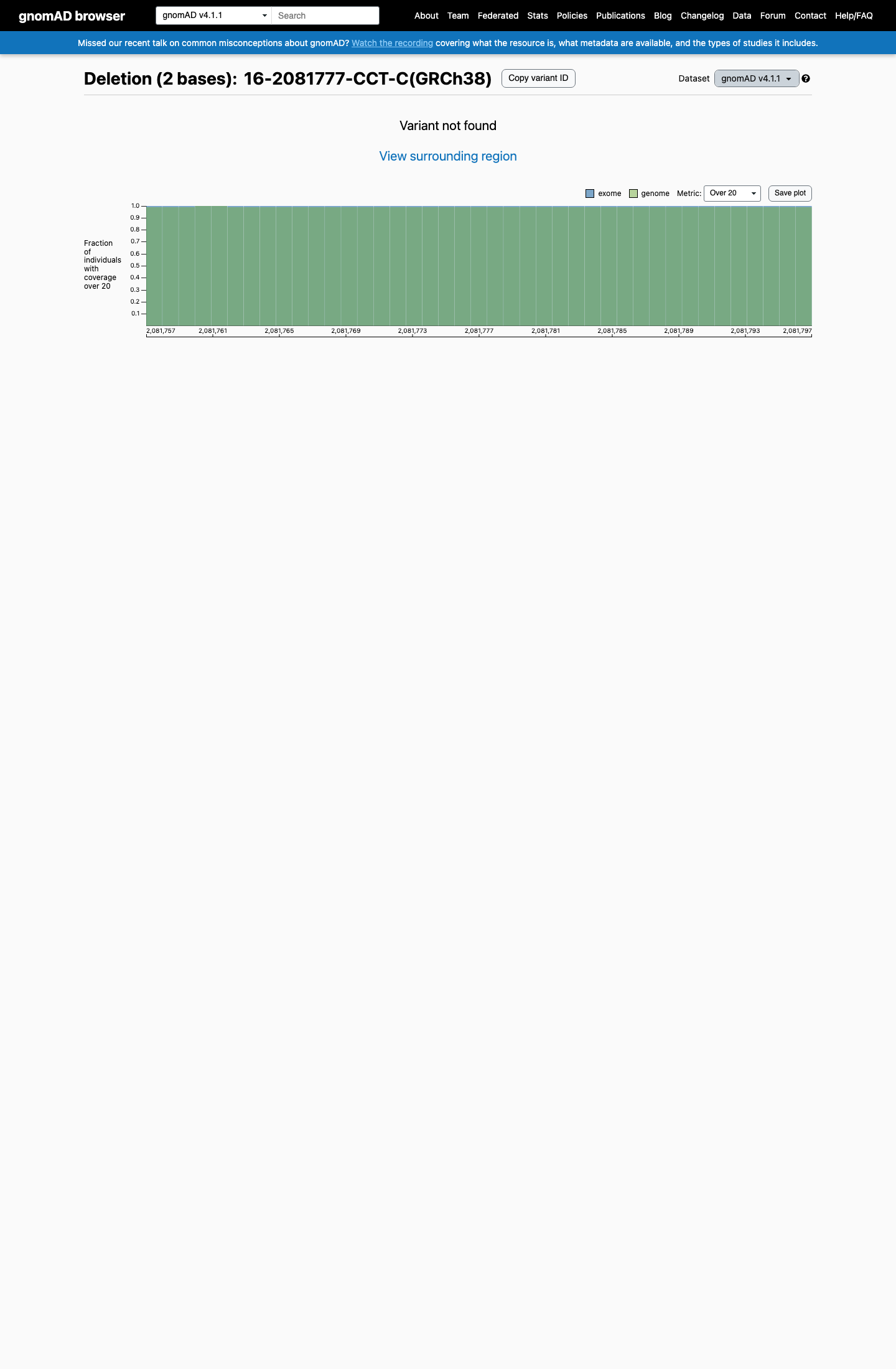
gnomAD v4.1 screenshot
gnomAD v4.1
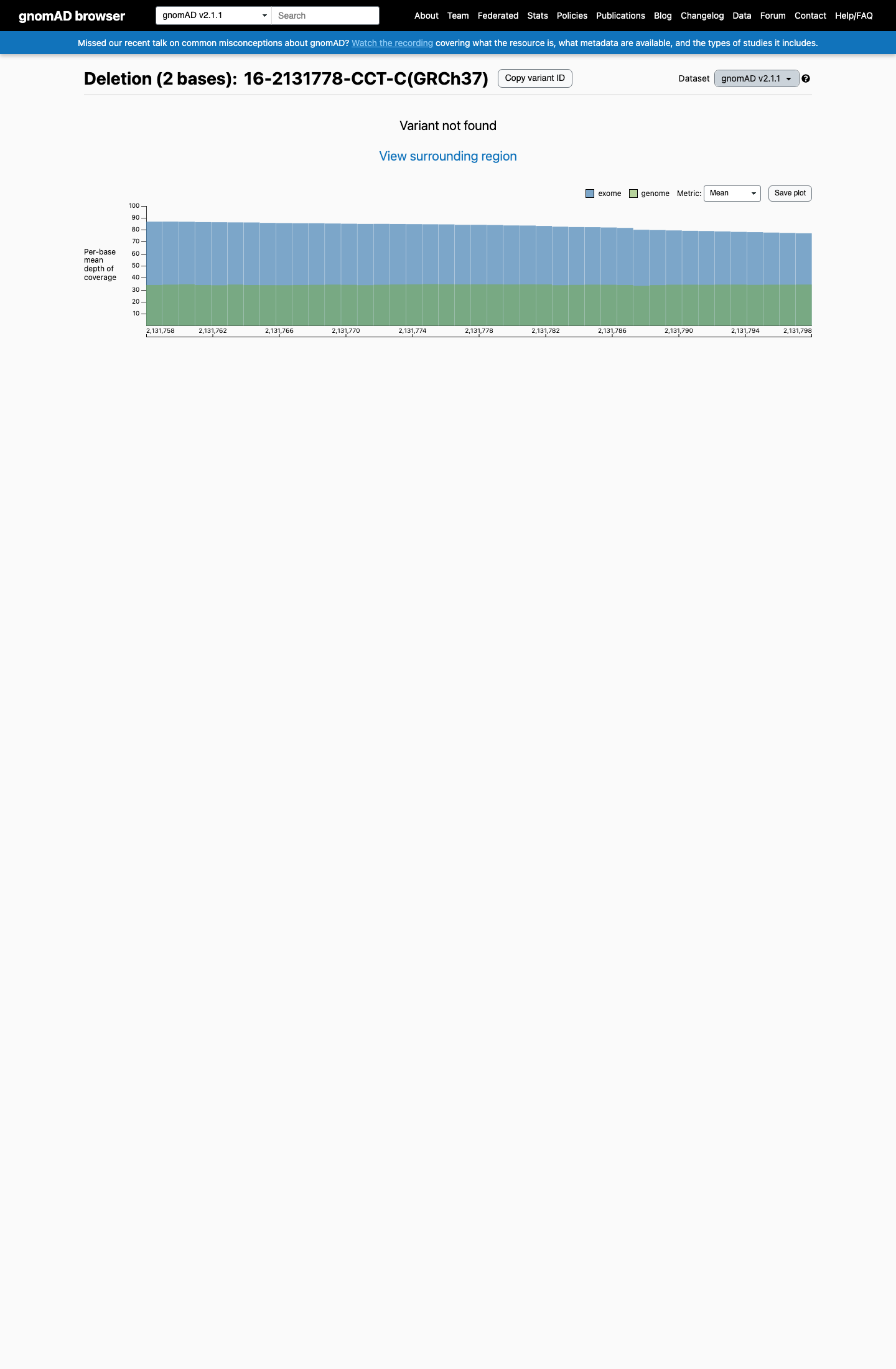
gnomAD v2.1 screenshot
gnomAD v2.1
v4.1
Absent from gnomAD v4.1.
v2.1
Absent from gnomAD v2.1.
🇨🇦 CA
Absent from gnomAD-Canada v1.0.
Allele frequency by ancestry
three datasets · side by side
gnomAD v4.1
Absent · 0 / ?
0 hom
Not observed in any ancestry group.
gnomAD v2.1
Absent · 0 / ?
0 hom
Not observed in any ancestry group.
gnomAD Canada 🇨🇦
Absent · 0 / ?
0 hom
Not observed in any ancestry group.
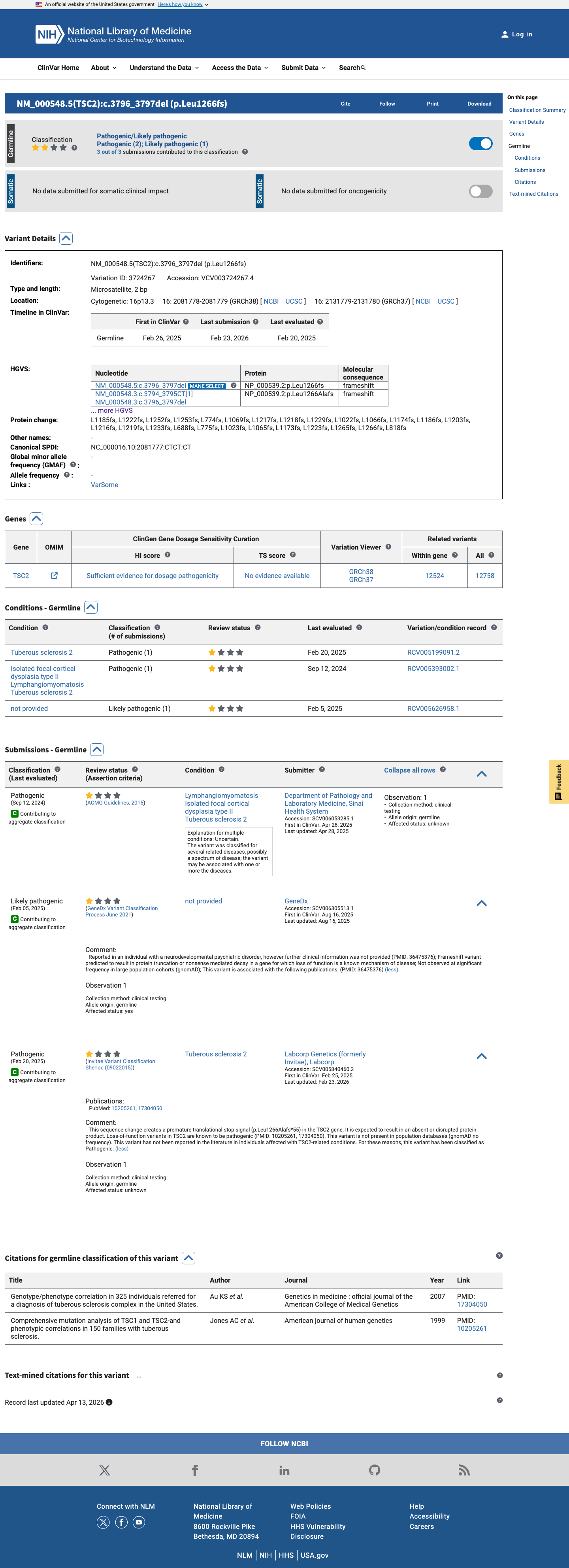
ClinVar screenshot
ClinVar
This variant has been reported in ClinVar as Pathogenic (2 clinical laboratories) and as Likely pathogenic (1 clinical laboratory). (ClinVarID = 3724267)
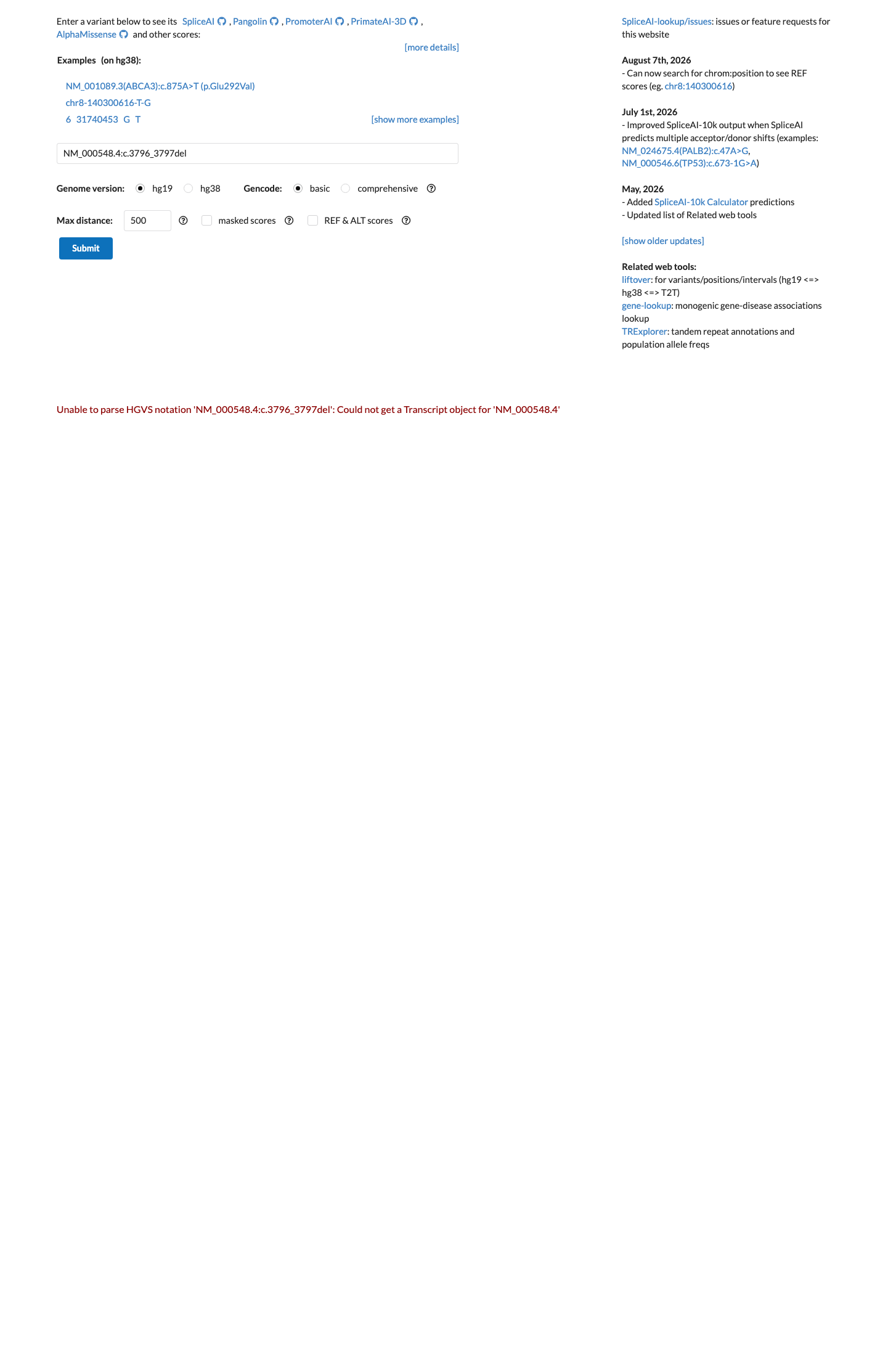
SpliceAI screenshot
In silico
SpliceAI predicts no significant splice impact for this variant (max delta score = 0.01).
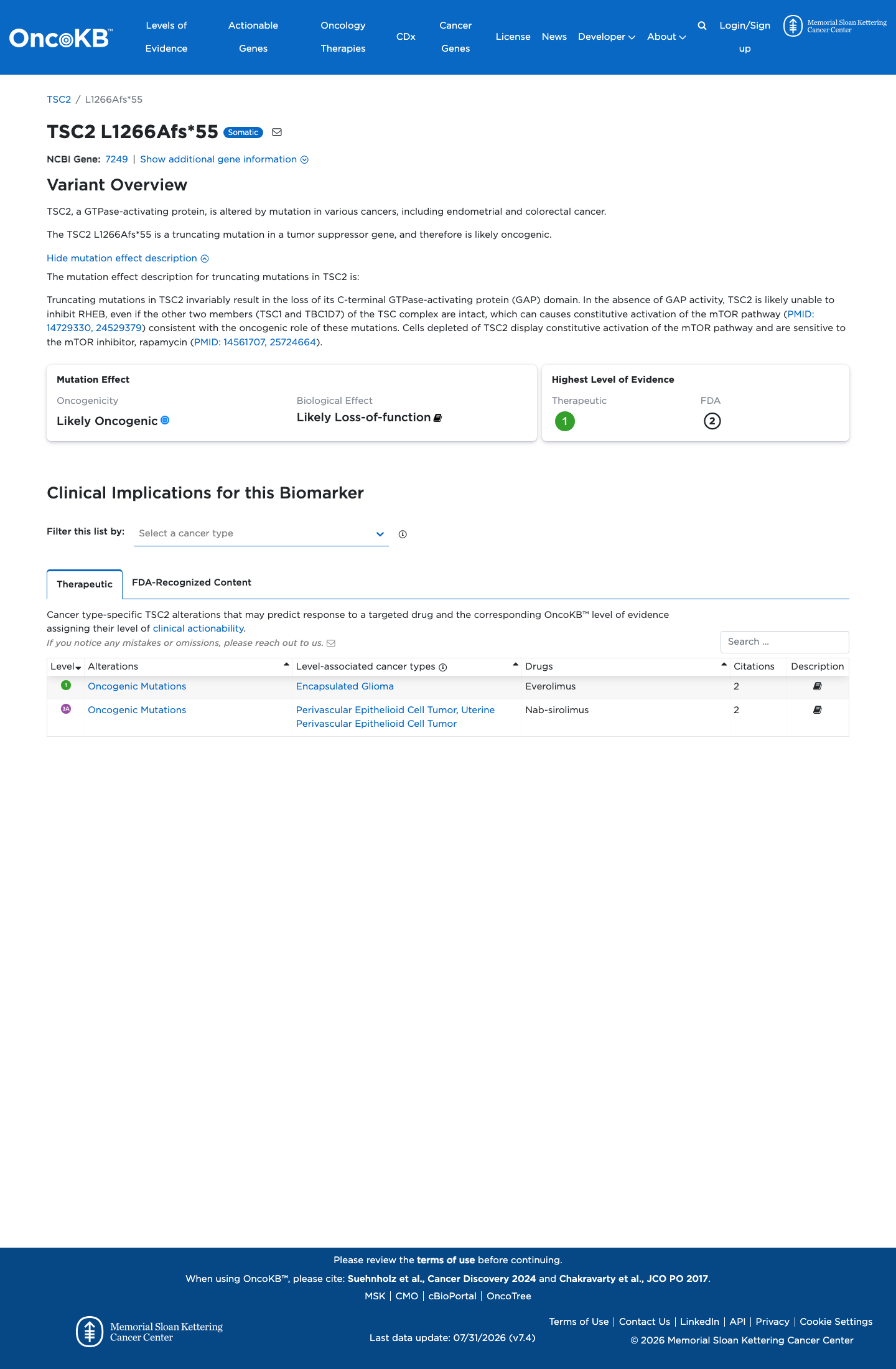
Functional / OncoKB screenshot
Functional Likely Oncogenic
OncoKB identified variant-specific curated literature and context relevant to functional review; biological-effect context: Likely Loss-of-function; curated oncogenicity label: Likely Oncogenic.
OncoKB ↗
COSMIC screenshot
COSMIC
Cancer hotspots screenshot
Cancer hotspots
Somatic evidence Not in COSMIC / hotspots
COSMIC
This variant does not lie in a statistically significant hotspot. This variant has not previously been reported in somatic cancers (COSMIC).
Hotspots
This variant does not lie in a statistically significant hotspot.
Literature · how each cited paper was used
3papers cited
Each card is an audit: what was searched, what was found, whether it names the variant, which criteria it fed, and why. 6 further PMIDs triaged but not cited — see Sources & References.
Rule & framework references · cited for criterion definitions, not variant evidence
10205261 ↗ Comprehensive mutation analysis of TSC1 and TSC2-and phenotypic correlations in 150 families with tuberous sclerosis.
17304050 ↗ Genotype/phenotype correlation in 325 individuals referred for a diagnosis of tuberous sclerosis complex in the United States.
25741868 ↗ Standards and guidelines for the interpretation of sequence variants: a joint consensus recommendation of the American College of Medical Genetics and Genomics and the Association for Molecular Pathology.
Sources & reference links
8Sources
ClinVar
gnomAD v2.1
gnomAD v4.1
gnomAD-Canada
SpliceAI
OncoKB
COSMIC
Cancer hotspots
Triaged references · 6 PMIDs not cited in assessment
14561707 ↗ Loss of Tsc1/Tsc2 activates mTOR and disrupts PI3K-Akt signaling through downregulation of PDGFR. ONCOKB
14729330 ↗ TSC2: filling the GAP in the mTOR signaling pathway. ONCOKB
24529379 ↗ Spatial control of the TSC complex integrates insulin and nutrient regulation of mTORC1 at the lysosome. ONCOKB
25724664 ↗ Loss of Tuberous Sclerosis Complex 2 (TSC2) Is Frequent in Hepatocellular Carcinoma and Predicts Response to mTORC1 Inhibitor Everolimus. ONCOKB
20301399 ↗ Tuberous Sclerosis Complex. CLINVAR
28492532 ↗ Sherloc: a comprehensive refinement of the ACMG-AMP variant classification criteria. CLINVAR