Analysis in progress
Initialising…
0%
complete
This report is still being assembled — sections appear as each stage finishes. It isn't final yet.
TSC2
Final classification
VUS
PVS1PM2
TSC2
c.5335del
p.Gln1779ArgfsTer47
frameshift · exon 42

TSC2 is a tumor suppressor gene that encodes tuberin, a growth-inhibitory protein. Tuberin teams up with hamartin to form the TSC protein complex, which keeps cell growth in check by dampening mTORC1 signaling. Mutations in TSC2 cause tuberous sclerosis, a disorder featuring benign and occasionally malignant tumors, and are also linked to lymphangioleiomyomatosis. Loss-of-function changes in TSC2 are seen in some cancers, such as liver and endometrial cancers, and can make tumors sensitive to mTOR-inhibiting drugs.

This variant

TSC2 loss-of-function drives tuberous sclerosis and related tumors by releasing mTORC1 growth signaling, but this frameshift sits at the extreme C-terminus of tuberin: it escapes nonsense-mediated decay and replaces only the final 29 residues (~1.6% of the protein), leaving most of the growth-inhibitory protein intact. With no functional or clinical evidence yet showing whether this altered tail disrupts tuberin's tumor-suppressor activity, the variant remains a VUS.

Transcript
NM_000548.4
HGVS · transcript:coding
NM_000548.4:c.5335del
GRCh38
chr16:2088520 AC>A
GRCh37
chr16:2138521 AC>A
Basis No TSC2-specific VCEP framework was available, so generic ACMG/AMP 2015 rules applied: PVS1 (supporting) plus PM2 (supporting), two supporting criteria, map to VUS.
No TSC2-specific VCEP framework was available, so generic ACMG/AMP 2015 rules applied: PVS1 (supporting) plus PM2 (supporting), two supporting criteria, map to VUS.
Classification rationale
PVS1PM2 VUS
TSC2 c.5335del frameshift · exon 42

PVS1 (Supporting): terminal-exon frameshift escapes nonsense-mediated decay and alters only 29 of 1807 residues (~1.6% of tuberin), below the ~10% critical-region threshold. PM2 (Supporting): variant is absent from gnomAD v2.1, v4.1, and gnomAD-Canada v1.0, consistent with extreme rarity. Combination: two supporting criteria under generic ACMG/AMP 2015 rules yield a VUS (variant of uncertain significance).

PVS1 + PM2 VUS
Gene diagram · NM_000548.4 · variants mapped to exon structure
TSC2 NM_000548.4
Fetching transcript structure from UCSC…
Applied criteria · 2 applied · 17 assessed
MetEvidence satisfies this criterion.
Not metEvaluated against available evidence; threshold not reached.
Not assessedApplies in principle, but no evidence was found to evaluate it.
N/ADoesn't apply to this variant type.
Applied · 2
Strength Supporting Moderate Strong Very strong
PVS1 supporting review Pathogenic
Met (supporting): frameshift escapes nonsense-mediated decay in the terminal exon, altering only 29 of 1807 residues (~1.6%), far below the ~10% critical-region threshold.
case_summary.json pvs1_variant_assessment: variant classified consequence_class='frameshift', variant_bucket='frameshift', framework_source PMC6185798, apply_generic_pvs1_framework=true, suggested_default_strength='PVS1' pending downgrade checks for NMD escape and exon/region importance.case_summary.json pvs1_variant_assessment.downgrade_considerations explicitly flag: confirm transcript relevance, downgrade if predicted truncation escapes NMD or affects only a non-critical distal region, downgrade/withhold if the affected exon is not biologically relevant or is enriched for population LoF variation.prefetch.json mutalyzer selector_short exon coordinates show the transcript has 42 total exons and variant_exonic_positions (start_exon=end_exon=42 for both GRCh37/GRCh38) place c.5335del in the final exon (exon 42/42), spanning c.5260-*110.
PM2 supporting Pathogenic
Met (supporting): absent from gnomAD v2.1, v4.1, and gnomAD-Canada v1.0, consistent with extreme rarity in TSC2-related disease.
gnomAD v2.1 reports NM_000548.4:c.5335del as absent.gnomAD v4.1 reports NM_000548.4:c.5335del as absent.gnomAD-Canada v1.0 reports NM_000548.4:c.5335del as absent.
Assessed · not applied · 4 not met · 13 not assessed
Pathogenic
PS2 Not assessed: no parental genotypes, trio testing, or de novo documentation was available.
PS3 Not assessed: no functional assay results for this specific variant, with controls, were available.
PS4 Not assessed: no affected-case series, case-control comparison, or enrichment data for this variant was available.
PM6 Not assessed: no unconfirmed de novo observation in an affected proband was reported.
PP1 Not assessed: no affected relatives, informative meioses, or segregation analysis were documented.
PP3 Not met: SpliceAI max delta 0.00 shows no predicted splice impact for this frameshift variant.
PP4 Not assessed: no proband phenotype or clinical diagnosis was available for evaluation.
PP5 Not assessed: the variant has no ClinVar entry or expert-panel assertion.
Benign
BA1 Not met: absent from gnomAD v2.1, v4.1, and gnomAD-Canada, below the stand-alone benign frequency threshold.
BS1 Not met: the variant is absent from population databases rather than present above the benign disease-frequency threshold.
BS2 Not assessed: no data on occurrence in healthy adults or homozygotes from population cohorts was available.
BS3 Not assessed: no variant-specific functional assay showing no damaging effect was available.
BS4 Not assessed: no unaffected carriers, non-segregation data, or phenotype-confirmed family dataset was provided.
BP2 Not assessed: no second pathogenic variant or phase information was documented for this variant.
BP4 Not met: SpliceAI max delta 0.00 suggests no splice disruption, but a benign splice score does not offset the frameshift's loss-of-function consequence.
BP5 Not assessed: no evidence of an alternative genetic cause of the phenotype was available.
BP6 Not assessed: the variant is absent from ClinVar with no benign or likely-benign classification.
N/A · 9 PS1 · PM1 · PM3 · PM4 · PM5 · PP2 · BP1 · BP3 · BP7
Research & evidence
Population frequency
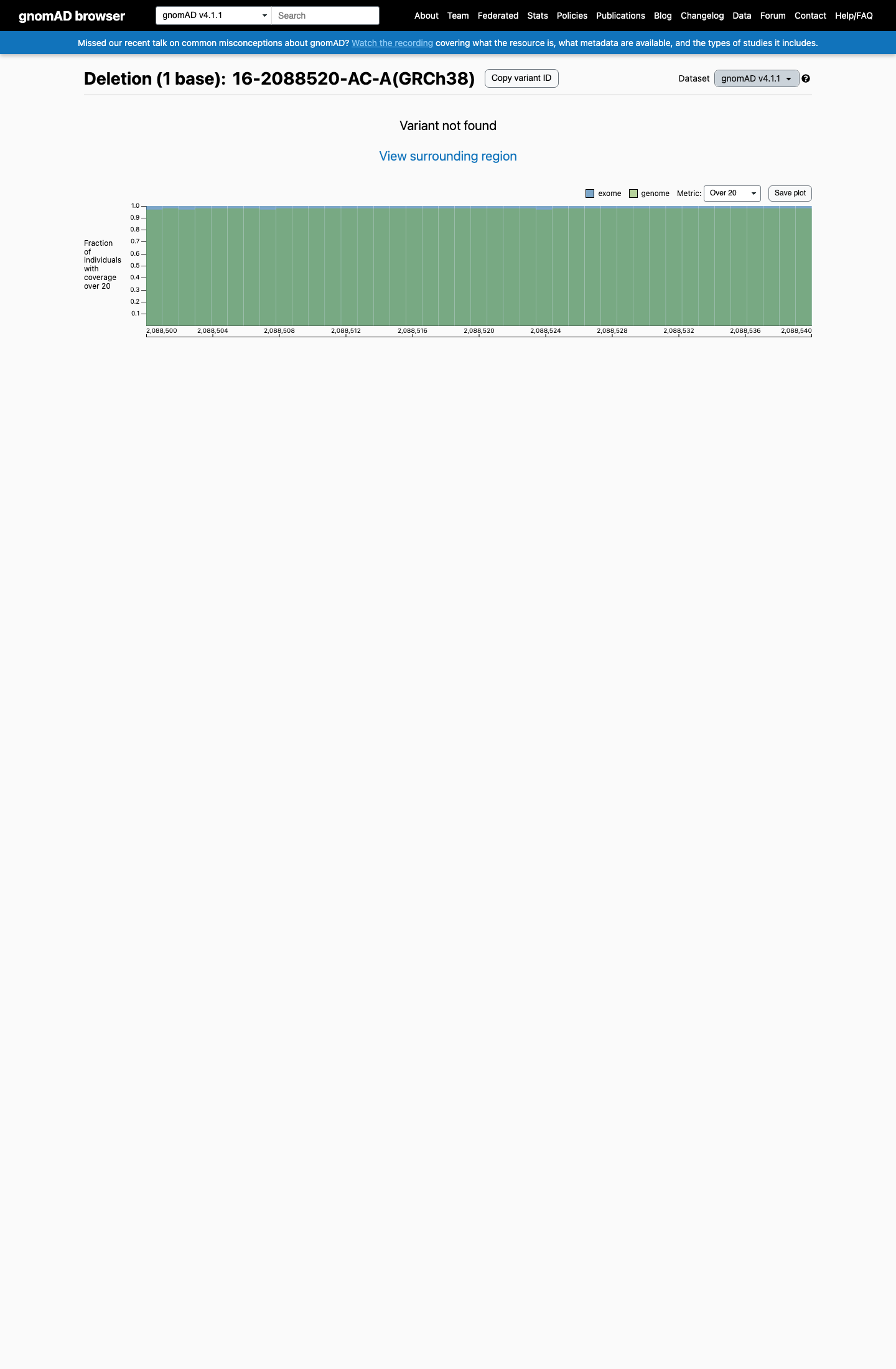
gnomAD v4.1 screenshot
gnomAD v4.1
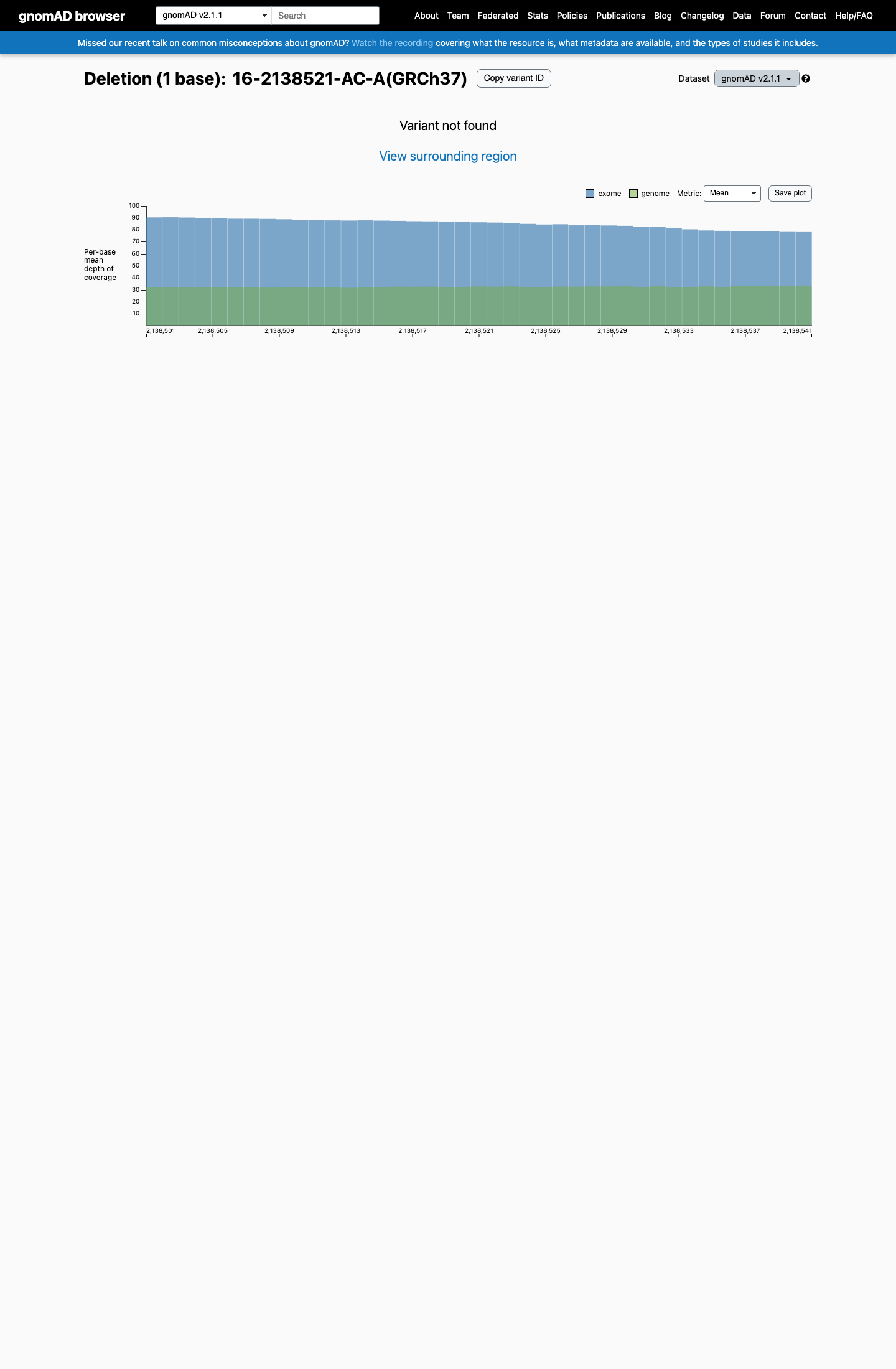
gnomAD v2.1 screenshot
gnomAD v2.1
v4.1
Absent from gnomAD v4.1.
v2.1
Absent from gnomAD v2.1.
🇨🇦 CA
Absent from gnomAD-Canada v1.0.
Allele frequency by ancestry
three datasets · side by side
gnomAD v4.1
Absent · 0 / ?
0 hom
Not observed in any ancestry group.
gnomAD v2.1
Absent · 0 / ?
0 hom
Not observed in any ancestry group.
gnomAD Canada 🇨🇦
Absent · 0 / ?
0 hom
Not observed in any ancestry group.
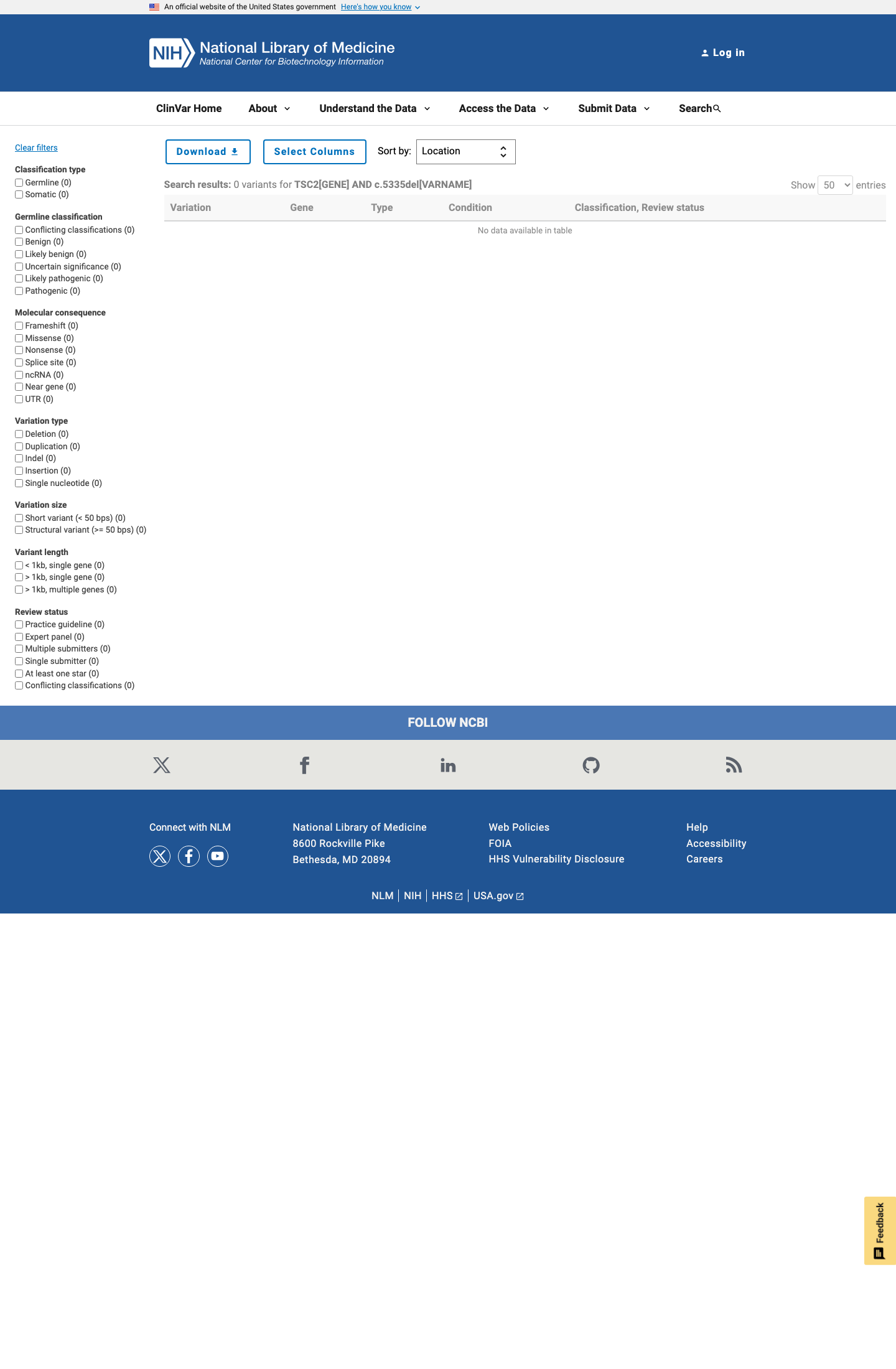
ClinVar screenshot
ClinVar
This variant is absent from ClinVar.
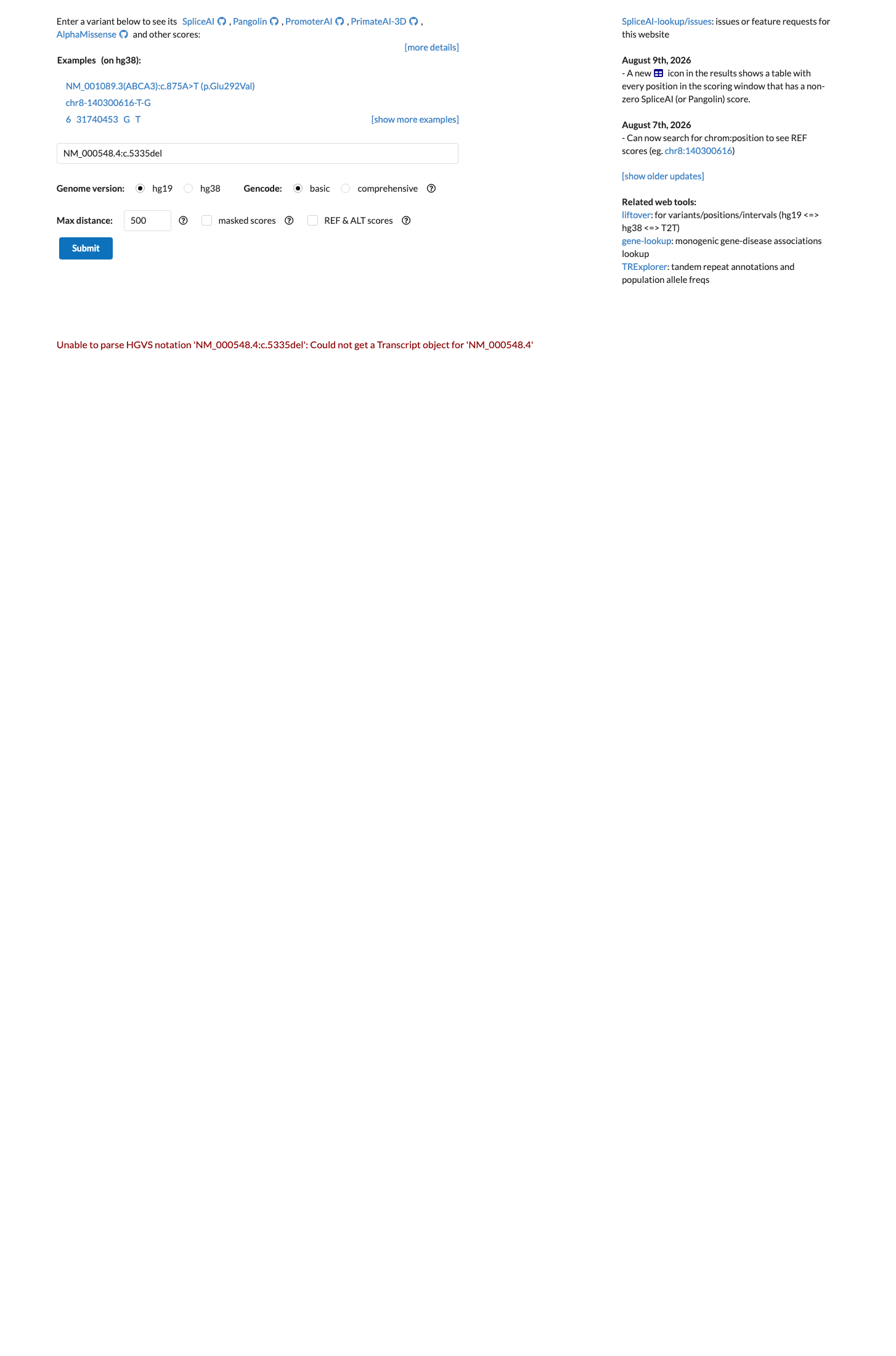
SpliceAI screenshot
In silico
SpliceAI predicts no significant splice impact for this variant (max delta score = 0.00).
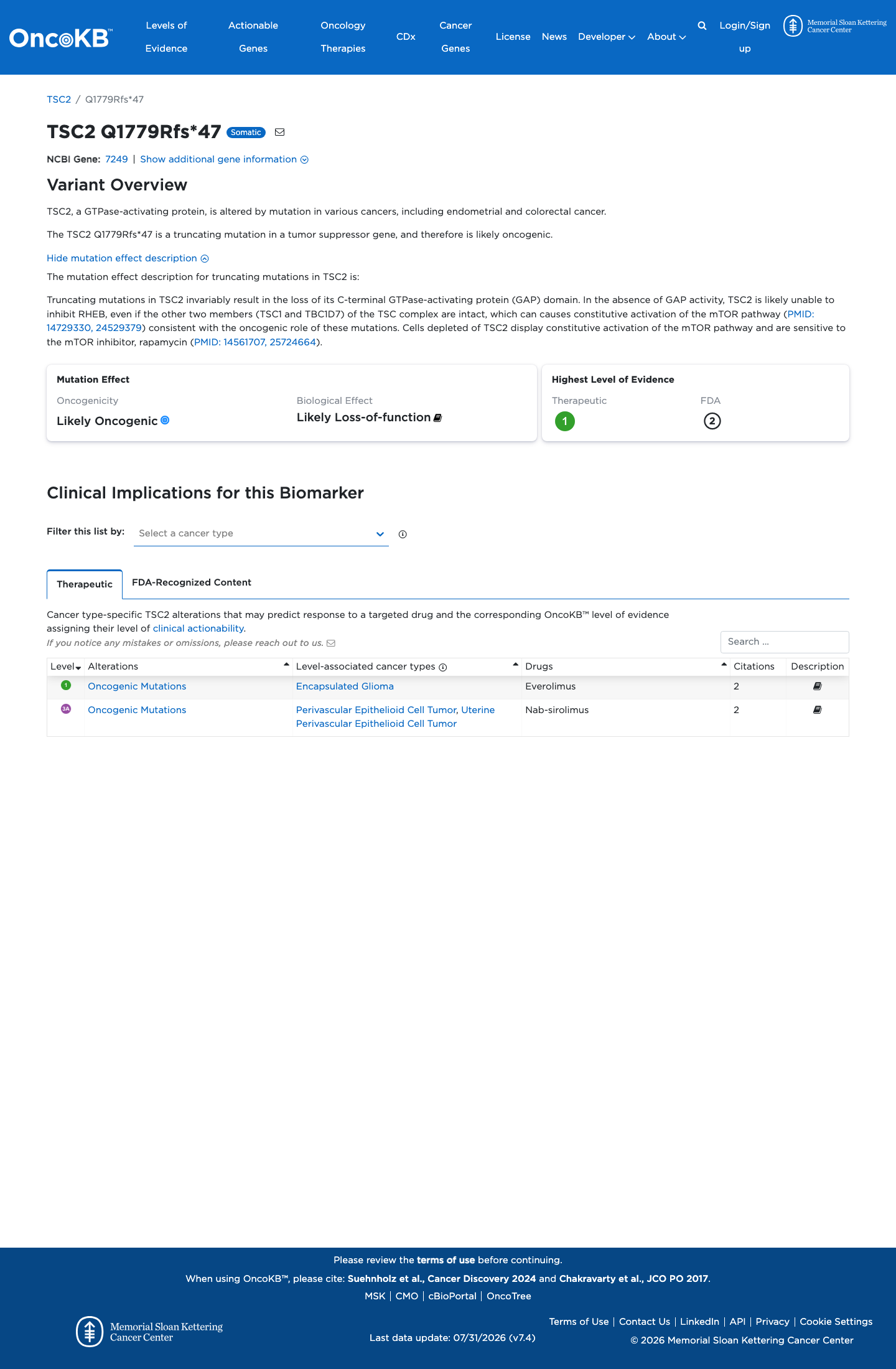
Functional / OncoKB screenshot
Functional Likely Oncogenic
OncoKB identified variant-specific curated literature and context relevant to functional review; biological-effect context: Likely Loss-of-function; curated oncogenicity label: Likely Oncogenic.
OncoKB ↗
COSMIC screenshot
COSMIC
Cancer hotspots screenshot
Cancer hotspots
Somatic evidence Not in COSMIC / hotspots
COSMIC
This variant does not lie in a statistically significant hotspot. This variant has not previously been reported in somatic cancers (COSMIC).
Hotspots
This variant does not lie in a statistically significant hotspot.
Sources & reference links
8Sources
ClinVar
gnomAD v2.1
gnomAD v4.1
gnomAD-Canada
SpliceAI
OncoKB
COSMIC
Cancer hotspots
Triaged references · 4 PMIDs not cited in assessment
14561707 ↗ Loss of Tsc1/Tsc2 activates mTOR and disrupts PI3K-Akt signaling through downregulation of PDGFR. ONCOKB
14729330 ↗ TSC2: filling the GAP in the mTOR signaling pathway. ONCOKB
24529379 ↗ Spatial control of the TSC complex integrates insulin and nutrient regulation of mTORC1 at the lysosome. ONCOKB
25724664 ↗ Loss of Tuberous Sclerosis Complex 2 (TSC2) Is Frequent in Hepatocellular Carcinoma and Predicts Response to mTORC1 Inhibitor Everolimus. ONCOKB