NM_001015877.1:c.834+53_834+58delAATTTA is an intronic deletion in PHF6 located 53 bases into intron 8, beyond the conserved splice consensus region.1 SpliceAI predicts no significant splice impact (max delta score 0.01), consistent with a benign interpretation (BP4).2 This variant is present in gnomAD v2.1 at low frequency (0.0101%, 18/178,302 alleles) and in gnomAD v4.1 (0.0021%, 25/1,205,804 alleles), below the 0.1% PM2 threshold.3 ClinVar classifies this variant as Benign (Ambry Genetics, criteria provided) and Likely benign (PreventionGenetics), supporting a benign interpretation (BP6).4 The intronic deletion at +53 position is well outside the conserved splice donor/acceptor consensus, and SpliceAI confirms no predicted splice effect (BP7).5 With three supporting benign criteria (BP4, BP6, BP7) met, exceeding the two supporting benign criteria threshold for Likely Benign under generic ACMG/AMP 2015 combination rules, the variant is classified as Likely Benign.6
Final classification
Likely Benign
PM2BP4BP6BP7
PHF6
c.834+53_834+58del
p.?
This variant
NM_001015877.1:c.834+53_834+58delAATTTA is an intronic deletion in PHF6 located 53 bases into intron 8, beyond the conserved splice consensus region.
gene-specific framework lacked a usable explicit final combination framework, so generic ACMG/AMP 2015 final-combination rules were applied as fallback; applied criteria: PM2 supporting, BP4 supporting benign, BP6 supporting benign, BP7 supporting benign; combination = 1 supporting + 3 supporting benign, which maps to Likely Benign.
Classification rationale
PM2
BP4BP6BP7
Likely Benign
PHF6 c.834+53_834+58del
PM2 + BP4 + BP6 + BP7
→
Likely Benign
6
generic_acmg_combination_rules
LYFE Sciences is an AI system, and it can make mistakes. Criteria
may be applied incorrectly, sources may be misread, and a confident-looking
classification can still be wrong. Double-check every criterion and
its underlying evidence before relying on any call.
Gene diagram
· NM_001015877.1 · variants mapped to exon structure
PHF6
NM_001015877.1
Fetching transcript structure from UCSC…
Applied criteria · 4 applied · 11 assessed
MetEvidence satisfies this criterion.
Not metEvaluated against available evidence; threshold not reached.
Not assessedApplies in principle, but no evidence was found to evaluate it.
N/ADoesn't apply to this variant type.
Applied · 4
Strength
Supporting
Moderate
Strong
Very strong
PM2
supporting
Pathogenic
This variant is present in gnomAD v2.1 at very low frequency (AF=0.0101%, 18/178,302 alleles, 0 homozygotes) and in gnomAD v4.1 at 0.0021% (25/1,205,804 alleles). Both frequencies fall below the 0.1% PM2 threshold, and the variant is absent from gnomAD-Canada. However, as a deep intronic variant with no confirmed functional consequence, the weight is limited to supporting level.
gnomAD v2.1 AF=0.0101% (18/178302)gnomAD v4.1 AF=0.0021% (25/1
BP4
supporting
Benign
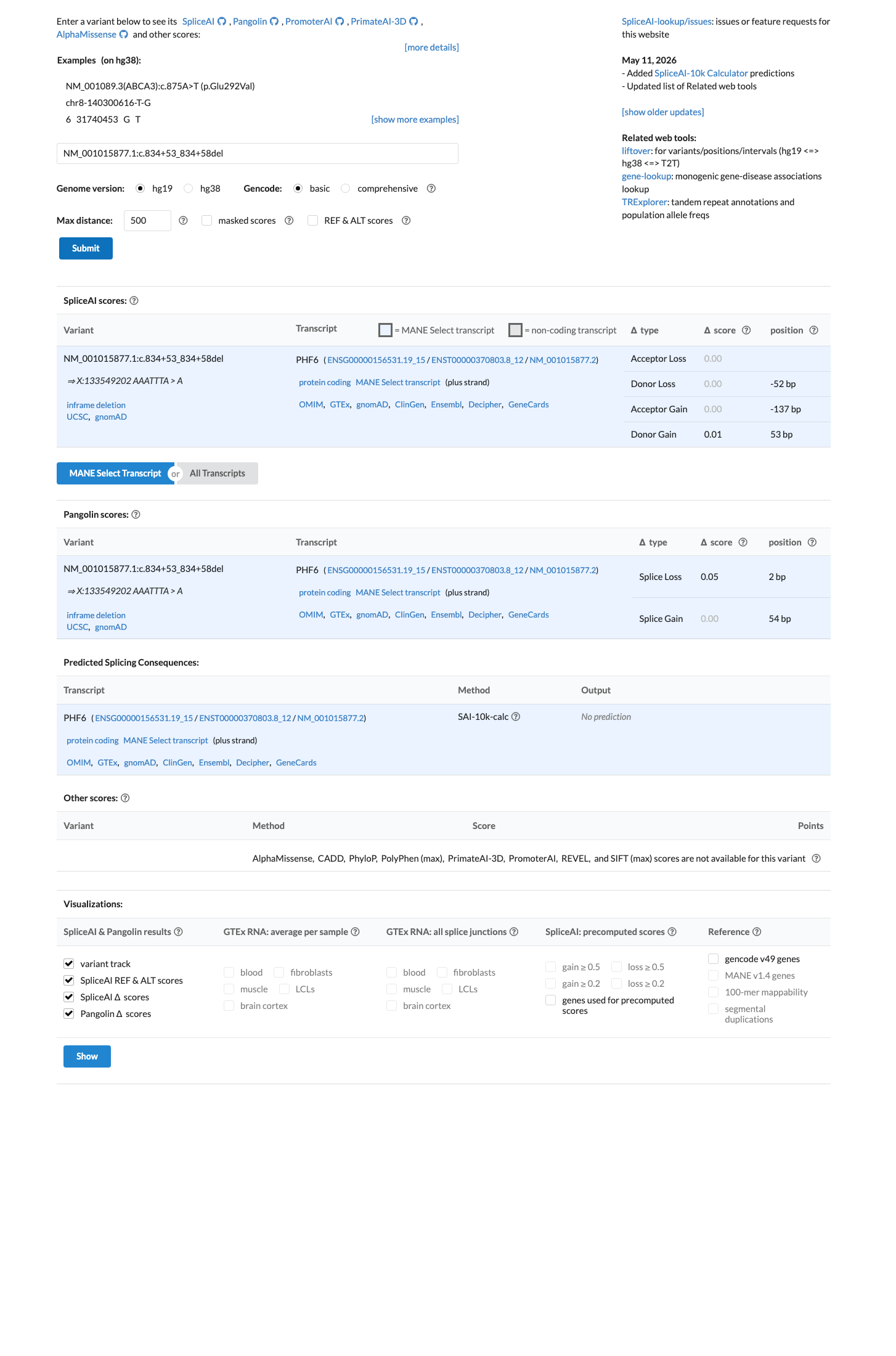
SpliceAI predicts no significant splice impact for this intronic deletion (max delta score = 0.01). Multiple in silico tools agree that this deep intronic variant is unlikely to alter splicing, supporting a benign interpretation. REVEL and BayesDel are not applicable as this is not a single nucleotide variant.
SpliceAI max delta = 0.01 (no predicted donor/acceptor gain or loss)SpliceAI Lookup confirms no significant splice impact
BP6
supporting
Benign
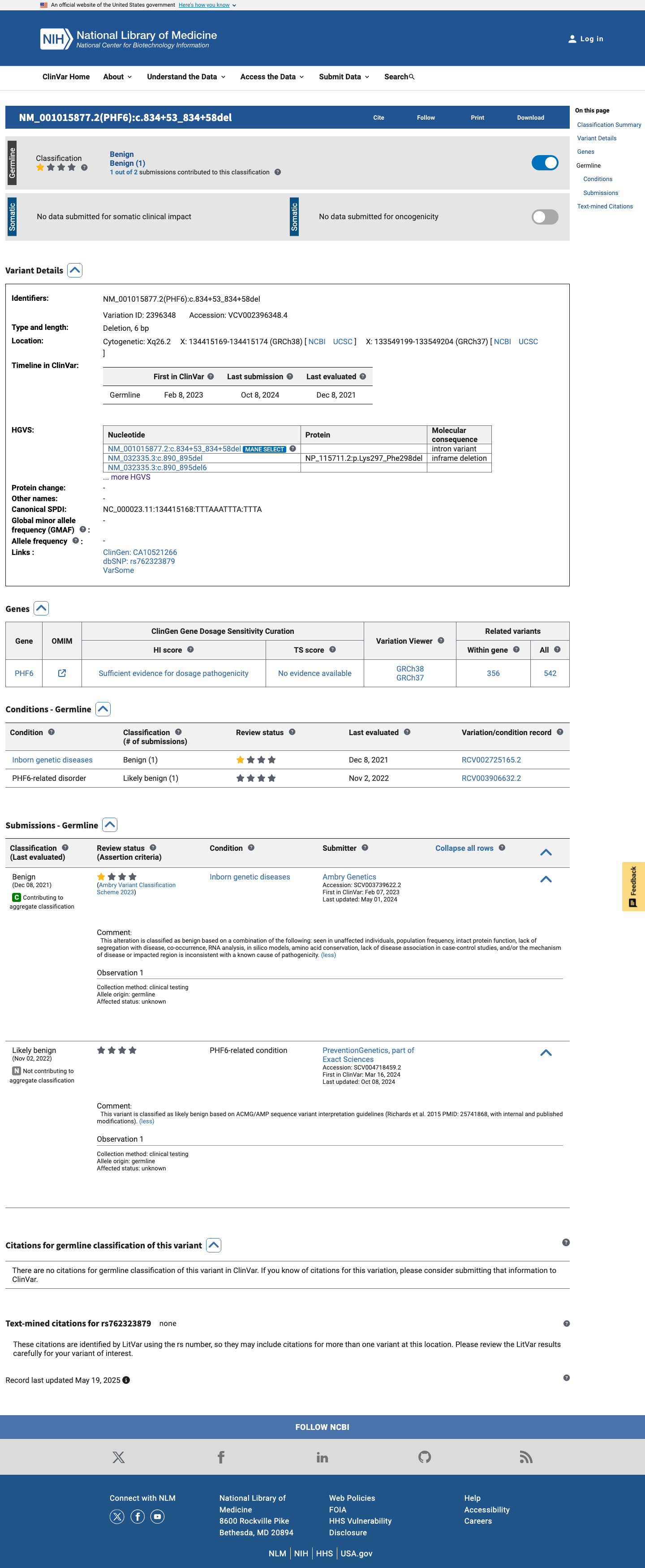
This variant has been reported in ClinVar as Benign by Ambry Genetics (criteria provided, single submitter) and as Likely benign by PreventionGenetics (Variation ID 2396348). Multiple clinical laboratories have independently classified this variant as benign or likely benign.
ClinVar variation 2396348: Benign (Ambry Geneticscriteria providedSCV003739622)
BP7
supporting
Benign
This variant is an intronic deletion at position +53 of intron 8, well beyond the conserved splice donor/acceptor consensus (±1,2). SpliceAI confirms no predicted splice impact (max delta = 0.01). Deep intronic variants at this distance from the splice junction, without predicted splice effects, are consistent with a benign interpretation.
Intronic deletion at +53 position in intron 8SpliceAI delta = 0.01 confirms no splice impact predictedVariant is outside conserved splice consensus region
Assessed · not applied
· 5 not met · 6 not assessed
Pathogenic
PS3
No functional studies have been identified that assess the biological effect of this intronic deletion.
PS4
No case-control or patient phenotype enrichment data are available for this variant.
PP1
No segregation data are available for this variant.
PP3
SpliceAI predicts no significant splice impact for this intronic deletion (max delta score = 0.01).
PP4
No patient phenotype data are available to assess specificity for a PHF6-associated disorder.
PP5
ClinVar classifies this variant as Benign and Likely benign from clinical laboratory submissions.
Benign
BA1
The highest population frequency in gnomAD v2.1 is 0.068% (Admixed American, 18/26,371 alleles) and in gnomAD v4.1 is 0.051% (Admixed American, 23/45,214 alleles).
BS1
The highest population frequency in gnomAD v2.1 is 0.068% (Admixed American) and in gnomAD v4.1 is 0.051% (Admixed American).
BS2
No specific data on observation of this variant in healthy adults are available beyond population database frequencies.
BS3
No functional assays have been identified that demonstrate no deleterious effect of this intronic deletion.
BS4
No segregation data are available to evaluate lack of cosegregation with disease.
N/A · 13
PVS1 · PS1 · PS2 · PM1 · PM3 · PM4 · PM5 · PM6 · PP2 · BP1 · BP2 · BP3 · BP5
Research & evidence
Population frequency · supports benign

gnomAD v4.1
gnomAD v2.1
v4.1
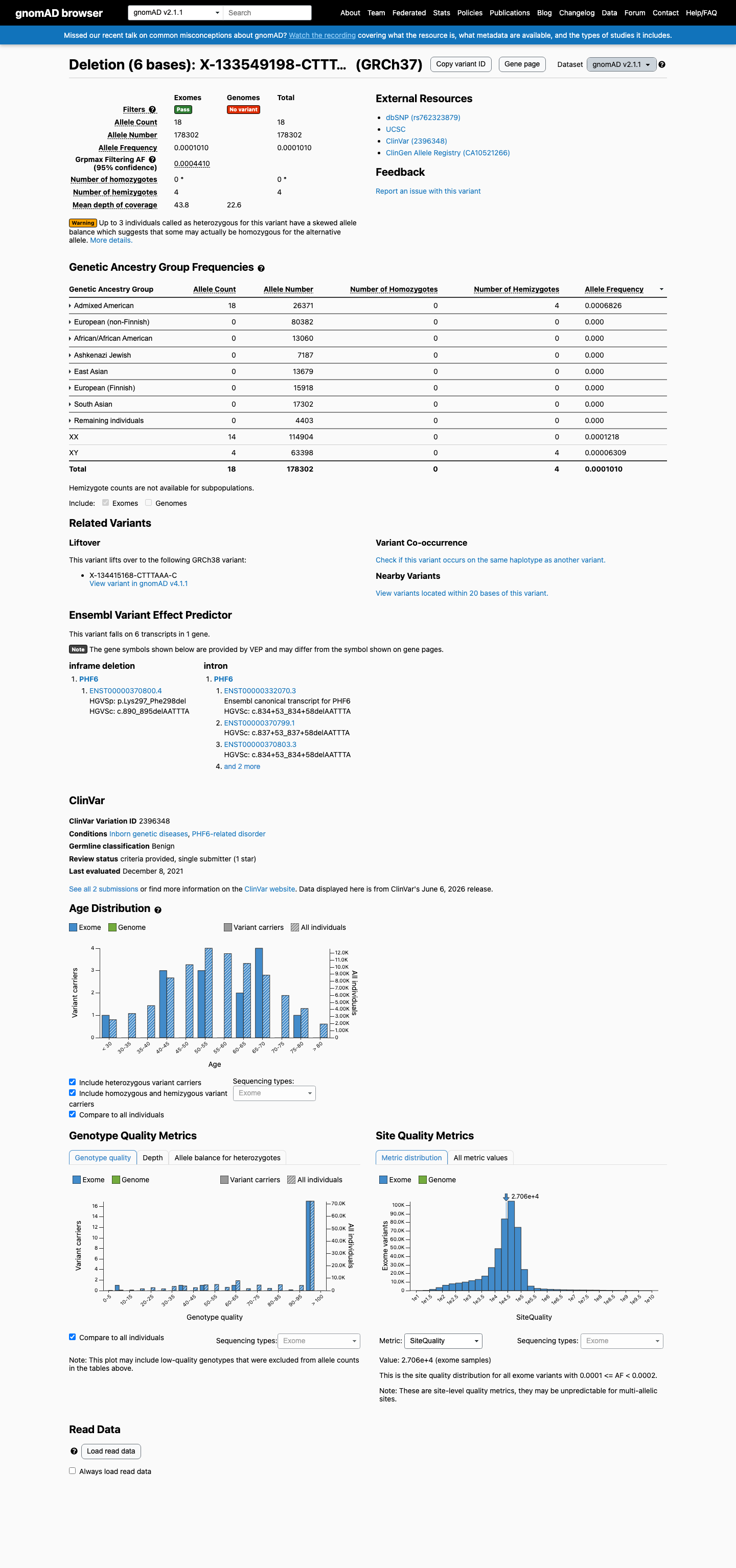
This variant is present in gnomAD v4.1 (AF= 2.07331e-05; MAF= 0.00207%, 25/1205804 alleles, homozygotes = 0) and has highest observed frequency in the Admixed American population (AF= 0.000508692; MAF= 0.05087%, 23/45214 alleles, homozygotes = 0); grpmax FAF= 0.00034725.
v2.1
This variant is present in gnomAD v2.1 (AF= 0.000100952; MAF= 0.01010%, 18/178302 alleles, homozygotes = 0) and has highest observed frequency in the Admixed American population (AF= 0.000682568; MAF= 0.06826%, 18/26371 alleles, homozygotes = 0); grpmax FAF= 0.00044099.
🇨🇦 CA
Absent from gnomAD-Canada v1.0.
Allele frequency by ancestry
three datasets · side by side
gnomAD v4.1
0.0021%
· 25 / 1,205,804
0 hom · FAF 0.035%
0 hom · FAF 0.035%
Admixed American 23 / 45,214 |
0.051% |
African/African American 1 / 57,160 |
0.0017% |
European (non-Finnish) 1 / 893,105 |
0.00011% |
+ 7 not observed (Remaining individuals, European (Finnish), Amish, East Asian, Middle Eastern, South Asian, Ashkenazi Jewish)
gnomAD v2.1
0.01%
· 18 / 178,302
0 hom · FAF 0.044%
0 hom · FAF 0.044%
Admixed American 18 / 26,371 |
0.068% |
+ 7 not observed (African/African American, Ashkenazi Jewish, East Asian, European (Finnish), European (non-Finnish), Remaining individuals, South Asian)
gnomAD Canada 🇨🇦
Absent
· 0 / ?
0 hom
0 hom
Not observed in any ancestry group.
ClinVar
This variant has been reported in ClinVar as Benign (1 clinical laboratory) and as Likely benign (1 clinical laboratory). (ClinVarID = 2396348)
In silico
SpliceAI predicts no significant splice impact for this variant (max delta score = 0.01).
Functional
No data
No calibrated functional assay or RNA evidence was identified for this variant.

COSMIC
Somatic evidence
COSMIC
This variant has not previously been reported in somatic cancers (COSMIC).
Hotspots
This variant does not lie in a statistically significant cancer hotspot.
Sources & reference links
Triaged references · 5 PMIDs not cited in assessment
23169492 ↗
The perspective from EASAC and FEAM on direct-to-consumer genetic testing for health-related purposes.
CLINVAR
23037933 ↗
Including the initial newborn screening bloodspot collection device serial number on birth certificates: basis and recommendations from the Secretary of Health and Human Services' Advisory Committee on Heritable Disorders in Newborns and Children.
CLINVAR
24022298 ↗
Offering prenatal diagnostic tests: European guidelines for clinical practice [corrected].
CLINVAR
24394680 ↗
Parental permission for pilot newborn screening research: guidelines from the NBSTRN.
CLINVAR
31022120 ↗
ACOG Committee Opinion No. 778 Summary: Newborn Screening and the Role of the Obstetrician-Gynecologist.
CLINVAR