Analysis in progress
Initialising…
0%
complete
This report is still being assembled — sections appear as each stage finishes. It isn't final yet.
PHF6
Final classification
VUS
PM2BP4
PHF6
c.859G>C
p.Gly287Arg
missense · exon 9

PHF6 is a chromatin-binding protein with two PHD-type zinc finger domains that acts as an epigenetic reader, helping regulate gene transcription, including during blood cell development, and is also involved in ribosomal RNA synthesis and cell cycle control. Germline mutations in PHF6 cause Borjeson-Forssman-Lehmann syndrome, a developmental disorder marked by intellectual disability, epilepsy, hypogonadism, obesity, and distinctive facial features. Somatic PHF6 mutations are found in blood cancers such as acute myeloid leukemia and T-cell acute lymphoblastic leukemia, where loss of the protein is associated with poorer outcomes, indicating that PHF6 acts as a tumor suppressor.

This variant

PHF6 is a tumor suppressor whose germline mutations cause Borjeson-Forssman-Lehmann syndrome and whose somatic mutations are found in leukemias. This missense variant (p.Gly287Arg) is a VUS: absent from population databases but lacking functional or clinical evidence, so its role in PHF6-related disease remains undetermined.

Transcript
NM_001015877.1
HGVS · transcript:coding
NM_001015877.1:c.859G>C
GRCh38
chrX:134417193 G>C
GRCh37
chrX:133551223 G>C
Basis VUS: only PM2 (Supporting) and BP4 (Supporting) were met, satisfying no ACMG/AMP combination rule.
VUS: only PM2 (Supporting) and BP4 (Supporting) were met, satisfying no ACMG/AMP combination rule.
Classification rationale
PM2 BP4 VUS
PHF6 c.859G>C missense · exon 9

PM2 (Supporting): absent from gnomAD v2.1, v4.1, and gnomAD-Canada. BP4 (Supporting): SpliceAI predicts negligible splice impact (max delta 0.002, below the 0.2 threshold). VUS: one supporting pathogenic and one supporting benign criterion satisfy no ACMG/AMP combination rule.

PM2 + BP4 VUS
Gene diagram · NM_001015877.1 · variants mapped to exon structure
PHF6 NM_001015877.1
Fetching transcript structure from UCSC…
Applied criteria · 2 applied · 22 assessed
MetEvidence satisfies this criterion.
Not metEvaluated against available evidence; threshold not reached.
Not assessedApplies in principle, but no evidence was found to evaluate it.
N/ADoesn't apply to this variant type.
Applied · 2
Strength Supporting Moderate Strong Very strong
PM2 supporting review Pathogenic
Met (Supporting): absent from gnomAD v2.1, v4.1, and gnomAD-Canada, supporting rarity for a rare disorder.
The consolidated evidence reports NM_001015877.1:c.859G>C as absent from gnomAD v2.1.The consolidated evidence reports NM_001015877.1:c.859G>C as absent from gnomAD v4.1.The consolidated evidence reports the variant as absent from gnomAD-Canada v1.0, with AC=0 and AF=0.0; the accompanying AN=0 is a data-quality limitation.
BP4 supporting Benign
Met (Supporting): SpliceAI predicts negligible splice impact (max delta 0.002, well below the 0.2 threshold).
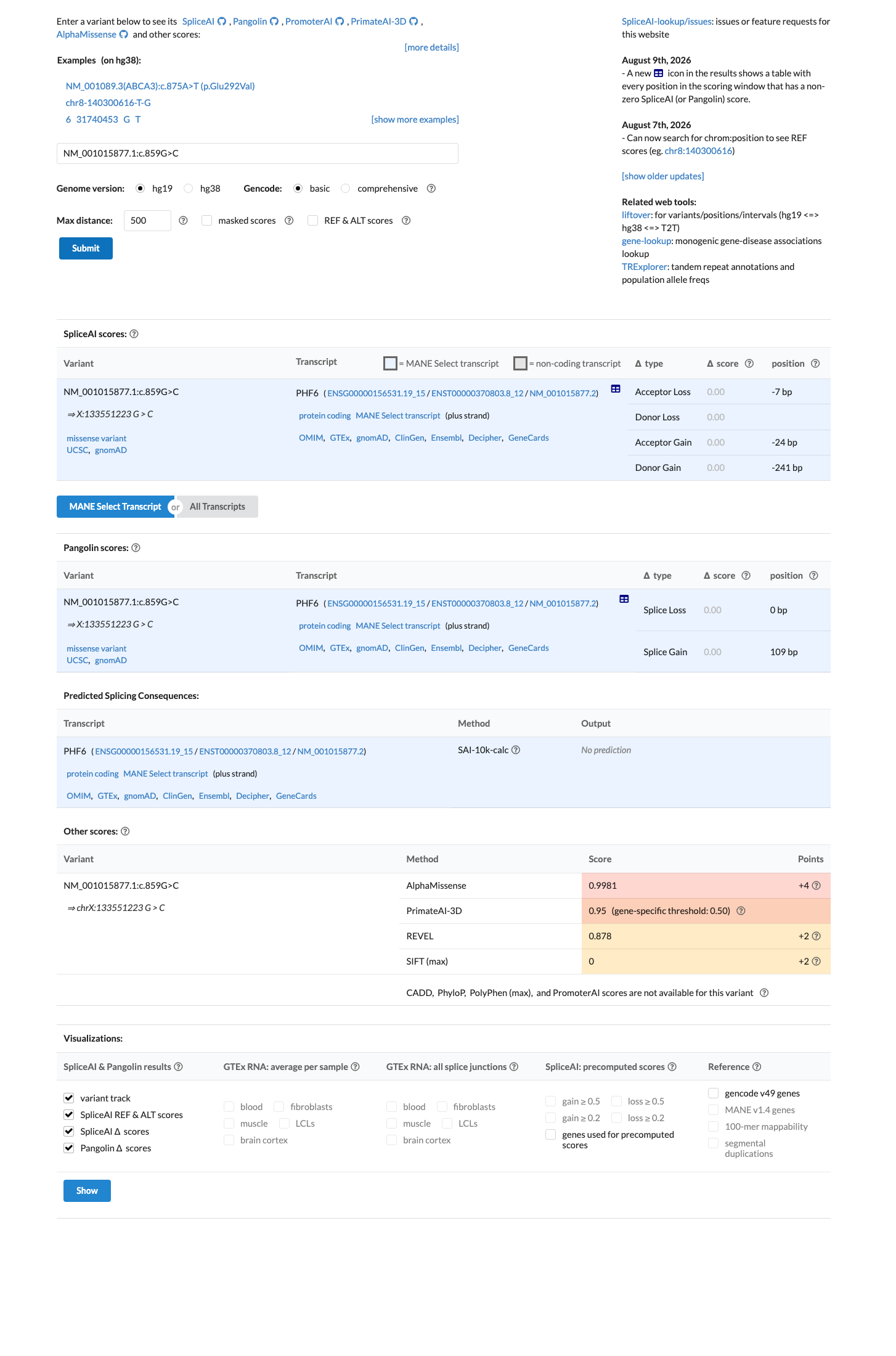
SpliceAI Lookup (spliceai source) reports max delta score 0.002 (DS_AG 0.0, DS_AL 0.001, DS_DG 0.002, DS_DL 0.0) for NM_001015877.1:c.859G>C, far below the ~0.2 delta-score threshold established as a splice-altering cutoff in the original SpliceAI publication (Jaganathan et al. 2019, PMID 30661751), supporting no predicted splicing impact.BayesDel score of 0.545598 was retrieved from the local predictor but is excluded from BP4 scoring because no verified published threshold/table is currently citable for BayesDel by this pipeline.REVEL prefetch failed ('No REVEL ZIP found for chrX:134417193'), so no missense REVEL-based evidence contributes to BP4.
Assessed · not applied · 5 not met · 17 not assessed
Pathogenic
PS1 Not assessed: no variant producing the identical p.Gly287Arg change with an established pathogenic classification was available.
PS2 Not assessed: no de novo observation with parental testing confirming absence in both parents was documented.
PS3 Not assessed: no functional assay evidence (e.g., transactivation, chromatin binding) for p.Gly287Arg was available.
PS4 Not assessed: no case-control cohort or affected-case counts for this variant were available.
PM1 Not assessed: residue 287 is not documented as a mutational hotspot or critical functional domain.
PM3 Not assessed: no evidence the variant occurs in trans with a pathogenic allele in an affected individual.
PM5 Not assessed: no pathogenic missense variant at codon 287 with a different amino acid was available.
PM6 Not assessed: no presumed de novo observation in a proband was documented.
PP1 Not assessed: no familial cosegregation or pedigree data was available.
PP2 Not assessed: no PHF6 missense constraint data (e.g., gnomAD Z-score) was available to assess benign missense rate.
PP3 Not met: no calibrated missense predictor evidence supported damage (REVEL unavailable), and SpliceAI predicted negligible splice disruption (max delta 0.002).
PP4 Not assessed: the patient's phenotype was not provided.
PP5 Not met: the variant is absent from ClinVar, with no expert-panel pathogenic classification available.
Benign
BA1 Not met: absent from gnomAD, so no population frequency at or above the BA1 threshold is demonstrated.
BS1 Not met: absent from gnomAD, so no elevated population frequency above the benign threshold is demonstrated.
BS2 Not assessed: no unaffected adult carriers or homozygotes were documented.
BS3 Not assessed: no functional assay evidence of normal protein activity for p.Gly287Arg was available.
BS4 Not assessed: no unaffected relatives carrying the variant were documented.
BP1 Not assessed: insufficient data on PHF6's benign missense rate to determine whether missense is a common disease mechanism.
BP2 Not assessed: no in-trans or in-cis observations with phase or inheritance information were available.
BP5 Not assessed: no alternate molecular diagnosis evidence was provided.
BP6 Not met: the variant is absent from ClinVar, with no expert-panel benign classification available.
N/A · 4 PVS1 · PM4 · BP3 · BP7
Research & evidence
Population frequency
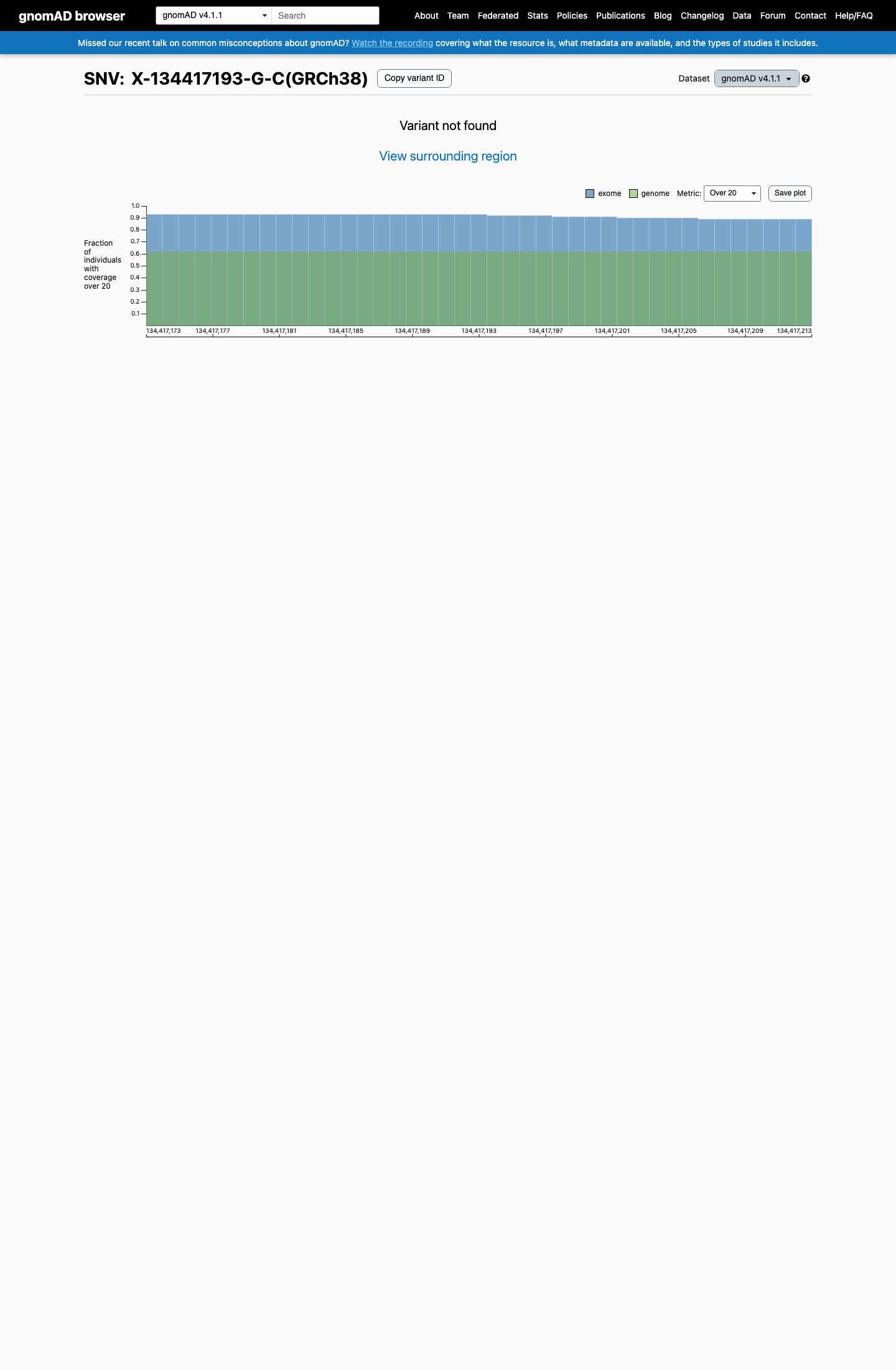
gnomAD v4.1 screenshot
gnomAD v4.1
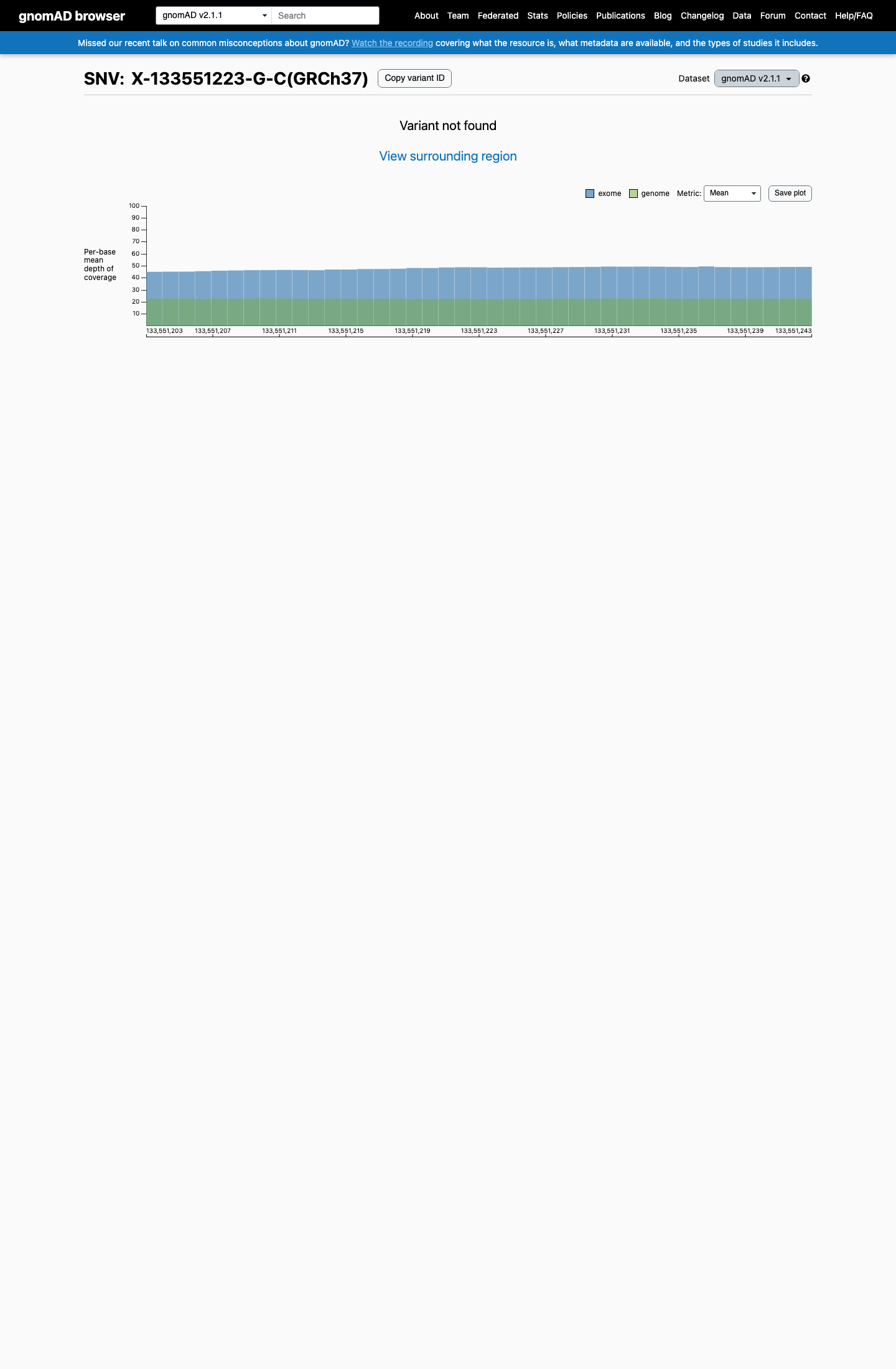
gnomAD v2.1 screenshot
gnomAD v2.1
v4.1
Absent from gnomAD v4.1.
v2.1
Absent from gnomAD v2.1.
🇨🇦 CA
Absent from gnomAD-Canada v1.0.
Allele frequency by ancestry
three datasets · side by side
gnomAD v4.1
Absent · 0 / ?
0 hom
Not observed in any ancestry group.
gnomAD v2.1
Absent · 0 / ?
0 hom
Not observed in any ancestry group.
gnomAD Canada 🇨🇦
Absent · 0 / ?
0 hom
Not observed in any ancestry group.
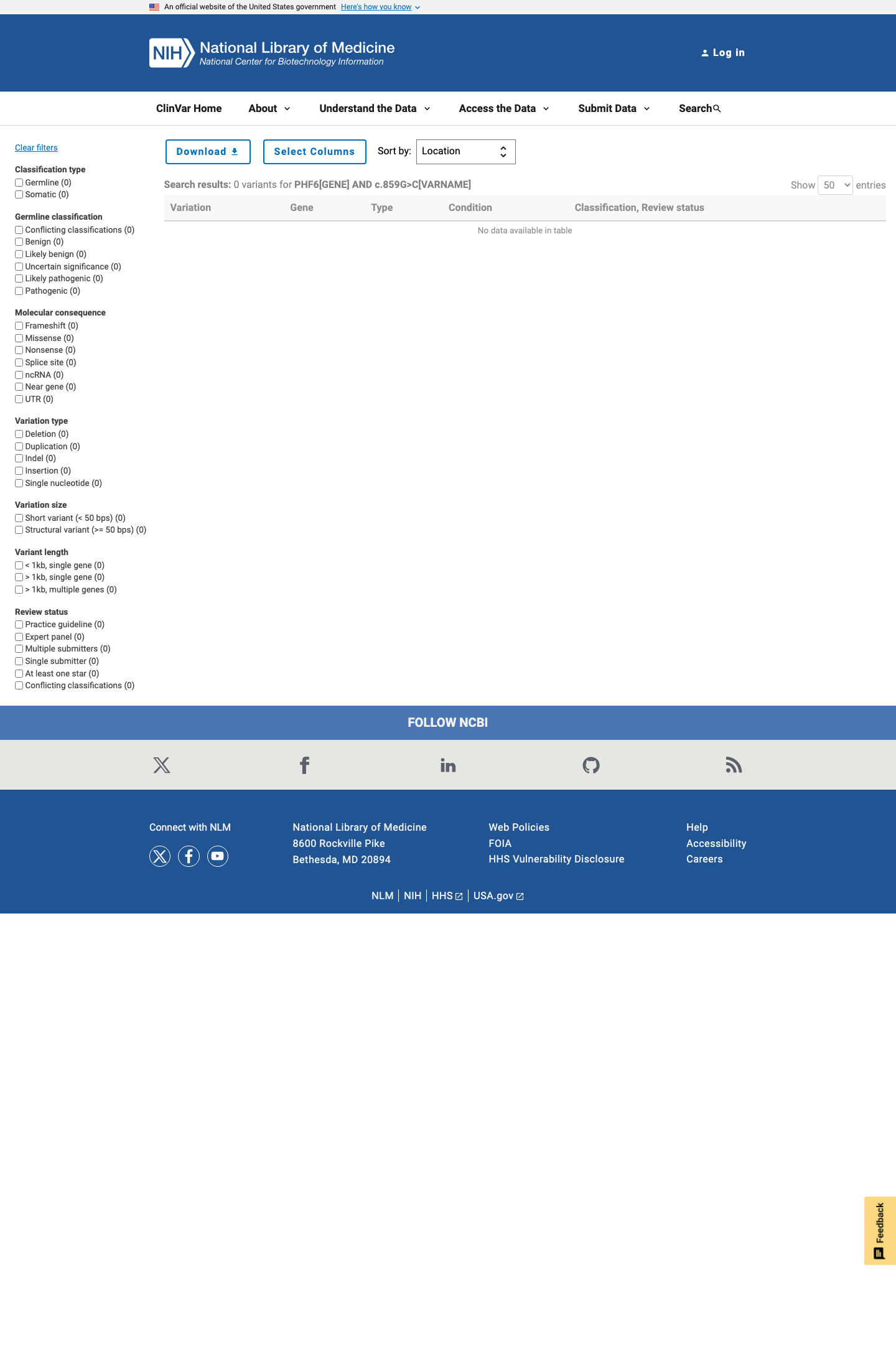
ClinVar screenshot
ClinVar
This variant is absent from ClinVar.
SpliceAI screenshot
In silico
SpliceAI predicts no significant splice impact for this variant (max delta score = 0.00). BayesDel score = 0.545598.
Functional / OncoKB screenshot
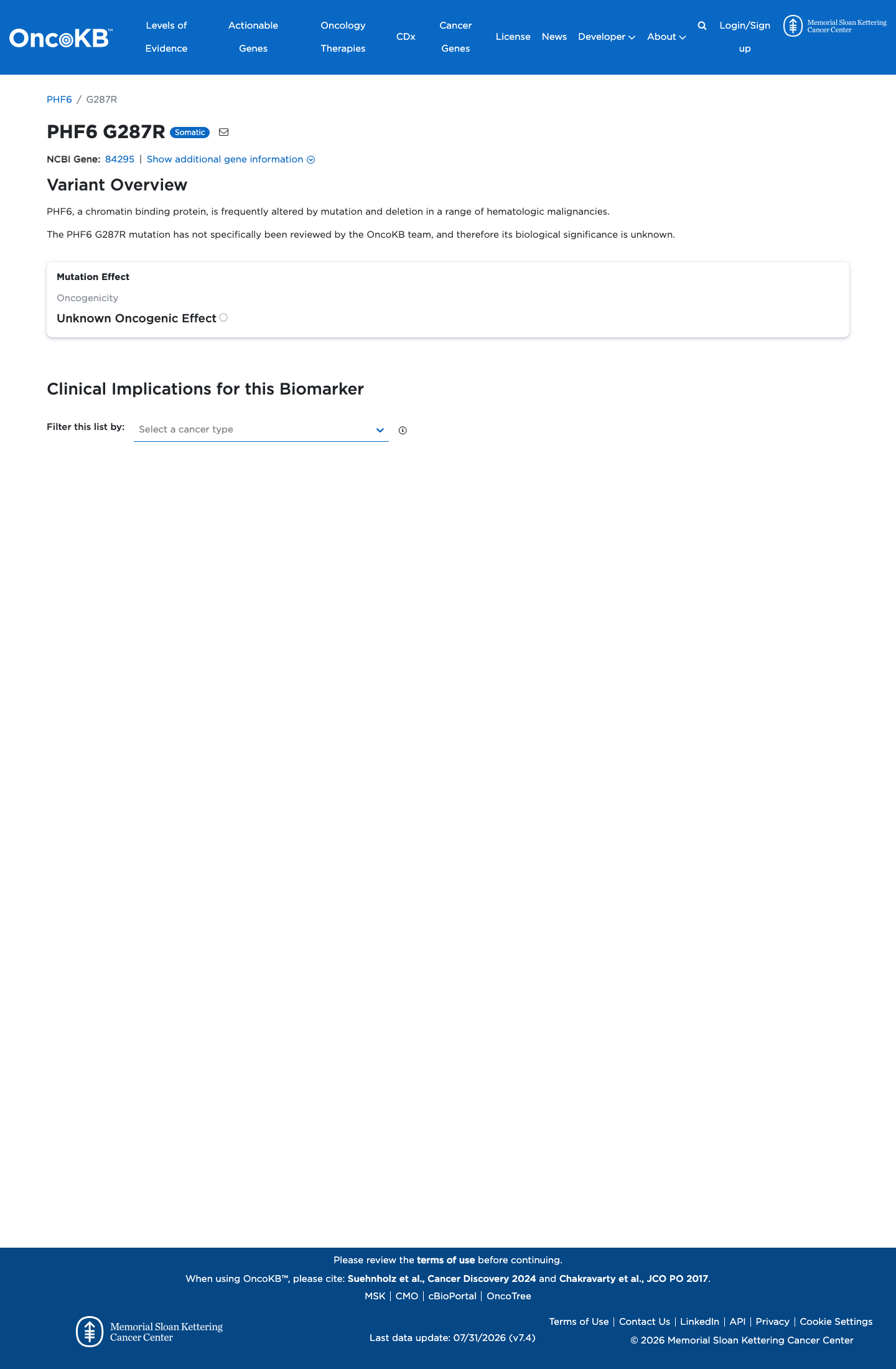
Functional Unknown Oncogenic Effect
OncoKB did not identify variant-specific reviewed functional evidence for this variant; gene-level curated context is available for reviewer follow-up. PHF6, a chromatin binding protein, is frequently altered by mutation and deletion in a range of hematologic malignancies.
OncoKB ↗
COSMIC screenshot
COSMIC
Cancer hotspots screenshot
Cancer hotspots
Somatic evidence Not in COSMIC / hotspots
COSMIC
This variant does not lie in a statistically significant hotspot. This variant has not previously been reported in somatic cancers (COSMIC).
Hotspots
This variant does not lie in a statistically significant hotspot.
Sources & reference links
8Sources
ClinVar
gnomAD v2.1
gnomAD v4.1
gnomAD-Canada
SpliceAI
OncoKB
COSMIC
Cancer hotspots