Back
NM_001015877.1:c.903delinsGTTTCCT
p.Tyr301Ter · PHF6
ACMG/AMP
0%
complete
Final classification
Likely Pathogenic
PVS1PM2
PHF6
c.903delinsGTTTCCT
p.Tyr301Ter
nonsense · exon 9

PHF6 is a chromatin-binding protein with two PHD-type zinc finger domains that acts as an epigenetic reader, helping regulate gene transcription, including during blood cell development, and is also involved in ribosomal RNA synthesis and cell cycle control. Germline mutations in PHF6 cause Borjeson-Forssman-Lehmann syndrome, a developmental disorder marked by intellectual disability, epilepsy, hypogonadism, obesity, and distinctive facial features. Somatic PHF6 mutations are found in blood cancers such as acute myeloid leukemia and T-cell acute lymphoblastic leukemia, where loss of the protein is associated with poorer outcomes, indicating that PHF6 acts as a tumor suppressor.

This variant

This truncating PHF6 variant is relevant to the gene's established loss-of-function mechanism in X-linked Borjeson-Forssman-Lehmann syndrome.

Transcript
NM_001015877.1
HGVS · transcript:coding
NM_001015877.1:c.903delinsGTTTCCT
GRCh38
chrX:134417237 C>GTTTCCT
GRCh37
chrX:133551267 C>GTTTCCT
Likely Pathogenic: PVS1 (very strong) plus PM2 (supporting) satisfy the generic ACMG/AMP fallback combination rule.
Classification rationale
PVS1PM2 Likely Pathogenic
PHF6 c.903delinsGTTTCCT nonsense · exon 9

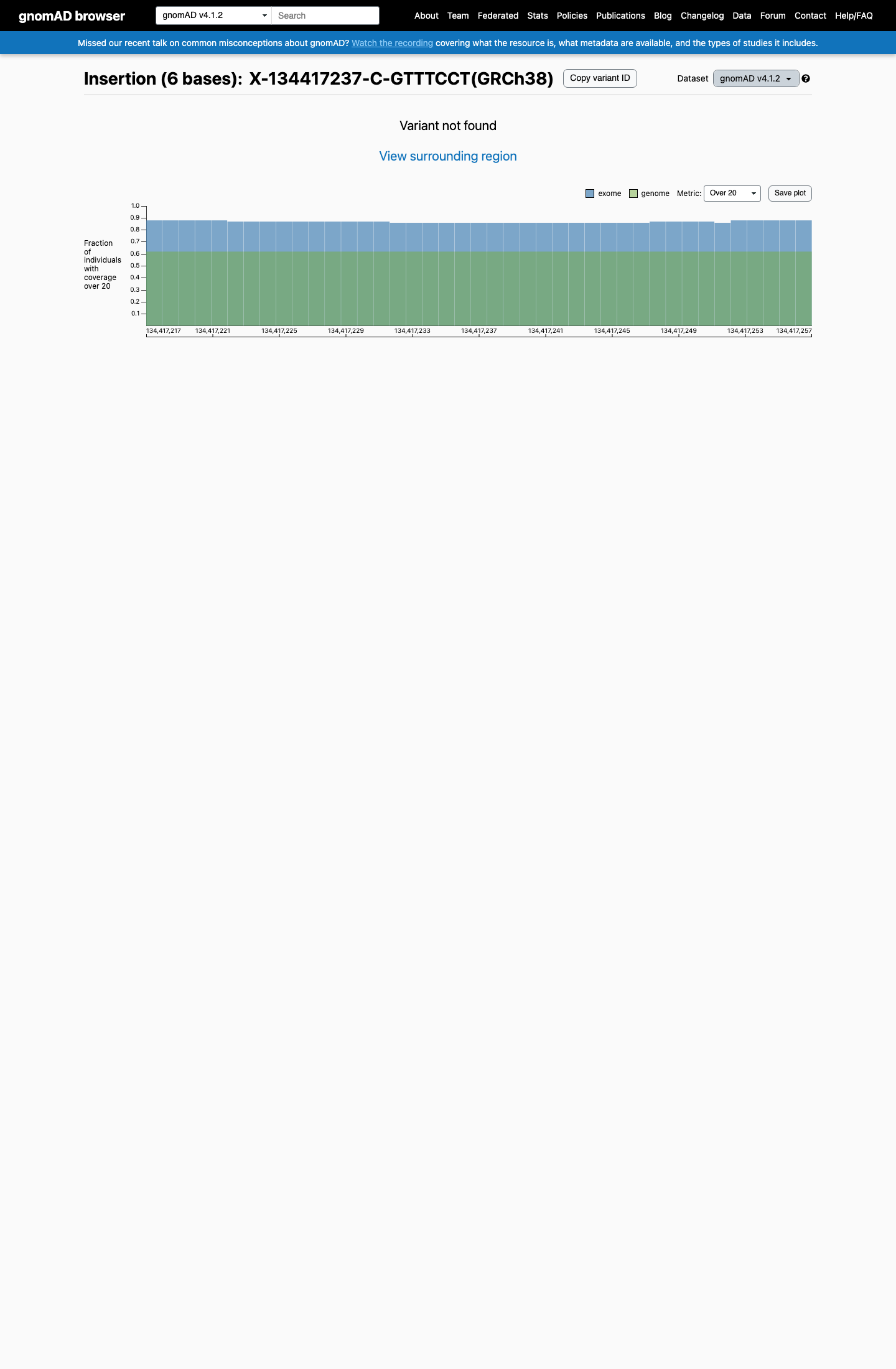
PVS1 very strong: p.(Tyr301Ter) is predicted to undergo nonsense-mediated decay in PHF6. PM2 supporting: the variant is absent from gnomAD v2.1 and v4.1.

PVS1 + PM2 → Likely Pathogenic
LYFE Sciences is an AI system, and it can make mistakes. Criteria may be applied incorrectly, sources may be misread, and a confident-looking classification can still be wrong. Double-check every criterion and its underlying evidence before relying on any call.
Gene diagram · NM_001015877.1 · variants mapped to exon structure
PHF6 NM_001015877.1
Fetching transcript structure from UCSC…
Applied criteria · 2 applied · 16 assessed
MetEvidence satisfies this criterion.
Not metEvaluated against available evidence; threshold not reached.
Not assessedApplies in principle, but no evidence was found to evaluate it.
N/ADoesn't apply to this variant type.
Applied · 2
Strength Supporting Moderate Strong Very strong
PVS1 very strong Pathogenic
Met at very strong: p.(Tyr301Ter) lies 66 coding nucleotides before the final exon junction, supporting NMD in PHF6 under the generic SVI framework.
VariantValidator confirms NM_001015877.1:c.903delinsGTTTCCT as a nonsense variant producing NP_001015877.1:p.(Tyr301Ter) in PHF6 and places it in exon 9.The transcript structure in the case evidence places exon 9 at coding positions c.835-c.968 and exon 10 at c.969-c.1098; the premature termination at c.903 is therefore approximately 66 coding nucleotides upstream of the final exon junction, supporting NMD rather than the last-exon escape exception.The normalized protein consequence predicts a 301-amino-acid product versus the 366-amino-acid reference protein, a loss of approximately 65 C-terminal residues.
PM2 supporting Pathogenic
Met at supporting strength: the variant is absent from gnomAD v2.1 and v4.1, corresponding to allele frequency 0 versus the PM2 threshold of <=0.0001.
gnomAD v2.1 and gnomAD v4.1 both report the variant as absent, giving an observed allele frequency of 0 in each queried dataset.The supplied ClinGen SVI recommendation uses PM2 at supporting strength for allele frequency <=0.0001 (PMID:25741868); no PHF6-specific VCEP framework was available.
Assessed · not applied · 5 not met · 11 not assessed
Pathogenic
PS2 Not assessed: no parental testing or confirmed de novo observation is documented for PHF6 c.903delinsGTTTCCT.
PS3 Not assessed: no validated functional assay directly tested PHF6 c.903delinsGTTTCCT or p.(Tyr301Ter).
PS4 Not assessed: no exact-variant affected-case/control counts or enrichment statistic are available for PS4.
PM3 Not assessed: no affected-proband, second-allele, or phase observation establishes the allelic configuration required for PM3 in this X-linked PHF6 case.
PM6 Not assessed: no unconfirmed de novo observation or parental-testing result is documented for PHF6 c.903delinsGTTTCCT.
PP1 Not assessed: no current-variant relatives, informative meioses, or phenotype-segregation data are documented for PHF6 c.903delinsGTTTCCT.
PP4 Not assessed: no patient phenotype, diagnosis, or family history is provided to establish a highly specific PHF6 disease match.
PP5 Not met: ClinVar has no exact-variant expert-panel Pathogenic or Likely pathogenic assertion for c.903delinsGTTTCCT.
Benign
BA1 Not met: the variant is absent from gnomAD v2.1 and v4.1, rather than reaching the generic BA1 allele-frequency threshold of >=0.05.
BS1 Not met: gnomAD v2.1 and v4.1 show no observed allele frequency, so the variant does not reach the generic BS1 threshold of >=0.01.
BS2 Not met: no unaffected carrier or hemizygote observation is documented, and gnomAD v2.1 and v4.1 report the variant as absent.
BS3 Not assessed: no validated assay demonstrated preserved PHF6 function for c.903delinsGTTTCCT or p.(Tyr301Ter).
BS4 Not assessed: no tested unaffected carriers or other informative relatives are documented for PHF6 c.903delinsGTTTCCT.
BP2 Not assessed: no informative individual has documented phase showing this variant in trans or cis with another pathogenic variant for BP2.
BP5 Not assessed: no affected individual with an alternative molecular explanation is documented for this exact variant.
BP6 Not met: ClinVar has no exact-variant expert-panel Benign or Likely benign assertion for c.903delinsGTTTCCT.
N/A · 10 PS1 · PM1 · PM4 · PM5 · PP2 · PP3 · BP1 · BP3 · BP4 · BP7
Research & evidence
Population frequency · supports pathogenic
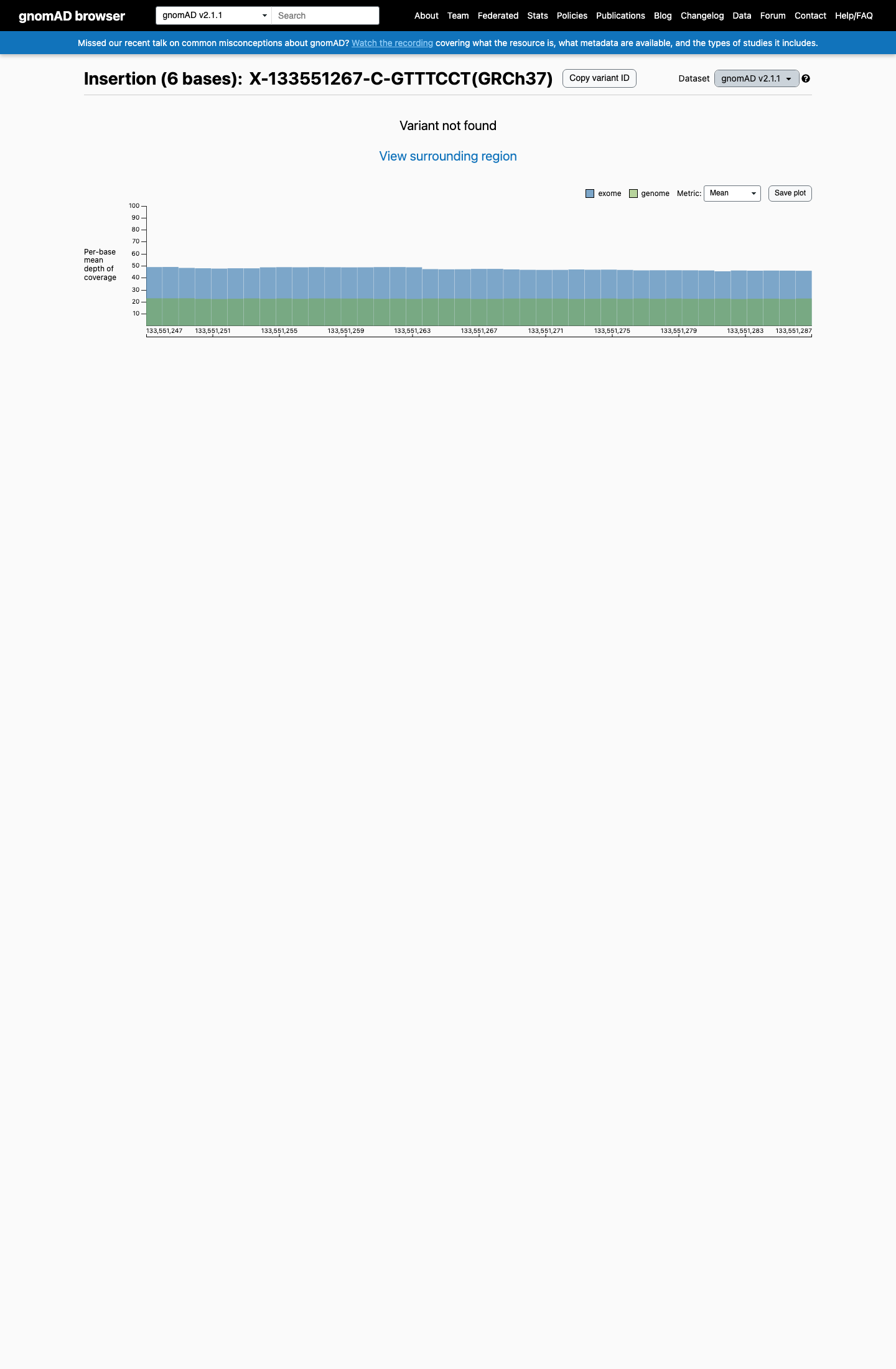
gnomAD v4.1 screenshot
gnomAD v4.1
gnomAD v2.1 screenshot
gnomAD v2.1
v4.1
Absent from gnomAD v4.1.
v2.1
Absent from gnomAD v2.1.
🇨🇦 CA
Not available in gnomAD-Canada v1.0.
Allele frequency by ancestry
three datasets · side by side
gnomAD v4.1
Absent · 0 / ?
0 hom
Not observed in any ancestry group.
gnomAD v2.1
Absent · 0 / ?
0 hom
Not observed in any ancestry group.
gnomAD Canada 🇨🇦
Absent · 0 / ?
0 hom
Not observed in any ancestry group.
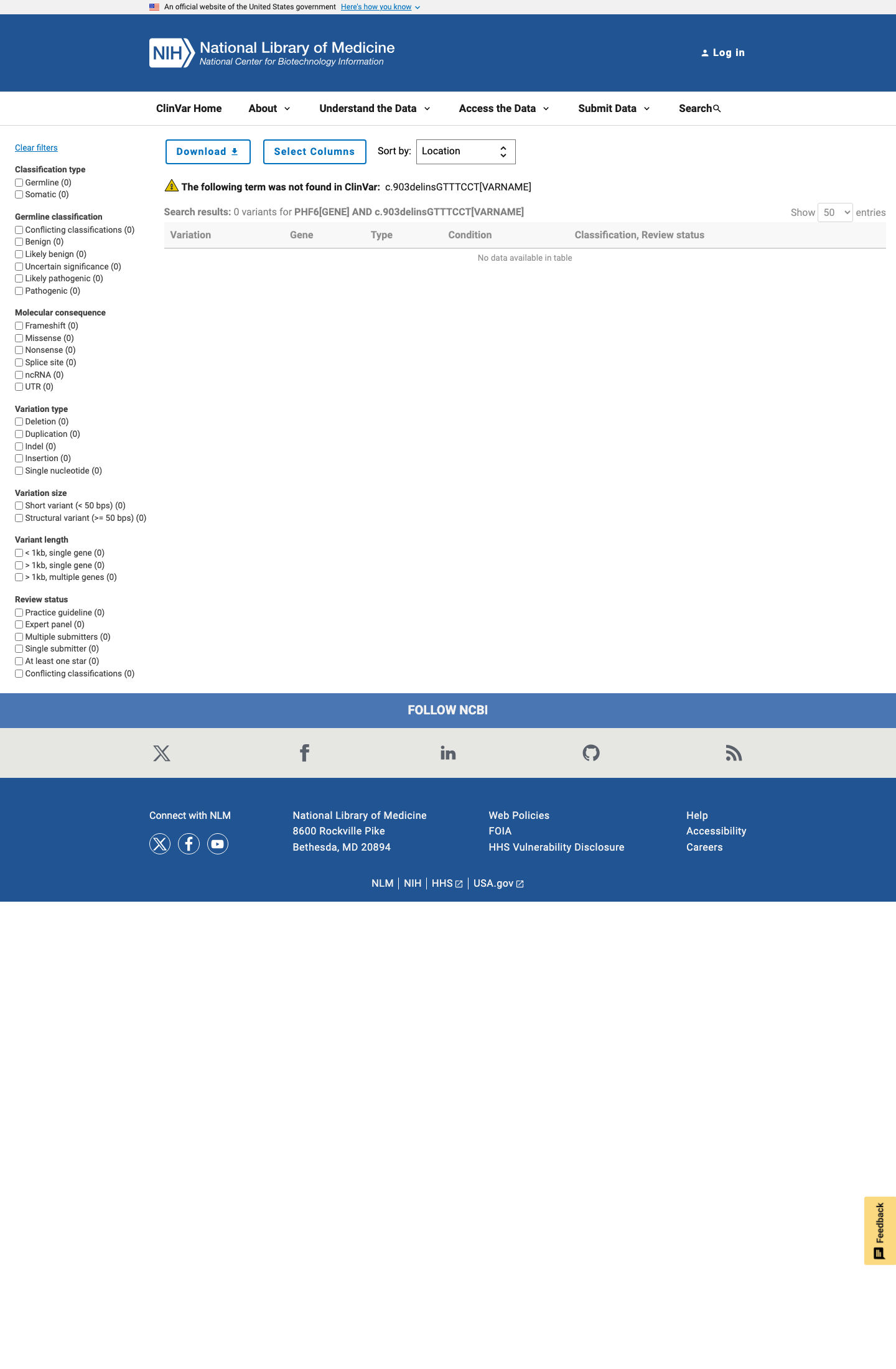
ClinVar screenshot
ClinVar
This variant is absent from ClinVar.
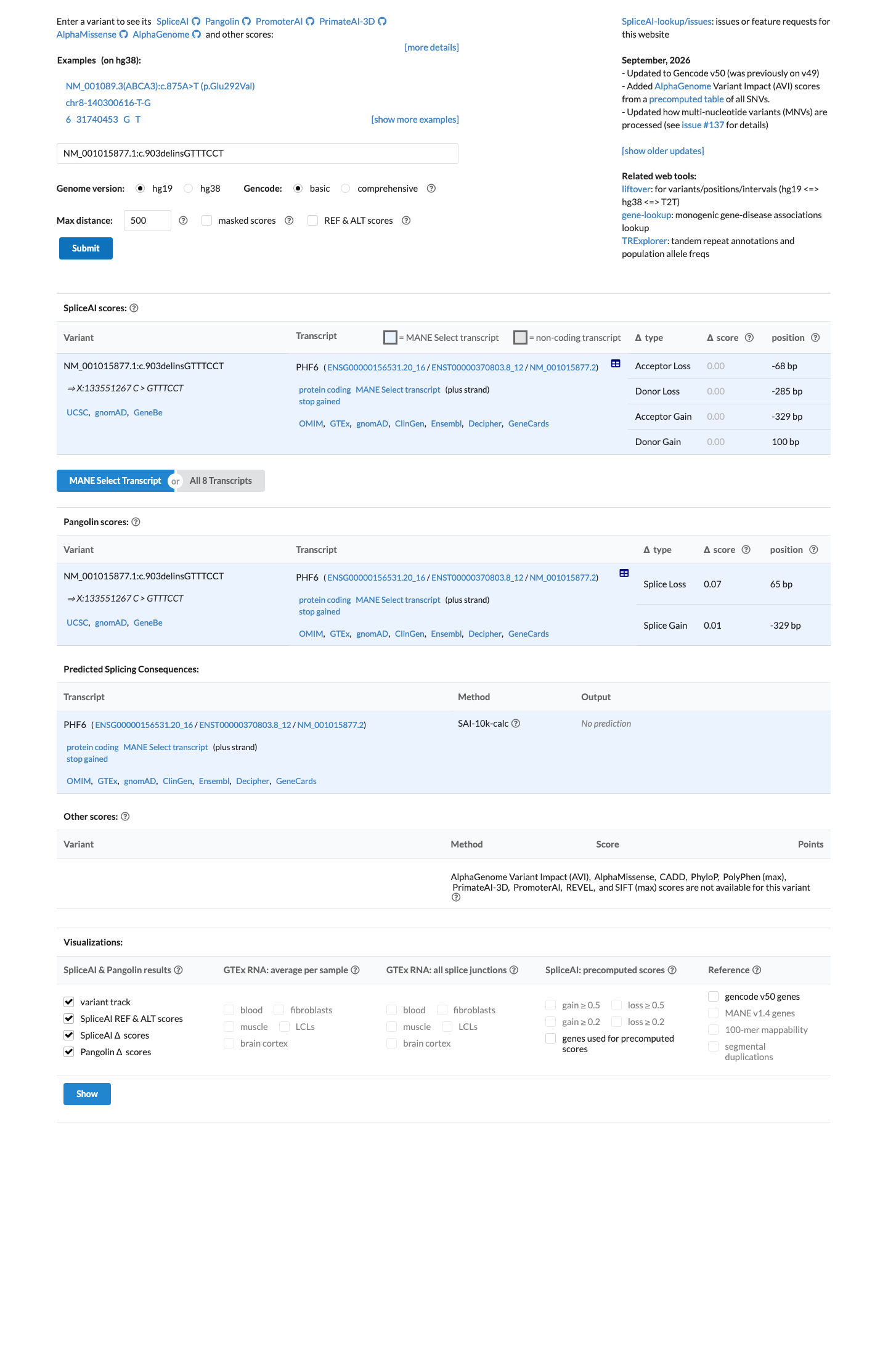
SpliceAI screenshot
In silico
SpliceAI predicts no significant splice impact for this variant (max delta score = 0.00).
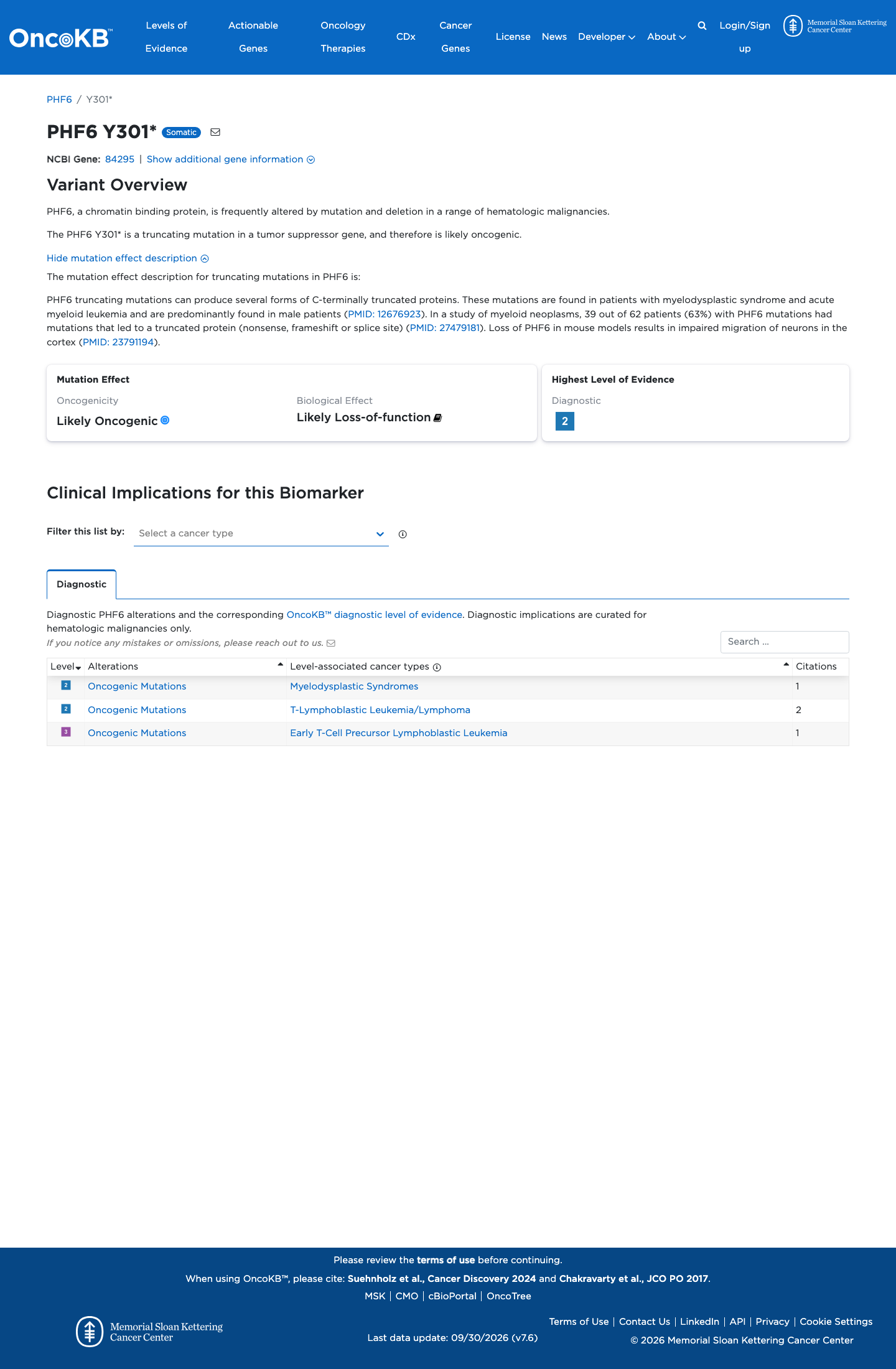
Functional / OncoKB screenshot
Functional Likely Oncogenic
OncoKB identified variant-specific curated literature and context relevant to functional review; biological-effect context: Likely Loss-of-function; curated oncogenicity label: Likely Oncogenic.
OncoKB ↗
COSMIC screenshot
COSMIC
Cancer hotspots screenshot
Cancer hotspots
Somatic evidence Not in COSMIC / hotspots
COSMIC
This variant does not lie in a statistically significant hotspot. This variant has not previously been reported in somatic cancers (COSMIC).
Hotspots
This variant does not lie in a statistically significant hotspot.
Sources & reference links
8Sources
ClinVar
gnomAD v2.1
gnomAD v4.1
gnomAD-Canada
SpliceAI
OncoKB
COSMIC
Cancer hotspots
Triaged references · 3 PMIDs not cited in assessment
12676923 ↗ Novel PHF6 mutation p.D333del causes B&#xf6;rjeson-Forssman-Lehmann syndrome. ONCOKB
23791194 ↗ The X-linked intellectual disability protein PHF6 associates with the PAF1 complex and regulates neuronal migration in the mammalian brain. ONCOKB
27479181 ↗ Somatic PHF6 mutations in 1760 cases with various myeloid neoplasms. ONCOKB