Back
NM_001033082.2:c.961C>G
p.Arg321Gly · MYCL
ACMG/AMP
0%
complete
Final classification
VUS
PM2PP3
MYCL
c.961C>G
p.Arg321Gly
missense

MYCL encodes a transcription factor of the MYC oncoprotein family that regulates gene expression via RNA polymerase II-mediated transcription. Unlike the ubiquitously expressed MYC, MYCL is preferentially expressed in the developing kidney and lung. MYCL functions as an oncogene, with amplification found in approximately 5-10% of small cell lung carcinomas, sometimes co-occurring with amplification of other MYC family members.

This variant

MYCL is a proto-oncogene whose cancer relevance comes from amplification and overexpression, most notably in small cell lung carcinoma, rather than recurrent germline missense changes. This rare missense variant is predicted damaging in silico, but with no established MYCL germline disease association, functional studies, or case observations, its clinical significance remains uncertain.

Transcript
NM_001033082.2
HGVS · transcript:coding
NM_001033082.2:c.961C>G
GRCh38
chr1:39897596 G>C
GRCh37
chr1:40363268 G>C
VUS: only PM2 (moderate) and PP3 (supporting) are met, and that combination satisfies no pathogenic or benign rule under the generic ACMG/AMP 2015 framework.
Classification rationale
PM2PP3 VUS
MYCL c.961C>G missense

PM2 (Moderate): variant is at extremely low population frequency — gnomAD v2.1 AF 3.98e-06 and v4.1 AF 2.48e-06, well below the <0.1% threshold, zero homozygotes. PP3 (Supporting): REVEL 0.914 and BayesDel 0.499 both predict a deleterious missense effect. One moderate plus one supporting criterion meets no generic ACMG/AMP 2015 combination rule, yielding Variant of Uncertain Significance (VUS).

PM2 + PP3 VUS
LYFE Sciences is an AI system, and it can make mistakes. Criteria may be applied incorrectly, sources may be misread, and a confident-looking classification can still be wrong. Double-check every criterion and its underlying evidence before relying on any call.
Gene diagram · NM_001033082.2 · variants mapped to exon structure
MYCL NM_001033082.2
Fetching transcript structure from UCSC…
Applied criteria · 2 applied · 21 assessed
MetEvidence satisfies this criterion.
Not metEvaluated against available evidence; threshold not reached.
Not assessedApplies in principle, but no evidence was found to evaluate it.
N/ADoesn't apply to this variant type.
Applied · 2
Strength Supporting Moderate Strong Very strong
PM2 moderate Pathogenic
Met (moderate): gnomAD v2.1 AF 3.98e-06 and v4.1 AF 2.48e-06, both far below the <0.1% threshold, with zero homozygotes.
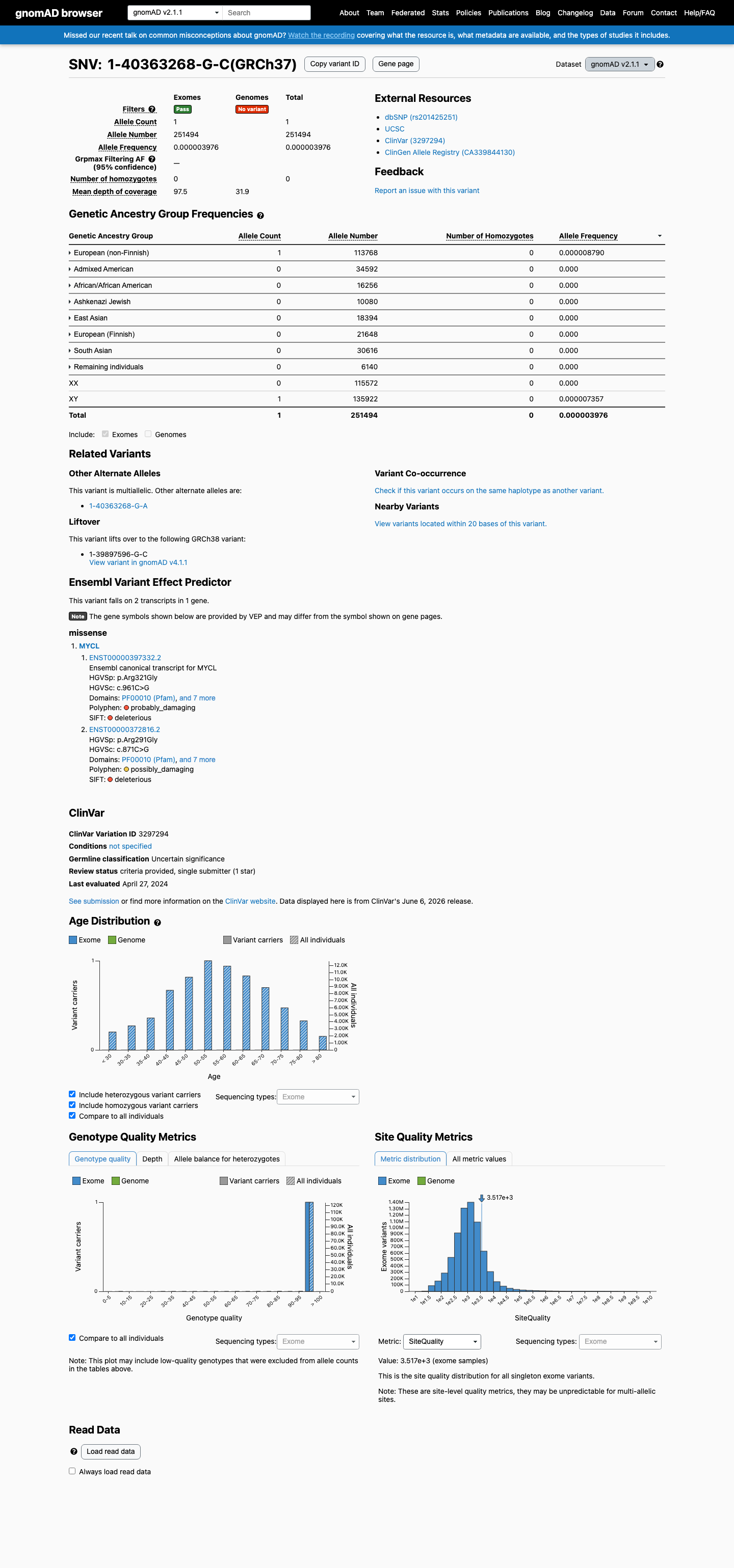
gnomAD v2.1: total AF 3.976e-06 (0.00040%, 1/251,494 alleles), 0 homozygotes, max subpop NFE AF 8.79e-06 (0.00088%)gnomAD v4.1: total AF 2.478e-06 (0.00025%, 4/1,614,198 alleles), 0 homozygotes, grpmax FAF 7.9e-07, max subpop NFE AF 3.39e-06 (0.00034%)gnomAD-Canada v1.0: variant absent
PP3 supporting Pathogenic
Met (supporting): REVEL 0.914 and BayesDel 0.499 both predict a deleterious missense effect.
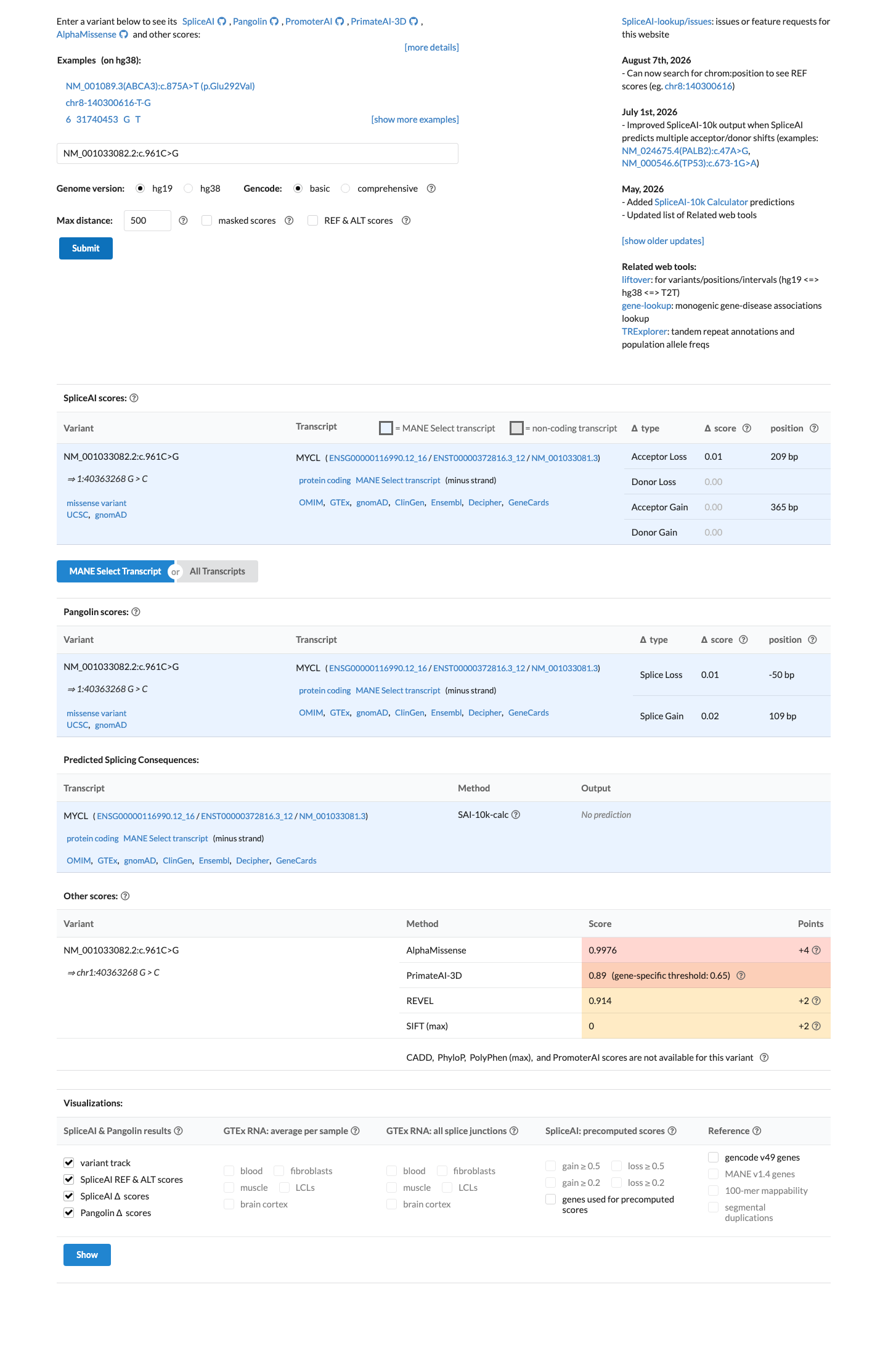
REVEL v1.3 score 0.914 for NM_001033082.2:c.961C>G (deleterious prediction)BayesDel (noAF) score 0.499098 for chr1:40363268 G>C (deleterious prediction)SpliceAI max delta 0.01 (no splice impact; neutral for PP3 on this missense variant)
Assessed · not applied · 9 not met · 12 not assessed
Pathogenic
PS1 Not met: no alternate-nucleotide variant producing p.Arg321Gly is established as pathogenic; the only ClinVar record is this variant itself (VUS).
PS2 Not assessed: no proband, parental-testing, or trio data were available to evaluate a de novo occurrence.
PS3 Not assessed: no wet-lab functional study of this variant was available in either direction.
PS4 Not assessed: no case-control or cohort study of this variant exists to demonstrate enrichment in affected individuals.
PM1 Not met: no mutational hotspot or critical functional domain is documented at MYCL Arg321, and no benign-variation constraint was established.
PM3 Not assessed: no allele-phase or segregation data exist, and MYCL has no established autosomal-recessive germline disease association.
PM5 Not assessed: no alternate missense change at Arg321 is established as pathogenic; flagged for human review.
PM6 Not assessed: no proband observation or parental-testing status is available to evaluate an assumed de novo occurrence.
PP1 Not assessed: no pedigree, affected relatives, or segregation data exist for this variant.
PP2 Not met: missense is not MYCL's disease mechanism — it is activated by amplification — and no missense constraint data support a low benign-missense rate.
PP4 Not assessed: no proband phenotype or family history data were available.
PP5 Not met: no ClinVar expert-panel pathogenic classification exists for this exact variant — only a single-submitter laboratory VUS.
Benign
BA1 Not met: gnomAD v2.1 AF 3.98e-06 and v4.1 AF 2.48e-06 are orders of magnitude below the >1% BA1 threshold.
BS1 Not met: observed allele frequencies (max 0.00088%) are far below the >0.3% threshold, and no disease-allele expectation applies.
BS3 Not assessed: no functional study demonstrating normal function was available.
BS4 Not assessed: no family data exist to evaluate non-segregation in affected relatives.
BP1 Not met: MYCL is an oncogene activated by amplification, not a gene whose disease mechanism is truncation.
BP2 Not assessed: no pathogenic second variant or allele-phase data exist to evaluate cis/trans configuration.
BP4 Not met: REVEL 0.914 and BayesDel 0.499 both predict a deleterious effect, directly contradicting a no-impact conclusion.
BP5 Not assessed: no proband-level data on an alternate molecular basis for disease were available.
BP6 Not met: no ClinVar expert-panel benign or likely-benign classification exists for this exact variant.
N/A · 5 PVS1 · PM4 · BS2 · BP3 · BP7
Research & evidence
Population frequency
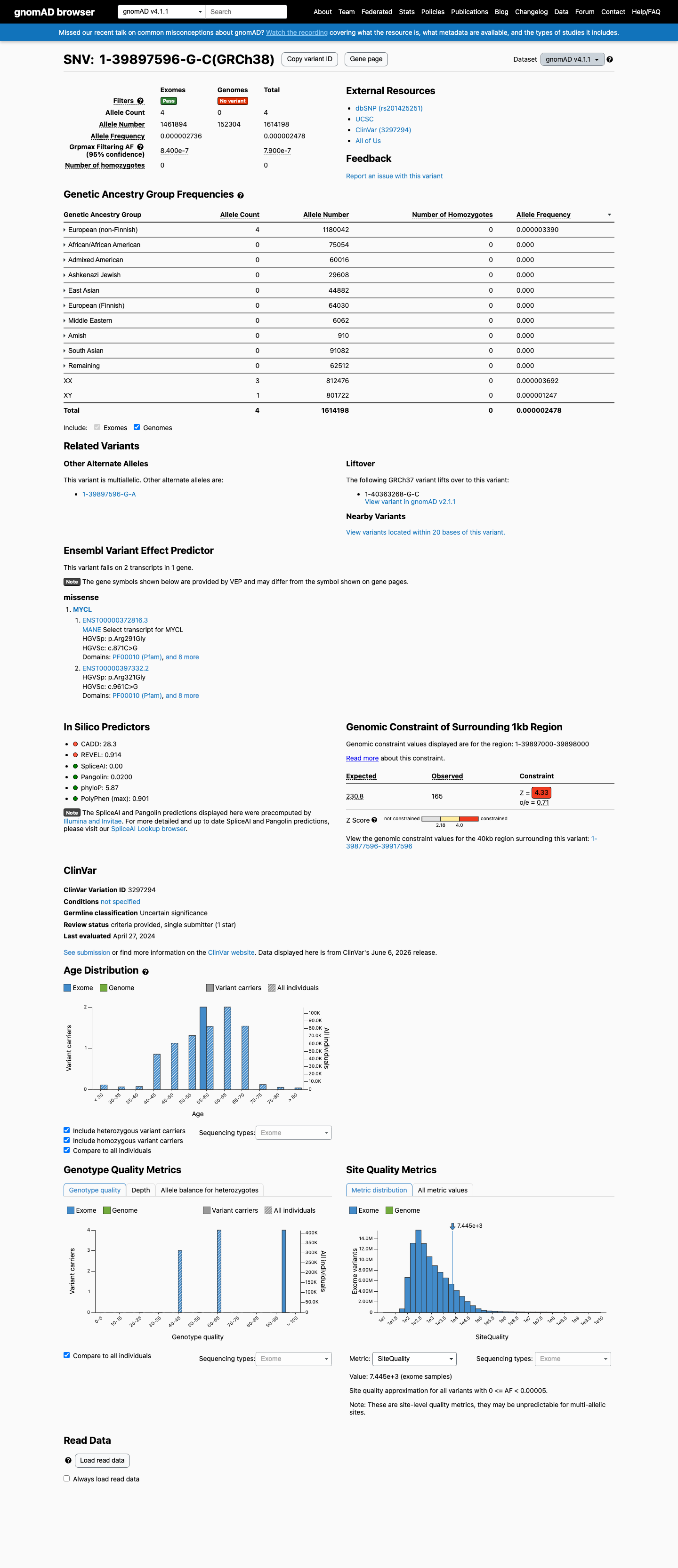
gnomAD v4.1 screenshot
gnomAD v4.1
gnomAD v2.1 screenshot
gnomAD v2.1
v4.1
This variant is present in gnomAD v4.1 (AF= 2.47801e-06; MAF= 0.00025%, 4/1614198 alleles, homozygotes = 0) and has highest observed frequency in the European (non-Finnish) population (AF= 3.38971e-06; MAF= 0.00034%, 4/1180042 alleles, homozygotes = 0); grpmax FAF= 7.9e-07.
v2.1
This variant is present in gnomAD v2.1 (AF= 3.97624e-06; MAF= 0.00040%, 1/251494 alleles, homozygotes = 0) and has highest observed frequency in the European (non-Finnish) population (AF= 8.78982e-06; MAF= 0.00088%, 1/113768 alleles, homozygotes = 0).
🇨🇦 CA
Absent from gnomAD-Canada v1.0.
Allele frequency by ancestry
three datasets · side by side
gnomAD v4.1
0.00025% · 4 / 1,614,198
0 hom · FAF 7.9e-05%
European (non-Finnish)
4 / 1,180,042
0.00034%
+ 9 not observed (Remaining individuals, Admixed American, European (Finnish), Amish, East Asian, Middle Eastern, South Asian, Ashkenazi Jewish, African/African American)
gnomAD v2.1
0.0004% · 1 / 251,494
0 hom
European (non-Finnish)
1 / 113,768
0.00088%
+ 7 not observed (African/African American, Admixed American, Ashkenazi Jewish, East Asian, European (Finnish), Remaining individuals, South Asian)
gnomAD Canada 🇨🇦
Absent · 0 / ?
0 hom
Not observed in any ancestry group.
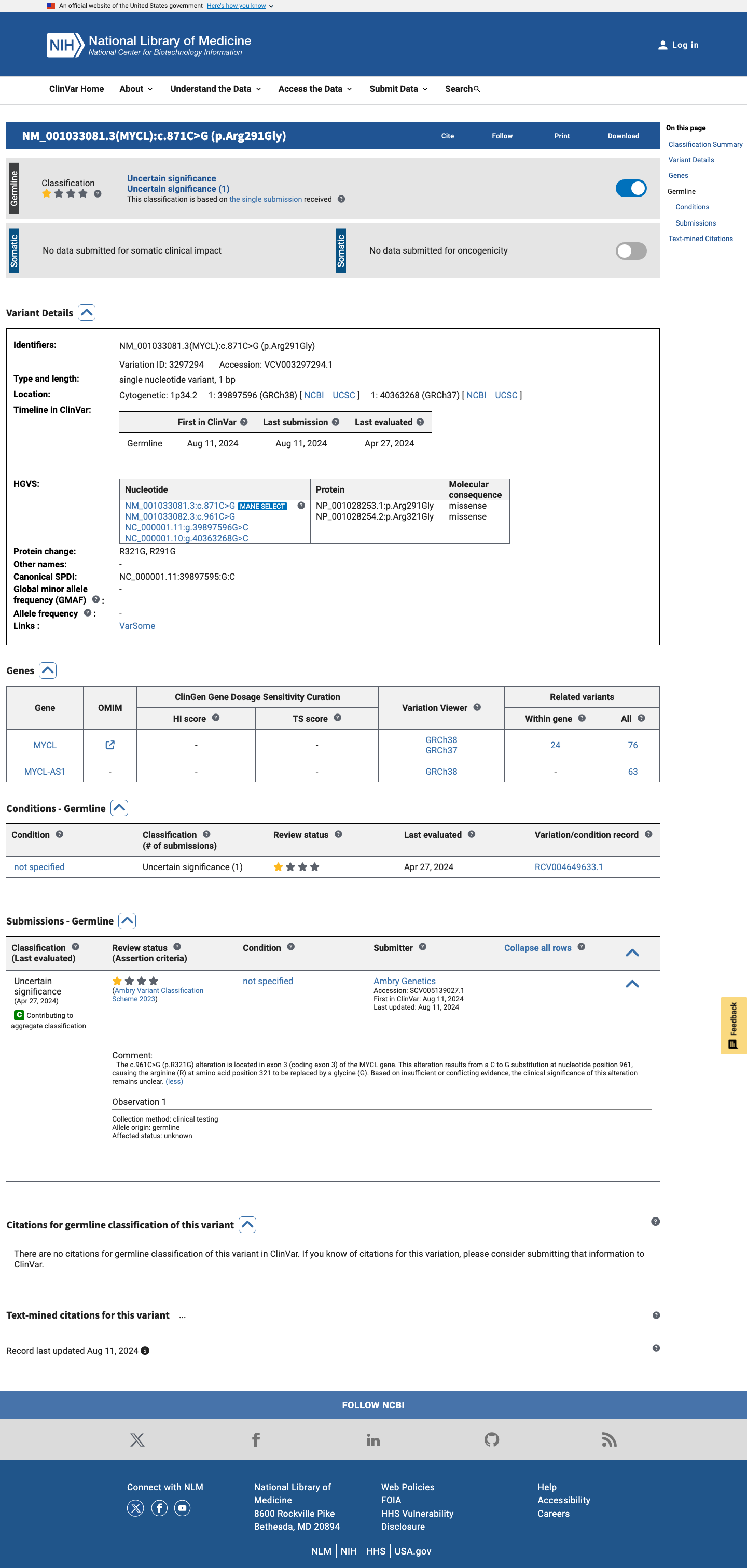
ClinVar screenshot
ClinVar
This variant has been reported in ClinVar as Uncertain significance (1 clinical laboratory). (ClinVarID = 3297294)
SpliceAI screenshot
In silico
SpliceAI predicts no significant splice impact for this variant (max delta score = 0.01). REVEL score = 0.914. BayesDel score = 0.499098.
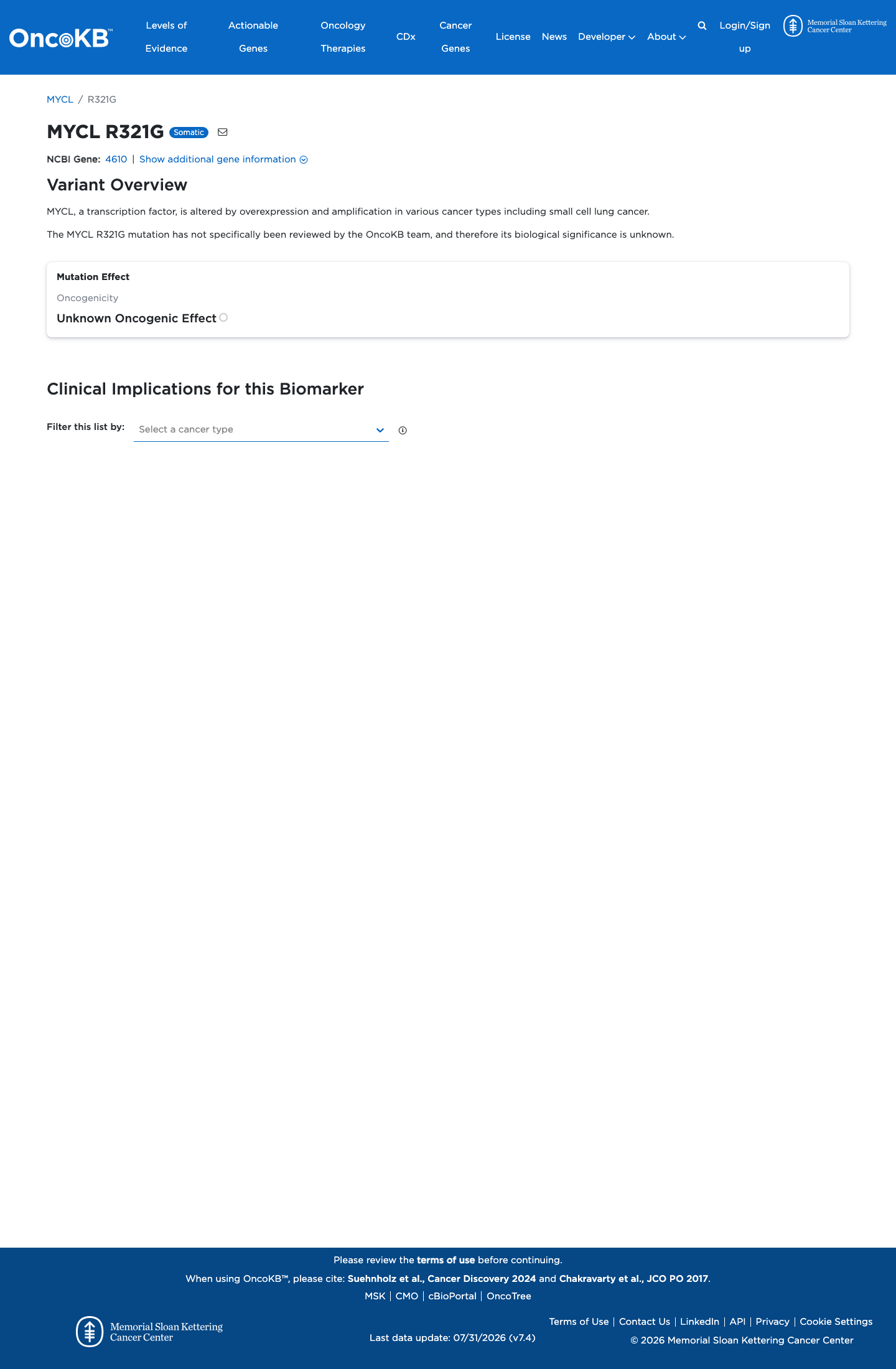
Functional / OncoKB screenshot
Functional Unknown Oncogenic Effect
OncoKB did not identify variant-specific reviewed functional evidence for this variant; gene-level curated context is available for reviewer follow-up. MYCL, a transcription factor, is altered by overexpression and amplification in various cancer types including small cell lung cancer.
OncoKB ↗
COSMIC screenshot
COSMIC
Cancer hotspots screenshot
Cancer hotspots
Somatic evidence Not in COSMIC / hotspots
COSMIC
This variant does not lie in a statistically significant hotspot. This variant has not previously been reported in somatic cancers (COSMIC).
Hotspots
This variant does not lie in a statistically significant hotspot.
Sources & reference links
8Sources
ClinVar
gnomAD v2.1
gnomAD v4.1
gnomAD-Canada
SpliceAI
OncoKB
COSMIC
Cancer hotspots