Analysis in progress
Initialising…
0%
complete
This report is still being assembled — sections appear as each stage finishes. It isn't final yet.
MLH3
Final classification
VUS
MLH3 c.3455G>A · p.Arg1152His
MLH3

PM2 (Supporting): extremely low population frequency — gnomAD v4.1 total AF 0.0128% (206/1,612,008 alleles), 0 homozygotes, absent from gnomAD-Canada — below the 0.1% calibration.

Gene
MLH3
Transcript
NM_001040108.2
HGVS · transcript:coding
NM_001040108.2:c.3455G>A
Consequence
N/A
GRCh38
chr14:75041625 C>T
GRCh37
chr14:75508328 C>T
Basis Variant of Uncertain Significance: only PM2 was met (supporting; gnomAD v4.1 AF 0.0128%, 0 homozygotes), which reaches no pathogenic or benign threshold under generic ACMG/AMP 2015 rules.
Variant of Uncertain Significance: only PM2 was met (supporting; gnomAD v4.1 AF 0.0128%, 0 homozygotes), which reaches no pathogenic or benign threshold under generic ACMG/AMP 2015 rules.
Classification rationale
PM2 VUS
MLH3 c.3455G>A

PM2 (Supporting): extremely low population frequency — gnomAD v4.1 total AF 0.0128% (206/1,612,008 alleles), 0 homozygotes, absent from gnomAD-Canada — below the 0.1% calibration. Synthesis: with a single supporting criterion and no other pathogenic or benign evidence, the variant is classified as Variant of Uncertain Significance under generic ACMG/AMP 2015 combination rules.

PM2 VUS
Gene diagram · NM_001040108.2 · variants mapped to exon structure
MLH3 NM_001040108.2
Fetching transcript structure from UCSC…
Applied criteria · 1 applied · 23 assessed
Applied · 1
Strength Supporting Moderate Strong Very strong
PM2 supporting Pathogenic
Met (supporting): gnomAD v4.1 total allele frequency 0.0128% (206/1,612,008 alleles), 0 homozygotes, below the 0.1% threshold.
gnomad_v4: gnomAD v4.1 total AF = 0.0001278 (0.01278%, 206/1,612,008 alleles), 0 homozygotes, grpmax FAF = 0.00014369 (0.01437%); below the local non-VCEP PM2 calibration of <0.1% (PMID:25741868 defines PM2 as absent or extremely low frequency, with extremely low frequency if recessive).gnomad_v2: gnomAD v2.1 total AF = 6.36e-05 (0.00636%, 16/251,476 alleles), 0 homozygotes; independently confirms extremely low frequency.gnomad_canada: variant absent from gnomAD-Canada v1.0 (HostSeq Canadian general-population genomes), consistent with extremely low population frequency.
Assessed · not applied
Pathogenic
PS1 Not met: no pathogenic variant producing the same amino-acid change p.Arg1152His is established; the only ClinVar record for it is Uncertain significance.
PS2 Not assessed: no proband phenotype or parental testing results were available to evaluate a de novo origin.
PS3 Not assessed: no functional studies of this variant exist; OncoKB lists no variant-specific functional evidence for R1152H.
PS4 Not assessed: no case-control study, case series, or affected-proband allele counts for this variant were available.
PM1 Not met: the variant is not in a statistically significant mutational hotspot, and no domain annotation places residue 1152 in a critical functional domain.
PM3 Not assessed: no observation of the variant in trans with a pathogenic MLH3 variant exists; phase data are lacking.
PM5 Not assessed: no different missense change at Arg1152 with a pathogenic classification was identified to serve as the required comparator.
PM6 Not assessed: no parental testing or de novo assertion data were available.
PP1 Not assessed: no pedigree or segregation data were available to evaluate cosegregation with disease.
PP2 Not assessed: no missense-constraint data for MLH3 were available, and evidence favors loss-of-function rather than missense as the disease mechanism.
PP3 Not met: SpliceAI max delta 0.06 and REVEL 0.361 both fall below their calibrated pathogenic thresholds.
PP4 Not assessed: no confirmed proband phenotype or family history was available.
PP5 Not met: no ClinVar expert-panel (VCEP) pathogenic classification exists for this exact variant; all six submissions are Uncertain significance.
Benign
BA1 Not met: highest observed allele frequency is 0.0163% (gnomAD v4.1 NFE), about 60-fold below the 1% stand-alone benign threshold.
BS1 Not met: highest observed allele frequency 0.0163% is below, not above, the expected disease allele frequency of ~0.17%.
BS2 Not met: zero homozygotes in gnomAD v2.1/v4.1, and Lynch-type cancer risk is not fully penetrant at an early age, so the healthy-adult requirement is not satisfied.
BS3 Not assessed: no functional studies demonstrate normal function; in-silico predictions alone do not qualify as such evidence.
BS4 Not assessed: no family or segregation data exist to demonstrate lack of segregation.
BP1 Not assessed: available evidence does not confirm that MLH3 disease is primarily caused by truncating variants.
BP2 Not assessed: no cis/trans observation with a pathogenic variant exists, and a fully dominant MLH3 mechanism is not established.
BP4 Not met: only one computational line supports no impact (SpliceAI max delta 0.06); REVEL 0.361 exceeds the 0.016 BP4 threshold.
BP5 Not assessed: no proband-level molecular data were available to evaluate an alternate molecular basis for disease.
BP6 Not met: no ClinVar expert-panel benign classification exists for this exact variant; all submissions are Uncertain significance.
N/A · 4 PVS1 · PM4 · BP3 · BP7
Research & evidence
Population frequency
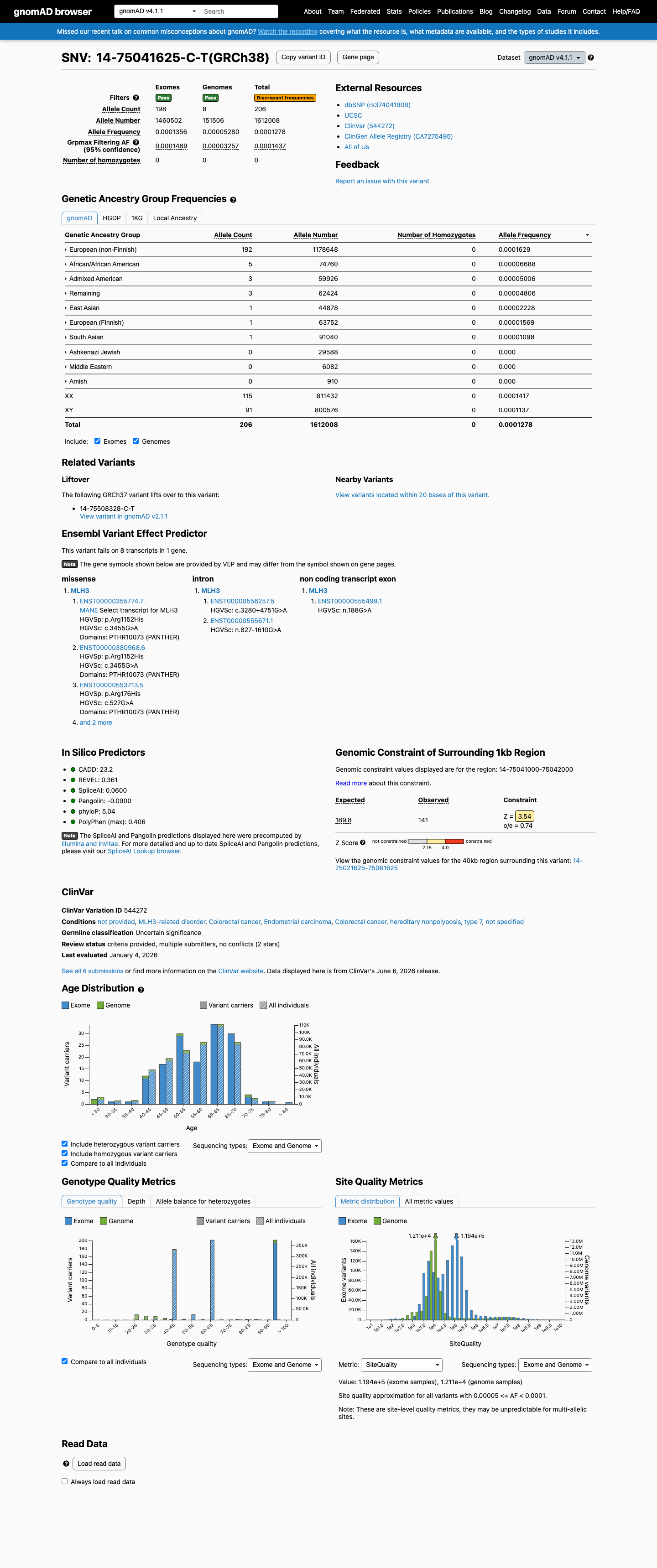
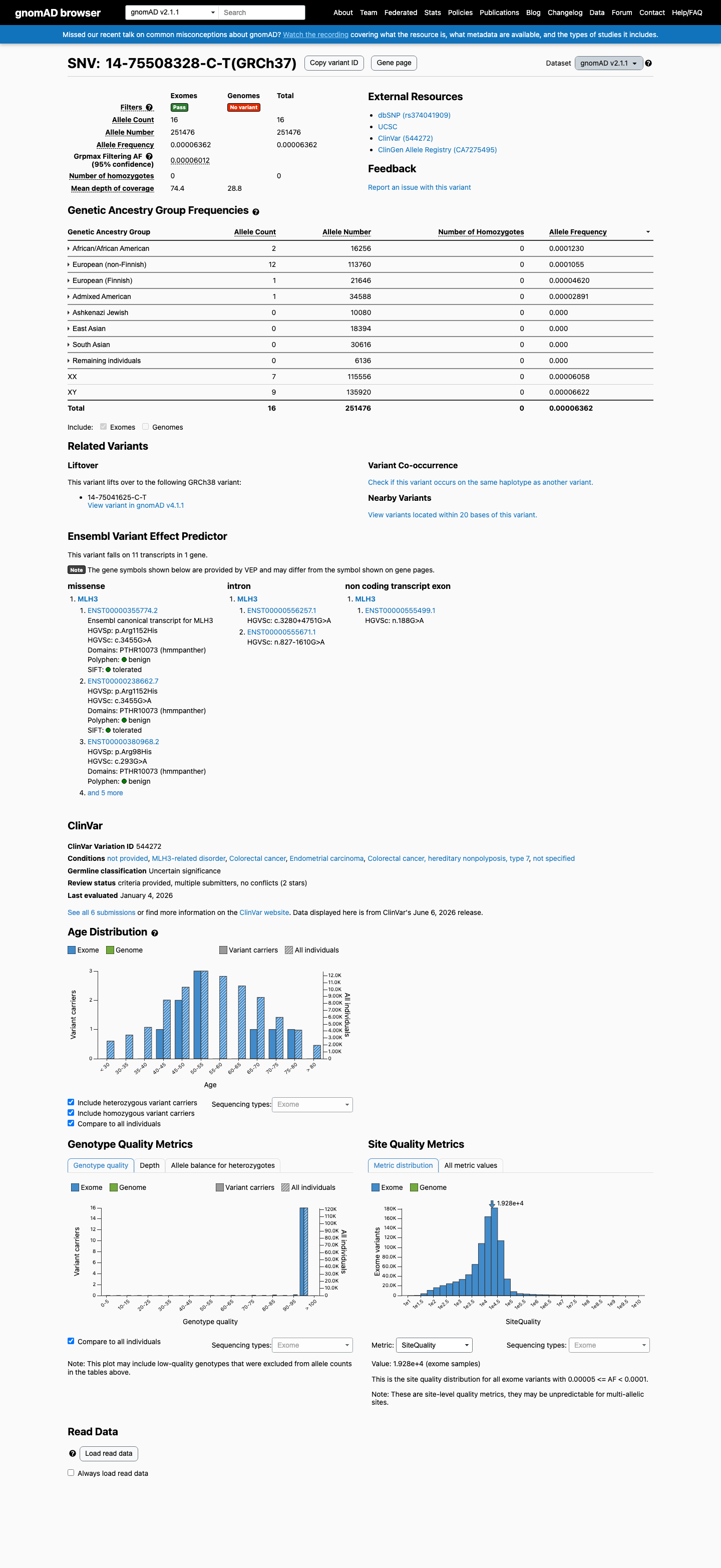
gnomAD v4.1 screenshot
gnomAD v4.1
gnomAD v2.1 screenshot
gnomAD v2.1
v4.1
This variant is present in gnomAD v4.1 (AF= 0.000127791; MAF= 0.01278%, 206/1612008 alleles, homozygotes = 0) and has highest observed frequency in the European (non-Finnish) population (AF= 0.000162899; MAF= 0.01629%, 192/1178648 alleles, homozygotes = 0); grpmax FAF= 0.00014369.
v2.1
This variant is present in gnomAD v2.1 (AF= 6.36244e-05; MAF= 0.00636%, 16/251476 alleles, homozygotes = 0) and has highest observed frequency in the African/African American population (AF= 0.000123031; MAF= 0.01230%, 2/16256 alleles, homozygotes = 0); grpmax FAF= 6.012e-05.
🇨🇦 CA
Absent from gnomAD-Canada v1.0.
Allele frequency by ancestry
three datasets · side by side
gnomAD v4.1
0.013% · 206 / 1,612,008
0 hom · FAF 0.014%
European (non-Finnish)
192 / 1,178,648
0.016%
African/African American
5 / 74,760
0.0067%
Admixed American
3 / 59,926
0.005%
Remaining individuals
3 / 62,424
0.0048%
East Asian
1 / 44,878
0.0022%
European (Finnish)
1 / 63,752
0.0016%
South Asian
1 / 91,040
0.0011%
+ 3 not observed (Amish, Middle Eastern, Ashkenazi Jewish)
gnomAD v2.1
0.0064% · 16 / 251,476
0 hom · FAF 0.006%
African/African American
2 / 16,256
0.012%
European (non-Finnish)
12 / 113,760
0.011%
European (Finnish)
1 / 21,646
0.0046%
Admixed American
1 / 34,588
0.0029%
+ 4 not observed (Ashkenazi Jewish, East Asian, Remaining individuals, South Asian)
gnomAD Canada 🇨🇦
Absent · 0 / ?
0 hom
Not observed in any ancestry group.
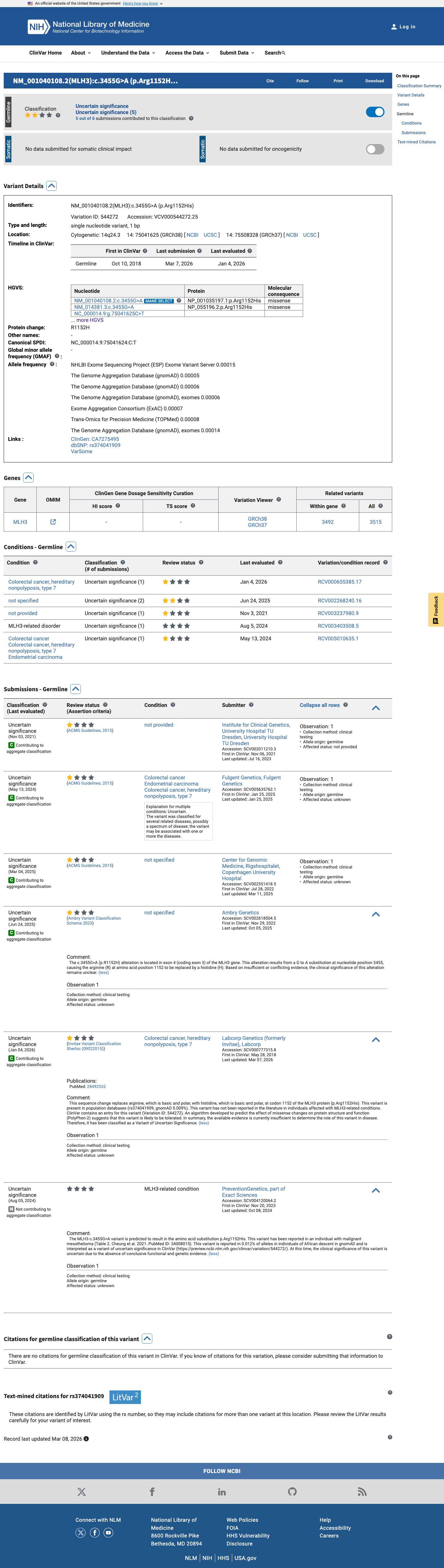
ClinVar screenshot
ClinVar
This variant has been reported in ClinVar as Uncertain significance (6 clinical laboratories). (ClinVarID = 544272)
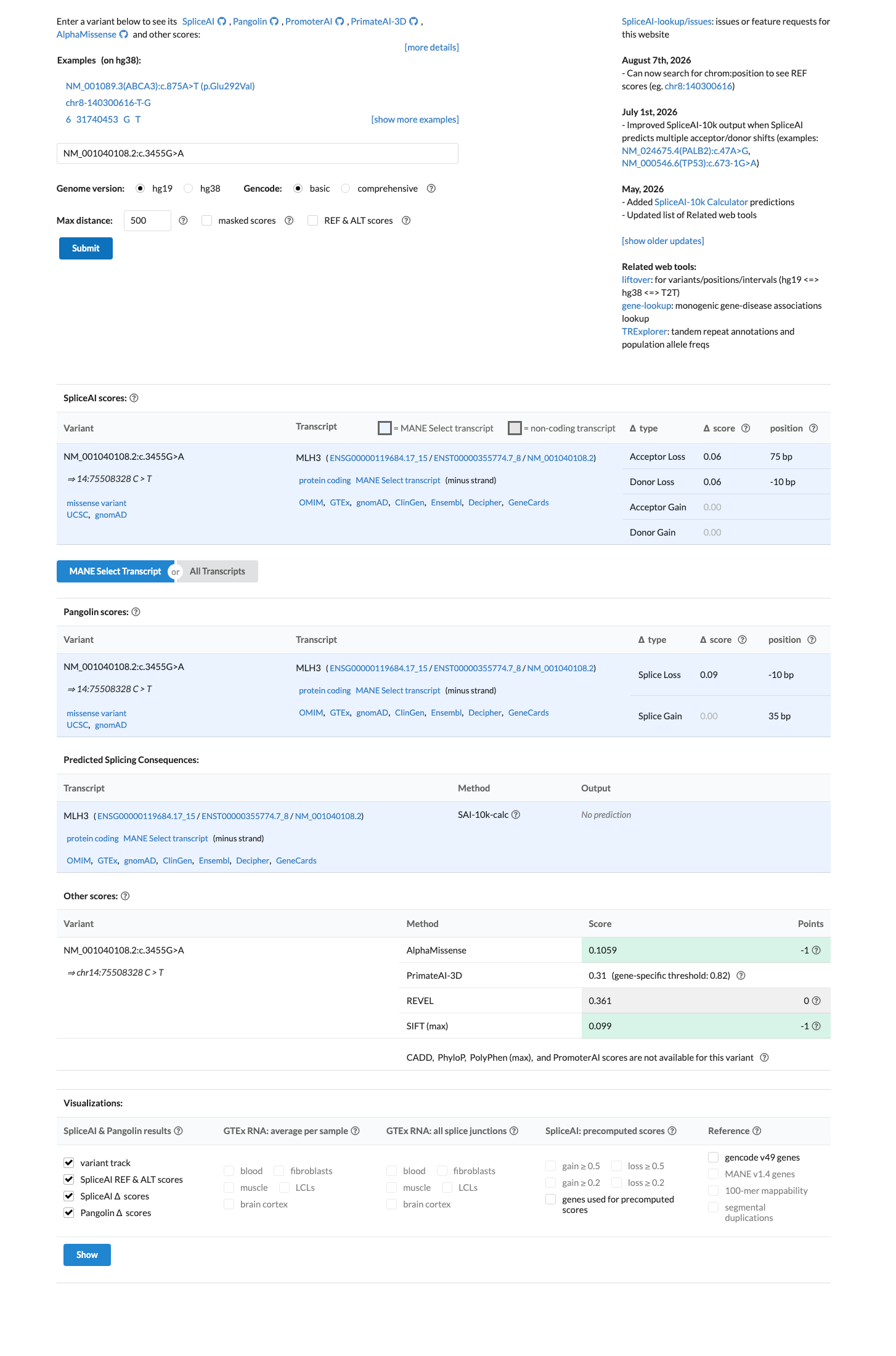
SpliceAI screenshot
In silico
SpliceAI predicts no significant splice impact for this variant (max delta score = 0.06). REVEL score = 0.361. BayesDel score = -0.112721.
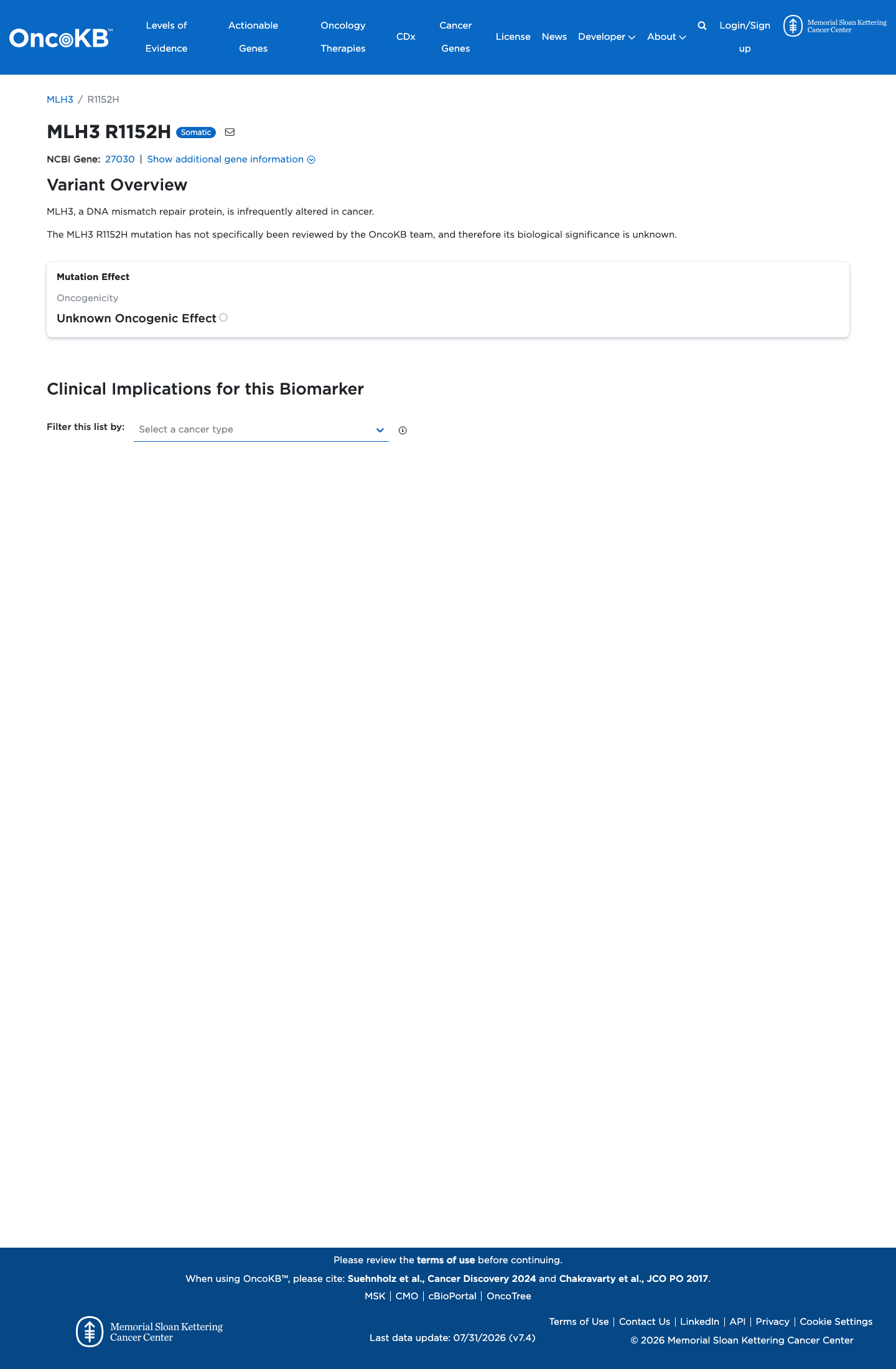
Functional / OncoKB screenshot
Functional Unknown Oncogenic Effect
OncoKB did not identify variant-specific reviewed functional evidence for this variant; gene-level curated context is available for reviewer follow-up. MLH3, a DNA mismatch repair protein, is infrequently altered in cancer.
OncoKB ↗
COSMIC screenshot
COSMIC
Cancer hotspots screenshot
Cancer hotspots
Somatic evidence Not in COSMIC / hotspots
COSMIC
This variant does not lie in a statistically significant hotspot. This variant has not previously been reported in somatic cancers (COSMIC).
Hotspots
This variant does not lie in a statistically significant hotspot.
Literature · how each cited paper was used
2papers cited
Each card is an audit: what was searched, what was found, whether it names the variant, which criteria it fed, and why. 4 further PMIDs triaged but not cited — see Sources & References.
Rule & framework references · cited for criterion definitions, not variant evidence
25741868 ↗ Standards and guidelines for the interpretation of sequence variants: a joint consensus recommendation of the American College of Medical Genetics and Genomics and the Association for Molecular Pathology.
34043773 ↗ European guidelines from the EHTG and ESCP for Lynch syndrome: an updated third edition of the Mallorca guidelines based on gene and gender.
Sources & reference links
8Sources
ClinVar
gnomAD v2.1
gnomAD v4.1
gnomAD-Canada
SpliceAI
OncoKB
COSMIC
Cancer hotspots
Triaged references · 4 PMIDs not cited in assessment
20301390 ↗ Lynch Syndrome. CLINVAR
33451724 ↗ Endometrial cancer: A society of gynecologic oncology evidence-based review and recommendations, part II. CLINVAR
33516529 ↗ Endometrial cancer: A society of gynecologic oncology evidence-based review and recommendations. CLINVAR
24929052 ↗ Endometrial cancer: a review and current management strategies: part II. CLINVAR