Analysis in progress
Initialising…
0%
complete
This report is still being assembled — sections appear as each stage finishes. It isn't final yet.
MLH3
Final classification
Benign
BA1BS1BP4
MLH3
c.3828-24dup
p.?
unknown · exon 8i

MLH3 is a member of the MutL-homolog family of DNA mismatch repair genes. It partners with other family members, notably MLH1, to form a complex that detects and repairs errors in DNA during replication, safeguarding genomic stability and preventing microsatellite instability, and it also helps promote meiotic crossover. Germline mutations in MLH3 are associated with hereditary nonpolyposis colorectal cancer type 7 (HNPCC7), and inactivating changes in the gene have also been found in endometrial and gastric cancers. Loss of MLH3 function increases susceptibility to tumors such as gastrointestinal cancers, indicating that it acts as a tumor suppressor.

This variant

MLH3 is a DNA mismatch-repair gene whose inactivating changes predispose to colorectal and other cancers. This intronic duplication is a common polymorphism - present in over 1% of the population with homozygotes observed - and is predicted to have no impact on splicing, so it does not indicate impaired MLH3 repair function and is classified Benign.

Transcript
NM_001040108.2
HGVS · transcript:coding
NM_001040108.2:c.3828-24dup
GRCh38
chr14:75030725 T>TA
GRCh37
chr14:75497428 T>TA
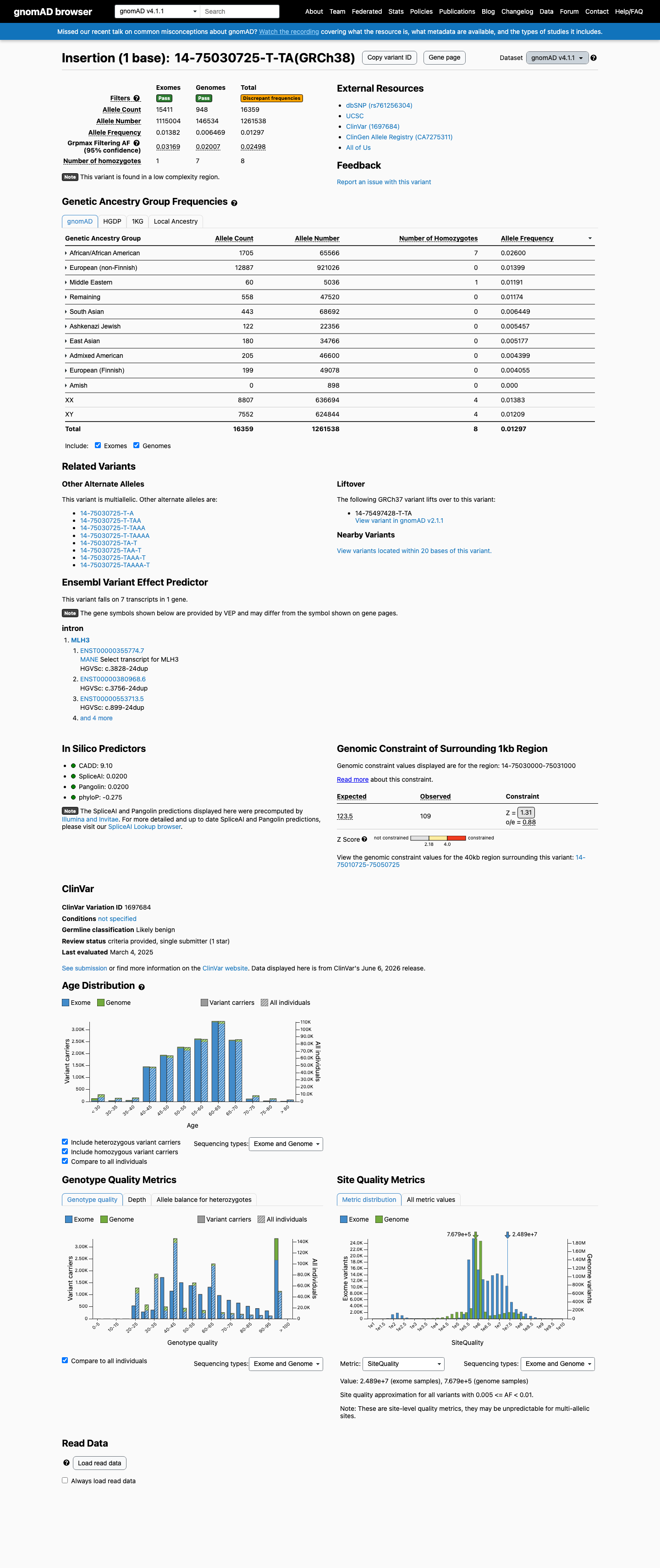
Basis Benign: BA1 met at stand-alone strength (gnomAD v4.1 total AF 1.297% exceeds the 1% threshold) under the generic ACMG/AMP 2015 rules.
Benign: BA1 met at stand-alone strength (gnomAD v4.1 total AF 1.297% exceeds the 1% threshold) under the generic ACMG/AMP 2015 rules.
Classification rationale
BA1BS1BP4 Benign
MLH3 c.3828-24dup unknown · exon 8i

BA1 (Stand-alone benign): gnomAD v4.1 total allele frequency 1.297% far exceeds the 1% threshold for a common benign polymorphism. BS1 (Strong): allele frequency exceeds the 0.3% threshold expected for MLH3-associated disease. BP4 (Supporting): SpliceAI max delta 0.056 is below the 0.1 threshold, predicting no splice impact. Overall: Benign, per generic ACMG/AMP 2015 combination rules with BA1 alone at stand-alone strength.

BA1 + BS1 + BP4 Benign
Gene diagram · NM_001040108.2 · variants mapped to exon structure
MLH3 NM_001040108.2
Fetching transcript structure from UCSC…
Applied criteria · 3 applied · 17 assessed
MetEvidence satisfies this criterion.
Not metEvaluated against available evidence; threshold not reached.
Not assessedApplies in principle, but no evidence was found to evaluate it.
N/ADoesn't apply to this variant type.
Applied · 3
Strength Supporting Moderate Strong Very strong
BA1 stand-alone Benign
Met (stand-alone benign): gnomAD v4.1 total allele frequency 1.297% exceeds the >1% BA1 threshold.
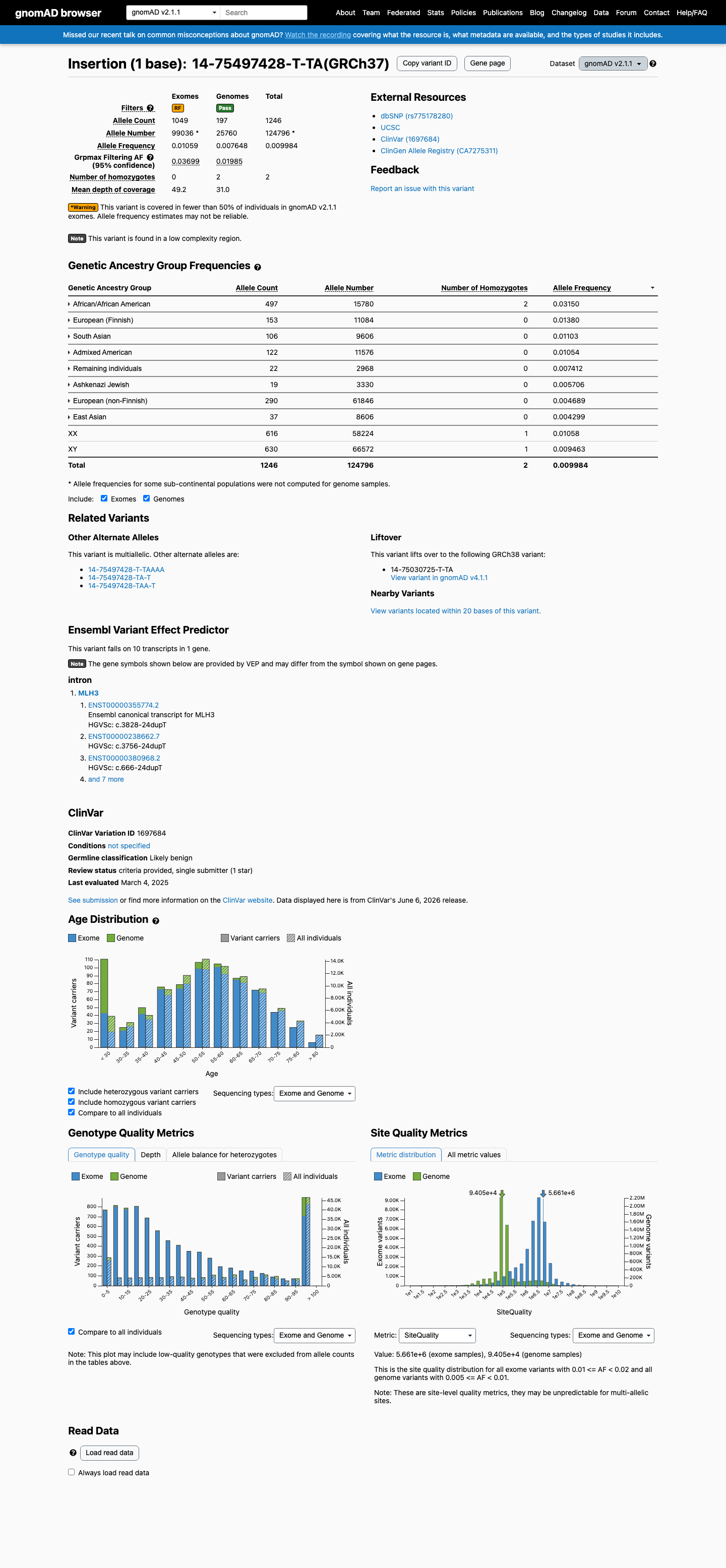
gnomAD v4.1 (source key gnomad_v4): total allele frequency for 14-75030725-T-TA = 0.0129675 (1.297%, 16359/1261538 alleles) with 8 homozygotes; exceeds the lab's non-VCEP BA1 operating threshold of AF > 1%.gnomAD v2.1 (source key gnomad_v2): total AF = 0.0099843 (0.998%, 1246/124796 alleles) with 2 homozygotes; African/African American subpopulation AF = 0.0315 (3.15%) and exome grpmax FAF = 0.03699, both well above 1%.BA1 rule per Richards et al. 2015 (PMID:25741868): allele frequency in population databases too high to be consistent with pathogenicity. No ClinGen CSPEC/VCEP exists for MLH3 (cspec.found=false, framework_mode=generic_acmg), so the generic rule applies with the lab's local non-VCEP threshold (BA1 > 1% in gnomAD).
BS1 strong Benign
Met (strong): gnomAD v4.1 total allele frequency 1.297% exceeds the >0.3% BS1 threshold.
gnomAD v4.1 (source key gnomad_v4): total AF = 0.0129675 (1.297%, 16359/1261538 alleles) and gnomAD v2.1 (source key gnomad_v2): total AF = 0.0099843 (0.998%, 1246/124796 alleles); both exceed the lab's non-VCEP BS1 operating threshold of AF > 0.3%.Highest population frequencies: African/African American AF = 3.15% (v2.1) and 2.60% (v4.1); gnomAD-Canada overall AF = 0.168% with AFR subpopulation AF = 1.86%.BS1 rule per Richards et al. 2015 (PMID:25741868): allele frequency greater than expected for the disorder. MLH3 germline disease (Lynch syndrome susceptibility, biallelic polyposis predisposition) is rare; a 1%+ allele frequency (carrier frequency ~2.6%) is far above any plausible disease prevalence.
BP4 supporting Benign
Met (supporting): SpliceAI max delta 0.056 is below the <0.1 BP4 threshold, predicting no splice impact.
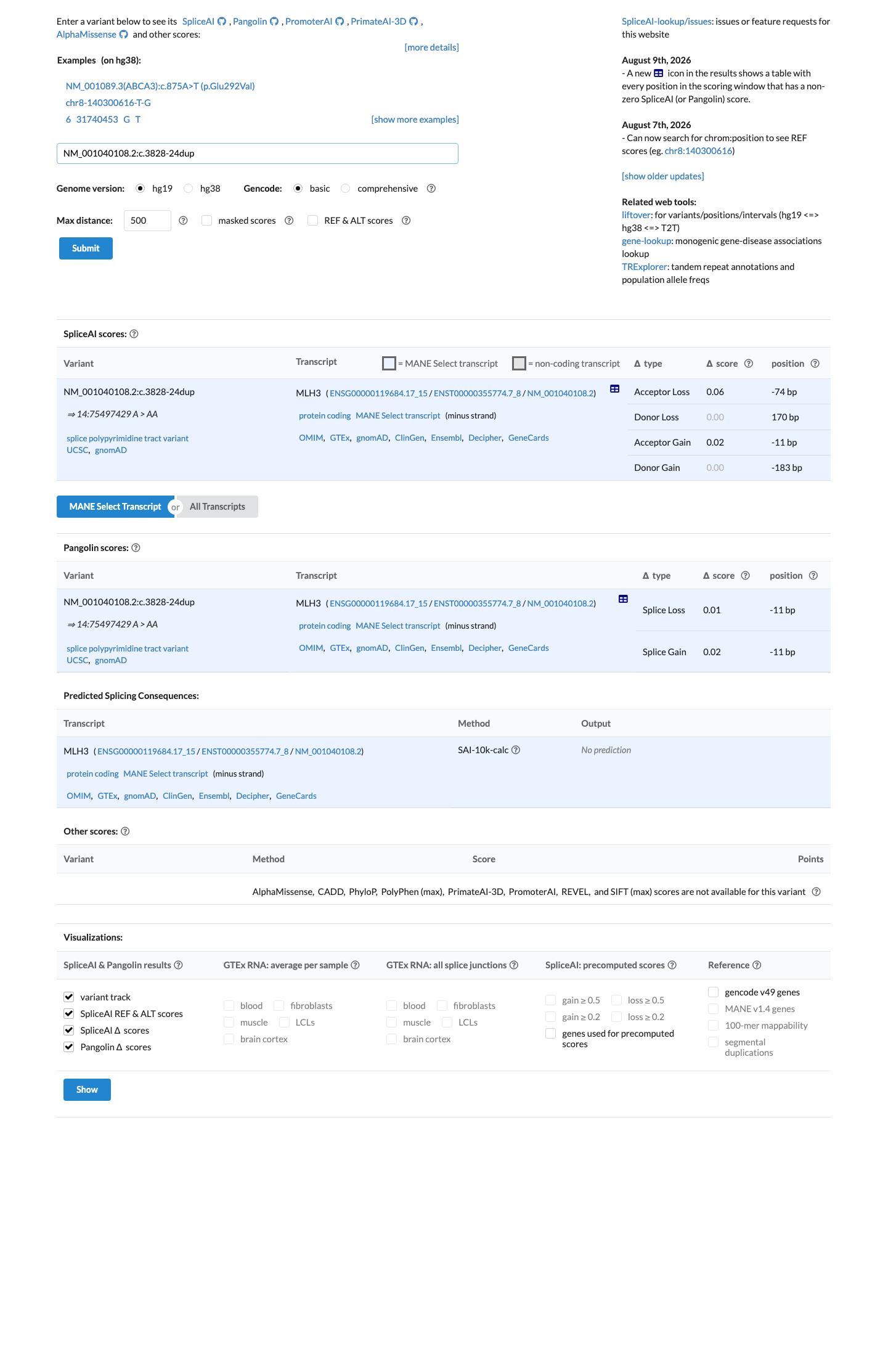
SpliceAI Lookup (source key 'spliceai') reports a max delta score of 0.056 for NM_001040108.2:c.3828-24dup (DS_AG 0.021, DS_AL 0.056, DS_DG 0.0, DS_DL 0.003), i.e. no significant predicted splice impact.Governing generic framework (generic_acmg_combination_rules; source basis ACMG/AMP 2015, PMID 25741868) pre-assigns BP4 (supporting) for intronic/synonymous/non-canonical-splice-position variants when SpliceAI max delta < 0.1; observed max delta 0.056 < 0.1, so BP4 is met.The score is also below the 0.2 (80% recall) recommended threshold for predicting splice-altering variants from the SpliceAI publication, Jaganathan et al. 2019, Cell 176(3):535-548 (PMID 30661751), supporting a no-impact interpretation.
Assessed · not applied · 9 not met · 8 not assessed
Pathogenic
PVS1 Not met: intronic duplication is not a null variant, and SpliceAI predicts no truncating splice effect (max delta 0.056).
PS2 Not assessed: no proband or parental-testing data available to establish a de novo origin.
PS3 Not met: no functional study of this variant exists to demonstrate a deleterious effect.
PS4 Not met: no case-control enrichment; variant is a common polymorphism (gnomAD v4.1 AF 1.297%).
PM2 Not met: allele frequency (gnomAD v4.1 1.297%) far exceeds the <0.1% PM2 threshold.
PM3 Not assessed: no affected-proband or phase data available to evaluate trans inheritance.
PM6 Not assessed: no proband or parental-testing data to document an assumed de novo origin.
PP1 Not assessed: no affected-family segregation data or meioses reported.
PP3 Not met: SpliceAI max delta 0.056 is below the >0.2 PP3 splice-impact threshold.
PP4 Not assessed: no proband phenotype or family history available to evaluate specificity.
PP5 Not met: ClinVar submission is single-submitter Likely benign, not an expert-panel pathogenic classification.
Benign
BS2 Not met: homozygotes observed (8 in gnomAD v4.1), but MLH3 disease is adult-onset and incompletely penetrant.
BS3 Not met: no functional assay demonstrates preserved function; the SpliceAI prediction alone is insufficient.
BS4 Not assessed: no family testing or non-segregation observations available.
BP2 Not assessed: no cis/trans co-occurrence or phase data available.
BP5 Not assessed: no proband data on an alternate molecular basis for disease.
BP6 Not met: ClinVar Likely benign is a single ordinary laboratory submission, not an expert-panel classification.
N/A · 8 PS1 · PM1 · PM4 · PM5 · PP2 · BP1 · BP3 · BP7
Research & evidence
Population frequency · supports benign
gnomAD v4.1 screenshot
gnomAD v4.1
gnomAD v2.1 screenshot
gnomAD v2.1
v4.1
This variant is present in gnomAD v4.1 (AF= 0.0129675; MAF= 1.29675%, 16359/1261538 alleles, homozygotes = 8) and has highest observed frequency in the African/African American population (AF= 0.0260043; MAF= 2.60043%, 1705/65566 alleles, homozygotes = 7); grpmax FAF= 0.0249764.
v2.1
This variant is present in gnomAD v2.1 (AF= 0.00998429; MAF= 0.99843%, 1246/124796 alleles, homozygotes = 2) and has highest observed frequency in the African/African American population (AF= 0.0314956; MAF= 3.14956%, 497/15780 alleles, homozygotes = 2); grpmax FAF= 0.0369887.
🇨🇦 CA
This variant is present in gnomAD-Canada v1.0 (AF= 0.0016829533116178067, 31/18420 alleles, homozygotes = 0).
Allele frequency by ancestry
three datasets · side by side
gnomAD v4.1
1.3% · 16359 / 1,261,538
8 hom · FAF 2.5%
African/African American
1705 / 65,566
2.6%
7 hom
European (non-Finnish)
12887 / 921,026
1.4%
Middle Eastern
60 / 5,036
1.2%
1 hom
Remaining individuals
558 / 47,520
1.2%
South Asian
443 / 68,692
0.64%
Ashkenazi Jewish
122 / 22,356
0.55%
East Asian
180 / 34,766
0.52%
Admixed American
205 / 46,600
0.44%
European (Finnish)
199 / 49,078
0.41%
+ 1 not observed (Amish)
gnomAD v2.1
1% · 1246 / 124,796
2 hom · FAF 3.7%
African/African American
497 / 15,780
3.1%
2 hom
European (Finnish)
153 / 11,084
1.4%
South Asian
106 / 9,606
1.1%
Admixed American
122 / 11,576
1.1%
Remaining individuals
22 / 2,968
0.74%
Ashkenazi Jewish
19 / 3,330
0.57%
European (non-Finnish)
290 / 61,846
0.47%
East Asian
37 / 8,606
0.43%
gnomAD Canada 🇨🇦
0.17% · 31 / 18,420
0 hom · FAF 1.2%
⚠ LCR indel · split
African/African American
19 / 1,020
1.9%
Middle Eastern
1 / 144
0.69%
Remaining individuals
6 / 1,138
0.53%
East Asian
1 / 1,336
0.075%
South Asian
1 / 1,362
0.073%
European (non-Finnish)
3 / 11,742
0.026%
+ 3 not observed (Latino/Admixed American, Ashkenazi Jewish, European (Finnish))
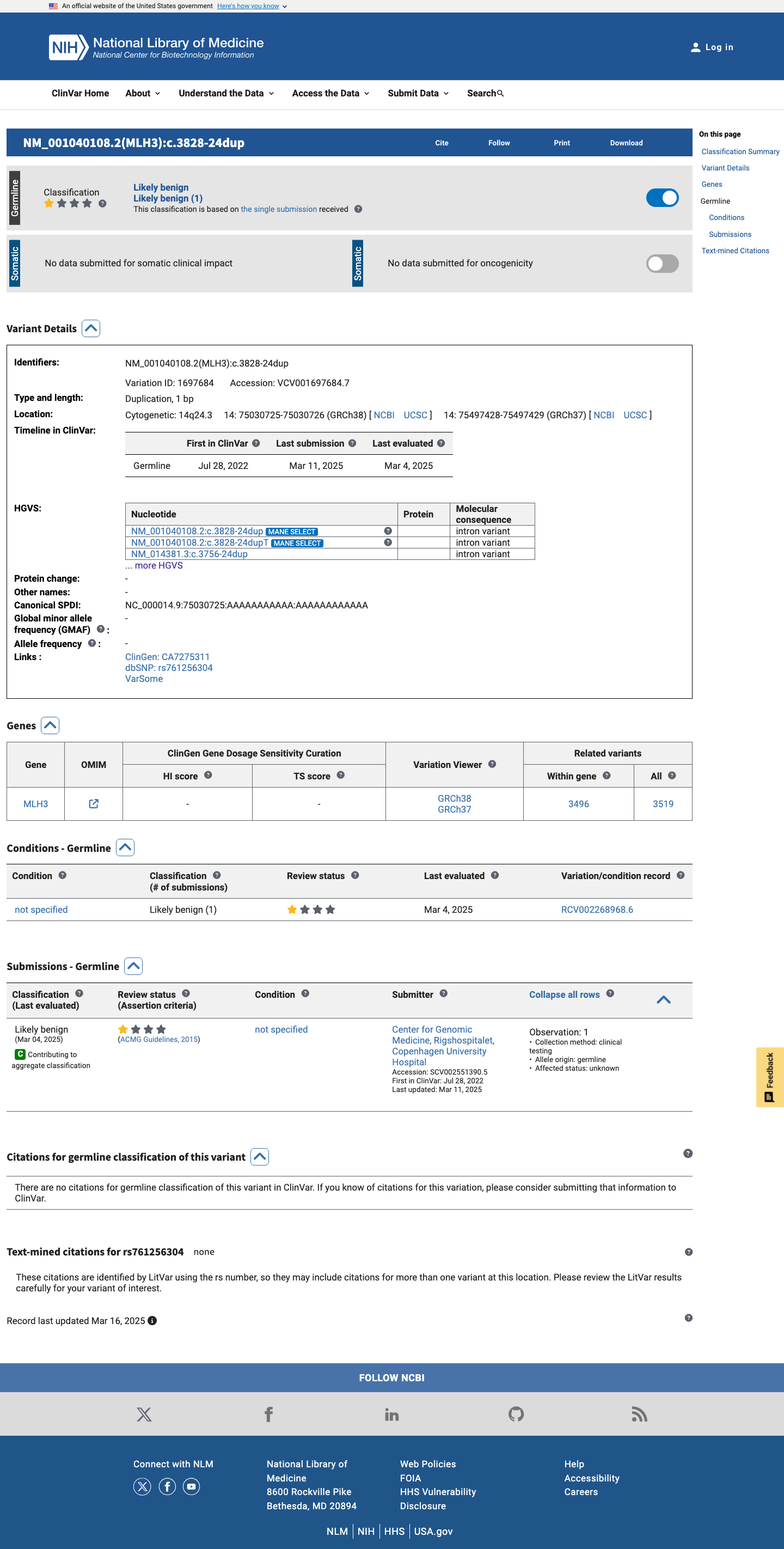
ClinVar screenshot
ClinVar
This variant has been reported in ClinVar as Likely benign (1 clinical laboratory). (ClinVarID = 1697684)
SpliceAI screenshot
In silico
SpliceAI predicts no significant splice impact for this variant (max delta score = 0.06).
Functional No data
No calibrated functional assay or RNA evidence was identified for this variant.
OncoKB ↗
COSMIC screenshot
COSMIC
Somatic evidence
COSMIC
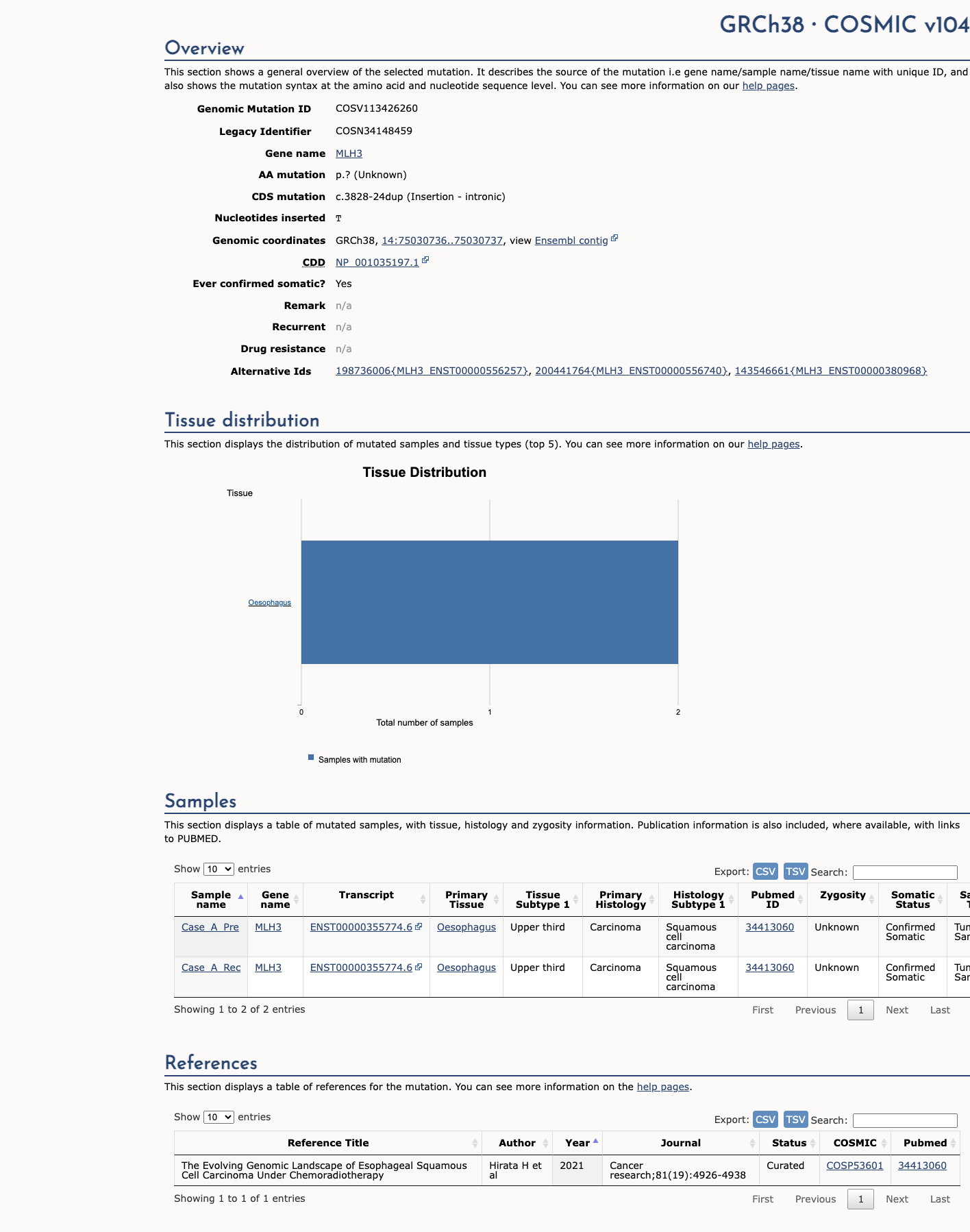
This variant has previously been reported in somatic cancers (COSMIC; COSV113426260, n = 2 times).
Hotspots
This variant does not lie in a statistically significant cancer hotspot.
COSMIC ↗
Literature · how each cited paper was used
1papers cited
Each card is an audit: what was searched, what was found, whether it names the variant, which criteria it fed, and why.
Rule & framework references · cited for criterion definitions, not variant evidence
25741868 ↗ Standards and guidelines for the interpretation of sequence variants: a joint consensus recommendation of the American College of Medical Genetics and Genomics and the Association for Molecular Pathology.
Sources & reference links
7Sources
ClinVar
gnomAD v2.1
gnomAD v4.1
gnomAD-Canada
SpliceAI
OncoKB
COSMIC