Back
NM_001042492.2:c.2092_2093insT
p.Pro698LeufsTer2 · NF1
0%
complete
Final classification
Likely Pathogenic
PVS1PM2
NF1
c.2092_2093insT
p.Pro698LeufsTer2
frameshift · exon 18

NF1 encodes neurofibromin, a tumor suppressor protein that negatively regulates the RAS signal transduction pathway. As a GTPase-activating protein, it helps switch RAS proteins from their active to inactive state, keeping cell growth in check; loss of NF1 function leaves RAS overactive and drives downstream growth pathways such as MAPK/ERK and PI3K. Inherited changes in NF1 cause the cancer-predisposition syndrome neurofibromatosis type 1, and are also linked to juvenile myelomonocytic leukemia and Watson syndrome. Somatic changes in NF1 are found in many tumor types, including breast cancer, melanoma, and glioma.

This variant

This NF1 frameshift is expected to cause loss of neurofibromin function, disrupting RAS pathway regulation relevant to inherited neurofibromatosis type 1.

Transcript
NM_001042492.2
HGVS · transcript:coding
NM_001042492.2:c.2092_2093insT
GRCh38
chr17:31226525 C>CT
GRCh37
chr17:29553543 C>CT
Likely Pathogenic: PVS1 (very strong) plus PM2 (supporting) satisfy the generic ACMG/AMP fallback with the ClinGen SVI PVS1-plus-supporting addendum.
Classification rationale
PVS1PM2 Likely Pathogenic
NF1 c.2092_2093insT frameshift · exon 18

PVS1 very strong: the exon 18 frameshift predicts p.(Pro698LeufsTer2), truncating NF1 at residue 699 of 2,840. PM2 supporting: the variant is absent from gnomAD v2.1 and v4.1, with observed allele frequency 0. Likely Pathogenic: PVS1 very strong plus PM2 supporting meet the applicable PVS1-plus-supporting combination addendum.

PVS1 + PM2 → Likely Pathogenic
LYFE Sciences is an AI system, and it can make mistakes. Criteria may be applied incorrectly, sources may be misread, and a confident-looking classification can still be wrong. Double-check every criterion and its underlying evidence before relying on any call.
Gene diagram · NM_001042492.2 · variants mapped to exon structure
NF1 NM_001042492.2
Fetching transcript structure from UCSC…
Applied criteria · 2 applied · 15 assessed
MetEvidence satisfies this criterion.
Not metEvaluated against available evidence; threshold not reached.
Not assessedApplies in principle, but no evidence was found to evaluate it.
N/ADoesn't apply to this variant type.
Applied · 2
Strength Supporting Moderate Strong Very strong
PVS1 very strong Pathogenic
Met at very strong: the exon 18 frameshift predicts p.(Pro698LeufsTer2), truncating NF1 at residue 699 of 2,840 with many downstream coding exons remaining.
The NF1 ClinGen CSPEC ruleset identifies NM_000267.3 as its preferred transcript but provides no criteria or PVS1-specific rule payload; therefore no gene-specific PVS1 downgrade rule is available.The ClinGen SVI PVS1 framework supports full-strength PVS1 for a loss-of-function frameshift when loss of function is an established disease mechanism, absent an NMD, transcript-relevance, critical-exon, or distal-region downgrade.NM_001042492.2:c.2092_2093insT is validated as a coding frameshift yielding NP_001035957.1:p.(Pro698LeufsTer2), with the predicted protein ending at residue 699 rather than the 2,840-residue reference length.
PM2 supporting Pathogenic
Met at supporting strength: observed frequency 0 in gnomAD v2.1 and v4.1 is below the PM2 threshold of 0.0001.
The NF1 ClinGen specification is the governing framework, but its retrieved ruleset provides no alternate PM2 threshold or population-source restriction.gnomAD v2.1 reports the variant as absent in the all-comers dataset.gnomAD v4.1 reports the variant as absent in the all-comers dataset.
Assessed · not applied · 4 not met · 11 not assessed
Pathogenic
PS2 Not assessed: no documented proband-parent genotype comparison or confirmed de novo status is available for this NF1 frameshift variant.
PS3 Not assessed: no validated functional assay for NF1 c.2092_2093insT or p.(Pro698LeufsTer2) was reported in the reviewed sources.
PS4 Not assessed: no exact-variant case-control counts, enrichment statistic, or applicable PS4 threshold is available.
PM6 Not assessed: no likely de novo occurrence based on parentage and phenotype is documented, and no meiosis or family evidence is available.
PP1 Not assessed: no affected-relative carrier data or informative cosegregation across meioses is documented for this NF1 variant.
PP4 Not assessed: the patient's phenotype and a disease-specific phenotype match are not documented in the available evidence.
PP5 Not met: ClinVar reports no exact-variant expert-panel Pathogenic or Likely pathogenic assertion for c.2092_2093insT.
Benign
BA1 Not met: the variant is absent from gnomAD v2.1 and v4.1, giving observed frequency 0 below the 0.05 BA1 threshold.
BS1 Not met: gnomAD v2.1 and v4.1 show observed frequency 0, below the generic BS1 threshold of 0.01.
BS2 Not assessed: no age-qualified healthy carriers, healthy homozygotes, penetrance data, or individual-level BS2 evidence are reported.
BS3 Not assessed: no validated benign-function assay for NF1 c.2092_2093insT or p.(Pro698LeufsTer2) was reported in the reviewed sources.
BS4 Not assessed: no unaffected relative with confirmed variant carriage and adequate clinical evaluation is documented to demonstrate non-segregation.
BP2 Not assessed: no affected-proband observation or phase-resolved pathogenic allelic partner is documented for the required in-trans BP2 configuration.
BP5 Not assessed: no alternative molecular diagnosis or applicable BP5 rule, metric, threshold, and operator is documented.
BP6 Not met: ClinVar reports no exact-variant expert-panel Benign or Likely benign assertion for c.2092_2093insT.
N/A · 11 PS1 · PM1 · PM3 · PM4 · PM5 · PP2 · PP3 · BP1 · BP3 · BP4 · BP7
Research & evidence
Population frequency · supports pathogenic
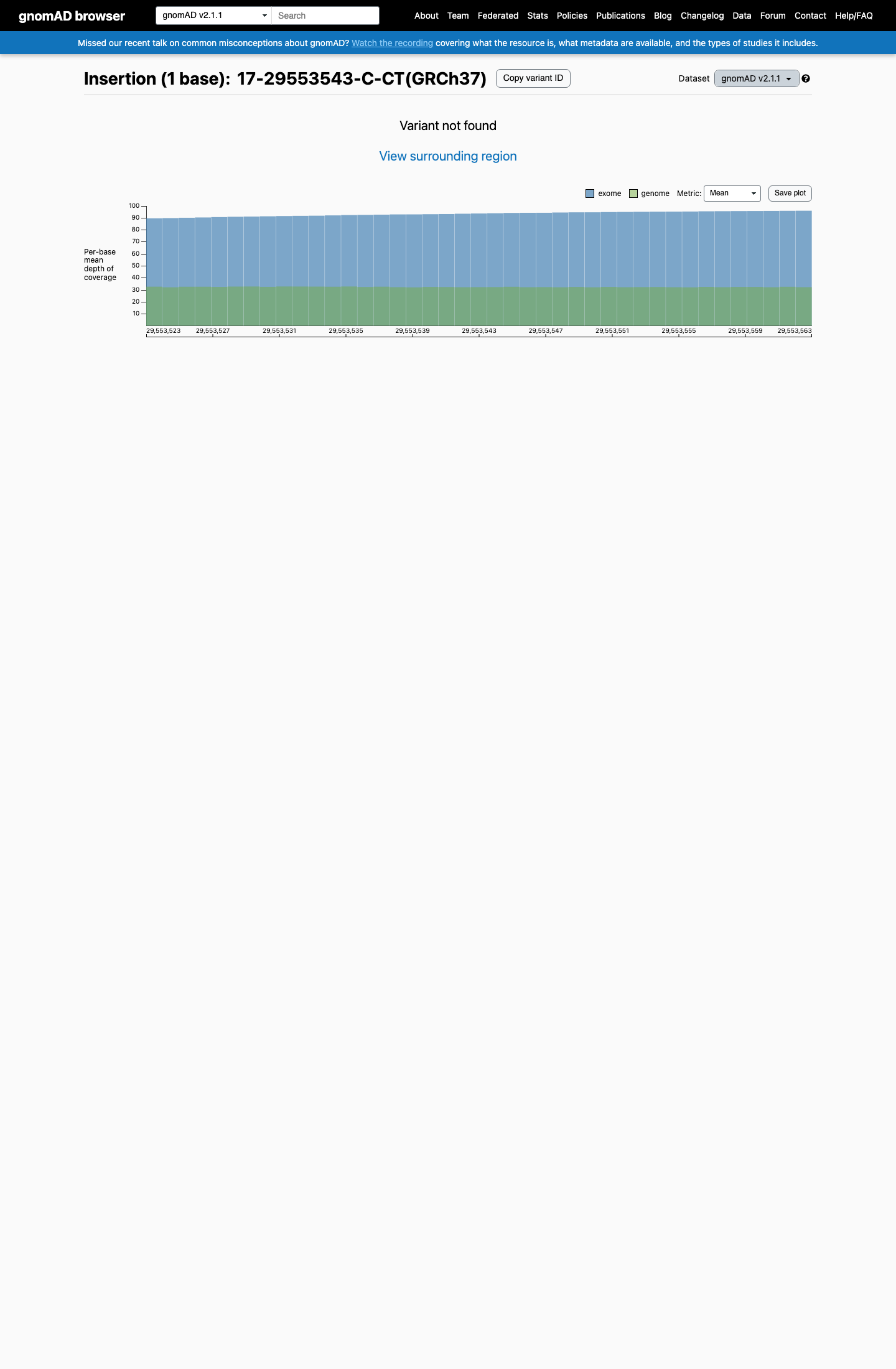
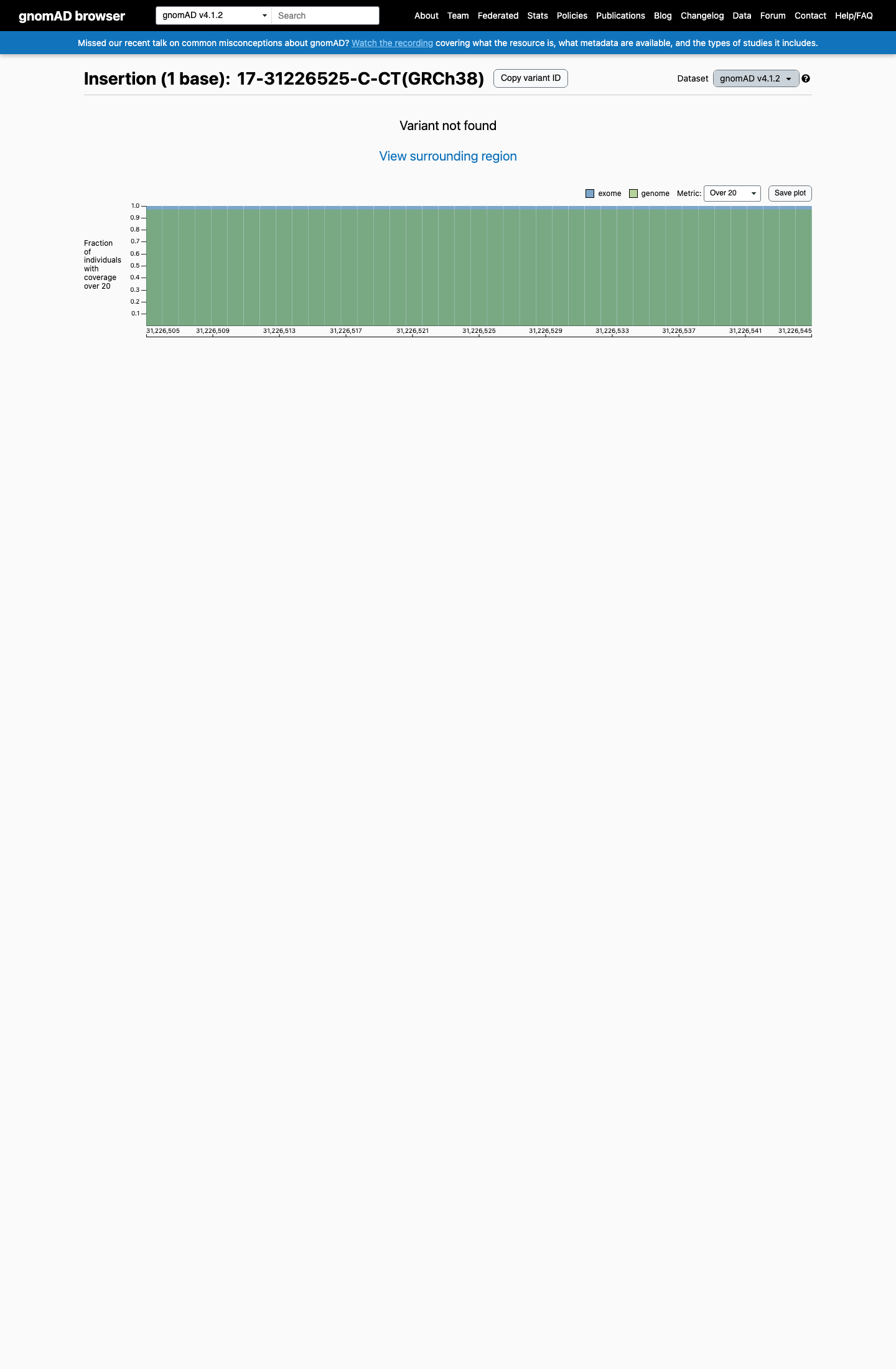
gnomAD v4.1 screenshot
gnomAD v4.1
gnomAD v2.1 screenshot
gnomAD v2.1
v4.1
Absent from gnomAD v4.1.
v2.1
Absent from gnomAD v2.1.
🇨🇦 CA
Absent from gnomAD-Canada v1.0.
Allele frequency by ancestry
three datasets · side by side
gnomAD v4.1
Absent · 0 / ?
0 hom
Not observed in any ancestry group.
gnomAD v2.1
Absent · 0 / ?
0 hom
Not observed in any ancestry group.
gnomAD Canada 🇨🇦
Absent · 0 / ?
0 hom
Not observed in any ancestry group.
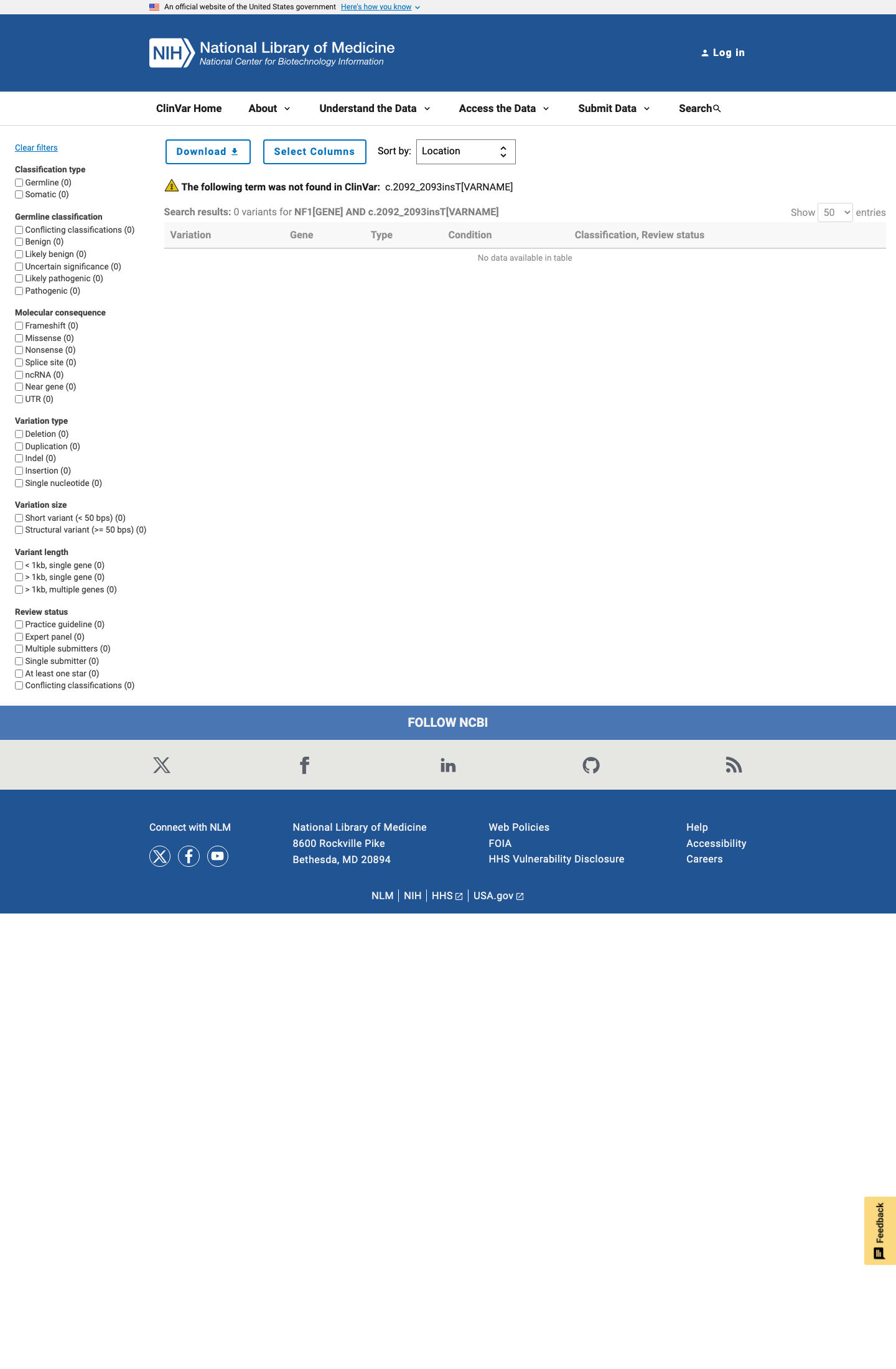
ClinVar screenshot
ClinVar
This variant is absent from ClinVar.
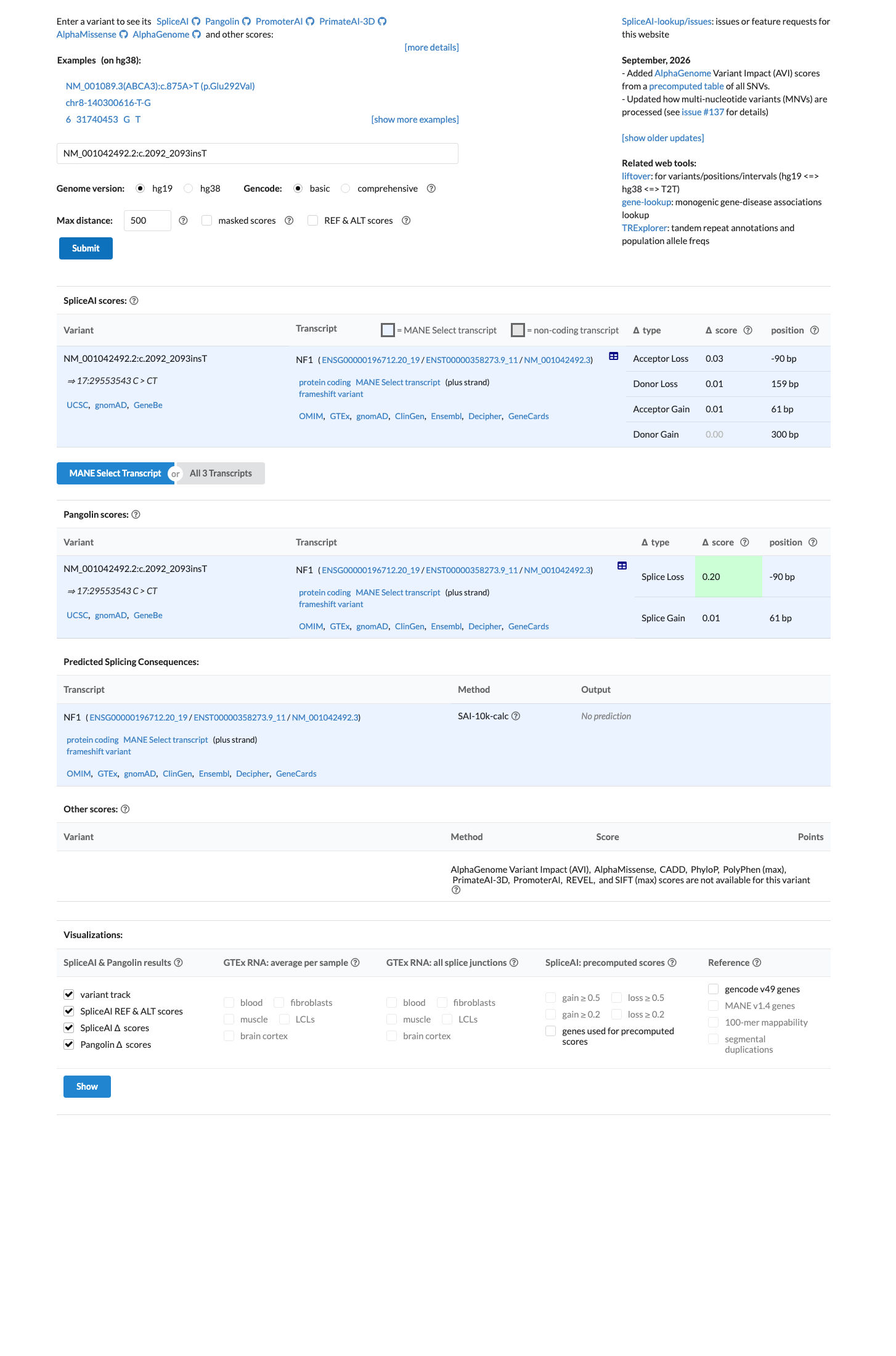
SpliceAI screenshot
In silico
SpliceAI predicts no significant splice impact for this variant (max delta score = 0.03).
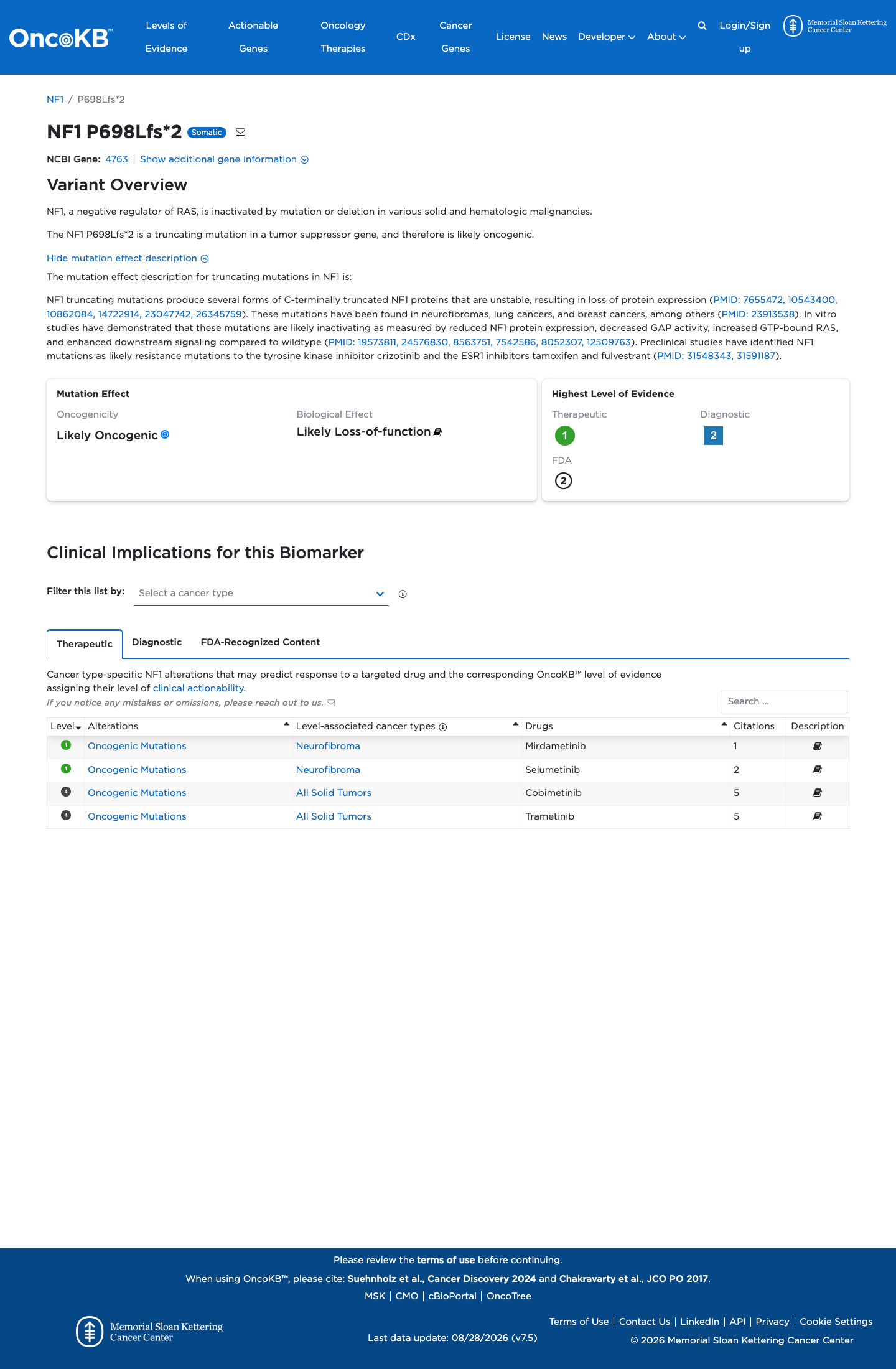
Functional / OncoKB screenshot
Functional Likely Oncogenic
OncoKB identified variant-specific curated literature and context relevant to functional review; biological-effect context: Likely Loss-of-function; curated oncogenicity label: Likely Oncogenic.
OncoKB ↗
COSMIC screenshot
COSMIC
Cancer hotspots screenshot
Cancer hotspots
Somatic evidence Not in COSMIC / hotspots
COSMIC
This variant does not lie in a statistically significant hotspot. This variant has not previously been reported in somatic cancers (COSMIC).
Hotspots
This variant does not lie in a statistically significant hotspot.
Sources & reference links
9Sources
CSpec VCEP
ClinVar
gnomAD v2.1
gnomAD v4.1
gnomAD-Canada
SpliceAI
OncoKB
COSMIC
Cancer hotspots
Triaged references · 5 PMIDs not cited in assessment
10543400 ↗ Evaluation of the protein truncation test and mutation detection in the NF1 gene: mutational analysis of 15 known and 40 unknown mutations. ONCOKB
10862084 ↗ Exhaustive mutation analysis of the NF1 gene allows identification of 95% of mutations and reveals a high frequency of unusual splicing defects. ONCOKB
12509763 ↗ Targeting RAS signalling pathways in cancer therapy. ONCOKB
14722914 ↗ Screening 500 unselected neurofibromatosis 1 patients for deletions of the NF1 gene. ONCOKB
19573811 ↗ Proteasomal and genetic inactivation of the NF1 tumor suppressor in gliomagenesis. ONCOKB