Analysis in progress
Initialising…
0%
complete
This report is still being assembled — sections appear as each stage finishes. It isn't final yet.
NF1
Final classification
VUS
PM2BP4
NF1
c.2190C>G
p.Asn730Lys
missense · exon 18

NF1 encodes neurofibromin, a tumor suppressor protein that negatively regulates the RAS signal transduction pathway. As a GTPase-activating protein, it helps switch RAS proteins from their active to inactive state, keeping cell growth in check; loss of NF1 function leaves RAS overactive and drives downstream growth pathways such as MAPK/ERK and PI3K. Inherited changes in NF1 cause the cancer-predisposition syndrome neurofibromatosis type 1, and are also linked to juvenile myelomonocytic leukemia and Watson syndrome. Somatic changes in NF1 are found in many tumor types, including breast cancer, melanoma, and glioma.

This variant

NF1 disease is predominantly caused by loss-of-function changes that leave RAS overactive, and this missense variant (p.Asn730Lys) falls outside that typical mechanism; computational predictors suggest a benign effect, yet its absence from population databases leaves a benign classification unconfirmed. As a variant of uncertain significance, it should not alone guide clinical decisions or cancer-risk assessment.

Transcript
NM_001042492.2
HGVS · transcript:coding
NM_001042492.2:c.2190C>G
GRCh38
chr17:31226623 C>G
GRCh37
chr17:29553641 C>G
Basis VUS: under the generic ACMG/AMP 2015 framework, only PM2 and BP4 (supporting) were met, with no pathogenic or benign criteria at higher strength.
VUS: under the generic ACMG/AMP 2015 framework, only PM2 and BP4 (supporting) were met, with no pathogenic or benign criteria at higher strength.
Classification rationale
PM2 BP4 VUS
NF1 c.2190C>G missense · exon 18

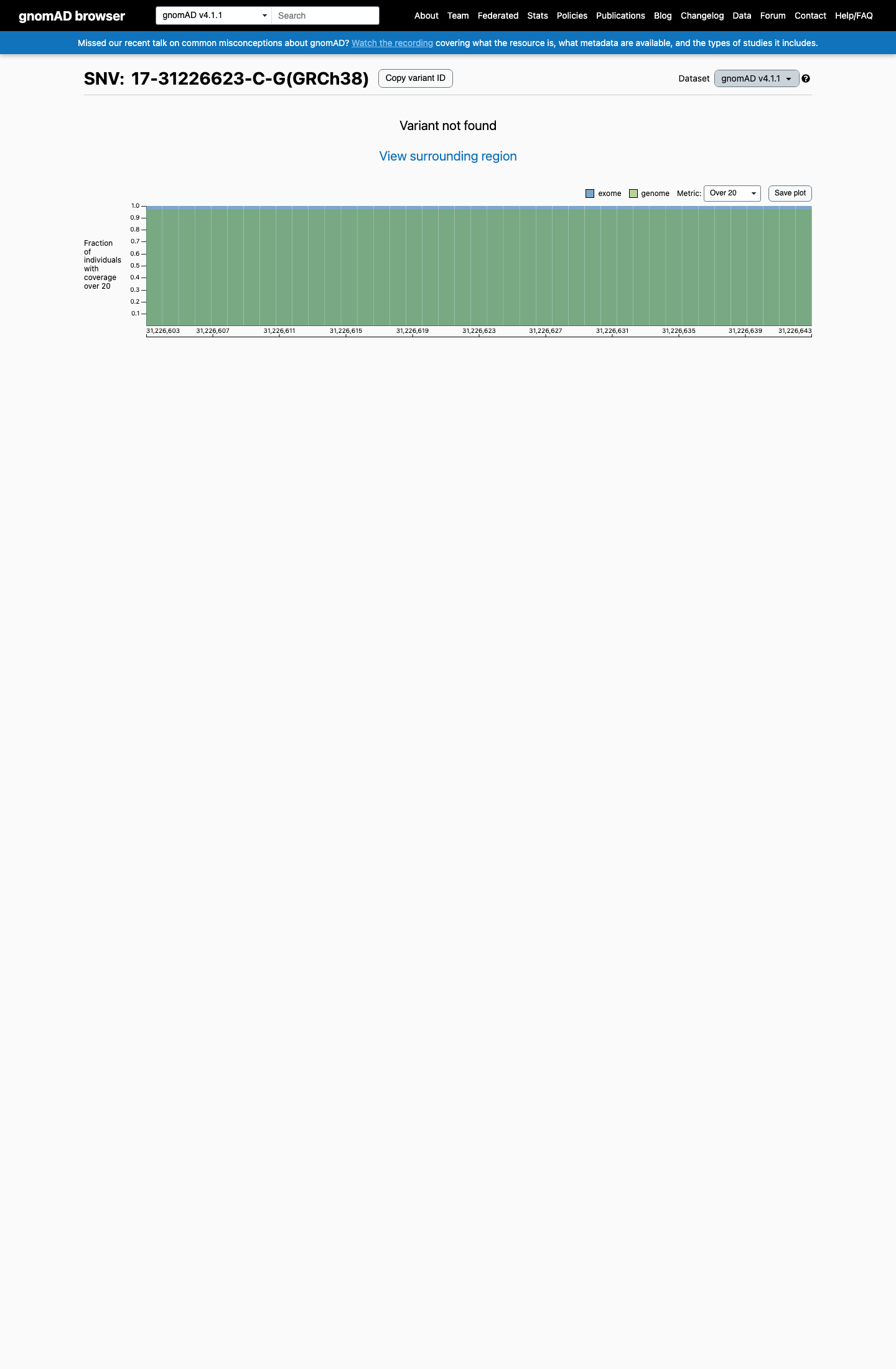
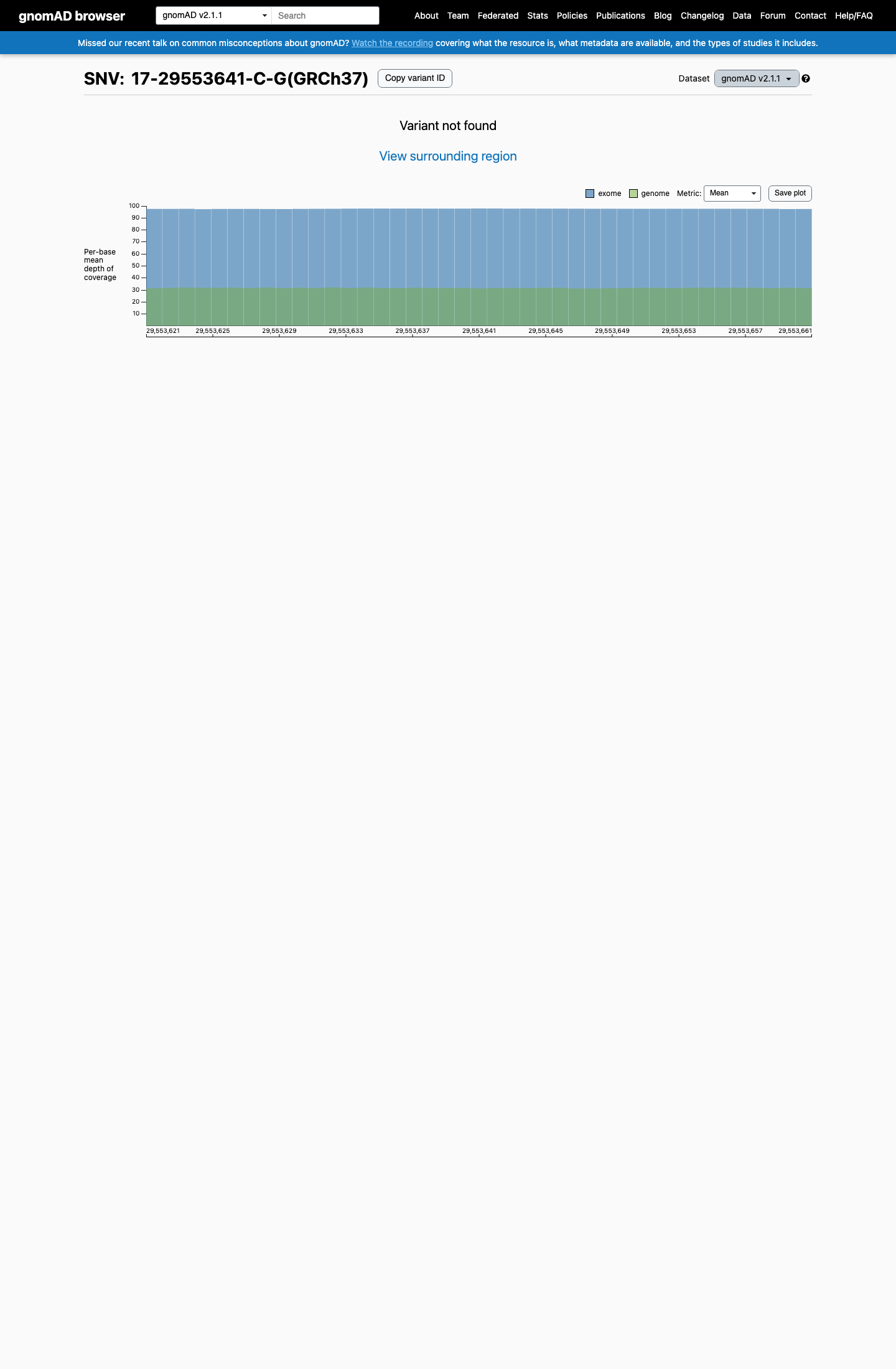
PM2 (Supporting): the variant is absent from gnomAD v2.1, v4.1, and gnomAD-Canada. BP4 (Supporting): SpliceAI max delta 0.002 and REVEL 0.06 both predict a benign effect. Classification: VUS - PM2 and BP4 at supporting strength are insufficient to reach the pathogenic or benign thresholds under the generic ACMG/AMP 2015 combination rules.

PM2 + BP4 VUS
Gene diagram · NM_001042492.2 · variants mapped to exon structure
NF1 NM_001042492.2
Fetching transcript structure from UCSC…
Applied criteria · 2 applied · 22 assessed
MetEvidence satisfies this criterion.
Not metEvaluated against available evidence; threshold not reached.
Not assessedApplies in principle, but no evidence was found to evaluate it.
N/ADoesn't apply to this variant type.
Applied · 2
Strength Supporting Moderate Strong Very strong
PM2 supporting Pathogenic
Met (supporting): absent from gnomAD v2.1, v4.1, and gnomAD-Canada.
The exact variant NM_001042492.2:c.2190C>G / NP_001035957.1:p.(Asn730Lys) is reported as absent from gnomAD v2.1.The exact variant is reported as absent from gnomAD v4.1.The exact variant is reported as absent from gnomAD-Canada v1.0.
BP4 supporting Benign
Met (supporting): SpliceAI max delta 0.002 and REVEL 0.06 both predict a benign effect.
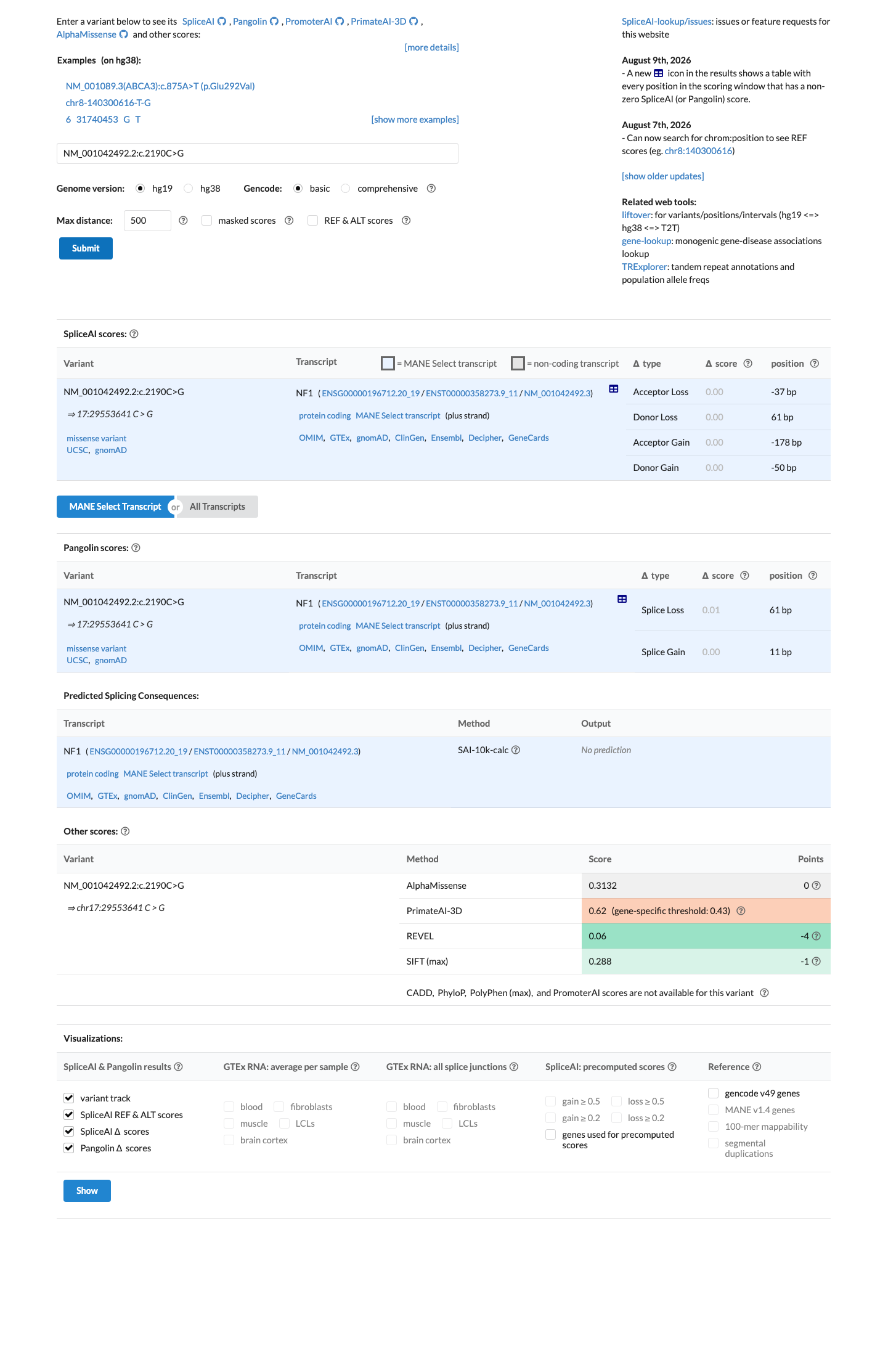
CSpec NF1 VCEP framework (doc 1553923915) has no gene-specific PP3/BP4 lookup table or rule_payload (framework_complete false), so generic ACMG BP4 logic applies.SpliceAI evidence_sentence: 'SpliceAI predicts no significant splice impact for this variant (max delta score = 0.00)'; individual deltas DS_AG=0.0, DS_AL=0.002, DS_DG=0.001, DS_DL=0.001 are all far below any splice-disruption threshold, supporting BP4 via the splice-impact path.REVEL score 0.06 (source_registry 'revel') is low and, per the published ClinGen SVI REVEL calibration (Pejaver et al. 2022, PMID 36413997), falls in the benign-supporting range for the missense in-silico path.
Assessed · not applied · 8 not met · 14 not assessed
Pathogenic
PS1 Not met: no ClinVar record exists for this variant or any alternate codon producing p.Asn730Lys.
PS2 Not assessed: no proband de novo observation or parental genotype data was available.
PS3 Not assessed: no functional assay data (e.g., Ras-GAP activity) for this variant was available.
PS4 Not assessed: no affected-case series or case-control enrichment data was available.
PM1 Not met: residue N730 lies in the N-HEAT scaffolding domain, not the GRD/RasGAP region containing the catalytic hotspot.
PM3 Not assessed: no second pathogenic allele, phase information, or segregation data was available.
PM5 Not assessed: no different missense change at Asn730 previously established as pathogenic was available.
PM6 Not assessed: no case report documenting the variant as presumed de novo was available.
PP1 Not assessed: no affected relatives or cosegregation observations were documented.
PP2 Not met: NF1 is predominantly truncating (48% nonsense vs 13% missense in one cohort), so missense is not a common disease mechanism.
PP3 Not met: SpliceAI max delta 0.002 and REVEL 0.06 both predict no damaging effect.
PP4 Not assessed: no patient phenotype or clinical features for this variant were available.
PP5 Not met: the variant is absent from ClinVar with no expert-panel classification.
Benign
BA1 Not met: absent from gnomAD v2.1, v4.1, and gnomAD-Canada, so no allele frequency exceeds the stand-alone benign threshold.
BS1 Not met: absent from gnomAD v2.1, v4.1, and gnomAD-Canada, so no allele frequency exceeds a disease-specific benign threshold.
BS2 Not assessed: no observations of unaffected homozygous adults for this variant were available.
BS3 Not assessed: no functional assay data demonstrating normal neurofibromin function was available.
BS4 Not assessed: no unaffected relatives tested for the variant were documented.
BP1 Not assessed: NF1 is predominantly truncating, but recurrent pathogenic missense in the GRD region prevents a reliable determination.
BP2 Not assessed: no observation of the variant in cis with a pathogenic variant or phase data was available.
BP5 Not assessed: no data establishing an alternative molecular cause was available.
BP6 Not met: the variant is absent from ClinVar with no expert-panel classification.
N/A · 4 PVS1 · PM4 · BP3 · BP7
Research & evidence
Population frequency
gnomAD v4.1 screenshot
gnomAD v4.1
gnomAD v2.1 screenshot
gnomAD v2.1
v4.1
Absent from gnomAD v4.1.
v2.1
Absent from gnomAD v2.1.
🇨🇦 CA
Absent from gnomAD-Canada v1.0.
Allele frequency by ancestry
three datasets · side by side
gnomAD v4.1
Absent · 0 / ?
0 hom
Not observed in any ancestry group.
gnomAD v2.1
Absent · 0 / ?
0 hom
Not observed in any ancestry group.
gnomAD Canada 🇨🇦
Absent · 0 / ?
0 hom
Not observed in any ancestry group.
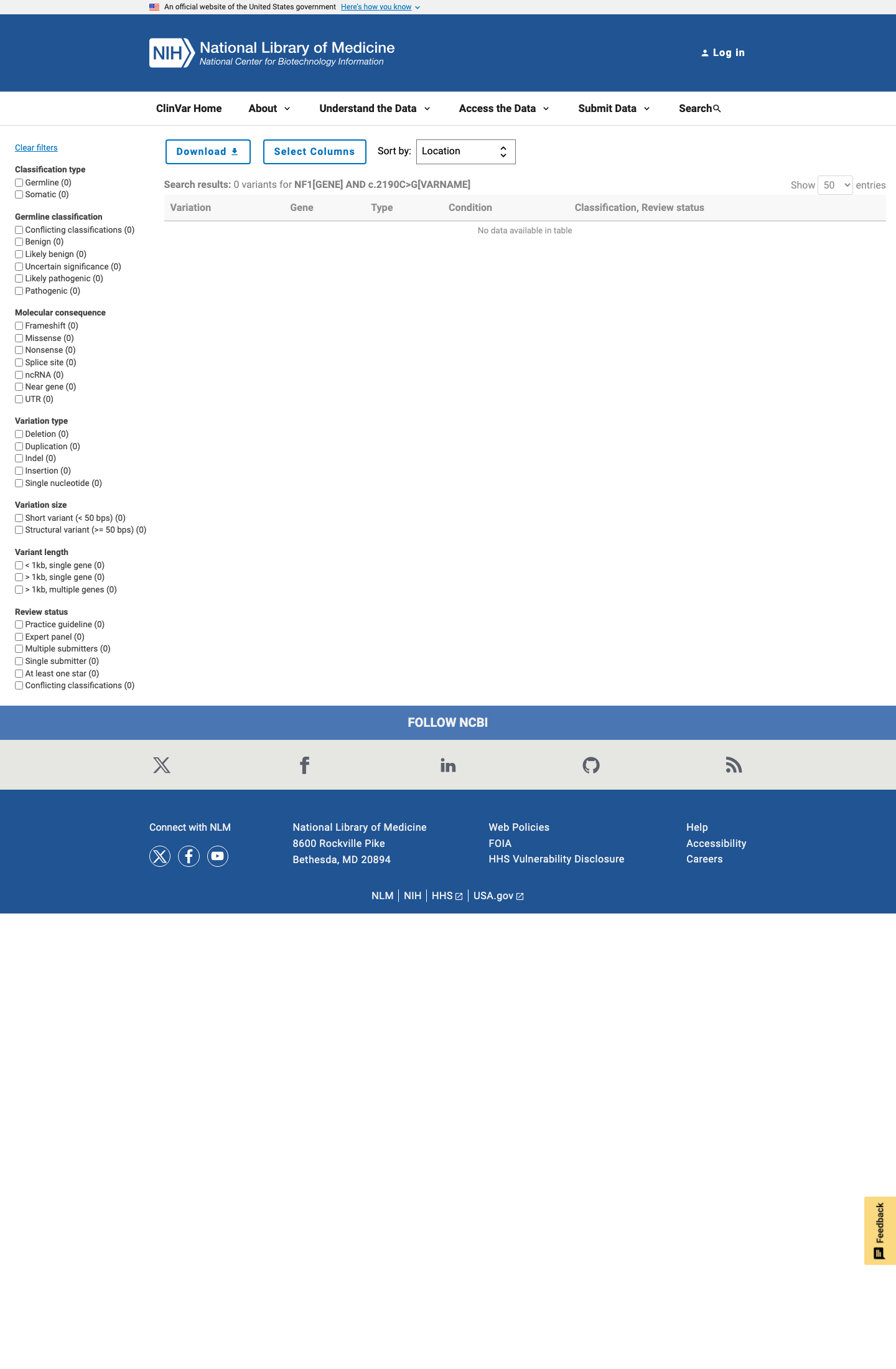
ClinVar screenshot
ClinVar
This variant is absent from ClinVar.
SpliceAI screenshot
In silico
SpliceAI predicts no significant splice impact for this variant (max delta score = 0.00). REVEL score = 0.06. BayesDel score = -0.61216.
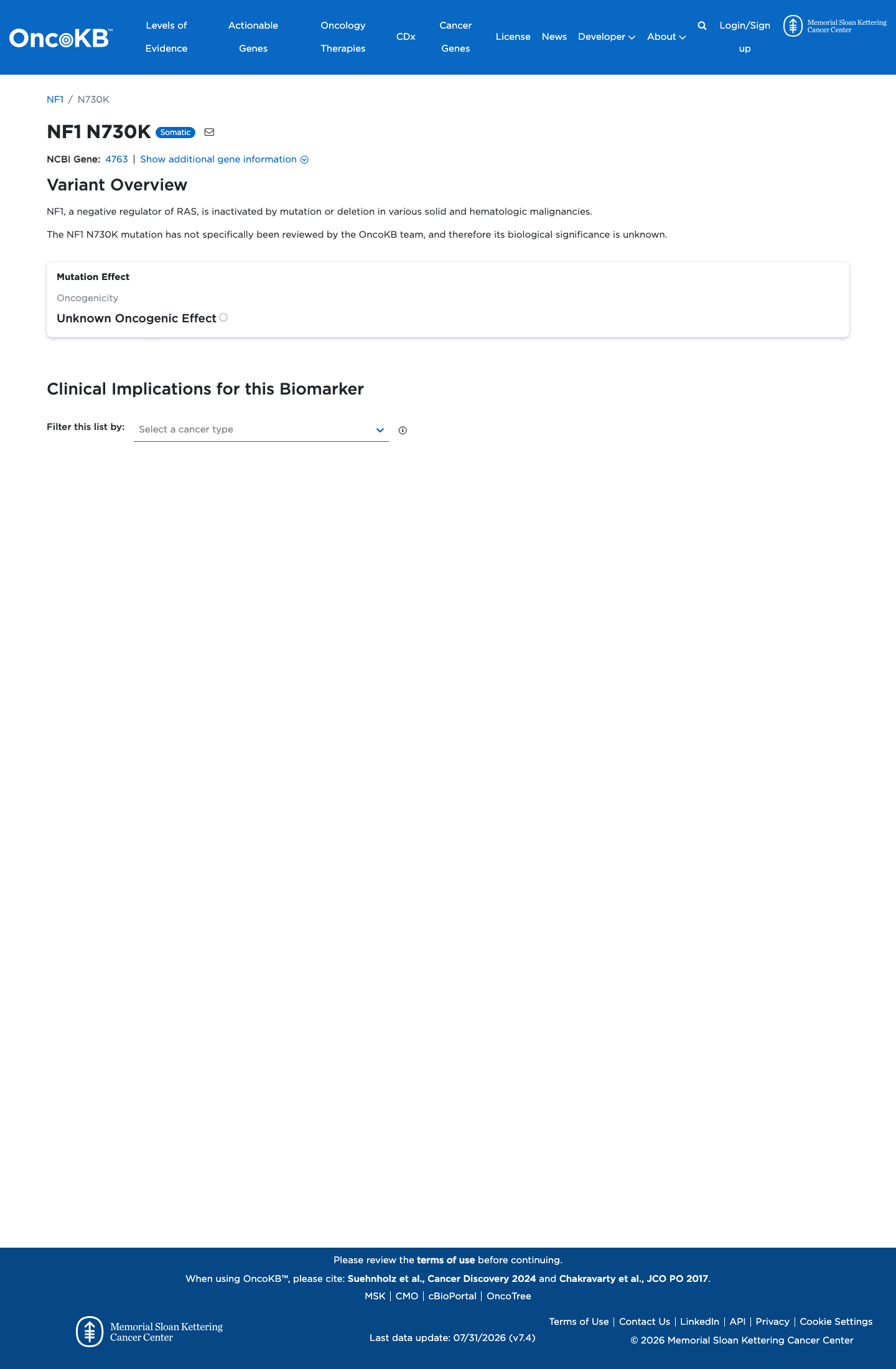
Functional / OncoKB screenshot
Functional Unknown Oncogenic Effect
OncoKB did not identify variant-specific reviewed functional evidence for this variant; gene-level curated context is available for reviewer follow-up. NF1, a negative regulator of RAS, is inactivated by mutation or deletion in various solid and hematologic malignancies.
OncoKB ↗
COSMIC screenshot
COSMIC
Cancer hotspots screenshot
Cancer hotspots
Somatic evidence Not in COSMIC / hotspots
COSMIC
This variant does not lie in a statistically significant hotspot. This variant has not previously been reported in somatic cancers (COSMIC).
Hotspots
This variant does not lie in a statistically significant hotspot.
Sources & reference links
9Sources
CSpec VCEP
ClinVar
gnomAD v2.1
gnomAD v4.1
gnomAD-Canada
SpliceAI
OncoKB
COSMIC
Cancer hotspots