Analysis in progress
Initialising…
0%
complete
This report is still being assembled — sections appear as each stage finishes. It isn't final yet.
NF1
Final classification
Benign
NF1 c.2544G>A · p.Gly848=
NF1 ·synonymous

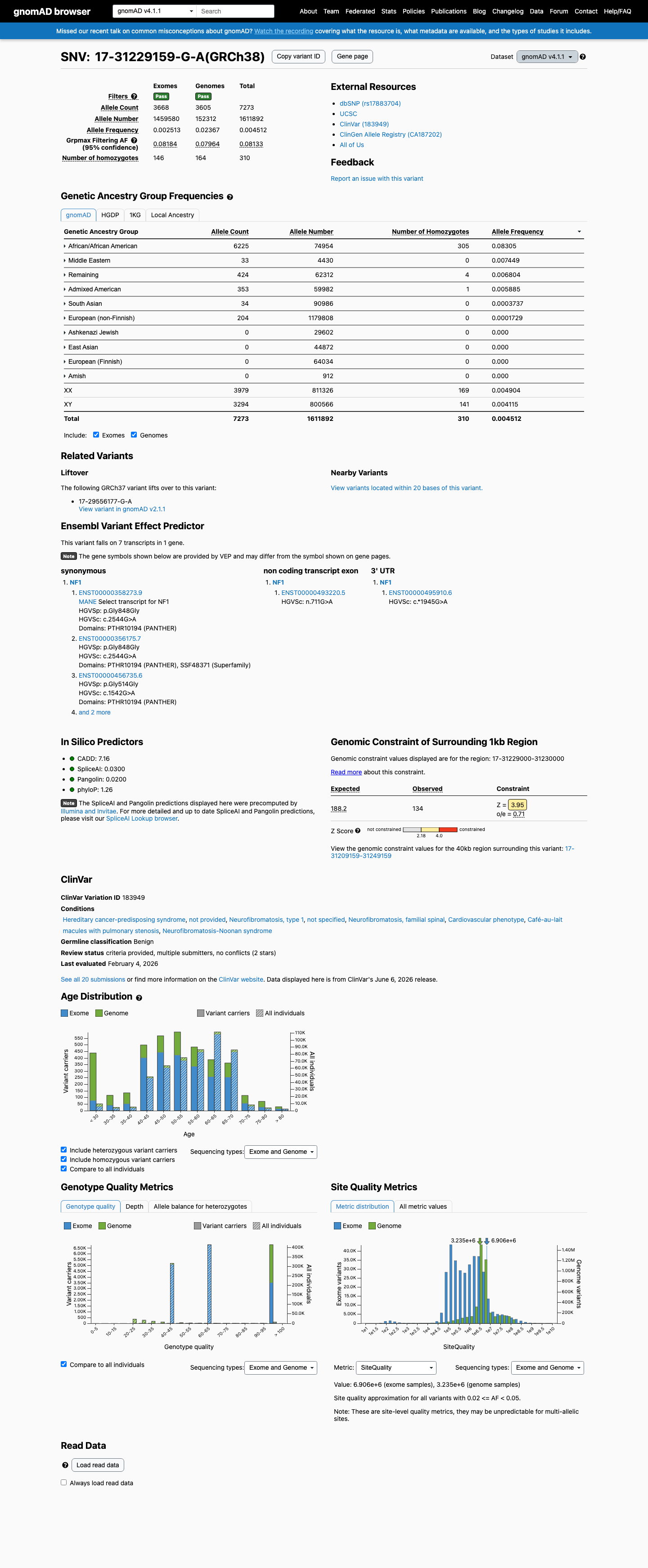
BA1 (Stand-alone): gnomAD v4.1 African/African American allele frequency 8.31% exceeds the >5% threshold.

Gene
NF1
Transcript
NM_001042492.2
HGVS · transcript:coding
NM_001042492.2:c.2544G>A
Consequence
synonymous
exon 21
GRCh38
chr17:31229159 G>A
GRCh37
chr17:29556177 G>A
Basis Benign: BA1 met as stand-alone evidence — gnomAD v4.1 African/African American allele frequency 8.31% exceeds the >5% threshold — with BS1, BS2, and BP4 also met.
Benign: BA1 met as stand-alone evidence — gnomAD v4.1 African/African American allele frequency 8.31% exceeds the >5% threshold — with BS1, BS2, and BP4 also met.
Classification rationale
BA1BS1BS2BP4 Benign
NF1 c.2544G>A synonymous · exon 21

BA1 (Stand-alone): gnomAD v4.1 African/African American allele frequency 8.31% exceeds the >5% threshold. BS1 (Strong): gnomAD v4.1 total allele frequency 0.45% is roughly 10–20-fold the ~0.02–0.05% expected for a pathogenic NF1 allele. BS2 (Strong): 310 homozygotes in gnomAD v4.1 despite NF1's near-complete penetrance by adulthood. BP4 (Supporting): SpliceAI max delta 0.079, below the 0.1 threshold for predicted splice impact. Overall: Benign — BA1 alone is sufficient under the generic ACMG/AMP 2015 rules, with two BS criteria independently satisfied as well.

BA1 + BS1 + BS2 + BP4 Benign
Gene diagram · NM_001042492.2 · variants mapped to exon structure
NF1 NM_001042492.2
Fetching transcript structure from UCSC…
Applied criteria · 4 applied · 15 assessed
Applied · 4
Strength Supporting Moderate Strong Very strong
BA1 stand-alone Benign
Met: gnomAD v4.1 African/African American allele frequency 8.31% exceeds the >5% stand-alone benign threshold.
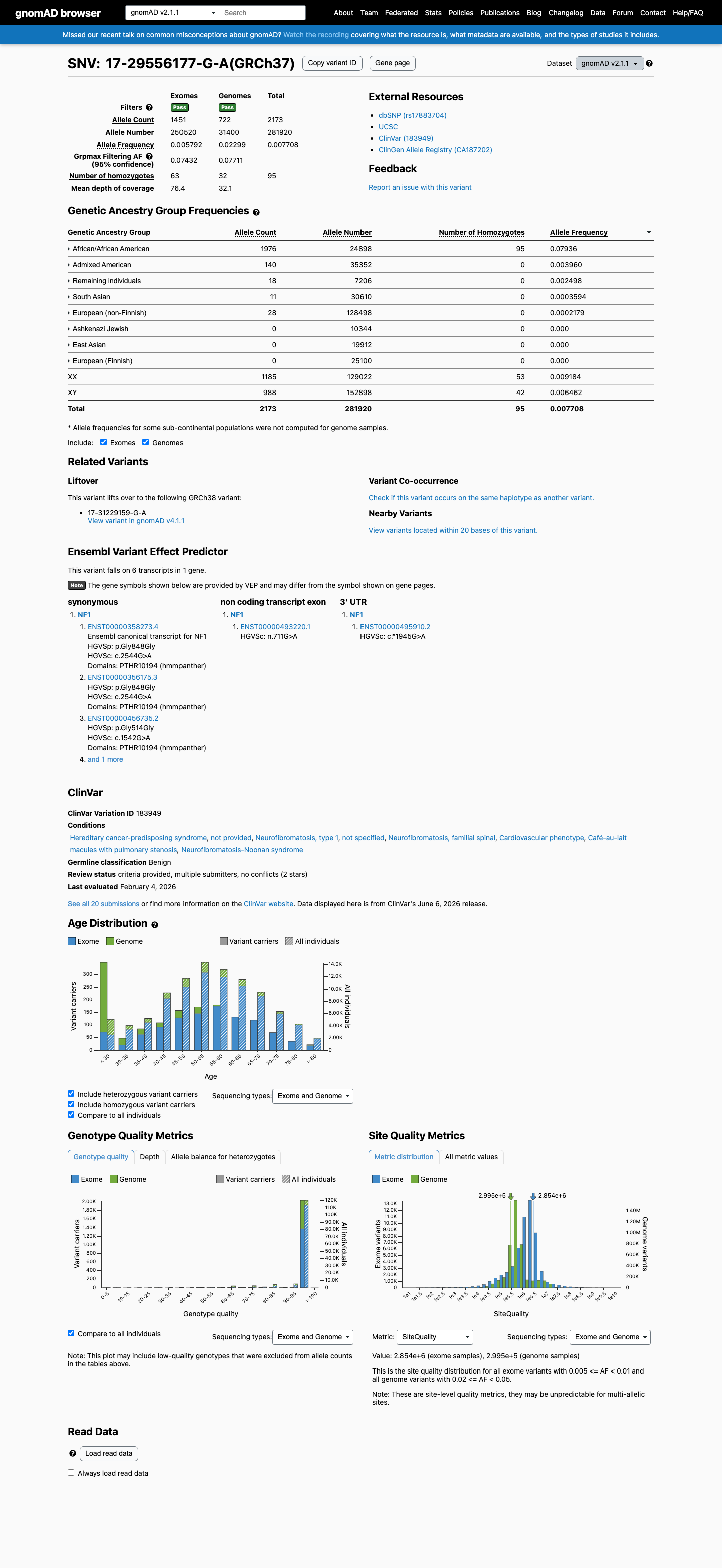
ACMG/AMP 2015 (PMID:25741868): 'In general, an allele frequency in a control population that is greater than expected for the disorder (Table 6) is considered strong support for a benign interpretation for a rare Mendelian disorder (BS1) or if over 5% then it is considered as stand-alone support (BA1).'gnomAD v4.1: AFR AF = 0.0830509 (6225/74954 alleles, 305 homozygotes), joint grpmax FAF = 0.0813264, total AF = 0.00451209 (7273/1611892) — AFR AF and grpmax FAF both exceed the >5% BA1 thresholdgnomAD v2.1: AFR AF = 0.0793638 (1976/24898 alleles, 95 homozygotes), grpmax FAF = 0.0771056, total AF = 0.00770786 (2173/281920) — AFR AF and grpmax FAF both exceed the >5% BA1 threshold
BS1 strong Benign
Met: gnomAD v4.1 total allele frequency 0.45%, far above the ~0.02–0.05% expected for a pathogenic NF1 allele.
ACMG/AMP 2015 (PMID:25741868): 'In general, an allele frequency in a control population that is greater than expected for the disorder (Table 6) is considered strong support for a benign interpretation for a rare Mendelian disorder (BS1) or if over 5% then it is considered as stand-alone support (BA1).'NF1 disease context: autosomal dominant, near-complete penetrance, prevalence ~1/3000 -> expected pathogenic allele frequency ~0.02-0.05%; observed gnomAD v4.1 total AF 0.0045 (0.45%) is ~10-20x expected and AFR AF 0.0831 is hundreds-fold above expectedgnomAD v2.1 total AF 0.0077 (0.77%) and AFR AF 0.0794 likewise far exceed the AF expected for NF1; gnomAD-Canada overall AF 0.0061 (0.61%) and AFR AF 0.10 corroborate
BS2 strong Benign
Met: 310 homozygotes observed in gnomAD v4.1 despite NF1's near-complete penetrance by adulthood.
ACMG/AMP 2015 (PMID:25741868): 'Furthermore, if the disease under investigation is fully penetrant at an early age and the variant is observed in a well-documented healthy adult individual for a recessive (homozygous), dominant (heterozygous), or X-linked (hemizygous) condition then this is considered strong evidence for a benign interpretation (BS2).'gnomAD v4.1: 310 homozygotes total (305 of 74954 AFR alleles), gnomAD v2.1: 95 homozygotes (all in AFR, 1976/24898 alleles), gnomAD-Canada v1.0: 5 homozygotes (112/18418 alleles) — homozygous observation of a fully penetrant dominant-disease allele at this scale strongly supports benignitygnomAD-Canada v1.0 age histogram for homozygotes shows carriers across ages 50-75 (age_hist_hom bins), consistent with healthy adult carriers
BP4 supporting Benign
Met: SpliceAI max delta 0.079, below the 0.1 threshold for predicted splice impact.
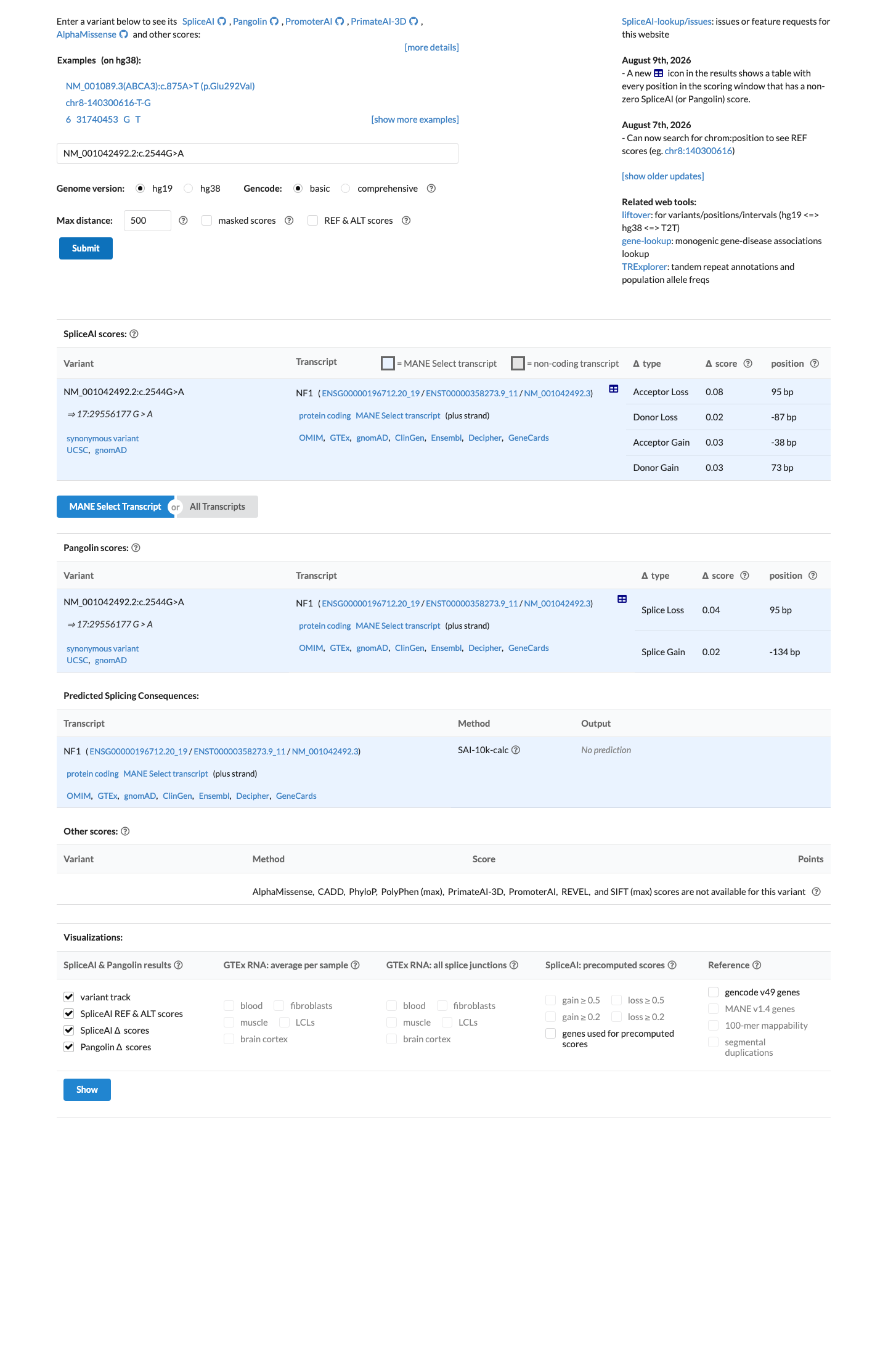
SpliceAI lookup (spliceai): DS_AG 0.029, DS_AL 0.079, DS_DG 0.032, DS_DL 0.016; max delta 0.079, with evidence sentence 'SpliceAI predicts no significant splice impact for this variant (max delta score = 0.08)'.Generic fallback calibration (generic_acmg_combination_rules): for synonymous (non-missense) variants use SpliceAI only; 'SpliceAI max delta < 0.1 -> BP4 (supporting)'. Max delta 0.079 < 0.1, so BP4 (supporting) is met (SVI-recommended thresholds; SpliceAI tool per Jaganathan et al. 2019, PMID 30661751).NF1 VCEP CSPEC (cspec) was consulted and carries no PP3/BP4 rule payload (criteria list empty, framework_complete=false); no gene-specific BP4 assignment overrides the generic calibration.
Assessed · not applied
Pathogenic
PS2 Not assessed: no proband or parental genotype data was available to confirm or exclude a de novo occurrence.
PS3 Not assessed: no well-established functional study of this variant was available.
PS4 Not assessed: no affected-versus-control prevalence data was available; control frequencies were high.
PM2 Not met: gnomAD v4.1 total allele frequency 0.45% — the variant is neither absent nor rare.
PM6 Not assessed: no proband or parental testing data was available to assume a de novo event.
PP1 Not assessed: no family, pedigree, or segregation data was available.
PP3 Not met: SpliceAI max delta 0.079 vs the >0.2 PP3 threshold.
PP4 Not assessed: no proband phenotype or family history data was available.
PP5 Not met: no ClinVar expert-panel pathogenic classification exists; all 20 submissions are from ordinary laboratories.
Benign
BS3 Not assessed: no functional assay evidence was available; unconfirmed in silico splice prediction does not qualify.
BS4 Not assessed: no affected family members were tested, so no non-segregation observations exist.
BP2 Not assessed: no cis/trans phase data was available.
BP5 Not assessed: no proband-level data was available to establish an alternate molecular basis.
BP6 Not met: the Benign ClinVar label reflects 20 ordinary laboratory submissions, not an expert panel.
BP7 Not assessed: no conservation score (e.g., PhyloP/GERP) was available to confirm the non-conservation requirement.
N/A · 9 PVS1 · PS1 · PM1 · PM3 · PM4 · PM5 · PP2 · BP1 · BP3
Research & evidence
Population frequency · supports benign
gnomAD v4.1 screenshot
gnomAD v4.1
gnomAD v2.1 screenshot
gnomAD v2.1
v4.1
This variant is present in gnomAD v4.1 (AF= 0.00451209; MAF= 0.45121%, 7273/1611892 alleles, homozygotes = 310) and has highest observed frequency in the African/African American population (AF= 0.0830509; MAF= 8.30509%, 6225/74954 alleles, homozygotes = 305); grpmax FAF= 0.0813264.
v2.1
This variant is present in gnomAD v2.1 (AF= 0.00770786; MAF= 0.77079%, 2173/281920 alleles, homozygotes = 95) and has highest observed frequency in the African/African American population (AF= 0.0793638; MAF= 7.93638%, 1976/24898 alleles, homozygotes = 95); grpmax FAF= 0.0771056.
🇨🇦 CA
This variant is present in gnomAD-Canada v1.0 (AF= 0.006081007709849061, 112/18418 alleles, homozygotes = 5).
Allele frequency by ancestry
three datasets · side by side
gnomAD v4.1
0.45% · 7273 / 1,611,892
310 hom · FAF 8.1%
African/African American
6225 / 74,954
8.3%
305 hom
Middle Eastern
33 / 4,430
0.74%
Remaining individuals
424 / 62,312
0.68%
4 hom
Admixed American
353 / 59,982
0.59%
1 hom
South Asian
34 / 90,986
0.037%
European (non-Finnish)
204 / 1,179,808
0.017%
+ 4 not observed (European (Finnish), Amish, East Asian, Ashkenazi Jewish)
gnomAD v2.1
0.77% · 2173 / 281,920
95 hom · FAF 7.7%
African/African American
1976 / 24,898
7.9%
95 hom
Admixed American
140 / 35,352
0.4%
Remaining individuals
18 / 7,206
0.25%
South Asian
11 / 30,610
0.036%
European (non-Finnish)
28 / 128,498
0.022%
+ 3 not observed (Ashkenazi Jewish, East Asian, European (Finnish))
gnomAD Canada 🇨🇦
0.61% · 112 / 18,418
5 hom · FAF 8.4%
African/African American
102 / 1,020
10%
5 hom
Middle Eastern
1 / 144
0.69%
Remaining individuals
5 / 1,138
0.44%
Latino/Admixed American
3 / 838
0.36%
European (non-Finnish)
1 / 11,740
0.0085%
+ 4 not observed (Ashkenazi Jewish, East Asian, European (Finnish), South Asian)
ClinVar screenshot
ClinVar
This variant has been reported in ClinVar as Benign (20 clinical laboratories). (ClinVarID = 183949)
SpliceAI screenshot
In silico
SpliceAI predicts no significant splice impact for this variant (max delta score = 0.08).
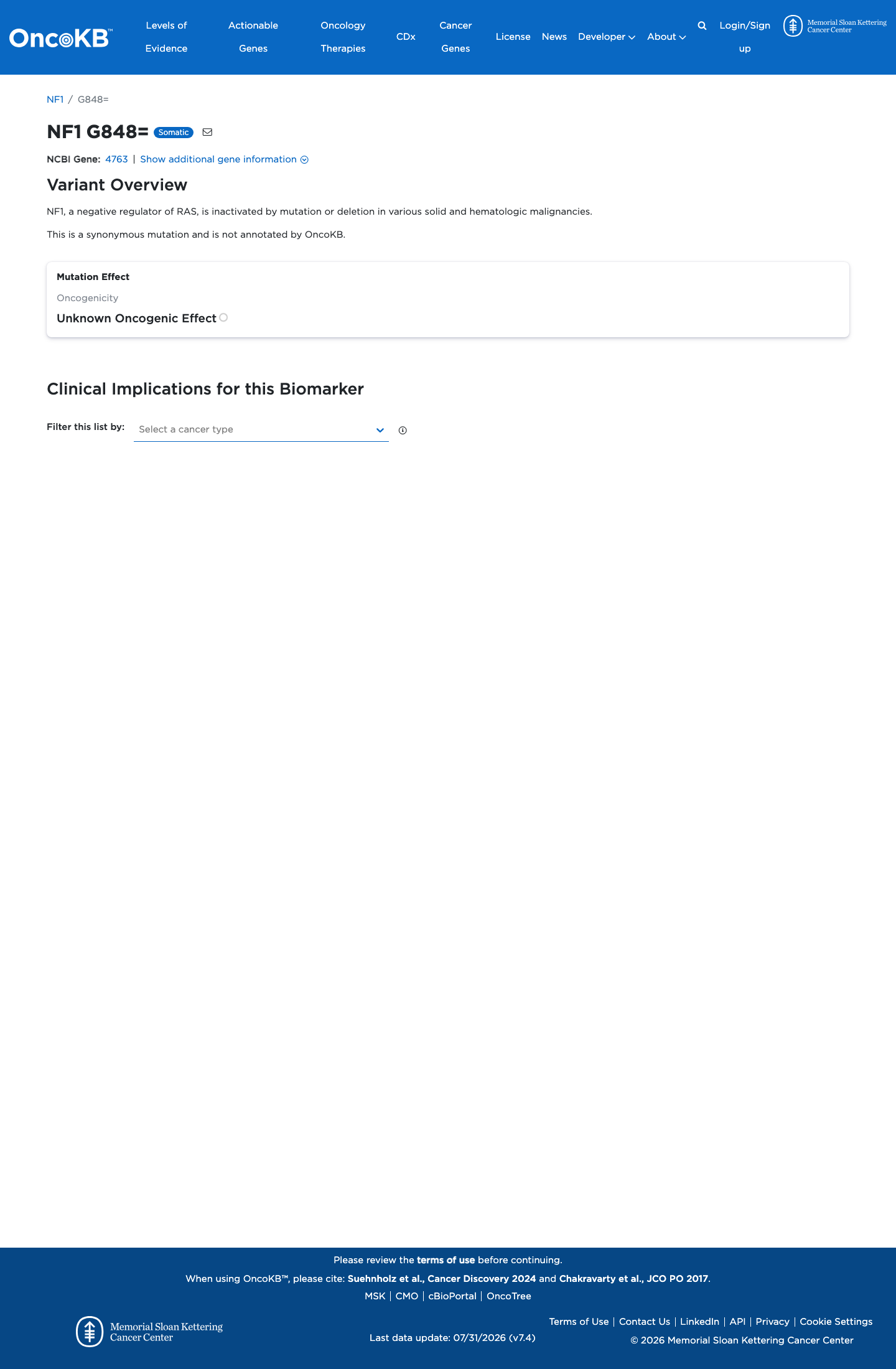
Functional / OncoKB screenshot
Functional Unknown Oncogenic Effect
OncoKB identified curated literature and non-variant-specific oncogenicity context for review; listed oncogenicity label: Unknown Oncogenic Effect.
OncoKB ↗
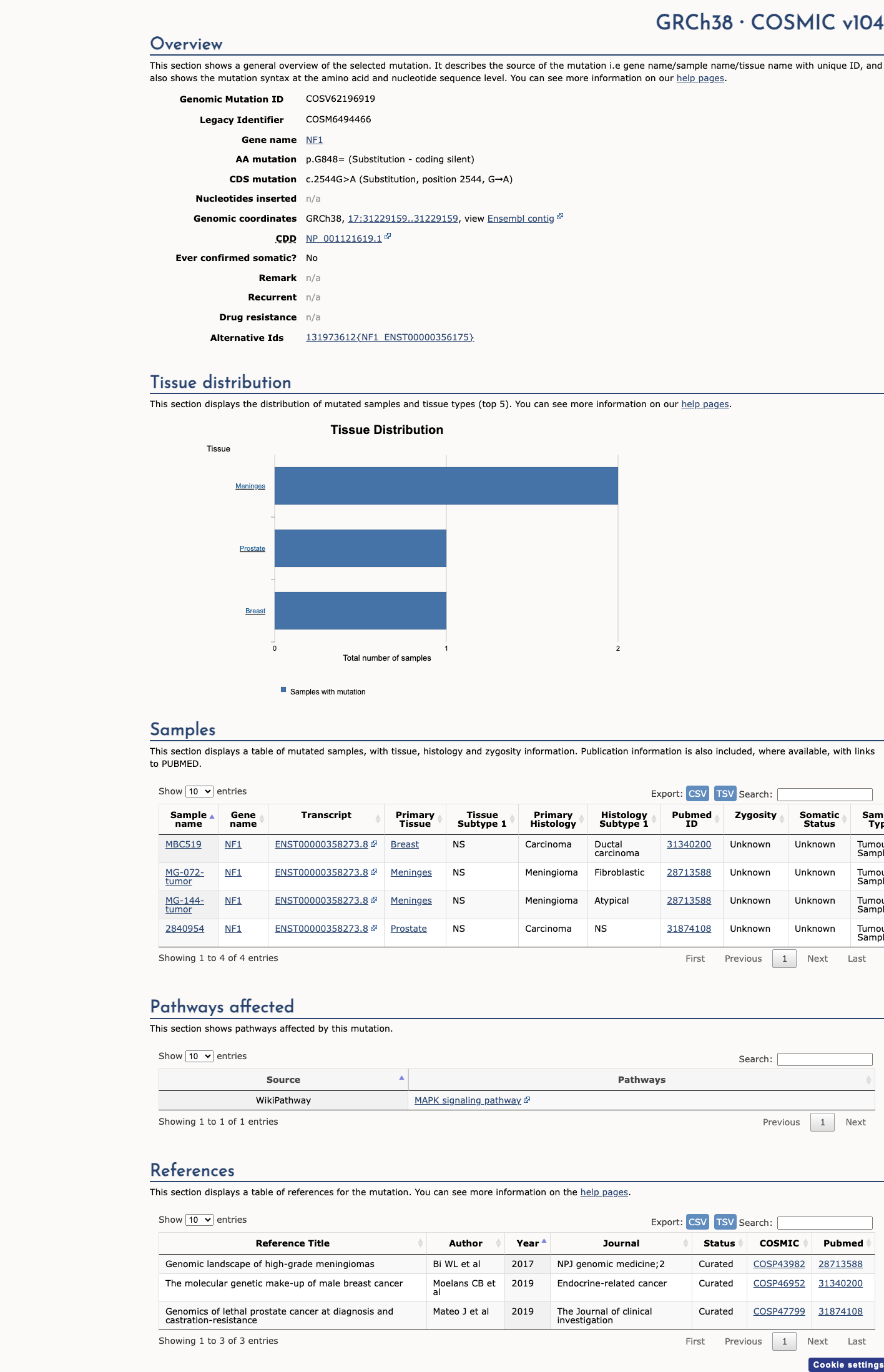
COSMIC screenshot
COSMIC
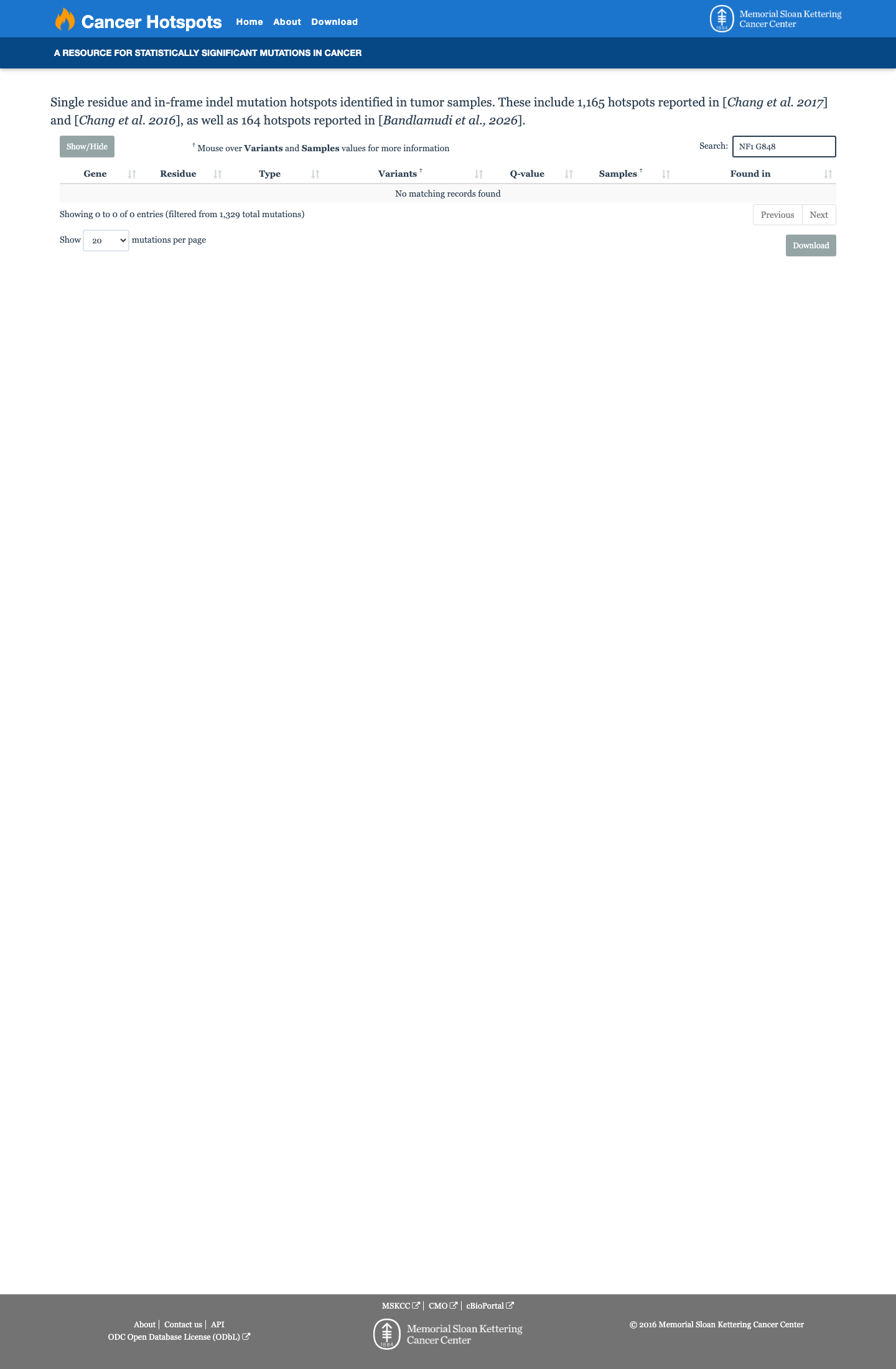
Cancer hotspots screenshot
Cancer hotspots
Somatic evidence Not in COSMIC / hotspots
COSMIC
This variant does not lie in a statistically significant hotspot. This variant has previously been reported in somatic cancers (COSMIC; COSV62196919, n = 4 times).
Hotspots
This variant does not lie in a statistically significant hotspot.
Literature · how each cited paper was used
1papers cited
Each card is an audit: what was searched, what was found, whether it names the variant, which criteria it fed, and why. 7 further PMIDs triaged but not cited — see Sources & References.
Rule & framework references · cited for criterion definitions, not variant evidence
25741868 ↗ Standards and guidelines for the interpretation of sequence variants: a joint consensus recommendation of the American College of Medical Genetics and Genomics and the Association for Molecular Pathology.
Sources & reference links
9Sources
CSpec VCEP
ClinVar
gnomAD v2.1
gnomAD v4.1
gnomAD-Canada
SpliceAI
OncoKB
COSMIC
Cancer hotspots
Triaged references · 7 PMIDs not cited in assessment
24033266 ↗ A systematic approach to assessing the clinical significance of genetic variants. CLINVAR
17636453 ↗ Neurofibromatosis type 1 in genetic counseling practice: recommendations of the National Society of Genetic Counselors. CLINVAR
25394175 ↗ A practice guideline from the American College of Medical Genetics and Genomics and the National Society of Genetic Counselors: referral indications for cancer predisposition assessment. CLINVAR
32602153 ↗ Genetic Counseling for Neurofibromatosis 1, Neurofibromatosis 2, and Schwannomatosis-Practice Resource of the National Society of Genetic Counselors. CLINVAR
24893135 ↗ Pheochromocytoma and paraganglioma: an endocrine society clinical practice guideline. CLINVAR
28492532 ↗ Sherloc: a comprehensive refinement of the ACMG-AMP variant classification criteria. CLINVAR
33939658 ↗ The North American Neuroendocrine Tumor Society Consensus Guidelines for Surveillance and Management of Metastatic and/or Unresectable Pheochromocytoma and Paraganglioma. CLINVAR