Analysis in progress
Initialising…
0%
complete
This report is still being assembled — sections appear as each stage finishes. It isn't final yet.
NF1
Final classification
Pathogenic
PVS1PM2PM6
NF1
c.4836-2A>G
p.?
canonical_splice · exon 36i

NF1 encodes neurofibromin, a tumor suppressor protein that negatively regulates the RAS signal transduction pathway. As a GTPase-activating protein, it helps switch RAS proteins from their active to inactive state, keeping cell growth in check; loss of NF1 function leaves RAS overactive and drives downstream growth pathways such as MAPK/ERK and PI3K. Inherited changes in NF1 cause the cancer-predisposition syndrome neurofibromatosis type 1, and are also linked to juvenile myelomonocytic leukemia and Watson syndrome. Somatic changes in NF1 are found in many tumor types, including breast cancer, melanoma, and glioma.

This variant

NF1 is a tumor suppressor whose loss leaves RAS overactive and drives the growth pathways behind neurofibromatosis type 1 and related cancers. This variant is predicted to disrupt NF1's canonical splice-acceptor site and trigger nonsense-mediated decay, a classic loss-of-function mechanism. Its Pathogenic classification therefore indicates a germline change expected to predispose to NF1-associated disease.

Transcript
NM_001042492.2
HGVS · transcript:coding
NM_001042492.2:c.4836-2A>G
GRCh38
chr17:31325818 A>G
GRCh37
chr17:29652836 A>G
Basis No NF1 VCEP combination framework was available, so generic ACMG/AMP 2015 rules apply: PVS1 (Very Strong) + PM2 (Moderate) + PM6 (Supporting) — overall Pathogenic.
No NF1 VCEP combination framework was available, so generic ACMG/AMP 2015 rules apply: PVS1 (Very Strong) + PM2 (Moderate) + PM6 (Supporting) — overall Pathogenic.
Classification rationale
PVS1PM2PM6 Pathogenic
NF1 c.4836-2A>G canonical_splice · exon 36i

PVS1 (Very Strong): disruption of the canonical splice-acceptor consensus predicted to trigger nonsense-mediated decay, in a gene with an established loss-of-function mechanism. PM2 (Moderate): the variant is absent from gnomAD v2.1 and v4.1. PM6 (Supporting): de novo origin reported by one ClinVar submission, unconfirmed by parental testing. Overall classification: Pathogenic — PVS1 + PM2 + PM6 under generic ACMG/AMP 2015 rules.

PVS1 + PM2 + PM6 Pathogenic
Gene diagram · NM_001042492.2 · variants mapped to exon structure
NF1 NM_001042492.2
Fetching transcript structure from UCSC…
Applied criteria · 3 applied · 15 assessed
MetEvidence satisfies this criterion.
Not metEvaluated against available evidence; threshold not reached.
Not assessedApplies in principle, but no evidence was found to evaluate it.
N/ADoesn't apply to this variant type.
Applied · 3
Strength Supporting Moderate Strong Very strong
PVS1 very strong review Pathogenic
Met (Very Strong): disruption of the canonical splice-acceptor consensus in NF1, a gene with an established loss-of-function disease mechanism, predicted to trigger nonsense-mediated decay.
pvs1_variant_assessment.json classifies this variant as consequence_class='canonical_splice', canonical_splice_consensus=true, variant_bucket='canonical_splice', and states 'This variant affects a canonical +/-1,2 splice consensus position. Under PMC6185798, canonical splice variants are evaluated with the generic PVS1 framework once germline loss of function is established for the gene...' with suggested_default_strength='PVS1'.prefetch.json variant_exonic_positions for NC_000017.10/NC_000017.11/NG_009018.1 all report start_exon='36i' and end_exon='36i', confirming the variant lies in the intron flanking exon 36 (consistent with a canonical acceptor-site position, c.4836-2).pvs1_gene_context.json states lof_mechanism_supported=true and pvs1_gene_gate='eligible', with mechanism_rationale: 'Targeted germline literature review identified disease-focused publications supporting NF1 loss of function as a germline disease mechanism, so generic PVS1 framework assessment is eligible.'
PM2 moderate Pathogenic
Met (Moderate): the variant is absent from gnomAD v2.1 and v4.1, so no population allele frequency supports a benign role.
gnomAD v2.1 (GRCh37 17-29652836-A-G), gnomAD v4.1 (GRCh38 chr17-31325818-A-G), and gnomAD-Canada v1.0 each report the exact variant as absent.The retrieved NF1 CSPEC material has no population-criterion rule payload, so no applicable NF1-specific PM2 strength modification was available.Richards et al. state that absence from a large general population or control cohort can be considered moderate pathogenic evidence, while noting that database read depth should be confirmed.
PM6 supporting review Pathogenic
Met (Supporting): one clinical-testing submission in ClinVar reports de novo origin. Parental genotypes and parentage confirmation are absent, so this is assumed de novo evidence pending laboratory review.
ClinVar variation 2573197 exactly matches NF1 c.4836-2A>G. SCV004015019, a single-submitter clinical-testing record, lists origin as de novo; no parental genotype or parentage-confirmation data are supplied in the case bundle.The retrieved NF1 CSPEC record has no criterion-specific content for PM6; generic ACMG/AMP PM6 logic was used for assumed, unconfirmed de novo occurrence.
Assessed · not applied · 6 not met · 9 not assessed
Pathogenic
PS2 Not assessed: a ClinVar submission reports de novo origin, but parental genotypes and parentage confirmation are absent.
PS3 Not assessed: no validated functional assay data (RNA, minigene, or protein-function) for this variant were available.
PS4 Not assessed: no case-control study or enrichment statistic for this exact variant was available.
PP1 Not assessed: no familial genotypes, phenotypes, or cosegregation data were available.
PP4 Not assessed: no individual-level phenotype data for the tested person were available.
PP5 Not met: only clinical-laboratory submissions exist in ClinVar for this exact variant; no expert-panel assertion supports PP5.
Benign
BA1 Not met: the variant is absent from gnomAD v2.1 and v4.1, so its allele frequency of 0 is far below the >5% BA1 threshold.
BS1 Not met: the variant is absent from gnomAD v2.1 and v4.1, so no allele frequency exceeds that expected for NF1.
BS2 Not met: no healthy adult carriers of this variant are reported, so the benign-observation criterion cannot be met.
BS3 Not assessed: no functional assay data of any kind for this variant were available.
BS4 Not assessed: no family data showing unaffected carriers or affected non-carriers were available.
BP2 Not assessed: no observation of this variant in trans with a pathogenic variant was available.
BP4 Not met: SpliceAI predicts a strong splice-altering effect (max delta 0.989), the opposite direction of a benign-supporting prediction.
BP5 Not assessed: no alternate molecular diagnosis fully explaining the phenotype was documented.
BP6 Not met: ClinVar contains no expert-panel benign assertion for this exact variant.
N/A · 10 PS1 · PM1 · PM3 · PM4 · PM5 · PP2 · PP3 · BP1 · BP3 · BP7
Research & evidence
Population frequency · supports pathogenic
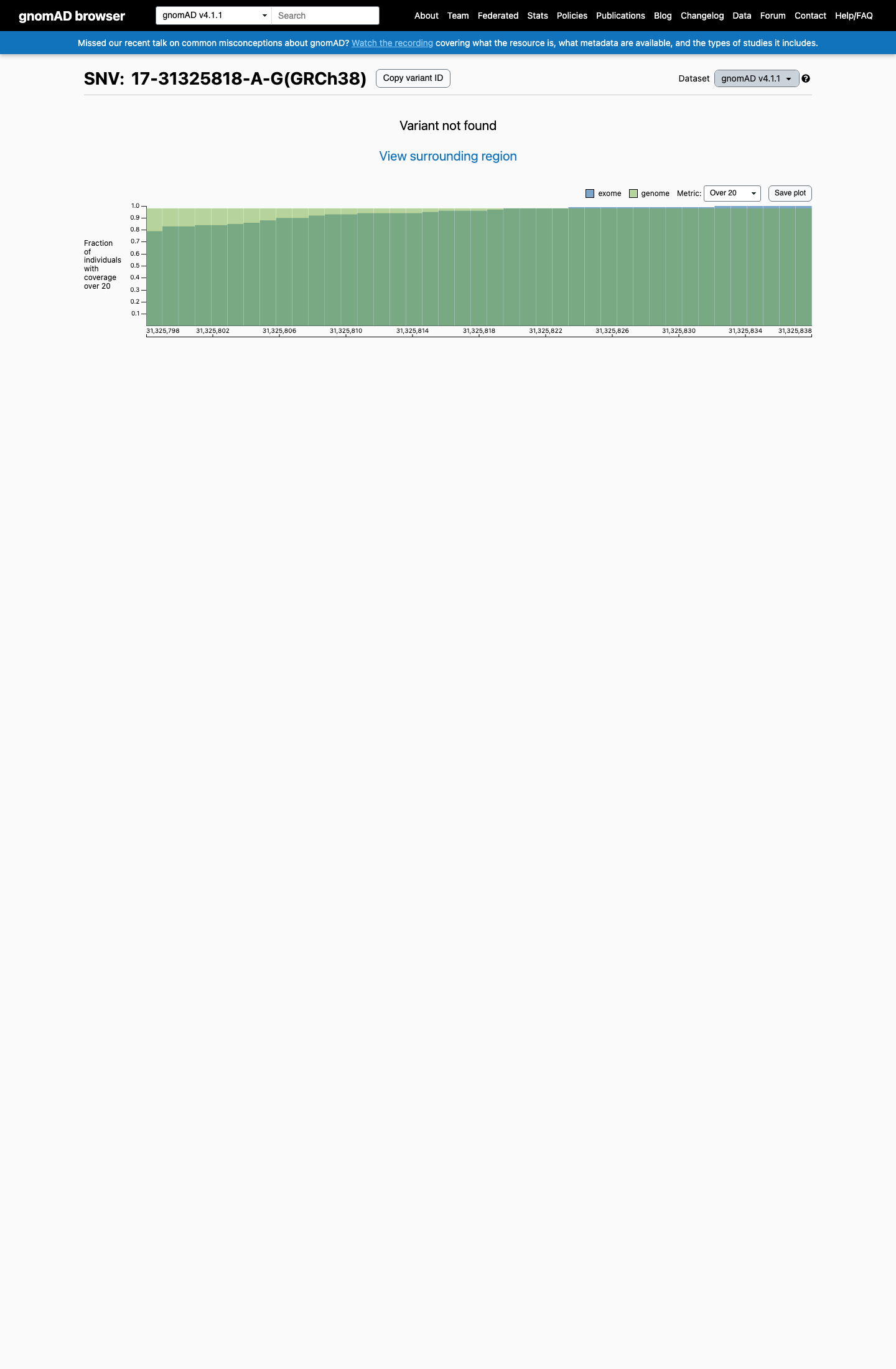
gnomAD v4.1 screenshot
gnomAD v4.1
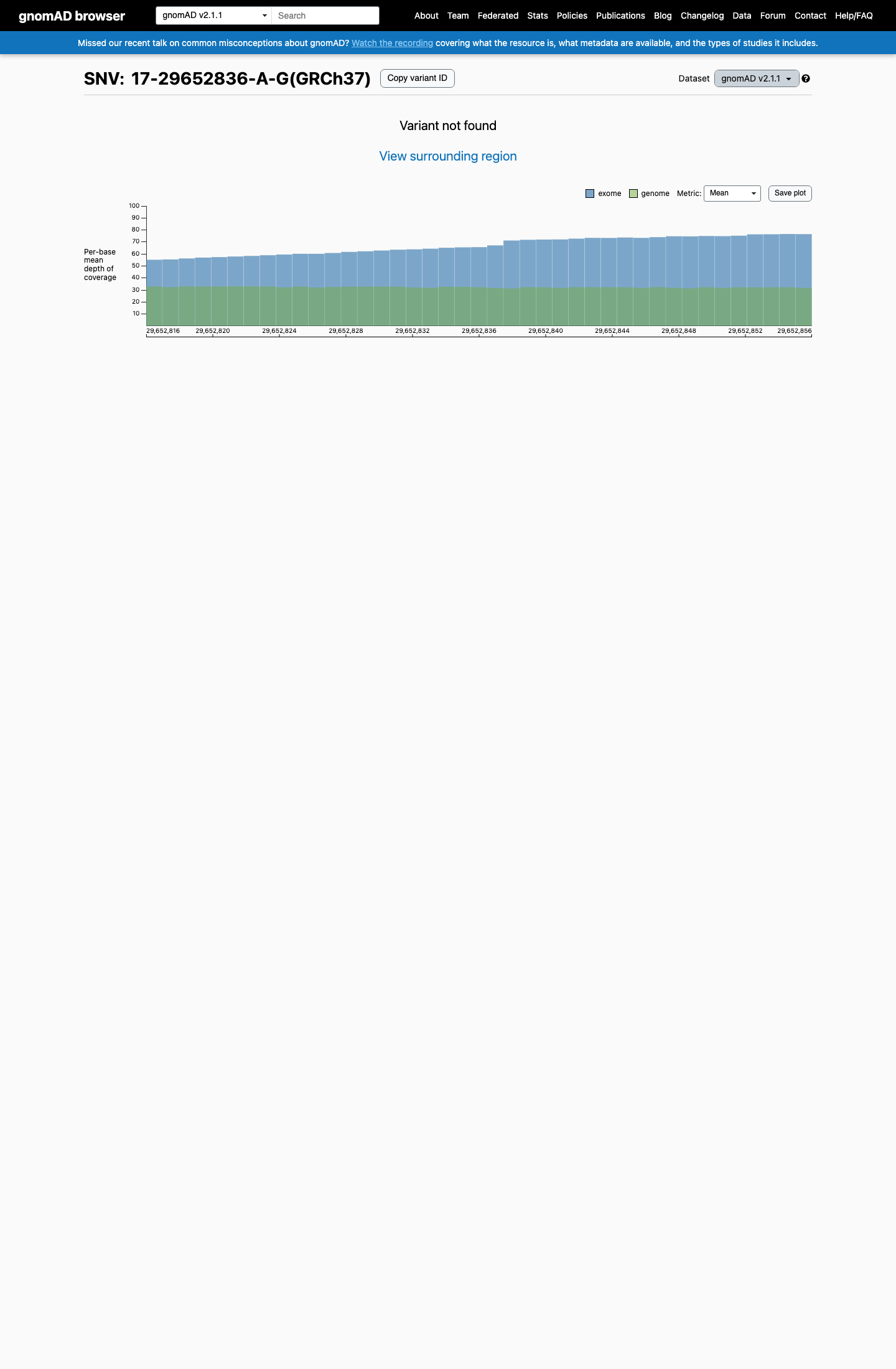
gnomAD v2.1 screenshot
gnomAD v2.1
v4.1
Absent from gnomAD v4.1.
v2.1
Absent from gnomAD v2.1.
🇨🇦 CA
Absent from gnomAD-Canada v1.0.
Allele frequency by ancestry
three datasets · side by side
gnomAD v4.1
Absent · 0 / ?
0 hom
Not observed in any ancestry group.
gnomAD v2.1
Absent · 0 / ?
0 hom
Not observed in any ancestry group.
gnomAD Canada 🇨🇦
Absent · 0 / ?
0 hom
Not observed in any ancestry group.
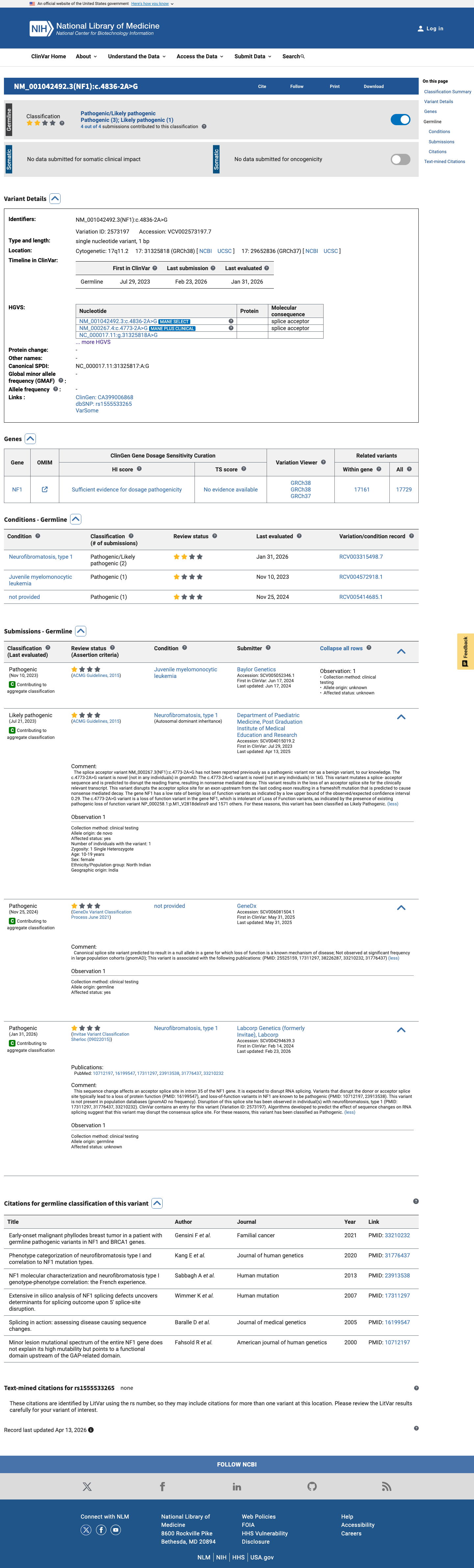
ClinVar screenshot
ClinVar
This variant has been reported in ClinVar as Pathogenic (3 clinical laboratories) and as Likely pathogenic (1 clinical laboratory). (ClinVarID = 2573197)
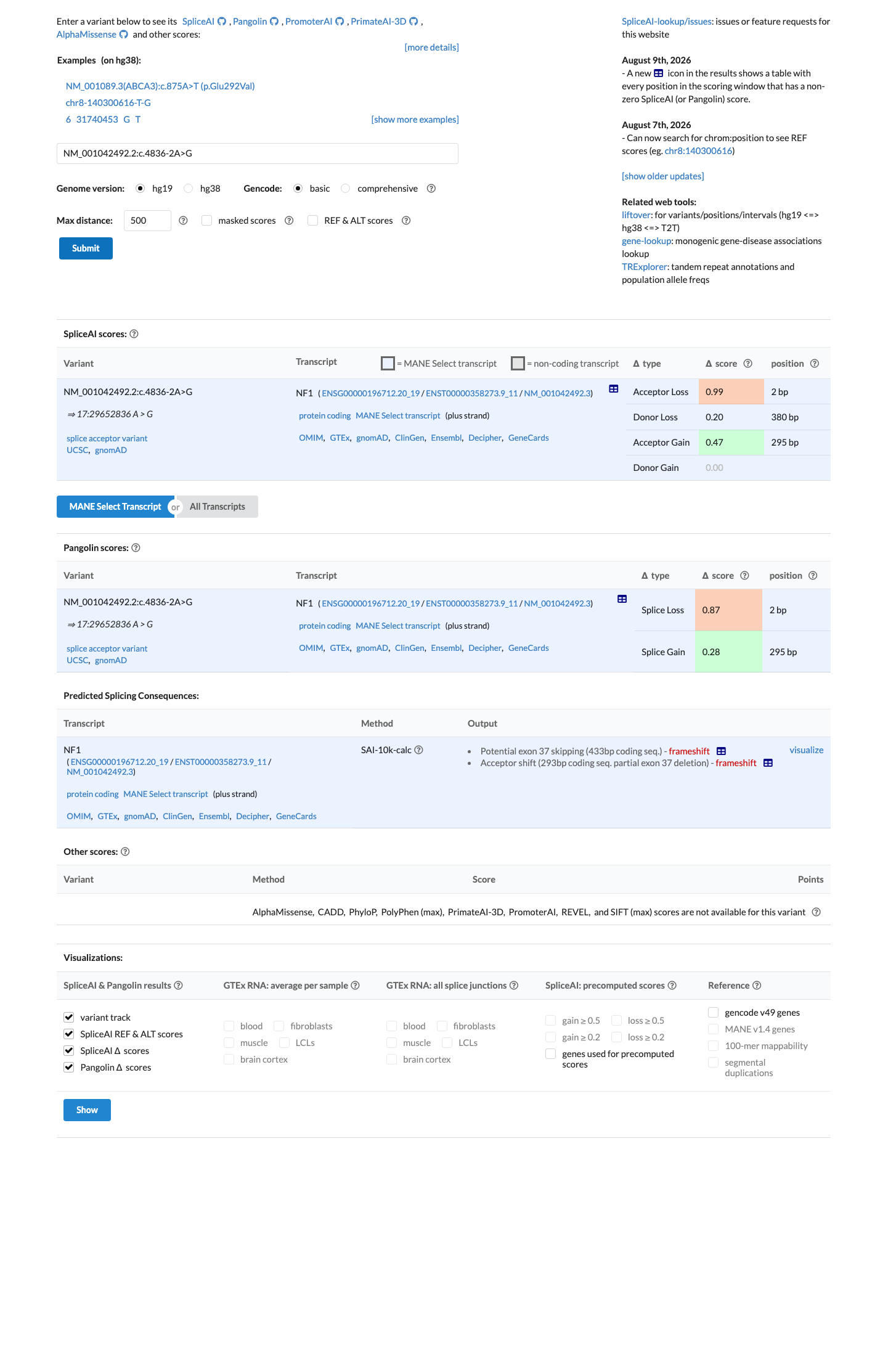
SpliceAI screenshot
In silico
SpliceAI predicts possible splice impact for this variant (max delta score = 0.99). BayesDel score = 0.235399.
Functional No data
No calibrated functional assay or RNA evidence was identified for this variant.
OncoKB ↗
COSMIC screenshot
COSMIC
Somatic evidence
COSMIC
This variant has not previously been reported in somatic cancers (COSMIC).
Hotspots
This variant does not lie in a statistically significant cancer hotspot.
COSMIC ↗
Literature · how each cited paper was used
1papers cited
Each card is an audit: what was searched, what was found, whether it names the variant, which criteria it fed, and why. 7 further PMIDs triaged but not cited — see Sources & references.
Rule & framework references · cited for criterion definitions, not variant evidence
25741868 ↗ Standards and guidelines for the interpretation of sequence variants: a joint co
Sources & reference links
8Sources
CSpec VCEP
ClinVar
gnomAD v2.1
gnomAD v4.1
gnomAD-Canada
SpliceAI
OncoKB
COSMIC
Triaged references · 7 PMIDs not cited in assessment
10712197 ↗ Minor lesion mutational spectrum of the entire NF1 gene does not explain its high mutability but points to a functional domain upstream of the GAP-related domain. CLINVAR
15604628 ↗ Genetic cancer risk assessment and counseling: recommendations of the national s CLINVAR
16199547 ↗ Splicing in action: assessing disease causing sequence changes. CLINVAR
17311297 ↗ Extensive in silico analysis of NF1 splicing defects uncovers determinants for splicing outcome upon 5' splice-site disruption. CLINVAR
17636453 ↗ Neurofibromatosis type 1 in genetic counseling practice: recommendations of the National Society of Genetic Counselors. CLINVAR
23913538 ↗ NF1 molecular characterization and neurofibromatosis type I genotype-phenotype correlation: the French experience. CLINVAR
24493721 ↗ American Society of Clinical Oncology Expert Statement: collection and use of a CLINVAR