0%
complete
Final classification
VUS
PM2BP4
NF1
c.2573C>G
p.Ser858Cys
missense · exon 21

NF1 encodes neurofibromin, a tumor suppressor protein that negatively regulates the RAS signal transduction pathway. As a GTPase-activating protein, it helps switch RAS proteins from their active to inactive state, keeping cell growth in check; loss of NF1 function leaves RAS overactive and drives downstream growth pathways such as MAPK/ERK and PI3K. Inherited changes in NF1 cause the cancer-predisposition syndrome neurofibromatosis type 1, and are also linked to juvenile myelomonocytic leukemia and Watson syndrome. Somatic changes in NF1 are found in many tumor types, including breast cancer, melanoma, and glioma.

This variant

NF1 encodes neurofibromin, a tumor suppressor that keeps RAS signaling in check, and its loss of function causes neurofibromatosis type 1. This VUS means the missense change p.(Ser858Cys) is not currently classifiable as disease-causing or benign: it is extremely rare but lacks functional, segregation, and de novo evidence. Clinical correlation with NF1 features, family studies, or functional data would be needed to refine this classification.

Transcript
NM_001042492.3
HGVS · transcript:coding
NM_001042492.3:c.2573C>G
GRCh38
chr17:31229188 C>G
GRCh37
chr17:29556206 C>G
The NF1 ClinGen specification lacked a complete classification rule, so the generic ACMG/AMP 2015 framework was applied; PM2 and BP4 at supporting strength alone meet no pathogenic or benign combination threshold.
Classification rationale
PM2 BP4 VUS
NF1 c.2573C>G missense · exon 21

PM2 (Supporting): extremely rare in population databases, with highest allele frequency 0.00143% in gnomAD v4.1, below the 0.1% threshold. BP4 (Supporting): REVEL 0.042 is at or below the benign-supporting threshold, and SpliceAI max delta 0.00 predicts no splice impact. Overall classification: VUS - one pathogenic-supporting (PM2) and one benign-supporting (BP4) criterion meet no combination threshold under the generic ACMG/AMP 2015 framework.

PM2 + BP4 VUS
Gene diagram · NM_001042492.3 · variants mapped to exon structure
NF1 NM_001042492.3
Fetching transcript structure from UCSC…
Applied criteria · 2 applied · 21 assessed
MetEvidence satisfies this criterion.
Not metEvaluated against available evidence; threshold not reached.
Not assessedApplies in principle, but no evidence was found to evaluate it.
N/ADoesn't apply to this variant type.
Applied · 2
Strength Supporting Moderate Strong Very strong
PM2 supporting Pathogenic
Met (Supporting): extremely rare in population databases, with highest allele frequency 0.00143% (23/1,611,856 alleles) in gnomAD v4.1, below the 0.1% threshold.
The NF1 ClinGen/CSPEC record was checked first, but no criterion-level PM2 rule was retrieved; generic ACMG/AMP PM2 guidance was applied.gnomAD v4.1 reports AF 1.42693e-05 (0.00143%), 23/1,611,856 alleles, and zero homozygotes; the highest listed subgroup AF is 1.94942e-05 (0.00195%).gnomAD v2.1 reports AF 2.3921e-05 (0.00239%), 6/250,826 alleles, and zero homozygotes.
BP4 supporting Benign
Met (Supporting): REVEL 0.042 is at or below the benign-supporting threshold, and SpliceAI max delta 0.00 predicts no splice impact.
The available NF1 CSPEC framework is incomplete and contains no PP3/BP4-specific rule payload, gene-specific computational lookup, or pre-assigned criterion for this variant.REVEL score is 0.042. The ClinGen SVI calibrated REVEL thresholds published in PMID:36413997 use REVEL >=0.70 for PP3 and <=0.15 for BP4; 0.042 meets the BP4 threshold.SpliceAI Lookup reports a maximum delta score of 0.00 and predicts no significant splice impact for NM_001042492.3:c.2573C>G.
Assessed · not applied · 5 not met · 16 not assessed
Pathogenic
PS1 Not assessed: no validated pathogenic or likely pathogenic same-amino-acid substitution at residue 858 was available for comparison.
PS2 Not assessed: no de novo observation with parental testing documenting absence of the variant in both biological parents was available.
PS3 Not assessed: no variant-specific functional assay demonstrating a deleterious effect was available.
PS4 Not assessed: no variant-specific case-control or cohort enrichment data were available.
PM1 Not assessed: the authoritative NF1 domain list required for a residue-based mutational-hotspot check was unavailable.
PM5 Not assessed: no validated pathogenic missense comparator at residue 858 was available.
PM6 Not assessed: no documented presumed de novo occurrence with family and phenotype details was available.
PP1 Not assessed: no segregation data in affected or unaffected relatives were available.
PP2 Not assessed: the NF1 specification provides no PP2 rule establishing missense as a common pathogenic mechanism.
PP3 Not met: REVEL 0.042 is below the pathogenic-supporting threshold, and SpliceAI max delta 0.00 predicts no splice impact.
PP4 Not assessed: no proband phenotype or phenotype-specificity evidence was provided.
PP5 Not met: no ClinVar expert-panel pathogenic or likely pathogenic classification exists for this exact variant.
Benign
BA1 Not met: highest observed population frequency is 0.00143%, far below the 1% benign stand-alone threshold.
BS1 Not met: highest subgroup frequency is 0.00195% in gnomAD v4.1, far below the 0.3% benign-frequency threshold.
BS2 Not assessed: no healthy adult carriers were documented, and absence of homozygotes is not positive evidence.
BS3 Not assessed: no variant-specific functional assay demonstrating preserved NF1 function was available.
BS4 Not assessed: no unaffected relatives carrying the variant or pedigree-based non-segregation evidence were documented.
BP1 Not assessed: the NF1 specification provides no BP1 rule, and missense is not established as a generally non-pathogenic mechanism in NF1.
BP2 Not assessed: a ClinVar note reports co-occurrence with an NF1 truncating variant, but phase (trans/cis) and individual-level records were not established.
BP5 Not assessed: no evidence of an independently pathogenic molecular diagnosis fully explaining the phenotype was available.
BP6 Not met: no ClinVar expert-panel benign or likely benign classification exists for this exact variant.
N/A · 5 PVS1 · PM3 · PM4 · BP3 · BP7
Research & evidence
Population frequency
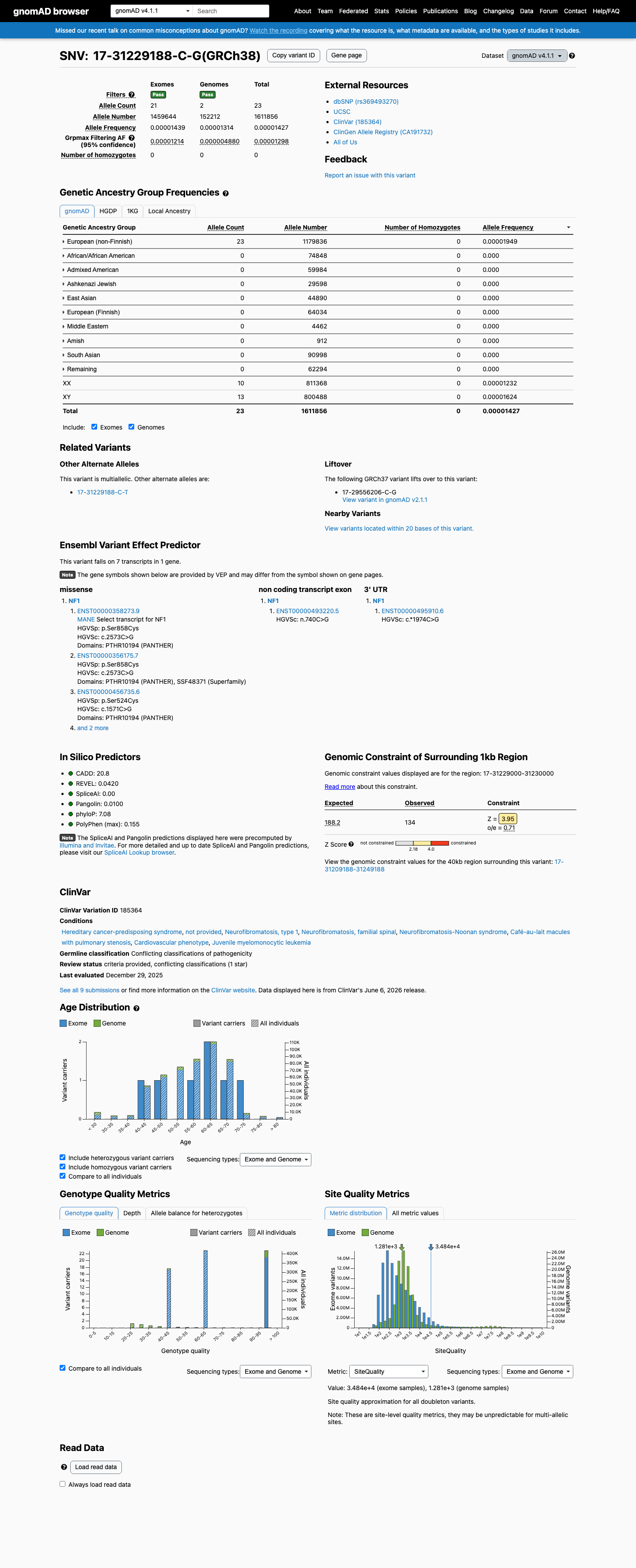
gnomAD v4.1 screenshot
gnomAD v4.1
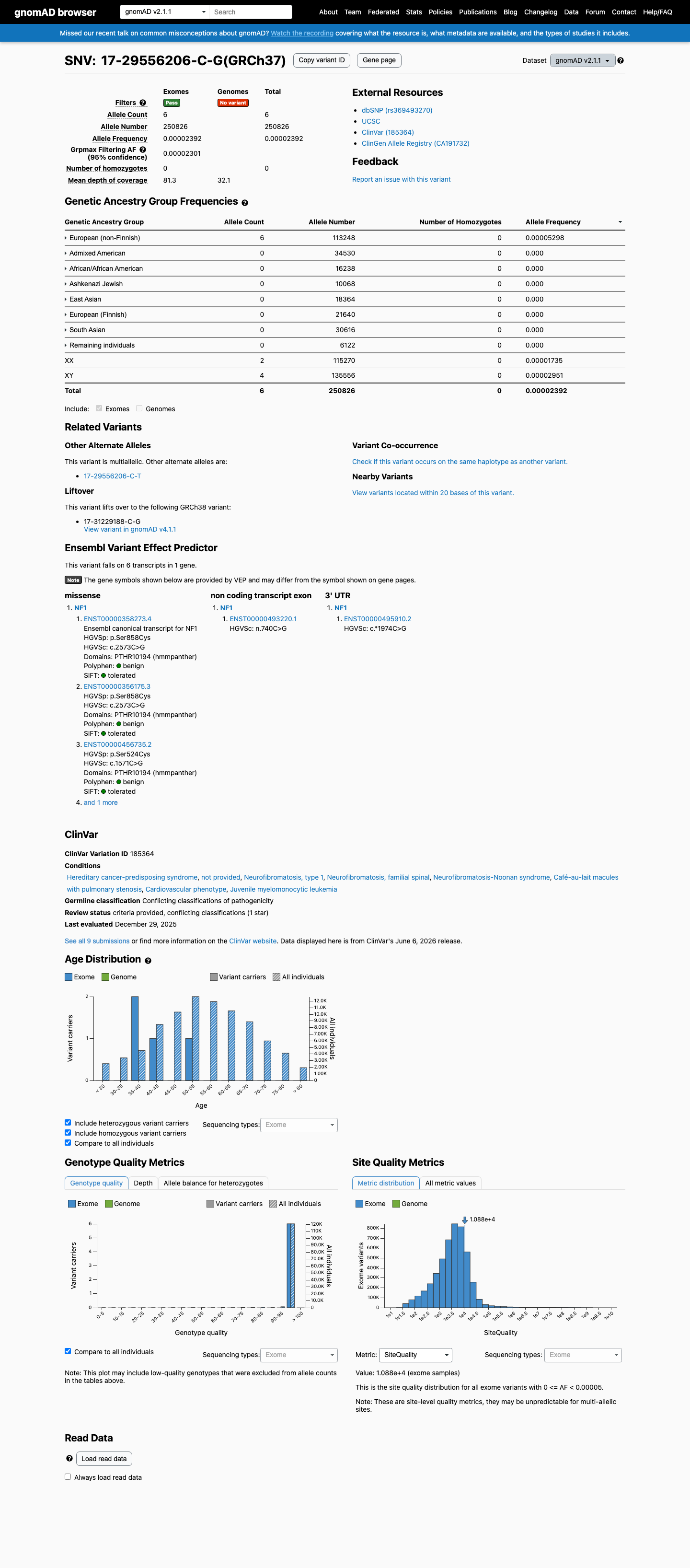
gnomAD v2.1 screenshot
gnomAD v2.1
v4.1
This variant is present in gnomAD v4.1 (AF= 1.42693e-05; MAF= 0.00143%, 23/1611856 alleles, homozygotes = 0) and has highest observed frequency in the European (non-Finnish) population (AF= 1.94942e-05; MAF= 0.00195%, 23/1179836 alleles, homozygotes = 0); grpmax FAF= 1.298e-05.
v2.1
This variant is present in gnomAD v2.1 (AF= 2.3921e-05; MAF= 0.00239%, 6/250826 alleles, homozygotes = 0) and has highest observed frequency in the European (non-Finnish) population (AF= 5.29811e-05; MAF= 0.00530%, 6/113248 alleles, homozygotes = 0); grpmax FAF= 2.301e-05.
🇨🇦 CA
Absent from gnomAD-Canada v1.0.
Allele frequency by ancestry
three datasets · side by side
gnomAD v4.1
0.0014% · 23 / 1,611,856
0 hom · FAF 0.0013%
European (non-Finnish)
23 / 1,179,836
0.0019%
+ 9 not observed (Remaining individuals, Admixed American, European (Finnish), Amish, East Asian, Middle Eastern, South Asian, Ashkenazi Jewish, African/African American)
gnomAD v2.1
0.0024% · 6 / 250,826
0 hom · FAF 0.0023%
European (non-Finnish)
6 / 113,248
0.0053%
+ 7 not observed (African/African American, Admixed American, Ashkenazi Jewish, East Asian, European (Finnish), Remaining individuals, South Asian)
gnomAD Canada 🇨🇦
Absent · 0 / ?
0 hom
Not observed in any ancestry group.
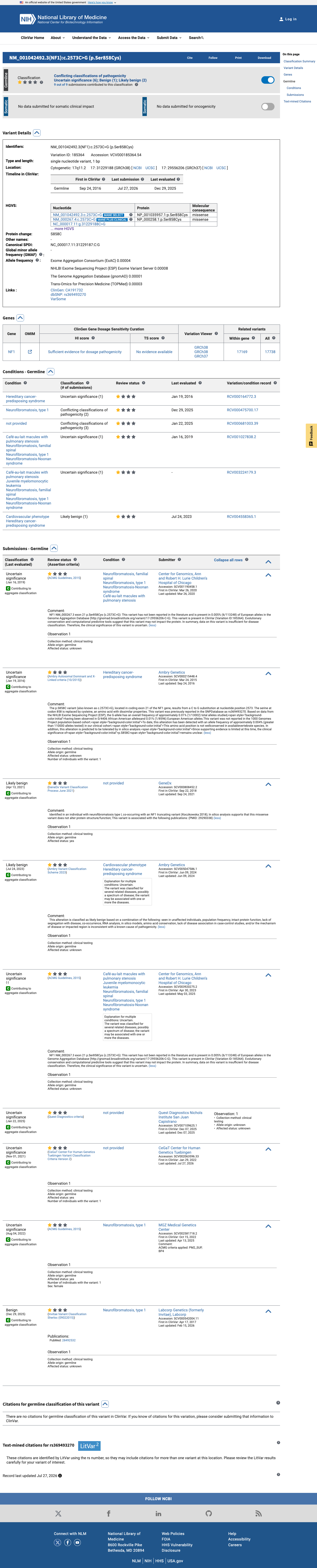
ClinVar screenshot
ClinVar
This variant has been reported in ClinVar as Uncertain significance (6 clinical laboratories) and as Likely benign (2 clinical laboratories) and as Benign (1 clinical laboratory). (ClinVarID = 185364)
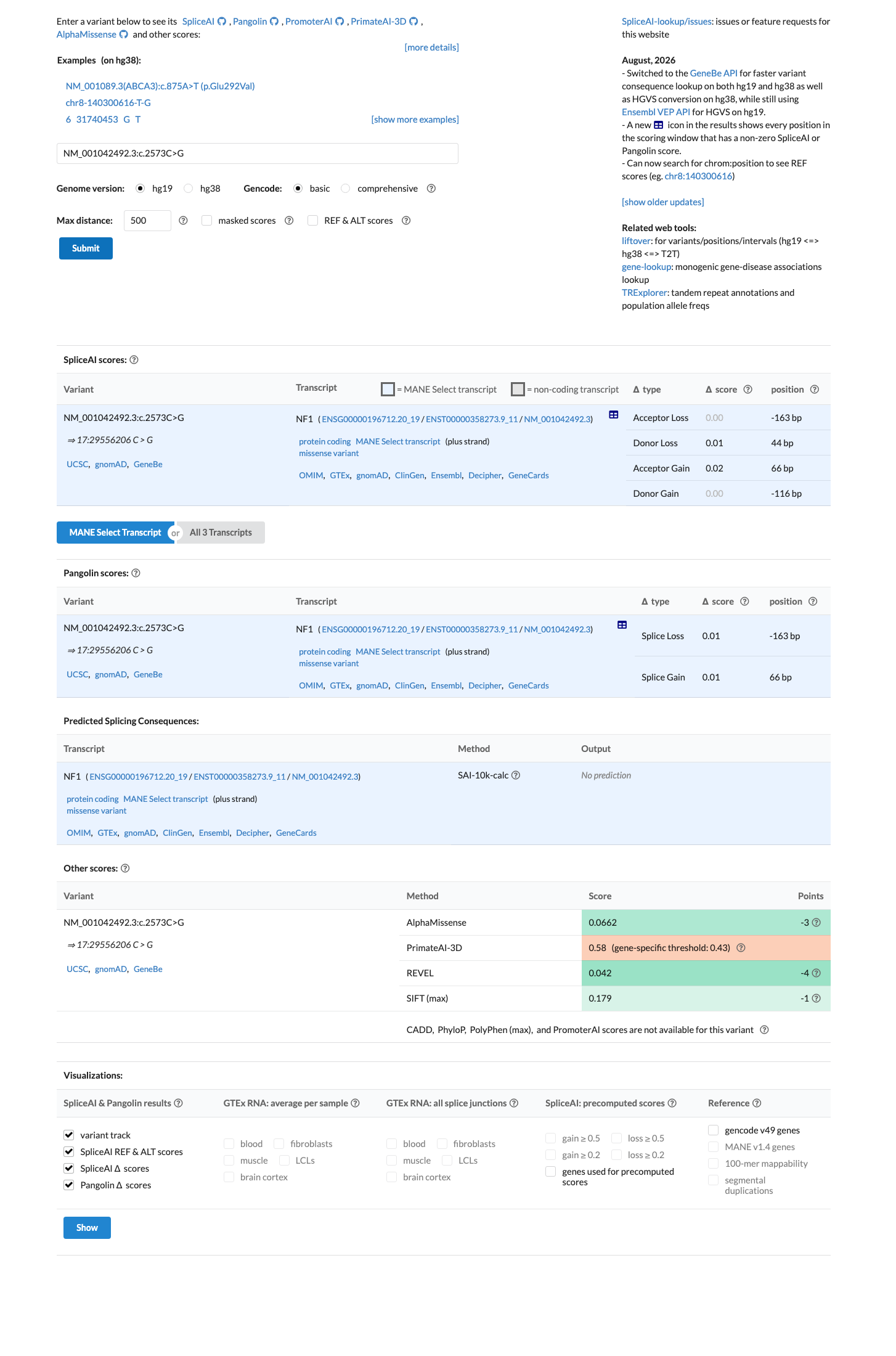
SpliceAI screenshot
In silico
SpliceAI predicts no significant splice impact for this variant (max delta score = 0.00). REVEL score = 0.042. BayesDel score = -0.546775.
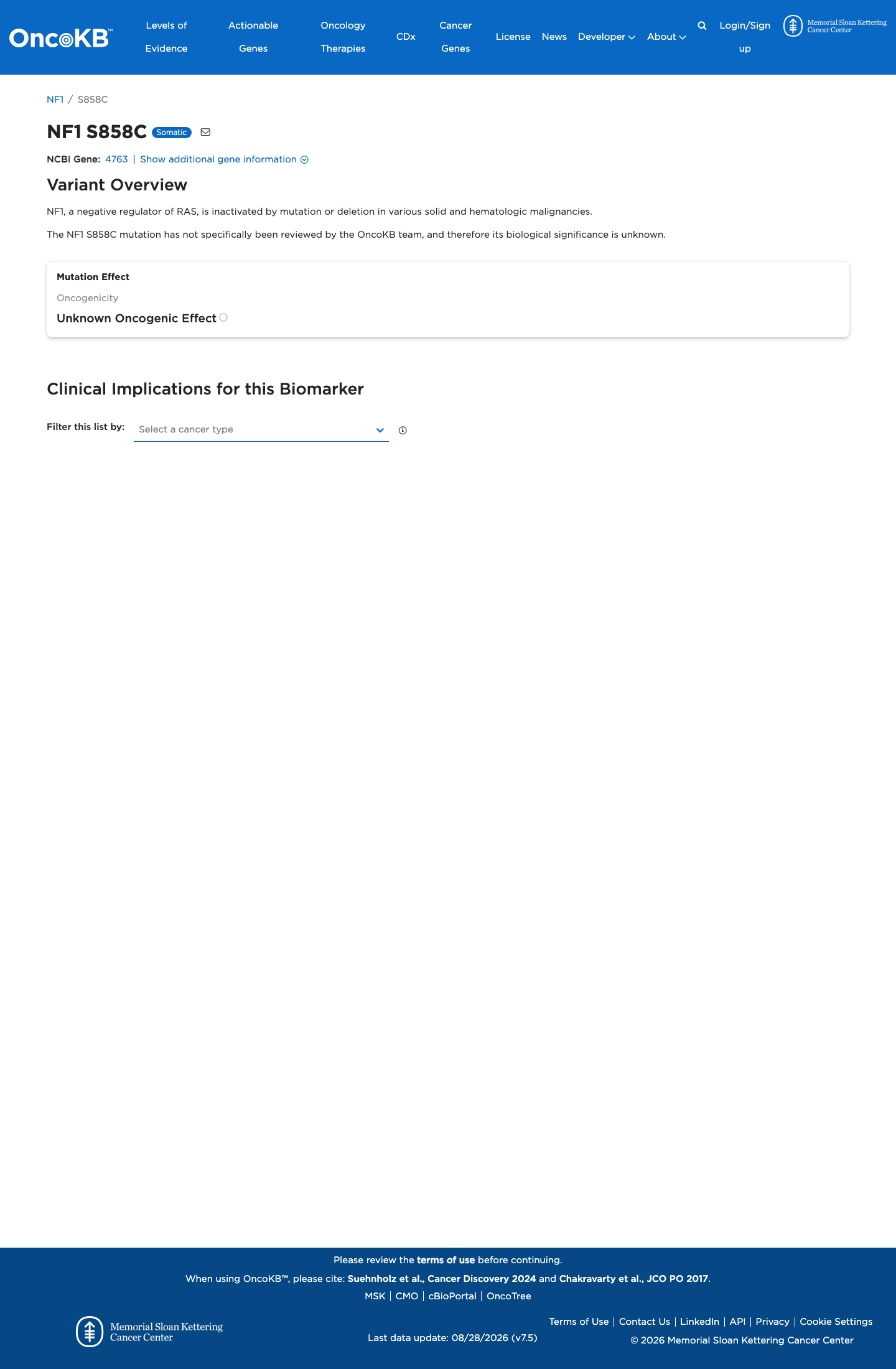
Functional / OncoKB screenshot
Functional Unknown Oncogenic Effect
OncoKB did not identify variant-specific reviewed functional evidence for this variant; gene-level curated context is available for reviewer follow-up. NF1, a negative regulator of RAS, is inactivated by mutation or deletion in various solid and hematologic malignancies.
OncoKB ↗
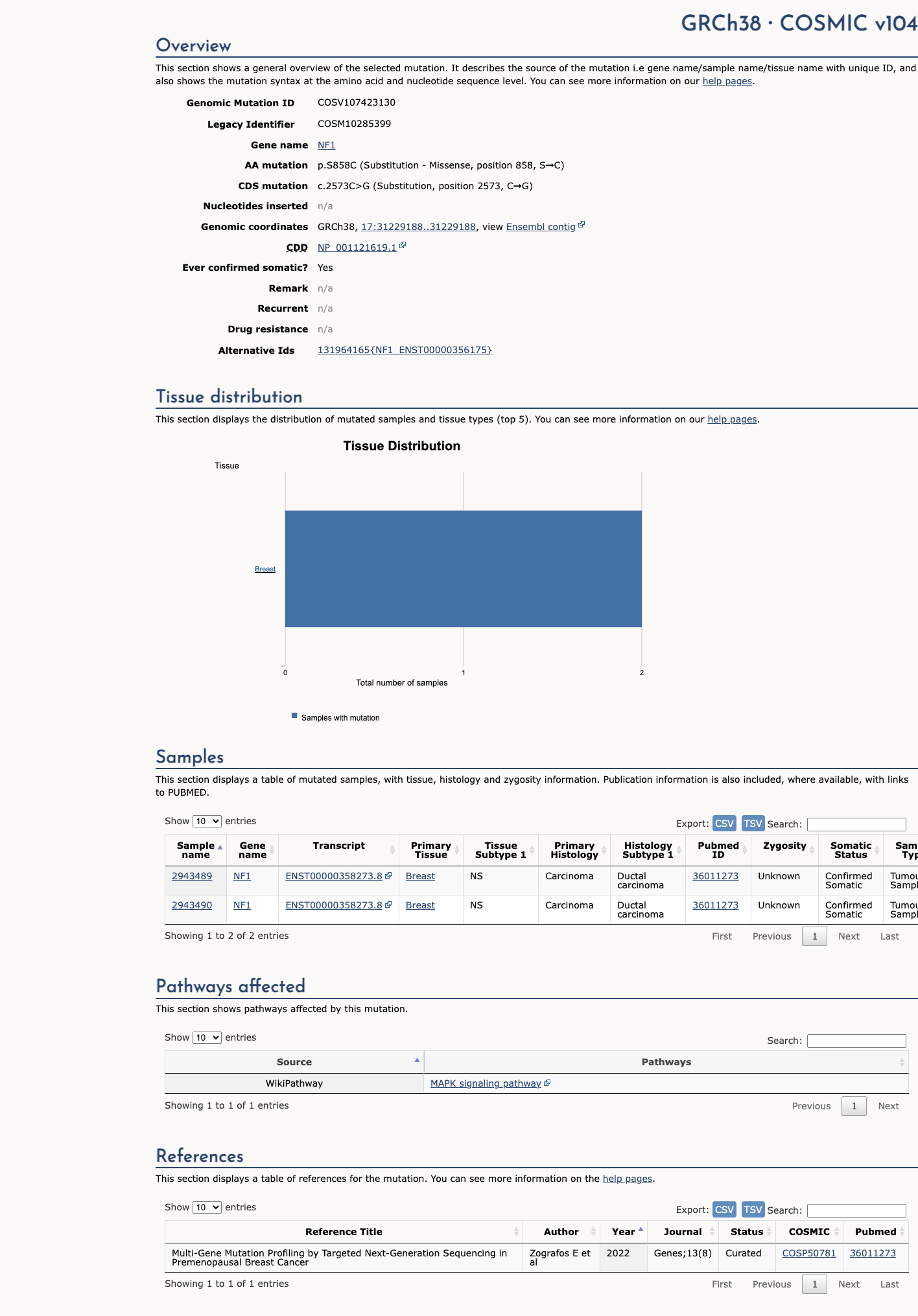
COSMIC screenshot
COSMIC
Cancer hotspots screenshot
Cancer hotspots
Somatic evidence Not in COSMIC / hotspots
COSMIC
This variant does not lie in a statistically significant hotspot. This variant has previously been reported in somatic cancers (COSMIC; COSV107423130, n = 2 times).
Hotspots
This variant does not lie in a statistically significant hotspot.
Sources & reference links
9Sources
CSpec VCEP
ClinVar
gnomAD v2.1
gnomAD v4.1
gnomAD-Canada
SpliceAI
OncoKB
COSMIC
Cancer hotspots
Triaged references · 8 PMIDs not cited in assessment
25741868 ↗ Standards and guidelines for the interpretation of sequence variants: a joint consensus recommendation of the American College of Medical Genetics and Genomics and the Association for Molecular Pathology. CLINVAR
26467025 ↗ A Standardized DNA Variant Scoring System for Pathogenicity Assessments in Mendelian Disorders. CLINVAR
17636453 ↗ Neurofibromatosis type 1 in genetic counseling practice: recommendations of the National Society of Genetic Counselors. CLINVAR
20065170 ↗ American Society of Clinical Oncology policy statement update: genetic and genomic testing for cancer susceptibility. CLINVAR
20301471 ↗ Wilms Tumor Predisposition. CLINVAR
26324357 ↗ American Society of Clinical Oncology Policy Statement Update: Genetic and Genomic Testing for Cancer Susceptibility. CLINVAR
28492532 ↗ Sherloc: a comprehensive refinement of the ACMG-AMP variant classification criteria. CLINVAR
33939658 ↗ The North American Neuroendocrine Tumor Society Consensus Guidelines for Surveillance and Management of Metastatic and/or Unresectable Pheochromocytoma and Paraganglioma. CLINVAR