Analysis in progress
Initialising…
0%
complete
This report is still being assembled — sections appear as each stage finishes. It isn't final yet.
NF1
Final classification
Likely Pathogenic
PVS1PM2
NF1
c.6737del
p.Pro2246GlnfsTer19
frameshift · exon 45

NF1 encodes neurofibromin, a tumor suppressor protein that negatively regulates the RAS signal transduction pathway. As a GTPase-activating protein, it helps switch RAS proteins from their active to inactive state, keeping cell growth in check; loss of NF1 function leaves RAS overactive and drives downstream growth pathways such as MAPK/ERK and PI3K. Inherited changes in NF1 cause the cancer-predisposition syndrome neurofibromatosis type 1, and are also linked to juvenile myelomonocytic leukemia and Watson syndrome. Somatic changes in NF1 are found in many tumor types, including breast cancer, melanoma, and glioma.

This variant

NF1 is a tumor suppressor whose loss leaves RAS overactive and drives uncontrolled cell growth, and most pathogenic NF1 variants are truncating changes that destroy one functional copy. This frameshift deletion, predicted to trigger nonsense-mediated decay, eliminates neurofibromin through that same dominant loss-of-function mechanism, consistent with neurofibromatosis type 1 and supporting the Likely Pathogenic classification.

Transcript
NM_001042492.3
HGVS · transcript:coding
NM_001042492.3:c.6737del
GRCh38
chr17:31338055 AC>A
GRCh37
chr17:29665073 AC>A
Basis Likely Pathogenic: 1 PVS1 (very strong) plus 1 supporting PM2 meets the ClinGen SVI 2020 threshold (posterior probability 0.988) under the generic ACMG/AMP 2015 rules.
Likely Pathogenic: 1 PVS1 (very strong) plus 1 supporting PM2 meets the ClinGen SVI 2020 threshold (posterior probability 0.988) under the generic ACMG/AMP 2015 rules.
Classification rationale
PVS1PM2 Likely Pathogenic
NF1 c.6737del frameshift · exon 45

PVS1 (Very Strong): frameshift deletion introduces a premature stop codon 19 residues downstream, predicted to trigger nonsense-mediated decay. PM2 (Supporting): the variant is absent from gnomAD v2.1, v4.1, and gnomAD-Canada v1.0. Likely Pathogenic: PVS1 (very strong) plus PM2 (supporting) reaches the Likely Pathogenic threshold under the ClinGen SVI 2020 points-based combination rule.

PVS1 + PM2 Likely Pathogenic
Gene diagram · NM_001042492.3 · variants mapped to exon structure
NF1 NM_001042492.3
Fetching transcript structure from UCSC…
Applied criteria · 2 applied · 15 assessed
MetEvidence satisfies this criterion.
Not metEvaluated against available evidence; threshold not reached.
Not assessedApplies in principle, but no evidence was found to evaluate it.
N/ADoesn't apply to this variant type.
Applied · 2
Strength Supporting Moderate Strong Very strong
PVS1 very strong review Pathogenic
Met (Very Strong): single-nucleotide deletion creates a frameshift with a premature stop codon 19 residues downstream, predicted to trigger nonsense-mediated decay.
pvs1_variant_assessment.json classifies c.6737del as consequence_class=frameshift, variant_bucket=frameshift, and recommends applying the generic PVS1 framework (framework_source PMC6185798) with a suggested_default_strength of PVS1, subject to confirming transcript relevance, NMD status, and exon importance.pvs1_gene_context.json confirms NF1 germline loss-of-function is a supported disease mechanism (lof_mechanism_supported=true, pvs1_gene_gate=eligible), based on a targeted germline literature search, since no official CSPEC/VCEP PVS1-specific ruleset was available (cautions note: 'generic PVS1 fallback should follow PMC6185798').PMID:10712197 (direct quote): 'Among the 278 mutations identified, we observed 84 (30.2%) nonsense mutations and 140 (50.4%) frameshift mutations... Thus, as many as 224 (80.6%) mutations caused, directly or indirectly, a premature termination codon (PTC).' This establishes that truncating/frameshift PTC-generating variants are the predominant and accepted pathogenic mechanism class in NF1, though this paper does not mention the specific variant c.6737del.
PM2 supporting Pathogenic
Met (Supporting): absent from gnomAD v2.1, v4.1, and gnomAD-Canada v1.0, consistent with a rare autosomal-dominant disease variant.
The exact normalized variant was reported absent from gnomAD v2.1.The exact normalized variant was reported absent from gnomAD v4.1.The exact normalized variant was reported absent from gnomAD-Canada v1.0.
Assessed · not applied · 4 not met · 11 not assessed
Pathogenic
PS2 Not assessed: no parental testing or confirmation of a de novo occurrence was documented.
PS3 Not assessed: no functional assay results for this specific variant were available.
PS4 Not assessed: no case-control or enrichment data for this variant were available.
PM6 Not assessed: no de novo occurrence with assumed or unverified parental relationships was documented.
PP1 Not assessed: no affected relatives or cosegregation data for this variant were documented.
PP4 Not assessed: no proband phenotype or diagnostic features were supplied for evaluation.
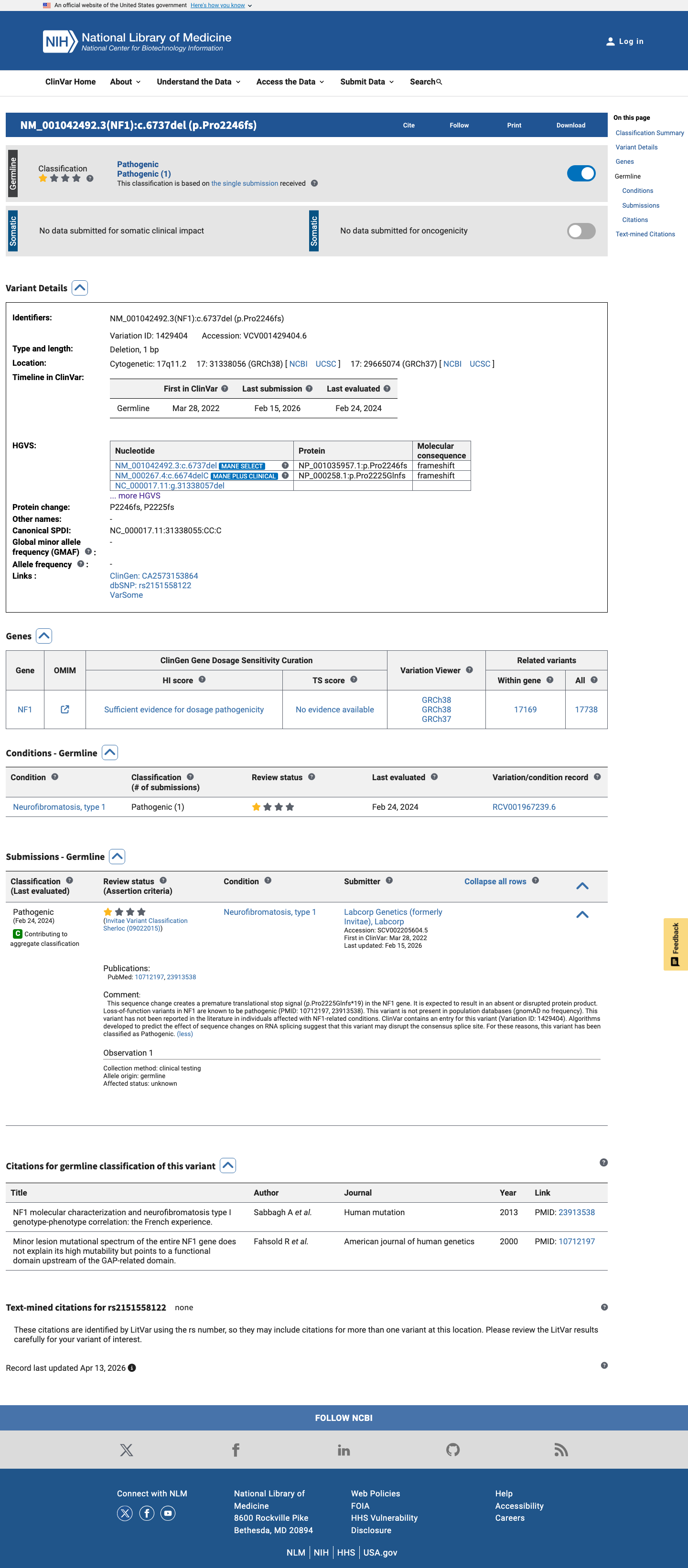
PP5 Not met: the ClinVar record has only a single laboratory assertion and no expert-panel submission.
Benign
BA1 Not met: the variant is absent from population databases, so no allele frequency reaches the stand-alone benign threshold.
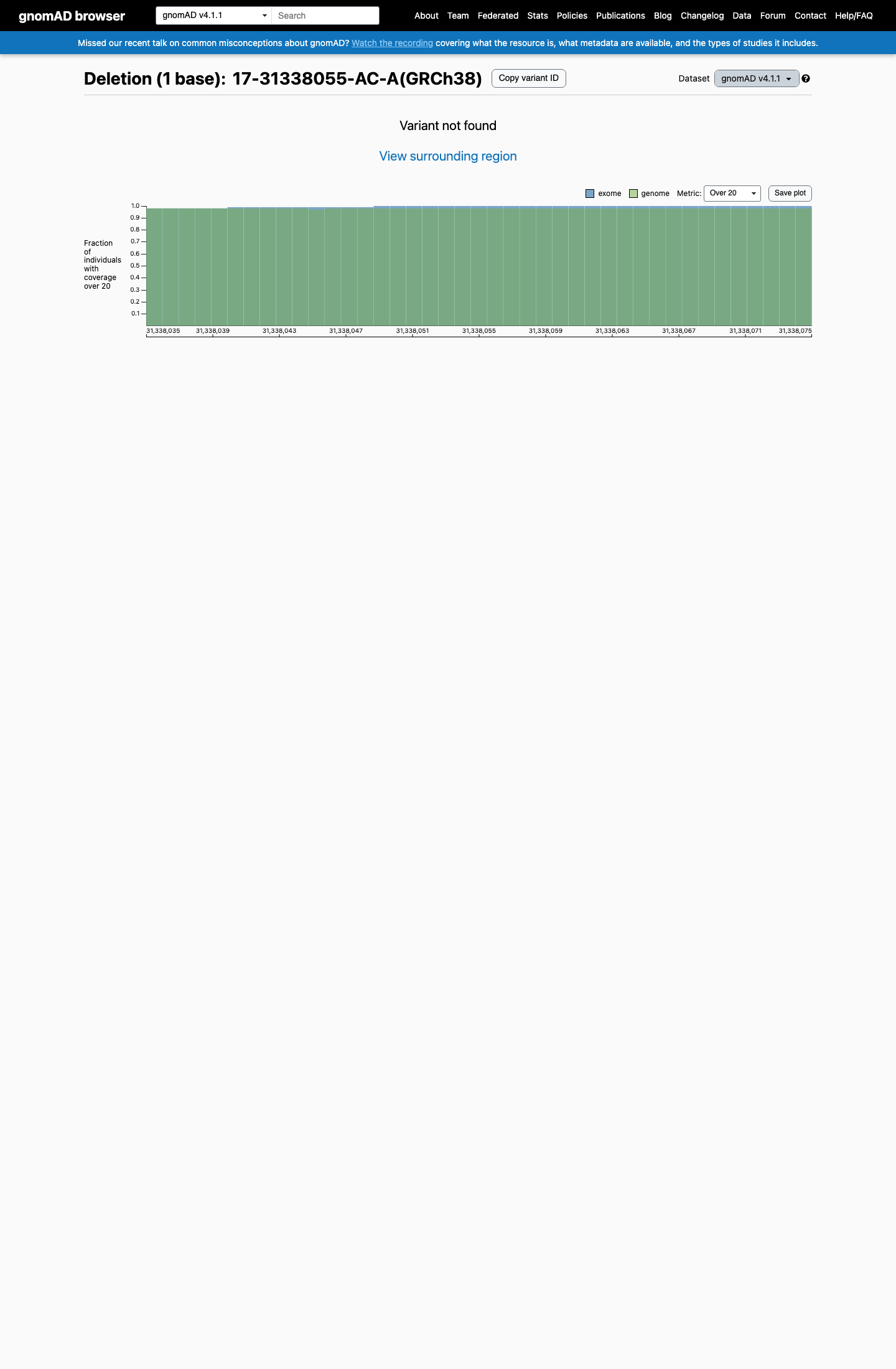
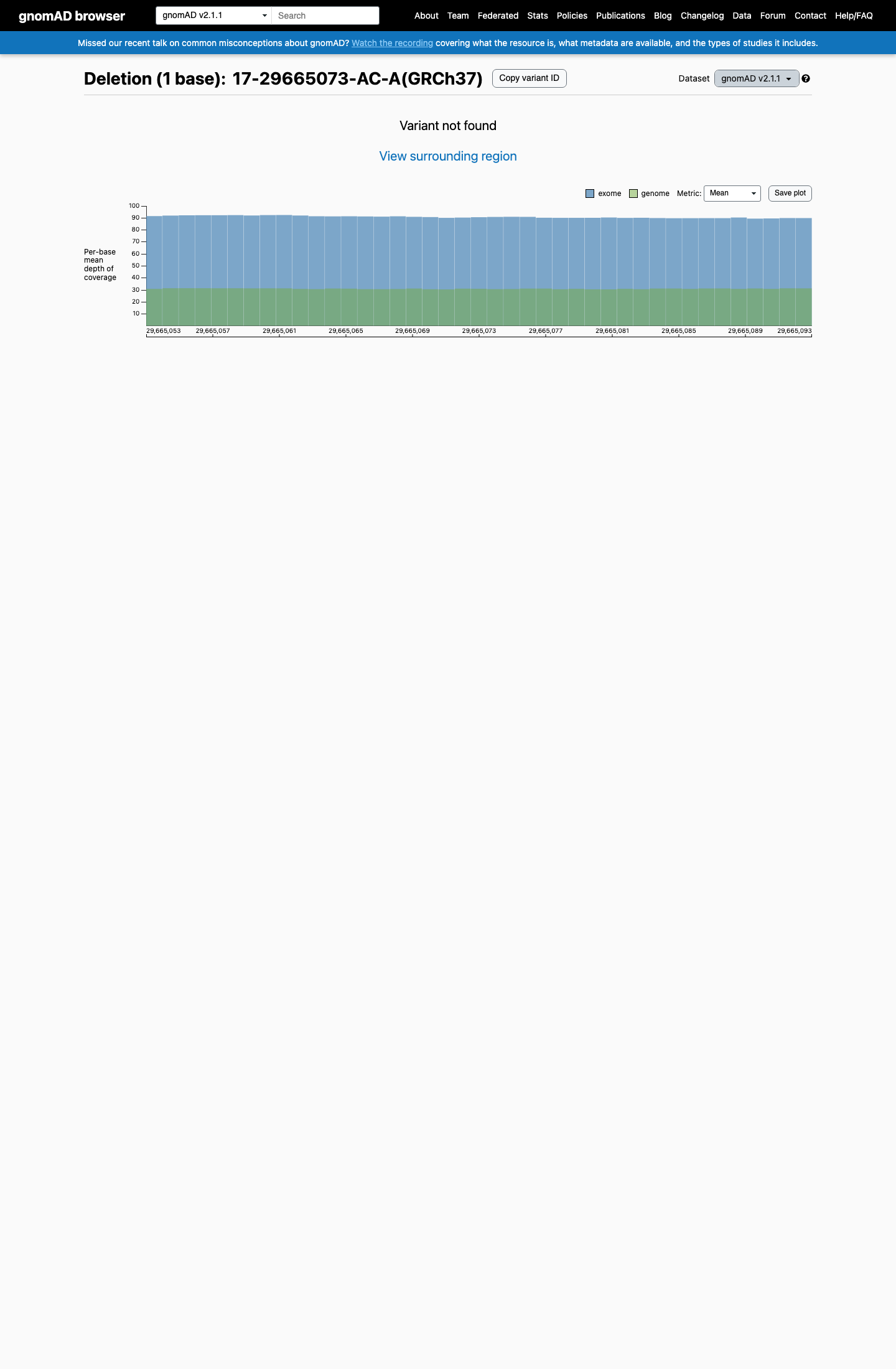
BS1 Not met: the variant is absent from gnomAD v2.1, v4.1, and gnomAD-Canada v1.0, so no excess allele frequency exists.
BS2 Not assessed: no data on the variant in healthy adults were available.
BS3 Not assessed: no assay evidence of normal protein function for this variant was available.
BS4 Not assessed: no genotype or phenotype data for unaffected relatives were documented.
BP2 Not assessed: no phase, parental, or trans-observation data were available.
BP5 Not assessed: no evidence of an alternative cause of disease was supplied.
BP6 Not met: the ClinVar record has no expert-panel submission and its sole laboratory assertion is Pathogenic.
N/A · 11 PS1 · PM1 · PM3 · PM4 · PM5 · PP2 · PP3 · BP1 · BP3 · BP4 · BP7
Research & evidence
Population frequency · supports pathogenic
gnomAD v4.1 screenshot
gnomAD v4.1
gnomAD v2.1 screenshot
gnomAD v2.1
v4.1
Absent from gnomAD v4.1.
v2.1
Absent from gnomAD v2.1.
🇨🇦 CA
Absent from gnomAD-Canada v1.0.
Allele frequency by ancestry
three datasets · side by side
gnomAD v4.1
Absent · 0 / ?
0 hom
Not observed in any ancestry group.
gnomAD v2.1
Absent · 0 / ?
0 hom
Not observed in any ancestry group.
gnomAD Canada 🇨🇦
Absent · 0 / ?
0 hom
Not observed in any ancestry group.
ClinVar screenshot
ClinVar
This variant has been reported in ClinVar as Pathogenic (1 clinical laboratory). (ClinVarID = 1429404)
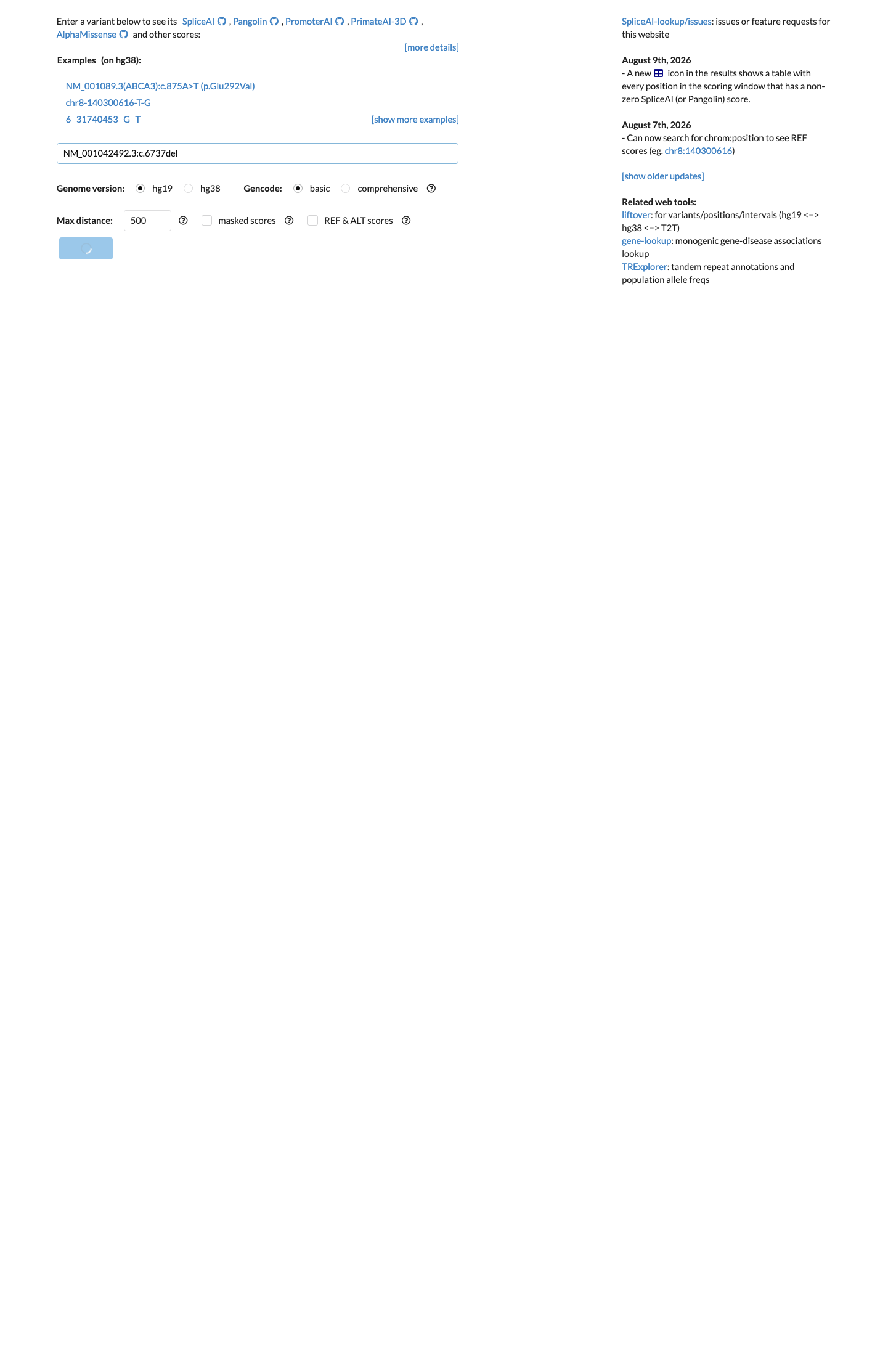
SpliceAI screenshot
In silico
SpliceAI predicts no significant splice impact for this variant (max delta score = 0.18).
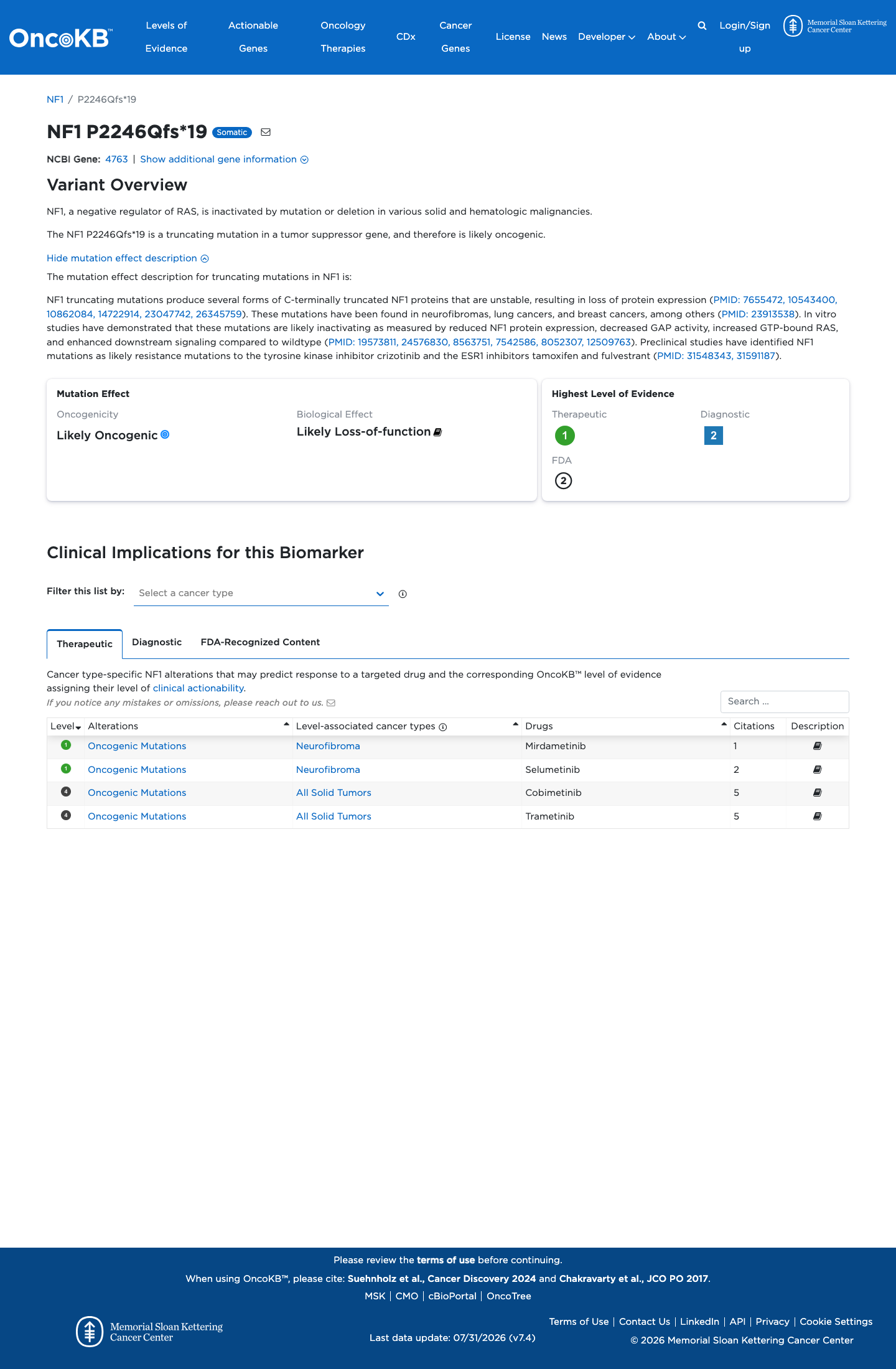
Functional / OncoKB screenshot
Functional Likely Oncogenic
OncoKB identified variant-specific curated literature and context relevant to functional review; biological-effect context: Likely Loss-of-function; curated oncogenicity label: Likely Oncogenic.
OncoKB ↗
COSMIC screenshot
COSMIC
Cancer hotspots screenshot
Cancer hotspots
Somatic evidence Not in COSMIC / hotspots
COSMIC
This variant does not lie in a statistically significant hotspot. This variant has not previously been reported in somatic cancers (COSMIC).
Hotspots
This variant does not lie in a statistically significant hotspot.
Literature · how each cited paper was used
6papers cited
Each card is an audit: what was searched, what was found, whether it names the variant, which criteria it fed, and why. 5 further PMIDs triaged but not cited — see Sources & references.
Rule & framework references · cited for criterion definitions, not variant evidence
10543400 ↗ Evaluation of the protein truncation test and mutation detection in the NF1 gene: mutational analysis of 15 known and 40 unknown mutations.
10712197 ↗ Minor lesion mutational spectrum of the entire NF1 gene does not explain its high mutability but points to a functional domain upstream of the GAP-related domain.
10862084 ↗ Exhaustive mutation analysis of the NF1 gene allows identification of 95% of mutations and reveals a high frequency of unusual splicing defects.
12509763 ↗ Targeting RAS signalling pathways in cancer therapy.
19573811 ↗ Proteasomal and genetic inactivation of the NF1 tumor suppressor in gliomagenesis.
23913538 ↗ NF1 molecular characterization and neurofibromatosis type I genotype-phenotype correlation: the French experience.
Sources & reference links
9Sources
CSpec VCEP
ClinVar
gnomAD v2.1
gnomAD v4.1
gnomAD-Canada
SpliceAI
OncoKB
COSMIC
Cancer hotspots
Triaged references · 5 PMIDs not cited in assessment
14722914 ↗ Screening 500 unselected neurofibromatosis 1 patients for deletions of the NF1 gene. ONCOKB
20301288 ↗ Neurofibromatosis 1. CLINVAR
24893135 ↗ Pheochromocytoma and paraganglioma: an endocrine society clinical practice guideline. CLINVAR
26140447 ↗ Points to Consider: Ethical, Legal, and Psychosocial Implications of Genetic Testing in Children and Adolescents. CLINVAR
33939658 ↗ The North American Neuroendocrine Tumor Society Consensus Guidelines for Surveillance and Management of Metastatic and/or Unresectable Pheochromocytoma and Paraganglioma. CLINVAR