Back
NM_001126049.2:c.136T>G
p.Phe46Val · KLLN
Generic ACMG/AMP 2015 with ClinGen SVI recommendations
0%
complete
Final classification
VUS
PM2BP4
KLLN
c.136T>G
p.Phe46Val
missense · exon 1
Gene context NCBI Gene ↗

KLLN encodes a small nuclear protein that binds DNA and inhibits DNA synthesis, halting cells in the S phase of the cell cycle and steering them toward programmed cell death (apoptosis). Its production is switched on by p53, a central tumor-suppressor protein, placing KLLN within a key growth-control pathway. Through this growth-suppressing and apoptosis-promoting activity, KLLN is considered part of the cell's natural defense against cancer, though no specific inherited disease syndrome is firmly tied to the gene.

This variant

KLLN encodes a p53-regulated nuclear protein involved in DNA synthesis inhibition and apoptosis, placing this variant in a key cellular growth-control pathway.

Transcript
NM_001126049.2
HGVS · transcript:coding
NM_001126049.2:c.136T>G
GRCh38
chr10:87862352 A>C
GRCh37
chr10:89622109 A>C
VUS: PM2 supporting and BP4 supporting provide conflicting evidence without meeting any generic ACMG/AMP 2015 classification threshold.
Classification rationale
PM2 BP4 VUS
KLLN c.136T>G missense · exon 1

PM2 supporting: gnomAD frequencies are below 0.0001. BP4 supporting: REVEL 0.124 is below the 0.29 threshold.

PM2 + BP4 → VUS
LYFE Sciences is an AI system, and it can make mistakes. Criteria may be applied incorrectly, sources may be misread, and a confident-looking classification can still be wrong. Double-check every criterion and its underlying evidence before relying on any call.
Gene diagram · NM_001126049.2 · variants mapped to exon structure
KLLN NM_001126049.2
Fetching transcript structure from UCSC…
Applied criteria · 2 applied · 22 assessed
MetEvidence satisfies this criterion.
Not metEvaluated against available evidence; threshold not reached.
Not assessedApplies in principle, but no evidence was found to evaluate it.
N/ADoesn't apply to this variant type.
Applied · 2
Strength Supporting Moderate Strong Very strong
PM2 supporting Pathogenic
Met at supporting strength: gnomAD v4.1 overall AF is 8.38204e-06, below the generic PM2 threshold of 0.0001.
Generic ACMG/AMP PM2 definition and supplied SVI supporting threshold: AF <=0.0001; the threshold is identified in the case data as the ClinGen SVI 2020 recommendation to downgrade PM2 to supporting (PMID:25741868).gnomAD v2.1 exomes report AF 1.29808e-05 (2/154074 alleles; zero homozygotes), with highest subgroup AF 8.78194e-05 in South Asian individuals.gnomAD v4.1 reports AF 8.38204e-06 (13/1550936 alleles; zero homozygotes), with highest subgroup AF 5.94983e-05 in South Asian individuals; all values are <=0.0001.
BP4 supporting Benign
Met, supporting: missense REVEL 0.124 meets the <=0.29 generic BP4 supporting threshold.
NM_001126049.2:c.136T>G is an exonic missense variant producing NP_001119521.1:p.(Phe46Val), so only REVEL is applicable for this criterion.The local REVEL lookup reports 0.124 for the variant (source_registry key: revel).The supplied generic calibration assigns BP4 supporting at REVEL <= 0.29; this threshold is from the ClinGen SVI REVEL calibration (Pejaver et al. 2022, PMID:36413997).
Assessed · not applied · 3 not met · 19 not assessed
Pathogenic
PS1 Not assessed: no verified pathogenic alternate nucleotide change producing p.Phe46Val at residue 46 was supplied.
PS2 Not assessed: no documented de novo observation with confirmed maternity and paternity, disease-consistent proband phenotype, and absent family history.
PS3 Not assessed: no variant-specific, validated in vitro or in vivo assay evidence established a damaging effect for KLLN p.Phe46Val.
PS4 Not assessed: no case-control odds ratio or relative risk with a confidence interval excluding 1.0 is available for this variant.
PM1 Not assessed: no authoritative critical-domain annotation covers KLLN F46, and no statistically significant F46 hotspot was reported.
PM3 Not assessed: no affected-proband observation, pathogenic partner, inheritance model, or parental/offspring phase testing is documented.
PM5 Not assessed: no different missense change at KLLN residue 46 was verified as pathogenic.
PM6 Not assessed: no documented assumed-de-novo observation or parental testing information is available for this variant.
PP1 Not assessed: zero documented affected relatives or informative meioses are available to evaluate co-segregation.
PP2 Not assessed: KLLN loss of function is supported, but no gene-wide benign-missense rate or common-missense-mechanism evidence was supplied.
PP3 Not met: missense REVEL 0.124 is below the >=0.644 generic PP3 supporting threshold.
PP4 Not assessed: patient phenotype and family history sufficient to demonstrate a highly specific single-etiology disease are unavailable.
PP5 Not assessed: the exact variant has no ClinVar expert-panel Pathogenic or Likely pathogenic classification available.
Benign
BA1 Not met: the highest observed allele frequency is 8.78194e-05, far below the generic BA1 threshold of 0.05.
BS1 Not met: the maximum observed allele frequency is 8.78194e-05, below the generic BS1 threshold of 0.01.
BS2 Not assessed: gnomAD reports zero homozygotes but provides no qualifying healthy-adult, age, phenotype, or penetrance evidence.
BS3 Not assessed: no variant-specific, validated in vitro or in vivo assay evidence demonstrated no damaging effect on KLLN p.Phe46Val function or splicing.
BS4 Not assessed: no affected family members with variant-negative testing are documented to demonstrate lack of segregation.
BP1 Not assessed: KLLN loss of function is supported, but a primarily truncating disease-variant spectrum was not established.
BP2 Not assessed: no pathogenic partner or phase observation demonstrates either trans occurrence in a fully penetrant dominant disorder or cis occurrence in any inheritance pattern.
BP5 Not assessed: no case evidence documents an alternate molecular basis for the patient's disease.
BP6 Not assessed: the exact variant has no ClinVar expert-panel Benign or Likely benign classification available.
N/A · 4 PVS1 · PM4 · BP3 · BP7
Research & evidence
Population frequency
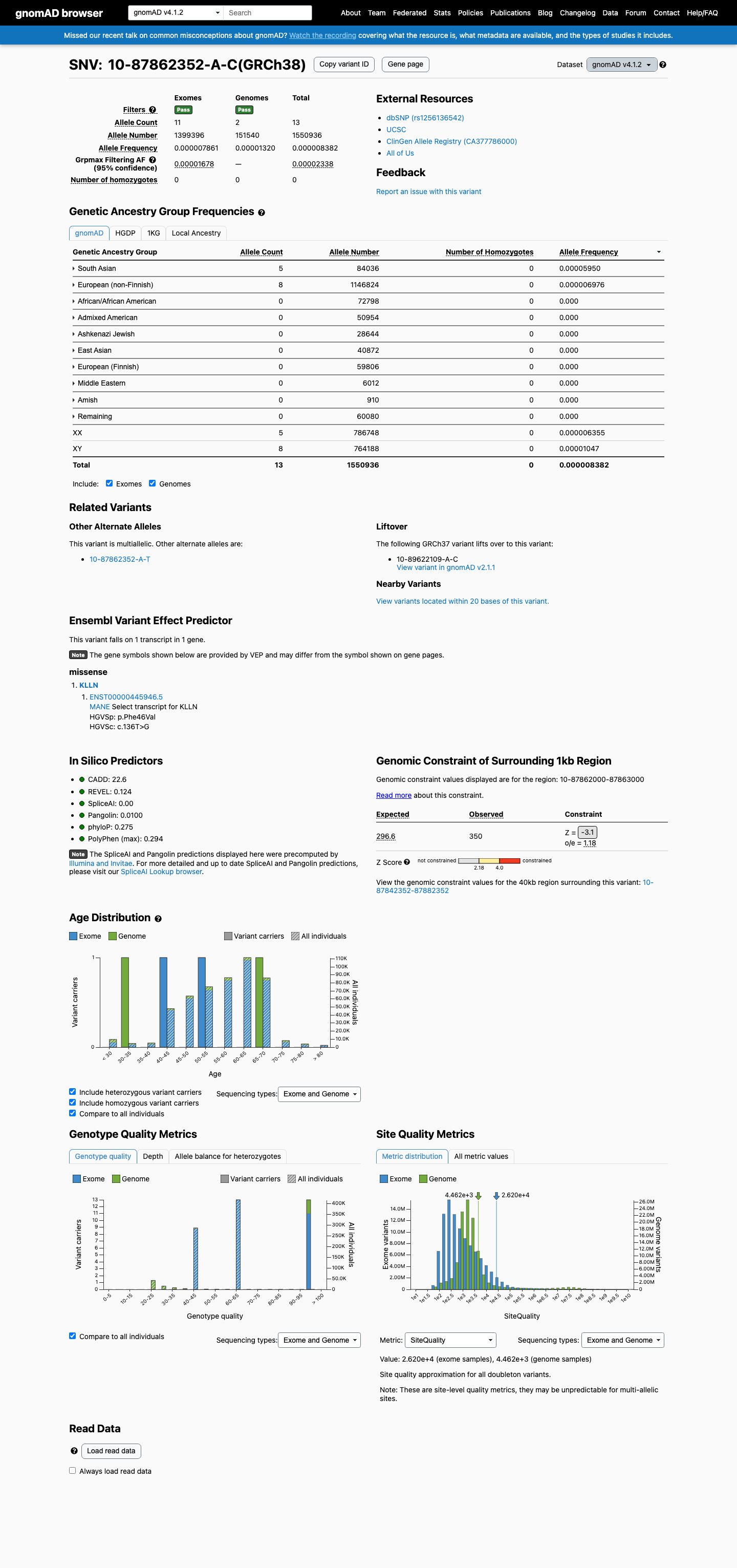
gnomAD v4.1 screenshot
gnomAD v4.1
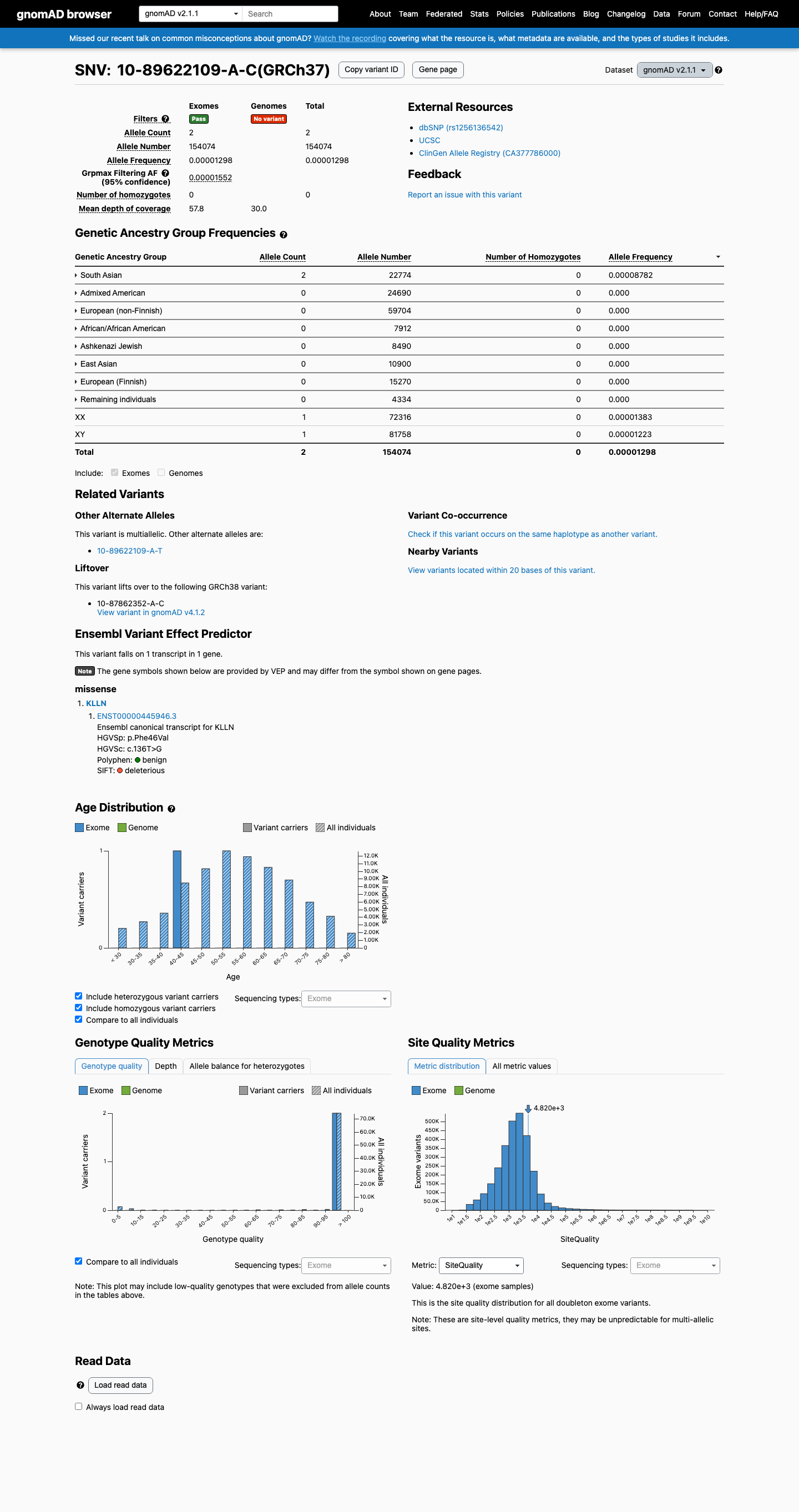
gnomAD v2.1 screenshot
gnomAD v2.1
v4.1
This variant is present in gnomAD v4.1 (AF= 8.38204e-06; MAF= 0.00084%, 13/1550936 alleles, homozygotes = 0) and has highest observed frequency in the South Asian population (AF= 5.94983e-05; MAF= 0.00595%, 5/84036 alleles, homozygotes = 0); grpmax FAF= 2.338e-05.
v2.1
This variant is present in gnomAD v2.1 (AF= 1.29808e-05; MAF= 0.00130%, 2/154074 alleles, homozygotes = 0) and has highest observed frequency in the South Asian population (AF= 8.78194e-05; MAF= 0.00878%, 2/22774 alleles, homozygotes = 0); grpmax FAF= 1.552e-05.
🇨🇦 CA
Absent from gnomAD-Canada v1.0.
Allele frequency by ancestry
three datasets · side by side
gnomAD v4.1
0.00084% · 13 / 1,550,936
0 hom · FAF 0.0023%
South Asian
5 / 84,036
0.0059%
European (non-Finnish)
8 / 1,146,824
0.0007%
+ 8 not observed (Remaining individuals, Admixed American, European (Finnish), Amish, East Asian, Middle Eastern, Ashkenazi Jewish, African/African American)
gnomAD v2.1
0.0013% · 2 / 154,074
0 hom · FAF 0.0016%
South Asian
2 / 22,774
0.0088%
+ 7 not observed (African/African American, Admixed American, Ashkenazi Jewish, East Asian, European (Finnish), European (non-Finnish), Remaining individuals)
gnomAD Canada 🇨🇦
Absent · 0 / ?
0 hom
Not observed in any ancestry group.
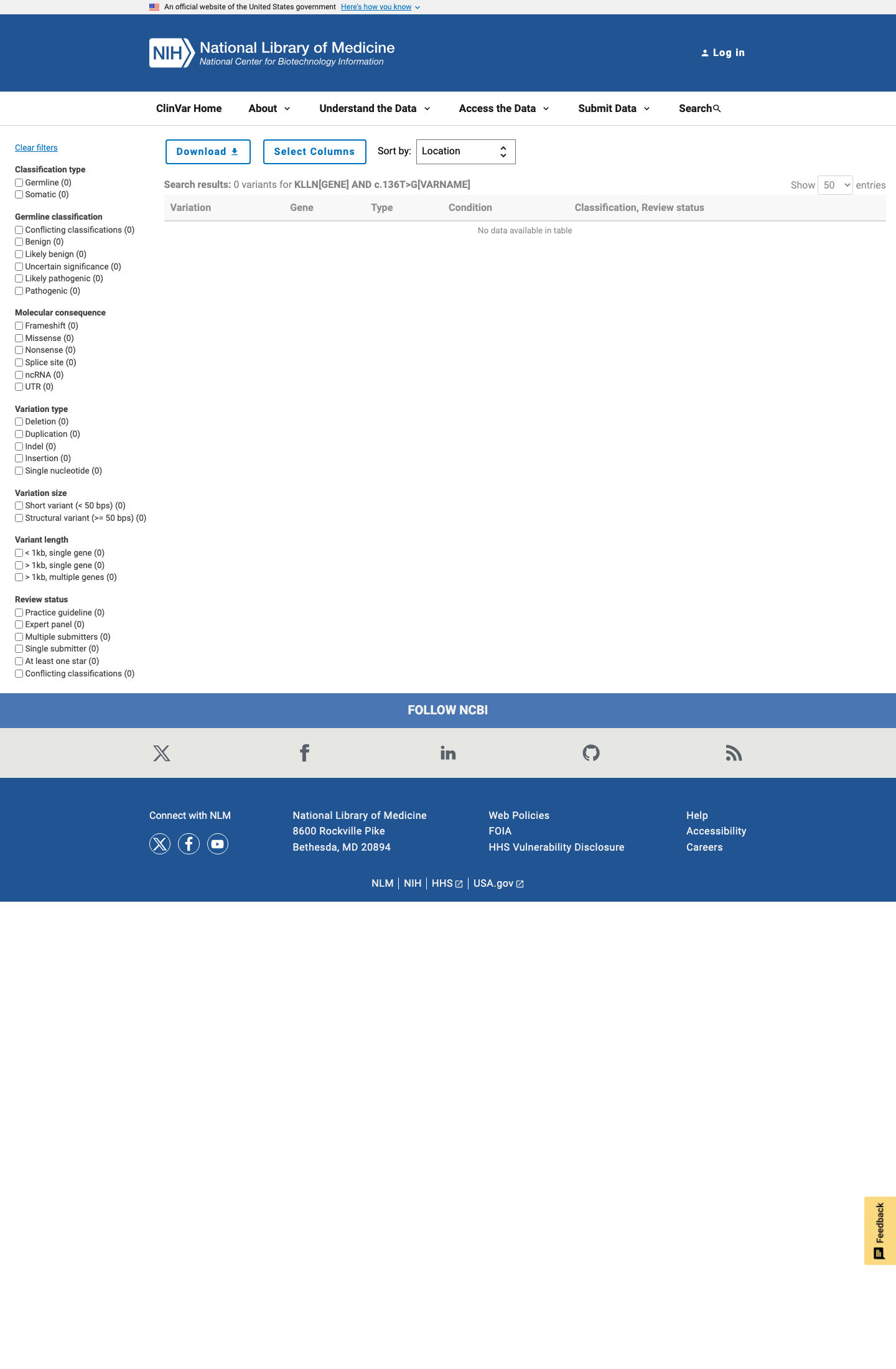
ClinVar screenshot
ClinVar
This variant is absent from ClinVar.
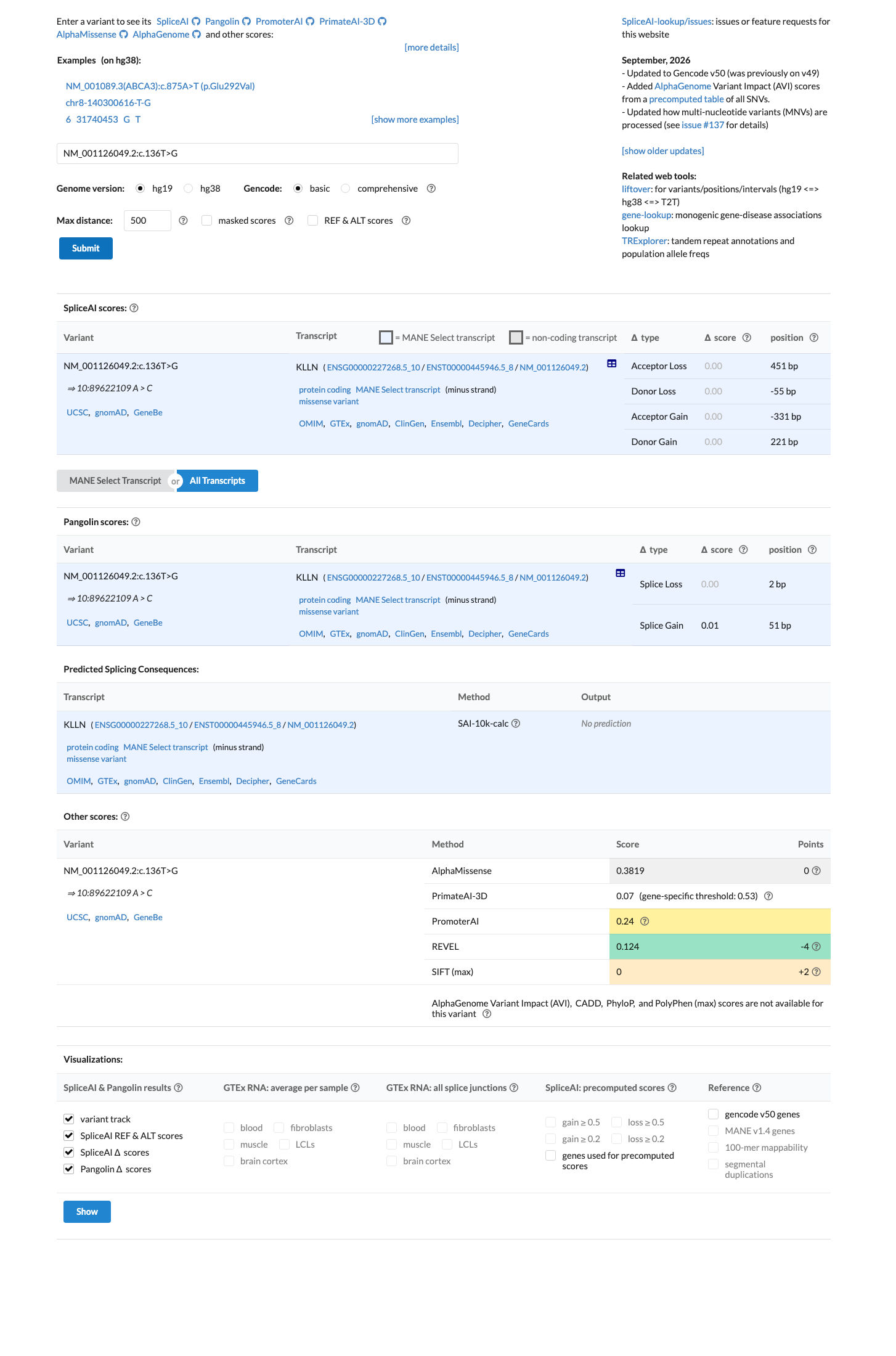
SpliceAI screenshot
In silico
SpliceAI predicts no significant splice impact for this variant (max delta score = 0.00). REVEL score = 0.124. BayesDel score = -0.246326.
Functional No data
No calibrated functional assay or RNA evidence was identified for this variant.
OncoKB ↗
COSMIC screenshot
COSMIC
Cancer hotspots screenshot
Cancer hotspots
Somatic evidence Not in COSMIC / hotspots
COSMIC
This variant does not lie in a statistically significant hotspot. This variant has not previously been reported in somatic cancers (COSMIC).
Hotspots
This variant does not lie in a statistically significant hotspot.
Sources & reference links
8Sources
ClinVar
gnomAD v2.1
gnomAD v4.1
gnomAD-Canada
SpliceAI
OncoKB
COSMIC
Cancer hotspots