Analysis in progress
Initialising…
0%
complete
This report is still being assembled — sections appear as each stage finishes. It isn't final yet.
TET2
Final classification
VUS
PM2BP1BP4
TET2
c.2119G>A
p.Ala707Thr
missense · exon 3

TET2 encodes an enzyme that converts 5-methylcytosine to 5-hydroxymethylcytosine, a key step in active DNA demethylation that helps regulate gene expression. It is important for normal blood cell formation, and defects in the gene are associated with several myeloproliferative disorders. TET2 acts as a tumor suppressor, and its mutations are most often found in blood cancers, where loss of its function can cooperate with other mutations to promote malignancy. Mutations are also found in people with clonal hematopoiesis who have no apparent blood disease but carry an increased risk of developing hematologic cancer with aging.

This variant

TET2 is a tumor suppressor whose germline disease mechanism is loss of function, and this variant is a full-length missense change (p.Ala707Thr) rather than the truncating type that defines that mechanism. It is classified as a variant of uncertain significance: frequency and computational evidence lean benign, but no functional or clinical data confirm its impact. The result means this missense does not clearly fit TET2's known disease pattern, yet its clinical significance remains unestablished.

Transcript
NM_001127208.2
HGVS · transcript:coding
NM_001127208.2:c.2119G>A
GRCh38
chr4:105236061 G>A
GRCh37
chr4:106157218 G>A
Basis VUS: the applied criteria (PM2 supporting, BP1 supporting, BP4 moderate) satisfy no generic ACMG/AMP 2015 combining rule for Pathogenic, Likely Pathogenic, Benign, or Likely Benign.
VUS: the applied criteria (PM2 supporting, BP1 supporting, BP4 moderate) satisfy no generic ACMG/AMP 2015 combining rule for Pathogenic, Likely Pathogenic, Benign, or Likely Benign.
Classification rationale
PM2 BP1BP4 VUS
TET2 c.2119G>A missense · exon 3

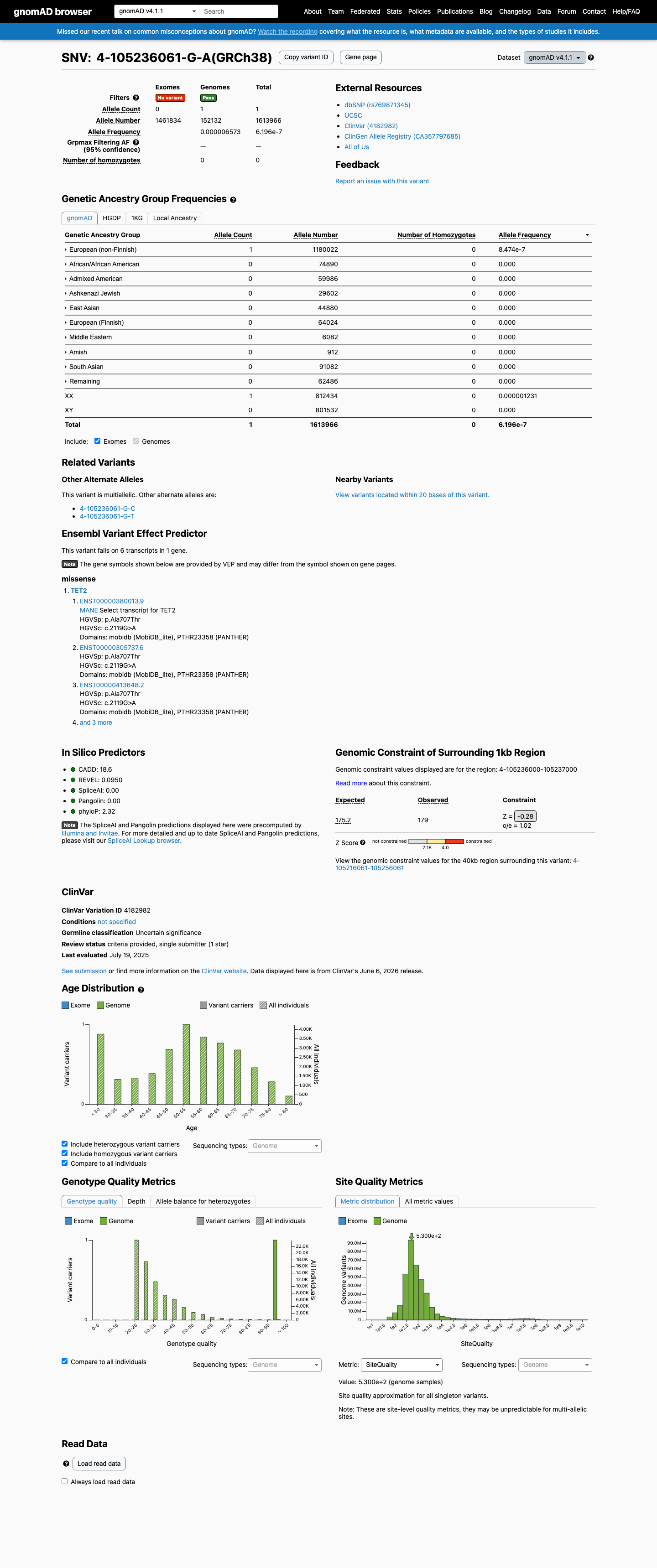
PM2 (Supporting): absent from gnomAD v2.1 and gnomAD-Canada, with only 1 alternate allele among 1,613,966 in gnomAD v4.1. BP1 (Supporting): TET2 germline disease is driven by loss-of-function variants, favoring a benign interpretation for this missense change. BP4 (Moderate): REVEL score 0.095 falls at or below the <=0.183 benign-predicting threshold. Overall: VUS — PM2 (supporting), BP1 (supporting), and BP4 (moderate) satisfy no generic ACMG/AMP 2015 combining rule for Pathogenic, Likely Pathogenic, Benign, or Likely Benign.

PM2 + BP1 + BP4 VUS
Gene diagram · NM_001127208.2 · variants mapped to exon structure
TET2 NM_001127208.2
Fetching transcript structure from UCSC…
Applied criteria · 3 applied · 19 assessed
MetEvidence satisfies this criterion.
Not metEvaluated against available evidence; threshold not reached.
Not assessedApplies in principle, but no evidence was found to evaluate it.
N/ADoesn't apply to this variant type.
Applied · 3
Strength Supporting Moderate Strong Very strong
PM2 supporting Pathogenic
Met (supporting): absent from gnomAD v2.1 and gnomAD-Canada, with only 1 alternate allele among 1,613,966 in gnomAD v4.1.
gnomAD v2.1 reports the variant as absent.gnomAD-Canada v1.0 reports the variant as absent.gnomAD v4.1 reports one alternate allele among 1,613,966 total alleles (AF 6.195917386115941e-07), zero homozygotes, and highest listed subpopulation AF 8.474418273557612e-07 in European non-Finnish samples.
BP1 supporting Benign
Met (supporting): TET2 germline disease is driven by loss-of-function variants, favoring benignity for this missense change.
pvs1_gene_context.json germline literature review (targeted TET2 germline syndrome/loss-of-function queries) supports TET2 loss-of-function as the established germline disease mechanism (lof_mechanism_supported=true), consistent with a gene where truncating variants primarily cause disease, favoring BP1 for this missense variant.
BP4 moderate Benign
Met (moderate): REVEL score 0.095 vs the <=0.183 benign-predicting threshold.
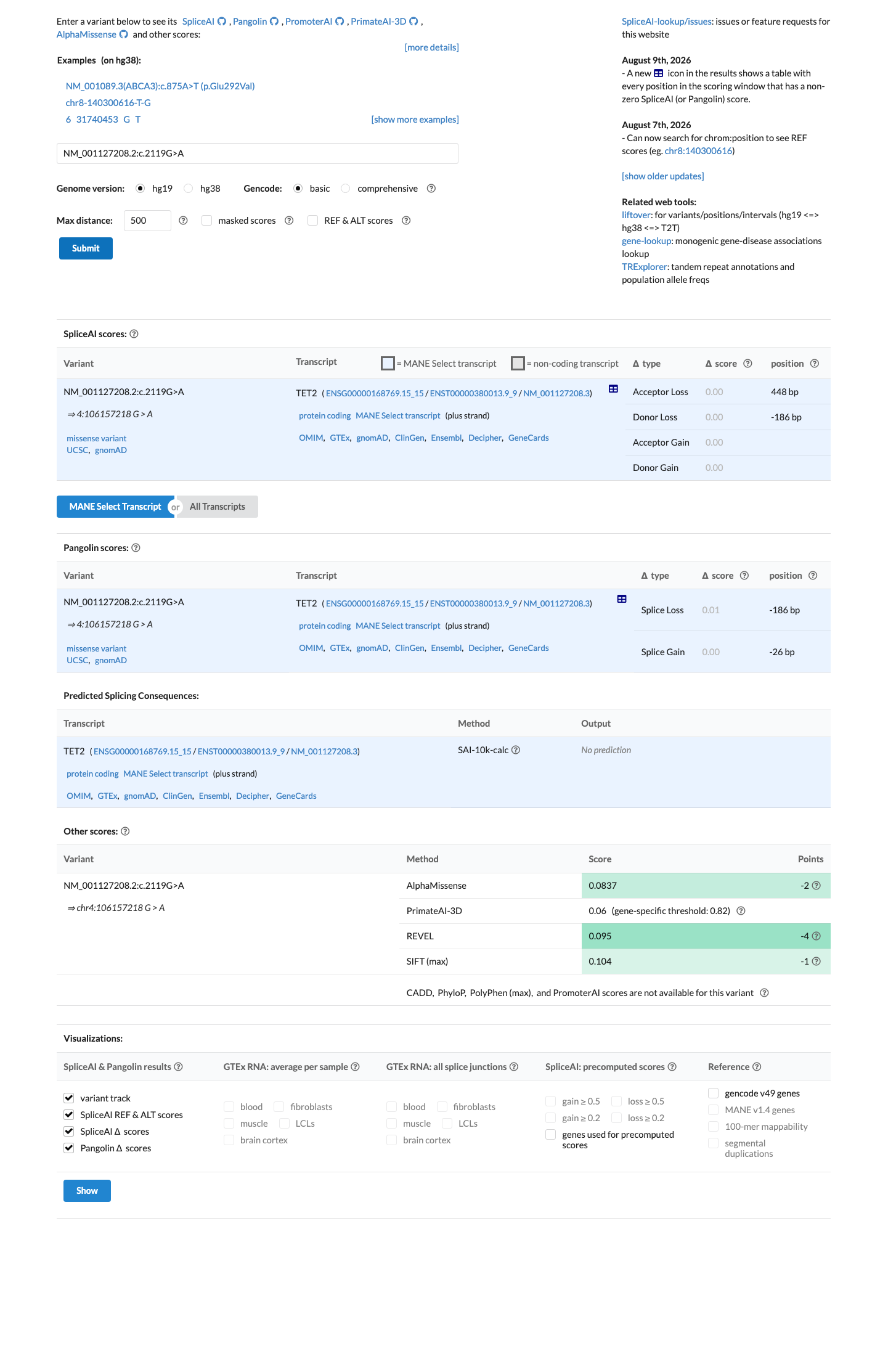
REVEL score = 0.095 for NM_001127208.2:c.2119G>A (p.Ala707Thr) meets the ClinGen SVI-calibrated BP4_Moderate threshold (<=0.183) per Pejaver et al. 2022 (PMID 36413997), supporting a benign in-silico prediction at moderate strength.SpliceAI shows no meaningful splice impact (max delta score = 0.002; all individual DS scores <=0.002), which is consistent with the missense-only interpretation and does not add a separate splice-based benign code alongside the REVEL-based BP4 call.BayesDel score (-0.507189) was retrieved but not used to strengthen or independently support BP4 because no verified published threshold/PMID for BayesDel calibration is available to this pipeline.
Assessed · not applied · 6 not met · 13 not assessed
Pathogenic
PS1 Not assessed: no pathogenic alternate nucleotide change producing the same p.Ala707Thr amino acid substitution was identified.
PS2 Not assessed: no de novo occurrence or confirmed parental testing was documented.
PS3 Not assessed: no functional assay data addressing TET2 p.Ala707Thr were available.
PS4 Not assessed: no case-control or disease-prevalence data for this variant were available.
PM1 Not met: no hotspot or somatic-recurrence signal was found, and residue 707 lies outside TET2's established catalytic domains.
PM3 Not assessed: no affected-proband observations, phase, or inheritance data were documented.
PM5 Not assessed: no different missense change at residue 707 established as pathogenic was identified.
PM6 Not assessed: no suspected de novo occurrence without confirmed parental relationships was reported.
PP1 Not assessed: no segregation or cosegregation observations were documented.
PP2 Not met: TET2 germline disease is mediated by loss-of-function variants, not by recurrent missense changes.
PP3 Not met: REVEL score 0.095 vs the >=0.644 pathogenic supporting threshold.
PP4 Not assessed: no patient phenotype or clinical information was provided.
Benign
BA1 Not met: gnomAD v4.1 allele frequency 6.2e-07 (1/1,613,966) vs the >1% stand-alone benign threshold.
BS1 Not met: highest population allele frequency 8.5e-07 vs the >0.3% benign threshold.
BS2 Not met: zero homozygotes in gnomAD v4.1, and the variant is absent from gnomAD v2.1 and gnomAD-Canada.
BS3 Not assessed: no functional assay data were available to establish normal, wild-type-like function.
BS4 Not assessed: no unaffected relatives were tested for the variant.
BP2 Not assessed: no data show the variant in cis or trans with a pathogenic variant.
BP5 Not assessed: no information on an alternative molecular diagnosis was available.
N/A · 6 PVS1 · PM4 · PP5 · BP3 · BP6 · BP7
Research & evidence
Population frequency
gnomAD v4.1 screenshot
gnomAD v4.1
gnomAD v2.1 screenshot
gnomAD v2.1
v4.1
This variant is present in gnomAD v4.1 (AF= 6.19592e-07; MAF= 0.00006%, 1/1613966 alleles, homozygotes = 0) and has highest observed frequency in the European (non-Finnish) population (AF= 8.47442e-07; MAF= 0.00008%, 1/1180022 alleles, homozygotes = 0).
v2.1
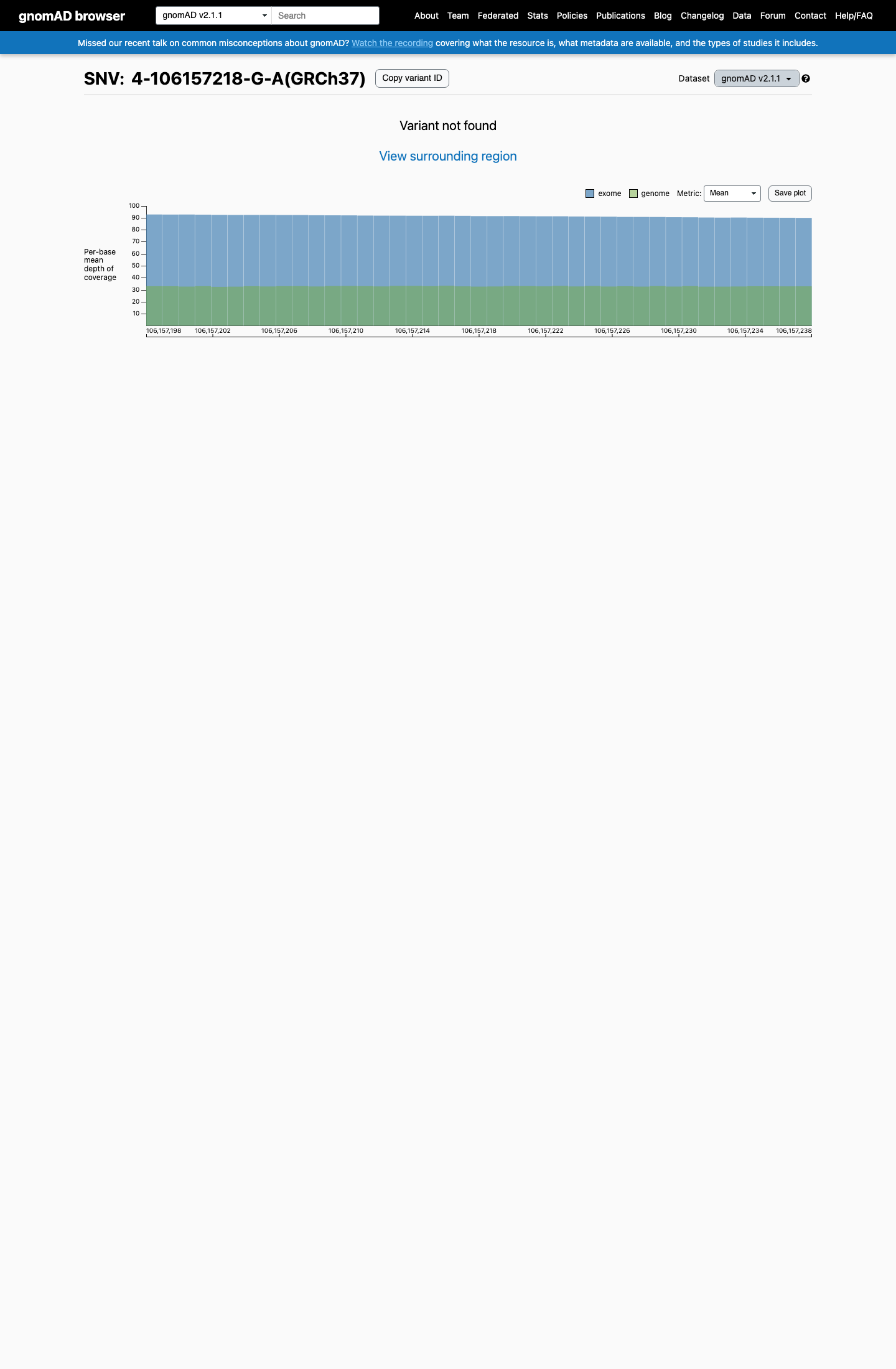
Absent from gnomAD v2.1.
🇨🇦 CA
Absent from gnomAD-Canada v1.0.
Allele frequency by ancestry
three datasets · side by side
gnomAD v4.1
6.2e-05% · 1 / 1,613,966
0 hom
European (non-Finnish)
1 / 1,180,022
8.5e-05%
+ 9 not observed (Remaining individuals, Admixed American, European (Finnish), Amish, East Asian, Middle Eastern, South Asian, Ashkenazi Jewish, African/African American)
gnomAD v2.1
Absent · 0 / ?
0 hom
Not observed in any ancestry group.
gnomAD Canada 🇨🇦
Absent · 0 / ?
0 hom
Not observed in any ancestry group.
ClinVar screenshot
ClinVar
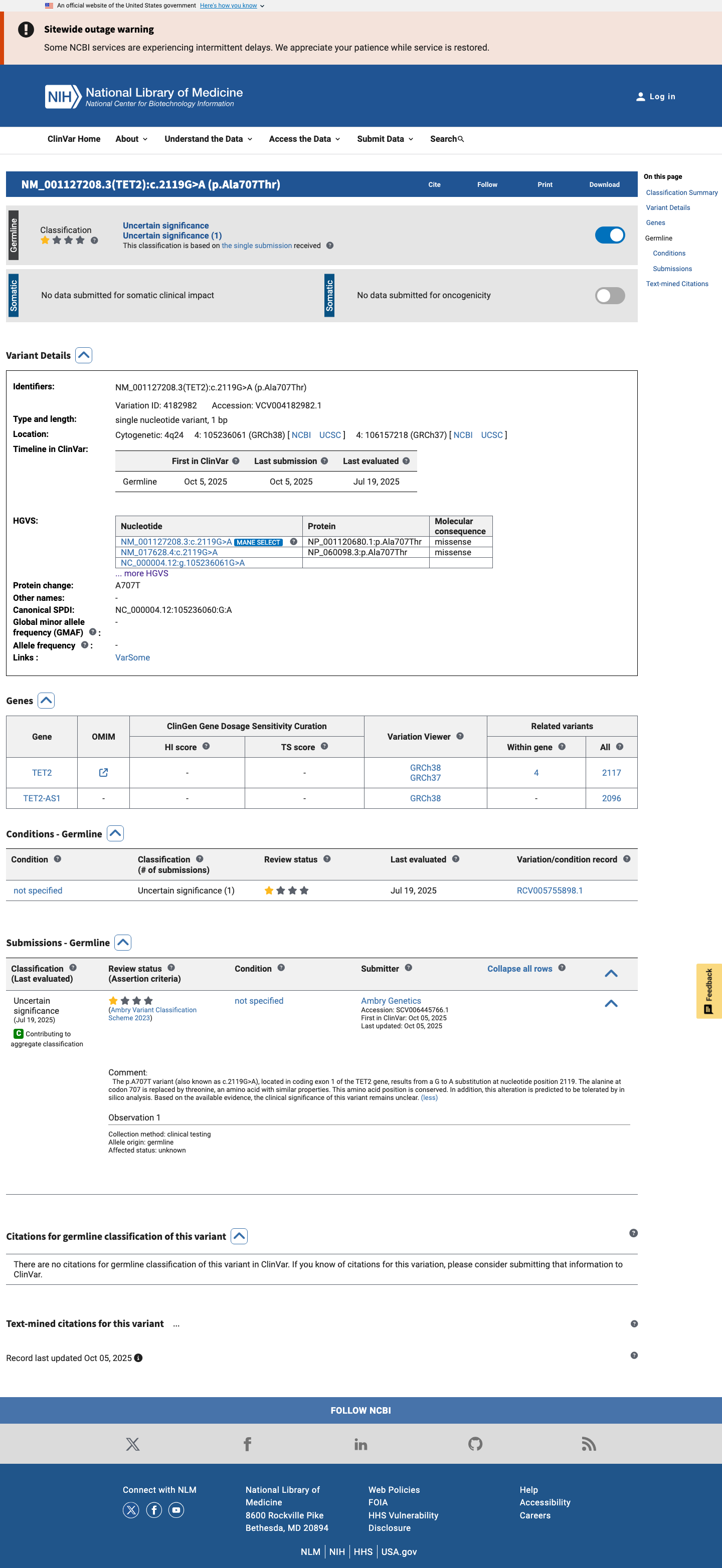
This variant has been reported in ClinVar as Uncertain significance (1 clinical laboratory). (ClinVarID = 4182982)
SpliceAI screenshot
In silico
SpliceAI predicts no significant splice impact for this variant (max delta score = 0.00). REVEL score = 0.095. BayesDel score = -0.507189.
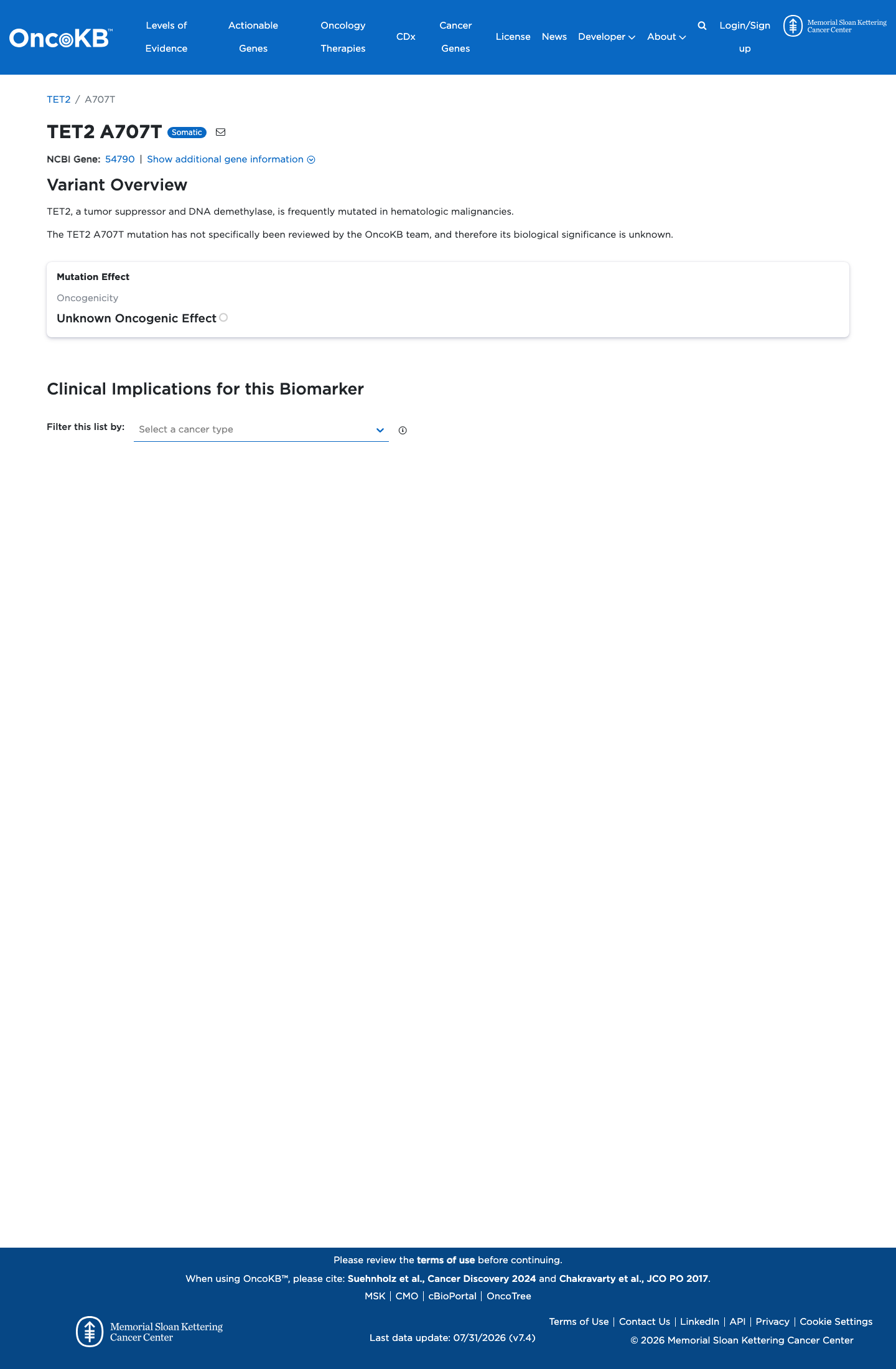
Functional / OncoKB screenshot
Functional Unknown Oncogenic Effect
OncoKB did not identify variant-specific reviewed functional evidence for this variant; gene-level curated context is available for reviewer follow-up. TET2, a tumor suppressor and DNA demethylase, is frequently mutated in hematologic malignancies.
OncoKB ↗
COSMIC screenshot
COSMIC
Cancer hotspots screenshot
Cancer hotspots
Somatic evidence Not in COSMIC / hotspots
COSMIC
This variant does not lie in a statistically significant hotspot. This variant has not previously been reported in somatic cancers (COSMIC).
Hotspots
This variant does not lie in a statistically significant hotspot.
Sources & reference links
8Sources
ClinVar
gnomAD v2.1
gnomAD v4.1
gnomAD-Canada
SpliceAI
OncoKB
COSMIC
Cancer hotspots