Analysis in progress
Initialising…
0%
complete
This report is still being assembled — sections appear as each stage finishes. It isn't final yet.
MET
Final classification
VUS
MET c.737C>T · p.Pro246Leu
MET

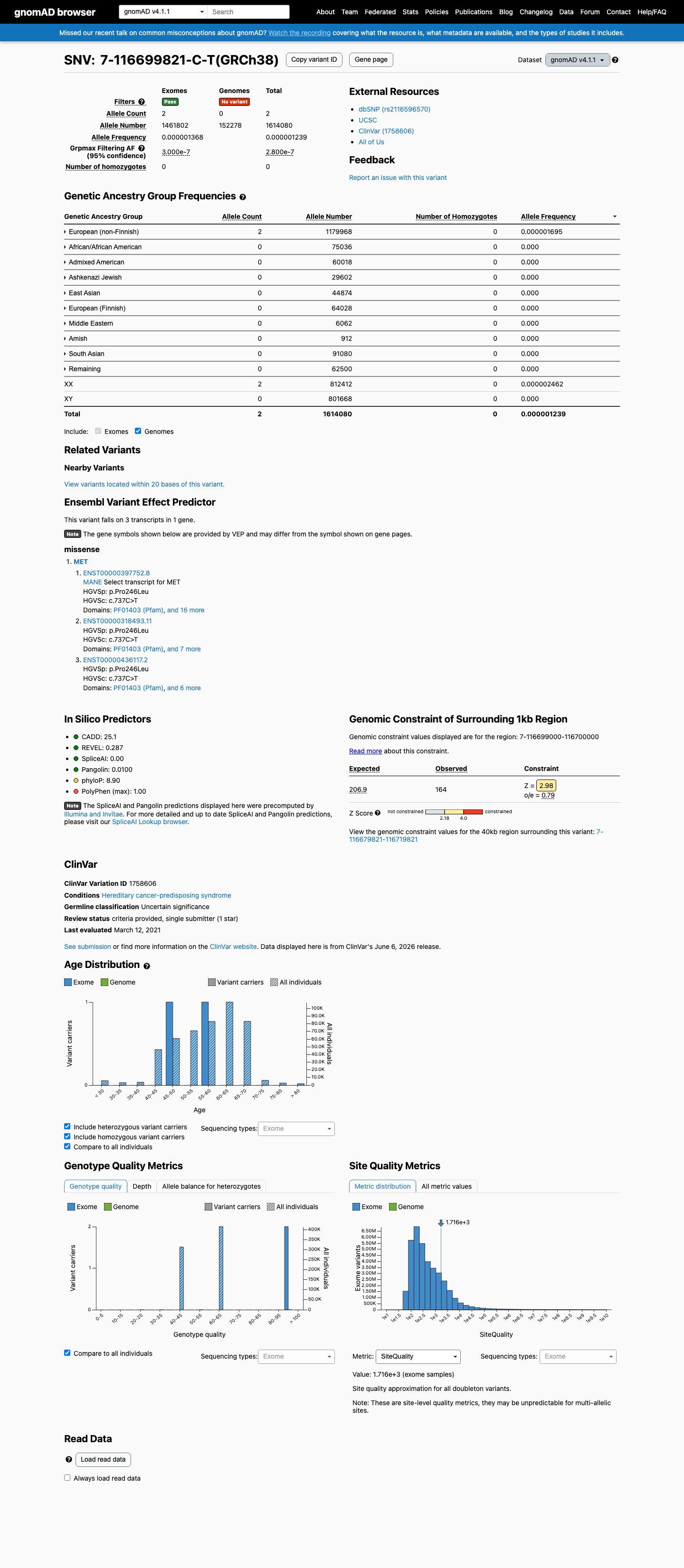
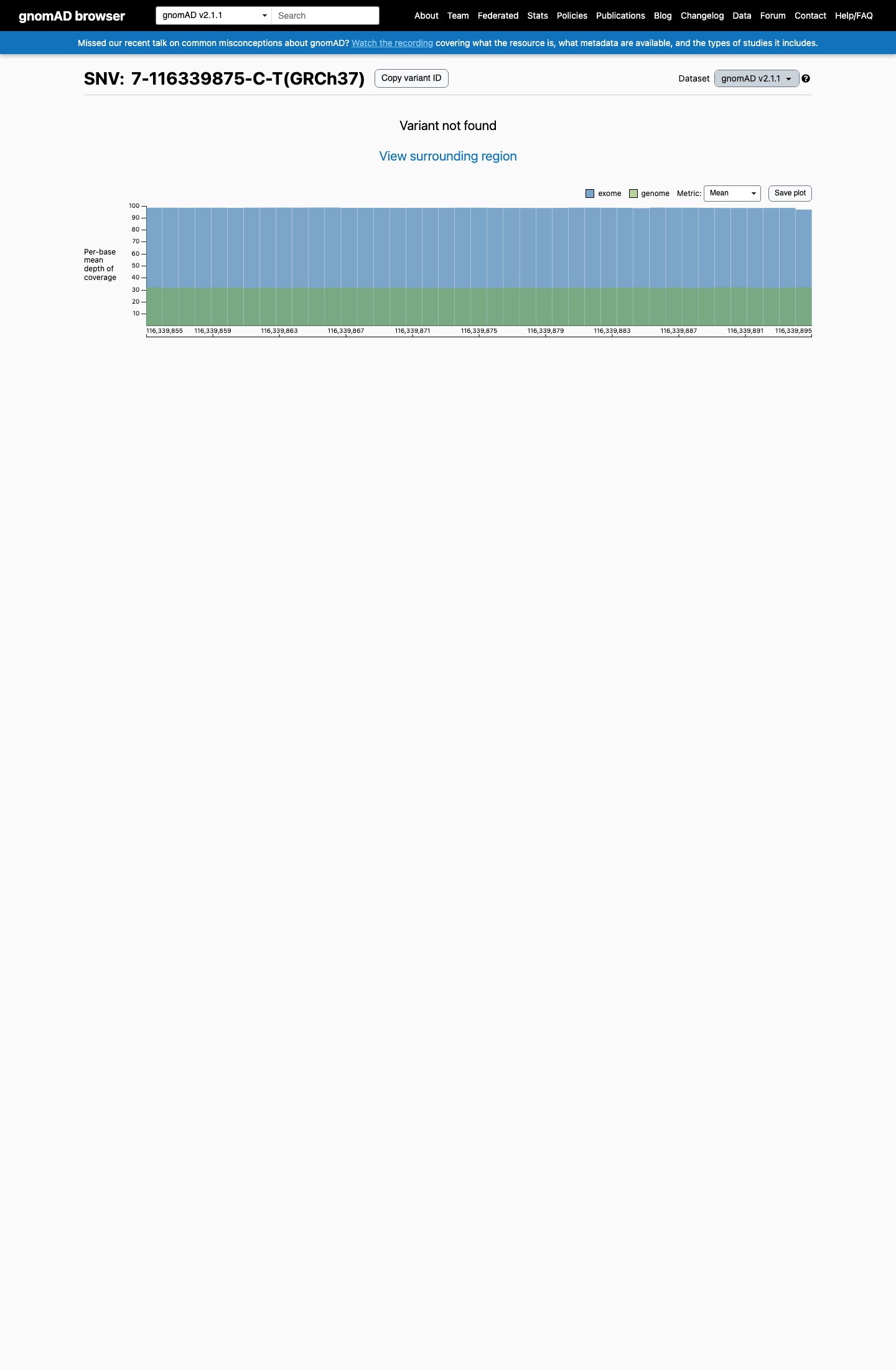
PM2 (Supporting): variant essentially absent from population databases — gnomAD v4.1 AF 1.24e-06 (2/1,614,080 alleles, 0 homozygotes); absent from gnomAD v2.1 and gnomAD-Canada v1.0.

Gene
MET
Transcript
NM_001127500.2
HGVS · transcript:coding
NM_001127500.2:c.737C>T
Consequence
N/A
GRCh38
chr7:116699821 C>T
GRCh37
chr7:116339875 C>T
Basis VUS: one supporting pathogenic-leaning criterion (PM2, gnomAD AF 1.24e-06) and one supporting benign-leaning criterion (BP4, REVEL 0.287) satisfy no ACMG/AMP combination rule, defaulting to VUS.
VUS: one supporting pathogenic-leaning criterion (PM2, gnomAD AF 1.24e-06) and one supporting benign-leaning criterion (BP4, REVEL 0.287) satisfy no ACMG/AMP combination rule, defaulting to VUS.
Classification rationale
PM2 BP4 VUS
MET c.737C>T

PM2 (Supporting): variant essentially absent from population databases — gnomAD v4.1 AF 1.24e-06 (2/1,614,080 alleles, 0 homozygotes); absent from gnomAD v2.1 and gnomAD-Canada v1.0. BP4 (Supporting): REVEL 0.287 falls within the ClinGen SVI-calibrated BP4-supporting interval (0.183-0.290), predicting a benign/tolerated effect; SpliceAI max delta 0.00 corroborates no splice impact. Final classification VUS: the single supporting pathogenic-leaning criterion (PM2) and single supporting benign-leaning criterion (BP4) satisfy no generic ACMG/AMP combination rule, so the result defaults to VUS.

PM2 + BP4 VUS
Gene diagram · NM_001127500.2 · variants mapped to exon structure
MET NM_001127500.2
Fetching transcript structure from UCSC…
Applied criteria · 2 applied · 21 assessed
Applied · 2
Strength Supporting Moderate Strong Very strong
PM2 supporting Pathogenic
Met (supporting): essentially absent from population databases — gnomAD v4.1 AF 1.24e-06 (2/1,614,080 alleles, 0 homozygotes); absent from gnomAD v2.1 and gnomAD-Canada v1.0.
gnomAD v4.1 (gnomad_v4): total AF 1.239095955590801e-06 (2/1,614,080 alleles), 0 homozygotes, exome AF 1.3681743491936664e-06, joint grpmax FAF 2.8e-07 - extremely low frequency consistent with PM2 (Richards et al. 2015, PMID 25741868)gnomAD v2.1 (gnomad_v2): variant absentgnomAD-Canada v1.0 (gnomad_canada): variant absent
BP4 supporting Benign
Met (supporting): REVEL 0.287 falls within the ClinGen SVI-calibrated BP4-supporting interval (0.183-0.290); SpliceAI max delta 0.00 corroborates no splice impact.
REVEL score 0.287 for 7-116699821-C-T (local REVEL v1.3 lookup) - within the ClinGen SVI BP4-supporting range 0.183-0.290 per Pejaver et al. 2022 (PMID 36413997); supports BP4 at supporting strength.SpliceAI max delta 0.00 for NM_001127500.2:c.737C>T (SpliceAI Lookup) - below the recommended 0.2 splice-altering threshold per Jaganathan et al. 2019 (PMID 30661751); no predicted splice impact, corroborating BP4 (not summed for strength).BayesDel score -0.254558 (local BayesDel noAF lookup) - not usable: no verified published calibration threshold can be cited for this predictor; treated as not available for BP4.
Assessed · not applied
Pathogenic
PS1 Not met: no pathogenic submission for p.(Pro246Leu) exists in ClinVar; the only entry is a single-submitter Uncertain significance record.
PS2 Not assessed: no de novo occurrence with confirmed maternity and paternity has been reported for this variant.
PS3 Not assessed: no well-established functional studies of this variant exist; in silico scores (REVEL 0.287, SpliceAI 0.00) cannot satisfy PS3.
PS4 Not assessed: no case-control or cohort enrichment data exist for this variant; the sole ClinVar entry supplies no affected-case counts.
PM1 Not met: residue 246 is not a statistically significant cancer hotspot (Cancer Hotspots no_result), and no critical functional domain around it could be established.
PM5 Not met: no pathogenic missense variant at a different amino acid at residue 246 is documented (absence-of-evidence determination).
PM6 Not assessed: no de novo report — confirmed or unconfirmed — for this variant exists.
PP1 Not assessed: no family segregation data exist — no affected relatives tested and no meioses observed.
PP2 Not assessed: no gene-level missense constraint metric (e.g., gnomAD missense z-score) is available to evaluate the low-benign-missense-rate prong.
PP3 Not met: REVEL 0.287 is far below the >=0.644 PP3-supporting threshold, and SpliceAI max delta 0.00 predicts no splice impact.
PP4 Not assessed: no proband phenotype, family history, or clinical summary is available to assess specificity for MET-associated disease.
PP5 Not met: no ClinVar expert-panel Pathogenic/Likely pathogenic classification exists for this exact variant; only a single-laboratory Uncertain significance entry.
Benign
BA1 Not met: gnomAD v4.1 AF 1.24e-06 is more than four orders of magnitude below the >5% BA1 threshold.
BS1 Not met: observed frequency (1.24e-06) is orders of magnitude below any plausible expected-frequency threshold for a germline cancer-predisposition disorder.
BS2 Not met: only 2 unconfirmed heterozygous carriers and 0 homozygotes in gnomAD v4.1; no phenotype-verified unaffected controls.
BS3 Not assessed: no well-established functional studies showing no damaging effect are available; in silico predictions alone cannot satisfy BS3.
BS4 Not assessed: no family segregation or non-segregation data exist for this variant.
BP1 Not met: MET disease is not predominantly truncating — germline activating missense variants are an established mechanism (hereditary papillary renal cell carcinoma).
BP2 Not assessed: no phase, co-occurrence, or parental-testing data exist to evaluate trans/cis observations with a pathogenic variant.
BP5 Not assessed: no proband-level molecular workup or alternative genetic diagnosis is available to evaluate an alternative disease cause.
BP6 Not met: no ClinVar expert-panel Benign/Likely benign classification exists for this exact variant.
N/A · 5 PVS1 · PM3 · PM4 · BP3 · BP7
Research & evidence
Population frequency
gnomAD v4.1 screenshot
gnomAD v4.1
gnomAD v2.1 screenshot
gnomAD v2.1
v4.1
This variant is present in gnomAD v4.1 (AF= 1.2391e-06; MAF= 0.00012%, 2/1614080 alleles, homozygotes = 0) and has highest observed frequency in the European (non-Finnish) population (AF= 1.69496e-06; MAF= 0.00017%, 2/1179968 alleles, homozygotes = 0); grpmax FAF= 2.8e-07.
v2.1
Absent from gnomAD v2.1.
🇨🇦 CA
Absent from gnomAD-Canada v1.0.
Allele frequency by ancestry
three datasets · side by side
gnomAD v4.1
0.00012% · 2 / 1,614,080
0 hom · FAF 2.8e-05%
European (non-Finnish)
2 / 1,179,968
0.00017%
+ 9 not observed (Remaining individuals, Admixed American, European (Finnish), Amish, East Asian, Middle Eastern, South Asian, Ashkenazi Jewish, African/African American)
gnomAD v2.1
Absent · 0 / ?
0 hom
Not observed in any ancestry group.
gnomAD Canada 🇨🇦
Absent · 0 / ?
0 hom
Not observed in any ancestry group.
ClinVar screenshot
ClinVar
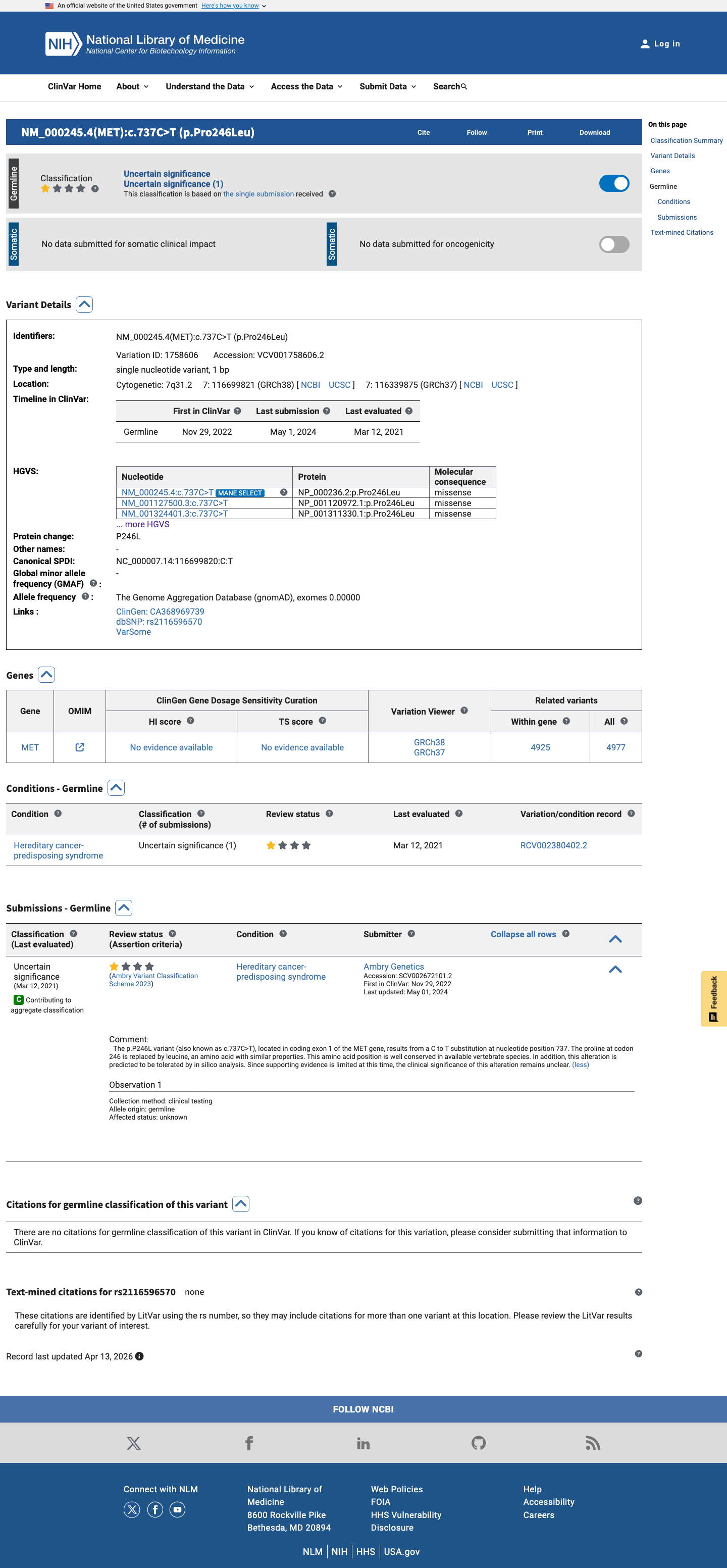
This variant has been reported in ClinVar as Uncertain significance (1 clinical laboratory). (ClinVarID = 1758606)
SpliceAI screenshot
In silico
SpliceAI predicts no significant splice impact for this variant (max delta score = 0.00). REVEL score = 0.287. BayesDel score = -0.254558.
Functional / OncoKB screenshot
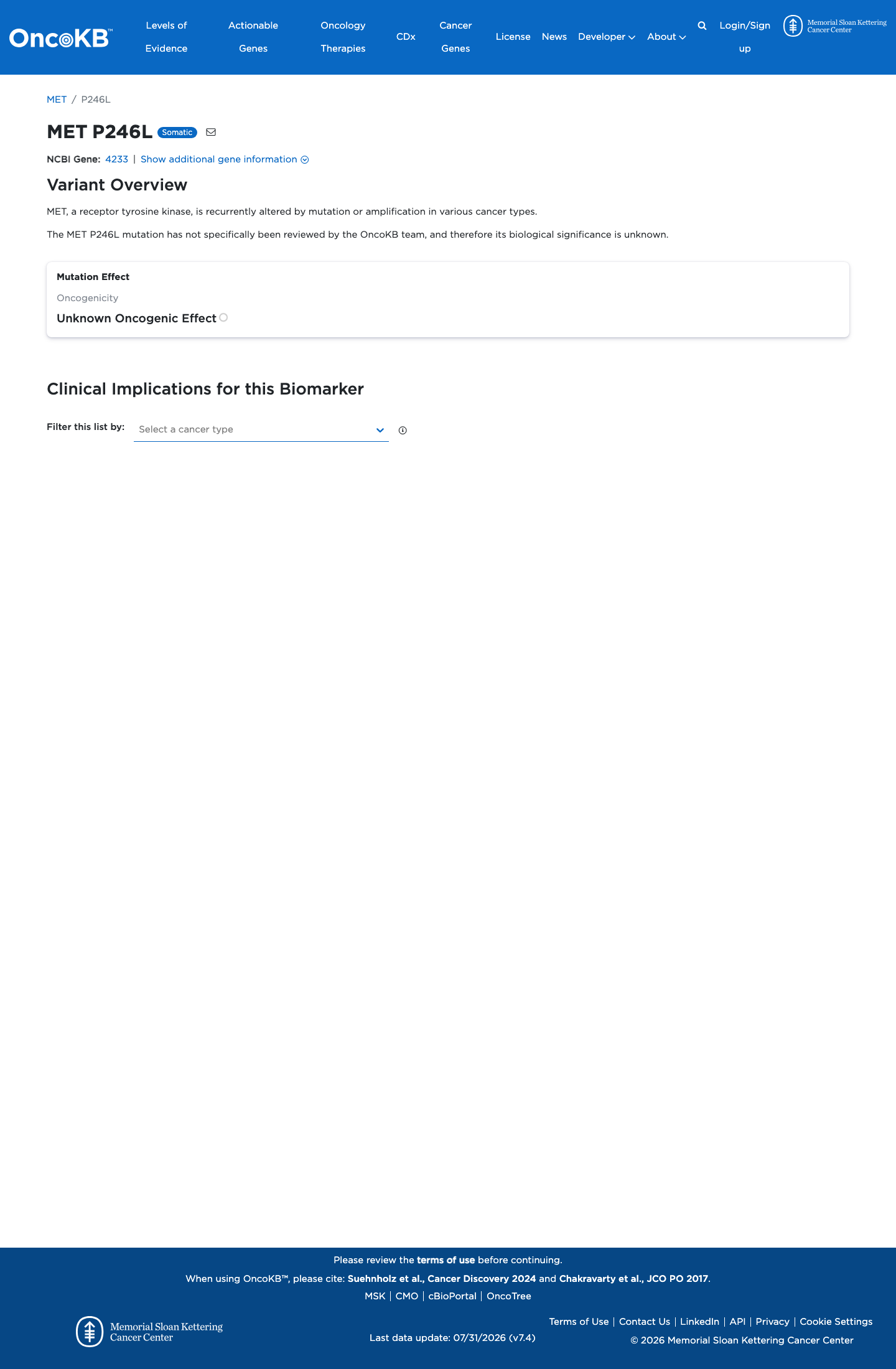
Functional Unknown Oncogenic Effect
OncoKB did not identify variant-specific reviewed functional evidence for this variant; gene-level curated context is available for reviewer follow-up. MET, a receptor tyrosine kinase, is recurrently altered by mutation or amplification in various cancer types.
OncoKB ↗
COSMIC screenshot
COSMIC
Cancer hotspots screenshot
Cancer hotspots
Somatic evidence Not in COSMIC / hotspots
COSMIC
This variant does not lie in a statistically significant hotspot. This variant has not previously been reported in somatic cancers (COSMIC).
Hotspots
This variant does not lie in a statistically significant hotspot.
Sources & reference links
8Sources
ClinVar
gnomAD v2.1
gnomAD v4.1
gnomAD-Canada
SpliceAI
OncoKB
COSMIC
Cancer hotspots
Triaged references · 1 PMID not cited in assessment
25394175 ↗ A practice guideline from the American College of Medical Genetics and Genomics and the National Society of Genetic Counselors: referral indications for cancer predisposition assessment. CLINVAR