Back
NM_001127510.3:c.4360A>G
p.Lys1454Glu · APC
0%
complete
Final classification
Benign
BA1BS1BS3BP1
APC
c.4360A>G
p.Lys1454Glu
missense · exon 17

APC is a tumor suppressor gene whose protein acts as a key brake on the Wnt signaling pathway by helping mark the growth-promoting protein beta-catenin for destruction; it also participates in cell migration, adhesion, and apoptosis. Inherited mutations in APC cause familial adenomatous polyposis (FAP), an autosomal dominant condition characterized by numerous colorectal polyps and a very high risk of colorectal cancer, with related forms including attenuated FAP and gastric adenocarcinoma and proximal polyposis of the stomach (GAPPS). Somatic APC mutations are found in roughly 50-80% of sporadic colorectal cancers, where they act as early tumor-initiating events, and are also observed in some breast, stomach, and prostate cancers. Loss of APC function leaves Wnt signaling abnormally active, driving uncontrolled cell growth, which makes APC a central tumor suppressor in colorectal cancer.

This variant

APC encodes a tumor suppressor that restrains Wnt/beta-catenin-driven cell growth, and germline loss-of-function alleles in it cause autosomal dominant familial adenomatous polyposis; c.4360A>G (p.Lys1454Glu) alters a residue in APC's beta-catenin down-regulating domain, the region through which that restraint is exerted.

Transcript
NM_001127510.3
HGVS · transcript:coding
NM_001127510.3:c.4360A>G
GRCh38
chr5:112839954 A>G
GRCh37
chr5:112175651 A>G
Benign: BA1 (stand-alone benign, non-cancer gnomAD v2.1.1 popmax filtering AF 0.6696%) alone satisfies the APC Expert Panel's Rule26.
Classification rationale
BA1BS1BS3BP1 Benign
APC c.4360A>G missense · exon 17

Benign: BA1 (stand-alone benign) - non-cancer gnomAD v2.1.1 popmax filtering AF 0.6696% clears the 0.1% threshold and alone satisfies the APC VCEP's Benign.Stand Alone rule. Benign: BS1 (strong) - the same VCEP-directed 0.6696% popmax filtering AF exceeds the 0.001% strong-benign ceiling, but is subsumed by BA1. Benign: BS3 (supporting) - a beta-catenin-regulated transcription assay shows K1454E retaining wild-type-comparable activity (PMID:18199528). Benign: BP1 (supporting) - a true missense change at codon 1454, outside the excepted 1021-1035 beta-catenin repeat window, in a gene where truncating variants cause disease.

BA1 + BS1 + BS3 + BP1 → Benign
LYFE Sciences is an AI system, and it can make mistakes. Criteria may be applied incorrectly, sources may be misread, and a confident-looking classification can still be wrong. Double-check every criterion and its underlying evidence before relying on any call.
Gene diagram · NM_001127510.3 · variants mapped to exon structure
APC NM_001127510.3
Fetching transcript structure from UCSC…
Applied criteria · 4 applied · 16 assessed
MetEvidence satisfies this criterion.
Not metEvaluated against available evidence; threshold not reached.
Not assessedApplies in principle, but no evidence was found to evaluate it.
N/ADoesn't apply to this variant type.
Applied · 4
Strength Supporting Moderate Strong Very strong
BA1 stand-alone Benign
Met: the VCEP-directed non-cancer gnomAD v2.1.1 popmax filtering AF is 0.6696%, far above the BA1 threshold of 0.1%.
Governing rule applied: APC VCEP v2.1 BA1 (Benign Stand Alone) - 'GnomAD Popmax Filtering Allele Frequency (AF) >= 0.1% (0.001)', with the specification's dataset directive to 'Use the non-cancer dataset from gnomAD (v2.1.1)'.VCEP-directed source, non-cancer gnomAD v2.1.1 exomes (variant 5-112175651-A-G): popmax filtering AF 0.00669606 (0.6696%); total exome AF 0.000582992 (138/236,710 alleles), 0 homozygotes; genome popmax filtering AF 0.0072541; combined total AF 0.0008056695 (216/268,100 alleles), 0 homozygotes.Ancestry breakdown in the directed non-cancer v2.1.1 dataset: African/African American exome AF 117/14,902 = 0.785% and genome-inclusive AFR AF 194/23,608 = 0.822%, which is the population maximum that generates the 0.6696% popmax filtering AF; other populations are far lower (e.g. Admixed American well under 0.1%).
BS1 strong Benign
Met: the VCEP-directed non-cancer gnomAD v2.1.1 popmax filtering AF of 0.6696% exceeds the BS1 threshold of 0.001%, though BA1 stand-alone supersedes it.
Governing rule applied: APC VCEP v2.1 BS1 (Benign Strong) - 'GnomAD Popmax Filtering Allele Frequency (AF) >= 0.001% (0.00001)', with the specification's dataset directive to 'Use the non-cancer dataset from gnomAD (v2.1.1)'.VCEP-directed source, non-cancer gnomAD v2.1.1 exomes: popmax filtering AF 0.00669606 (0.6696%) versus the 0.001% (0.00001) BS1 threshold - exceeded ~670-fold.Corroborating frequency figures, all above the BS1 threshold: non-cancer exome total AF 0.000582992 (138/236,710); non-cancer exome+genome total AF 0.0008056695 (216/268,100); all-comers gnomAD v4.1 total AF 0.000473942 (765/1,614,122) with popmax filtering AF 0.00853602.
BS3 supporting review Benign
Met at Supporting: CRT assay (PMID:18199528) shows K1454E retains beta-catenin-regulated transcription comparable to wild type (about 1.15x, not significant) in a codon-1454 variant.
APC VCEP v2.1 BS3_Supporting, quoted verbatim: 'Protein assay show retention of beta-catenin regulated transcription activity comparable to wild-type (only for variants within the beta-catenin binding domain, which refers to codons 959-2129 of APC, see PMID: 33348689)'; the BS3_Strong tier is restricted to 'RNA assay of a synonymous or intronic variant in constitutional patient sample demonstrates no mRNA aberration AND biallelic expression is shown and/or nonsense-mediated decay inhibition was used'.Variant eligibility for the protein-assay route: NP_001120982.1:p.(Lys1454Glu) = codon 1454, within the VCEP-specified beta-catenin binding domain of codons 959-2129.PMID:18199528 (Azzopardi et al. 2008) assay controls and validation, quoted: 'we made and tested six synonymous variants (normal controls) and four truncating mutations (mutant controls) within the beta-catenin down-regulating domain ... the six synonymous variants and the wild-type APC construct all suppressed CRT in an APC-deficient cell line (Fig. 2A)'; '1309D, which is associated with a severe FAP phenotype, failed to suppress CRT (P < 0.0001) whereas 1450D, 1517D, and 1914D suppressed CRT more effectively than 1309D but not as effectively as the wild-type construct (P < 0.05; Fig. 2B)'.
BP1 supporting Benign
Met at supporting: missense at codon 1454 lies outside the APC VCEP's excepted 1021-1035 beta-catenin repeat window in a primarily truncating-mechanism gene.
APC VCEP/InSiGHT specification (v2.1) BP1 rule and applicability: 'BP1 is applicable to APC with the exception of missense variants located in the first 15-amino acid repeat of the beta-catenin binding domain (codon 1021-1035)'; the variant is at codon 1454, outside the excepted window.APC VCEP BP1 instructionsToUse: a number of assumed missense variants are in fact splice variants, and at least several splice prediction tools should be used before applying BP1.pvs1_gene_context.json: loss-of-function mechanism supported (lof_mechanism_supported true), supporting the premise that APC disease is driven primarily by truncating variants.
Assessed · not applied · 12 not met · 4 not assessed
Pathogenic
PVS1 Not met: c.4360A>G is a missense substitution (p.Lys1454Glu), not a null variant, and SpliceAI max delta 0.001 excludes a cryptic splice-null allele.
PS1 Not met: no established P/LP APC variant shares the p.(Lys1454Glu) amino-acid change; the VCEP recognises only p.(Asn1026Ser) and p.(Ser1028Arg).
PS2 Not assessed: no proband de novo occurrence or parental testing exists, and published germline occurrences of c.4360A>G are inherited, including 2/969 healthy controls (PMID:18199528).
PS3 Not met: the only functional assay (CRT, PMID:18199528) shows K1454E at about 1.15x wild-type activity, not significantly increased, so no damaging effect is demonstrated.
PS4 Not met: reported carriers total 0.5 phenotype points, below the PS4_Supporting minimum of 1 phenotype point (0.5 >= 1? no).
PM2 Not met: non-cancer gnomAD v2.1.1 allele frequency 0.0583% (138/236,710, AC > 1) far exceeds the PM2 ceiling of 0.0003%.
PM5 Not met: no different missense at codon 1454 is established Pathogenic/Likely Pathogenic (VCEP lists only p.(Asn1026Ser) and p.(Ser1028Arg)).
PM6 Not assessed: no assumed de novo occurrence is documented; the variant is inherited in published reports (PMID:18199528) and present in gnomAD v4.1 at 765 alleles with 9 homozygotes.
PP1 Not assessed: no pedigree or meioses are available for c.4360A>G, and the APC VCEP requires at least 3 meioses in one family even for supporting PP1.
PP3 Not met: SpliceAI maximum delta 0.001 is below the 0.2 supporting threshold, giving no deleterious splice evidence.
PP5 Not met: zero ClinVar expert-panel submissions for this variant (aggregate Benign from single submitters), so no expert-panel pathogenic assertion triggers PP5.
Benign
BS2 Not met: the VCEP-directed non-cancer gnomAD v2.1.1 dataset shows zero homozygotes and healthy-control carriers total about 1 point, below the >= 3 needed.
BS4 Not assessed: no genotyped family members exist, so no affected non-carrier can be scored against the >= 1 Table 1 phenotype-point threshold for BS4.
BP2 Not met: no report shows c.4360A>G in trans with a pathogenic APC variant, nor three unknown-phase occurrences with different pathogenic APC variants.
BP5 Not met: no (likely) pathogenic variant in another adenomatous polyposis gene (POLD1/POLE/MUTYH/NTHL1/MSH3/MMR) is reported for this case.
BP6 Not met: no ClinVar expert-panel Benign/Likely benign assertion exists for this variant (zero expert-panel submissions; aggregate Benign from single submitters).
N/A · 8 PM1 · PM3 · PM4 · PP2 · PP4 · BP3 · BP4 · BP7
Research & evidence
Population frequency · supports benign
gnomAD v4.1 screenshot
gnomAD v4.1
gnomAD v2.1 screenshot
gnomAD v2.1
v4.1
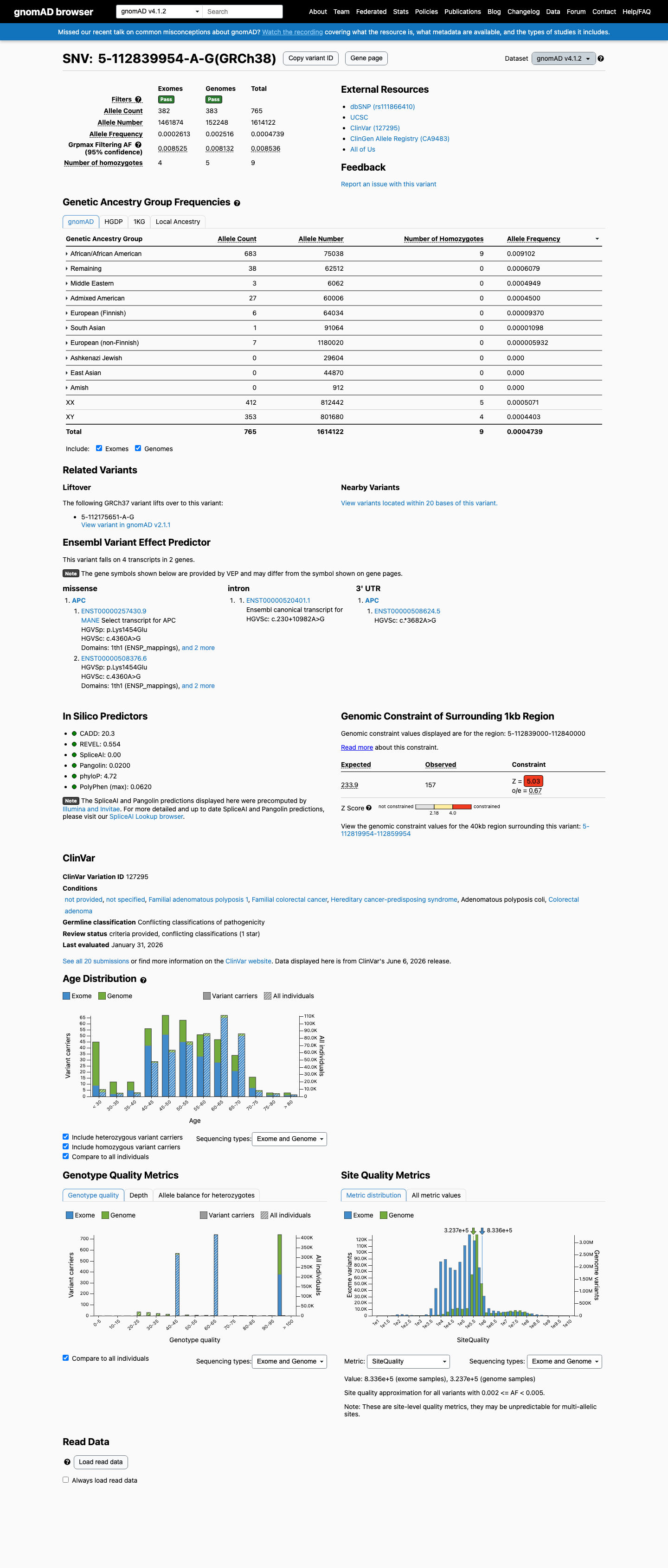
This variant is present in gnomAD v4.1 (AF= 0.000473942; MAF= 0.04739%, 765/1614122 alleles, homozygotes = 9) and has highest observed frequency in the African/African American population (AF= 0.00910205; MAF= 0.91021%, 683/75038 alleles, homozygotes = 9); grpmax FAF= 0.00853602.
v2.1
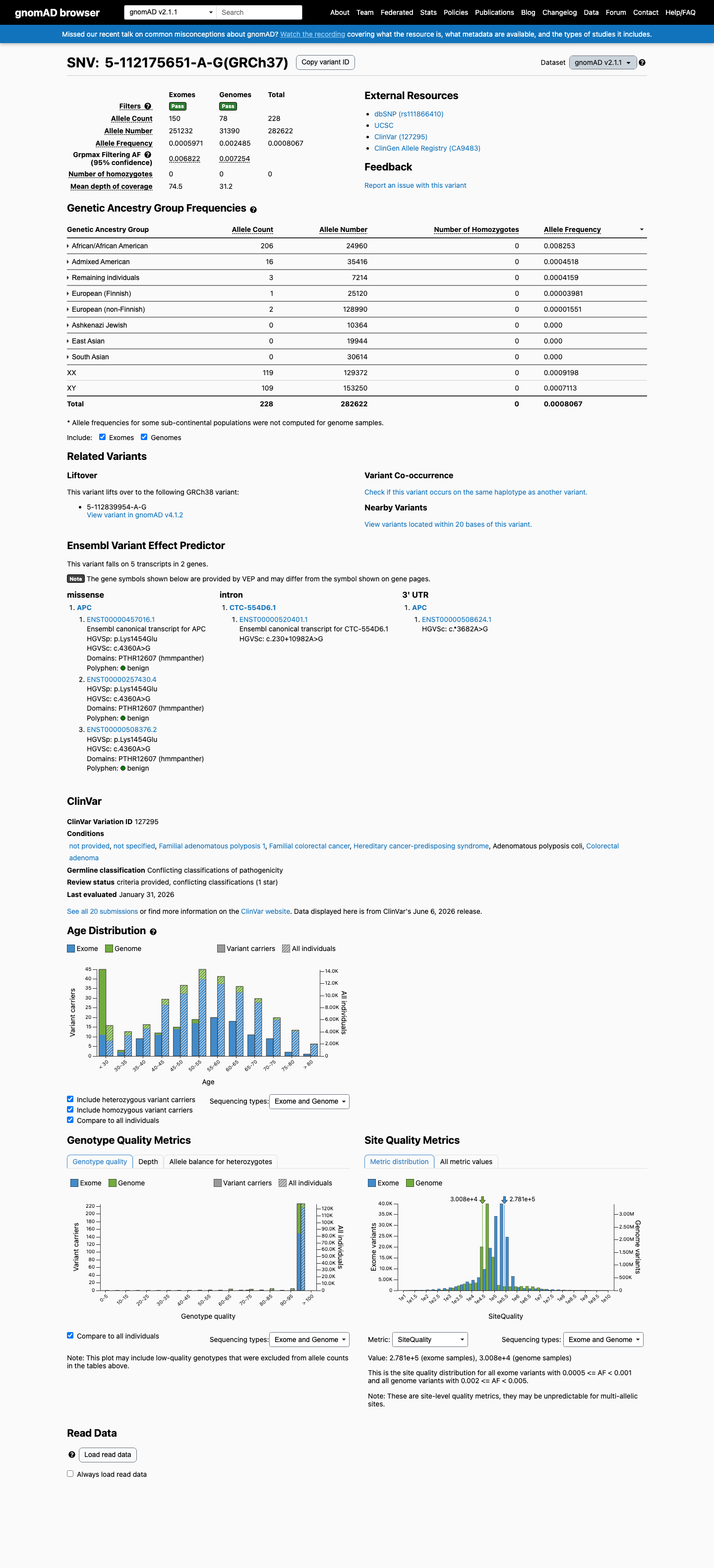
This variant is present in gnomAD v2.1 (AF= 0.000806731; MAF= 0.08067%, 228/282622 alleles, homozygotes = 0) and has highest observed frequency in the African/African American population (AF= 0.00825321; MAF= 0.82532%, 206/24960 alleles, homozygotes = 0); grpmax FAF= 0.0072541.
🇨🇦 CA
This variant is present in gnomAD-Canada v1.0 (AF= 0.0005431830526887561, 10/18410 alleles, homozygotes = 0).
Allele frequency by ancestry
three datasets · side by side
gnomAD v4.1
0.047% · 765 / 1,614,122
9 hom · FAF 0.85%
African/African American
683 / 75,038
0.91%
9 hom
Remaining individuals
38 / 62,512
0.061%
Middle Eastern
3 / 6,062
0.049%
Admixed American
27 / 60,006
0.045%
European (Finnish)
6 / 64,034
0.0094%
South Asian
1 / 91,064
0.0011%
European (non-Finnish)
7 / 1,180,020
0.00059%
+ 3 not observed (Amish, East Asian, Ashkenazi Jewish)
gnomAD v2.1
0.081% · 228 / 282,622
0 hom · FAF 0.73%
African/African American
206 / 24,960
0.83%
Admixed American
16 / 35,416
0.045%
Remaining individuals
3 / 7,214
0.042%
European (Finnish)
1 / 25,120
0.004%
European (non-Finnish)
2 / 128,990
0.0016%
+ 3 not observed (Ashkenazi Jewish, East Asian, South Asian)
gnomAD Canada 🇨🇦
0.054% · 10 / 18,410
0 hom · FAF 0.46%
African/African American
9 / 1,020
0.88%
Latino/Admixed American
1 / 832
0.12%
+ 7 not observed (Ashkenazi Jewish, East Asian, European (Finnish), Middle Eastern, European (non-Finnish), Remaining individuals, South Asian)
ClinVar screenshot
ClinVar
This variant has been reported in ClinVar as Benign (11 clinical laboratories) and as Likely benign (6 clinical laboratories) and as benign (1 clinical laboratory) and as Uncertain significance (1 clinical laboratory). (ClinVarID = 127295)
SpliceAI screenshot
In silico
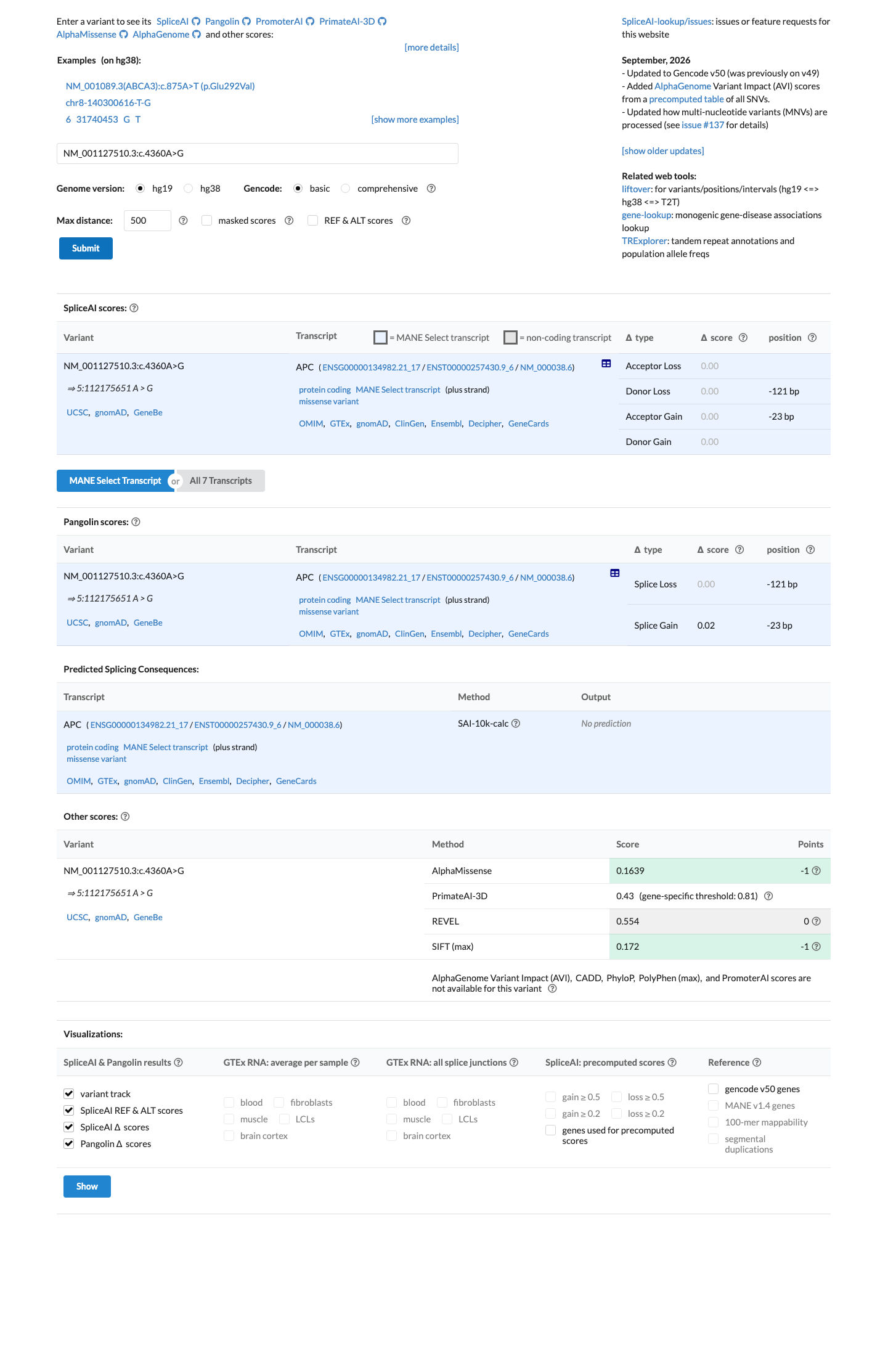
SpliceAI predicts no significant splice impact for this variant (max delta score = 0.00). REVEL score = 0.554. BayesDel score = 0.113841.
Functional / OncoKB screenshot
Functional Likely Neutral
OncoKB identified variant-specific curated literature and context relevant to functional review; biological-effect context: Likely Neutral; curated oncogenicity label: Likely Neutral.
OncoKB ↗
COSMIC screenshot
COSMIC
Cancer hotspots screenshot
Cancer hotspots
Somatic evidence Not in COSMIC / hotspots
COSMIC
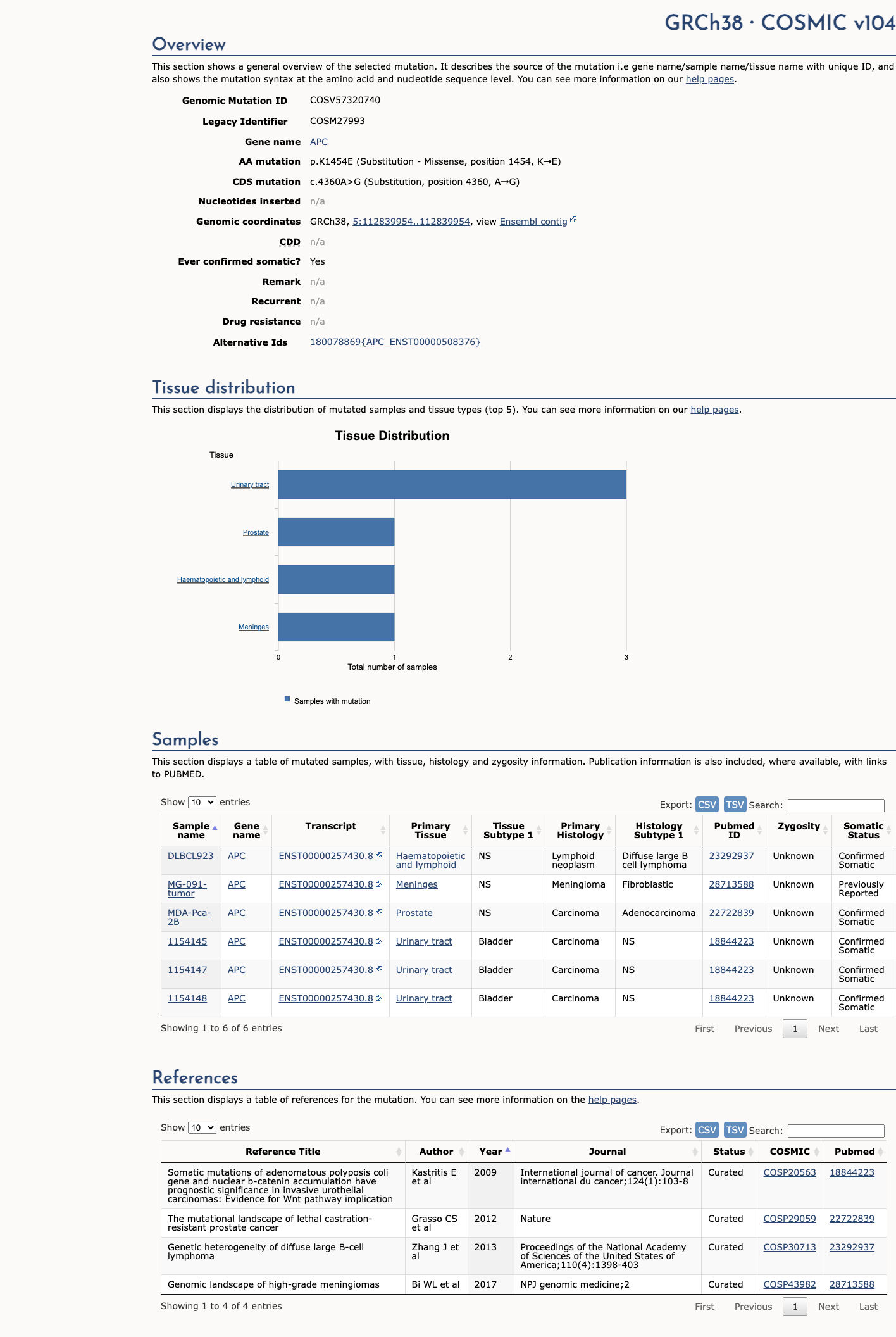
This variant does not lie in a statistically significant hotspot. This variant has previously been reported in somatic cancers (COSMIC; COSV57320740, n = 6 times).
Hotspots
This variant does not lie in a statistically significant hotspot.
Literature · how each cited paper was used
4papers cited
Each card is an audit: what was searched, what was found, whether it names the variant, which criteria it fed, and why. 3 further PMIDs triaged but not cited — see Sources & references.
Hepatic adenomas: analysis of sex steroid receptor status and the Wnt signaling pathway.
Searched
c.4360A>Gp.(K1454E)K1454ENP_001120982.1:p.(K1454E)
Found
In a series of 15 hepatic adenomas resected from premenopausal women, direct sequencing of the APC mutational cluster region found no APC mutations overall, but one case (Case 9) carried a base-pair change at codon 1454 (AAA to GAA) producing an amino acid substitution, lysine to glutamate (reported in the text as lysine to glutamine). This change was present in both the patient's normal liver and the adenoma and was therefore interpreted as a polymorphism of unknown significance; the patient had no clinical evidence of a colonic polyposis syndrome. Codon 1454 noted occasionally affected by insertions/deletions but no missense mutations in the cited Thierry Soussi APC database.
Variant
✓ Names this variant — characterised directly
Applied to
→BS3 supporting
However, in Case 9, a base pair change in Codon 1454 did lead to a change in the amino acid sequence, from lysine to glutamine. The amino acid change was present in both the normal liver and adenoma and was interpreted as a polymorphism. The patient had no clinical evidence for a colonic polyposis syndrome.
Location Results, Mutational Analysis (2nd paragraph); Table 3, Case 9 (APC column: '4378, A to G; 1454, AAA to GAA; lys3glu')  ·  Context Direct (Sanger) sequencing of the APC mutational cluster region (codons 1260-1596, four amplicons A-D) plus 5q LOH analysis (D5S299, D5S346, D5S82) in 15 hepatic adenomas from premenopausal women resected 1991-2001 at Johns Hopkins; variant detected in Case 9 and in matched nonneoplastic liver.  ·  full text
Multiple rare nonsynonymous variants in the adenomatous polyposis coli gene predispose to colorectal adenomas.
Searched
APC c.4360A>GNP_001120982.1:p.(K1454E)K1454Ec.4360A>G
Found
This paper explicitly names the exact variant K1454E. It was identified as a rare (MAF <2%) inherited nonsynonymous APC variant within the beta-catenin down-regulating domain, occurring once among non-FAP/non-MAP colorectal adenoma (CRA) patients recorded as having multiple CRAs of unknown number (Table 1), and twice among the 969 healthy controls (Table 1). The authors list K1454E as one of five variants detected in both the patient cohort and the control group. K1454E was not among the 16 nonsynonymous variants functionally assayed by beta-catenin-regulated transcription (CRT), so no variant-specific CRT result is reported for it. The paper's overall finding relevant to the gene is that rare nonsynonymous APC variants are overrepresented in non-FAP non-MAP CRA patients (81/480, 16.9% vs 20/211 FAP/MAP, P=0.0113), including specifically within the beta-catenin down-regulating domain compared with controls (32/480 vs 37/969, P=0.0166), supporting a low-penetrance predisposition role.
Variant
✓ Names this variant — characterised directly
Applied to
→BS3 supporting
The only variant-specific functional assay for K1454E: a controlled, replicated CRT (beta-catenin regulated transcription) assay in which K1454E retained activity comparable to wild type (approximately 1.15x, not significant), matching the APC VCEP BS3_Supporting protein-assay wording for a variant inside codons 959-2129.
→BP1 supporting
Documents K1454E as a rare nonsynonymous missense variant in the beta-catenin down-regulating domain, consistent with a genuine missense substitution outside the excepted 1021-1035 repeat.
Five of 18 of the nonsynonymous variants (I1307K, E1317Q, M1413V, K1454E, and R1676G) were previously identified in the patient cohort, whereas the remaining 13 variants were unique to the control group.
Location Table 1 (non-FAP non-MAP patients, 'Multiple CRAs' row; Healthy controls, beta-catenin down-regulating domain row) and Results, 'Nonsynonymous variants in healthy controls' paragraph  ·  Context 691 unrelated North American patients with colorectal adenomas and 969 matched healthy controls; patients sequenced across the entire APC ORF and splice sites plus MUTYH exons 7/13, controls sequenced over a ~2.4-kb region spanning the beta-catenin down-regulating domain (codons 1262-2033); functional effects assessed by beta-catenin-regulated transcription (CRT) luciferase reporter assay (pTOPFLASH/pFOPFLASH in SW480 cells) and by PolyPhen/Align-GVGD in silico prediction.  ·  full text
Somatic mutations of adenomatous polyposis coli gene and nuclear b-catenin accumulation have prognostic significance in invasive urothelial carcinomas: evidence for Wnt pathway implication.
Searched
c.4360A>Gp.(K1454E)NP_001120982.1:p.(K1454E)Lys1454GluK1454Ecodon 1454
Found
This paper directly reports the APC c.4360A>G (p.Lys1454Glu / K1454E) substitution as a somatic missense mutation in invasive urothelial (bladder) carcinoma. Sequencing of the APC mutation cluster region (codons 1260-1541) in tumor tissue from 70 patients with muscle-invasive disease identified single amino-acid substitutions in 9/70 (13%) tumors and frameshift deletions in 2/70 (3%). The identical AAA>GAA change at codon 1454 (Lys>Glu) was found in three separate patients (patients 5, 7 and 8), making it the most recurrent missense change in the series, and was confirmed as somatic by absence in the matched normal urothelial tissue. All missense substitutions, including codon 1454, were located between or adjacent to the 20-amino-acid repeats that constitute the beta-catenin binding sites; the authors state all missense mutations identified were novel and differ from the usual (chain-terminating) colorectal cancer spectrum, and speculate that such substitutions may alter APC 3-D conformation and its affinity for beta-catenin. Clinically, APC somatic mutations were associated with significantly shorter disease-specific overall survival (18 vs 60 months, p=0.02), and in multivariate analysis the presence of a somatic APC mutation or beta-catenin nuclear accumulation was an independent predictor of worse survival (p=0.048). No APC mutations were found in upper urinary tract tumors (all mutations were in bladder tumors). This is a somatic-tumor study with no germline classification data or functional assay for this variant.
Variant
✓ Names this variant — characterised directly
Applied to
→BS3 supporting
5 AAA>GAA 1454 Lys>Glu ... 7 AAA>GAA 1454 Lys>Glu ... 8 AAA>GAA 1454 Lys>Glu ... All somatic missense point mutations and both deletions that we identified are novel ... All missense mutations that we identified were located between and/or near 20 amino acid repeats which are the binding sites for beta-catenin.
Location Table III (APC missense and frameshift mutations in urothelial cancer patients), rows for patients 5, 7 and 8; corroborated in Results (paragraphs 1-2 of Results) and Discussion (paragraph 5)  ·  Context 70-patient cohort with muscle-invasive urothelial carcinoma treated with cystectomy and adjuvant paclitaxel/carboplatin; direct (nested PCR, bi-directional Sanger) sequencing of the APC mutation cluster region spanning codons 1260-1541 from paraffin-embedded tumor tissue with matched normal urothelial tissue as internal control; reference sequences NM_000038.2 and AC008575.  ·  full text
Rule & framework references · cited for criterion definitions, not variant evidence
21859464 ↗ Messing up disorder: how do missense mutations in the tumor suppressor protein APC lead to cancer?
Sources & reference links
9Sources
CSpec VCEP
ClinVar
gnomAD v2.1
gnomAD v4.1
gnomAD-Canada
SpliceAI
OncoKB
COSMIC
Cancer hotspots
Triaged references · 3 PMIDs not cited in assessment
15604628 ↗ Genetic cancer risk assessment and counseling: recommendations of the national s CLINVAR
22995991 ↗ An informatics approach to analyzing the incidentalome. CLINVAR
23970361 ↗ APC germline mutations in families with familial adenomatous polyposis. CLINVAR