PS1
Not met: no second nucleotide change encoding p.Arg426Cys exists; the only codon-426 substitution is the query itself, classified uncertain or likely benign.
PS2
Not assessed: no proband or parental/trio testing is available, so a confirmed de novo occurrence of this MUTYH variant cannot be established.
PS3
Not met: the calibrated E.
PS4
Not met: the only occurrence of this allele is one monoallelic carrier among 60 polyposis patients, with no significant case-control enrichment or odds ratio.
PM1
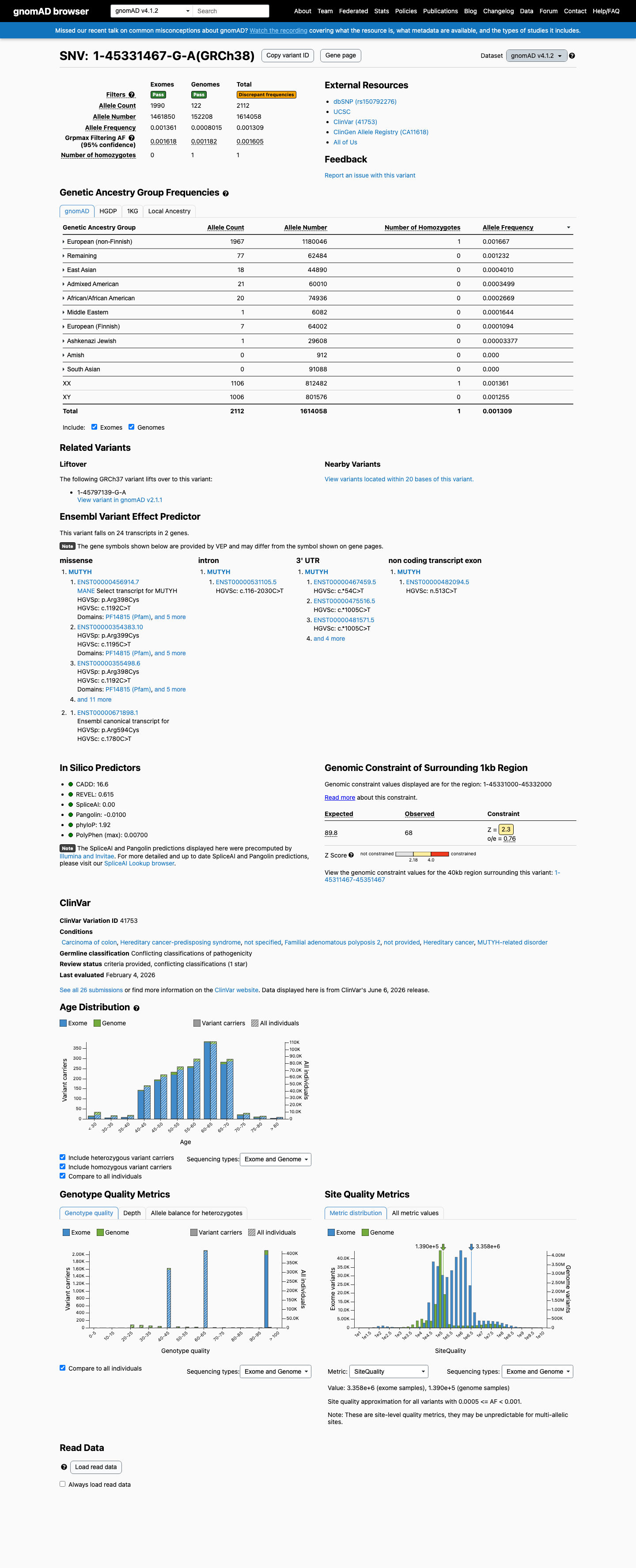
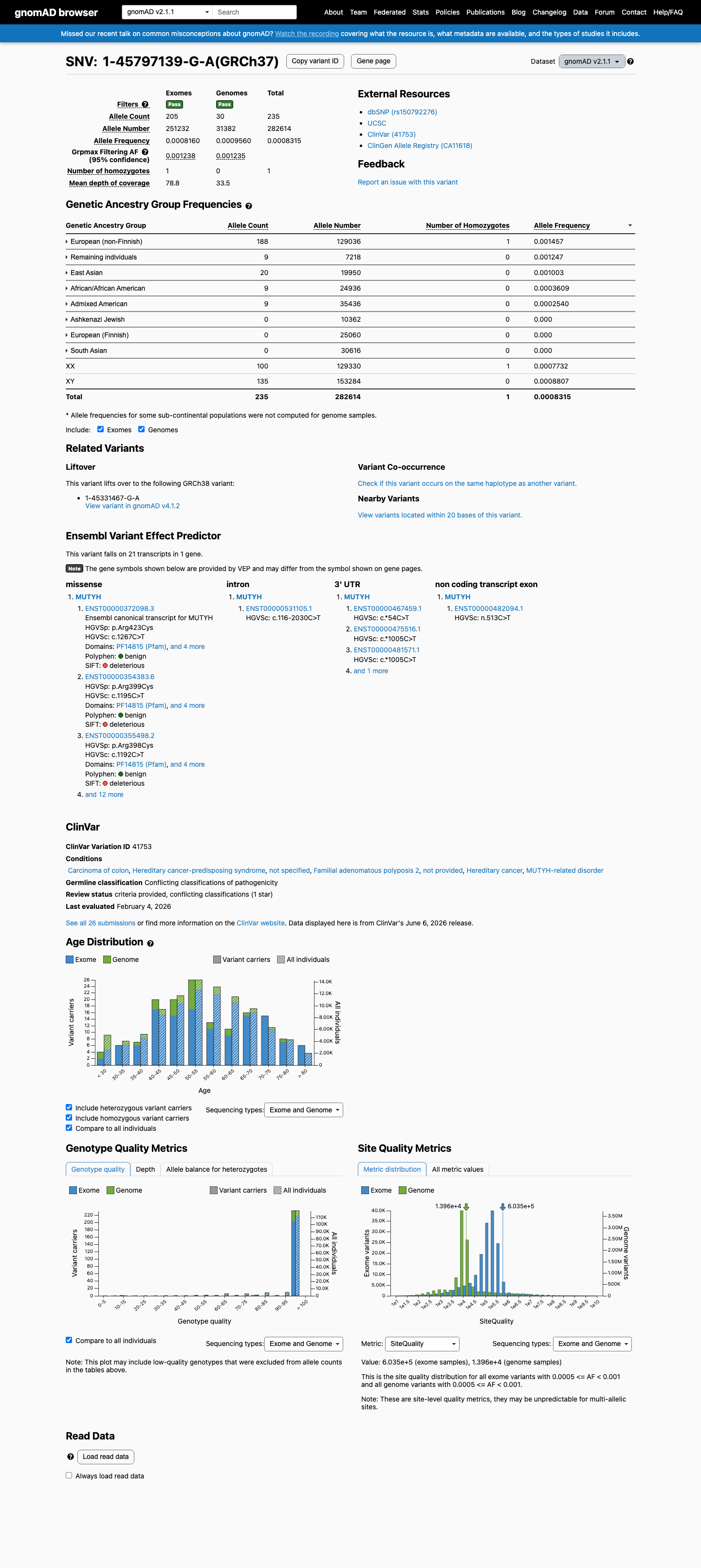
Not met: MUTYH R426 is not a cancer hotspot and this residue carries benign variation (gnomAD 0.083%, 1 homozygote; 11 likely-benign submissions).
PM2
Not met: gnomAD v2.1 AF 0.000831523 and v4.1 AF 0.0013085 both exceed the PM2 supporting rarity threshold of <=0.0001.
PM3
Not met: every primary report places the variant monoallelic (Aceto 2005 GD108, [c.1234C>T]+[c.=]), with no phase-confirmed in-trans pathogenic MUTYH variant.
PM5
Not met: no pathogenic missense at MUTYH residue 426 other than the query variant itself was identified in ClinVar or the literature.
PM6
Not assessed: no de novo occurrence of this MUTYH variant is documented in any patient, so assumed de novo status cannot be evaluated.
PP1
Not assessed: no pedigree with genotyped affected relatives exists, so co-segregation of this variant with MUTYH-associated polyposis cannot be demonstrated.
PP2
Not met: MUTYH carries established common benign missense polymorphisms, so the low-benign-missense-rate precondition fails despite missense being a disease mechanism.
PP3
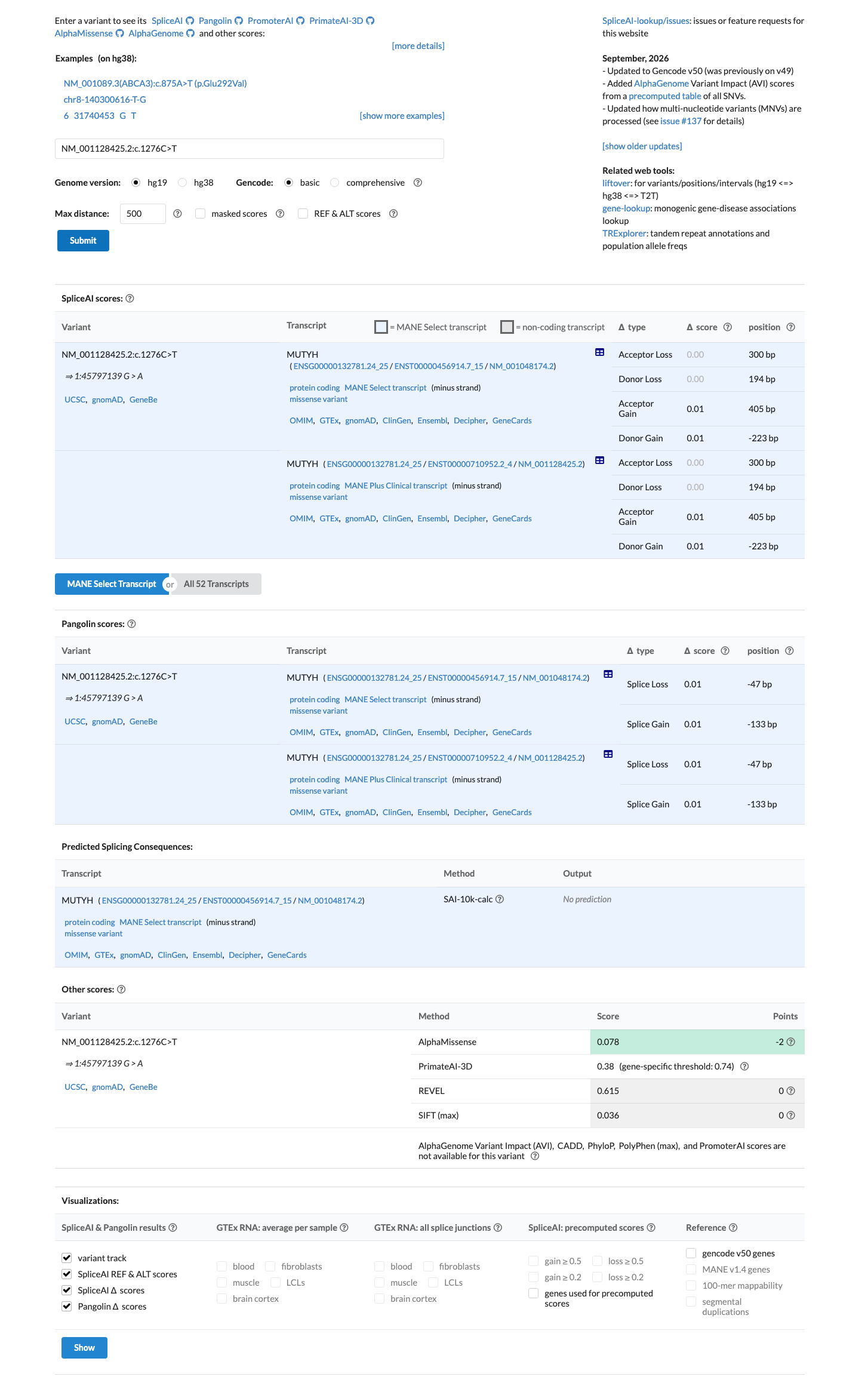
Not met: REVEL 0.615 falls below the 0.644 PP3 supporting threshold for this missense variant.
PP4
Not met: the single reported carrier had classical FAP (>100 polyps) with vertical transmission, a phenotype atypical for recessive MUTYH-associated polyposis, where 70/71 biallelic patients were attenuated.
PP5
Not met: ClinVar VCV000041753 has zero expert-panel submissions and only a 1-star, conflicting, laboratory-level review status, not an expert-panel pathogenic call.