Back
NM_001128425.2:c.1476+2C>T
p.? · MUTYH
0%
complete
Final classification
VUS
PP3
MUTYH
c.1476+2C>T
p.?
canonical_splice · exon 14i

MUTYH encodes a DNA repair enzyme (a glycosylase) that fixes oxidative DNA damage by removing adenine bases that have been mistakenly paired with guanine or with oxidized guanine lesions. Inherited mutations in both copies of the gene cause MUTYH-associated polyposis (MAP), a recessive condition that strongly predisposes people to multiple colorectal polyps and colorectal cancer. The gene acts as a tumor suppressor whose loss of function allows DNA damage to accumulate, and somatic changes in it have also been reported in colon cancer, though whether they drive cancer on their own is not fully established.

This variant

MUTYH encodes a DNA glycosylase that removes adenine mispaired with oxidized guanine during base-excision repair, and biallelic loss of that repair activity causes MUTYH-associated polyposis (familial adenomatous polyposis 2), an autosomal-recessive syndrome of multiple colorectal adenomas and early colorectal cancer; a splice-region change such as c.1476+2C>T therefore matters clinically only in the context of the second MUTYH allele and the recessive mechanism.

Transcript
NM_001128425.2
HGVS · transcript:coding
NM_001128425.2:c.1476+2C>T
GRCh38
chr1:45331180 G>A
GRCh37
chr1:45796852 G>A
Variant of Uncertain Significance: only PP3 (supporting, SpliceAI delta 0.257) is met, which falls below every generic ACMG/AMP 2015 combination threshold.
Classification rationale
PP3 VUS
MUTYH c.1476+2C>T canonical_splice · exon 14i

PP3 supporting: SpliceAI maximum delta 0.257 exceeds the >=0.2 supporting cutoff but not the >=0.5 moderate cutoff. PVS1 not met: the +2C>T change restores a consensus GT donor and the maximal exon 14 skip is in-frame (51 codons, no NMD). PM2 not met: grpmax filtering AF 0.00107 (gnomAD v4.1) is about 11-fold above the <=0.0001 supporting threshold. BA1, BS1, BS2 not met: highest ancestry frequency 0.00128 and zero homozygotes, far below stand-alone and strong benign cutoffs. PS3 and BS3 not met: no functional splice or enzyme assay has been reported for this variant in either direction.

PP3 → VUS
LYFE Sciences is an AI system, and it can make mistakes. Criteria may be applied incorrectly, sources may be misread, and a confident-looking classification can still be wrong. Double-check every criterion and its underlying evidence before relying on any call.
Gene diagram · NM_001128425.2 · variants mapped to exon structure
MUTYH NM_001128425.2
Fetching transcript structure from UCSC…
Applied criteria · 1 applied · 19 assessed
MetEvidence satisfies this criterion.
Not metEvaluated against available evidence; threshold not reached.
Not assessedApplies in principle, but no evidence was found to evaluate it.
N/ADoesn't apply to this variant type.
Applied · 1
Strength Supporting Moderate Strong Very strong
PP3 supporting review Pathogenic
Met at supporting: SpliceAI max delta 0.257 exceeds the >=0.2 supporting cutoff but stays below the >=0.5 moderate threshold.
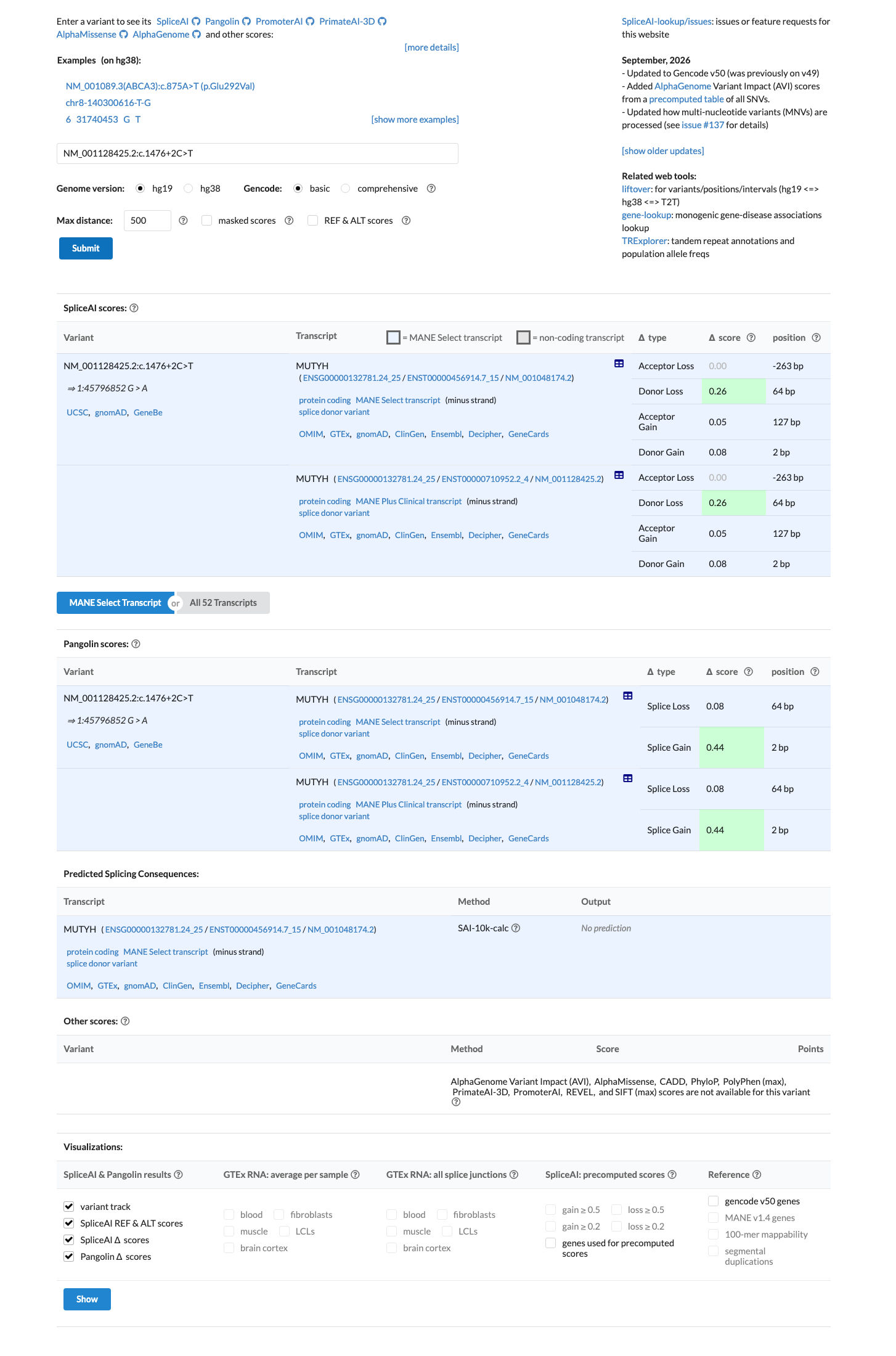
SpliceAI lookup for NM_001128425.2:c.1476+2C>T / chr1:45796852 G>A (hg19): max delta score 0.257, from donor loss (DS_DL 0.257; DS_AG 0.049, DS_AL 0.001, DS_DG 0.084; DP_AG 127, DP_AL -263, DP_DG 2, DP_DL 64), Pangolin SG 0.438 / SL -0.081; the lookup result annotates the change as a splice donor variant on MANE Plus Clinical transcript NM_001128425.2 (minus strand).SpliceAI online lookup screenshot (spliceailookup.broadinstitute.org, hg19, Gencode basic, max distance 500) shows the scores table with Donor Loss 0.26 and Acceptor Loss 0.05, and lists NM_001128425.2 (MANE Plus Clinical) and NM_001048174.2 (MANE Select) both as protein-coding splice donor variants.Path selection: the variant is intronic/splice-region (canonical splice donor +2), so PP3/BP4 take evidence from the SpliceAI path only; REVEL returned no score for this position and the available BayesDel value (-0.0838218) was not used, since BayesDel has no established published ACMG-strength calibration for PP3/BP4 and is a missense-path predictor.
Assessed · not applied · 11 not met · 8 not assessed
Pathogenic
PVS1 Not met: PVS1 requires a null allele, but exon 14 skipping is in-frame (153 nt = 51 codons, no NMD) and the +2C>T change restores the consensus GT donor.
PS2 Not assessed: the case contains no proband and no parental genotype data, so a confirmed de novo occurrence cannot be evaluated.
PS3 Not met: no functional assay of MUTYH c.1476+2C>T exists, and submitters state functional studies remain unconfirmed.
PS4 Not met: no case-control data exist for c.1476+2C>T, absent from all retrieved case literature yet present in gnomAD v4.1 (131/1,614,160 alleles).
PM2 Not met: grpmax filtering AF 0.00107 (~11x the <=0.0001 threshold) and African/African American AF 0.00128, despite v4.1's global AF of 0.0000812.
PM3 Not assessed: MUTYH is autosomal recessive and no data establish c.1476+2C>T in trans with a pathogenic MUTYH variant in any affected individual.
PM6 Not assessed: no proband, phenotype or parental information exists in this case, so an assumed de novo occurrence cannot be evaluated.
PP1 Not assessed: no pedigree, affected relatives or informative meioses for this variant exist in this case, so co-segregation cannot be counted.
PP4 Not assessed: no proband phenotype or family history was provided, so phenotype specificity for MUTYH-associated polyposis could not be tested.
PP5 Not met: ClinVar 187040 has zero expert-panel submissions among 17 (review status criteria provided, single submitter), so its expert-panel prerequisite fails.
Benign
BA1 Not met: the highest population frequency is 0.00128 (African/African American, gnomAD v4.1), roughly 40-fold below the >=0.05 BA1 stand-alone threshold.
BS1 Not met: grpmax filtering AF 0.00107 (gnomAD v4.1) is ~10-fold below the >=0.01 threshold; a 4/132 1KG:LWK outlier was rejected as too small.
BS2 Not met: zero homozygotes in gnomAD v4.1 (0/1,614,160 alleles) and v2.1 (0/282,888), although absence is expected at this allele frequency.
BS3 Not met: no functional assay demonstrates normal MUTYH function for c.1476+2C>T, as submitters confirm functional studies have not been reported.
BS4 Not assessed: no pedigree or genotyped relatives exist to demonstrate non-segregation, so BS4 cannot be asserted.
BP2 Not assessed: no evidence places c.1476+2C>T in cis with a pathogenic MUTYH variant, the only BP2 clause open to an autosomal-recessive gene.
BP4 Not met: SpliceAI max delta 0.257 exceeds the <=0.1 supporting BP4 threshold for a splice-neutral effect.
BP5 Not assessed: no case-level data show whether the variant occurred in a patient whose disease had an alternate molecular basis.
BP6 Not met: ClinVar 187040 has no expert-panel Benign/Likely benign assertion; its two Benign and two Likely benign submissions are ordinary laboratory assertions.
N/A · 8 PS1 · PM1 · PM4 · PM5 · PP2 · BP1 · BP3 · BP7
Research & evidence
Population frequency
gnomAD v4.1 screenshot
gnomAD v4.1
gnomAD v2.1 screenshot
gnomAD v2.1
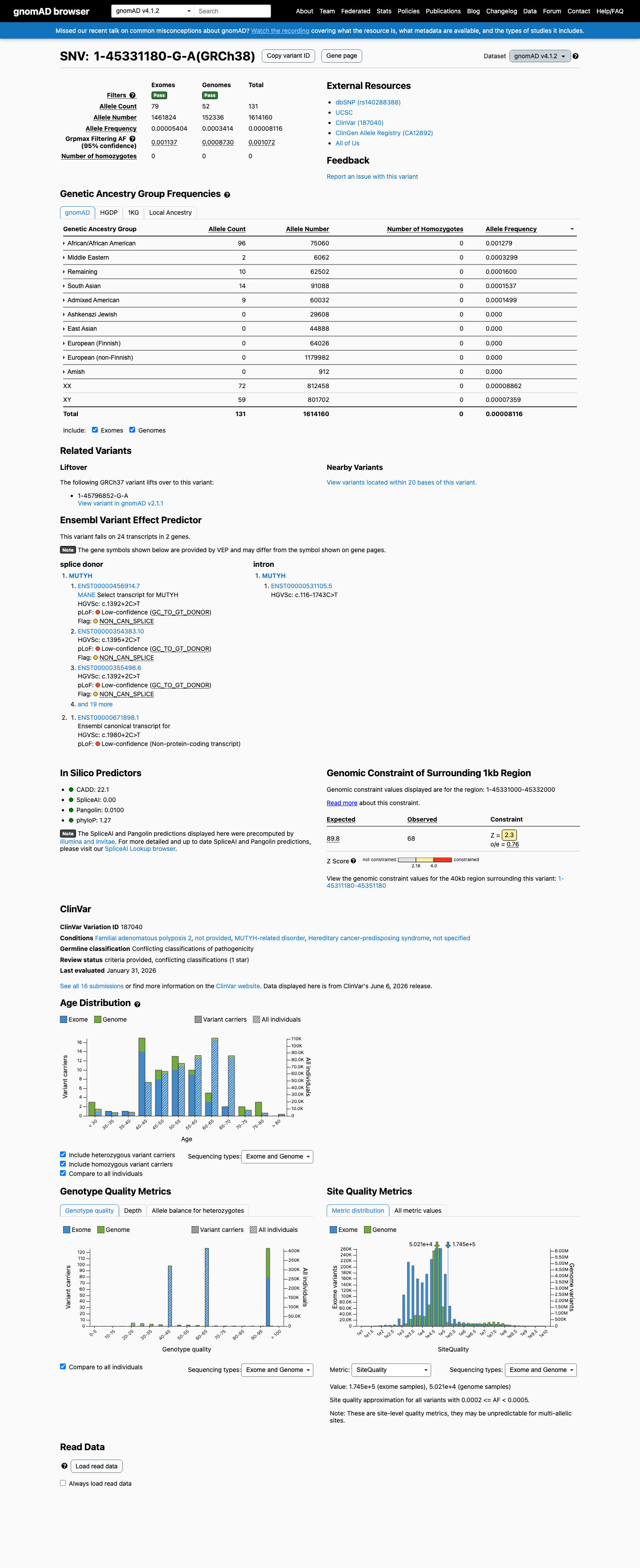
v4.1
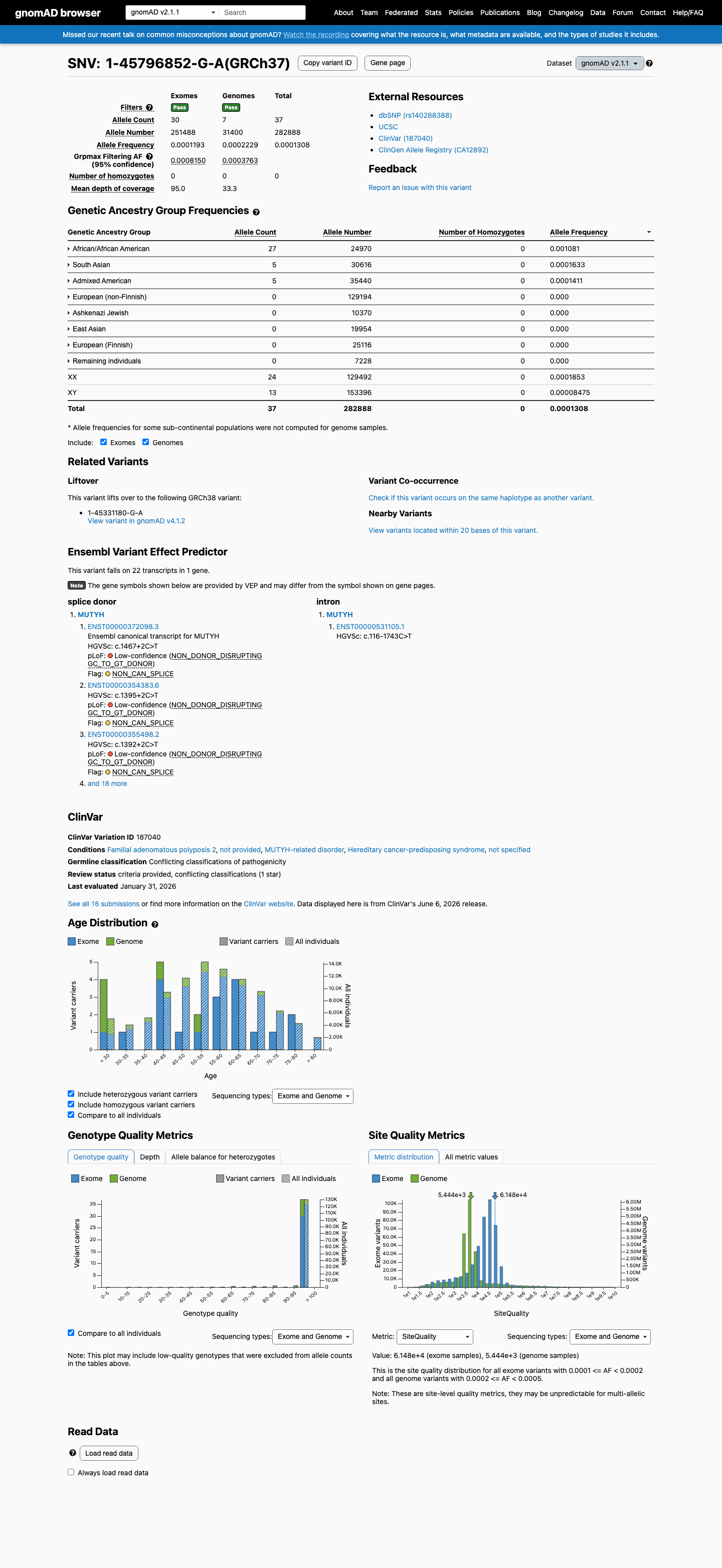
This variant is present in gnomAD v4.1 (AF= 8.11568e-05; MAF= 0.00812%, 131/1614160 alleles, homozygotes = 0) and has highest observed frequency in the African/African American population (AF= 0.00127898; MAF= 0.12790%, 96/75060 alleles, homozygotes = 0); grpmax FAF= 0.00107164.
v2.1
This variant is present in gnomAD v2.1 (AF= 0.000130794; MAF= 0.01308%, 37/282888 alleles, homozygotes = 0) and has highest observed frequency in the African/African American population (AF= 0.0010813; MAF= 0.10813%, 27/24970 alleles, homozygotes = 0); grpmax FAF= 0.00081502.
🇨🇦 CA
Absent from gnomAD-Canada v1.0.
Allele frequency by ancestry
three datasets · side by side
gnomAD v4.1
0.0081% · 131 / 1,614,160
0 hom · FAF 0.11%
African/African American
96 / 75,060
0.13%
Middle Eastern
2 / 6,062
0.033%
Remaining individuals
10 / 62,502
0.016%
South Asian
14 / 91,088
0.015%
Admixed American
9 / 60,032
0.015%
+ 5 not observed (European (Finnish), Amish, East Asian, Ashkenazi Jewish, European (non-Finnish))
gnomAD v2.1
0.013% · 37 / 282,888
0 hom · FAF 0.082%
African/African American
27 / 24,970
0.11%
South Asian
5 / 30,616
0.016%
Admixed American
5 / 35,440
0.014%
+ 5 not observed (Ashkenazi Jewish, East Asian, European (Finnish), European (non-Finnish), Remaining individuals)
gnomAD Canada 🇨🇦
Absent · 0 / ?
0 hom
Not observed in any ancestry group.
ClinVar screenshot
ClinVar
This variant has been reported in ClinVar as Uncertain significance (10 clinical laboratories) and as Benign (2 clinical laboratories) and as Likely benign (2 clinical laboratories) and as Uncertain Significance (1 clinical laboratory) and as Likely pathogenic (1 clinical laboratory). (ClinVarID = 187040)
SpliceAI screenshot
In silico
SpliceAI predicts possible splice impact for this variant (max delta score = 0.26). BayesDel score = -0.0838218.
Functional No data
No calibrated functional assay or RNA evidence was identified for this variant.
OncoKB ↗
COSMIC screenshot
COSMIC
Somatic evidence
COSMIC
This variant has not previously been reported in somatic cancers (COSMIC).
Hotspots
This variant does not lie in a statistically significant cancer hotspot.
COSMIC ↗
Sources & reference links
8Sources
CSpec VCEP
ClinVar
gnomAD v2.1
gnomAD v4.1
gnomAD-Canada
SpliceAI
OncoKB
COSMIC
Triaged references · 8 PMIDs not cited in assessment
25186627 ↗ Frequency of mutations in individuals with breast cancer referred for BRCA1 and BRCA2 testing using next-generation sequencing with a 25-gene panel. CLINVAR
25356965 ↗ ACMG policy statement: updated recommendations regarding analysis and reporting CLINVAR
25394175 ↗ A practice guideline from the American College of Medical Genetics and Genomics and the National Society of Genetic Counselors: referral indications for cancer predisposition assessment. CLINVAR
25452455 ↗ Hereditary colorectal cancer syndromes: American Society of Clinical Oncology Clinical Practice Guideline endorsement of the familial risk-colorectal cancer: European Society for Medical Oncology Clinical Practice Guidelines. CLINVAR
25645574 ↗ ACG clinical guideline: Genetic testing and management of hereditary gastrointes CLINVAR
25741868 ↗ Standards and guidelines for the interpretation of sequence variants: a joint co CLINVAR
26389505 ↗ Genetics of Colorectal Cancer (PDQ®): Health Professional Version. CLINVAR
26467025 ↗ A Standardized DNA Variant Scoring System for Pathogenicity Assessments in Mende CLINVAR