Back
NM_001128425.2:c.309G>A
p.Trp103Ter · MUTYH
0%
complete
Final classification
Likely Pathogenic
PVS1PM2
MUTYH
c.309G>A
p.Trp103Ter
nonsense · exon 3

MUTYH encodes a DNA repair enzyme (a glycosylase) that fixes oxidative DNA damage by removing adenine bases that have been mistakenly paired with guanine or with oxidized guanine lesions. Inherited mutations in both copies of the gene cause MUTYH-associated polyposis (MAP), a recessive condition that strongly predisposes people to multiple colorectal polyps and colorectal cancer. The gene acts as a tumor suppressor whose loss of function allows DNA damage to accumulate, and somatic changes in it have also been reported in colon cancer, though whether they drive cancer on their own is not fully established.

This variant

MUTYH encodes a DNA repair glycosylase, and loss of function in both gene copies causes the recessive cancer-predisposition syndrome MUTYH-associated polyposis.

Transcript
NM_001128425.2
HGVS · transcript:coding
NM_001128425.2:c.309G>A
GRCh38
chr1:45333452 C>T
GRCh37
chr1:45799124 C>T
Likely Pathogenic: PVS1 (very strong) plus PM2 (supporting) are the applied criteria under the generic ACMG/AMP fallback used by the incomplete MUTYH framework.
Classification rationale
PVS1PM2 Likely Pathogenic
MUTYH c.309G>A nonsense · exon 3

Likely Pathogenic: PVS1 (very strong) supports a loss-of-function effect from the early p.Trp103Ter truncation. Likely Pathogenic: PM2 (supporting) is met because the maximum gnomAD population frequency is below 0.0001.

PVS1 + PM2 → Likely Pathogenic
LYFE Sciences is an AI system, and it can make mistakes. Criteria may be applied incorrectly, sources may be misread, and a confident-looking classification can still be wrong. Double-check every criterion and its underlying evidence before relying on any call.
Gene diagram · NM_001128425.2 · variants mapped to exon structure
MUTYH NM_001128425.2
Fetching transcript structure from UCSC…
Applied criteria · 2 applied · 16 assessed
MetEvidence satisfies this criterion.
Not metEvaluated against available evidence; threshold not reached.
Not assessedApplies in principle, but no evidence was found to evaluate it.
N/ADoesn't apply to this variant type.
Applied · 2
Strength Supporting Moderate Strong Very strong
PVS1 very strong Pathogenic
Met at very strong: nonsense p.Trp103Ter truncates the 550-amino-acid MUTYH protein at residue 103, with no evidence of a downgrade-triggering NMD escape or distal non-critical region.
The governing MUTYH framework names NM_001128425.2 as the preferred transcript and provides no gene-specific PVS1 rule payload or downgrade decision tree.The normalized consequence is nonsense: NM_001128425.2:c.309G>A causes NP_001121897.1:p.(Trp103Ter), with the predicted product ending at residue 103 while the reference protein ends at residue 550.The generic ClinGen SVI PVS1 framework supports full-strength assessment of a nonsense variant when loss of function is an established disease mechanism, with downgrades considered for NMD escape, non-critical distal regions, irrelevant exons/transcripts, or population-enriched loss-of-function regions.
PM2 supporting Pathogenic
Met at supporting strength: gnomAD v4.1 maximum population AF 3.8134e-05 is below the 0.0001 PM2 threshold.
The InSiGHT MUTYH Version 1.0 framework was checked first; its retrieved rule payload contains no population-specific PM2 threshold or population-source override, so the default all-comers datasets were used.gnomAD v4.1 reports overall AF 2.7879279004672568e-05 from 45/1614102 alleles, maximum named-subpopulation AF 3.813404200507098e-05 in European (non-Finnish) individuals, and 0 homozygotes.gnomAD v2.1 reports AF 3.9763328667769435e-06 from 1/251488 alleles and 0 homozygotes; the highest named-subpopulation AF is 8.790126929432861e-06.
Assessed · not applied · 5 not met · 11 not assessed
Pathogenic
PS2 Not assessed: no documented parental genotypes or confirmed de novo occurrence is available for the affected proband.
PS3 Not assessed: no validated functional assay directly tested MUTYH c.309G>A (p.Trp103Ter), so PS3 strength cannot be calibrated from the available evidence.
PS4 Not assessed: the available 302-person cohort report lacks exact-variant case counts, controls, enrichment, odds ratio, or statistical significance for NM_001128425.2:c.309G>A.
PM3 Not assessed: no affected-proband genotype, second pathogenic MUTYH allele, or phase information is documented to evaluate biallelic inheritance.
PM6 Not assessed: no apparently de novo proband observation or parental-testing context is reported for this variant.
PP1 Not assessed: no informative relatives, segregating meioses, or genotype–phenotype co-segregation data are reported.
PP4 Not assessed: no patient phenotype or phenotype-specific clinical features are provided to establish a match with MUTYH-associated polyposis.
PP5 Not met: ClinVar has 12 Pathogenic and one Likely pathogenic laboratory assertions, but zero exact-variant expert-panel submissions.
Benign
BA1 Not met: gnomAD v4.1 maximum population AF 3.8134e-05 is far below the 0.05 BA1 threshold.
BS1 Not met: gnomAD v4.1 maximum population AF 3.8134e-05 is below the generic 0.01 BS1 threshold.
BS2 Not met: gnomAD reports 0 homozygotes, so no unaffected-homozygote observation supports BS2.
BS3 Not assessed: no validated benign functional assay directly tested MUTYH c.309G>A (p.Trp103Ter) or demonstrated preserved function.
BS4 Not assessed: no unaffected carrier with adequate phenotype and age information is documented to demonstrate non-segregation.
BP2 Not assessed: no same-individual co-occurrence with a pathogenic variant and no cis/trans phase information are documented for BP2.
BP5 Not assessed: no alternate pathogenic cause, second disease-causing variant, or relevant co-occurrence evidence is documented.
BP6 Not met: the exact-match ClinVar audit reports zero expert-panel submissions and no Benign or Likely benign expert-panel classification.
N/A · 10 PS1 · PM1 · PM4 · PM5 · PP2 · PP3 · BP1 · BP3 · BP4 · BP7
Research & evidence
Population frequency · supports pathogenic
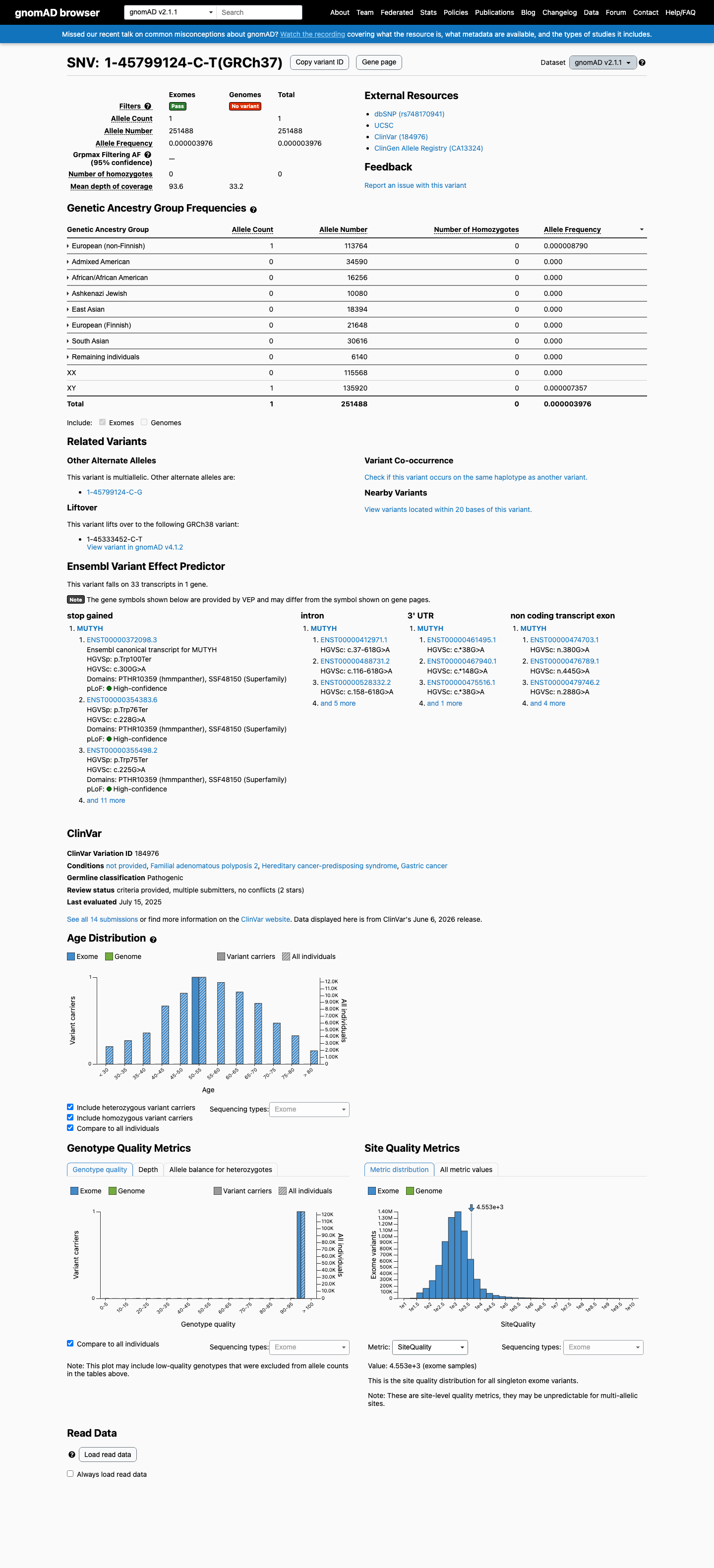
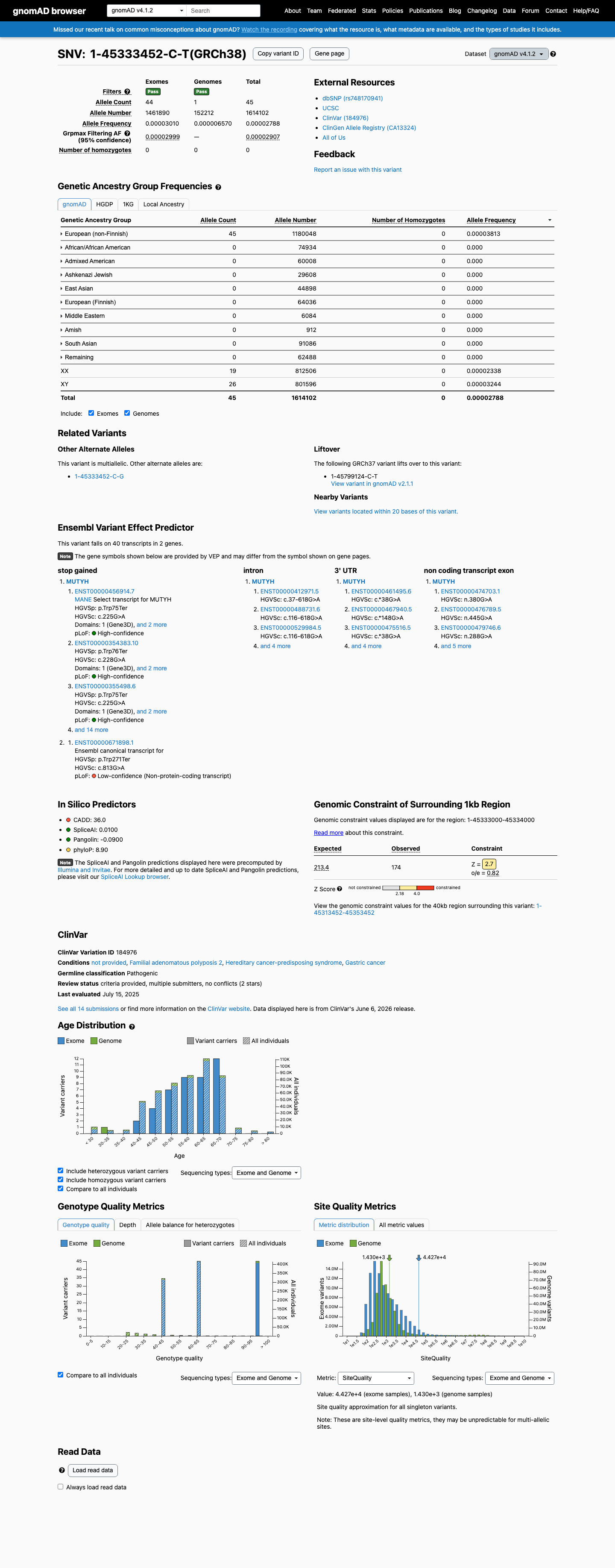
gnomAD v4.1 screenshot
gnomAD v4.1
gnomAD v2.1 screenshot
gnomAD v2.1
v4.1
This variant is present in gnomAD v4.1 (AF= 2.78793e-05; MAF= 0.00279%, 45/1614102 alleles, homozygotes = 0) and has highest observed frequency in the European (non-Finnish) population (AF= 3.8134e-05; MAF= 0.00381%, 45/1180048 alleles, homozygotes = 0); grpmax FAF= 2.907e-05.
v2.1
This variant is present in gnomAD v2.1 (AF= 3.97633e-06; MAF= 0.00040%, 1/251488 alleles, homozygotes = 0) and has highest observed frequency in the European (non-Finnish) population (AF= 8.79013e-06; MAF= 0.00088%, 1/113764 alleles, homozygotes = 0).
🇨🇦 CA
Not available in gnomAD-Canada v1.0.
Allele frequency by ancestry
three datasets · side by side
gnomAD v4.1
0.0028% · 45 / 1,614,102
0 hom · FAF 0.0029%
European (non-Finnish)
45 / 1,180,048
0.0038%
+ 9 not observed (Remaining individuals, Admixed American, European (Finnish), Amish, East Asian, Middle Eastern, South Asian, Ashkenazi Jewish, African/African American)
gnomAD v2.1
0.0004% · 1 / 251,488
0 hom
European (non-Finnish)
1 / 113,764
0.00088%
+ 7 not observed (African/African American, Admixed American, Ashkenazi Jewish, East Asian, European (Finnish), Remaining individuals, South Asian)
gnomAD Canada 🇨🇦
Absent · 0 / ?
0 hom
Not observed in any ancestry group.
ClinVar screenshot
ClinVar
This variant has been reported in ClinVar as Pathogenic (12 clinical laboratories) and as Likely pathogenic (1 clinical laboratory). (ClinVarID = 184976)
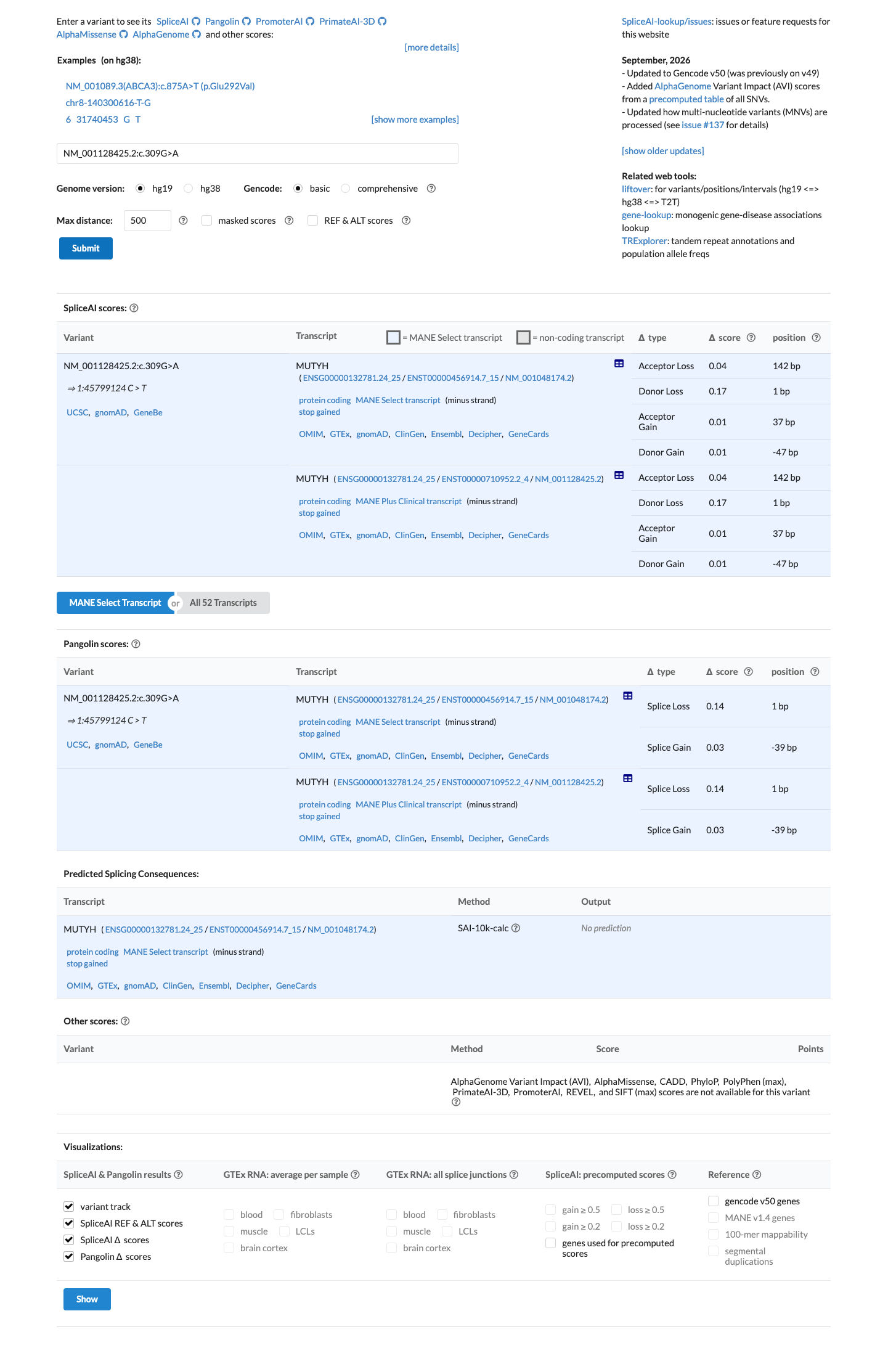
SpliceAI screenshot
In silico
SpliceAI predicts no significant splice impact for this variant (max delta score = 0.17). BayesDel score = 0.655873.
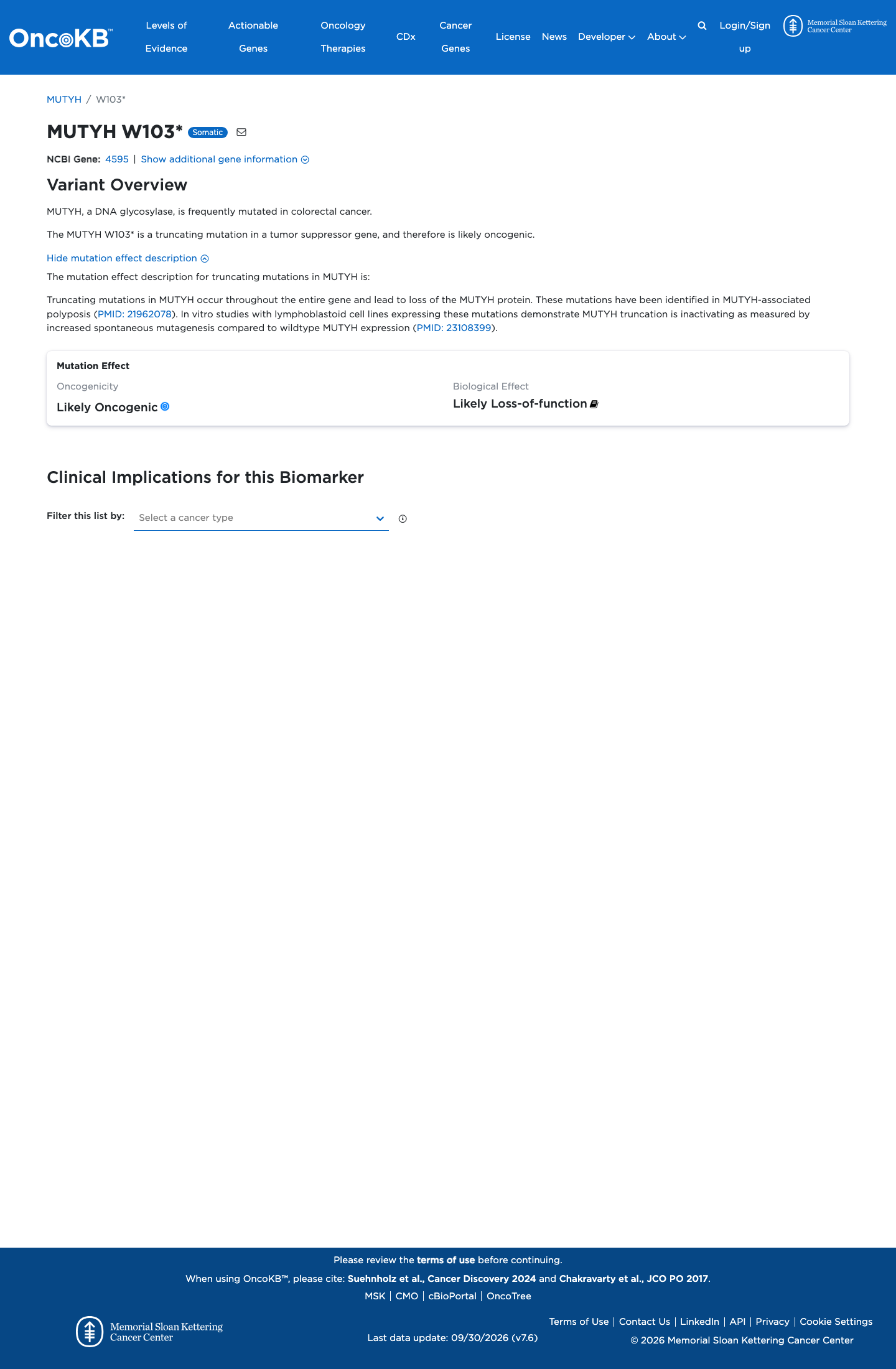
Functional / OncoKB screenshot
Functional Likely Oncogenic
OncoKB identified variant-specific curated literature and context relevant to functional review; biological-effect context: Likely Loss-of-function; curated oncogenicity label: Likely Oncogenic.
OncoKB ↗
COSMIC screenshot
COSMIC
Cancer hotspots screenshot
Cancer hotspots
Somatic evidence Not in COSMIC / hotspots
COSMIC
This variant does not lie in a statistically significant hotspot. This variant has not previously been reported in somatic cancers (COSMIC).
Hotspots
This variant does not lie in a statistically significant hotspot.
Literature · how each cited paper was used
1papers cited
Each card is an audit: what was searched, what was found, whether it names the variant, which criteria it fed, and why. 7 further PMIDs triaged but not cited — see Sources & references.
Standards and guidelines for the interpretation of sequence variants: a joint consensus recommendation of the American College of Medical Genetics and Genomics and the Association for Molecular Pathology.
Found
).
Applied to
→PM2 supporting
Sources & reference links
9Sources
CSpec VCEP
ClinVar
gnomAD v2.1
gnomAD v4.1
gnomAD-Canada
SpliceAI
OncoKB
COSMIC
Cancer hotspots
Triaged references · 7 PMIDs not cited in assessment
21962078 ↗ Breakpoint characterization of a novel large intragenic deletion of MUTYH detected in a MAP patient: case report. ONCOKB
23108399 ↗ Loss of MUTYH function in human cells leads to accumulation of oxidative damage and genetic instability. ONCOKB
18534194 ↗ Characterization of mutant MUTYH proteins associated with familial colorectal cancer. CLINVAR
25525159 ↗ RNA splicing. The human splicing code reveals new insights into the genetic determinants of disease. CLINVAR
26467025 ↗ A Standardized DNA Variant Scoring System for Pathogenicity Assessments in Mendelian Disorders. CLINVAR
15761860 ↗ Mutation analysis of the MYH gene in an Australian series of colorectal polyposis patients with or without germline APC mutations. CLINVAR
20663686 ↗ MUTYH-associated polyposis (MAP). CLINVAR