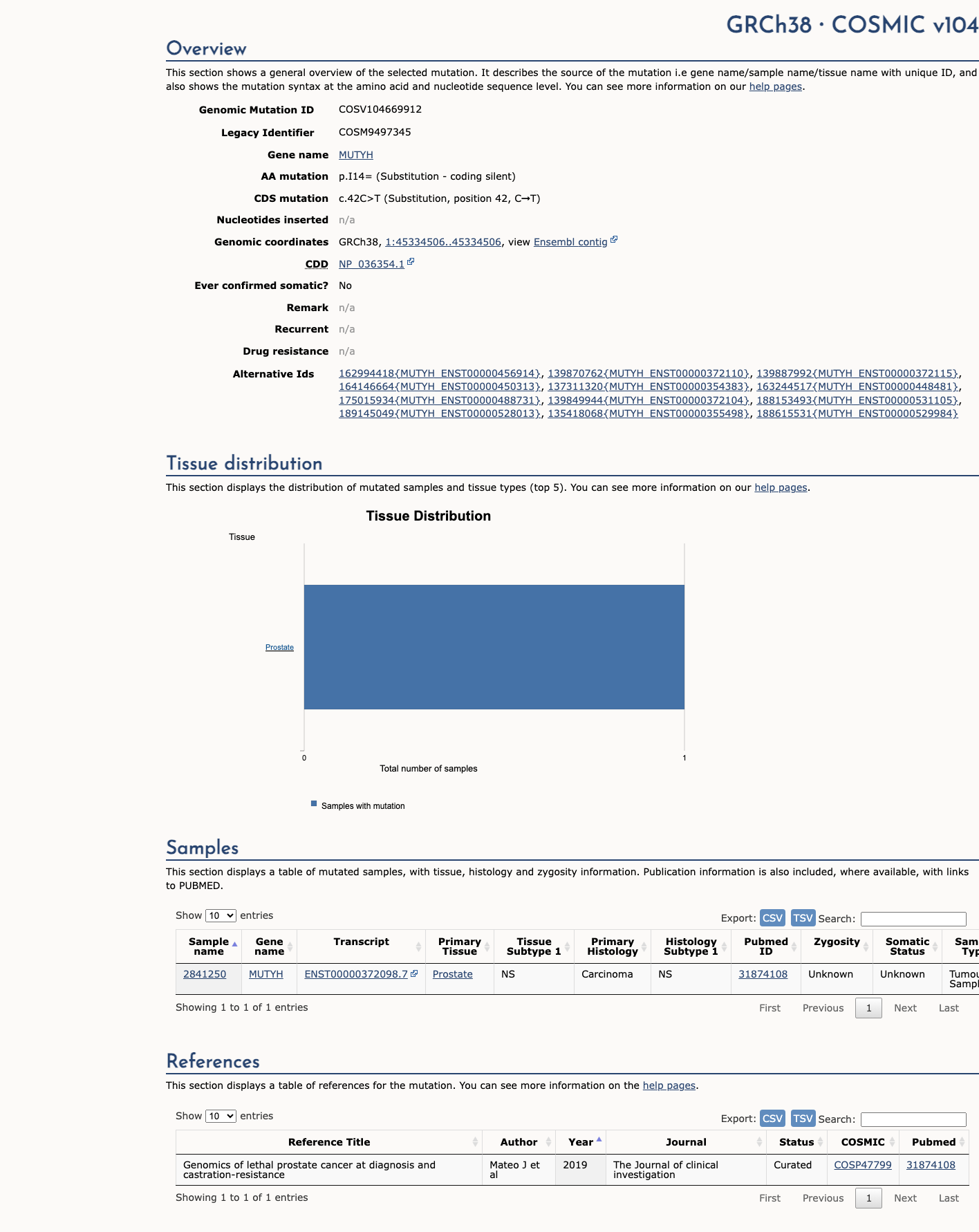
The segregation/de novo evidence group contributes no pathogenic and no benign weight for MUTYH NM_001128425.2:c.42C>T (NP_001121897.1:p.(Ile14=)): PS2 and PM6 are not met because no de novo or assumed de novo occurrence is reported for this variant in any source, and the allele is documented instead as a transmitted low-frequency variant (gnomAD v2.1 26/282,876 alleles, gnomAD v4.1 277/1,613,946 alleles, 0 homozygotes in both) detected only heterozygously in 1 of 329 APC-mutation-negative polyposis index patients (PMID:16557584). PP1 and BS4 are not_assessed rather than failed: the case is a variant-level query with no proband, pedigree, or genotyped relatives, and neither variant-specific publication reports family data for this variant, so co-segregation and non-segregation are equally undemonstrated. Absence of a family study must not be converted into benign evidence for BS4. Framework: the ClinGen InSiGHT Hereditary Colorectal Cancer/Polyposis Expert Panel specification for MUTYH v1.0 was retrieved but carries no criterion-level rules (framework_complete=false, unstructured_ruleset, empty rule_payload), so generic ACMG/AMP 2015 criteria were applied throughout. The specification does record MUTYH-associated disease as autosomal recessive (familial adenomatous polyposis 2, MONDO:0012041), which is relevant context for both the de novo criteria and any future segregation analysis. Human review is flagged for PP1 and BS4 only, because a proband pedigree or relative genotypes would make those two criteria assessable; PS2 and PM6 verdicts do not depend on unavailable data. Functional evidence group (PS3, BS3) for MUTYH NM_001128425.2:c.42C>T (NP_001121897.1:p.(Ile14=)), a synonymous substitution in exon 2: neither criterion is met, so this group contributes no evidence points to the final classification. PS3 is not met because no functional assay (MUTYH glycosylase activity, DNA binding, complementation, MSH6 interaction, cell survival, expression or mRNA/splicing) has ever been performed on this variant; the MUTYH LOVD functional-assay compendium (PMID:20725929, Table 2) contains no entry for it, and the only patient dataset (PMID:16557584) places the codon-14 change among silent changes not assigned predicted functional relevance on prediction grounds rather than assay grounds. BS3 is not met because no assay demonstrates preserved function: the same absence of functional data applies, SpliceAI returned no score for this variant (missing data, explicitly not read as a zero delta), and the Pangolin values reported (SG 0.002, SL -0.008) are not calibrated as ACMG/AMP functional or in-silico evidence. Assay-control and biological-relevance considerations: the variant sits in the MUTYH 5' region near the second translation initiation site, a region where, per PMID:20725929, alpha/beta/gamma transcripts may behave differently and variants should be verified at least in silico; any future functional study would need isoform-aware design and internal controls before PS3 or BS3 could be scored at any strength. Strength calibration: no strength could be assigned for either criterion, because PS3/BS3 strength calibration requires an established functional assay with validated controls and no such assay exists for this variant; the generic ACMG/AMP 2015 definitions (PMID:25741868) were used because the governing InSiGHT MUTYH CSPEC v1.0 specification retrieved for this case carried no structured PS3/BS3 criteria text. No other source's final classification (e.g. ClinVar submissions) was used to derive either criterion; the verdicts rest solely on the primary functional and assay evidence reviewed above. Group verdict for NM_001128425.2:c.42C>T (MUTYH p.(Ile14=), synonymous): PS4 not met, PP4 not assessed (no proband-level phenotype or family history in the case), PP5 not met, BP5 not met, BP6 not met. No criterion in this group could be assigned any strength. Case-control and prevalence: the only case-level quantitative data are a single heterozygous carrier among 329 unselected APC-mutation-negative polyposis patients (1/658 chromosomes, 0.15%, PMID:16557584), with no biallelic MAP genotype observed. The cross-dataset comparison against gnomAD controls gives OR 8.87 with two-sided Fisher exact p = 0.107 ('0.107 <= 0.05? no'), so the statistically significant enrichment PS4 requires is absent; population frequencies (gnomAD v2.1 9.19e-05, v4.1 1.72e-04, 0 homozygotes in both) are of the same order as the case-cohort frequency. Phenotype: no proband phenotype or family history exists in this case, and the available cohort/submission phenotype context (FAP/AFAP referral cohort, generic ClinVar conditions such as carcinoma of colon and familial adenomatous polyposis 2) is not specific for a single-gene etiology; PP4 is therefore not_assessed rather than negative. Expert assertions: the exact-variant ClinVar record VCV000138307 has zero expert-panel submissions (all 11 submissions ordinary laboratories; 1-star, conflicting classifications), so neither the pathogenic PP5 route nor the benign BP6 route is available, even though the aggregate label is Likely benign and several laboratories report benign-side classifications. Alternate molecular basis: no case in the available evidence is documented with an alternate genetic explanation for disease (the published carrier came from a cohort that was APC-mutation-negative by design), so BP5 is not met. Net contribution of this group to the case classification: no pathogenic prevalence or phenotype support (PS4, PP4) and no benign assertion-based support (BP5, BP6); the group is neutral apart from documenting the absence of enrichment and of any expert-panel assertion for this variant. The variant is NM_001128425.2:c.42C>T in MUTYH, a synonymous substitution predicting NP_001121897.1:p.(Ile14=) in exon 2, in a gene whose disease (familial adenomatous polyposis 2 / MUTYH-associated polyposis) is autosomal recessive per the governing InSiGHT MUTYH version 1.0 specification; allelic criteria therefore operate only on phase (cis/trans) configurations. The only variant-specific clinical observation available is a single heterozygous (monoallelic) carrier among 329 unselected APC-mutation-negative polyposis index patients (1/658 chromosomes, 0.15%; Aretz et al. 2006, PMID:16557584). That variant is listed separately from the study's assumed-pathogenic mutations, which were essentially all found in a biallelic state, and it is not assigned functional relevance. No source reports c.42C>T in trans with a pathogenic MUTYH allele (PM3 unmet), and no source reports it in cis with a pathogenic allele or in trans with a pathogenic allele of a dominant disorder (BP2 unmet; the latter clause is structurally inapplicable to recessive MUTYH disease). ClinVar variation 138307 (11 submissions, no expert panel) reports classifications only and contains no phase or partner-allele information for either criterion. Both criteria are therefore non-scoring for this variant; the allelic group contributes no pathogenic or benign points. Governing framework: ClinGen InSiGHT Hereditary Colorectal Cancer/Polyposis Expert Panel Specifications to the ACMG/AMP guidelines for MUTYH v1.0 (cspec doc 1742141534, preferred transcript NM_001128425.2), consulted first. It supplies no structured PP3/BP4/BP7 rule, no MUTYH-specific computational cutoff and no gene-specific PP3/BP4 lookup table, so the generic ACMG/AMP 2015 definitions and the published calibration thresholds were applied. Variant class decides scope: NM_001128425.2:c.42C>T is synonymous (NP_001121897.1:p.(Ile14=)) with no amino-acid substitution and no protein-length change, and it is an exonic, non-canonical-splice, non-intronic/non-splice-region position (six nucleotides into exon 2). PP3 and BP4 are therefore out of scope, and BP7 is the computational criterion in scope for this variant. BP7 cannot be applied: the SpliceAI lookup returned no score for this position, which is missing data and must not be read as a max delta near zero; the Pangolin outputs (gain 0.002, loss -0.008) are uncalibrated for this purpose, and no nucleotide-conservation metric is available for c.42. Both prongs of BP7 (no predicted splice impact; nucleotide not highly conserved) are consequently unevaluable, and the criterion is left not assessed with the gaps recorded. Net contribution of this group: no computational evidence code (PP3, BP4 or BP7) is added by the in-silico/splicing assessment of this variant. All four population criteria were evaluated against the same six source views for NM_001128425.2:c.42C>T (MUTYH p.(Ile14=)): gnomAD v2.1 all-comers, gnomAD v4.1 all-comers, gnomAD v2.1 non-cancer (exomes-only figures), gnomAD v3.1 non-cancer (genomes-only), gnomAD-Canada v1.0 (HostSeq), and the governing specification's inheritance metadata. BA1 not met: the highest ancestry-group frequency anywhere is 3.24064e-04 (gnomAD v3.1 non-cancer, European non-Finnish), about 150-fold below the 0.05 stand-alone benign threshold. BS1 not met: the same maximum frequency is about 30-fold below the 0.01 generic strong-benign default (Whiffin et al. 2017, PMID:28518168), and a threshold derived for a recessive disorder would be higher still. BS2 not met: homozygote counts are zero in every dataset (0/282876 v2.1, 0/1613946 v4.1, 0/236942 v2.1 non-cancer exomes, 0/147886 v3.1 non-cancer, 0/18414 Canada), and the variant was seen only monoallelically in 329 APC-negative polyposis patients (PMID:16557584); MUTYH-associated polyposis is also incompletely penetrant with adult onset, so BS2's full-penetrance/early-onset premise fails independently. PM2 not met: using the ancestry-specific and grpmax comparisons, every dataset exceeds the 0.0001 supporting threshold (v4.1 total 1.71629e-04, grpmax FAF 1.976e-04; v2.1 grpmax FAF 1.303e-04, NFE 1.85779e-04; v3.1 non-cancer NFE 3.24064e-04; Canada 1.08613e-04), and 277 carrier alleles in v4.1 confirm the variant is not absent from controls. Flagged for human review only because the InSiGHT MUTYH v1.0 rule payload was empty and the gnomAD v2.1 non-cancer exome-only total (8.86293e-05) alone sits just under threshold. Net population contribution to this case: no benign population stand-alone or strong evidence (BA1, BS1), no BS2 healthy-homozygote evidence, and no PM2 rare-variant support; the variant is a low-frequency but recurrent, heterozygote-only observation in every cohort examined.
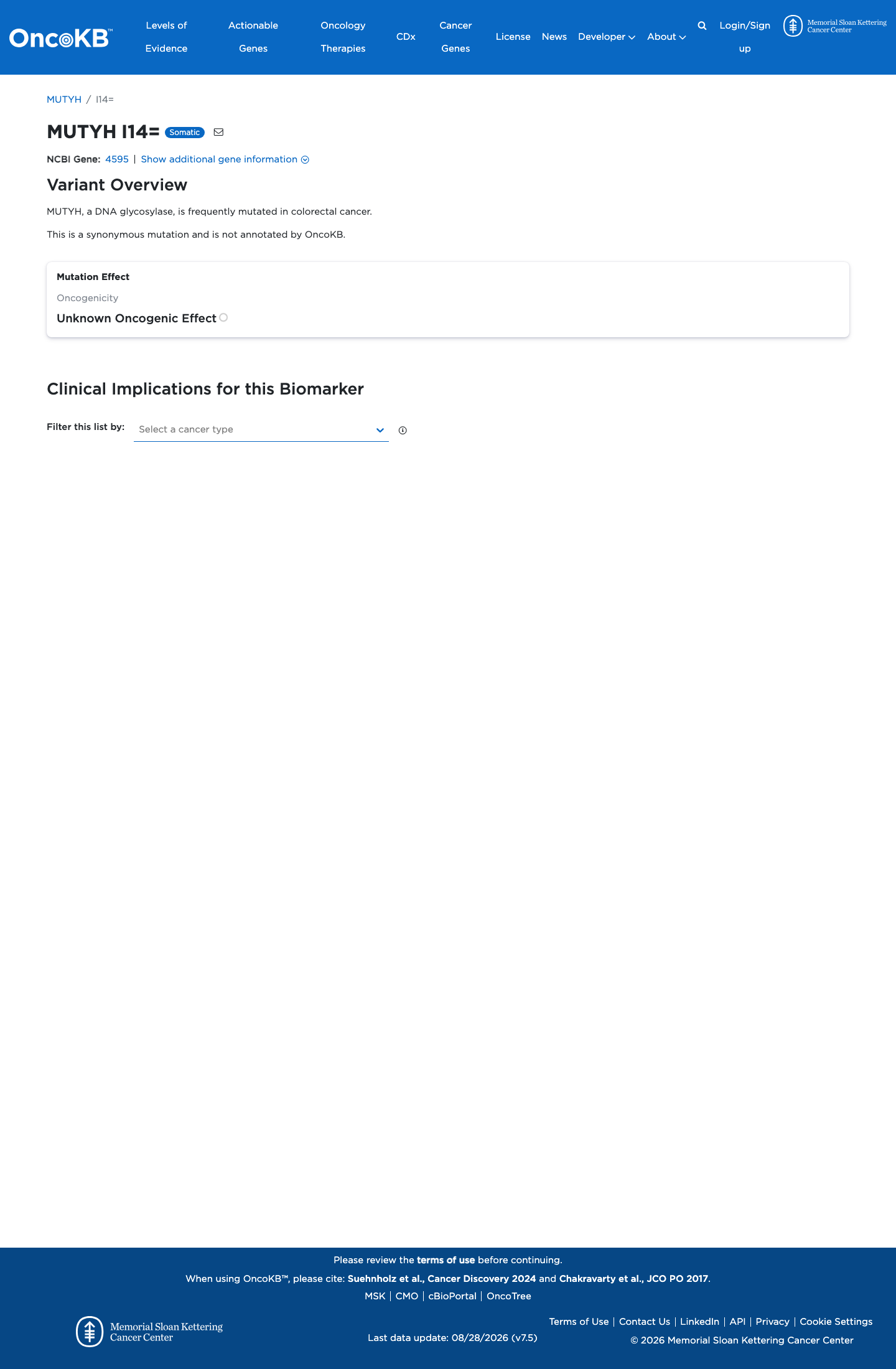
MUTYH encodes a DNA repair enzyme (a glycosylase) that fixes oxidative DNA damage by removing adenine bases that have been mistakenly paired with guanine or with oxidized guanine lesions. Inherited mutations in both copies of the gene cause MUTYH-associated polyposis (MAP), a recessive condition that strongly predisposes people to multiple colorectal polyps and colorectal cancer. The gene acts as a tumor suppressor whose loss of function allows DNA damage to accumulate, and somatic changes in it have also been reported in colon cancer, though whether they drive cancer on their own is not fully established.
MUTYH encodes a base-excision-repair glycosylase whose biallelic loss of function causes autosomal recessive MUTYH-associated polyposis, so a synonymous change such as c.42C>T (p.Ile14=) would need biallelic loss-of-function evidence before it could be regarded as disease-causing.
No criteria were applied for this variant.
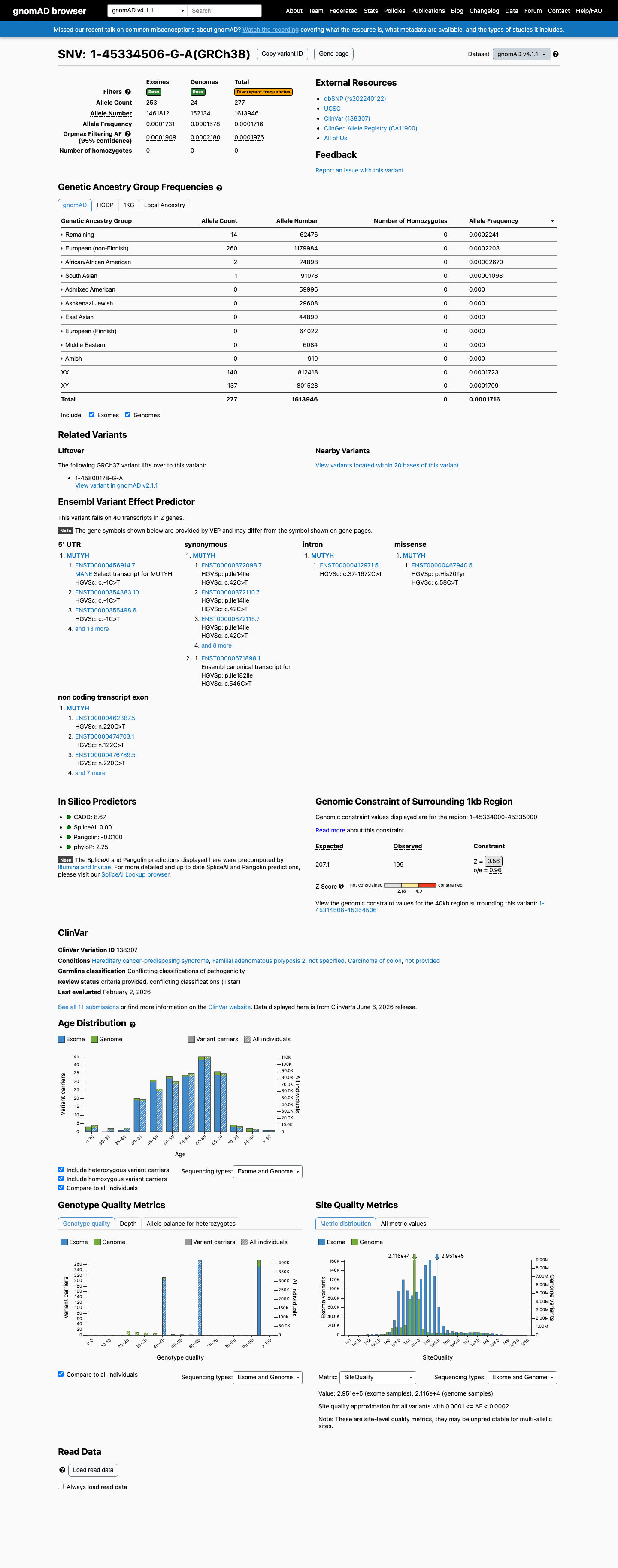
0 hom · FAF 0.02%
Remaining individuals 14 / 62,476 |
0.022% |
European (non-Finnish) 260 / 1,179,984 |
0.022% |
African/African American 2 / 74,898 |
0.0027% |
South Asian 1 / 91,078 |
0.0011% |
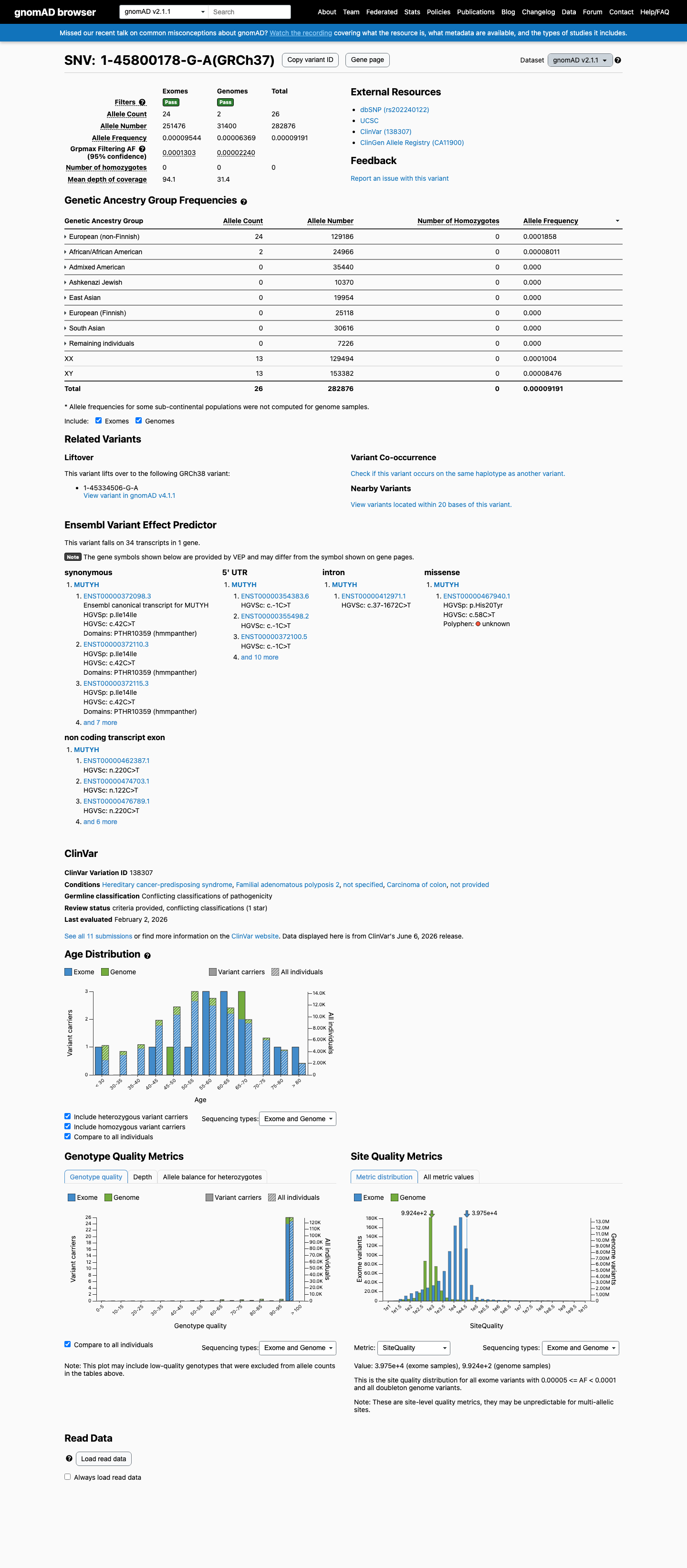
0 hom · FAF 0.013%
European (non-Finnish) 24 / 129,186 |
0.019% |
African/African American 2 / 24,966 |
0.008% |
0 hom · FAF 0.003%
European (non-Finnish) 2 / 11,738 |
0.017% |