Back
NM_001128425.2:c.1187G>A
p.Gly396Asp · MUTYH
0%
complete
Final classification
Likely Pathogenic
PS3PM1PP3
MUTYH
c.1187G>A
p.Gly396Asp
missense · exon 13

MUTYH encodes a DNA repair enzyme (a glycosylase) that fixes oxidative DNA damage by removing adenine bases that have been mistakenly paired with guanine or with oxidized guanine lesions. Inherited mutations in both copies of the gene cause MUTYH-associated polyposis (MAP), a recessive condition that strongly predisposes people to multiple colorectal polyps and colorectal cancer. The gene acts as a tumor suppressor whose loss of function allows DNA damage to accumulate, and somatic changes in it have also been reported in colon cancer, though whether they drive cancer on their own is not fully established.

This variant

The p.Gly396Asp substitution affects MUTYH, a DNA-repair glycosylase whose biallelic loss of function causes the recessive MUTYH-associated polyposis syndrome.

Transcript
NM_001128425.2
HGVS · transcript:coding
NM_001128425.2:c.1187G>A
GRCh38
chr1:45331556 C>T
GRCh37
chr1:45797228 C>T
Likely Pathogenic: PS3 (moderate), PM1 (supporting), and PP3 (strong) satisfy the generic ACMG/AMP combination of one strong, one moderate, and one supporting criterion.
Classification rationale
PS3PM1PP3 Likely Pathogenic
MUTYH c.1187G>A missense · exon 13

Likely Pathogenic: PS3 moderate—p.G396D caused a 1.7-fold higher mutation rate than wild-type MUTYH and was partially defective. Likely Pathogenic: PM1 supporting—residue 396 lies in MUTYH's functionally critical C-terminal 8-oxo-guanine recognition domain. Likely Pathogenic: PP3 strong—REVEL 0.954 exceeds the strong threshold of 0.932.

PS3 + PM1 + PP3 → Likely Pathogenic
LYFE Sciences is an AI system, and it can make mistakes. Criteria may be applied incorrectly, sources may be misread, and a confident-looking classification can still be wrong. Double-check every criterion and its underlying evidence before relying on any call.
Gene diagram · NM_001128425.2 · variants mapped to exon structure
MUTYH NM_001128425.2
Fetching transcript structure from UCSC…
Applied criteria · 3 applied · 21 assessed
MetEvidence satisfies this criterion.
Not metEvaluated against available evidence; threshold not reached.
Not assessedApplies in principle, but no evidence was found to evaluate it.
N/ADoesn't apply to this variant type.
Applied · 3
Strength Supporting Moderate Strong Very strong
PS3 moderate Pathogenic
Met, moderate: p.G396D caused a 1.7-fold higher mutation rate than wild-type MUTYH and was classified as partially defective in a controlled complementation assay.
The MUTYH InSiGHT/ClinGen specification was identified as governing, but its retrieved rule payload contained no criterion-specific PS3 strength rule; generic ACMG/AMP functional calibration was therefore used as fallback.PMID:25820570 tested the exact p.G396D variant in MutY-deficient E. coli, comparing wild-type MUTYH with an empty-vector control; nine independent overnight cultures were analyzed for rifampicin-resistant mutations.In PMID:25820570, wild-type MUTYH reduced the mutation rate to 9.67 per 10^8 versus 137 per 10^8 for empty vector, while p.G396D had a 1.7-fold higher mutation rate than wild type and was classified as partially defective using the study's stated 1.7-fold boundary.
PM1 supporting Pathogenic
Met, supporting: residue 396 lies in the C-terminal 8-oxo-guanine recognition domain described as functionally critical for MUTYH repair.
The MUTYH InSiGHT framework governs this case, but its extracted domain_tables object is empty, so no authoritative VCEP domain boundary can be applied.PMID:19506731 states that G396D is located in the MUTYH C-terminal domain responsible for 8-oxo-guanine recognition and binding and base flipping, and reports reduced substrate binding and repair in biallelic G396D cell lines.PMID:25820570 describes glycine 396 as contributing to 8-oxoG:A mismatch recognition and MUTYH conformational flexibility and categorizes p.G396D as partially defective in a MutY-deficient complementation assay.
PP3 strong Pathogenic
Met, strong: missense REVEL score 0.954 exceeds the >=0.932 strong PP3 threshold.
The variant consequence is missense, p.Gly396Asp; therefore REVEL is the sole applicable computational path for PP3/BP4.Local REVEL lookup reports a score of 0.954.ClinGen SVI REVEL calibration specifies strong PP3 at >=0.932 (Pejaver et al. 2022, PMID:36413997).
Assessed · not applied · 7 not met · 14 not assessed
Pathogenic
PS1 Not assessed: no distinct pathogenic nucleotide change producing p.Gly396Asp was documented in the reviewed evidence.
PS2 Not assessed: no documented proband-parent genotypes or confirmed de novo status are available for c.1187G>A.
PS4 Not assessed: the available odds ratio 6.87 applies to c.1103G>A, not the assessed c.1187G>A variant, so exact-variant enrichment is unavailable.
PM2 Not met: the non-cancer exome allele frequency is 0.00295109, exceeding the PM2 threshold of 0.0001.
PM3 Not assessed: PMID:19506731 describes biallelic G396D cell lines but documents no affected proband, pathogenic allele in trans, or phase.
PM5 Not assessed: no distinct pathogenic missense substitution at residue 396 was documented, and the comparator search returned zero candidates.
PM6 Not assessed: no plausible unconfirmed de novo occurrence of c.1187G>A is reported in the available evidence.
PP1 Not assessed: no informative relatives, genotypes, phenotypes, or meioses are reported for segregation of c.1187G>A.
PP2 Not assessed: no validated MUTYH gene-level missense-enrichment or low-benign-missense metric was available for PP2.
PP4 Not assessed: p.G396D is associated with MUTYH-associated polyposis, but the patient's specific phenotype and family history are not available.
PP5 Not met: ClinVar shows zero expert-panel submissions, and the displayed record maps to c.1103G>A rather than the assessed c.1187G>A.
Benign
BA1 Not met: the highest observed allele frequency is 0.00588456, below the generic BA1 threshold of 0.05.
BS1 Not met: the highest observed allele frequency is 0.00588456, below the generic BS1 threshold of 0.01.
BS2 Not assessed: gnomAD reports 26 homozygotes, but unaffected status, age, and disease ascertainment are unavailable for BS2.
BS3 Not met: p.G396D caused a 1.7-fold higher mutation rate than wild-type MUTYH and was classified as partially defective, not functionally normal.
BS4 Not assessed: no tested unaffected relatives or family genotype-phenotype data demonstrate non-segregation of c.1187G>A.
BP1 Not assessed: no validated gene-level evidence showed that MUTYH disease is predominantly caused by truncating rather than missense variants.
BP2 Not assessed: no second pathogenic MUTYH variant or cis-phase observation is documented for the autosomal-recessive disorder.
BP4 Not met: missense REVEL score 0.954 exceeds the <=0.29 supporting BP4 threshold.
BP5 Not assessed: no qualifying alternative molecular explanation or applicable MUTYH-specific BP5 rule is documented for this case.
BP6 Not met: ClinVar reports zero expert-panel submissions and no exact-variant benign or likely-benign expert-panel assertion.
N/A · 4 PVS1 · PM4 · BP3 · BP7
Research & evidence
Population frequency · supports pathogenic
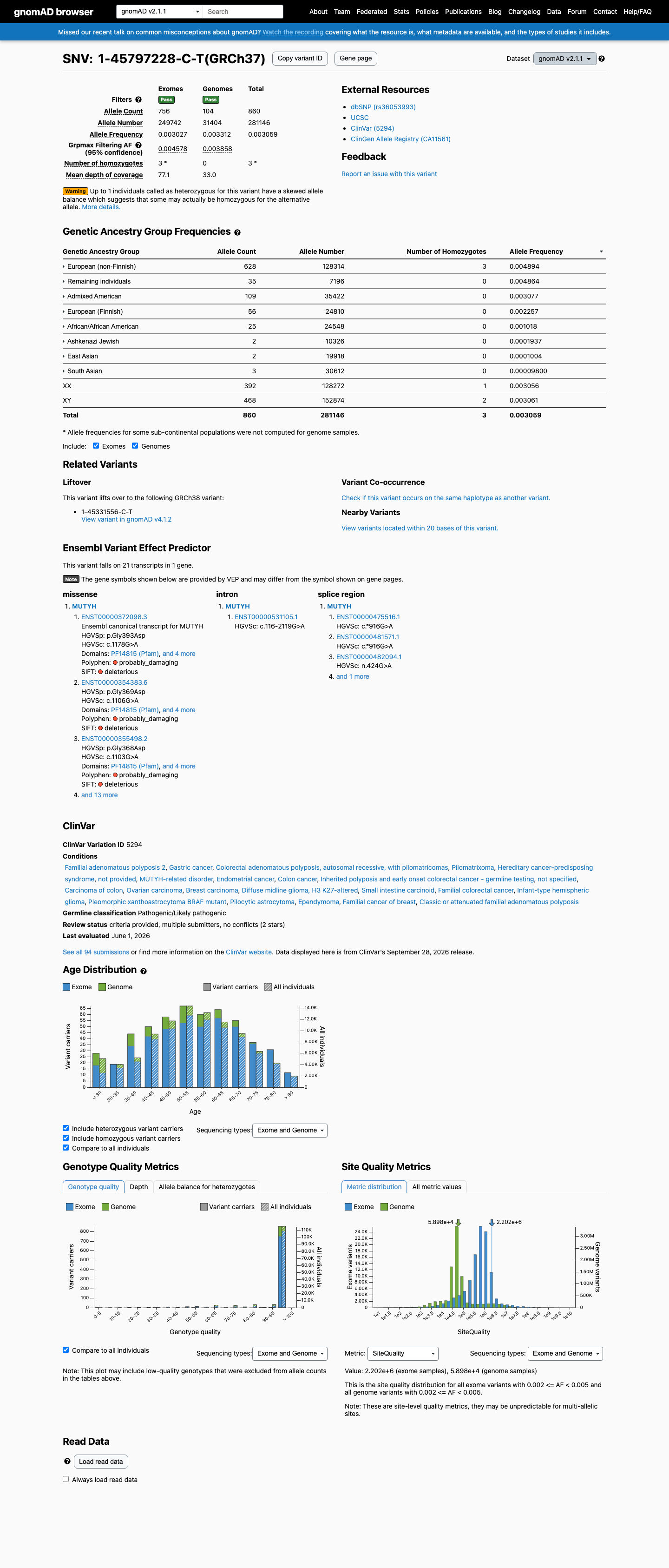
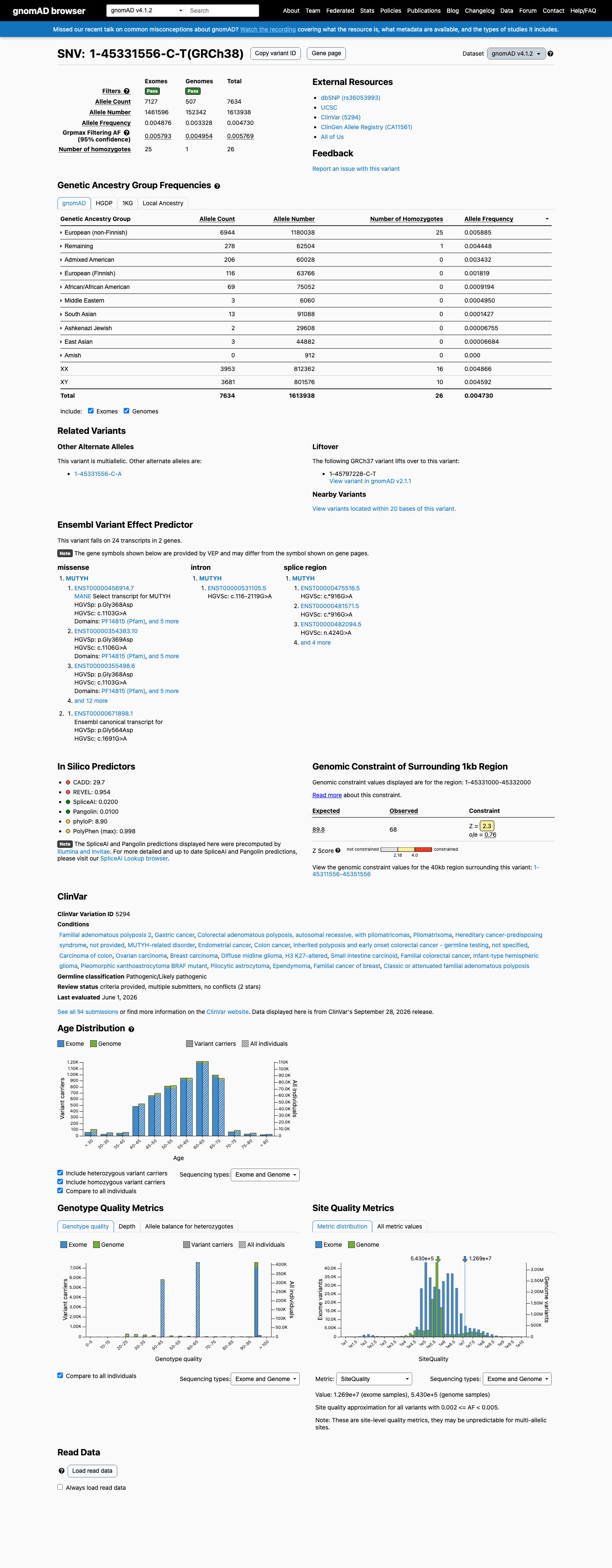
gnomAD v4.1 screenshot
gnomAD v4.1
gnomAD v2.1 screenshot
gnomAD v2.1
v4.1
This variant is present in gnomAD v4.1 (AF= 0.00473005; MAF= 0.47300%, 7634/1613938 alleles, homozygotes = 26) and has highest observed frequency in the European (non-Finnish) population (AF= 0.00588456; MAF= 0.58846%, 6944/1180038 alleles, homozygotes = 25); grpmax FAF= 0.00576855.
v2.1
This variant is present in gnomAD v2.1 (AF= 0.00305891; MAF= 0.30589%, 860/281146 alleles, homozygotes = 3) and has highest observed frequency in the European (non-Finnish) population (AF= 0.00489424; MAF= 0.48942%, 628/128314 alleles, homozygotes = 3); grpmax FAF= 0.00457807.
🇨🇦 CA
Not available in gnomAD-Canada v1.0.
Allele frequency by ancestry
three datasets · side by side
gnomAD v4.1
0.47% · 7634 / 1,613,938
26 hom · FAF 0.58%
European (non-Finnish)
6944 / 1,180,038
0.59%
25 hom
Remaining individuals
278 / 62,504
0.44%
1 hom
Admixed American
206 / 60,028
0.34%
European (Finnish)
116 / 63,766
0.18%
African/African American
69 / 75,052
0.092%
Middle Eastern
3 / 6,060
0.05%
South Asian
13 / 91,088
0.014%
Ashkenazi Jewish
2 / 29,608
0.0068%
East Asian
3 / 44,882
0.0067%
+ 1 not observed (Amish)
gnomAD v2.1
0.31% · 860 / 281,146
3 hom · FAF 0.46%
European (non-Finnish)
628 / 128,314
0.49%
3 hom
Remaining individuals
35 / 7,196
0.49%
Admixed American
109 / 35,422
0.31%
European (Finnish)
56 / 24,810
0.23%
African/African American
25 / 24,548
0.1%
Ashkenazi Jewish
2 / 10,326
0.019%
East Asian
2 / 19,918
0.01%
South Asian
3 / 30,612
0.0098%
gnomAD Canada 🇨🇦
Absent · 0 / ?
0 hom
Not observed in any ancestry group.
ClinVar screenshot
ClinVar
This variant has been reported in ClinVar as Pathogenic (72 clinical laboratories) and as Likely pathogenic (2 clinical laboratories) and as pathogenic (1 clinical laboratory). (ClinVarID = 5294)
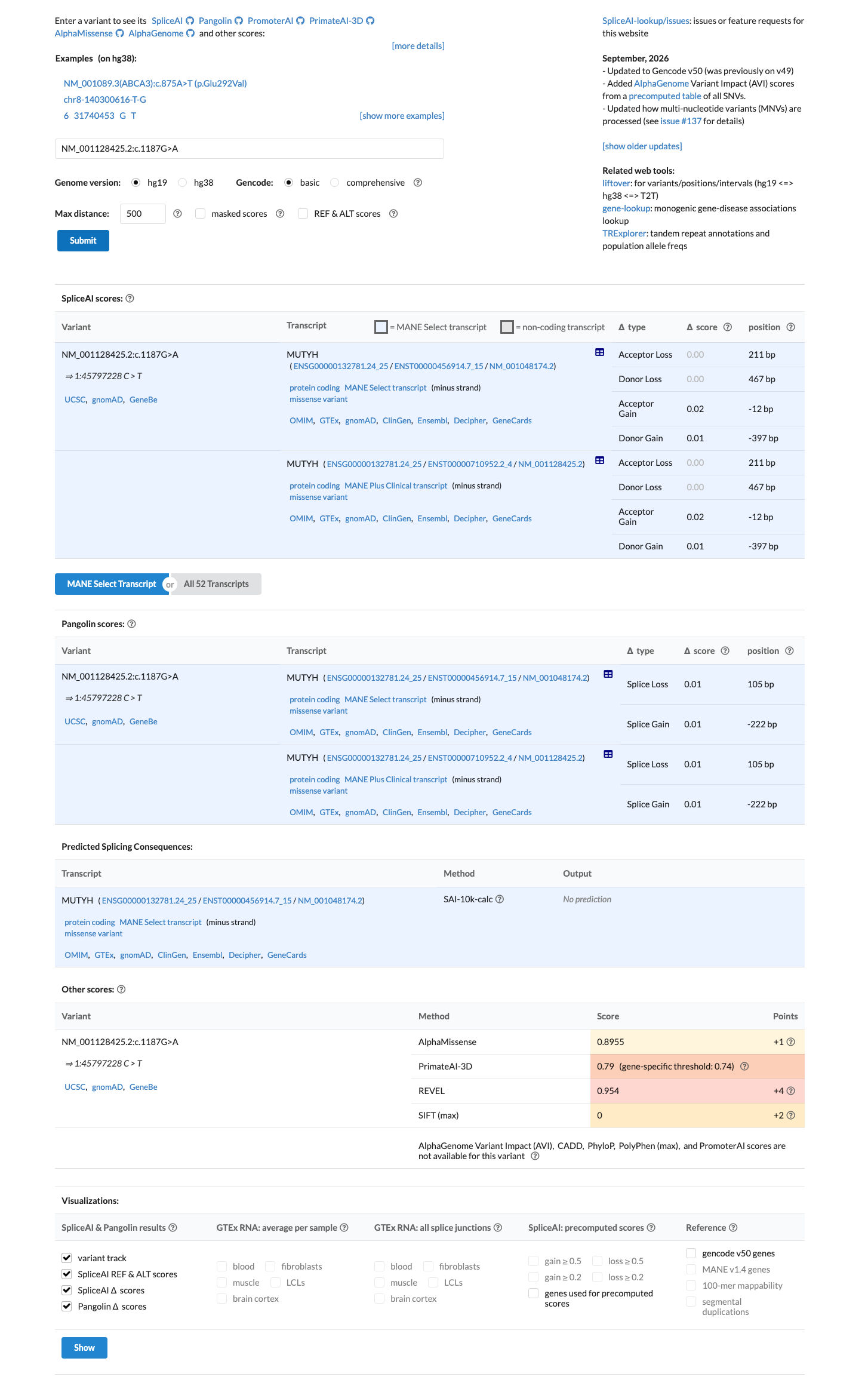
SpliceAI screenshot
In silico
SpliceAI predicts no significant splice impact for this variant (max delta score = 0.02). REVEL score = 0.954. BayesDel score = 0.531718.
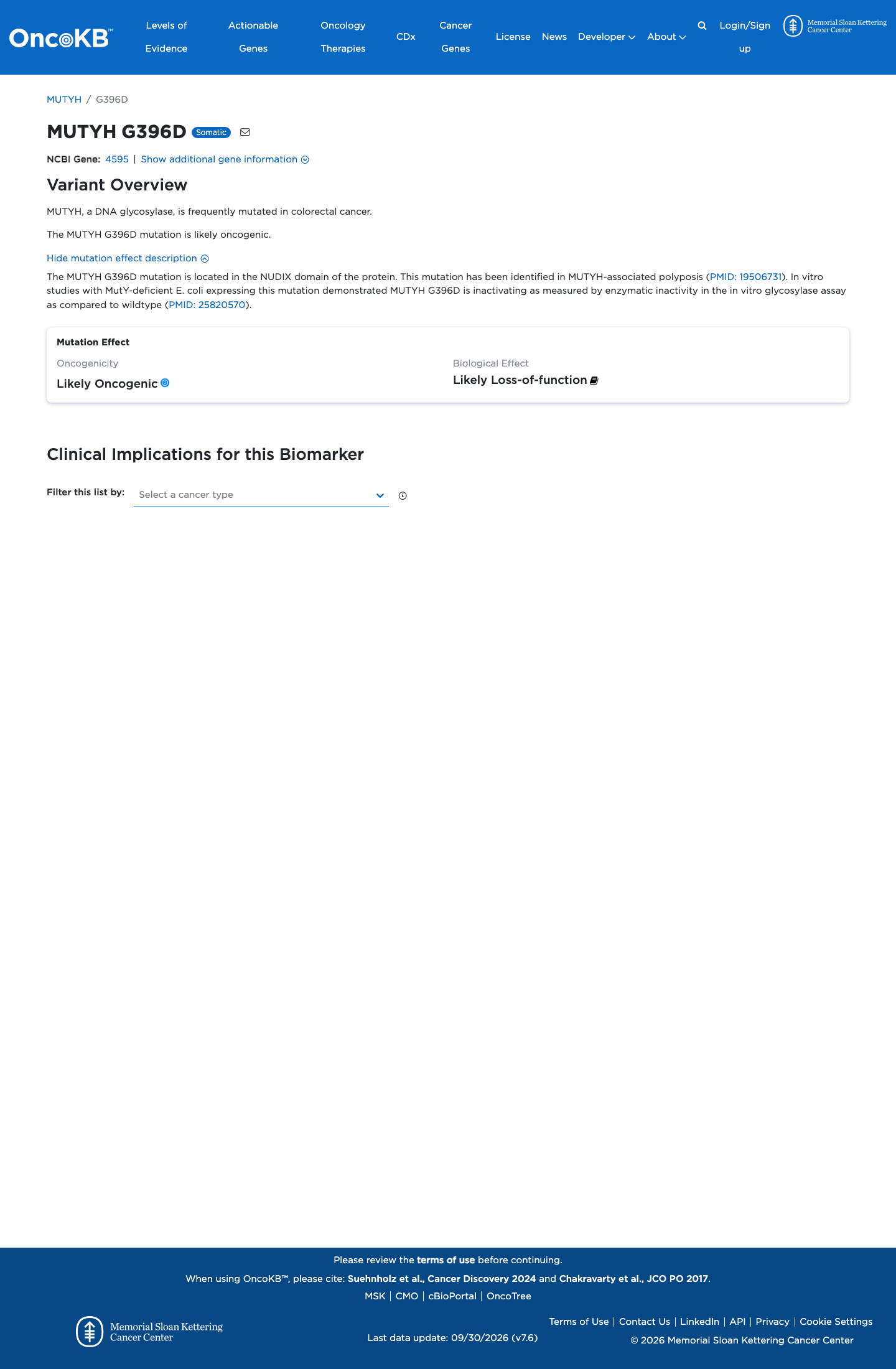
Functional / OncoKB screenshot
Functional Likely Oncogenic
OncoKB identified variant-specific curated literature and context relevant to functional review; biological-effect context: Likely Loss-of-function; curated oncogenicity label: Likely Oncogenic.
OncoKB ↗
COSMIC screenshot
COSMIC
Cancer hotspots screenshot
Cancer hotspots
Somatic evidence Not in COSMIC / hotspots
COSMIC
This variant does not lie in a statistically significant hotspot. This variant has not previously been reported in somatic cancers (COSMIC).
Hotspots
This variant does not lie in a statistically significant hotspot.
Literature · how each cited paper was used
2papers cited
Each card is an audit: what was searched, what was found, whether it names the variant, which criteria it fed, and why. 5 further PMIDs triaged but not cited — see Sources & references.
MUTYH Associated Polyposis (MAP).
Searched
c.1187G>ANP_001121897.1:p.(G396D)
Found
This paper explicitly discusses MUTYH p.G396D and places it in the C-terminal domain involved in 8-oxo-guanine recognition and binding and base flipping. Human cell lines with biallelic G396D showed approximately 50% of wild-type binding activity for mismatched substrates and lower repair rates despite equivalent protein levels.
Variant
✓ Names this variant — characterised directly
Applied to
→PS3 moderate
The source directly reports reduced G396D substrate binding and repair with preserved protein levels, corroborating impaired MUTYH function.
→PM1 supporting
Identifies the C-terminal 8-oxo-guanine recognition domain containing residue 396 as functionally critical.
G396D is located in the C-terminal domain of the MUTYH, which is thought to be responsible for 8-oxo-G recognition and binding, as well as mediating the base-flipping mechanism [31, 32, 49, 79, 80].
Location Sections "ALLELIC FREQUENCIES OF MUTYH GERMLINE MUTATIONS IN DIFFERING POPULATIONS" and "FUNCTIONAL CONSEQUENCES OF SPECIFIC GERMLINE MUTYH MUTATIONS"  ·  Context Functional analysis in human cell lines with biallelic G396D mutations and corresponding E. coli MutY variant assays; population observations from European/Caucasian cohorts.  ·  full text
Functional Complementation Assay for 47 MUTYH Variants in a MutY-Disrupted Esche
Searched
MUTYH c.1187G>ANP_001121897.1:p.(G396D)p.G396D
Found
This paper studied MUTYH p.G396D in a MutY-deficient Escherichia coli complementation assay. Relative to wild type, p.G396D produced a 1.7-fold higher rifampicin-resistant mutation rate and was categorized as partially defective; the paper also links glycine 396 to 8-oxoG:A mismatch recognition and conformational flexibility.
Variant
✓ Names this variant — characterised directly
Applied to
→PS3 moderate
The exact p.G396D complementation assay showed a calibrated partial BER defect with wild-type and empty-vector controls.
→PM1 supporting
Provides functional evidence that residue 396 contributes to the critical MUTYH mismatch-recognition mechanism.
The mutation rates of p.Y179C and p.G396D, two common variants found in Caucasian patients with MAP, were 4.8- and 1.7-fold, respectively.
Location Results, "BER Detection with a MutY-Deficient E. coli Complementation Assay"; Discussion  ·  Context Functional complementation assay using human MUTYH variants expressed in MutY-deficient E. coli CC104mutY, with mutation-rate measurement; protein expression and localization were also evaluated in HCT116 cells.  ·  full text
Sources & reference links
9Sources
CSpec VCEP
ClinVar
gnomAD v2.1
gnomAD v4.1
gnomAD-Canada
SpliceAI
OncoKB
COSMIC
Cancer hotspots
Triaged references · 5 PMIDs not cited in assessment
11818965 ↗ Inherited variants of MYH associated with somatic G:C-->T:A mutations in colorectal tumors. CLINVAR
12606733 ↗ Multiple colorectal adenomas, classic adenomatous polyposis, and germ-line mutations in MYH. CLINVAR
15036665 ↗ Identification of critical residues required for the mutation avoidance function of human MutY (hMYH) and implications in colorectal cancer. CLINVAR
15635083 ↗ The potential for increased clinical sensitivity in genetic testing for polyposis colorectal cancer through the analysis of MYH mutations in North American patients. CLINVAR
15987719 ↗ Cells with pathogenic biallelic mutations in the human MUTYH gene are defective in DNA damage binding and repair. CLINVAR