Back
NM_001128425.2:c.1276C>T
p.Arg426Cys · MUTYH
0%
complete
Final classification
VUS
BS3
MUTYH
c.1276C>T
p.Arg426Cys
missense · exon 13

MUTYH encodes a DNA repair enzyme (a glycosylase) that fixes oxidative DNA damage by removing adenine bases that have been mistakenly paired with guanine or with oxidized guanine lesions. Inherited mutations in both copies of the gene cause MUTYH-associated polyposis (MAP), a recessive condition that strongly predisposes people to multiple colorectal polyps and colorectal cancer. The gene acts as a tumor suppressor whose loss of function allows DNA damage to accumulate, and somatic changes in it have also been reported in colon cancer, though whether they drive cancer on their own is not fully established.

This variant

MUTYH encodes a DNA glycosylase that repairs oxidative DNA damage, and biallelic loss of that repair activity causes MUTYH-associated polyposis, an autosomal recessive syndrome of multiple colorectal polyps and increased colorectal cancer risk; this missense substitution, c.1276C>T (p.Arg426Cys), is assessed here against that recessive, loss-of-function disease mechanism.

Transcript
NM_001128425.2
HGVS · transcript:coding
NM_001128425.2:c.1276C>T
GRCh38
chr1:45331467 G>A
GRCh37
chr1:45797139 G>A
VUS: the only met criterion is BS3 (supporting), and one supporting benign criterion does not satisfy the generic ACMG/AMP 2015 Likely Benign combination (two supporting benign).
Classification rationale
BS3 VUS
MUTYH c.1276C>T missense · exon 13

BS3 (supporting) met: the calibrated E. coli base-excision-repair complementation assay classified p.Arg426Cys as functionally retained, below its 1.7-fold retained cutoff. No pathogenic criterion met: PS1, PS3 and PM5 find no established pathogenic comparator at codon 426, PP3 is indeterminate (REVEL 0.615) and PM2 fails because gnomAD frequencies (up to 0.00167) exceed the 0.0001 rarity threshold. No benign-frequency criterion met: BA1 (0.05) and BS1 (0.01) both fail, with the highest observed population frequency about 30-fold and 6-fold below their thresholds.

BS3 → VUS
LYFE Sciences is an AI system, and it can make mistakes. Criteria may be applied incorrectly, sources may be misread, and a confident-looking classification can still be wrong. Double-check every criterion and its underlying evidence before relying on any call.
Gene diagram · NM_001128425.2 · variants mapped to exon structure
MUTYH NM_001128425.2
Fetching transcript structure from UCSC…
Applied criteria · 1 applied · 22 assessed
MetEvidence satisfies this criterion.
Not metEvaluated against available evidence; threshold not reached.
Not assessedApplies in principle, but no evidence was found to evaluate it.
N/ADoesn't apply to this variant type.
Applied · 1
Strength Supporting Moderate Strong Very strong
BS3 supporting review Benign
Met at supporting strength: the controlled E. coli BER complementation assay placed p.Arg426Cys among functionally retained variants, below its 1.7-fold retained cutoff.
PMID:25820570 (E. coli CC104mutY complementation assay): p.R426C listed among the 17 functionally retained variants, with mutation rate below the 1.7-fold retained/partially-defective cut-off; 13 variants were defective and 17 partially defective.PMID:25820570 assay controls and calibration: p.Y179C (defective, 4.8-fold) and p.G396D (partially defective, 1.7-fold) as pathogenic anchors, p.V22M (1.2-fold), p.Q338H (0.7-fold) and p.S515F (1.0-fold) as benign/common-population anchors; wild-type MUTYH 9.67 per 10^8 versus empty vector 137 per 10^8.PMID:25820570 direct quote bearing on strength: 'However, the clinical application of our results might be limited by the difficulty in establishing an appropriate cut-off value, as we could not estimate how intermediate or subtle functional defects would contribute to the pathogenesis of MAP.'
Assessed · not applied · 18 not met · 4 not assessed
Pathogenic
PS1 Not met: no second nucleotide change encoding p.Arg426Cys exists; the only codon-426 substitution is the query itself, classified uncertain or likely benign.
PS2 Not assessed: no proband or parental/trio testing is available, so a confirmed de novo occurrence of this MUTYH variant cannot be established.
PS3 Not met: the calibrated E.
PS4 Not met: the only occurrence of this allele is one monoallelic carrier among 60 polyposis patients, with no significant case-control enrichment or odds ratio.
PM1 Not met: MUTYH R426 is not a cancer hotspot and this residue carries benign variation (gnomAD 0.083%, 1 homozygote; 11 likely-benign submissions).
PM2 Not met: gnomAD v2.1 AF 0.000831523 and v4.1 AF 0.0013085 both exceed the PM2 supporting rarity threshold of <=0.0001.
PM3 Not met: every primary report places the variant monoallelic (Aceto 2005 GD108, [c.1234C>T]+[c.=]), with no phase-confirmed in-trans pathogenic MUTYH variant.
PM5 Not met: no pathogenic missense at MUTYH residue 426 other than the query variant itself was identified in ClinVar or the literature.
PM6 Not assessed: no de novo occurrence of this MUTYH variant is documented in any patient, so assumed de novo status cannot be evaluated.
PP1 Not assessed: no pedigree with genotyped affected relatives exists, so co-segregation of this variant with MUTYH-associated polyposis cannot be demonstrated.
PP2 Not met: MUTYH carries established common benign missense polymorphisms, so the low-benign-missense-rate precondition fails despite missense being a disease mechanism.
PP3 Not met: REVEL 0.615 falls below the 0.644 PP3 supporting threshold for this missense variant.
PP4 Not met: the single reported carrier had classical FAP (>100 polyps) with vertical transmission, a phenotype atypical for recessive MUTYH-associated polyposis, where 70/71 biallelic patients were attenuated.
PP5 Not met: ClinVar VCV000041753 has zero expert-panel submissions and only a 1-star, conflicting, laboratory-level review status, not an expert-panel pathogenic call.
Benign
BA1 Not met: the highest observed frequency (gnomAD v4.1 grpmax FAF 0.00160542) sits about 30-fold below the 0.05 BA1 stand-alone threshold.
BS1 Not met: the highest observed frequency (gnomAD v4.1 grpmax FAF 0.00160542) is roughly 6-fold below the generic BS1 strong threshold of 0.01.
BS2 Not met: only one gnomAD homozygote is reported and MAP's incomplete, adult-onset penetrance fails the healthy-adult full-penetrance precondition.
BS4 Not assessed: no genotyped family with multiple affected members exists, so lack of co-segregation of this variant with disease cannot be demonstrated.
BP2 Not met: no report places c.1276C>T in cis with a pathogenic MUTYH variant, and the trans clause applies only to dominant disorders.
BP4 Not met: REVEL 0.615 sits far above the 0.29 BP4 supporting threshold for this missense variant.
BP5 Not met: the only case carrying this variant was APC-mutation-negative, so no alternate molecular basis for disease was documented.
BP6 Not met: ClinVar VCV000041753 has zero expert-panel submissions, so no expert-panel benign or likely benign classification exists for this allele.
N/A · 5 PVS1 · PM4 · BP1 · BP3 · BP7
Research & evidence
Population frequency
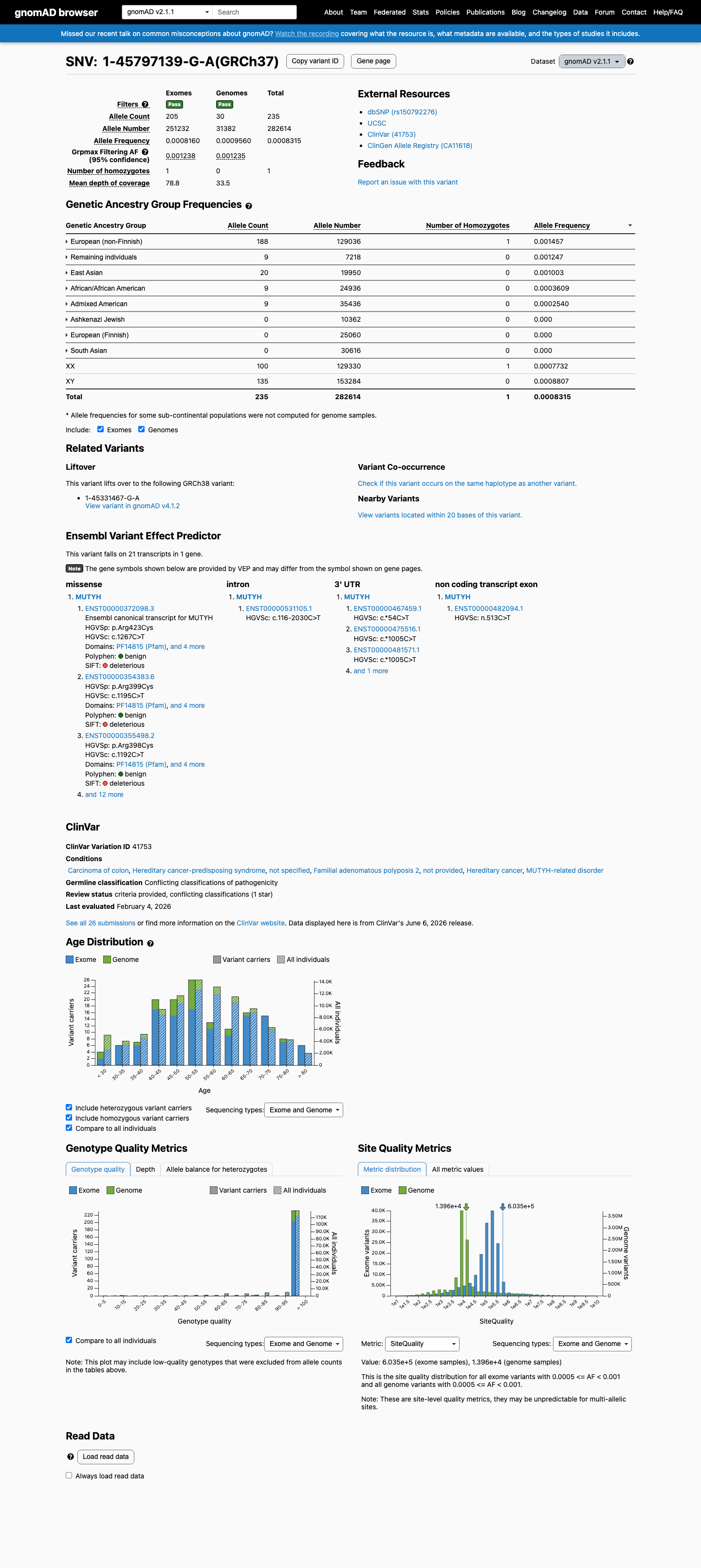
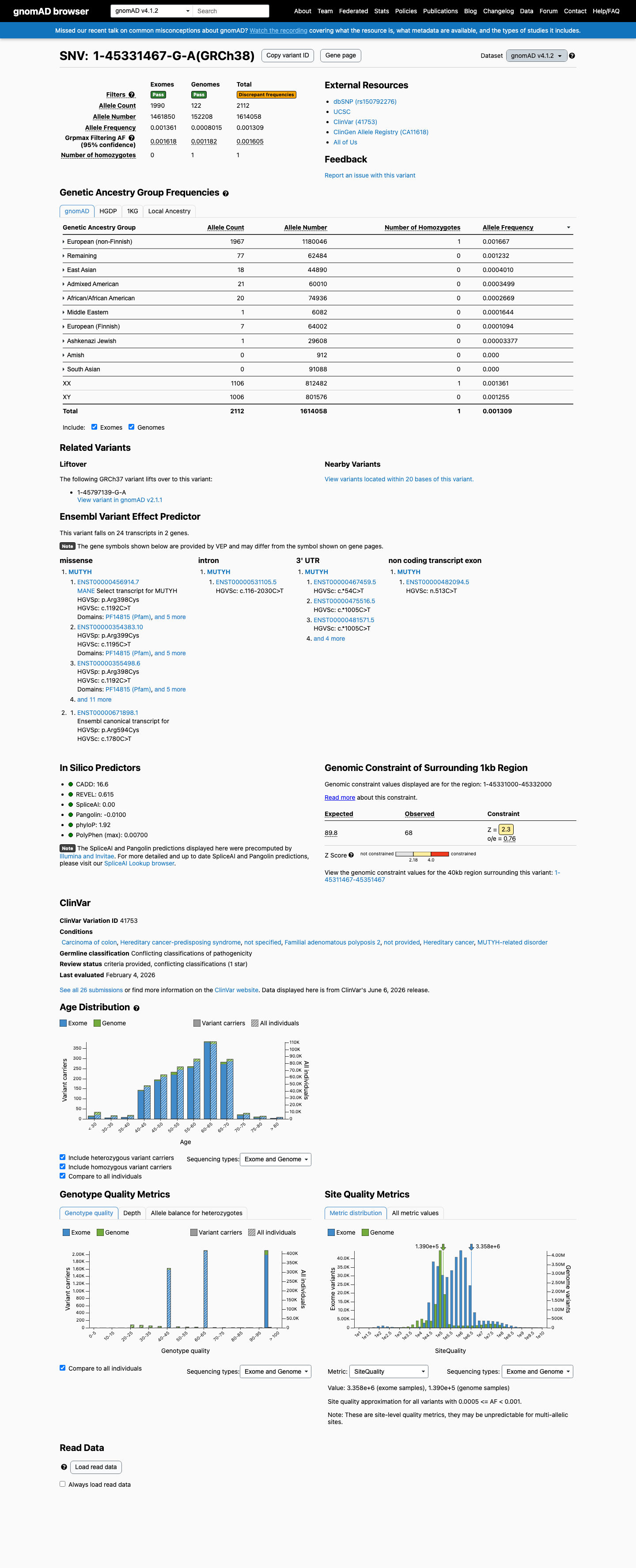
gnomAD v4.1 screenshot
gnomAD v4.1
gnomAD v2.1 screenshot
gnomAD v2.1
v4.1
This variant is present in gnomAD v4.1 (AF= 0.0013085; MAF= 0.13085%, 2112/1614058 alleles, homozygotes = 1) and has highest observed frequency in the European (non-Finnish) population (AF= 0.00166688; MAF= 0.16669%, 1967/1180046 alleles, homozygotes = 1); grpmax FAF= 0.00160542.
v2.1
This variant is present in gnomAD v2.1 (AF= 0.000831523; MAF= 0.08315%, 235/282614 alleles, homozygotes = 1) and has highest observed frequency in the European (non-Finnish) population (AF= 0.00145696; MAF= 0.14570%, 188/129036 alleles, homozygotes = 1); grpmax FAF= 0.00123834.
🇨🇦 CA
Not available in gnomAD-Canada v1.0.
Allele frequency by ancestry
three datasets · side by side
gnomAD v4.1
0.13% · 2112 / 1,614,058
1 hom · FAF 0.16%
European (non-Finnish)
1967 / 1,180,046
0.17%
1 hom
Remaining individuals
77 / 62,484
0.12%
East Asian
18 / 44,890
0.04%
Admixed American
21 / 60,010
0.035%
African/African American
20 / 74,936
0.027%
Middle Eastern
1 / 6,082
0.016%
European (Finnish)
7 / 64,002
0.011%
Ashkenazi Jewish
1 / 29,608
0.0034%
+ 2 not observed (Amish, South Asian)
gnomAD v2.1
0.083% · 235 / 282,614
1 hom · FAF 0.12%
European (non-Finnish)
188 / 129,036
0.15%
1 hom
Remaining individuals
9 / 7,218
0.12%
East Asian
20 / 19,950
0.1%
African/African American
9 / 24,936
0.036%
Admixed American
9 / 35,436
0.025%
+ 3 not observed (Ashkenazi Jewish, European (Finnish), South Asian)
gnomAD Canada 🇨🇦
Absent · 0 / ?
0 hom
Not observed in any ancestry group.
ClinVar screenshot
ClinVar
This variant has been reported in ClinVar as Uncertain significance (14 clinical laboratories) and as Likely benign (9 clinical laboratories) and as Likely Benign (2 clinical laboratories). (ClinVarID = 41753)
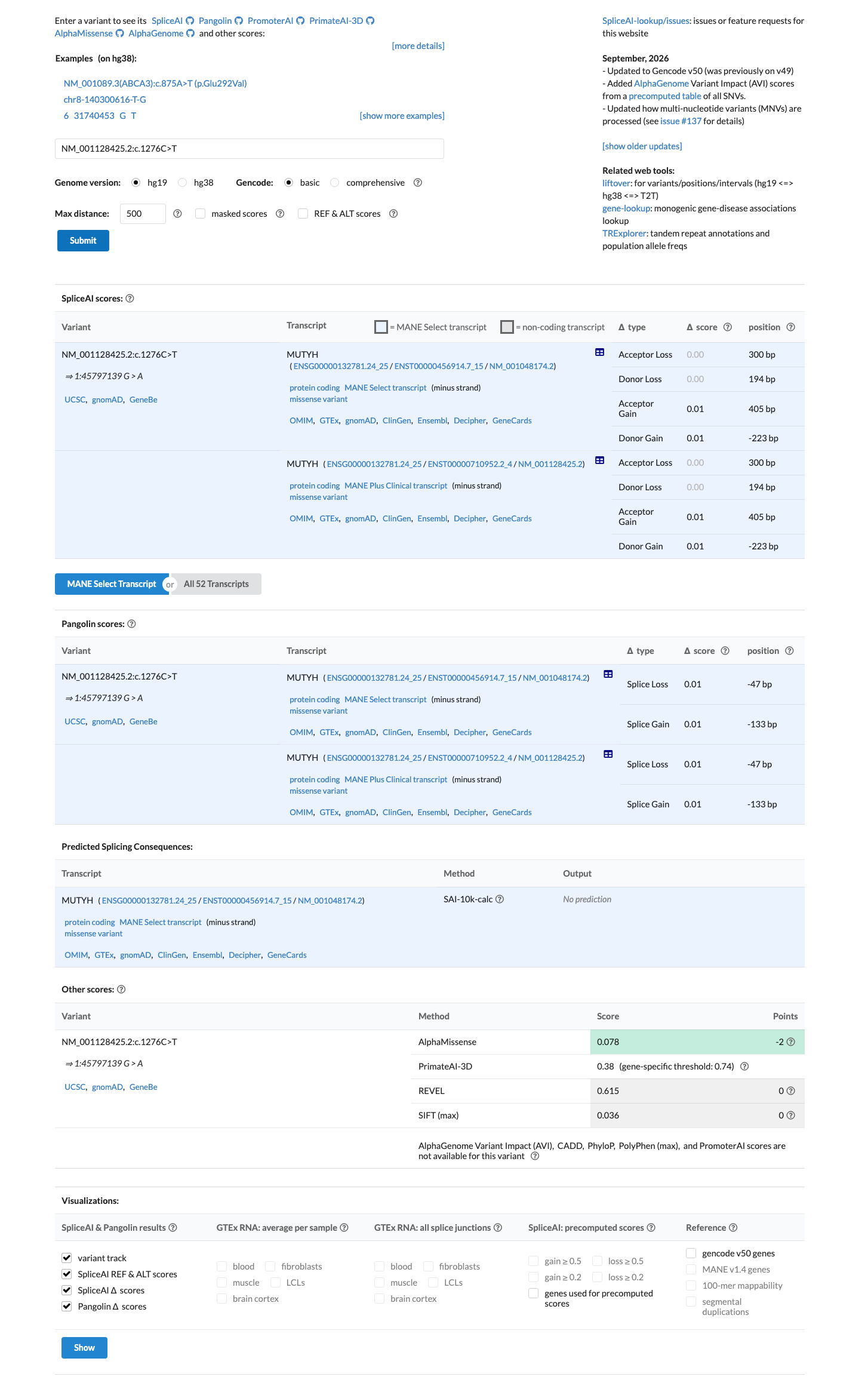
SpliceAI screenshot
In silico
SpliceAI predicts no significant splice impact for this variant (max delta score = 0.01). REVEL score = 0.615. BayesDel score = -0.00912838.
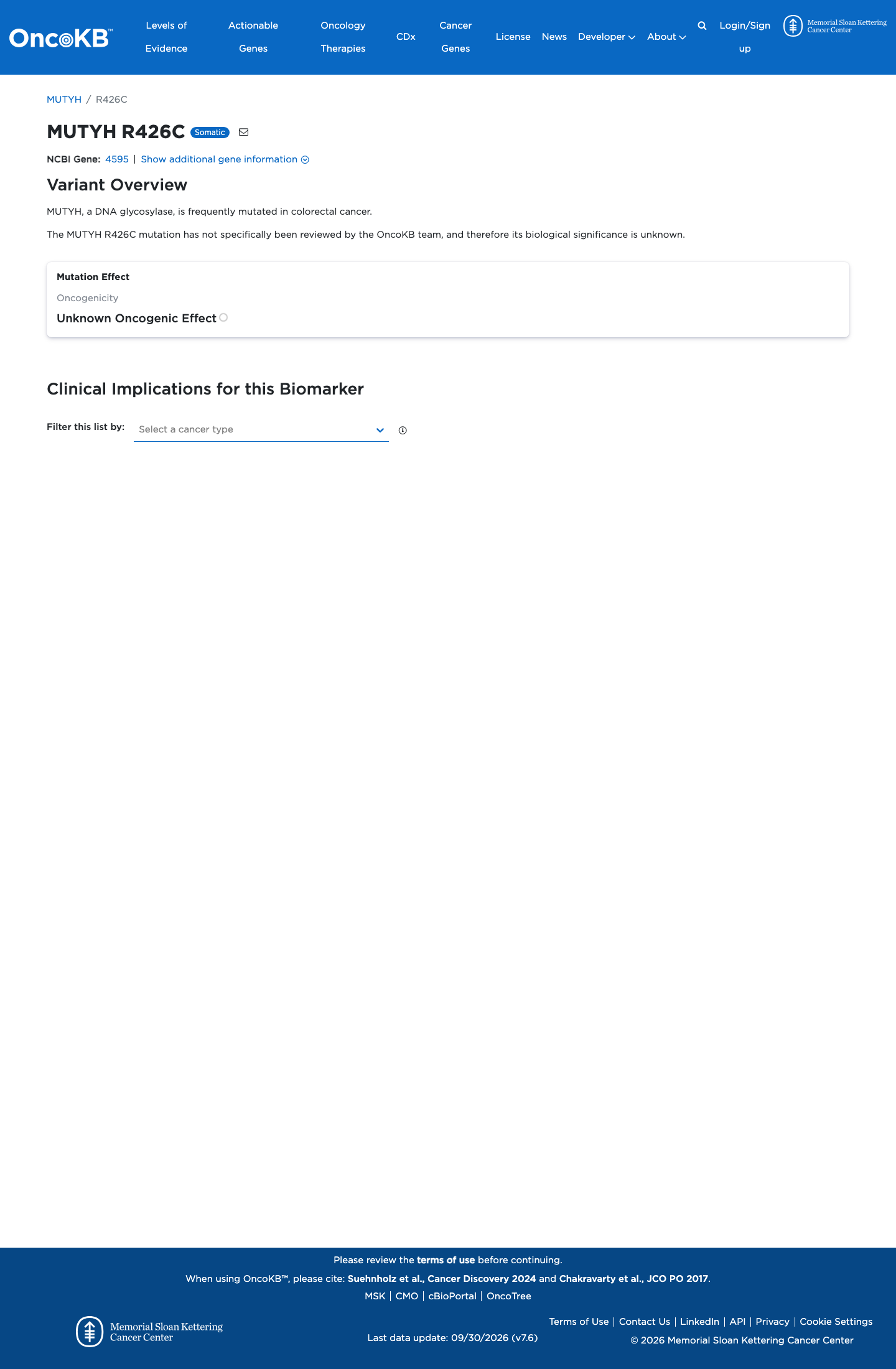
Functional / OncoKB screenshot
Functional Unknown Oncogenic Effect
OncoKB did not identify variant-specific reviewed functional evidence for this variant; gene-level curated context is available for reviewer follow-up. MUTYH, a DNA glycosylase, is frequently mutated in colorectal cancer.
OncoKB ↗
COSMIC screenshot
COSMIC
Cancer hotspots screenshot
Cancer hotspots
Somatic evidence Not in COSMIC / hotspots
COSMIC
This variant does not lie in a statistically significant hotspot. This variant has not previously been reported in somatic cancers (COSMIC).
Hotspots
This variant does not lie in a statistically significant hotspot.
Literature · how each cited paper was used
3papers cited
Each card is an audit: what was searched, what was found, whether it names the variant, which criteria it fed, and why. 5 further PMIDs triaged but not cited — see Sources & references.
Mutations of APC and MYH in unrelated Italian patients with adenomatous polyposis coli.
Searched
c.1276C>TNP_001121897.1:p.(R426C)p.(R426C)p.Arg426Cysc.1234C>T (legacy U63329 numbering)p.Arg412Cys (legacy U63329 numbering)MYH exon 13R426C
Found
Reports the MUTYH missense variant p.Arg412Cys (legacy U63329 nomenclature c.1234C>T), which is the same substitution as the queried c.1276C>T / p.(Arg426Cys) under MANE transcript NM_001128425.2 (fixed 14-codon offset; the paper's legacy p.Gly382Asp equals MANE p.Gly396Asp). It was detected monoallelic (heterozygous) in patient GD108, an Italian classical FAP patient, and is described as lying in the NUDIX domain of the MYH protein with the residue conserved in S. pombe and A. thaliana; SIFT predicted it as not tolerated; it was absent from 158 control chromosomes (allelic frequency 0, 95% C.I. 0-0.0237); and no splice effect was predicted. The paper also reports two MYH polymorphisms (p.Val22Met, p.His324Gln) at equal frequency in cases and controls, and places the pathogenic p.Gly382Asp in the NUDIX domain.
Variant
✓ Names this variant — characterised directly
Applied to
→BS3 supporting
The other two novel missense variants (p.Leu374Pro and p.Arg412Cys) are located in the NUDIX domain of the MYH protein and also affect residues conserved in S. pombe and A. thaliana.
Location Results, section 'Analysis of the MYH gene' (paragraph beginning 'The p.Tyr165Cys and p.Gly382Asp missense mutations are located in the ENDO3c and NUDIX domains'); variant also listed in Table 2, patient GD108, under 'Patients with monoallelic variants' (exon 13, [c.1234C>T]+[c.=], [p.Arg412Cys]+[p.=], FAP, family history yes (vertical))  ·  Context 60 unrelated Italian adenomatous polyposis patients (45 classical FAP with >100 polyps, 15 AFAP with <100 polyps); MYH coding sequence and intron-exon borders analysed by DHPLC followed by direct sequencing in the 29 patients without detectable APC truncating mutations; in silico analysis by SIFT plus SpliceSitefinder, Berkeley Drosophila Genome Project Splice Site Prediction and GENSCAN; control cohort of 158 chromosomes from 79 individuals with no personal or family history of colorectal cancer.  ·  full text
Functional Complementation Assay for 47 MUTYH Variants in a MutY-Disrupted Escherichia coli Strain.
Searched
c.1276C>Tp.(R426C)p.R426CNP_001121897.1:p.(R426C)
Found
Functional characterisation of 47 germline MUTYH variants in a MutY-deficient E. coli complementation assay. The queried p.Arg426Cys is explicitly listed among 17 variants classified as functionally retained (below the 1.7-fold rifampicin-resistant mutation-rate cut-off), together with benign-like alleles such as p.V22M, p.Q338H and p.S515F; no difference in protein expression/stability or nuclear localisation was found. The paper also reports that functionally retained variants were distributed throughout the whole gene whereas defective variants clustered in the N-terminal catalytic domain and C-terminal MutT-like domain, and that p.Tyr179Cys (p.Y179C) and p.Gly396Asp (p.G396D) are the two most prevalent MUTYH pathogenic variants.
Variant
✓ Names this variant — characterised directly
Applied to
→BS3 supporting
Internally controlled, biologically relevant complementation assay of the core MUTYH BER function classified p.R426C as functionally retained, below the 1.7-fold cut-off, with normal expression and localisation - no damaging effect on protein function.
According to this categorization, 17 variants (p.V22M, p.G25D, p.D105N, p.I223V, p.V246F, p.G286E, p.Q338H, p.Q338R, p.Q414R, p.L420M, p.R426C, p.R437Q, p.A473T, p.S515F, p.P516L, p.L529M, and p.R534Q) were functionally retained
Location Results, 'BER Detection with a MutY-Deficient E. coli Complementation Assay' (paragraph listing the retained/partially defective/defective variants) and Table 1  ·  Context E. coli CC104mutY (MutY-deficient) complementation assay measuring rifampicin-resistant mutation frequency for 47 germline MUTYH variants (46 missense, 1 in-frame deletion), with cut-offs of 1.7-fold (retained vs partially defective) and 4.8-fold (partially defective vs defective) set from reference variants p.Tyr179Cys and p.Gly396Asp; complemented by western blot protein-stability analysis in HCT116 cells and EGFP-fusion subcellular localisation; variant numbering in the paper is based on the MUTYH type 2 reference NM_001048171.1.  ·  full text
Rule & framework references · cited for criterion definitions, not variant evidence
25741868 ↗ Standards and guidelines for the interpretation of sequence variants: a joint consensus recommendation of the American College of Medical Genetics and Genomics and the Association for Molecular Pathology.
Sources & reference links
9Sources
CSpec VCEP
ClinVar
gnomAD v2.1
gnomAD v4.1
gnomAD-Canada
SpliceAI
OncoKB
COSMIC
Cancer hotspots
Triaged references · 5 PMIDs not cited in assessment
14579148 ↗ Inherited variants in MYH are unlikely to contribute to the risk of lung carcinoma. CLINVAR
16557584 ↗ MUTYH-associated polyposis: 70 of 71 patients with biallelic mutations present with an attenuated or atypical phenotype. CLINVAR
17060676 ↗ ASCO 2006 update of recommendations for the use of tumor markers in gastrointestinal cancer. CLINVAR
17524638 ↗ Mutation analysis of the MYH gene in unrelated Czech APC mutation-negative polyposis patients. CLINVAR
14991577 ↗ Comprehensive analysis of the contribution of germline MYH variation to early-onset colorectal cancer. CLINVAR