Analysis in progress
Initialising…
0%
complete
This report is still being assembled — sections appear as each stage finishes. It isn't final yet.
MUTYH
Final classification
VUS
MUTYH c.1465G>A · p.Ala489Thr
MUTYH

PS3 (Moderate): E. coli complementation assay showed a 3.2-fold increased mutation rate, a partial functional defect comparable to founder-pathogenic p.G396D (1.7-fold).

Gene
MUTYH
Transcript
NM_001128425.2
HGVS · transcript:coding
NM_001128425.2:c.1465G>A
Consequence
N/A
GRCh38
chr1:45331193 C>T
GRCh37
chr1:45796865 C>T
Basis Because the MUTYH gene-specific (VCEP) framework provided no applicable rules, generic ACMG/AMP 2015 criteria were applied. PS3 (moderate), PM2 (supporting), and PP3 (supporting) were met, and no benign criteria were met. One moderate plus two supporting criteria falls three supporting criteria short of the closest likely-pathogenic rule (one moderate plus four supporting) and meets no benign threshold, so the final classification is VUS.
Because the MUTYH gene-specific (VCEP) framework provided no applicable rules, generic ACMG/AMP 2015 criteria were applied. PS3 (moderate), PM2 (supporting), and PP3 (supporting) were met, and no benign criteria were met. One moderate plus two supporting criteria falls three supporting criteria short of the closest likely-pathogenic rule (one moderate plus four supporting) and meets no benign threshold, so the final classification is VUS.
Classification rationale
PS3PM2PP3 VUS
MUTYH c.1465G>A

PS3 (Moderate): E. coli complementation assay showed a 3.2-fold increased mutation rate, a partial functional defect comparable to founder-pathogenic p.G396D (1.7-fold). PM2 (Supporting): allele frequency 0.004% in gnomAD (0 homozygotes), about 25-fold below the 0.1% threshold for recessive disorders. PP3 (Supporting): REVEL 0.724 predicts a deleterious missense effect (SVI supporting band 0.644-0.772). Combination: one moderate plus two supporting criteria meets no pathogenic or benign threshold under ACMG/AMP 2015; final classification VUS.

PS3 + PM2 + PP3 VUS
Gene diagram · NM_001128425.2 · variants mapped to exon structure
MUTYH NM_001128425.2
Fetching transcript structure from UCSC…
Applied criteria · 3 applied · 19 assessed
Applied · 3
Strength Supporting Moderate Strong Very strong
PS3 moderate Pathogenic
Met (moderate): E. coli complementation assay showed a 3.2-fold increased mutation rate, a partial defect comparable to founder-pathogenic p.G396D (1.7-fold).
PMID:25820570 (Komine et al. 2015) - E. coli CC104mutY complementation assay, rifampicin-resistance mutation rate; variant tested as p.A489T c.1423G>A (NM_001048171.1) = c.1465G>A (NM_001128425.2), same genomic nucleotide g.45796865C>T (verified by CDS alignment); 32.0 rifR/10^8 (SD 3.3) ~ 3.2-fold vs wild type -> 'partially defective' (1.7-4.8-fold bin), more impaired than founder pathogenic p.G396D (1.7-fold); cut-offs calibrated against known pathogenic (p.Y179C, p.G396D) and known polymorphic (p.V22M, p.Q338H, p.S515F) variants; protein stability 1.07x; nuclear localization unaffectedPMID:25741868 (ACMG/AMP 2015) - PS3 definition: 'Well-established in vitro or in vivo functional studies supportive of a damaging effect on the gene or gene product'; used as the applicable generic criterion since the VCEP rule payload was emptycspec (InSiGHT MUTYH VCEP v1.0, doc 1742141534) - consulted as governing framework; no PS3 rule text available in bundle
PM2 supporting Pathogenic
Met (supporting): gnomAD allele frequency 0.004% (0 homozygotes), about 25-fold below the 0.1% threshold for recessive disorders.
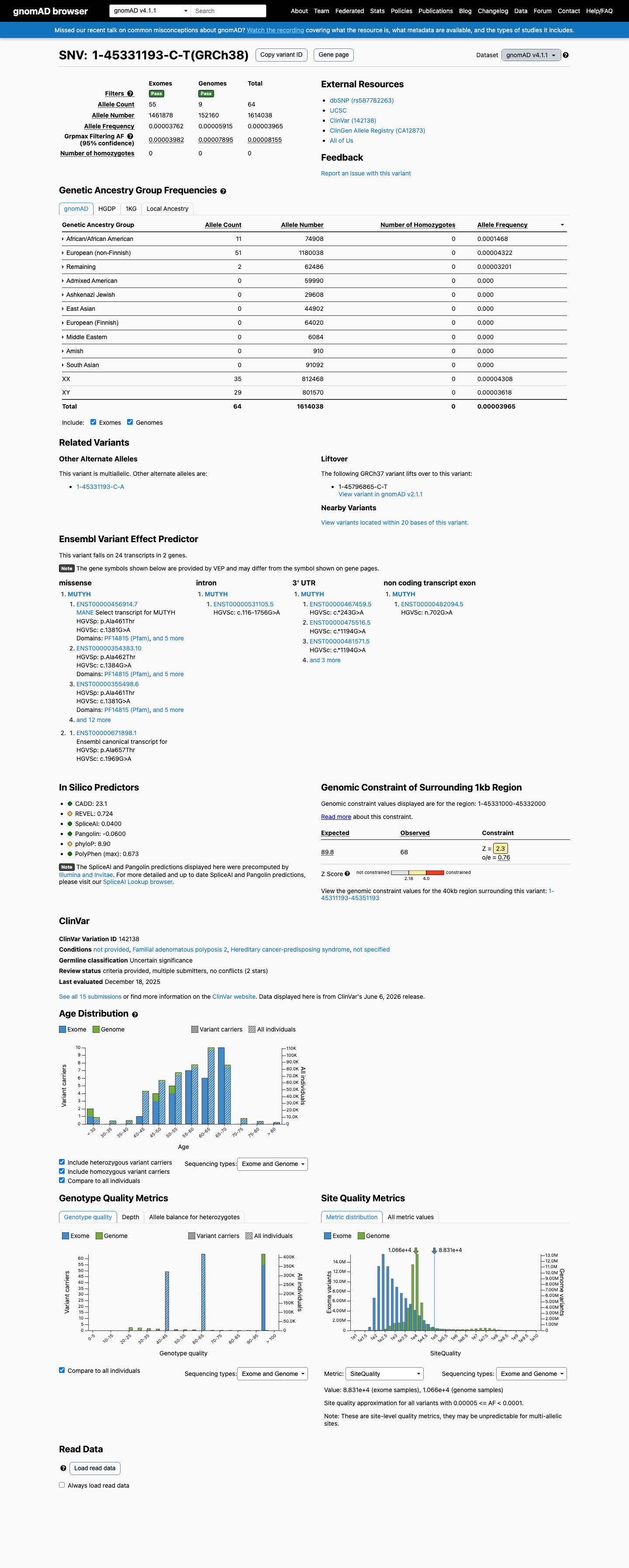
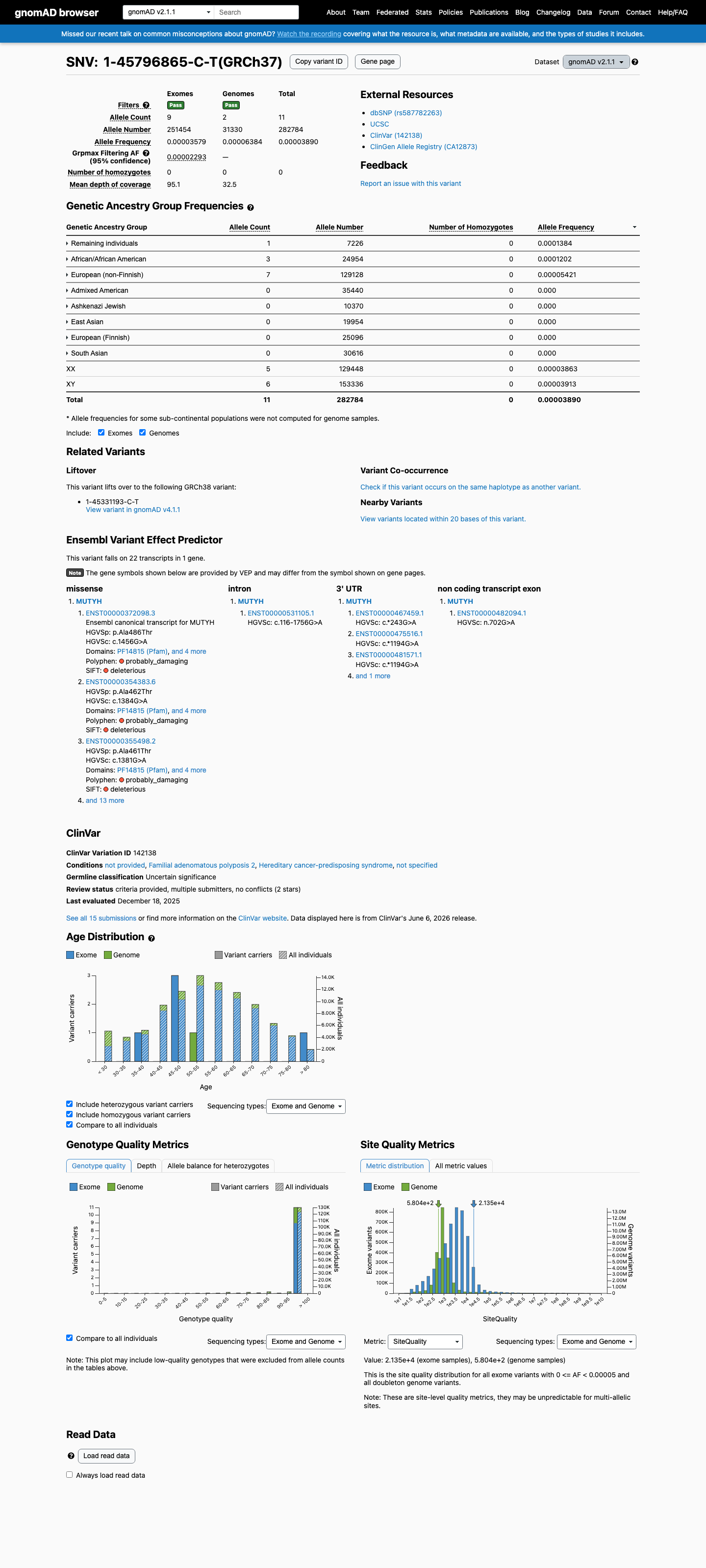
gnomAD v4.1 (gnomad_v4): total AF 3.96521e-05 (0.00397%), 64/1,614,038 alleles, 0 homozygotes; max subpopulation AFR AF 0.000146847 (0.01468%, 11/74,908 alleles); grpmax FAF 8.155e-05gnomAD v2.1 (gnomad_v2): total AF 3.88989e-05 (0.00389%), 11/282,784 alleles, 0 homozygotes; max subpopulation AF 0.000138389 (0.01384%, 1/7,226 alleles); grpmax FAF 2.293e-05PM2 definition ('Absent in controls (or at extremely low frequency if recessive)'): Richards et al. 2015 (PMID 25741868), Table 3
PP3 supporting Pathogenic
Met (supporting): REVEL 0.724 falls in the supporting band (0.644-0.772) for a predicted deleterious missense effect.
REVEL score 0.724 for MUTYH c.1465G>A p.(Ala489Thr) (local REVEL v1.3 lookup, source_registry key 'revel'); ClinGen SVI REVEL calibration (Pejaver et al., Am J Hum Genet 2022; PMID 36413997) maps PP3 as supporting >= 0.644, moderate >= 0.773, strong >= 0.932; 0.724 lies in the supporting band (0.644-0.772), so PP3 supporting.SpliceAI max delta score 0.00 (source_registry key 'spliceai'): no splice impact predicted; not counted toward PP3 to avoid double counting the same prediction across splice and missense axes.BayesDel score 0.234861 (source_registry key 'bayesdel'): treated as not_available for PP3/BP4 because no verified published calibration threshold with a named publication/table is available to this pipeline (per group rule, any BayesDel score is insufficiently calibrated for PP3/BP4 unless a citable publication and table are named).
Assessed · not applied
Pathogenic
PS1 Not met: p.Ala489Thr is not established as pathogenic - ClinVar VCV000142138 is Uncertain significance across all 15 submitters.
PS4 Not assessed: no case-control or cohort-enrichment study of this exact variant exists - only a single monoallelic case report without controls.
PM1 Not met: residue 489 lies outside any confirmed mutational hotspot or defined critical functional domain.
PM3 Not met: trans configuration with a pathogenic allele is unconfirmed - the only co-occurrence report states phase was unknown.
PM5 Not assessed: no pathogenic alternate missense at codon 489 was identified, and no complete variant inventory was available to exclude one.
PP1 Not assessed: no co-segregation data exist - affected relatives of the single reported carrier were not tested.
PP2 Not assessed: missense is a common MUTYH disease mechanism, but gene-level missense constraint data were unavailable to confirm a low benign-missense rate.
PP4 Not met: the only observation is a single heterozygous carrier, which does not establish the biallelic phenotype of this recessive disorder.
PP5 Not met: no ClinVar expert panel has classified this variant - all 15 submissions are from clinical laboratories.
Benign
BA1 Not met: gnomAD allele frequency 0.004% is far below the >1% stand-alone benign threshold.
BS1 Not met: gnomAD allele frequency 0.004% is far below the >0.3% threshold and below MUTYH founder carrier frequencies.
BS2 Not met: no healthy homozygous individuals observed - 0 homozygotes in gnomAD v2.1 and v4.1.
BS3 Not met: the only functional data show a damaging effect (3.2-fold increased mutation rate), directly contradicting a no-effect conclusion.
BS4 Not assessed: no affected family members have been genotyped, so lack of segregation cannot be tested.
BP1 Not met: MUTYH-associated polyposis is caused predominantly by missense variants, so the truncating-disease premise does not apply.
BP2 Not met: no cis configuration with a pathogenic variant is reported - the only co-occurrence report states phase was unknown.
BP4 Not met: the calibrated in-silico evidence (REVEL 0.724) predicts a deleterious effect, directly contradicting BP4.
BP5 Not assessed: no alternate molecular cause (e.g., APC or MMR variants) is documented in any carrier of this variant.
BP6 Not met: no ClinVar expert panel has classified this variant as Benign or Likely benign.
N/A · 6 PVS1 · PS2 · PM4 · PM6 · BP3 · BP7
Research & evidence
Population frequency
gnomAD v4.1 screenshot
gnomAD v4.1
gnomAD v2.1 screenshot
gnomAD v2.1
v4.1
This variant is present in gnomAD v4.1 (AF= 3.96521e-05; MAF= 0.00397%, 64/1614038 alleles, homozygotes = 0) and has highest observed frequency in the African/African American population (AF= 0.000146847; MAF= 0.01468%, 11/74908 alleles, homozygotes = 0); grpmax FAF= 8.155e-05.
v2.1
This variant is present in gnomAD v2.1 (AF= 3.88989e-05; MAF= 0.00389%, 11/282784 alleles, homozygotes = 0) and has highest observed frequency in the Remaining individuals population (AF= 0.000138389; MAF= 0.01384%, 1/7226 alleles, homozygotes = 0); grpmax FAF= 2.293e-05.
🇨🇦 CA
Absent from gnomAD-Canada v1.0.
Allele frequency by ancestry
three datasets · side by side
gnomAD v4.1
0.004% · 64 / 1,614,038
0 hom · FAF 0.0082%
African/African American
11 / 74,908
0.015%
European (non-Finnish)
51 / 1,180,038
0.0043%
Remaining individuals
2 / 62,486
0.0032%
+ 7 not observed (Admixed American, European (Finnish), Amish, East Asian, Middle Eastern, South Asian, Ashkenazi Jewish)
gnomAD v2.1
0.0039% · 11 / 282,784
0 hom · FAF 0.0023%
Remaining individuals
1 / 7,226
0.014%
African/African American
3 / 24,954
0.012%
European (non-Finnish)
7 / 129,128
0.0054%
+ 5 not observed (Admixed American, Ashkenazi Jewish, East Asian, European (Finnish), South Asian)
gnomAD Canada 🇨🇦
Absent · 0 / ?
0 hom
Not observed in any ancestry group.
ClinVar screenshot
ClinVar
This variant has been reported in ClinVar as Uncertain significance (14 clinical laboratories) and as Uncertain Significance (1 clinical laboratory). (ClinVarID = 142138)
SpliceAI screenshot
In silico
SpliceAI predicts no significant splice impact for this variant (max delta score = 0.00). REVEL score = 0.724. BayesDel score = 0.234861.
Functional / OncoKB screenshot
Functional Unknown Oncogenic Effect
OncoKB did not identify variant-specific reviewed functional evidence for this variant; gene-level curated context is available for reviewer follow-up. MUTYH, a DNA glycosylase, is frequently mutated in colorectal cancer.
OncoKB ↗
COSMIC screenshot
COSMIC
Cancer hotspots screenshot
Cancer hotspots
Somatic evidence Not in COSMIC / hotspots
COSMIC
This variant does not lie in a statistically significant hotspot. This variant has not previously been reported in somatic cancers (COSMIC).
Hotspots
This variant does not lie in a statistically significant hotspot.
Literature · how each cited paper was used
2papers cited
Each card is an audit: what was searched, what was found, whether it names the variant, which criteria it fed, and why. 6 further PMIDs triaged but not cited — see Sources & References.
Functional Complementation Assay for 47 MUTYH Variants in a MutY-Disrupted Escherichia coli Strain.
Searched
p.A489Tp.Ala489Thrc.1465G>AA461Ala461A475489domainhotspotmissense
Found
Komine et al. 2015 report p.A489T (c.1423G>A in NM_001048171.1 numbering; same genomic variant as the case variant NM_001128425.2:c.1465G>A, verified via matching anchor variants p.G396D c.1145G>A and p.G503E c.1466G>A) among 47 germline MUTYH variants tested in a MutY-disrupted E. coli functional complementation assay. A489T was observed in one AFAP patient, showed a 32.0-fold mutation rate relative to wild type and was categorized by the authors as partially defective (between the 1.7x and 4.8x cut-offs), with SIFT 'A' (0.01) and PolyPhen-2 'D' (0.973). The paper describes MUTYH's two functional domains (N-terminal catalytic HhH/FCL domain and C-terminal MutT-like/nudix domain), states functionally defective variants are distributed widely across these domains 'without a clear hot spot', and notes that the majority of MUTYH alterations are missense (>200 registered in LOVD). The variant is not classified pathogenic by the authors; no alternate missense at residue 489 appears in the panel.
Variant
✓ Names this variant — characterised directly
Applied to
PS3 moderate
Direct variant-specific functional assay: p.A489T shows ~3.2-fold increased mutation rate (partially defective category, same bin as founder pathogenic p.G396D) - well-established functional evidence of a damaging effect, applied as PS3 at moderate strength
p.A489T c.1423G>A 32.0 (3.3) 1.07 A (0.01) D (++) (0.973) NE NE AFAP (1) ... 17 variants (p.P18L, p.Y128H, p.P157L, p.G189E, p.A227V, p.V234M, p.R241W, p.R245C, p.R309C, p.P380T, p.G396D, p.P405S, p.R437P, p.A489T, p.V493F, p.G503E, and p.E480del) were partially defective ... Mapping of the secondary structure of MUTYH showed that the functionally defective variants were distributed widely in the two functional domains (i.e., the N-terminal catalytic domain and the C-terminal MutT-like domain) without a clear hot spot ... The majority of MUTYH alterations are missense variants. Currently, more than 200 unique missense variants have been registered in LOVD.
Location Table 1 (row p.A489T); Results text (functional categorization paragraph; domain/hotspot discussion); Introduction  ·  Context MutY-disrupted E. coli CC104 complementation assay (rifampicin-resistance mutation rate relative to wild type; cut-offs 1.7x retained / 4.8x defective), FLAG-tagged protein expression in HCT116 cells by western blot, SIFT and PolyPhen-2 in silico predictions; 47 germline MUTYH variants from MAP patients and LOVD; reference sequence NM_001048171.1  ·  full text
Rule & framework references · cited for criterion definitions, not variant evidence
25741868 ↗ Standards and guidelines for the interpretation of sequence variants: a joint consensus recommendation of the American College of Medical Genetics and Genomics and the Association for Molecular Pathology.
Sources & reference links
9Sources
CSpec VCEP
ClinVar
gnomAD v2.1
gnomAD v4.1
gnomAD-Canada
SpliceAI
OncoKB
COSMIC
Cancer hotspots
Triaged references · 6 PMIDs not cited in assessment
21325953 ↗ Lynch syndrome and MYH-associated polyposis: review and testing strategy. CLINVAR
25645574 ↗ ACG clinical guideline: Genetic testing and management of hereditary gastrointestinal cancer syndromes. CLINVAR
26467025 ↗ A Standardized DNA Variant Scoring System for Pathogenicity Assessments in Mendelian Disorders. CLINVAR
15761860 ↗ Mutation analysis of the MYH gene in an Australian series of colorectal polyposis patients with or without germline APC mutations. CLINVAR
16234049 ↗ Correlation of polyp number and family history of colon cancer with germline MYH mutations. CLINVAR
20618354 ↗ MUTYH-associated polyposis - variability of the clinical phenotype in patients with biallelic and monoallelic MUTYH mutations and report on novel mutations. CLINVAR